Occasional thoughts of an Anglican Episcopal priest

Category: Anglican (Page 114 of 115)

Shrewsbury Abbey – 12 July 2011

Several years ago a woman named Edith Mary Pargeter began writing a series of murder mysteries set in the Middle Ages under the pseudonym of Ellis Peters. The “detective” protagonist of these mysteries was a monk named Cadfael. When dramatized by the BBC the actor Derek Jacobi played Brother Cadfael. Brother Cadfael’s monastic community was Shrewsbury Abbey, which is a real place. The abbey church of Shrewsbury Abbey still stands and is a functioning congregation of the Church of England. I visited the Abbey Church the morning of 12 July 2011.

Initially a small Saxon church, the Church of Saints Peter and Paul which was founded by Roger de Montgomery, a relative of William the Conqueror in 1083. It subsequently became a Benedictine Abbey and during the following 450 or so years it grew to become one of the most important and influential abbeys in England. In 1147, the relics of a Welsh Saint, Winefride, were brought to the Abbey and his shrine became an important place of pilgrimage. In 1283, the first English Parliament in which the Commons had a legal share took place in the Abbey Chapter House, and in 1398 Richard II summoned the Great Parliament in the Abbey. The Abbey was surrendered to the Crown in January of 1540 when Henry VIII disestablished the monasteries. Although much was destroyed, the nave continued to serve, as it does today, as the place of worship for the Parish of the Holy Cross.

In the nineteenth century plans for restoration of the Abbey were drawn up, but financial constraints compelled the building of only part of the plan; everything to the east of the pulpit and lectern are the work of the Gothic Revival architect John Loughborough Pearson, best known for designing Truro Cathedral; his work dates from 1886. The Pearson plans were put on hold and never completed because of the intervention of World War I.

Here are some pictures of the church:

This is the façade of the church seen from the small car park for the church staff:

Facade of Shrewsbury Abbey Church

Facade of Shrewsbury Abbey Church

This is the side of the church along which a major highway now runs (in the city of Shrewsbury this street is called Abbey Foregate, but it is national highway A5191 with lots of traffic). This would have been the side on which the cloister, dormitory, and other living spaces of the monastic community were built; you can see the ragged edges where the broken-down walls once adjoined the structure. The building is made of a red sand-stone native to the Shropshire area.

The interior of the church is quite large and spacious and, despite the dark stone from which it is built, natural light from the clerestory windows makes it quite bright. A very handsome painted reredos in the chancel (with a much gilt) fairly glows, and below it the altar is draped with a heavily embroidered frontal:

Nave of Shrewsbury Abbey Church

Nave of Shrewsbury Abbey Church

Reredos of Shrewsbury Abbey Church

Reredos of Shrewsbury Abbey Church

Altar Frontal, Shrewsbury Abbey Church

Altar Frontal, Shrewsbury Abbey Church

Around the side aisles of the church are tombs, such as these. The first picture is the tomb of a medieval priest; the second, of an Elizabethan couple.

Medieval Tomb, Shrewsbury Abbey Church

Medieval Tomb, Shrewsbury Abbey Church

Elizabethan Tomb, Shrewsbury Abbey Church

Elizabethan Tomb, Shrewsbury Abbey Church

There are numerous stained glass windows, old and new, such as these two. The first dates from the Middle Ages and shows the Adoration of the Magi; the second is of quite recent vintage and celebrates the Brother Cadfael series!

Adoration of the Magi Window, Shrewsbury Abbey Church

Adoration of the Magi Window, Shrewsbury Abbey Church

Brother Cadfael Window, Shrewsbury Abbey Church

Brother Cadfael Window, Shrewsbury Abbey Church

The ladies of Shrewsbury Abbey church were quite gracious when I visited. They have a small shop set up just inside the entrance to the church and a small coffee and tea bar at the rear of the left aisle. It was quite astonishing and rather funny to see a kitchen sink and countertop with modern appliances set up right next to an Elizabethan tomb, but this sort of “repurposing” is something the church needs to do and needs to do more frequently!

As I was about to leave, one of the ladies asked where I was from. I said, “Near Cleveland in the state of Ohio.” “Of course, you’re from America,” she said, “you such a lovely accent!” I nearly burst out laughing … I thanked her and went on my way, hoping to see a neolithic ring fort at Old Oswestry about an hour away. Unfortunately, road construction, indecipherable signage, and a GPS error made that impossible.

Visiting Wilmslow

I’ve driven from Hay-on-Wye to Wilmslow (near Manchester) to visit friend Sally M. She’s taken me on a whirlwind tour of the area focusing on the two churches of the Parish, St. Bartholomew’s and St. Anne’s. Both lovely church facilities. Take a look at their website, which includes a virtual tour of the older church (St. Bartholomew’s).

One the way, I stopped in Shrewsbury and saw the Abbey, then drove on to Oswestry where I had planned to visit the neolithic round fort at Old Oswestry, but somehow got lost and never made it.

Now I’m here for my last night in England (tomorrow I’ll be back in Scotland and the next day off to Ireland). More later….

My Day in Wales (Part 3)

This post concludes the tale of this day begun in Part 1 and continued in Part 2.

Llanthony Priory was a monastery of Augustinian Canons nine miles south of Hay-on-Wye. St. David is said to have lived in the area as a hermit, but this tradition lacks confirmation.

The story of the Priory is that around the year 1100 the ruins of a chapel and cell, supposed to have been that occupied by St. David, were discovered by a retainer of Hugh de Lacy, Baron of Herefordshire, named William. He thereupon decided to quit the world and become a hermit himself. He was later joined by Ernisius, chaplain to Queen Maud, wife of Henry I. These two anchorites became famous and their story reached Baron de Lacy, who in 1107 founded and endowed a monastery for them, dedicated to St. John the Baptist. The rule of the Canons Regular of St. Augustine was adopted. In the course of time, the severity of the climate, the poverty of the soil, and the persecution of the Welsh natives combined to make life there impossible. In 1134 the entire community, numbering about forty, abandoned the monastery and took refuge in the palace of Robert, Bishop of Hereford. After two years a new monastery was built for them near Gloucester by Milo, Earl of Hereford, which was called Llanthony Secunda. Only a few canons lived from time to time in the original monastery, and both houses were governed by one prior, who resided at Gloucester.

The buildings at Llanthony fell gradually into decay and passed into private hands when Henry VIII dissolved the monasteries in 1539. In 1807 the property was bought by Walter Savage Landor. It still belongs to his descendents, the habitable portion of it having been added to and converted into an inn during Queen Victoria’s reign. The church is in ruins, but the western towers, part of the central one, and some of the nave piers and arches are standing.

Here are a few pictures of Llanthony Priory taken today, 11 July 2011:

Llanthony Priory, Black Mountains, Wales

Llanthony Priory, Black Mountains, Wales

Llanthony Priory, Black Mountains, Wales

Llanthony Priory, Black Mountains, Wales

Llanthony Priory, Black Mountains, Wales

Llanthony Priory, Black Mountains, Wales

Llanthony Priory, Black Mountains, Wales

Llanthony Priory, Black Mountains, Wales

And this is the Inn built into the Priory ruins by the Landor family:

Victorian Inn at Llanthony Priory, Black Mountains, Wales

Victorian Inn at Llanthony Priory, Black Mountains, Wales

There is also a functioning Anglican Church in Wales parish church on the site of the Priory, St. Davids, Llanthony. The structure first seen in this picture is a cottage attached to the church, presumably intended to be the vicarage:

St Davids Parish Church, Llanthony, Wales

St Davids Parish Church, Llanthony, Wales

This is the interior of the church:

Interior of St Davids Parish Church, Llanthony, Wales

Interior of St Davids Parish Church, Llanthony, Wales

Notice the pulpit … it is built into the wall and cannot be accessed from the congregation’s side of a wall and arch that separates the congregation from the choir and chancel.

Pulpit of St Davids Parish Church, Llanthony, Wales

Pulpit of St Davids Parish Church, Llanthony, Wales

I entered the pulpit through this door. I almost couldn’t fit in and getting back out was a really spine-bending challenge!

Pulpit Doorway of St Davids Parish Church, Llanthony, Wales

Pulpit Doorway of St Davids Parish Church, Llanthony, Wales

All things considered, it was a good day in Wales. After visiting the parish church, I made my way back to the B&B in Hay-on-Wye by way of a “single track lane with passing areas” about which I’ve written earlier.

My Day in Wales (Part 1)

Noswaith dda!

Noswaith dda is Welsh for “Good evening” – do not try to pronounce it – whatever you guess will be wrong, I assure you.

I drove a circle through the Brecon Beacons today – I almost drove to St. David’s – but five hours of driving (two to get there from where I was just west of Swansea and three to get back from there to my B&B in Hay-on-Wye) didn’t seem like a good idea, so I didn’t. Instead I went to St. Illtuds in Llantwit Major, then to the Penderyn Distillery, then to Llanthony Priory … and then walked the streets of Hay-on-Wye and looked at lots of old books. It was overwhelming, even for a bibliophile like me … there are too many books … and some of the shops are simply disorganized. Many have the books categorized by subject, shelved alphabetically by author, etc. But some are just disorganized heaps of books – I think even the owners don’t know where anything is.

I was disappointed in St. Illtud’s Church and the ruins at Llantwit Major. The modern Welsh-English name comes from the old Welsh name Llanilltud Fawr. Llan means “monastery” and you can see St. Illtud’s name in the rest of that first word. The second word, fawr, means “great”. So the name is something like “Illtud’s Great Monastery” which was founded in the early 5th Century by St. Illtud as a center of learning … but it’s not so great any longer.

This is a very important site in Celtic Christian history and it’s not cared for very well at all. The monastic community here, over which St. Illtud and St. Samson were priors, was once so important in the formation of monks, priests, missionaries, and bishops that it has been called “The University of Celtic Saints.” St. David of Wales was educated and ordained there, and he is not the only one: in addition to St. David, St. Samson, St. Paul Aurelian, St. Gildas, St. Tudwal, St. Baglan and King Maelgwn ap Cadwallon (King of Gwynedd and apparently High King of Wales in the middle of the 5th Century) are said to have studied at the Cor Tewdws or “divinity school”.

The Scots and the Irish seem to have a sense of reverence for their ancient Christian monastic sites, but apparently not so the Welsh (or at least not the people of Llantwit Major). Although inside the church there is a poster about a fund raising effort to preserve what’s left and build a visitor center, it’s pretty clear it’s not going anywhere – the poster is a few years old. And in the old chapel, there are dustbins and a composting thing set up….

Here are some pictures of the Church of St. Illtud’s and what remains of the medieval buildings that were once found at this site. Of course, the earlier Celtic site has long since disappeared. First, the church as seen from the town’s public car park and then a couple of photos of the building from the church yard.

St. Illtuds Church, Llantwit Major, from town car park

St. Illtuds Church, Llantwit Major, from town car park

St. Illtuds Church, Llantwit Major, from church yard

St. Illtuds Church, Llantwit Major, from church yard

St. Illtuds Church, Llantwit Major, from church yard and showing ruined monastic chapel at west end

St. Illtuds Church, Llantwit Major, from church yard and showing ruined monastic chapel at west end

There is a ruined chapel affixed to the functioning church directly out the west door; in this chapel are currently housed dustbins (trash cans, to an American) and a green plastic composting container!

St. Illtuds, ruined chapel with composting bin

St. Illtuds, ruined chapel with composting bin

On the grounds was also a ruined chantry which has now been turned into a memory garden:

St. Illtuds, ruined chantry memory garden

St. Illtuds, ruined chantry memory garden

Inside the church there are some stones with Celtic carving and Latin inscriptions which may date from the early Celtic monastery:

St. Illtuds, Celtic Cross bearing name of Illtud

St. Illtuds, Celtic Cross bearing name of Illtud

St. Illtuds, Celtic carved stones

St. Illtuds, Celtic carved stones

And, of course, the Victorians got to the place and their influence is seen in the chancel of the church and the reredos:

St. Illtuds, chancel, altar and reredos

St. Illtuds, chancel, altar and reredos

After surveying the church at Llantwit Major (which didn’t really take as much time as I thought it would), I gave serious consideration to driving the 101 miles from there to St. David’s where the primatial Cathedral of the Church in Wales is located. It really is a lovely cathedral and there are well-preserved ruins of a monastery founded by St. David there. (Here is a link to the Cathedral’s website.) In fact, I got onto the M4 motorway and started to do just that, but a little bit west of Swansea, stopping for petrol and a Diet Coke, discretion got hold of me and I realized that I really didn’t want to spend two hours driving there and then to face three hours getting back to Hay-on-Wye. So I went back to my original plan, which was to drive to the village of Penderyn and visit the only whisky distillery in Wales. (See My Day in Wales (Part 2) for more about that.)

(Later in the day I visited Llanthony Priory, another monastic ruin, in the Black Mountains south of Hay-on-Wye. Read My Day in Wales (Part 3) for that story and more photos.)

Neolithic Britain – 9 July 2011

Today, 9 July 2011, I walked the hills of southeastern England visiting two fascinating sites that may date back as many as 5,000 years!

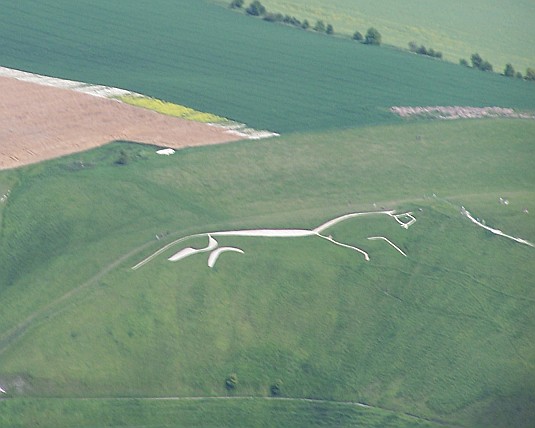
First I visited the village of Uffington, Oxfordshire, and the hill south of town on which one finds a massive depiction in white chalk of a horse. I tried to take a picture of it, but from ground level that is very difficult to do and (on this day) the site was crawling with several hundred early elementary school students on school outings. So here’s a picture from Wikicommons:

The Uffington White Horse from the Air

The Uffington White Horse from the Air

I walked up to the area where the head of the horse is seen in this picture. It was an overcast and hazy but warm day – a good thing because it was also very breezy. It was about a mile or so walk up the hill from the car park via the Ridge Path, which took me through the Uffington Castle, which isn’t what you think it is at all … not a castle in the medieval sense. Uffington Castle is all that remains of an early Iron Age hill fort. It is composed of two circular earth berms (with a circular ditch between them) surrounding about 32,000 square meters (nearly 8 acres). There is an entrance in the eastern portion, near the White Horse and another at the south (through which I entered). An entrance in the western side was apparently blocked up a few centuries after it was built. I was able to take a picture of the “castle” (although it doesn’t look like much). This picture is taken from the eastern entrance of the southeastern quadrant; the southern entrance can be seen at the right of the picture.

Uffington Castle, Oxfordshire, UK

Uffington Castle, Oxfordshire, UK

As you can see, the White Horse is a highly stylised prehistoric hill figure, 110 m long (374 feet), formed from deep trenches filled with crushed white chalk. The figure is believed, and scientific tests have shown it, to date back some 3,000 years, to the Bronze Age. The purposes of its creators is completely unknown. It is not of Celtic origin, but G.K. Chesterton used it as the setting for part of his Catholic allegorical and poetic retelling of the story of the Saxon king Alfred the Great, who defeated the invading Danes in the Battle of Ethandun in 878, which is entitled The Ballad of the White Horse.

Before the gods that made the gods
Had seen their sunrise pass,
The White Horse of the White Horse Vale
Was cut out of the grass.

Before the gods that made the gods
Had drunk at dawn their fill,
The White Horse of the White Horse Vale
Was hoary on the hill.

Age beyond age on British land,
Aeons on aeons gone,
Was peace and war in western hills,
And the White Horse looked on.

For the White Horse knew England
When there was none to know;
He saw the first oar break or bend,
He saw heaven fall and the world end,
O God, how long ago.

As retold by Chesterton, Alfred and his Saxons set out from the White Horse and Alfred gathers there three great chieftains, Mark a Roman, Eldred the Franklin who is a Saxon, and Colan who is a Celt. In describing Colan, Chesterton includes these priceless lines:

For the great Gaels of Ireland
Are the men that God made mad,
For all their wars are merry,
And all their songs are sad.

After visiting the Uffington site, I went to Avebury to see the largest “henge” in Britain (possibly the largest man-made earthwork of its kind in all of Europe). A henge (the word is derived from Stonehenge and was coined in the mid-20th Century) is an earthen berm circular with an interior circular ditch. Because the ditch is on the inside, not the outside, of the berm, henges are not considered to be defensive fortifications. One scholar, however, has suggested that they are defensive in that he believes they were built to contain something and protect those outside from what was inside – and what was inside was divine energy. The Avebury henge contains many standing stones that are laid out in peculiar formations, some circles, some straight lines, some curving formations not forming full circles. Here are some photos of the standing stones.

Standing Stones near World Heritage Center Shop, Avebury, UK

Standing Stones near World Heritage Center Shop, Avebury, UK

Stone Circle portion within the Avebury Henge

Stone Circle portion within the Avebury Henge

This is a map (from Wikimedia) showing the Avebury henge and the position of the standing stones (and theoretical stones completing the circles). It does not show the Avebury village buildings which have been built within the henge. The henge has a circumference of about 3/4 of a mile.

Map of Avebury Henge (non-free material from Wikimedia)

Map of Avebury Henge (non-free material from Wikimedia)

I am intrigued by the idea that because the ditch and bank face inward, in the opposite order that they would be placed in a defensive ring fort, something “dangerous” or “powerful” was understood to be inside the enclosure. The proposal is that henges were designed mainly to enclose ceremonial sites seen as “ritually charged” and therefore dangerous to people, that whatever took place inside the enclosures was intended to be separate from the outside. In other words, the henge may have been a means by which neolithic society set aside “sacred space” in much the same way that modern human beings do with churches, mosques, temples, and so forth.

The hymn An Aluinn Dún (The Heavenly Habitation), which was set out in an earlier post, is about sacred space (heaven, particularly). The Celts and the Gaels have a special sense about sacred places; they marked them, but did not attempt to set them off or guard against them in the way henges seem to do. In fact, holy caves and holy wells were understood to be places of refreshment, “thin places” between our world and the spiritual realm, not something to be feared, but something to enjoy, somewhere to grow closer to God.

St. Alban’s Cathedral

The other cathedral church I visited on 8 July 2011 was that in the town of St. Albans. It might not actually be a town. British law makes distinctions between hamlets, villages, towns, and cities – and perhaps other urban designations (I don’t really know). There are also parishes (of two types, ecclesiastical and legal), boroughs, and counties. Each of these legal geographies has its own council or other form of government, and their interactions (amongst themselves and between them and the national government) are the stuff of much news commentary. In any event, there is a place called St. Albans and I’ll call it a town whether it legally is one or not.

St. Albans was founded by the Romans who called it Verulamium. The town now has a really lovely public park call Verulamium Park and parts of the old Roman town’s wall are on display there. There are also lovely rolling green hills, huge willows and other shade trees, and a delightful pond which is the home of swans, geese, and ducks who are regularly fed by the citizenry. Here are a couple of pictures of the park (including the wall):

Pond at Verulamium Park, St. Albans

Pond at Verulamium Park, St. Albans

Roman Wall, Verulamium Park, St. Albans

Roman Wall, Verulamium Park, St. Albans

St. Albans Cathedral seen through the Roman Wall, Verulamium Park

St. Albans Cathedral seen through the Roman Wall, Verulamium Park

The cathedral is dedicated to, and the town gets its current name from, St. Alban, first martyr of Britain. The story is that Alban was a pagan Roman soldier. According to James Kiefer’s hagiography, “he gave shelter to a Christian priest who was fleeing from arrest, and in the next few days the two talked at length, and Alban became a Christian. When officers came in search of the priest, Alban met them, dressed in the priest’s cloak, and they mistook him for the priest and arrested him. He refused to renounce his new faith, and was beheaded. He thus became the first Christian martyr in Britain. The second was the executioner who was to kill him, but who heard his testimony and was so impressed that he became a Christian on the spot, and refused to kill Alban. The third was the priest, who when he learned that Alban had been arrested in his place, hurried to the court in the hope of saving Alban by turning himself in. The place of their deaths is near the site of St. Alban’s Cathedral today.”

Front porch, Cathedral Church of St. Alban, St. Albans, UK

Front porch, Cathedral Church of St. Alban, St. Albans, UK

The shrine of St. Alban is inside the cathedral. It forms a separate chapel behind the “screen” or reredos behind the high altar (and before the Lady Chapel which takes up what an American church member would think of as the “chancel” area of the building). While I was photographing the shrine, one of the cathedral guides came up and engaged me in conversation. In the course of our discourse she said, “We have a bone you know?” – “I thought the saint’s whole body was here!” – “Oh, no! The bones were taken away when Henry the Eighth abolished the monasteries! Most of his bones were taken to the continent and an awful lot of them were taken to the cathedral in Cologne. A few years ago the Bishop of Cologne visited and he brought us a bone – Alban’s right shoulder bone! Of course, we’re Anglicans so we’re not much on relics … but we said, ‘Thank you very much’ and accepted his bone.” – “Oh… well, where is this bone?” – “It’s in a lovely box under the shroud on the shrine!” So here’s a picture of the shrine … under that red cover somewhere is a “lovely box” contained a shoulder bone, allegedly Alban’s…..

Shrine of St. Alban, St. Albans Cathedral

Shrine of St. Alban, St. Albans Cathedral

The reason I visited this particular place, other than it’s Roman history connection (there’s no Celtic connection that I know of), is that I was ordained on the feast of St. Alban (well… the eve, actually, but we used the Propers for St. Alban’s feast), so I consider him the patron of my priesthood.

St. Edmundsbury Cathedral

On 8 July 2011 I visited two cathedrals, the first of which was St. Edmundsbury Cathedral (which is in the town of Bury St. Edmunds – don’t ask me why the names are differently formatted; even the cathedral guide I spoke with couldn’t tell me). The town and cathedral are named for St. Edmund, King and Martyr, who was king of the East Angles; he was killed by Danish invaders in 869 CE. They had offered him peace on condition that he would rule as their vassal and forbid the practice of the Christian faith. For his refusal, he was tied to a tree and shot with arrows. Around 900 CE, Edmund’s body was brought to Bedericesworth (now called Bury St. Edmunds) and housed in a shrine in what developed into a great Benedictine abbey. That shrine became a great place of pilgrimage and Edmund was the patron saint of England, until St George replaced him.

The Diocese of St Edmundsbury and Ipswich was created in 1914, the Church of St James (on the grounds of the Benedictine abbey’s ruins) was designated as the Cathedral. In 2009 the Cathedral changed its dedication to become the Cathedral Church of St James and St Edmund.

Here are a few photos from the cathedral. First, exterior as seen from the gate from the Abbey Gardens. It was a very rainy day when I visited, so I did not go around and take a photo of the front of the cathedral from the High Street.

St. Edmundsbury Cathedral seen from the Abbey Garden gate

St. Edmundsbury Cathedral seen from the Abbey Garden gate

The main nave of the church:

St. Edmundsbury Cathedral Interior

St. Edmundsbury Cathedral Interior

The High Altar and then the altar in a side chapel:

St. Edmundsbury Cathedral High Altar

St. Edmundsbury Cathedral High Altar

St. Edmundsbury Cathedral side chapel

St. Edmundsbury Cathedral side chapel

Finally a couple of pieces of statuary. First, a wood carving of St. Edmund inside the cathedral. There is a larger bronze statue on the grounds, but because of the rain, I wasn’t able to get a picture of it. The second statue is a piece commemorating explorer Bartholomew Gosnold who gave Martha’s Vineyard, Massachusetts, its name. He sailed to the island in 1602. On seeing wild grape vines growing there, he named it for his second child, who died in infancy, and who was named Martha. Martha Gosnold had been christened in St James Church and her body is buried it its churchyard.

Wooden carving of St. Edmund, King and Martyr

Wooden carving of St. Edmund, King and Martyr

Statue commemorating explorer Bartholomew Gosnold

Statue commemorating explorer Bartholomew Gosnold

After visiting St. Edmundbury Cathedral, I left the city and drove to the university town of Cambridge to have lunch with friends. Unfortunately, the English roads, English traffic, and English congestion got the better of me and I never made it to the lunch date. I tried … but I can now say, “I have been to Cambridge, where I failed.” Instead of meeting my friends for lunch, I threw up my hands in frustration and drove on to St. Albans where I visited the second cathedral of the day and about which I will write another post later.

Some Pictures

No great thoughts today (have there been any at all so far?) – just a few pictures.

I’m trying to figure out what to do about Flickr and its upload limit. I may need to figure out how to use MobileMe and make it publicly accessible. In the meantime, some photos here…

First, from Lady Waterford Hall in the Village of Ford, Northumberland. Lady Louisa Waterford founded a school here well before elementary education was compulsory in Britain. She was an amateur painter and also a very religious woman. To make the stories of the Bible come alive for her students she decorated the inside of her classroom with murals of biblical stories for which they and their parents were the models. The project took her 21 years. This is her portrait of “The Boy Jesus” –

The Boy Jesus at Waterford Hall

The Boy Jesus at Waterford Hall

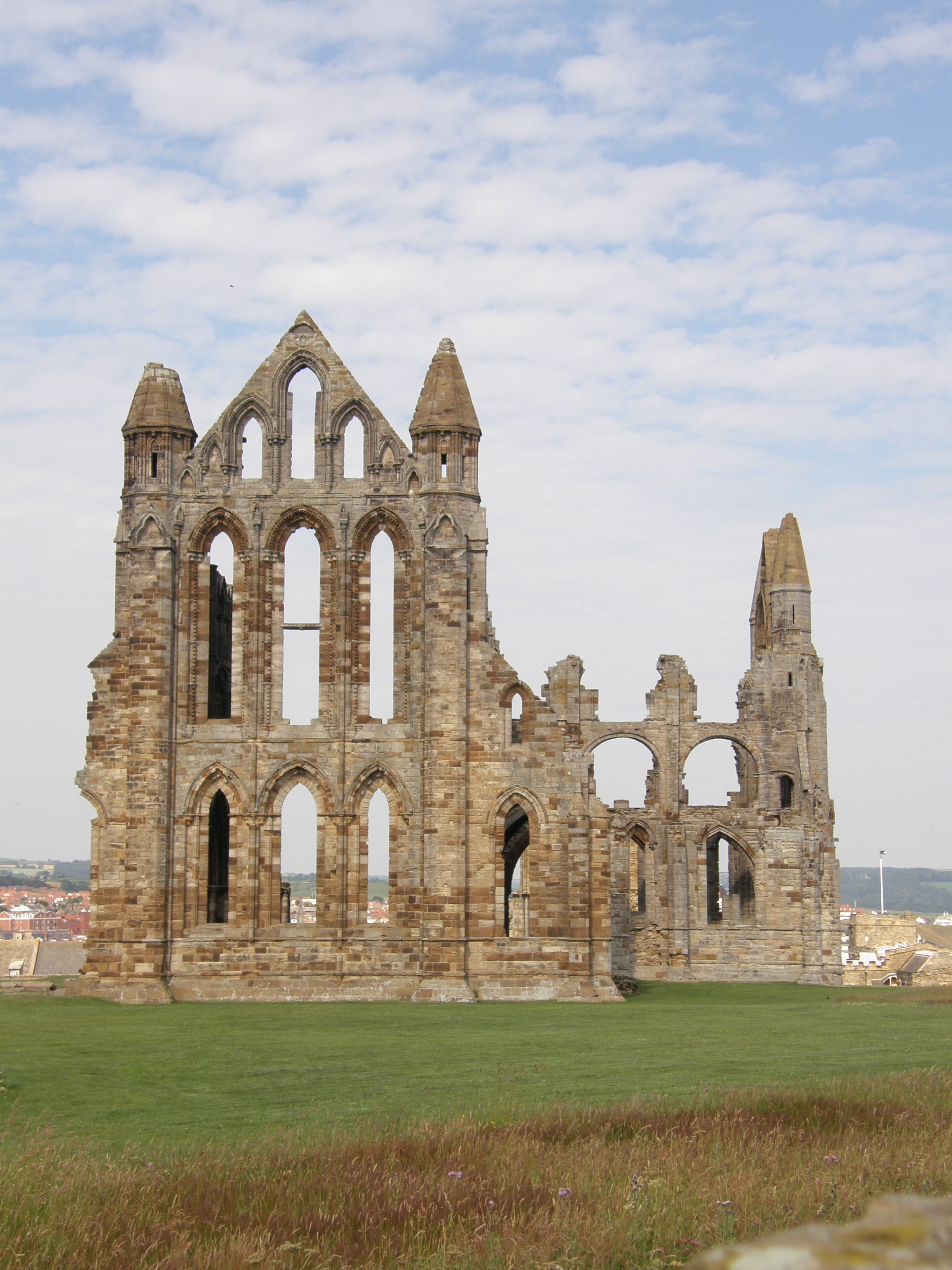
Next, Whitby Abbey. Whitby is a place important in Celtic Church history for it is here that a synod was held which essentially ended the influence of Celtic Christianity in Britain for several centuries. The first monastery here was founded in 657 CE by King Oswy of Northumbria. An Anglo-Saxon style “double monastery” for men and women, its first abbess was a formidable royal princess named Hilda. She hosted the Synod of Whitby in 664 at which it was decided that the English church would follow the traditions of Rome rather than the Celtic practices. Whitby is also famous as the home of the Anglo-Saxon poet Caedmon, an illiterate cowherd who was transformed into an inspired writer of Christian hymns. The Anglo-Saxon monastery has long since disappeared and is believed to have been in a location closer to the ocean than this 13th Century ruin; this monastery was begun in 1220 CE, like many of the re-established Celtic and Anglo-Saxon sites, by the Benedictines.

Whitby Abbey, N. Yorkshire, UK

Whitby Abbey, N. Yorkshire, UK

Third, a tomb in the Minster at York. I don’t actually know who this bishop is … but I love this non-traditional effigy. Usually these things simply look like the fully-vested stretched out corpse of whomever … but this one, with the bishop reclining, resting his head on his hand, and looking for all the world like a day-dreaming schoolboy who ought to be studying his Bible, struck me as delightfully whimsical.

Bishop's Tomb at York Minster

Bishop's Tomb at York Minster

My friend, the Rev. Michael Bishop, is the vicar of an eight-congregation united benefice in the Church of England. He ministers to the members of these eight congregations, offering worship in seven of the eight every Sunday! One of these is All Saints, Dalbury, Derbyshire, which houses this window – the oldest piece of stained glass in the British Isles. It depicts St. Michael the Archangel. I was particularly taken with it because Michaelmas happens to be my birthday.

St. Michael Window, All Saints, Dalbury, Derbyshire, UK

St. Michael Window, All Saints, Dalbury, Derbyshire, UK

Lastly – another depiction of St. Michael from a side chapel in Coventry Cathedral. My poor photographic skills and inadequate camera simply cannot convey the grandeur of the Cathedral of St. Michael, Coventry, nor the emotional impact this place has. The original Gothic cathedral was bombed during World War II. After the war, rather than restore the ruins or rebuild on the same site, it was decided that the ruins would be turned into a prayer area and the new cathedral built adjoining it. The new structure, in a style that can only be called “mid-century modern”, was started in 1956 and completed in 1962. It is magnificent! The old cathedral prayer garden is also outstanding.

Chapel at Coventry Cathedral

Chapel at Coventry Cathedral

Sermon on the Sunday I Left for Sabbatical…. (June 26, 2011)

There is a lot happening at St. Paul’s Parish this morning – it would seem to be a lot more than one might expect to find going on in a church on a summer Sunday! If this is your first visit to our parish and you are not one of the members of Medina Lodge #58, Free & Accepted Masons of Ohio, who are our guests today, you may be wondering what sort of church this is, what is all this activity! Well, let me tell you ….

First – it is the last Sunday of the month and that means that, in addition to our regular weekly offerings, we take up a collection called “the 2-cent-a-meal offering” to fund hunger relief work in this parish and throughout the Episcopal Diocese of Ohio. Nick Magee, who oversees our Free Farmers Market food pantry ministry, sent me an email yesterday with the half-year statistics on that ministry. His spreadsheet showed that yesterday 221 people were provided with food by this parish, which just happens to be the average number of clients served each week the Free Farmers Market is open. In the first half of 2011, our food pantry has provided a week’s worth of groceries to 2,646 persons; nearly twenty thousand pounds of food have been distributed. A word of congratulations to Nick and the Free Farmers Market volunteers – the food pantry was recognized by the Akron Community Foundation last month which awarded it a grant of $4,000! It continues to be a vital and necessary ministry in our community and I encourage you to be as generous as the Akron foundation.

Second – also because it is the last Sunday of the month, this is the Sunday on which we offer prayers for healing and when we bless the work of our knitting circles. For those who are ill or injured, we offer unction and the laying on of hands here at the communion rail following the distribution of Holy Communion. You can also come forward to receive unction and prayer on behalf of someone else, someone unable to be here. The knitted items are, for the most part, prayer shawls made for the comfort of those recovering from illness or injury, warm garments (hats, scarves, and gloves) for merchant marine seamen served by the Episcopal Church’s Seamen’s Institute, and baby blankets for the newborn (many of which we now have or are soon expecting in this parish, by the way. Congratulations again to Nick Magee and to his wife Sian who this week welcomed Finn Griffiths Magee into the world and into their family.)

Third – this past week marked the 20th Anniversary of my ordination into the priesthood and my wife Evelyn and our Senior Warden Barbara Baird cooked up a scheme to have a reception acknowledging that milestone during our usual “coffee hour” after this service. Ladies, I’m very grateful to you for doing so. As I said in a post on Facebook on Tuesday, the actual anniversary, I am extremely grateful and humbled by the gift and privilege of priesthood which permits those of us in this office to share with each of you and all of you the milestones of your lives, to celebrate with you in times of joy and to grieve with you in times of misfortune and sorrow, to preside at our faith’s most significant acts of worship, and to participate in all the small but meaningful ways we form community. My wife secretly arranged for our children, Caitlin and Patrick, to be here for this reception, and Patrick (who was recently ordained a deacon and in a few months will himself be ordained a priest) is serving at the altar with me today – our first time to do so together.

Fourth – later this week … to be precise in four days, seven hours, and fifteen minutes (but who’s counting?) … I will be flying to Scotland to begin three months of sabbatical studying Celtic Christianity, learning more of the Irish Gaelic language, visiting ancient British, Scottish and Irish ruins, and translating and arranging some ancient Irish hymns. So the anniversary reception is also something of a going away party. Please join us in the Parish Hall after this service for the party!
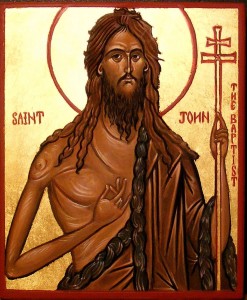
Finally – as we have done for the past few years, St. Paul’s Parish is hosting our friends from the local Masonic Lodge whom I mentioned earlier and whose custom it is to worship together on the Sunday closest to the feast of the Nativity of St. John the Baptist. Thus, we are using the lessons assigned to that feast not those of the usual Sunday lectionary, and singing songs which might seem to some more fitting for the season of Advent than for the middle of summer. The members of the Lodge do so because modern American Freemasonry regards both St. John the Evangelist and St. John the Baptist referring to them jointly as “the Holy Saints John of Jerusalem.”

Why, you may ask, would Masons, who insist that our fraternity is not a religious institution, thus venerate these saints? Why would Masons gather together in worship on this particular Sunday?

As every Mason knows, one of the symbols found in a lodge room is a certain point within a circle, bounded by two parallel lines, with the volume of sacred law displayed atop the circle. Christopher L. Hodapp, the author of the book Freemasons For Dummies, has suggested that this is one of the least understood Masonic emblems. On his internet blog, he writes:

The symbol is actually based on an old astrological and alchemical symbol. The point in the center represented the Earth, which was thought to be the center of the universe. The heavens were believed to spin around the Earth, represented by the circle. The two lines represented the summer and winter solstices, the longest and shortest days of the year. For thousands of years, these days were celebrated as pagan feast days all over the world, and they were especially important to farming societies, because they were the astronomical methods of determining planting seasons.

In about 300A.D., the [Christian] Church began to dedicate popular pagan feast days to the saints. June 24th, the longest day of the year, was declared St. John the Baptist day, while December 27th, the shortest day, was dedicated to St. John the Evangelist. Collectively, Masons refer to them as the Holy Saints John.

Operative Freemasonry was first developed when Roman Catholicism was the prevailing religion, and these feast days continued under the Church of England. It was common for guilds and other trade groups to adopt a patron saint or two. Some Masons picked both Saints John, and over the centuries Masons commonly celebrate their feast days with banquets. And curiously, even though Freemasonry today is non-denominational and non-sectarian, American Masons have retained these customs of old. ….

John the Baptist was zealous, while John the Evangelist was learned, and by picking both of them as patron saints, Masons symbolically united both passion and reason.

The symbol also shows the Volume of Sacred Law at the top. In Masonry, the point represents the individual, and the circle is the boundary of his actions. Taken as a whole, the symbol implies that a Mason should consult the sacred texts of his own religion to achieve the proper balance between passion and intensity on one side, and knowledge and education on the other. In other words, he should balance education, excitement and faith to effectively subdue his passions. In a way, it is a graphic representation of the conscience.

Zeal and learning, passion and reason, excitement and education … the effective blending of these supposed opposites into effective action and ministry … this is what is going on here at St. Paul’s Parish today.

It is all well and good to be zealous and passionate about the need to feed people, but to get it done people like Nick and the other Free Farmers’ Market leaders have to do the reasonable work, really the hard work of figuring out what’s needed, ordering it, stocking it, and organizing volunteers to actually get it done. The proper balance between passion and intensity on one side, and knowledge and education on the other, effectively accomplishes the mission of the church – people are fed.

It is all well and good to love to knit and want share what one makes with the excitement and intensity that our knitting circles display, but without someone to take on the job of learning where the shawls, the gloves and scarves, and the baby blankets are needed, and how to get them there, all that excitement and intensity goes nowhere. The proper balance between passion on one side, and knowledge and education on the other, effectively accomplishes the mission of the church – the ill are comforted and lonely seamen are kept warm.

Today, in commemorating St. John the Baptist, we honor the zealous, passionate, excited side of this equation; we honor the forerunners, the visionaries, the pioneers, the people who “dream dreams and see visions,” those who go to the mountain-top and cry out “Behold!”

It has been said of visionaries that what they do is make the untrue become true. Author Ken Zaretsky puts it this way:

If you say something you know isn’t true and just leave it at that, then you are a liar.

If you believe that untruth, then you are delusional.

On the other hand, if you say something you know isn’t true; then not only believe it but also make it true, you are a visionary! Visionaries are deserving of praise and accolades from friends, peers and the public.

There are fine lines between liars, delusional individuals and visionaries. After all, what is the difference between making something up and making something up?

The first difference is intent. A liar conjures an image. He or she might see it. He might get others to believe in it. But he doesn’t believe it himself. The liar has no intention to make anything happen.

Like the liar, the delusional person also has an image. He or she can see it and, unlike the liar, believe it. It’s possible that she can also get others to believe in it. But she doesn’t do anything beyond believing because, to the delusional person, the image already exists in reality.

A visionary has an image of the ideal. The visionary sees the image, believes it and gets other people to believe in it. Then the visionary works to make the image come to life.

Visionaries see and proclaim an inspired and inspiring positive picture of the future, with a clear sense of direction as to how to get there. They keep communicating the vision to create an energy that sometimes they, but more often others, use to bring their vision into physical reality. Nelson Mandela, for example, clearly held a positive vision of a racially harmonious South Africa during his 28 years in jail and helped bring it into reality peacefully – to the amazement of the world.

Visionaries inspire use to be better than we are and help us identify with what Lincoln called “the better angels of our nature.” This was the power of Martin Luther King’s “I have a dream” speech.

Visionaries often have the ability to see higher spiritual forces at work behind the scenes of events, and they align with the vision of these redemptive forces. Both George Washington and Winston Churchill spoke about the help they received from a “guiding hand.” Churchill said, “…we have a guardian because we serve a great cause, and we shall have that guardian as long as we serve that cause faithfully.”

Vision, it has been said, is an energy field that brings new realities into form. Visionaries tap into and transmit that energy to people, giving us a new sense of hope and confidence, helping us to believe in ourselves and work to create a better world.

More than twenty years ago I had a vision of the priesthood, a sense of call to the ministry of hope and confidence, to the work of creating a better world, to the gift of sharing with God’s people their times of joy and their times of misfortune and sorrow, to the privilege of presiding at our faith’s most significant acts of worship, and to the simple good fun of participating in all the small but meaningful ways the church forms community. I am very grateful for every minute of the twenty years that I have lived out that vision in this and other parishes, but let me be honest and tell you that after twenty years of managing tight budgets, chairing vestry meetings, rehearsing and solemnizing weddings, baptizing babies, leading bible studies, sitting beside hospital beds, and burying the dead … it’s time for a break. So I am also especially grateful for the opportunity to take these next several weeks of time away from the church.

I do so confident that this church will do just fine without me, that things will be (as I am wont to say) “Just peachy!” I know that they will be because our vestry, our lay leadership is a bunch of visionaries. They dream dreams and see visions and generate the energy make them come true. They are neither liars nor delusional, what they purpose they accomplish. They have dreamed a dream and seen a vision of a growing St. Paul’s Parish with and expanded and improved building, and they are going to see it accomplished. They have a clear sense of direction as to how to get there and over these coming weeks they will communicate that vision in way that I am sure will create the energy that they and you will use to bring that vision into reality.

Today, in commemorating St. John the Baptist, we honor the zealous, passionate, and excited leadership of the church; we honor the forerunners, the visionaries, the pioneers, the people who “dream dreams and see visions,” those who go to the mountain-top and cry out “Behold!”

The Vestry has begun closing its meetings with a prayer for vision attributed to Sir Francis Drake, the explorer who claimed North America on behalf of Queen Elizabeth the First and whose ship’s chaplain offered the first Christian worship on North American soil. I’m going to close my sermon today with that same prayer.

Let us pray:

Disturb us, Lord, when we are too well pleased with ourselves, when our dreams have come true because we have dreamed too little, when we arrived safely because we sailed too close to the shore. Disturb us, Lord, when with the abundance of things we possess we have lost our thirst for the waters of life; having fallen in love with life, we have ceased to dream of eternity and in our efforts to build a new earth, we have allowed our vision of the new Heaven to dim. Disturb us, Lord, to dare more boldly, to venture on wider seas where storms will show your mastery; where losing sight of land, we shall find the stars. We ask you to push back the horizons of our hopes, to push us into the future in strength, courage, hope, and love. Amen.

(This sermon is also posted at The Theology Diner)

Preaching on Teen Suicide

The following is the text of an email I sent to some friends with whom I am part of an on-going internet community of some duration – an “email listserve” that has been in existence for several years.

This is long, but I have to write it down and share it with someone. And I apologize in advance for what I know to be offensive content below. It offended me – and I protested to the sender.

This morning I preached about the rash of recent gay teen suicides. I want to share the experience with you all. I preached ad lib with only a few notes.

I began reading John Donne’s Meditation XVII (“No man is an island, etc….”) and said that we had all been diminished recently by the suicides of Tyler Clementi (18 y.o. freshman at Rutgers), Asher Brown (13 y.o. middle school student in Houston), an unnamed 11 y.o. child in California, and Sladjana Vidovic (a Croatian immigrant student at a high school in Mentor, Ohio, age 16). Each of these children was driven to commit suicide because of bullying, teasing, oppression aimed at them because they were perceived as “different”, as outcasts. And the fault lies with each one of us because we have all participated in behaviour which has made such bullying permissible in our society. We have all sat by silently as jokes or political comments or gossip which was racist or sexist or heterosexist were uttered in our presence; we may even have told those jokes or made those remarks ourselves.

I then exegeted the lesson from Jeremiah and talked about how the Jews were the foreigners, the “other” in their exile in Babylon, and how although Jeremiah seems to be counseling assimilation, he is actually telling them to be proud of their heritage in a way that is respectful of those who are their oppressors, to pray and work for the welfare of the society in which they find themselves because in its welfare they will find their own wellbeing. And I noted how when they returned from exile, they hadn’t learned the lesson of what it is like to be “the other” in a strange society, how they had excluded the “Samaritans” from participating in the rebuilding of the Jerusalem temple and how the Jews continued, some of them even to this day, to practice religious intolerance and an exclusionary theology, noting particularly how it affected groups like women, gentiles, tax collectors, and the chronically ill (lepers) in Jesus’ day, and Palestinians today. I then moved on to the Gospel and focused on Jesus’s last words to Samaritan former leper – “your faith has made you well.”

I argued that it is our faith which can make our society well, if we will simply live up to it. Basically my message was “Stop it!” – do not in anyway participate in jokes, comments, conversations, that promote racism, heterosexism, sexism, or any other exclusionary ism. If you are with someone …who starts that kind of talk, tell them to stop it!

I made note of the fact that I had heard members of the congregation criticizing and making jokes about the President in the vilest and most racist of language, that I had heard men in the congregation make jokes about their wives or other women that were not fit to repeat, that I had heard women in the parish make jokes about gays and lesbians that were decidedly unladylike … and that I had said nothing when I had, but fair warning – no longer – if someone from now on says anything of that nature in my presence I will tell them “Stop it!”

I noted that in our Epistle Lesson, Paul warned Timothy of the power of words, of wrangling over words, and that’s basically what we have to deal with — the power of abusive, exclusionary words, of taunting and teasing and “making fun of” (a terrible euphemism if ever there was one). I made mention of James’s letter in which he notes that the tongue is a flame which can start a conflagration — and that is what we have – a conflagration of youthful suicides which result from words being spoken abusively, in a social climate which makes that acceptable behaviour. It is NOT acceptable and so we must stop it! So from now on, I will speak up and protest when I hear it. I will not do it myself … and I begged them not to do it and to speak up when they hear it.

Jesus told the outcast (the leper) that his faith had made him well – only our faith can make our society well – but that faith must be public and vocal – we must tell those who make an atmosphere of abuse acceptable through their racist, sexist, hetersexist jokes and snide remarks to STOP IT! And we must do it because that is the only way to be faithful to Jesus Christ!

That was my sermon, in a nutshell; it was longer, but that’s enough for here for now.

I expected a negative reaction from some, and I’m sure there was some. Mostly those who agreed with me told me as much, and those who didn’t avoided talking with me at all, even those very conservative members who usually do exchange pleasantries didn’t do so. Oh well….

Anyway, I came home … had lunch … checked my email.

So now I need to explain that we have a men’s group loosely affiliated with the church. It started as an attempt to create a men’s fellowship, but devolved into a poker and Scotch-sampling group and includes men whose families, for whatever reason, have left the Episcopal Church as well as members of the parish. This group meets on the 2nd Tuesday of the month and though I am usually unable to take part, I’m still on their email list. Tuesday is the next meeting and so several emails have been exchanged about where they are gathering, who’s hosting, the need to replenish the stock of various labels of Scotch, and so forth.

One of the men whose family are former members of the parish (now worshiping in a Southern Baptist church because of the couple’s very strong right-wing and Christian conservative feelings) … sent this email which I found in my in basket this afternoon:

Sorry guys, if any of you are offended by the attachment below, just couldn’t help it.

This will be my daily routine, through to 2012.

HOW TO START EACH DAY WITH A POSITIVE OUTLOOK

1. Open a new file in your computer.
2. Name it ‘Barack Obama’.
3. Send it to the Recycle Bin.
4. Empty the Recycle Bin.
5. Your PC will ask you: ‘Do you really want to get rid of ‘Barack Obama?’
6. Firmly Click ‘Yes.’
7. Feel better? GOOD! – Tomorrow we’ll do Nancy Pelosi.

Could there have been a more timely email, a better example of exactly what I was talking about? This offensive drivel was sent to about twenty men, mostly members of the parish, at least half of whom were in church this morning.

I sent this reply to the same recipients:

I am offended. This kind of nonsense is precisely what is wrong with this country. It comes from both sides of the political spectrum and it has to stop. This country and our society will only get worse if this kind of disrespect continues.

If anyone is tempted to send me anything of this nature, whether it be from the Left or the Right — Please don’t. And think about what you are doing and take my advice … don’t send it to anyone.

Stop this! Stop it now before this country sinks deeper into the abyss of incivility.

The sender very quickly sent a one-line email to the same list – “I apologize to everyone.” And I sent a quick one line, “Apology accepted. Thank you.”

It has to stop … it is this kind of incivility to those perceived as “other”, the demonizing of those that are different from ourselves, that has brought us to the point where 11 y.o. and 13 y.o. and 16 y.o. and 18 y.o. children are killing themselves because they are the targets of this sort of thing. It has to stop.

We have to stop it and we can only do that by standing up to it and demanding it stop.

« Older posts Newer posts »