Occasional thoughts of an Anglican Episcopal priest

Category: Lectionary (Page 1 of 100)

The Gospel Is Off Center: Sermon for the 22nd Sunday after Pentecost 2026 (RCL Proper 25A)

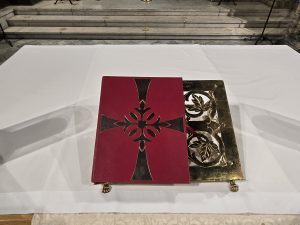
Several weeks ago, I arrived here at Trinity too early for the late service, but too late for the education offering, so I sat down in the nave and watched the sacristans setting things up. I noticed that the Gospel Book for a while was not placed squarely on its stand, but was off to one side. Now, to be fair, it didn’t remain that way: it was soon picked up by the acolyte who carried it in the procession and, when she later replaced it on the stand, it was centered. Nonetheless, it reminded me of the director of the Altar Guild in the first church I served as a priest, a lady named Jackie.

Jackie was a stickler when it came to the set up of the altar. The candles’ bases had to be placed exactly two inches in from each end of the altar, exactly two inches back from the front edge; the linens had to be placed just so; the chalice had to be centered; the veil on the chalice had to be draped evenly; the orphrey band on the veil had to be centered and, if it had a directional design, that design had to be running the proper direction.

With Jackie, there was no other way. There was no easier or more relaxed way to do things. No middle ground. No compromises.
Continue reading

A Dual-Nature Ordination Anniversary Meditation: June 21, 1996 (Pentecost 4, RCL Year A)

I am not preaching today, the 35th anniversary of my ordination to the priesthood. If I were, I might offer something like this, but then again I might not. These are simply my thoughts apropos of today’s gospel lesson (Matthew 10:24-39) in light of the day. Particularly Jesus disturbing statement, “Do not think that I have come to bring peace to the earth; I have not come to bring peace, but a sword…. and one’s foes will be members of one’s own household.”[1] I would start the sermon with the story of a dog.

In November, 1941, a brick maker named Carlo Soriani found an injured puppy by the side of the road in the village of Luco di Mugello, which is a neighborhood in metropolitan Florence. He took the puppy home, nursed it back to health, and then he and his wife adopted the dog and named it “Fido” (pronouncedo “Fee-doh” in Italian), a name meaning “faithful.”

Mr. Soriani worked at a brick kiln some miles away from his home. Every morning he went to the bus stop at the Piazza Dante in the center of Luco di Mugello accompanied by Fido; he’d get on the bus and Fido would go back home. Every evening, Fido would go to the bus stop and wait for Carlo, and then they’d walk home together. Everybody in Luco di Mugello got to know Fido.

Continue reading

Death of a Nation: Sermon for the Fifth Sunday in Lent – 22 March 2026

I asked ChatGPT’s image generator, “What sort of image would you create to illustrate the concept of a dead nation?” and this is what it produced.
Nations die. Just like people. The reasons nations die are as varied and numerous as the reasons people die. Some nations die because they just get too unwieldy to survive, like the Roman Empire. It simply became too large to manage, which led to a fatal weakening of its political structure and military capability, and ultimately to its collapse. Some die because of internal rot. The German Weimar Republic, for example, died when its president appointed a madman named Adolf Hitler to be its chancellor, and he in turn dismantled its democratic institutions. The Weimar Republic died, replaced by the Third Reich, which was supposed to last a thousand years, but it died in the most common way nations die – because they are conquered.

Continue reading

An Unjust War: Sermon for the Third Sunday in Lent – 8 March 2026

There is an aphorism about preaching that says the preacher “must hold the Bible in one hand and the newspaper in the other.” This is often attributed to the influential Swiss theologian Karl Barth, whom Time Magazine in the 1960s called “the greatest living Protestant theologian.” Truth is, however, that he never really said it. What he actually said, in an interview with Time in 1963, was, “Take your Bible and take your newspaper, and read both. But interpret newspapers from your Bible.”[1] In other words, try to understand events in the world through the lens of Scripture and take guidance from it as you seek to live in this world.

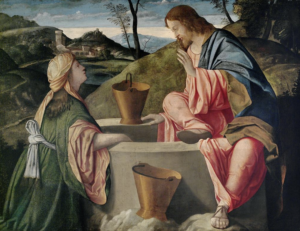
As I followed the news media the past few weeks, two stories stood out for me. One was the witness of the women who are the surivors of Jeffrey Epstein’s human trafficking enterprise. The other was the tale of the US Women’s Ice Hockey team who won the Olympic gold medal but were nonetheless made the butt of a joke by the president. It seemed to me that John’s story of Jesus’ long conversation with the Samaritan woman at Jacob’s well offers us a lens through which to view these news stories. So I started making notes for a sermon along those lines.

Continue reading

Satan Is a Bully: Sermon for the First Sunday in Lent – 22 February 2026

I assume that everyone here has seen A Christmas Story?[1] It’s hard to live in the Cleveland area and not to know about the 1983 cult classic Christmas movie, and by now, with the Turner movie channel running it as a marathon every Christmas, to have seen it. Do you remember the character “Scut” Farkus? That was the bully who, accompanied by his toady Grover Dill, made Ralphie’s life miserable. Until, that is, Ralphie had simply had enough and exploded, knocked Scut down into the snow, and gave him a bloody nose. This morning, I’m going to try to convince you that that’s sort of what’s happening in today’s gospel lesson.

A rather standard way of preaching the Temptations of Christ is to say that Satan’s point is to raise doubts about whether Jesus is who he thinks he is by casting doubt on his relationship with God, and that Jesus’ rejections of the temptations “prove his identity as God’s divine and beloved son.”[2] I’m probably a heretic, but I don’t think that’s the point of this story at all; that’s not what this episode is about.

Continue reading

Loneliness and Light: Sermon for 5 Epiphany – 8 February 2026

“You are the light of the world. … [L]et your light shine before others, so that they may see your good works and give glory to your Father in heaven.”[1]

Last week, I read this story on Facebook:

I own a small bakery. Business has been slow. Rent is up. I was thinking about closing. Last Friday, a teenager came in. He looked nervous. He counted out change for a cookie. He was short 50 cents. “It’s okay,” I said. “Take it.” He ate it at a table, looking at his math homework. I walked over. “Quadratic equations?” He nodded. “I don’t get it.” I sat down and helped him for 20 minutes. He got it. He left smiling. The next day, he came back with two friends. They bought cookies. The day after that, five kids came. Apparently, he told the school, “The lady at the bakery helps with homework.” Now, my bakery is the after-school hang-out spot. It’s loud. It’s messy. There are backpacks everywhere, Yesterday, I found a note in the tip jar. It was wrapped around a $20 bill. “Thanks for helping my son pass math. A Mom.” I’m not closing the bakery. I think I finally found my purpose. It’s not cookies. It’s community.

This baker is a light shining before others. I think that both Jesus and the prophet Isaiah would have approved of this baker.

Continue reading

Incarnation and Democracy: Sermon for the First Sunday of Christmas, 28 December 2025

I’m sure you’re all familiar with Howard Thurman’s meditation entitled The Work of Christmas:

When the song of the angels is stilled,
when the star in the sky is gone,
when the kings and princes are home,
when the shepherds are back with their flocks,
the work of Christmas begins:
to find the lost,
to heal the broken,
to feed the hungry,
to release the prisoner,
to rebuild the nations,
to bring peace among the people,
to make music in the heart.[1]

This year I think I would have to suggest that there is one more task to add: to preserve democracy.

Continue reading

Not ORPman’s Prayer: Sermon for Pentecost VII, Proper 12C – 27 July 2025

Do you all know what a tort is? Tort … T-O-R-T … no E on the end; I’m not talking about those wonderful little German or Austrian pastries. A tort is a civil wrong that causes harm to another person, resulting in legal liability for the person who commits the wrong. You leave a puddle of milk on the floor of your grocery store knowing it’s there, then someone slips in it and injures themselves: you have committed a tort. You speed through a stop sign, collide with another car, and injure the driver: you’ve not only broken the law, you’ve committed a tort.
A million years ago when I was in law school studying the law of torts with Professor Bill Lynch of blessed memory, I was introduced to the superhero of Anglo-American civil jurisprudence: the ordinary, reasonably prudent person, often called “ORPman”. ORPman’s super power, as you can tell from his name, is ordinary, reasonable prudence. His conduct is the standard against which allegedly tortious behavior is judged. His conduct is always sensible, never outrageous, not too timid, nor too bold. He is not a coward, but neither is he an excessive risk-taker. His expectations are rational; he is not demanding, but neither is he a doormat.

Continue reading

The Political Influence of the Trinity: Radical Equality — 15 June 2025

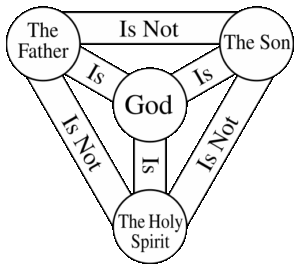
A few weeks ago, as I was looking forward to my annual cover-Rachel’s-vacation gig here at Harcourt Parish, my plan was to preach a sort of two-part sermon on play and playfulness. Seemed like a good summer-time thing to do. Last week, on Pentecost Sunday, I suggested to you that playfulness is a gift of the Holy Spirit, that play is why we were made. Today being Trinity Sunday, I planned to follow-up with a few words about how a metaphor of play and playfulness can help us understand and participate in the relational community which the triune God is.
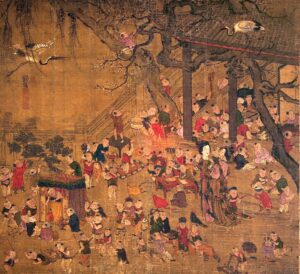
Then the Immigration and Customs Enforcement doubled down on Mr. Trump’s promises of “mass deportations” across the country, but especially in Southern California and particularly in Los Angeles (where I grew up, by the way). People took to the streets in protest; the administration used that as an excuse to nationalize the California National Guard and met the protesters not only with 2,000 guardsmen but with 700 Marines, as well.

Continue reading

Come! See How We Play! Sermon for Pentecost –– 8 June 2025

Y’all know who John Wesley is, or was, I’m sure. The Anglican priest who founded Methodism? My paternal grandparents were Methodists and they really tried to make me into one but, for some reason, it didn’t stick. To this day when Evelyn and I visit a Methodist church, I will often turn to her as we are leaving and say, “There’s a reason I’m not a Methodist.”

Don’t get me wrong! Our church has an ongoing and productive ecumenical dialogue with the United Methodist Church and Methodists are fine people. I just don’t want to be one. There’s a reason I’m not a Methodist. To be honest, though, I wasn’t ever really sure what that reason was, but I was sure there must be one.

Continue reading

« Older posts