From Luke’s Gospel:
They brought [a colt] to Jesus; and after throwing their cloaks on the colt, they set Jesus on it. As he rode along, people kept spreading their cloaks on the road. As he was now approaching the path down from the Mount of Olives, the whole multitude of the disciples began to praise God joyfully with a loud voice for all the deeds of power that they had seen, saying,
“Blessed is the king who comes in the name of the Lord!
Peace in heaven, and glory in the highest heaven!”
Some of the Pharisees in the crowd said to him, “Teacher, order your disciples to stop.” He answered, “I tell you, if these were silent, the stones would shout out.”
(From the Daily Office Lectionary – Luke 19:35-40 (NRSV) – November 30, 2012)

Duddo Stone Circle
Why waste your breath moaning at the crowd?
Nothing can be done to stop the shouting.
If every tongue were stilled
The noise would still continue.
The rocks and stones themselves would start to sing
That’s one of my favorite verses of scripture and one of my favorite songs and, whenever I’m traveling and come across a stone monument of some sort, the image of shouting stones and the music of Andrew Lloyd Webber and Tim Rice pop into my head.
In northeastern England there is a circle of standing stones at Duddo in Northumberland. I visited those stones in the summer of 2011, spending a lonely afternoon with them, loudly singing the music of Superstar all by myself in the English countryside. To reach the circle, you park your car at the side of a narrow country road and hike through a farmer’s fields for the better part of 40 minutes.
No one is quite sure what the Duddo Stone Circle is all about. It may have marked a burial site, but that cannot be proven because Victorian and early 20th Century excavations disturbed any cremation chamber that may have been there. It may have been a religious site of some sort, but who can tell? It is dated to the Bronze Age principally because of its size. Archeologists tell us that the final phase of stone circle building occurred during the early to middle Bronze Age (c. 2200–1500 BCE) which saw the construction of small circles like Duddo, probably by family groups or clans rather than the larger population groups needed to build the larger circles and henges, such as Stonehenge or huge stone circle that encompasses the village of Avebury in Wiltshire.
The purpose of stone circles and henges is forever lost to us. They may have been religious; they have been astrological or astronomical observatories of a sort; they have been talismanic. Still, whatever their purpose and whoever their builders, they remain today as monuments to community and cooperation, to the human need to communicate and connect with that which is greater than the individual. Though the stones at Duddo have fallen and been stood up again over time, they continue (perhaps 4,000 years after their initial placement on that hillside in Northumbria) to shout that message of human need.
I think that’s what Jesus’ answer to the Pharisees is all about. It’s an acknowledgement that our human need to connect with that which is larger than ourselves can never be silenced. Standing circles, henges, temples, church buildings, cathedrals are all evidence of that, even though they are nothing more than stones. They are stones artfully arranged to shout out, to sing glory to the heavens, to celebrate our connection to the infinite. Even when we are silent, like the long-gone builders of the Duddo Stone Circle, the stones themselves continue to cry out.
====================
A request to my readers: I’m trying to build the readership of this blog and I’d very much appreciate your help in doing so. If you find something here that is of value, please share it with others. If you are on Facebook, “like” the posts on your page so others can see them. If you are following me on Twitter, please “retweet” the notices of these meditations. If you have a blog of your own, please include mine in your links (a favor I will gladly reciprocate). Many thanks!
====================
Father Funston is the rector of St. Paul’s Episcopal Church, Medina, Ohio.
 I know I’ve read this bit of Zechariah before, but I don’t think I’ve ever paid any attention to it. This morning, the image of parents “piercing” their own children who happen to be prophets and that of “the wounds I received in the house of my friends” really hit home! Strife within families and between friends is here the recompense paid by God to false prophets, but it seems to be the lot of the prophet, the priest, or the ardent advocate in any age. I am reminded of Jesus’ quoting Micah to the effect that “your enemies are members of your own household.” (Micah 7:6; cf Matt. 10:35-36 and Luke 12:52-53) Speaking on behalf of God or any god or any cause is never easy; it leads to misunderstanding and conflict – just look at what happened in many families during the recently passed political campaigns.
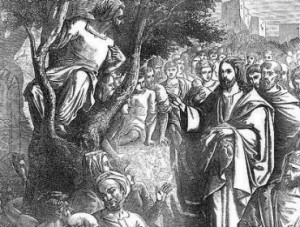 Zacchaeus climbs a tree to see Jesus. So today’s reading got me thinking scattered thoughts about trees. The weeping willow in my childhood backyard. The peach and cherry trees in my grandfather’s garden. The pinion pines of my native Nevada. The eucalyptus trees that were everywhere on my college campus. The huge ornamental pepper tree that shaded the first house my wife and I bought. I close my eyes, think of those trees, and I see my parents, my childhood friends, my college roommates. Trees are filled with meaning and memory; they bear the fruits of remembrance.
 Who is you? That’s not a grammatically incorrect question. It’s a deeply important question in our study and understanding of scripture.
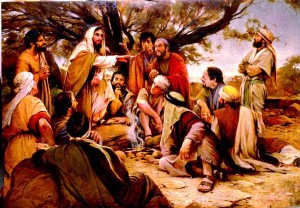 Do you ever wish someone whom you respect and admire hadn’t said what they said, because what they said is so hard to explain to someone who doesn’t respect and admire them, and what they said just sounds wrong, even to you? Then you know how I feel about the last response of Jesus in this conversation with Peter!
 Today is the last Sunday after Pentecost called “the Feast of Christ the King.” A relatively new feast on the calendar of the church, it was instituted by a 20th Century pope and originally set in late October as a response to the Protestant celebration of “Reformation Sunday” on the Sunday closest to October 31, the anniversary of Luther’s posting on the Wittenburg chapel door. The latter, I would suppose, started with the Lutherans but has spread throughout American Protestantism; I know of Presbyterian, Reformed, UCC, and Methodist churches that mark it. I know of no Episcopal congregations that do so. Episcopalians did take to Christ the King, however, and since Paul VI moved it to the last Sunday of the Christian year, every congregation I’ve been a part of has celebrated it. With the adoption of the Revised Common Lectionary, it is now an official part of our tradition.
 Although from a modern perspective, the prayer of the Pharisee is rather bigoted, but we should try to see it from his perspective and from within his culture, which Jesus shares. When we do so, we can see that Jesus is not criticizing the individual, but rather condemning an entire system of religion which divides and categorizes people. Jesus is denouncing any system, religious, social, or political, which separates people on the basis of bigotry and fear.
 It may be the United States’ holiday of Thanksgiving Day, but the Daily Office continues at this time of year delivering its message of repentance rather than encouraging thanksgiving. The Old Testament lesson is another from Malachi in which the Lord speaking to the priests says that he has spread dung on their faces and put them out of his presence! The gospel lesson from Luke has Jesus predicting the end of the world. And then there’s this epistle lesson which condemns the wealthy. Just not a lot of giving thanks!
 Several years ago I served in a small parish which had a very tight budget. Among its many cost-saving efforts was the reuse of altar flowers. Arrangements would be purchased and used on one Sunday, then quickly put away in the refrigerator in the basement kitchen to be used again the next week. Of course, they didn’t last as well as they might have been wished to (and some varieties of flower fared worse than others), so it was noticeable that they’d been around for awhile. In addition, if there’d been any sort of parish dinner in the interim so that food had been stored in the same refrigerator, they would often have taken on a bit of the odor of fried chicken or garlic or cheesy tuna surprise.

