Occasional thoughts of an Anglican Episcopal priest

Category: First Corinthians (Page 5 of 10)

Faith, Hope, and Charity – Sermon for Pentecost 22 (25 October 2015)

====================

A sermon offered on Twenty-Second Sunday after Pentecost (Proper 25B, Track 1, RCL), October 25, 2015, to the people of St. Paul’s Episcopal Church, Medina, Ohio, where Fr. Funston is rector.

(The lessons for the day are Job 42:1-6,10-17, Psalm 34:1-8, Hebrews 7:23-28; and Mark 10:46-52. These lessons may be found at The Lectionary Page. The collect for the day, referenced in the sermon, is found at the same site.)

====================

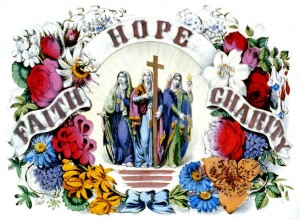
Faith-Hope-CharityLast week, I gave away the ending of Job. I told you that everything turned out all right in the end, and so it has. Job has repented, not of any sin that warranted his suffering, but of the pride and arrogance (and ignorance) he displayed during his suffering by demanding to confront God. God has forgiven him and to make up for all his loss, his fortunes have been restored many times over. Happy ending! Except not quite . . .

I’ll come back to Job in a minute, but first I want to look at a petition in today’s opening collect and then at the gospel story. The petition is this: “Increase in us the gifts of faith, hope, and charity.” The gospel story is the restoration of sight to blind Bartimaeus to whom Jesus says, “Your faith has made you well.”

What is “faith,” the first of the theological virtues our prayer asks of God and the active agent in healing Bartimaeus? The writer of the Letter to the Hebrews tells us that “faith is the assurance of things hoped for, the conviction of things not seen.” (Heb 11:1) Faith is sometimes equated with belief, and in an ancient way that is true but in the modern sense of the word “belief,” that is a misleading equation.

In contemporary English, “belief” is understood to be an opinion or judgment of which the believer is fully persuaded, or alternatively it is considered intellectual assent to a factual assertion. By some it is derided as a false alternative to scientific certainty: one is said to believe that which cannot be proven, but to know that which is made evident by factual data. That’s a false dichotomy, but not one I want to debate this morning. For the moment, let’s accept the notion that belief is assent to an opinion, judgment, or assertion. This may be the first step of faith for, as Paul reminds us in the Letter to the Romans, “faith comes from what is heard,” (Rom 10:17a), through acceptance of assertions. However, faith must be more than that.

In the Epistle of James, we are reminded that such faith, faith which consists only of belief, “by itself, if it has no works, is dead,” (Jm 2:17) and Paul would seem to agree with that when, in his letter to the Galatians, he writes that “the only thing that counts is faith working through love.” (Gal 5:6b, emphasis added)

So, then, faith is not simply the same as belief (as belief is currently understood). Faith is belief plus action. This is in accord with the New Testament understanding of faith; remember that our New Testament was written in Greek and the word we translate as “faith” is pistis, a verb. From a New Testament perspective, faith is not a noun, an object or substance which one has; faith is a verb, an action which one does. But is it more? Is there another element of faith.

I suggest to you that there is and we find that element in the original meaning of the word “belief.” Our word “belief” derives from the same root as our word “beloved,” and in original meaning as more the sense of “confidence” or “trust” than of intellectual assent. It means to give one’s heart to the object of one’s belief.

Faith then is belief plus action plus confidence, and it was faith such as this which led blind Bartimaeus to throw off his cloak and cry out to Jesus, “Son of David, have mercy on me!” Even when those around him would silence him, this faith made him yell even more loudly. This is the faith which our opening prayer asks God to increase in us: not our assurance of the rectitude of some factual assertion made (for example) in the Nicene Creed, but that belief given shape in action and that action undertaken with confidence, and confidence (the Letter to the Hebrews tells us) belongs to hope (Heb 3:6), which is the second theological virtue in our petition to God this morning.

Did you know that we have iconic depictions of the theological virtues in our stained glass windows? Look to the back of the church over the entrance doors. Below the circular rose window are the figures of three women. One holds a cross; one, an anchor; and one, loaves of bread. The figure with the cross is the depiction of Faith. Next to her is the figure holding the anchor of Hope. Which brings us back to Job.

We are, as I mentioned earlier, at the end of the story and everything has turned out all right. Job confesses that he has been arrogant and prideful in demanding a hearing before God; he is healed of his loathsome sores, reconciled to God, and rewarded with an abundance of wealth and family and comfort.

Once again, however, the lectionary leaves something out. Between verse 6, the end of his confession, and verse 10, which begins the description of his reward, God addresses Job’s three friends, Eliphaz the Temanite, Bildad the Shuhite, and Zophar the Naamathite. God says, “My wrath is kindled against you . . . ; for you have not spoken of me what is right, as my servant Job has.” (v. 7)

What is the difference between Job and these other three? The answer is, “Hope.” Throughout his ordeal, despite his pride, despite his arrogant demand that God present himself, despite his denials of any sin, Job has steadfastly maintained his hope in the justice of God. His friends have counseled him to admit to wrongdoing that even they are not sure he has done; they have advised him to just give up. They have given up hope, but Job has not.

What is “hope”? Well, that’s a good question. St. Paul wrote a lot about hope in his various letters, but he never really defines it. He comes closest to doing so in the Letter to Romans in which he writes: “[S]uffering produces endurance, and endurance produces character, and character produces hope, and hope does not disappoint us.” (Rm 5:3-5) And then later in the same letter he says, “In hope we were saved. Now hope that is seen is not hope. For who hopes for what is seen? But if we hope for what we do not see, we wait for it with patience.” (Rm 8:24-25)

Theologically, hope is the “virtue by which we desire the kingdom of heaven and eternal life as our happiness, placing our trust in Christ’s promises and relying not on our own strength, but on the help of the grace of the Holy Spirit.” (C.C.C., 2nd Ed., 1997, Para. 1817)

Hope is not optimism. Optimism claims everything will be good despite all evidence of reality to the contrary; pessimism denies even the possibility of good because of present evidence. The nuclear physicist J. Robert Oppenheimer said, “The optimist thinks this is the best of all possible worlds. The pessimist fears it is true.”

Optimism can be defeated by reality. Pessimism revels in reality but defeats itself. Hope, like optimism, expects the good. Hope, like pessimism, accepts reality. Hope does not deny the poverty of spirit that underlies fear, the sinfulness that underlies all tragedy, and the evil that causes systemic inertia. Hope, however, has a trump card – the capacity of the human heart. When reality grinds optimism down and reduces pessimism to a self-defeating smugness, hope will go toe-to-toe with reality because the heart’s capacity to love refuses to quit. This is why the letter to the Hebrews describes hope as “a sure and steadfast anchor of the soul” (Heb 6:19) and why the iconic figure of Hope holds an anchor.

This is the steadfastness that our opening prayer seeks from God.

The last of the theological virtues for which we have prayed is Charity, who is depicted in our window as a woman distributing bread to hungry children. Theologically, Charity is the “virtue by which we love God above all things for his own sake, and our neighbor as ourselves for the love of God.” (C.C.C., Para. 1822) Interestingly, though, we almost never read of charity in our English language bibles. In the New Revised Standard Version, the word “charity” appears only five times and four of those are in the Apocrypha; in the canonical scriptures, the word appears only in the book of Acts. In the Authorized or “King James” version it appears 24 times, more than a third of those in one book, St. Paul’s First Letter to the Corinthians from which you will (I’m sure) recognize these words:

Though I speak with the tongues of men and of angels, and have not charity, I am become as sounding brass, or a tinkling cymbal. And though I have the gift of prophecy, and understand all mysteries, and all knowledge; and though I have all faith, so that I could remove mountains, and have not charity, I am nothing. And though I bestow all my goods to feed the poor, and though I give my body to be burned, and have not charity, it profiteth me nothing. Charity suffereth long, and is kind; charity envieth not; charity vaunteth not itself, is not puffed up, doth not behave itself unseemly, seeketh not her own, is not easily provoked, thinketh no evil; rejoiceth not in iniquity, but rejoiceth in the truth; beareth all things, believeth all things, hopeth all things, endureth all things. Charity never faileth . . . . (1 Cor 13:108a)

In our modern translation we have changed the word “charity” to “love” and that bit of First Corinthians has become very popular at weddings, but it’s not about romantic love at all. It is about something much different. You know (you’ve heard it here before!) that the word in the original Greek is agape, which refers to selfless love. This is the love that one extends to all people, whether family members or distant strangers; it is the according of human dignity to everyone, simply because they are human. Agape was translated by St Jerome into the Latin word caritas, which is the origin of our word “charity.” C.S. Lewis referred to it as “gift love” and described it as the highest form of Christian love. But it is not solely a Christian concept; it appears in other religious traditions, such as the idea of metta or “universal loving kindness” in Buddhism.

Charity, agape, is not simply love generated by an impulse emotion. Instead, charity, agape, is an exercise of the will, a deliberate choice. This is why Jesus can command us to love one another as he loves us, to love our neighbors, even our enemies, as ourselves. God is not commanding us to have a good feeling for these others, but to act in charity, in “gift love,” in self-giving agape toward them. Charity, agape, is matter of commitment and obedience, not of feeling or emotion. When Paul admonishes Christians in the Letter to the Ephesians to “live in love, as Christ loved us and gave himself up for us,” offering himself (as our reading from Hebrews says) “once for all,” it is precisely this kind of self-sacrificing love, Charity, agape, to which we are called.

When the Resurrected Jesus asks Peter, “Do you love me?” three times, the first two times the word is agape. “Peter,” Jesus is asking, “are you willing to do things for my sake that you do not want to do?” This is the sort of love, of Charity, that is depicted in our third iconic window, the woman giving bread to poor and hungry children, love which leads us to give sacrificially.

The contemporary hymn writer John Bell, a Scotsman affiliated with the Iona Community, has written a beautiful song entitled The Summons which I wish I had the voice to sing to you. I don’t, so you don’t want me to sing it, but please listen as I read the lyrics. I believe these words perfectly describe the sort of Charity our opening prayer asks God to increase in us:

Will you come and follow me
If I but call your name?
Will you go where you don’t know
And never be the same?
Will you let my love be shown,
Will you let my name be known,
Will you let my life be grown
In you and you in me?

Will you leave yourself behind
If I but call your name?
Will you care for cruel and kind
And never be the same?
Will you risk the hostile stare
Should your life attract or scare?
Will you let me answer pray’r
In you and you in me?

Will you let the blinded see
If I but call your name?
Will you set the pris’ners free
And never be the same?
Will you kiss the leper clean,
And do such as this unseen,
And admit to what I mean
In you and you in me?

Will you love the ‘you’ you hide
If I but call your name?
Will you quell the fear inside
And never be the same?
Will you use the faith you’ve found
To reshape the world around,
Through my sight and touch and sound
In you and you in me?

Lord, your summons echoes true
When you but call my name.
Let me turn and follow you
And never be the same.
In your company I’ll go
Where your love and footsteps show.
Thus I’ll move and live and grow
In you and you in me.

We have prayed this morning that God will increase in us the gift of faith – faith like Bartimaeus’s, belief given shape by action undertaken in confidence which is sustained by hope. We have prayed this morning that God will increase in us the gift of hope – hope like Job’s, the sure and steadfast anchor of the soul not crushed by the suffering of the present sustained by the heart’s capacity to love and the assurance that in end all will make sense. And we have prayed this morning that God will increase in us the gift of charity – the agape love commanded and demonstrated by Christ who gave himself once for all which leads us to give sacrificially.

“And now abideth faith, hope, charity, these three; but the greatest of these is charity.” (1 Cor 13:13) May Christ’s charity move and live and grow in us and we in him. Amen.

====================

A request to my readers: I’m trying to build the readership of this blog and I’d very much appreciate your help in doing so. If you find something here that is of value, please share it with others. If you are on Facebook, “like” the posts on your page so others can see them. If you are following me on Twitter, please “retweet” the notices of these meditations. If you have a blog of your own, please include mine in your links (a favor I will gladly reciprocate). Many thanks!

====================

Father Funston is the rector of St. Paul’s Episcopal Church, Medina, Ohio.

Dog Crap, the Temple, and Love – From the Daily Office Lectionary

Dog Crap, the Temple, and Love

From the Daily Office Lectionary for Friday in the week of Proper 24, Year 1 (Pentecost 21, 2015)

Ezra 3:10 ~ When the builders laid the foundation of the temple of the Lord, the priests in their vestments were stationed to praise the Lord with trumpets, and the Levites, the sons of Asaph, with cymbals, according to the directions of King David of Israel . . . .

So I haven’t written one of these random meditations for a week . . . and instead of starting this one early in the morning as I usually do (so that they are sort of sleep befuddled first impressions of the Daily Office lessons more than anything else), I went out to do yard work.

I was reminded of another verse of scripture: “You shall have a designated area outside the camp to which you shall go. With your utensils you shall have a trowel; when you relieve yourself outside, you shall dig a hole with it and then cover up your excrement.” (Dt 23:12-13) We have a “dog yard” on the west side of our house; it is our “designated area outside the camp” and it is my privilege to clean it up every Friday on my day off. After doing that, I mow the lawn.

The yard clean up is the foundation, if you will, of my day off. After that is accomplished, I can relax and enjoy the day; I can rejoice and praise the Lord. Foundations, it seems to me, are like that. The work of digging footings, laying foundation stones (or blocks of concrete, or pumping in concrete), making sure the work is level, providing for proper drainage, and so forth, is all very hard work. And then it gets covered up and no one ever sees or thinks about it again, unless something goes wrong. Picking up dog crap is like that. It’s gross and unpleasant work, and no one ever thinks about it . . . unless it doesn’t get done and the stuff piles up. Getting that unpleasant but necessary work done, the work that makes everything else possible, the very important and absolutely necessary work that no one notices when all is well, that is good reason to praise the Lord.

This was not, of course, my initial thought reading the lessons this morning; this only came to me after the dog yard was cleaned and the lawn was mowed. My initial thought was a question: Did St. Paul have this scene in mind when he wrote to the Corinthians, “If I speak in the tongues of mortals and of angels, but do not have love, I am a noisy gong or a clanging cymbal”? (1 Cor 13:1) Was he thinking of noisy temple rituals when he wrote of actions lacking the foundation of love?

For love is the true foundation of all good. On its website, a Canadian food ministry in which the Anglican Church of Canada is a part includes a prayer beginning with these words: “Creator God, we know that love is the foundation of creation and all life, your love and ours. We know that all things are possible with love – that the least becomes the most important, the last becomes the first.” Done with love even the grossest and most unpleasant of jobs, even most hidden and little recognized work, becomes the most important. Picking up dog shit, cleaning up the latrine, digging ditches, laying stones . . . done with love they are the foundation of the temple and worthy of praise and celebration.

You Are What You Eat ~ From the Daily Office Lectionary

You Are What You Eat

From the Daily Office Lectionary for Wednesday in the week of Proper 21, Year 1 (Pentecost 18, 2015)

1 Corinthians 8:8 ~ “Food will not bring us close to God.”

Apparently St. Paul is quoting someone? I have not the vaguest idea who that might be . . . but it seems a strange thing to say as the proponent of a religion whose principal act of worship is a meal!

I haven’t done a service of the Holy Eucharist using Rite One of the current Book of Common Prayer in so long that I can’t remember the last time. The last time I used the 1928 Book of Common Prayer was more than twenty years ago. Nonetheless, phrases from those services are indelibly etched in my psyche. One of them is this sentence from the Prayer of Humble Access as it is found in the earlier liturgy: “Grant us therefore, gracious Lord, so to eat the flesh of thy dear Son Jesus Christ, and to drink his blood, that our sinful bodies may be made clean by his Body, and our souls washed through his most precious Blood, and that we may evermore dwell in him, and he in us.” If ever there was a refutation of Paul’s quotation from whomever, it is found in that sentence which (in my opinion) is at the heart of Anglican eucharistic theology: food, this food we call “communion,” does indeed bring us closer to God!

Of course, Paul wasn’t thinking of that when making his arguments about eating meat sacrificed to pagan idols. His thoughts, however, did turn to Christian table fellowship almost immediately for just three chapters later he recounts: “For I received from the Lord what I also handed on to you, that the Lord Jesus on the night when he was betrayed took a loaf of bread, and when he had given thanks, he broke it and said, ‘This is my body that is for you. Do this in remembrance of me.’ In the same way he took the cup also, after supper, saying, ‘This cup is the new covenant in my blood. Do this, as often as you drink it, in remembrance of me.’ For as often as you eat this bread and drink the cup, you proclaim the Lord’s death until he comes.” (1 Cor 11:23-26)

Perhaps Paul might better have quoted the aphorism, “You are what you eat,” to make his points both about pagan-sacrifice meat and the eucharist.

“I Give My Opinion” – From the Daily Office Lectionary

“I give my opinion”

From the Daily Office Lectionary for Monday in the week of Proper 21, Year 1 (Pentecost 18, 2015)

1 Corinthians 7:25 ~ Now concerning virgins, I have no command of the Lord, but I give my opinion as one who by the Lord’s mercy is trustworthy.

Wouldn’t it have been great if Paul had prefaced every letter with a comment like this: “This isn’t a command from God, it’s just my opinion”? Wouldn’t it be great if every preacher began his or her sermon in a similar way?

I know that’s contrary to what preachers are taught. I can’t remember in which seminary class nor from which seminary professor I heard it, but I do remember a comment being made that a preacher should steer away from saying, “I believe” or “I think” because the congregation “doesn’t want to know what you think; they want to hear the Word of the Lord.” Maybe so, but in all honesty the only thing I can give my congregation are my thoughts; I can’t give them “the Word of the Lord.” (It’s no accident that one of my favorite prophetic utterances is from Amos: “I am no prophet, nor a prophet’s son; but I am a herdsman, and a dresser of sycamore trees.” 7:14) So my sermons tend, in contravention of that professor’s admonition, to be liberally peppered with “I believes” and “I thinks” . . . .

Truth be told, after a quarter century of preaching, I am more tempted than I was when I started to preface every homily with Paul’s words, “I have no command of the Lord, but I give my opinion,” and end each one with my own, “But what do I know?”

Bewitched, Bothered, and Bewildered! – From the Daily Office Lectionary

Bewitched, bothered, and bewildered!

From the Daily Office Lectionary for Friday in the week of Proper 20, Year 1 (Pentecost 17, 2015)

Matthew 6:9-13 ~ Jesus said, “Pray then in this way:
Our Father in heaven,
hallowed be your name.
Your kingdom come.
Your will be done,
on earth as it is in heaven.
Give us this day our daily bread.
And forgive us our debts,
as we also have forgiven our debtors.
And do not bring us to the time of trial,
but rescue us from the evil one.”

Today the Lord’s Prayer instruction from Matthew’s Gospel is paired in the Daily Office readings with the story of the death of Jezebel (with dogs eating her corpse) in the Second Book of Kings, and with Paul’s advice to the Corinthians about sex and marriage. It’s been three hours since I said the Office and read those lessons; I’ve had several cups of coffee and a high-fiber-high-protein breakfast. Despite that nourishment and caffeine, which should have kickstarted my brain, I confess to befuddlement. I don’t get the connection, any connection!

So that’s the take away today, not from the lessons themselves but from the Lectionary and its lack of connection between the readings that come up on the rota. In the Sunday Lectionary, one can generally find a linkage between at least two of the four readings (For non-Lectionary folk: the Eucharistic Lectionary for Sunday celebrations nearly always has four selections from Scripture – a lesson from the Old Testament, a Psalm, a lesson from the Epistles, and a lesson from one of the Gospels. Frequently, there is a thematic connection between the Old Testament readings and the Gospels), but not always. In the Daily Office Lectionary, thematic connections are even less common.

As a preacher I strive to find those connections when drafting my homilies for Sundays, and that influences my meditations on the Daily Office readings. Out of habit I try to find the linkages, the thematic relationships, the common message . . . and when it’s not there, I get bewitched, bothered, and bewildered. I become a simpering, whimpering child again . . . I want the lessons to make sense, together, not individually, and I’m angry with the Lectionary and whatever group of editors put it together!

Especially when I feel like I should be getting a good jolt of religion and spirituality with the Our Father but, instead, get Jezebel’s bloody death and Paul’s going on about people “aflame with passion.” I’m vexed again, perplexed again, and (frankly) oversexed again! Lead us not into temptation . . . .

Bewitched, bothered, and bewildered!

Favorite Bible Verse? Not Likely – From the Daily Office Lectionary

Favorite Bible Verse? Not Likely

From the Daily Office Lectionary for Saturday in the week of Proper 19, Year 1 (Pentecost 16, 2015)

1 Corinthians 4:7 ~ What do you have that you did not receive? And if you received it, why do you boast as if it were not a gift?

“I built this.”
“I earned this.”
“I am a self-made man/woman.”

These are the self-affirmations of the American dream. Paul challenges them, and that mythology, with this simple question: “What do you have that you did not receive?” I can claim to have built or earned something but, in the final analysis, whatever I have built or earned came as a result of the skills, talents, and resources that I received somewhere along the line in my life, and (more importantly) with the investment of the skills, talents, and resources of many others.

Paul’s point (I think) is the same one he makes privately to the young bishop Timothy: “We brought nothing into the world, so that we can take nothing out of it.” (1 Tim 6:7) Coming into this world naked and unprepared, suckling infants unable to build, earn, or self-construct, we start only with that which we a given by others: parents, family, community, and God. At core, everything we end up with, even that which we claim to have built or earned (including ourselves), comes from those gifts. Why, then, do we boast as if anything were not a gift?

Political candidates are being asked to quote their favorite bible verses. Wouldn’t it be nice to hear one mention this question? Not very likely, though.

Rambling and Disjointed in the Spirit – From the Daily Office Lectionary

Rambling and Disjointed in the Spirit

From the Daily Office Lectionary for Thursday in the week of Proper 19, Year 1 (Pentecost 16, 2015)

1 Corinthians 2:14 ~ Those who are unspiritual do not receive the gifts of God’s Spirit, for they are foolishness to them, and they are unable to understand them because they are discerned spiritually.

Wait a minute, Paul, aren’t you setting up a Catch-22 here? I remember as a young adult seeking a job being told that I could not be hired because I had no experience, but I couldn’t get experience if I wasn’t hired. Now, Paul, you’re telling us that we can’t be spiritual unless we’re already spiritual; isn’t that what you’re saying?

A few years ago several of the parishes in my diocese took part in a program which envisioned a congregation as a barrel made up of many staves. The “staves” were characteristics possessed by the church and its programs: inviting small groups, exciting worship, visionary leadership, vibrant spirituality, and so forth. The premise was that a congregation could grow only to the extent allowed by shortest stave and there was a diagnostic process for determining the parish’s shortest stave. Nearly every Episcopal congregation tested came up with the same short stave: vibrant spirituality. Why? I suggested that the issue was not in the congregations but in the testing instrument. The language of the survey was that of European evangelicalism (the program was designed by a German engineer turned church leader), a language not “spoken” by North American Anglicans. It wasn’t that Episcopalians weren’t spiritual; rather, the problem was that they didn’t describe their spirituality in a way compatible with the testing instrument.

That program was undertaken at about the same time that the studiers of religious phenomena began to hear (and publicize and thus encourage) the phrase “spiritual but not religious” (SBNR). Perhaps Paul’s phrase “those who are unspiritual” is his way of referring to the non-religious; it may be, because I don’t think Paul would even consider separating “spiritual” from “religious” in the way that is done today. I’m fairly certain that, for Paul, religion and spirituality are the same thing.

But they are not to modern Americans. A member of my extended family once told me that she had “no spiritual impulse.” This same family member then was asked to read a lesson another family member’s funeral and, when she did, it was quite clear that she was, in fact, deeply spiritual; she was not, however, religious. I know plenty of people like my family member, people who are not religious (in the sense that they belong to no particular church or faith community). However, I have begun to wonder if there is anyone who is not spiritual in some way. Is there any human being who does not have a spirituality? Is there, in a word, anyone who is “unspiritual” (whatever Paul may have meant by that word)?

My sense is (and I know of no way to test this) is that there is not. Everyone, I think, has a spirituality of some sort. It may not be a religious spirituality; it may not even be recognized (by that person, such as my family member) as a spirituality. However, if as we religious people believe, every human has a spirit, then every person must have a spirituality. There are no “unspiritual” people and, thus, no Catch-22 in Paul’s formulation. But, then, what is Paul saying? Is he limiting the gifts of the Spirit to the religious? If so, I think he’s wrong. Jesus didn’t limit his gifts to the religious (in fact, he didn’t seem to like the religious all that much). So I don’t believe the Spirit will (or does) either.

I know this is sort of rambling and disjointed. That’s my spiritual gift for today, to be rambling and disjointed in the Spirit!

Where Is the One Who Is Wise? – From the Daily Office Lectionary

Where is the one who is wise?

From the Daily Office Lectionary for Tuesday in the week of Proper 19, Year 1 (Pentecost 16, 2015)

1 Corinthians 1:20-25 ~ Where is the one who is wise? Where is the scribe? Where is the debater of this age? Has not God made foolish the wisdom of the world? For since, in the wisdom of God, the world did not know God through wisdom, God decided, through the foolishness of our proclamation, to save those who believe. For Jews demand signs and Greeks desire wisdom, but we proclaim Christ crucified, a stumbling-block to Jews and foolishness to Gentiles, but to those who are the called, both Jews and Greeks, Christ the power of God and the wisdom of God. For God’s foolishness is wiser than human wisdom, and God’s weakness is stronger than human strength.

Is it possible that our current American era, in which ignorance is extolled and foolishness seems to run rampant, results at least in part from a “biblical literalism” and belief in scriptural “inerrancy” which leads to a misreading and misunderstanding of passages such as this? Thirty-five years ago, Isaac Asimov wrote in Newsweek magazine, “There is a cult of ignorance in the United States, and there always has been. The strain of anti-intellectualism has been a constant thread winding its way through our political and cultural life, nurtured by the false notion that democracy means that ‘my ignorance is just as good as your knowledge.'”

Recently on the internet (on Facebook and other forms of social media) an advertisement for a “Bible Believers” church has been making the rounds; it asks if the reader is tired of preachers using “Greek translations” and promises exclusive use of the “King James Version.” Such things do make one wonder, “Where is the one who is wise?”

But churches alone are not responsible for the “cult of ignorance” seen by Asimov. American educational institutions and our business enterprises must also accept responsibility. In an effort to create a workforce of specialists, prepared for specific careers meeting the needs of corporate America, our colleges and other schools seem to have abandoned broad-based curricula.

When I was an undergraduate in the decade before Asimov diagnosed that “strain of anti-intellectualism,” my college laid out a program of “general education requirements,” a core curriculum which every student had to pursue before specializing in a major. My first term (we were on the quarter system) my class schedule included calculus, physics, a course called “The Humanities” (a series over six terms which included the literature, history, art, philosophy, and so forth of specific time periods; the first, entitled “The Jews and the Greeks,” covered classical antiquity), an art course, a language course, and a class in developing study habits. For the next two years my course schedule was pretty much determined by this program of core requirements; there were very few electives and there was no emphasis on specialization. This was a broad-spectrum, “Renaissance” education.

Today, as an old curmudgeon parish priest, I talk with the young adults from my congregation and find that they are being asked to make life career decisions as high school sophomores and juniors, to decide at age 16 or 17 what they will do for the rest of their lives. Their guidance counselors then funnel them into programs designed to prepare them for specific colleges which will give them those career skills, and only those. I know recent college graduates whose education is so narrow and so limited that they are truly ignorant outside of their major. For example, I know a young person who recently graduated with a bachelor’s degree in business who took no biology course during college, who read not a single play by Shakespeare, and whose only exposure to the French Revolution was the music of Les Mis . . . .

How have we come to this point? How have we arrived in world where ignorance and foolishness, not the foolishness of God but the intractable folly of humankind, are order of the day? Have biblical literalism, a belief in scriptural inerrancy, and a system of “higher education” catering to the needs of corporate business conspired to “dumb down” America?

This is sort of thing is not, of course, what Paul was addressing when he wrote to the church in Corinth, but it’s what is on my mind this morning as I read both his epistle and a newspaper report of yet another politician answering a question with the opening line, “Well, I’m not a scientist, but . . . .”

“Where is the one who is wise?”

Enter Into Resurrection: Sermon for Easter Sunday 2015

====================

A sermon offered on Resurrection Sunday, April 5, 2015, to the people of St. Paul’s Episcopal Church, Medina, Ohio, where Fr. Funston is rector.

(The lessons for the day are Isaiah 25:6-9; Psalm 118:1-2, 14-24; 1 Corinthians 15:1-11 and Mark 16:1-8. These lessons can be read at The Lectionary Page.)

====================

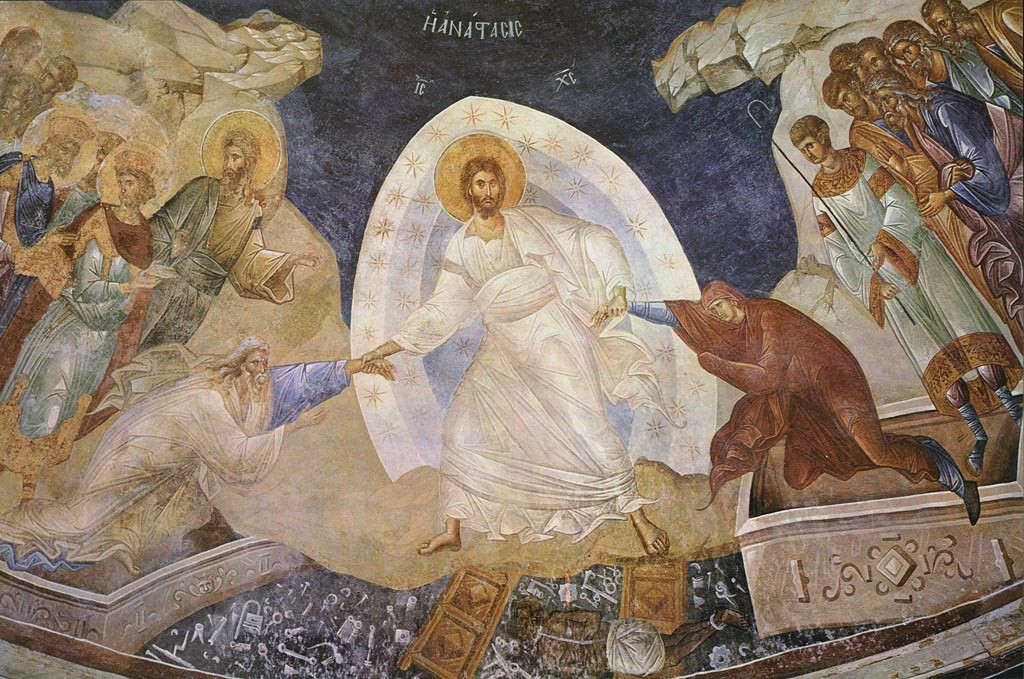
Anastasis Icon at Chora

I love poetry. There is something about the way poets describe the world that simply cannot be found in other forms of literature. Poets encourage us not to understand the world, but to experience it; not to be concerned with facts, but to comprehend Truth.

Recently, I’ve been introduced to the world of a Guatemalan woman named Julia Esquivel. Esquivel lived through the Guatemalan civil war which lasted from the 1960s into the 1990s and during which hundreds of thousands of people died in terror sanctioned by the Guatemalan government. Many of these simply “disappeared;” they were the “Desaparecidos,” taken away from their families and never seen again. Many families in Guatemala will never know what happened to their loved one; few of those responsible for the tragedies have stood trial and most never will. Darkness and evil often seem to entomb goodness and light. Into this hopelessness Esquivel’s poetry speaks a word of hope:

There is something here within us
which doesn’t let us sleep, which doesn’t let us rest,
which doesn’t stop pounding deep inside,
it is the silent, warm weeping
of Indian women without their husbands,
it is the sad gaze of the children
fixed there beyond memory,
in the very pupil of our eyes
which during sleep, though closed, keep watch
with each contraction of the heart
in every awakening . . . .

What keeps us from sleeping
is that they have threatened us with resurrection!
Because at each nightfall,
though exhausted from the endless inventory
of killings since 1954,
yet we continue to love life,
and do not accept their death!

. . . . because in this marathon of Hope,
there are always others to relieve us
in bearing the courage necessary
to arrive at the goal which lies beyond death. . . .

Accompany us then on this vigil
and you will know what it is to dream!
You will then know how marvelous it is
to live threatened with resurrection!
To dream awake,
to keep watch asleep
to live while dying
and to already know oneself resurrected!
(From Threatened With Resurrection: Prayers and Poems from an Exiled Guatemalan, September 1982)

Isn’t that wonderful? To “know how marvelous it is to live threatened by resurrection!”

We, unfortunately, live in a world in which other things are threatened — in which the sorts of things that happened in Guatemala (and in many Latin American countries) in the late 20th Century continue to happen in many places. Human cruelty to other humans often astounds us; human indifference to the suffering of other humans amazes us. We live in a world where laws are passed to make it easy for privileged majorities to discriminate against minorities, to abuse those who are unusual, to despoil the lives those who are different, to bury the poor in their poverty, to entomb the stranger in hopelessness, to start wars in distant countries, to trouble us so that “there is something here within us which doesn’t let us sleep, which doesn’t let us rest, which doesn’t stop pounding deep inside.”

Today, we celebrate the Resurrection of Jesus Christ, the One who “exhausted from the endless inventory of killings . . . continue[d] to love life, and [did] not accept . . . death,” the One in whose death and resurrection we acknowledge that, yes indeed, we are “threatened with” resurrection, the One in whom we “already know [ourselves] resurrected.”

I mentioned in our Parish Newsletter for April that one of my favorite contemporary American poets is Kentucky farmer Wendell Berry, and one my favorites among his poems is Manifesto: The Mad Farmer Liberation Front:

Love the quick profit, the annual raise,
vacation with pay. Want more
of everything ready-made. Be afraid
to know your neighbors and to die.
And you will have a window in your head.
Not even your future will be a mystery
any more. Your mind will be punched in a card
and shut away in a little drawer.
When they want you to buy something
they will call you. When they want you
to die for profit they will let you know.

So, friends, every day do something
that won’t compute. Love the Lord.
Love the world. Work for nothing.
Take all that you have and be poor.
Love someone who does not deserve it.
Denounce the government and embrace
the flag. Hope to live in that free
republic for which it stands.
Give your approval to all you cannot
understand. Praise ignorance, for what man
has not encountered he has not destroyed.

Ask the questions that have no answers.
Invest in the millennium. Plant sequoias.
Say that your main crop is the forest
that you did not plant,
that you will not live to harvest.
Say that the leaves are harvested
when they have rotted into the mold.
Call that profit. Prophesy such returns.

Put your faith in the two inches of humus
that will build under the trees
every thousand years.
Listen to carrion – put your ear
close, and hear the faint chattering
of the songs that are to come.
Expect the end of the world. Laugh.
Laughter is immeasurable. Be joyful
though you have considered all the facts.
So long as women do not go cheap
for power, please women more than men.
Ask yourself: Will this satisfy
a woman satisfied to bear a child?
Will this disturb the sleep
of a woman near to giving birth?

Go with your love to the fields.
Lie down in the shade. Rest your head
in her lap. Swear allegiance
to what is nighest your thoughts.
As soon as the generals and the politicos
can predict the motions of your mind,
lose it. Leave it as a sign
to mark the false trail, the way
you didn’t go. Be like the fox
who makes more tracks than necessary,
some in the wrong direction.
Practice resurrection.
(From The Mad Farmer Poems, January 2014)

Esquivel reminds us, in the face of a world of cruelty and death, that we are “threatened with resurrection” and that we should “already know [ourselves] resurrected;” Berry encourages us embrace that “threat” as a promise, to “expect the end of the world [and] laugh,” not merely to know ourselves resurrected, but to act upon that knowledge and “practice resurrection.”

That’s not easy to do in this world, no matter how simple Wendell Berry makes it sound. Sometimes the biggest barrier we face . . . is ourselves. The late Israeli poet Yehuda Amichai writes about this in his short verse The Place Where We Are Right:

From the place where we are right
Flowers will never grow
In the spring.

The place where we are right
Is hard and trampled
Like a yard.

But doubts and loves
Dig up the world
Like a mole, a plow.
And a whisper will be heard in the place
Where the ruined
House once stood.
(From The Selected Poetry Of Yehuda Amichai, Newly Revised and Expanded, October, 1996)

Every single human being on earth is convinced that he or she is right; that’s the nature of human beings and always has been. Judas was sure he was right; the chief priests and the scribes were sure that they were right; Pilate, the Imperial governor, was sure that he was right; the Roman soldiers were sure that they were right. We are always sure that we are right and, thus, we become the ones who pass the laws that make it easy to discriminate, to abuse, to despoil, to crucify, and to entomb beneath that hard and trampled place where we are right, where “there is something here within us which doesn’t let us sleep, which doesn’t let us rest, which doesn’t stop pounding deep inside.”

Yesterday, in our meditations for Holy Saturday, I shared with those assembled here that my favorite artistic depiction of Christ’s Resurrection is an Orthodox icon in which Jesus stands within the arch of his tomb ready to come out. Beneath his feet are the gates of Hell, broken and fallen into the form of a cross, and o either side of him are two other tombs, broken open. From them Christ is pulling two figures, a man and a woman representing Adam and Eve. They seem almost reluctant to leave their graves, but Jesus grasps them by their wrists and seems to strain to lift them. Behind them are ranged the prophets and patriarchs of Israel, the righteous dead awaiting resurrection. This liberation of those who were already dead is known as the “Harrowing of Hell,” which is the title of poet Denise Levertov’s contemplation of this icon:

Down through the tomb’s inward arch
He has shouldered out into Limbo
to gather them, dazed, from dreamless slumber:
the merciful dead, the prophets,
the innocents just His own age and those
unnumbered others waiting here
unaware, in an endless void He is ending
now, stooping to tug at their hands,
to pull them from their sarcophagi,
dazzled, almost unwilling. Didmas,
neighbor in death, Golgotha dust
still streaked on the dried sweat of his body
no one had washed and anointed, is here,
for sequence is not known in Limbo;
the promise, given from cross to cross
at noon, arches beyond sunset and dawn.
All these He will swiftly lead
to the Paradise road: they are safe.
That done, there must take place that struggle
no human presumes to picture:
living, dying, descending to rescue the just
from shadow, were lesser travails
than this: to break
through earth and stone of the faithless world
back to the cold sepulchre, tearstained
stifling shroud; to break from them
back into breath and heartbeat, and walk
the world again, closed into days and weeks again,
wounds of His anguish open, and Spirit
streaming through every cell of flesh
so that if mortal sight could bear
to perceive it, it would be seen
His mortal flesh was lit from within, now,
and aching for home. He must return,
first, in Divine patience, and know
hunger again, and give
to humble friends the joy
of giving Him food – fish and a honeycomb.
(From A Door in the Hive, October 1989)

Levertov, I think, is probably right when she suggests that the work of freeing those trapped in Hell was, for Christ, easier than “break[ing] through [the] earth and stone of the faithless world;” breaking through where privileged majorities to discriminate against minorities, abuse those who are unusual, despoil the lives those who are different, bury the poor in their poverty, entomb the stranger in hopelessness, and start wars in distant countries; breaking through the hard and trampled place where we insist that we are right . . . but break through he does for he is the love that digs up the world so that whispers are again heard where the ruined houses of our lives once stood.

Do you doubt that? Do you have difficulty feeling that promise of resurrection? Do you not feel threatened with resurrection in your own life? Do you not know yourself already resurrected?

At the vigil service each year, in place of a sermon of my own, I follow the ancient tradition of the Orthodox church and read for those present an oration or homily from one of the early doctors of the church; today I read selections from St. Gregory Nazianzan’s Second Easter Oration. In part of that great speech, St. Gregory offers advice on how one can enter personally into the Resurrection; if one cannot comprehend the whole of the story, focus on that part which most resonates with you. This is what he wrote:

If you are a Simon of Cyrene, take up the Cross and follow.
If you are crucified with Him as a robber, acknowledge God as a penitent robber.
If even He was numbered among the transgressors for you and your sin, do you become law-abiding for His sake. Worship Him Who was hanged for you, even if you yourself are hanging; make some gain even from your wickedness; purchase salvation by your death; enter with Jesus into Paradise, so that you may learn from what you have fallen.
Contemplate the glories that are there; let the murderer die outside with his blasphemies; and if you be a Joseph of Arimathæa, beg the Body from him that crucified Him, make your own that which cleanses the world.
If you be a Nicodemus, the worshiper of God by night, bury Him with spices.
If you be a Mary, or another Mary, or a Salome, or a Joanna, weep in the early morning. Be first to see the stone taken away, and perhaps you will see the Angels and Jesus Himself.
Say something; hear His Voice. If He say to you, Touch Me not, stand afar off; reverence the Word, but grieve not; for He knows those to whom He appears first.
Keep the feast of the Resurrection; come to the aid of Eve who was first to fall, of Her who first embraced the Christ, and made Him known to the disciples.
Be a Peter or a John; hasten to the Sepulchre, running together, running against one another, vying in the noble race. And even if you be beaten in speed, win the victory of zeal; not Looking into the tomb, but Going in.
And if, like a Thomas, you were left out when the disciples were assembled to whom Christ shows Himself, when you do see Him be not faithless; and if you do not believe, then believe those who tell you; and if you cannot believe them either, then have confidence in the print of the nails.
If He descended into Hell, descend with Him. Learn to know the mysteries of Christ there also, what is the providential purpose of the twofold descent, to save all [humankind] absolutely by His manifestation.
(From Oration 45, Nicene and Post-Nicene Fathers, Second Series, Volume 7, February 1996)

Become a part of the story in whatever way you can. If you cannot now comprehend the whole, grab hold of that fraction that resonates for you, but do not strive to understand, do not strive to be right, do not trample hard a place where flowers will never grow; instead, enter into the narrative, simply experience the truth, put your faith in two inches of spiritual humus where you may plant things you may not live to harvest. Remember that Christ is the love Who digs up the world, Who breaks through faithless earth and stone, expect the end of the world and laugh:
Accompany us then on this vigil
and you will know what it is to dream!
You will then know how marvelous it is
to live threatened with resurrection!
To dream awake,
to keep watch asleep
to live while dying
and to already know [your]self resurrected!

Christ is Risen! We are risen! Alleluia!

(Note: The illustration above is widely agreed to be the most striking exemplar of the traditional Byzantine Anastasis icon. It is the fresco in the apse of the arekklesion or funerary chapel, of the Monastery of Chora at Istanbul.)

====================

A request to my readers: I’m trying to build the readership of this blog and I’d very much appreciate your help in doing so. If you find something here that is of value, please share it with others. If you are on Facebook, “like” the posts on your page so others can see them. If you are following me on Twitter, please “retweet” the notices of these meditations. If you have a blog of your own, please include mine in your links (a favor I will gladly reciprocate). Many thanks!

====================

Father Funston is the rector of St. Paul’s Episcopal Church, Medina, Ohio.
Washing Away RFRA: Sermon for Maundy Thursday – 2 April 2015

====================

A sermon offered on Maundy Thursday, April 2, 2015, to the people of St. Paul’s Episcopal Church, Medina, Ohio, where Fr. Funston is rector.

(The lessons for the day are Exodus 12:1-14; Psalm 116:1,10-17; 1 Corinthians 11:23-26, and John 13:1-17,31b-35 [all of Ch. 13 was read]. These lessons can be read at The Lectionary Page.)

====================

Foot WashingEvery year on Maundy Thursday in the Episcopal Church we do this thing: we gather for Eucharist and we hear these lessons – the story of the Passover from the Book of Exodus, St. Paul’s retelling of the institution narrative of the Eucharist, and St. John’s story of the Last Supper in which he focuses not on the meal but on Jesus’ act of humility and service during the meal (probably quite early in the evening) of washing the feet of the others present.

In many parishes the liturgy of this evening will include a formal washing of the feet of selected participants by the presiding priest and others. You may have seen pictures or video of the Pope doing so in the Vatican’s celebration of this feast. We’ve broadened that practice to allow any who wish to follow Jesus’ example to do so during the Agape Feast. There are foot washing stations in the Parish Hall for that purpose.

Why did Jesus wash his disciples’ feet? Tradition (as I just mentioned) tells us that it was to display and model humility and servanthood. In First Century Palestine, sandals were the most common form of footwear. Walking the dusty desert roads made one’s feet filthy; it was imperative that that be washed before a communal meal. In those days, people didn’t sit on chairs to eat at a table. Instead, they reclined at low tables; feet were very much in evidence. When Jesus rose from the table and began to wash the others’ feet, he was doing the work of the lowliest of servants. The disciples must have been stunned by this act of self-effacement and condescension. The humility expressed by this action with towel and basin foreshadowed Jesus’ ultimate act of humility on the cross.

Although the Lectionary only requires that we read certain verses of Chapter 13 of John’s Gospel, I
chose to read the entire chapter because I think tonight we need to remember exactly whose feet Jesus washed. When we read only that he washed “the disciples’ feet” we can gloss over and forget that John makes it very plain that among that group were two who, to our modern minds, clearly did not deserve the honor: Judas, who would betray him, and Peter, who would deny him. And John also makes it very clear that Jesus knew that both of them would do what they ultimately did.

I think it is important that we note that in particular this year, this Holy Week because for the past several days we have all heard a great deal about something called the Religious Freedom Restoration Act, something that was passed 25 years ago by the federal government and versions of which have been adopted in several states, most recently next door to us to the west in the State of Indiana. The law recently passed in Indiana, though it bears the same name as the federal act, is not the same as the federal law. During the past 25 years various state and federal courts have interpreted and to some extent limited the application of the federal or similar state laws, and so later-enacted versions have tried to answer and overcome those judicial limitations, Indiana’s (and now a nearly-identical act in Arkansas) being the broadest.

The impetus for these laws, of course, is the growing legal acceptance of marriage equality, the movement to allow same-sex couples to contract civil marriage in the same way as opposite-sex couples. Indeed, Professor Garrett Epps, who teaches Constitutional Law at the University of Baltimore, has said of the Indiana law that it is clear that its purpose is

. . . to be used as a means of excluding gays and same-sex couples from accessing employment, housing, and public accommodations on the same terms as other people. True, there is no actual language that says, All businesses wishing to discriminate in employment, housing, and public accommodations on the basis of sexual orientation, please check this “religious objection” box. But, as Henry David Thoreau once wrote, “Some circumstantial evidence is very strong, as when you find a trout in the milk.” (What Makes Indiana’s Religious-Freedom Law Different?, The Atlantic, March 30, 2015)

And the Rev. Franklin Graham, the son and heir of the Dr. Billy Graham, specifically extolled the Indiana act as “a religious freedom bill that would protect [Christian] business owners who want to decline to provide services for same-sex marriages.” (Facebook posting, March 25, 2015, 10:39 am)

And that is why I think it important that we specifically name Judas and Peter as being among those before whom Jesus knelt in abject humility and washed their feet. Presumably those ‘Christians (about whom Mr. Graham spoke) [want] to live out their faith’ and follow Jesus Christ by refusing to serve those whose actions they find offensive. The problem with that is that Jesus didn’t refuse to serve those whose actions were not only offensive to him; their actions were downright fatal to him! He didn’t refuse to serve them; he knelt in humility and washed their feet!

In answer to Mr. Graham, another Baptist preacher, the Rev. Russ Dean, co-pastor of Park Road Baptist Church in Charlotte, NC, wrote these words in Baptist News Global:

Mr. Graham opposes same-sex marriage. Maybe he also thinks women should stay home with their kids, and not work outside the home. Some Christians believe this, too. Maybe Indiana should also defend an employer’s right to decline employing young mothers? Whose religious views will we defend? Whose won’t we defend? And where will it stop?

Religious freedom is one of the principles that defines the genius of America – but only a secular state can actually defend that principle for all of its citizens. Otherwise, we might have Indiana defending conservative Christian views and another state defending liberal Christian views; one state defending Sharia law and another writing the codes of Leviticus into the law books in favor of a Jewish majority.

What this means, of course, is that some Christian business owners may have to break the law to defend their religious convictions. (Some Christian business owners did just that when Jim Crow was the law of the land.) But when Christians, or adherents of any religion, go into business, the secular law of the land rules. I have no doubt that in the coming months gay marriage will be the law of the entire land, so some Christian business owners will have a decision to make: uphold the law, or defend their understanding of one religious conviction — and suffer the consequence of breaking that law.

But let the government keep its hands out of religion. When the day comes that Christians have no other way to motivate religious conviction than through legislation, secular government will be the least of our worries. (Why do so many Christians think we need government to prop up Jesus?, Baptist News Global, April 1, 2015)

My purpose tonight is not to debate the merits or demerits of marriage equality; like the Rev. Mr. Dean, I believe that in the not-too-distant future same-sex marriages will be legal throughout the country, but whether that is or is not the case is irrelevant at the moment. What is relevant is how we as followers of Jesus Christ relate to and interact with those who are different from us in whatever way and for whatever reason, so different that, in fact, we find them or their actions offensive. What is relevant is this: do we respond to them with arrogance and condescension, enacting laws that some have gone so far as to call “a license to discriminate,” or do we embrace them in humility and love, kneeling down to wash their feet? Do we try to motivate religious conviction by enacting secular legislation or do we do so the way Jesus did, by example?

“Do you know what I have done to you?” Jesus asked Judas and Peter. “If I . . . have washed your feet, you also ought to wash one another’s feet. . . . If you know these things, you are blessed if you do them.” Judas failed utterly and committed suicide when he realized it; Peter failed, as well, but was forgiven and eventually taught the church “that God shows no partiality” and that “everyone who believes in [Jesus] receives forgiveness of sins through his name.” (Acts 10:34,43)

We call this day “Maundy Thursday” from an old English word meaning “commandment” because, after demonstrating what it means by washing their feet, Jesus admonished the Twelve, and through them admonishes us: “I give you a new commandment, that you love one another. Just as I have loved you, you also should love one another. By this everyone will know that you are my disciples, if you have love for one another.”

May the world know that we are his disciples because, in everything we do, we do not stand in arrogance and condescension, but rather we kneel in humility and love before others, even those who differ greatly from us, even those who offend us.

Steve Garnaas-Holmes, United Methodist pastor and poet, recently published this poetic prayer with which I will close:

Lord, what was it like to wash Judas’ feet,
on your knees, with such tender kindness?
An act of love, not irony.

What is it like to so humbly serve me,
to kneel at the feet of my failure and betrayals,
to welcome and wash and soothe me
as if I am your master?
Pure love, without demand.

Give me this love, this gentle humility,
to wash the feet of those who oppose me,
to treat them with tender kindness,
to seek always to be closer to you,
on your knees below us all,
serving in perfect love.
(Found at the poet’s Unfolding Light blog)

Amen.

====================

A request to my readers: I’m trying to build the readership of this blog and I’d very much appreciate your help in doing so. If you find something here that is of value, please share it with others. If you are on Facebook, “like” the posts on your page so others can see them. If you are following me on Twitter, please “retweet” the notices of these meditations. If you have a blog of your own, please include mine in your links (a favor I will gladly reciprocate). Many thanks!

====================

Father Funston is the rector of St. Paul’s Episcopal Church, Medina, Ohio.

« Older posts Newer posts »