From the Book of Genesis:
The Lord came down to see the city and the tower, which mortals had built. And the Lord said, “Look, they are one people, and they have all one language; and this is only the beginning of what they will do; nothing that they propose to do will now be impossible for them.”
(From the Daily Office Lectionary – Genesis 11:5-6 (NRSV) – January 23, 2014.)
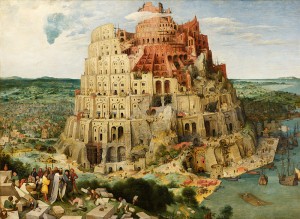 I’ve never quite understood the story of the tower of Babel. I get that it’s an etiological myth to explain the variety of languages spoken by human beings, but the picture of God that it paints is (shall we say?) less than positive. Might it have been better to cast someone else (say the Tempter?) as the “bad guy” who thwarts the plans of the tower builders?
As the story of God and God’s People develops over time and through the pages of Scripture, we learn that God’s goal is that “they may all be one. As you, Father, are in me and I am in you,” or at least that’s what Jesus said (John 17:21). The apostle Paul proclaimed this Good News setting out that the goal was that all people, indeed all things, be put in subjection under the Christ and ultimately under the one God “so that God may be all in all” (1 Corinthians 15:28). And his colleague, Peter, argued that preachers should speak as if speaking the very words of God so that “God may be glorified in all things through Jesus Christ” (1 Peter 4:11).
It’s not just the New Testament that proclaims this goal of universal solidarity. Solomon proclaimed in prayer that the goal of his kingdom was “that all the peoples of the earth may know that the Lord is God; there is no other” (I Kings 8:60). The prophet Isaiah proclaimed that “in days to come the mountain of the Lord’s house shall be established as the highest of the mountains, and shall be raised above the hills; all the nations shall stream to it” (Isaiah 2:2).
So, if that has been God’s goal all along, isn’t God’s fit of pique at the plain of Shinar just a wee bit counterproductive?
Playing with questions like that is why I so enjoy studying the Bible; the Bible is fun! So, I get really annoyed when someone treats it as some sort of scientifically or historically accurate text, and robs it of its capacity to provide fun and enjoyment.
It’s a bunch of stories and other sorts of literature! It’s a bunch of often contradictory stories, myths, poems, histories, memoirs, and so forth which, despite their contradictions (and often because of them) point to a truth that transcends our mundane perceptions. Sure, if I were writing a single text to tell the story of God, I’d use the Babel story quite differently and tell it from a very different perspective. But that’s not how the Bible came to be and, thanks be to God, I don’t have to write God’s story! Suffice to say that the Bible is not a history book; it’s not a scientific text. It’s a library, a collection of all different sorts of literature.
These texts must be read in light of each other. The prophet’s vision of the nations streaming to a temple on a hill and Jesus’ prayer for unity among all peoples (the prayer is not just about his followers) provide lenses through which we view the myth of the tower at Babel; the story of the tower provides a critical backdrop and foundation for the prophecy and the prayer. So, I may not understand the story of the tower of Babel standing alone, but I understand it in context. I understand it as a part of a synthetic whole (synthetic in the sense of dialectic synthesis, not as “artificial” or “unnatural”).
I’m not going to write a synthesis of these stories this morning (and probably not ever), but I am going to start the day acknowledging that, if the Bible is anything, it is fun!
====================
A request to my readers: I’m trying to build the readership of this blog and I’d very much appreciate your help in doing so. If you find something here that is of value, please share it with others. If you are on Facebook, “like” the posts on your page so others can see them. If you are following me on Twitter, please “retweet” the notices of these meditations. If you have a blog of your own, please include mine in your links (a favor I will gladly reciprocate). Many thanks!
====================
Father Funston is the rector of St. Paul’s Episcopal Church, Medina, Ohio.
 I have a pair of cufflinks with part of this verse inscribed on them in Latin: “Sacerdos in Aeternum” (“Priest Forever”). They were given to me as an ordination present. I seldom have reason or opportunity to wear them as I don’t generally wear long-sleeved, let alone French-cuff, shirts. But yesterday I did.
 I had to read the first line of this familiar parable three or four times this morning before my eyes (it had to be my eyes; it couldn’t have been my brain) focused well enough to properly read the word landowner. On first reading, I read it as lawnmower.
  I will go on record has being not an adherent of the ransom theory of the Atonement, which holds that the death of Christ was a ransom sacrifice in satisfaction for the bondage and debt on the souls of humanity as a result of inherited sin (another theory, “original sin,” with which I have some strong debate). It is unclear to me exactly who is the recipient of the ransom. Depending on who is setting out the argument, the ransom is usually said to have been paid either to Satan, which I think makes the ol’ devil rather bigger than he ought to be, or to God the Father, which makes the Almighty considerably less than we ought to think of God.
 These may be my favorite words from the pen of the Apostle Paul. My mentor during my education for ordained ministry, who also became my first boss after ordination, often referred to these verses and would add, “Not even ourselves.”
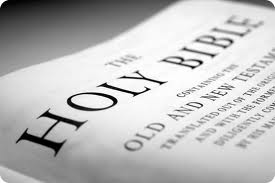 It’s called bibliolatry and it’s been around a long, long time. The dictionary definition of bibliolatry is “excessive reverence for the Bible as literally interpreted.” What I most enjoy about modern bibliolatry is that it denies that it is bibliolatry in the most circular and bibliolatrous of ways.
  Today is the last Sunday after Pentecost called “the Feast of Christ the King.” A relatively new feast on the calendar of the church, it was instituted by a 20th Century pope and originally set in late October as a response to the Protestant celebration of “Reformation Sunday” on the Sunday closest to October 31, the anniversary of Luther’s posting on the Wittenburg chapel door. The latter, I would suppose, started with the Lutherans but has spread throughout American Protestantism; I know of Presbyterian, Reformed, UCC, and Methodist churches that mark it. I know of no Episcopal congregations that do so. Episcopalians did take to Christ the King, however, and since Paul VI moved it to the last Sunday of the Christian year, every congregation I’ve been a part of has celebrated it. With the adoption of the Revised Common Lectionary, it is now an official part of our tradition.

