Occasional thoughts of an Anglican Episcopal priest

Category: John (Page 12 of 25)

We Do Not Have The Privilege – Sermon for Advent 1 – November 30, 2014

====================

On the First Sunday of Advent, Year B, November 30, 2014, this sermon was offered to the people of St. Paul’s Episcopal Church, Medina, Ohio, where Fr. Funston is rector.

(The lessons for the day, RCL Advent 1B, were Isaiah 64:1-9; Psalm 80:1-7, 16-18; 1 Corinthians 1:3-9; and Mark 13:24-37. These lessons can be read at The Lectionary Page.)

====================

Racism Is So YesterdayWhen Philip told Nathanael that he had found the Messiah and that he was the son of a carpenter from Nazareth, Nathanael’s immediate response was, “Can anything good come from Nazareth?” (Jn 1:46). Obviously Nazareth had a reputation, and not a good one. I often wonder if, as Jesus was making his way through the Holy Land, especially early in his ministry when he wasn’t well-known, people would ask him, “What was it like growing up in Nazareth?”

All of my life, whenever I tell my story to folks, they have asked, “What was it like growing up in Las Vegas?” And I have always answered, “Like growing up anywhere else. Las Vegas, when you get off the Strip, was just like anywhere else. It was hometown America.” Las Vegas at the time was smaller than Medina is today; the population of Las Vegas in the early 1950s was only about 25,000 people.

Although there was an airport by then, visitors to Las Vegas usually either drove across the desert or rode the Union Pacific Railroad. The line from Salt Lake City to Los Angeles went through Las Vegas; the railroad ran through town north-to-south and the business and hotel district now know as “the Las Vegas Strip” grew up parallel to, and east of, the tracks.

That’s the side of the tracks I grew up on; on the other side, “the Westside,” was where black people lived. Whites didn’t go there, and Negroes (as black Americans were then politely called) didn’t come to the east side of the tracks except to work, mostly in low paying service jobs as janitors, maids, cooks, porters, and doormen. Yes, indeed, the Las Vegas of my childhood was hometown America. Just like any other town in this country was, and just like many still are. Need I mention the St. Louis metropolitan area and its suburb of Ferguson? Need I mention the Cleveland metroplex and the westside neighborhood near the Cuddell Recreation Center? Need I mention, even, Medina itself?

Yes, I think I need to. A few years ago, our nation elected a black man to be president and many proclaimed that we now lived in a “post-racial” world, that racism is “so yesterday.” Throughout the whole of Barack Obama’s presidency, however, the rhetoric and behavior of many have demonstrated just how wrong that judgment was. We do not live in a “post-racial” society. The shooting deaths of black men and boys, Michael Brown in Ferguson, MO, John Crawford in Beavercreek, OH, and Tamir Rice in Cleveland, OH, all by white police officers, and the choke-hold death of Eric Garner, a black man in the custody of white officers of the New York Police Dept., together with the perceived failures of the justice system and the social unrest which have followed, have demonstrated just how wrong that judgment was. We do not live in a “post-racial” world.

“Keep awake!” said Jesus, “Keep alert!”

Elsewhere, ISIS in Iraq and the Taliban in Afghanistan murder those who differ from themselves, Jewish nationalists in Israel pass laws denying basic human rights to Palestinian Arabs, and Buddhist monks in Myanmar threaten to kill Muslim children, demonstrating just how wrong that judgment continues to be not only in our own country but throughout the world. We do not live in a “post-racial” world. Racism is not “yesterday;” it is today!

“Keep awake!” said Jesus, “Keep alert!”

Meanwhile, epidemics such as the ebola crisis in Africa have caused social upheaval, ethnic conflict, and calls for borders to be closed and walls to be raised between nations. Really quite silly notions about vaccines have led people to refuse them and diseases once thought nearly eradicated are being seen again, such as polio and bubonic plague.

“Keep awake!” said Jesus, “Keep alert!”

Weather extremes are being felt throughout the world and sea levels are rising threatening populations in low-lying areas in the South Pacific Islands, southeast Asia, various parts of Africa and South America, and even in our own country, and these things seem to be the result of our poor stewardship of the earth’s environment. At least, that’s what the great majority of the world’s climate scientists tell us.

“Keep awake!” said Jesus, “Keep alert!”

Jesus said, “Nation will rise against nation, and kingdom against kingdom; there will be earthquakes in various places; there will be famines . . . Brother will betray brother to death, and a father his child, and children will rise against parents and have them put to death . . . There will be suffering, such as has not been from the beginning of the creation . . . [and] after that suffering, the sun will be darkened, and the moon will not give its light, and the stars will be falling from heaven, and the powers in the heavens will be shaken.” (Mk 13:8,12,19,24-25)) Therefore, “Keep awake!” said Jesus, “Keep alert!”

Are we seeing the end-times? Are these things that are happening – the racial and ethnic conflicts, the wars, the epidemics, the weather crises, the floods – are these those fig-tree signs that “when [we] see these things taking place, [we] know that [the Son of Man] is near, at the very gates”? (Mk 8:29) I don’t think so, but who’s to say? As Jesus made quite clear, “about that day or hour no one knows, neither the angels in heaven, nor the Son, but only the Father.” (v. 32)

So I don’t know if these are the signs of the end, but I do know this, that these are the signs of things that displease God. And when God is displeased, watch out! When God is displeased, God “tear[s] open the heavens and . . . the mountains . . . quake at [God’s] presence.” (Is 64:1) It is when God is angry that stars fall from heaven and the powers of the heavens are shaken. We do not want to face an angry God!

And yet we cannot dismiss God’s indignation. We would like to. We would like to focus only on the loving God proclaimed by Jesus, not that angry God that Isaiah and the Psalmist remind us of. We would like to, but we can’t because when we blind ourselves to the potential of God’s anger, we blind ourselves to the things that provoke God’s anger. We fail to see (and thus to deal with) the racism which is endemic our society; we fail to see (and thus to deal with) our poor stewardship of creation; we fail to see (and thus to deal with) the illnesses and diseases which are pandemic among populations less fortunate than ourselves.

I’ll be honest with you. I don’t want to talk about the shooting of Michael Brown in Ferguson, MO, the shooting of John Crawford in Beavercreek, Ohio, the shooting of Tamir Rice in Cleveland, Ohio, or the chokehold death of Eric Garner in New York City. I don’t want to talk about the response of the justice system to those deaths and whether or not it functioned properly in not punishing, in some way, the police officers responsible for those deaths. I don’t want to.

In the same way, I don’t want to remember that when my father’s client and friend Sammy Davis, Jr., came to Las Vegas to perform in the Strip casino showrooms he was not allowed to enter those casinos through the front door but had to come in through the service entrance. I don’t want to remember that when Louis Armstrong and Duke Ellington played in Las Vegas they were not allowed to stay in the hotels that hired them but had to put up at boarding houses on the Westside. I don’t want to remember that when Cab Calloway played at a casino bar in Las Vegas in 1954 he was refused a drink at that same bar during a break in the performance.

I don’t want to talk about or remember these things and, I suspect, neither would most people in this church this morning. Frankly, a large fraction of the white society in which we live would, likewise, prefer that we not do so. We believe that we enjoy the privilege of not talking about, remembering, or doing anything about those things, that those things really don’t affect us, that they really aren’t any of our business. The families of Michael Brown, John Crawford, Tamir Rice, and Eric Garner, and the communities within which they lived, however, do not have that privilege. Black performers who succeeded Davis, Armstrong, Ellington, and Calloway, who now can enter the casino through the front door, stay in the hotel, and drink at the bar, who are the beneficiaries of the groundbreaking they did, do not have that privilege.

And, truth be told, neither do we. If we do not remember and talk about these things, we will have failed to see and deal with the racism, the conflict, the poor stewardship of humankind that is all around us; we will have failed to follow Jesus’ admonition in today’s Gospel to “keep alert” and to “keep awake.” We will have failed to follow the second great commandment to “love our neighbors as ourselves.” We will have failed to heed to word of God recorded in the law of Moses: “You shall not wrong a stranger or oppress him” (Ex 22:21); “The stranger who resides with you shall be to you as the native among you, and you shall love him as yourself” (Lev. 19:34); “You shall not pervert the justice due to [anyone]” (Deut. 24:17). We simply are not allowed to think of or to treat any human being differently from ourselves. We do not have the privilege not to talk about, not to remember, not to do something about the injustices done to others, whatever their race or color, whatever their religion, whatever their sex or sexual orientation.

Nathanael asked Philip, “Can anything good come out of Nazareth?” The world today is asking, “Can anything good come out of Ferguson? Out of Beavercreek? Out of Cleveland? Can anything good come of the shooting deaths of young black men by white police officers?” I pray that it can: we have had enough of the bread of tears; we have had enough of the derision of neighbors; we have had enough of the laughter of scorn. Some good must come from these things and it must start with our realization that we do not have the privilege to stand by and think these things have nothing to do with us.

We do not have the privilege to think of or to treat anyone differently from ourselves. We do not have the privilege not to talk about, not to remember, not to do something about the injustices done to others. If we do that, we fail to keep alert and to keep awake, and we risk the anger of the God who tears open the heavens and makes the mountains quake.

Are the things we are seeing signs of the end-times? No, I don’t think so. Are they signs to which we need to pay attention? Things we need to do something about? Oh, yes! Very much so!

“O Lord, you are our Father; we are the clay, and you are our potter; we are all the work of your hand. Do not be exceedingly angry, O Lord, and do not remember [our] iniquity forever.” (Is 64:8-9) “Restore us, O Lord God of hosts; show the light of your countenance, and we shall be saved.” (Ps. 80:18)

Amen.

====================

A request to my readers: I’m trying to build the readership of this blog and I’d very much appreciate your help in doing so. If you find something here that is of value, please share it with others. If you are on Facebook, “like” the posts on your page so others can see them. If you are following me on Twitter, please “retweet” the notices of these meditations. If you have a blog of your own, please include mine in your links (a favor I will gladly reciprocate). Many thanks!

====================

Father Funston is the rector of St. Paul’s Episcopal Church, Medina, Ohio.

Frustration – From the Daily Office – October 18, 2014

From the Gospel of Luke:

“You faithless and perverse generation, how much longer must I be with you and bear with you?”

(From the Daily Office Lectionary – Luke 9:41 (NRSV) – October 18, 2014)

PERT ChartProject Evaluation Review Technique – “PERT” . . . . I learned to do PERT charts in business school. PERT charts diagram the flow of a project through its various tasks and processes, assigning some as “essential” tasks which must be done in a particular order, later tasks depending on earlier tasks to have been accomplished by particular persons, while other tasks “float,” they can be done any time by any team member.

I wonder sometimes if Jesus could have made use of one. What would he have put into the “essential task” boxes and what into the “floating task” boxes and what would have been the flow of activities and to whom would everything be assigned? If Jesus had made use of a PERT chart, I wonder if he would do with it what I eventually did with every one I tried to make for parish ministry . . . throw it away in frustration!

That was the eventual outcome of every parish project PERT chart because inevitably some essential task to be done by a volunteer would not get done; the entire enterprise would grind to a halt and either never be accomplished or only get done if the rector or another paid staff member did what the volunteer had promised to do.

I confess to possibly breaking the Third Commandment on a regular basis. I suppose I could have echoed Jesus’ words of frustration, “You faithless and perverse generation, how much longer must I be with you and bear with you?” However, more often than not, my prayer of weariness is a single word, “Jesus!” I try not to do that, but it just pops out. Stymied and upset, before I even think about it, I let loose, “Jesus!” My hope is that he understands this as a prayer rather than as an curse. (I once had a Jesuit spiritual director who opined that, uttered in exasperation, the ejaculation “O fuck!” may be the most honest of human prayers. I don’t use that one very often.)

In such instances, the PERT chart, now useless, ends up in the circular file cabinet. In fact, I’ve stopped making PERT charts for any project that requires volunteer labor. It’s just a waste of time.

Of course, the church is not a volunteer organization. The apostles were not volunteers – they were called. Christians, likewise, are not volunteers – we are called. “You did not choose me but I chose you.” (Jn 15:16) Jesus, the one who does the calling, probably has more claim to be frustrated that parish clergy like me, who are simply among the called . . . but there it is.

In any event, I hear the frustration in this text and, therefore, I trust that he understands when I utter my prayers of exasperation.

====================

A request to my readers: I’m trying to build the readership of this blog and I’d very much appreciate your help in doing so. If you find something here that is of value, please share it with others. If you are on Facebook, “like” the posts on your page so others can see them. If you are following me on Twitter, please “retweet” the notices of these meditations. If you have a blog of your own, please include mine in your links (a favor I will gladly reciprocate). Many thanks!

====================

Father Funston is the rector of St. Paul’s Episcopal Church, Medina, Ohio.

Anglo? Israel? What Is Truth? – From the Daily Office – August 20, 2014

From the Psalter:

“Greatly have they oppressed me since my youth,”
let Israel now say;
“Greatly have they oppressed me since my youth,
but they have not prevailed against me.”
The plowmen plowed upon my back
and made their furrows long.

(From the Daily Office Lectionary – Psalm 129:1-3 (BCP Version) – August 20, 2014)

Multivocality Depicted as Speech BubblesTruth, United States Senator Hiram Johnson observed in 1917, is the first casualty of war. When war becomes nearly universal is truth in danger of being fully obliterated? I don’t think so; I think truth will ultimately survive and prevail. My faith is that the Truth will no doubt prevail, but for the moment, I am speaking neither of grand philosophical concepts nor of the One who made the audacious claim, “I am the Truth.” (Jn 14:6) Rather, I speak simply of factual accuracy and of the intellectual integrity of those who communicate; that truth is suffering some mighty hurtful body blows at present.
Following up on Senator Johnson’s observation several decades later, linguist William Lutz (best known as the editor of the Quarterly Review of Doublespeak) suggested language as an alternative “first casualty of war” because, he said, “with language goes the truth.” In a 1992 essay in English Today, Lutz argued that in times of war and conflict language becomes corrupted and turned into “an instrument for concealing and preventing thought, not for expressing or extending thought.” (The First Casualty)

I was reminded of Johnson and Lutz this week when Missouri’s Republican lieutenant governor, in response to the civil unrest in Ferguson following the killing of Michael Brown, an 18-year-old black man, by a white police officer, suggested that those with grievances (and they and their complaints are many and legitimate) should turn not to the streets but to the “Anglo-American jurisprudence tradition.” Almost immediately a fire-storm erupted on social media and in the left-leaning press accusing the man of being a “white supremacist” because of his use of the term “Anglo-American.”

I was particularly astounded to see religious journalists, pastors, preachers, and essayists, friends and colleagues whom I respect, jumping on this bandwagon. I suggested in a couple of Facebook discussions that “Anglo-American” is not a white racist buzzword, that it is a term of art to those who study or have studied (as the Missouri politician and I both have) the law and the history of the American judicial system. It refers to the historical reality that our system and our preconceptions of fairness, equity, and justice stem from origins in the laws and processes of England and English jurisprudence (the “Anglo” part) imported to and further developed in this country (the “American” part). I have no doubt that our judicial system (and our entire society) embody a systemic racism that must be addressed, but vehement criticism of the Missouri lieutenant governor for use of a longstanding and venerable term of art is not the way to do it. As I pointed out, I have used the term “Anglo-American” myself on many occasions in briefs, oral arguments, and lectures, and I have never used it to mean “white supremacy,” so I give the Missouri politician the benefit of the doubt.

As I thought more about it, it took me back to my college days in the late 1960s and early 1970s in Southern California. Those were the heydays of La Raza Unida, LULAC, the United Farm Workers, and other Chicano labor and political organizations. (Does anyone even use the terms “Chicano” or “Chicana” any longer?) In the rhetoric of the day, any non-hispanic caucasian was an “Anglo.” It didn’t matter where in northern Europe one’s ancestors may actually have come from — Ireland, France, and Germany (my own heritage), Poland and Ukraine (my then-girlfriend’s background), or Scandinavia (my roommate’s family), we were all “Anglos.” What had previously been a prefix referring specifically to the English became an all-inclusive term for white people in general. The racial and ethnic conflict of the day corrupted the language; truth suffered. Apparently, the corruption still taints almost a half-century later.

Then this evening’s psalm — “let Israel now say” — and I am confronted with my own failure to embrace multiple word meanings, my own tendency to corrupt language and to distort truth! I hear the words of the psalm, “Greatly have they oppressed me since my youth,” and I hear them as untrue in today’s world. Israel (the modern nation state) is not oppressed; it is the oppressor! I hear Israel’s metaphoric claim that “plowmen [have] plowed upon my back,” and it rankles me! It is Israel with her air force and her bombs who is “plowing upon the backs” of others! I must divorce myself from my modern irritation for it is not the psalm but my reaction to it which is untrue. The word Israel is a word of many meanings, for some of which the psalm is true; for others, not.

Who is this “Israel”? What does the name mean?

Israel could mean

  • Jacob, son of Isaac, who spent a night wrestling with God and was given this new name
  • His genetic descendants
  • Those who adhere to the religion of Judaism as it has evolved from its earliest beginnings
  • Those like myself who adhere to the Christian faith, the “New Israel” grafted to the old (Romans 11)
  • The ancient ethnic “nation” of diverse tribes (twelve?) who inhabited the eastern Mediterranean, through its various permutations of governance
  • The original singular kingdom which was one of the iterations of that “nation”
  • The subsequent northern kingdom which rebelled against the central imperial government and established itself as a separate entity
  • The modern nation state established by United Nations Resolution 181 in 1947
  • The land on which that nation state sits
  • The additional land of “Greater Israel” claimed by ultra-Orthodox Zionists
  • And a host of additional meanings others may list

How I hear, interpret, pray, accept, reject, or otherwise respond to this evening’s (and any other) psalm naming “Israel” depends on which of these meanings I choose to accept at the moment, and in that choice lies either truth or falsehood. If I choose to accept only one of those meanings to the exclusion of all others, I corrupt language, I betray truth.

The internet discussion of “Anglo” focused (I think) on a single, limited understanding of the term and, in doing so, distorted it and betrayed the truth. There may have been truth — the truth of white privilege, the truth of non-uniform application of laws, the truth of a sometimes failing judicial system — but there was also falsehood and distortion — the condemnation of the Missouri lieutenant govern as a racist (he may be, I don’t know, but the use of the word is hardly sufficient evidence by itself), the dismissal of the historical term is nothing more than a “white supremacist buzzword,” the rejection of the notion of “Anglo-American civilization” as an oxymoron.

Back in college, I often protested, “I am not an Anglo!” My Irish and French ethnic heritage bristles at the very suggestion. And, yet, as an Anglican Episcopalian, as an American lawyer, as a speaker of the English language (corrupted though my American version may be), and in may other ways, I am very much an Anglo. As a student and practitioner of Anglo-American jurisprudence (I am still licensed and admitted to practice in two states and before the Federal judiciary), I am an Anglo. As a user of the term “Anglo-American,” however, I am not a white supremacist but, as a white person in the “Anglo-American civilization” which the Missouri politician lauded, I am a person who possesses (and must be conscious of) white privilege. Youthful protest notwithstanding, I must accept and admit that I am an Anglo.

My negative reaction to the psalm is the same. To be certain, in one sense, the modern state of Israel is not oppressed, nor is its back being plowed, but perhaps in another sense there is truth about the modern nation in the ancient psalm. If I am to hear that truth, I must not distort the language by closing off alternative understandings.

Who are these “Anglos”? Who is this “Israel”? There is more than a single answer to each question and the answers are many and varied, and in all of the several answers there is truth.

“What is truth?” Pilate famously asked. (Jn 18:38) Jesus did not answer him, but had elsewhere asserted, “You will know the truth, and the truth will make you free.” (Jn 8:32) It will only do so if we open ourselves to it. Truth is multi-vocal, and even though we may not want wish to hear all of the voices of truth, but we need to do so. To the extent that we limit, distort, or corrupt the language of our conversations, religious or political, we will be unable to hear its many voices. We must be open to truth’s multi-vocality; only then will the truth set us free.

====================

A request to my readers: I’m trying to build the readership of this blog and I’d very much appreciate your help in doing so. If you find something here that is of value, please share it with others. If you are on Facebook, “like” the posts on your page so others can see them. If you are following me on Twitter, please “retweet” the notices of these meditations. If you have a blog of your own, please include mine in your links (a favor I will gladly reciprocate). Many thanks!

====================

Father Funston is the rector of St. Paul’s Episcopal Church, Medina, Ohio.

An Aquifer – From the Daily Office – August 19, 2014

From the Psalter:

I lift up my eyes to the hills; from where is my help to come?

(From the Daily Office Lectionary – Psalm 121:1 (BCP Version) – August 19, 2014)

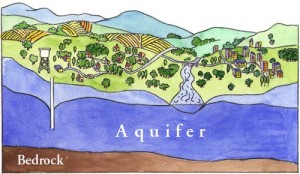
AquiferI love Psalm 121 for a variety of reasons. It is the psalm which the sanctoral lectionary provides for the feast of St. Francis of Assisi (October 4), always a favorite saint. It is the psalm my late mother chose to be read at her funeral. It is one of the psalms of ascent which pilgrims to the Temple are believed to have sung as they made their way to Jerusalem for the major festivals of ancient Judaism; on pilgrimage in Israel and Palestine, my wife and I recalled it as we rode in a travel coach from Ben Gurion Airport in Tel Aviv to ancient city. There many good memories, some joyful, some sad, all meaningful, associated with it.
Its first verse seems particularly appropriate this week as the world has come through and continues to experience the tragedy of conflict in Gaza, the carnage that is the on-going fighting in Iraq, and the violence that has erupted in Ferguson, Missouri. I can imagine people on every side of every one of those situations lifting their eyes and wondering where help is going to come from.

Help, the psalm assures us, comes from the Lord, “the maker of heaven and earth.” But I sometimes think that many (if not most) find that about as helpful as Job did: “Oh, that I knew where I might find him . . . If I go forward, he is not there; or backward, I cannot perceive him; on the left he hides, and I cannot behold him; I turn to the right, but I cannot see him.” (Job 23:3a,8-9) We live in a world where people do not know where to find God, do not know where to look for strength.

I would suspect that most who acknowledge the objective reality of God when asking the question posed in this psalm look for help “out there somewhere” hoping to find God swooping in like Superman bounding tall buildings, or more disturbingly like American bombers defending an Iraqi dam. On the other hand, those who deny the reality of God either don’t bother to look at all or (more commonly) also look “out there somewhere” expecting never to see anything.

A few, however, will know that (as St. Bernard de Clairvaux observed) our spiritual nourishment comes from the place where we think, pray and work, that we begin our spiritual journey where we are and not somewhere else. Moses promised his people that God was bringing them “into a good land, a land with flowing streams, with springs and underground waters welling up in valleys and hills,” (Dt 8:7) and while that may have been the promise of real and tangible place it is also a metaphor for the spiritual reality of God’s help and strength. Jesus told the Samaritan woman at Jacob’s Well that he would give those who asked the water of life which would become in them “a spring of water gushing up to eternal life.” (Jn 4:14)

God’s help, God’s strength, God’s spirit is like an aquifer underlying the soil of our lives. We tap that help and strength by going within, by searching the core of our being, not by looking “out there somewhere.” Yes, like the psalmist, we lift up our eyes to hills as we wonder where to find help, but we must turn our gaze around to actually discover it.

Certainly the people of Gaza, Iraq, and Missouri are right to look for help from outside, but such help is contingent and temporary; it cannot produce any real, lasting, long-term solution. Real change will only come when all people look deep within and tap that spiritual aquifer to which we all have access, that underground stream of living water, that spring of eternal life which has been promised all along.

From where is my help to come? From the Lord, deep within not “out there somewhere.”

====================

A request to my readers: I’m trying to build the readership of this blog and I’d very much appreciate your help in doing so. If you find something here that is of value, please share it with others. If you are on Facebook, “like” the posts on your page so others can see them. If you are following me on Twitter, please “retweet” the notices of these meditations. If you have a blog of your own, please include mine in your links (a favor I will gladly reciprocate). Many thanks!

====================

Father Funston is the rector of St. Paul’s Episcopal Church, Medina, Ohio.

Russian Steam Locomotive? – From the Daily Office – August 18, 2014

From the Gospel according John:

[Jesus said:] “Very truly, I tell you, anyone who hears my word and believes him who sent me has eternal life, and does not come under judgment, but has passed from death to life. Very truly, I tell you, the hour is coming, and is now here, when the dead will hear the voice of the Son of God, and those who hear will live.”

(From the Daily Office Lectionary – John 5:24-25 (NRSV) – August 18, 2014)

Russian Steam LocomotiveDid Jesus actually say these things? Most contemporary bible scholars would probably answer “No.” The author of John’s Gospel has made Jesus say the things a largely Jewish community of the church in the late 1st Century, a church struggling to cope with its separation from traditional Judaism, believed about Jesus; Jesus is thus both the subject and the interpreter of the message of John’s Gospel. In the 21st Century, we might have preferred the author to have included the interpretation of Jesus in the narrative, not in the words spoken by the character of Jesus portrayed here, but that’s not what we’ve got. What we’ve got is the Jesus remembered by a community with a highly developed Christology telling that community, and us, who Jesus was then and now.
Realizing that helps one realize that this is not Jesus’ predicting the end of the world as we know it. The tenses of verbs in this passage are important. The passing of believers “from death to life” is something that has already happened; it is not something in the future. The coming hour “is now here;” it is a present reality not something for which we are still waiting. This is a spiritual reality, not a prediction about physical reality. Death and life, eternity and judgment, coming hour and voice of the Son of God are all metaphoric terms describing a believer’s present spiritual reality, whether that believer is a 1st Century Jew or a 21st Century Gentile.

Metaphoric language is often difficult to understand, especially when the metaphor is an unfamiliar one. It can be confusingly dreamlike and stubbornly unenlightening. The past few days, recovering from minor surgery on my knee (a partial meniscectomy), I have also been “detoxing” from the general anesthesia used during surgery and the pain management medication prescribed afterward (which I only took for 36 hours). Apparently, vivid dreams are a part of that detoxification process.

One of the recurring images of these dreams is travel on a Russian cross-country train pulled by an antique steam engine! I have never been to Russia, rarely traveled anywhere by train, and never in steam-engine driven conveyance; as metaphors for something, these are highly unfamiliar images. To say the least, this imagery is disconcerting, disorienting, and (as I said) stubbornly unenlightening. I do believe that dreams, especially those we remember, are ways in which our minds work out issues in non-rational ways; I believe they are ways our psyches provide us insights not accessible by the conscious mind. But what are my dreams trying to tell me?

When I read today’s Gospel with Jesus’ interpretive discourse today, I have a similar experience of disorientation; I have almost as little experience with John’s images as I do with Russian steam locomotives. I have no direct experience of death though I have witnessed it; I have no direct experience of divine judgment though I have courtroom experience with its earthly analog; I have no direct experience of the voice of the Son of God though I have heard the voices of parents and children. What is scripture trying to tell me when John’s Jesus uses these metaphoric images?

Fortunately, as Walter Brueggemann has often reminded his readers, metaphors are not univocal, nor do they claim a one-to-one correlation with reality. They speak differently each time we encounter them. Today scripture’s voice maybe as confusing as the dream of a Russian train; tomorrow it may be as clear as a bell; the next day . . . who knows?

What I do know is this, that everyday I am called to listen to the voice of scripture and, in it, hope to hear the voice of the Son of God which promises life. Everyday, I must climb aboard the Russian steam-driven train that is Holy Write and ride where it takes me. Everyday, I must wrestle with scripture as Jacob wrestled with the angel at Peniel and hope that, as he saw God face to face and lived, so may I.

====================

A request to my readers: I’m trying to build the readership of this blog and I’d very much appreciate your help in doing so. If you find something here that is of value, please share it with others. If you are on Facebook, “like” the posts on your page so others can see them. If you are following me on Twitter, please “retweet” the notices of these meditations. If you have a blog of your own, please include mine in your links (a favor I will gladly reciprocate). Many thanks!

====================

Father Funston is the rector of St. Paul’s Episcopal Church, Medina, Ohio.

I Believe – From the Daily Office – August 15, 2014

From the Gospel according John:

There was a royal official whose son lay ill in Capernaum. When he heard that Jesus had come from Judea to Galilee, he went and begged him to come down and heal his son, for he was at the point of death. Then Jesus said to him, “Unless you see signs and wonders you will not believe.” The official said to him, “Sir, come down before my little boy dies.” Jesus said to him, “Go; your son will live.” The man believed the word that Jesus spoke to him and started on his way. As he was going down, his slaves met him and told him that his child was alive. So he asked them the hour when he began to recover, and they said to him, “Yesterday at one in the afternoon the fever left him.” The father realized that this was the hour when Jesus had said to him, “Your son will live.” So he himself believed, along with his whole household.

(From the Daily Office Lectionary – John 4:46b-53 (NRSV) – August 15, 2014)

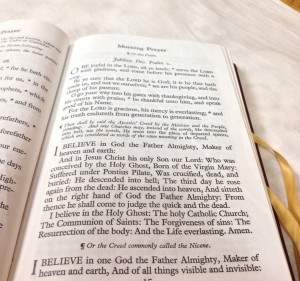
Apostle's Creed in Prayer BookJohn uses the word “believe” three times in this short passage: once quoting Jesus about witnesses to his acts of power and twice regarding the royal official’s state of mind. What, precisely, does John mean by doing so? That is one of the ponderable but unanswerable questions about scripture, the precise meaning of a biblical author.

John wrote in Greek and in each of the three cases here the Greek word used is some form of the verb pisteuo, which is also occasionally translated as “faith” and as “trust.” It does not usually carry a strong sense of intellectual assent to a doctrine or concept, although our English “believe” certainly does. Jesus, most likely, did not actually use a Greek word in his statement; more likely he spoke Aramaic in which (as in Hebrew) the word for “believe” is ‘aman and, like the Greek, it does not carry a strong association with intellectual concurrence to a proposition.

When we read or hear John’s testimony in English, therefore, we have to appreciate both the ambiguity of the original and the rather different thrust of our modern understanding of the word “believe”. What we especially must not do is hear John’s “believe” in the same way that we use the word in the creeds.

Of course, when I make such a statement I am immediately confronted by the realization that I have not the slightest idea what you mean by the word “believe” when you recite the Nicene Creed! Even more so, I am confronted by my own lack of clarity when I recite the creed.

Recently, my friend and colleague in ordained ministry, Presbyterian elder Mark Sandlin, published an essay on his blog The God Article entitled “Jesus Is Not My God” in which he confessed to being a heretic by beginning with the declaration, “I am a believer. Mostly. I believe that there is probably a god . . . .” Mark then followed up with, “I also believe there might not be a god. . . .” So how is Mark using “believe”? I think (notice I avoided using the word “believe”) that he is saying that he can intellectually assent to those propositions.

That’s not, however, how I understand the word when it pops up in the Nicene Creed which, as a liturgical Episcopalian, I recite publicly at least once each week, or the Apostle’s Creed which, as a practitioner of the Daily Office, I recite twice each day. I regularly say that I believe that there is a God, that that God created everything, that God had a Son and that Jesus the Anointed One is that Son, that Jesus was born of a virgin, that Jesus was killed on a cross, that he rose from the dead, that he went to heaven and that I expect him to return.

When I do so, however, I am not limiting myself to merely assent to the factual accuracy of those statements. In fact, I’m not even concerned with facticity when I make these statements of belief. In the discussion in the comments about Mark’s “heretical” essay, I said this:

I have no problem whatsoever saying the traditional creeds (Nicene, Apostle’s), every single word of them – virgin birth, death on cross, resurrection, expected return, the whole kit-and-kaboodle. (Did I spell “kaboodle” correctly?) That’s because I understand that “believe” doesn’t mean “assent to the scientific [or historical, I will now add] factual accuracy” of the statements set forth. “Believe” means I trust that these things mean something — usually something more than I currently understand and certainly something a lot more important than mere scientific [or historical] factual accuracy.

I don’t (I hasten to add) disbelieve the factuality of the statements in the creeds, don’t get me wrong, but if it turned out that Mary wasn’t, for example, a virgin, I would still recite the creedal words without a qualm. They are metaphoric; they are symbolic; it’s what they say about Jesus, not what they say about Mary, that is important. Or suppose someone actually were to find and verify a bunch of bones as being the remains of Yeshua of Nazareth; I would still assert my belief in his resurrection. Why? Because his truth, his gospel, the good news that God loves the human race was resurrected in, made alive by, and continues to sustain us in his church.

Whatever Jesus and John may have meant by the word “believe” in this story of the healing of the royal official’s son, that’s what I understand it to be in the creeds. I trust in the importance of what the creedal assertions point us toward. Far from being answers, the creedal statements are starting points for further spiritual exploration; they raise more questions than they answer. And I believe (I am using the word intentionally) that exploring those questions is a healthy and health-giving spiritual activity.

====================

A request to my readers: I’m trying to build the readership of this blog and I’d very much appreciate your help in doing so. If you find something here that is of value, please share it with others. If you are on Facebook, “like” the posts on your page so others can see them. If you are following me on Twitter, please “retweet” the notices of these meditations. If you have a blog of your own, please include mine in your links (a favor I will gladly reciprocate). Many thanks!

====================

Father Funston is the rector of St. Paul’s Episcopal Church, Medina, Ohio.

Of Tombs and Siblings – From the Daily Office – August 14, 2014

From the Book of Acts:

[Stephen the Deacon answered the High Priest in the council and said:] “Joseph sent and invited his father Jacob and all his relatives to come to him, seventy-five in all; so Jacob went down to Egypt. He himself died there as well as our ancestors, and their bodies were brought back to Shechem and laid in the tomb that Abraham had bought for a sum of silver from the sons of Hamor in Shechem.”

(From the Daily Office Lectionary – Acts 7:14-16 (NRSV) – August 14, 2014)

Icon of the Martyrdom of St PhiloumenosShechem was known as Sychar in Jesus’ time. Near that land that Abraham had bought for use as a tomb, just a short walk south from the traditional location of Joseph’s tomb, is a well that belonged to Jacob. At that well, Jesus stopped to ask a Samaritan woman for a drink; part of the story of that meeting and Jesus’ conversation with the woman (the longest of all the conversations recorded in the Gospels) is today’s Gospel text (John 4:27-42).

Near Sychar the Romans built the Greek-named city of Flavia Neapolis which grew large and encompassed the ancient Jewish and Samaritan city. As the predominant local language changed to Arabic, the Greek name was retained but shortened and Arabicized, and now the modern city of Nablus is among the largest Arab cities in the Holy Land.

Over the site of Jacob’s Well stands the Greek Orthodox Church of St. Photini. The name Photini is given by Orthodox tradition to the Samaritan woman; it means “light bringer” in recognition of her bringing the light of Christ to the people of the city. The first church dedicated to her at the site was built in 311 AD.

There are two tombs at St. Photini Church. One inside houses the remains of Archimandrite Philoumenos, a priest who almost single-handedly restored the ancient church to its present modern condition. In 1979 a group of radical Zionists from a nearby Israeli settlement claimed Jacob’s Well, which is in a chapel inside the crypt of the church, as a Jewish holy place and demanded that crosses and icons be removed. A week later, on November 29, Fr. Philoumenos was hacked to death with an ax in the crypt and the church was desecrated. Although it is widely believed that the settlers were responsible, no one was ever convicted of the priest’s murder. Fr. Philoumenos was ranked among the Saints of the Church of Jerusalem on August 30, 2008, and his feast day set on November 29, the anniversary of his martyrdom.

Fr Justinus's TombThe second tomb is that of Fr. Justinus, the priest who took over the church from St. Philoumenos and continued his work of restoration. An accomplished artist, Fr. Justinus wrote all of the icons which now decorate the nave, sanctuary, and crypt, including an icon of the martyrdom of St. Philoumenos. Fr. Justinus’s tomb is empty because he is still alive. He built his tomb himself and it is placed just outside the front door of the church; he walks past it everyday coming from his residence in the neighboring monastery to the church. It is a daily reminder of his (and our) mortality and of the dangers he (and many) face in the on-going violence or threat of violence that characterizes the Holy Land today.

If we were to read further in Acts (and we will tomorrow and the day after) we would read of the martyrdom of Stephen. His address to the Sanhedrin (perhaps one would best characterize it as a polemical sermon) so enraged his hearers that “they dragged him out of the city and began to stone him” (Acts 7:58) which resulted in his death. We are told that “devout men buried Stephen and made loud lamentation over him” (8:2) but we are not told where his burial place may have been, though surely it is in or near Jerusalem.

Nonetheless, his sermon about Jesus at Jacob’s Well in Shechem-Sychar-Nablus, the well’s location near Joseph’s Tomb and its intimate connection to the martyrdom of St. Philoumenos, and the eventual outcome of Stephen’s address are stark reminders that the Good News of God (whether that be the Covenant of the Old Testament or the Gospel of the New) is not the promise of an easy life. One would not be surprised to hear the Almighty singing the lyrics of that old country song:

I beg your pardon; I never promised you a rose garden.
Along with the sunshine, there’s gotta be a little rain sometime.
When you take you gotta give so live and let live and let go.
I beg your pardon, I never promised you a rose garden.

In fact, Jesus did pretty much that when he disabused his disciples, “Do not think that I have come to bring peace to the earth; I have not come to bring peace, but a sword.” (Mat. 10:34)

The People of God are called to be risk-takers and, sometimes, to risk even death. Christians most surely must know that; we have only the example of our Lord to prove it. But it is also true of all the children of Abraham, not only Christians but also Jews and Muslims. What is sad is that Abraham’s descendants cannot live peaceably among themselves, that it is often our Abrahamic “siblings” from whom we face the greatest danger (sometimes even more so from our brothers and sisters within the same faith group). I believe that this breaks God’s heart!

As he died, Stephen the Deacon “knelt down and cried out in a loud voice, ‘Lord, do not hold this sin against them.’” (Acts 7:60) So should we all pray for those who persecute us, and let us pray especially for all who are the spiritual descendants of Abraham, that there may be peace among Jews, Muslims, and Christians.

(Note: The icon of the martyrdom of St. Philoumenos may be photographed by pilgrims and tourists, and those photographs are to be found widely posted on the internet, the Israeli Government and the Palestinian Authority will not permit the Greek Orthodox Patriarchate of Jerusalem nor the parish church or monastery to reproduce the icon. It is considered politically inflammatory and is therefore censored.)

====================

A request to my readers: I’m trying to build the readership of this blog and I’d very much appreciate your help in doing so. If you find something here that is of value, please share it with others. If you are on Facebook, “like” the posts on your page so others can see them. If you are following me on Twitter, please “retweet” the notices of these meditations. If you have a blog of your own, please include mine in your links (a favor I will gladly reciprocate). Many thanks!

====================

Father Funston is the rector of St. Paul’s Episcopal Church, Medina, Ohio.

Unsignaled Turns – From the Daily Office – August 11, 2014

From the Gospel according to John:

Jesus said to Nicodemus: “The wind blows where it chooses, and you hear the sound of it, but you do not know where it comes from or where it goes. So it is with everyone who is born of the Spirit.”

(From the Daily Office Lectionary – John 3:8 (NRSV) – August 11, 2014)

Turn SignalI wasn’t going to mention this, really, but the mind makes strange associations and when I read the Gospel lesson this morning, particularly this line about the wind blowing where it will and us being unable to tell its origin or its destination, the image that came immediately to mind is an automobile turn signal.
It may be that that happened because in the past several days there have been three incidents at intersections where other drivers have failed to signal their turns and I, anticipating that they would be going straight, have nearly collided with them. Yesterday’s near-collision, I thought, was the worst.

Since moving to Ohio eleven years ago, my wife and I have several times commented a local phenomenon of driver behavior that we have not previously encountered living in other states. We have lived and been licensed drivers in Nevada, California, and Kansas since marrying, and driven in many other places, and we’ve never seen this phenomenon with the same frequency that it occurs here. The phenomenon in question? Drivers signaling their turn after beginning their maneuver.

This is what happened yesterday: I arrived, northbound, at a four-way stop-sign-controlled intersection simultaneously with a southbound vehicle; neither of us were signaling a turn. There was one eastbound vehicle, which proceeded through the intersection as the southbound vehicle and I came to a stop. When the eastbound vehicle cleared the intersection, we both started, the southbound vehicle beginning a left turn into my drive path and at that moment turning on its turn signal. Of course, we both slammed on our breaks and the other driver began yelling at me. I yelled back and proceeded through the intersection.

That incident was still on my mind when I read about the wind and the Spirit’s unknown movements. I thought, “How silly and ridiculous! I’m not going to write about that!” But I couldn’t shake the image from my mind, so I resolved to write nothing in the way of a reflection or meditation until this evening when I would read the other lessons and the evening psalm and, perhaps, have a more “spiritual” take on things.

And then this happened . . . . On the way to the office this morning, northbound on a major roadway through the southern part of our town, I was nearly hit by an historical Jeep (I know it to have been “historical” because it had a license tag that so proclaimed it). The historical Jeep whipped around the corner of an east-west side street, neither stopping (or even slowing down) at a stop sign nor signaling its turn. Fortunately, I was able to (again) slam on my breaks and avoid a collision, the Jeep proceeding ahead of me, the driver completely oblivious to our near-collision; I don’t think he ever saw me! (But I got a good look at his historical vehicle license plate.)

I wonder if Jesus might have used this as alternative metaphor if he were talking with Nicodemus today: “Other drivers go where they choose, and you hear the sound of them, but you do not know where they come from or where they are going, because they do not signal or stop. So it is with everyone who is born of the Spirit.” Probably not. It lacks the ambiguity of the wind/spirit image inherent in both Hebrew and Greek where the same word is used for the two words.

Nonetheless, it reminds me how dangerous the Spirit can be! The danger of a ton or two of steel headed down a city street piloted by a driver who fails to obey traffic laws cannot compare to the danger presented by the Holy Spirit! I am reminded of a favorite quotation from Annie Dillard’s 1982 book Teaching a Stone to Talk:

Does any-one have the foggiest idea what sort of power we so blithely invoke? Or, as I suspect, does no one believe a word of it? The churches are children playing on the floor with their chemistry sets, mixing up a batch of TNT to kill a Sunday morning. It is madness to wear ladies’ straw hats and velvet hats to church; we should all be wearing crash helmets. Ushers should issue life preservers and signal flares; they should lash us to our pews. For the sleeping god may wake some day and take offense, or the waking god may draw us out to where we can never return.

It also reminds me how irresponsible God can be! These drivers who fail to signal, who fail to stop, who aren’t obeying the rules are simply irresponsible. Like the wind in Jesus’ metaphor they go where they choose and the rest of us have no idea where that might be; we just have to be on our guard or get out of the way. And Jesus says that this powerful, uncontrollable, unknowable, freely-changing-direction behavior is shared by those who are reborn in the Spirit. Have you taken a good, close look at the people that are so empowered? Have you really looked closely at anyone to whom God has given the power to make unsignaled turns in life?

If not . . . grab a mirror and do so.

====================

A request to my readers: I’m trying to build the readership of this blog and I’d very much appreciate your help in doing so. If you find something here that is of value, please share it with others. If you are on Facebook, “like” the posts on your page so others can see them. If you are following me on Twitter, please “retweet” the notices of these meditations. If you have a blog of your own, please include mine in your links (a favor I will gladly reciprocate). Many thanks!

====================

Father Funston is the rector of St. Paul’s Episcopal Church, Medina, Ohio.

A Pointless Question? – From the Daily Office – August 6, 2014

From the Gospel according to John:

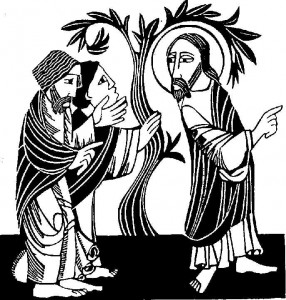
The next day John again was standing with two of his disciples, and as he watched Jesus walk by, he exclaimed, “Look, here is the Lamb of God!” The two disciples heard him say this, and they followed Jesus. When Jesus turned and saw them following, he said to them, “What are you looking for?” They said to him, “Rabbi” (which translated means Teacher), “where are you staying?”

(From the Daily Office Lectionary – John 1:35-38 (NRSV) – August 6, 2014)

Come and See by Cerezo BarredoEvery time I read this tale from John’s gospel, I am caught up short by this apparently pointless question. It seems such a non-sequitur, a request for irrelevant information. What could it have mattered where Jesus was staying? John doesn’t bother to give us an answer. We don’t know where this event took place. John never tells us a town and though the two disciples are permitted to come and see where Jesus was staying, the information is never given to the reader. A useless, irrelevant question made important in the dialog but never resolved for the audience — my college writing instructors would have torn this story apart.

All this question does is give Jesus an opportunity to invite them to come with him and spend the rest of the day (and perhaps the night) talking with him, which is all that John wants it to do. The question itself and its answer really don’t matter. Except they do . . . to nitpicky detail freaks like me!

I’ve read a lot of exegeses of this verse. Some suggest that the dialog — “What are you looking for?” “Where are you staying?” “Come and see.” — is an encapsulated invitation to discipleship. That feels like an eisegesis (a reading-into) of the scripture to me. Others suggest that the two men’s question should be understood something like slang, such as we used to use back in the 1970’s — “Where are you at, Jesus?” “What’s happening with you, Jesus?” — but that seems even less likely than the first idea.

I’ve always been convinced that John is just using the question as a scene-setting device and it has no deeper meaning. But today I’m not so sure . . . today I’m thinking maybe John is suggesting that there are no useless, irrelevant questions. Not because this one is some sort of code for entering the discipled life, nor because it’s a colloquial way to make inquiry into the deeper meaning of Jesus teaching, but rather because we can never know what questions may be meaningful nor where the answers to seemingly innocuous questions may lead us.

I didn’t write my Daily Office thoughts this morning for a variety of reasons — computer failure being at the top of the list, but also because of early morning commitments to the veterinarian and to the intake nurse at my orthopedist’s office. I am having surgery on my knee next week, so I had to go first thing this morning to the doctor’s office and answer a bunch of questions. Later in the day, I had to go through almost the same litany of inquiries (and more) at the surgical center where the procedure will be done.

Many of the questions were relevant, but some seemed entirely pointless. I wondered why they were being asked. Apparently some legislators and judges believe that questions about firearm ownership are irrelevant to medical treatment. A recent Federal Appeals Court decision upheld a Florida state law prohibiting physicians from asking about that. I didn’t mind answering any of the questions and wouldn’t have minded answering about gun ownership (the answer would have been “No”). I might have wondered why the question, but the asking wouldn’t have bothered me. (On the other hand, state legislators second guessing my doctor and telling him what he can and can’t ask, that bothers me.)

One of the apparently pointless questions in the afternoon session, however, led to an extended inquiry into very relevant data, however. So I began to appreciate the breadth of the queries and to see why they were being asked. And as I thought about that on my drive back to my office, I made a connection with John’s tale of Andrew and his companion asking Jesus, “Rabbi, where are you staying?”

It may seem like a pointless and irrelevant question. Maybe even John thought its substance was irrelevant (after all, he didn’t give us the answer), but the asking of it led to a life changing event in Andrew’s life, and then to a change in his brother’s life, and his brother’s life led to leadership in a new religious community, and that leadership led to the creation of the church and the spread of the Gospel . . . . One never knows where a question may lead.

Perhaps that is the point of John’s story. One never knows.

====================

A request to my readers: I’m trying to build the readership of this blog and I’d very much appreciate your help in doing so. If you find something here that is of value, please share it with others. If you are on Facebook, “like” the posts on your page so others can see them. If you are following me on Twitter, please “retweet” the notices of these meditations. If you have a blog of your own, please include mine in your links (a favor I will gladly reciprocate). Many thanks!

====================

Father Funston is the rector of St. Paul’s Episcopal Church, Medina, Ohio.

Uncounted, Unnamed Children – Sermon for August 3, 2014, Pentecost 8, Proper 13A

====================

On the Eighth Sunday after Pentecost, August 3, 2014, this sermon was offered to the people of St. Paul’s Episcopal Church, Medina, Ohio, where Fr. Funston is rector.

(The lessons for the day were: Isaiah 55:1-5; Psalm 145: 8-9,15-22; Romans 9:1-5; and Matthew 14:13-21. These lessons can be read at The Lectionary Page.)

====================

Tabgha Mosaic - Loaves and FishToday we are witnesses to one of the great and popular miracles of the gospel story, the feeding of the 5,000, which is actually the feeding of many more than that — notice the last few words of the gospel lesson text: “those who ate were about five thousand men, besides women and children.” (v. 21, emphasis added) Matthew gives little thought to the men’s wives or their uncounted, unnamed children.

I would like to put us in context, both in time and space, so we have a fuller picture of what we have just witnessed. Matthew tells this story in the middle of chapter 14 of his gospel. In chapter 13 he related all those parables told by Jesus sitting in a boat off the shore of the Galilean lake at Capernaum, but at the end of the chapter he doesn’t leave Jesus sitting in the boat. Instead, he tells us that “when Jesus had finished these parables, he left that place [and] came to his hometown,” which would be Nazareth. (Mt 13:53-54) (You may recall that that didn’t go well: Jesus was heard to say that ” prophets are not without honor except in their own country” – v. 57)

Then, at the beginning of chapter 14 Matthew leaves Jesus altogether and tells us about the beheading of John the Baptist, which took place Sebastia, about 36 miles south of Nazareth. Matthew then brings us back to Jesus saying at the beginning of our lesson today that upon hearing the news of John’s execution, Jesus “withdrew in a boat to a deserted place.” (14:13)

Since Nazareth is not on any river or lake, I’m not sure how he did that! Here’s my difficulty: Nazareth is about 20 miles due west of the southern tip of the Sea of Galilee. In order to “withdraw in a boat” he’d have had to walk for a day or two first. It’s possible though.

Near by Nazareth, about four miles away, is the city of Sepphoris, believed to be the Virgin Mary’s hometown. In Jesus’ time it was a Roman city and may have been where craftsmen from Nazareth, like Joseph, worked. There probably was regular commerce between Sepphoris and the Roman city of Tiberias on Galilee; today there is a highway between them. Jesus may have walked to Tiberias and then gotten in a boat to make his way back to Capernaum (about 10 miles north along the shore).

Tradition tells us that the feeding of the 5,000 (or more) took place about three miles south of Capernaum at a place called Tabgha, or al-Tabigha in Arabic, a name derived from the Greek name Heptapegon meaning “seven springs”. As early as the Fourth Century there was a shrine at the identified location. A pilgrim woman from Spain named Egeria chronicled her travels in the Holy Land around the year 384 and, about Tabgha, wrote: “In the same place (not far from Capernaum) facing the Sea of Galilee is a well watered land in which lush grasses grow, with numerous trees and palms. Nearby are seven springs which provide abundant water. In this fruitful garden Jesus fed five thousand people with five loaves of bread and two fish.” (Egeria, of course, has thought only of the men, not their wives or their uncounted, unnamed children.)

In the floor of that shrine was a mosaic of loaves and fishes which has become famous throughout the Christian world. It is reproduced on your bulletin cover and is now preserved in the floor before the altar of the Church of the Multiplication, a Benedictine monastery church built at the site. The place is about a mile inland from the shore of Lake Galilee.

One last detail must be attended to and that is the question, “Could there really have been that many people there?” Possibly. That’s the best answer one can give. There are many towns and cities close enough to Tabgha that, if word got around that a miracle worker were there, people could have gotten there within a day or less of good solid walking, more quickly if they could ride a donkey or camel. Sepphoris had a population 40,000 or more, and Tiberias may have been of similar size; both were within a day’s journey. Capernaum probably had a population of 2,000 or more. The city of Chorazin, which Jesus (by the way) had cursed, is nearby. Migdala Nunia, the hometown of Mary Magdalene, is nearby. A large, m ixed crowd of Jews, Romans, and other Gentiles could easily have gathered. Matthew may be exaggerating, but even if he has increased the number of men tenfold, we are still witnessing something wonderful. Jesus is able to feed a whole lot more people than he ought with two fish and a few loaves of bread.

So that’s when and where we are as we witness this scene of Jesus providing lunch for an unbelievably huge number of people. We are on a hillside a mile from the Sea of Galilee where Jesus has gone in an attempt to get away by himself. He has just recently had a negative experience in Nazareth; he has just heard about the execution of his cousin John; he has tried to get away from it all, but the people have followed him and now find themselves with nothing to eat. And so they have turned to Jesus’ disciples, to the Twelve (who seem also to have followed him) and asked them for food. And the Twelve are at loss about what to do. They have taken stock and they simply do not believe that they can feed all these men, to say nothing of the women and the uncounted, unnamed children.

So they have a very reasonable suggestion for Jesus: “Send them away. Tell them to go back where they came from, or if that is too far away then to one of the nearer towns, and buy themselves something to eat. We cannot feed all these men and their women and their unnamed, uncounted children.”

Send them away! We do not have enough to share with these children who are fleeing drug wars and violence in Central America and illegally crossing our border and . . . .

O, wait . . . I’m mixing up my stories, sorry. This isn’t the Mexican border. This is the Holy Land. Right . . . .

Send them away! We do not have enough to share with these Palestinian children with their demands for civil liberty and a country of their own and . . . .

O, darn. I’ve done it again, mixed up my stories. This isn’t Gaza; this is the Galilee. Right . . . .

But the stories are easy to mix up. Unnamed people in need, unnamed children in need, and the response at the Mexican border is the response in Gaza is the response on that hillside at Tabgha. Send them away! Get rid of them! And whatever you do don’t count the children, don’t name the children, don’t even think of them as children.

Think of them as “law breakers.” Think of them as “illegal immigrants.” Think of them as “migrant hispanics.” And send them away. Get rid of them.

A few days ago, a major news organization quoted a North Carolina politician as saying (and, as God is my witness, I am not making this up): “To me, they’re breaking the law when they come here. If we can’t turn them back, I think if we pop a couple of them off and leave the corpses laying on the border, maybe they’ll see that we’re serious about stopping immigration.” (Raw Story)

Send them away! Get rid of them! And whatever you do don’t count them, don’t name them, don’t even think of them as children.

A few days after the current fighting in and around Gaza started a U.N. school was bombed — Hamas claimed it was an Israeli shell; Israel claimed it was an errant Hamas rocket; but to the seventeen children who died that was really irrelevant. The numbers of Palestinian dead began to rise and a disproportionate number of the dead every day are kids. By July 23, over 600 Gazans had died, 150 of them children. On that day, international aid agencies were reporting that “a child had been killed in Gaza on average every hour for the preceding two days, and more than 70,000 children had been forced to flee their homes.” (The Guardian)

That week, the Israeli human rights organization B’Tselem offered for radio broadcast a public service advertisement listing the names of some of the children. The Israeli Broadcasting Authority banned the ad saying its content was “politically controversial.” B’Tselem appealed and in its appeal said: “Is it controversial that the children [aren’t] alive? That they’re children? That those are their names? These are facts that we wish to bring to the public’s knowledge.” Its appeal was denied and the names of the children have never been published in Israel.

Whatever you do don’t count the children, don’t name the children, don’t even think of them as children. Think of them as “collateral damage.” Think of them as “Hamas sympathizers.” Think of them as “dirty Palestinians.” But send them away. Get rid of them.

On learning that the advertisement had been banned, the respected British children’s author Michael Rosen wrote a poem. Rosen, for two years, was British Children’s Laureate and has written more than 140 books for children. He is, incidentally, an ethnic Jew. This is his poetic response to the Broadcasting Authority’s ban:

Don’t mention the children.
Don’t name the dead children.
The people must not know the names
of the dead children.
The names of the children must be hidden.
The children must be nameless.
The children must leave this world . . .
having no names.
No one must know the names of
the dead children.
No one must say the names of the
dead children.
No one must even think that the children
have names.
People must understand that it would be dangerous
to know the names of the children.
The people must be protected from
knowing the names of the children.
The names of the children could spread
like wildfire.
The people would not be safe if they knew
the names of the children.
Don’t name the dead children.
Don’t remember the dead children.
Don’t think of the dead children.
Don’t say: ‘dead children’.
(Don’t Name the Dead Children)

“Send them away,” said the Twelve, “Get rid of them.” Jesus answer took them by surprise: “You feed them,” he said. And he proceeded to show them how they could, to prove to them that with whatever resources they had, they could care for those 5,000 men and their wives and their uncounted, unnamed children.

LambsAbout a mile away from the spot where that happened, on the beach of the Sea of Galilee is another church. It is called by two names. One is the Church of the Primacy of Peter; the other is Mensa Domini, the Lord’s Table. It marks the place where, after his Resurrection, the Lord appeared to his disciples and cooked for them a breakfast of broiled fish. As they ate, Jesus asked Peter, “Simon, son of John, do you love me?” Peter

said to him, “Yes, Lord; you know that I love you.” Jesus said to him, “Feed my lambs.” A second time he said to him, “Simon son of John, do you love me?” He said to him, “Yes, Lord; you know that I love you.” Jesus said to him, “Tend my sheep.” He said to him the third time, “Simon son of John, do you love me?” Peter felt hurt because he said to him the third time, “Do you love me?” And he said to him, “Lord, you know everything; you know that I love you.” Jesus said to him, “Feed my sheep.” (Jn 21:15-17)

On the Mexican border, in the person of our brothers and sisters who work in Episcopal Border Ministry or Episcopal Migration Ministry, we meet those refugee children fleeing violence and death in Central America . . . In Gaza, in the person of our sisters and brothers of the Episcopal Diocese of Jerusalem who work in the hospitals and clinics our own Good Friday offerings support, we meet the Palestinian children facing bombs and rockets and death . . . And when we meet those uncounted and still in the media unnamed children, we are just like the Twelve standing on that hillside at Tabgha looking at those 5,000 men and their wives and their unnamed, uncounted children and wondering, “How are we going to deal with this?” Some of us will want to say “Send them away we can’t handle this,” but Jesus says to us as he said to the Twelve, “Feed them.”

Jesus asks us what he asked Simon, son of John, on that beach, “Do you love me?” And if our answer is “Yes” he will name those children: he will name them “my lambs,” and what he said to Peter he will say to us, “Feed my lambs.”

====================

A request to my readers: I’m trying to build the readership of this blog and I’d very much appreciate your help in doing so. If you find something here that is of value, please share it with others. If you are on Facebook, “like” the posts on your page so others can see them. If you are following me on Twitter, please “retweet” the notices of these meditations. If you have a blog of your own, please include mine in your links (a favor I will gladly reciprocate). Many thanks!

====================

Father Funston is the rector of St. Paul’s Episcopal Church, Medina, Ohio.

« Older posts Newer posts »