From the Gospel of Mark:
Immediately he made his disciples get into the boat and go on ahead to the other side, to Bethsaida, while he dismissed the crowd. After saying farewell to them, he went up on the mountain to pray.
(From the Daily Office Lectionary – Mark 6:45-46 (NRSV) – March 27, 2014.)
 Jesus sure spends a lot of time on mountains! And I can understand why. They are generally inaccessible to all but the most determined making them the perfect place for someone who needs a little “down” time, a little bit of “I’m exhausted by all of this and need to recharge” time, a little “leave me be for a while” time.
It may be cynical of me, but my first thought reading these two verses was, “I hope he remembered to turn off his cellphone.” I have learned that lesson well, even though I sometimes fail to follow my own advice and answer the phone on my day away from church business and usually regret it when I do.
Why is it that we take little note of, and often ignore, these last two verses of the story of the feeding of the 5,000? When Matthew’s version of the tale is used in the Sunday readings (as Proper 13 in Year A of the Revised Common Lectionary), his similar statement is cut off from it:
Immediately he made the disciples get into the boat and go on ahead to the other side, while he dismissed the crowds. And after he had dismissed the crowds, he went up the mountain by himself to pray. (Matt 14:22-23)
Luke does not mention Jesus’ behavior after the miracle of the loaves and fishes, but neither Luke’s nor Mark’s versions are read in the Sunday rotation. John’s version ascribes a motive other than prayer to Jesus’ climbing the mountain: “When Jesus realized that they were about to come and take him by force to make him king, he withdrew again to the mountain by himself.” (John 6:15, RCL Year B, Proper 12)
I don’t give John’s political twist much credence. It may be that people wanted to “make him king,” after all the Jews were anticipating that sort of Messiah, but I suspect that exhaustion and the need for privacy were much bigger motives for Jesus at the moment.
When in public worship we end the story with the report that “those who ate were about five thousand men, besides women and children” (Matt. 14:21, cf. Mk. 6:44), we get an incomplete picture of Jesus. And John’s “I don’t want to be king” motivation for his departure just makes it worse! He becomes a superman who does incredible miraculous things with little or no effort and with no cost to himself, and then (like some super-spy) thwarts the political designs of the ignorant and ill-informed; as a model for life or ministry, he is an impossible paradigm. Being Christ-like becomes an impossible task beyond the ken of mortal human beings.
But what if we include these two verses, this post-script about depleted reserves, this acknowledgement of Jesus’ weariness and need to replenish? What a richer, more nuanced vision we are given! Jesus becomes a much more accessible savior! He truly is seen to be (as the writer of the Letter to Hebrews insisted) someone who is able “to sympathize with our weaknesses . . . in every respect . . . as we are.” (Heb. 4:15) He is seen as a model of healthy ministry, of self-care following service to others. We see him as someone who really would turn off his cellphone!
====================
A request to my readers: I’m trying to build the readership of this blog and I’d very much appreciate your help in doing so. If you find something here that is of value, please share it with others. If you are on Facebook, “like” the posts on your page so others can see them. If you are following me on Twitter, please “retweet” the notices of these meditations. If you have a blog of your own, please include mine in your links (a favor I will gladly reciprocate). Many thanks!
====================
Father Funston is the rector of St. Paul’s Episcopal Church, Medina, Ohio.
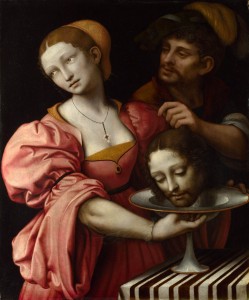 I have a hard time with the beheading thing . . . . I don’t know what it is, but there’s something about cutting someone’s head off that just appalls me.
 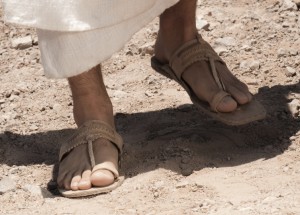 It may be pedestrian of me, but I can’t stop thinking of the messenger’s feet and whether this passage of Isaiah is really very well chosen as the Old Testament lesson for Morning Prayer on the Feast of the Annunciation! Reading the rest of the lesson with its message of redemption and salvation, one can see why it is set out in the special set of Daily Office readings for this feast day, but I can’t get my mind off the feet.
 The story of the reaction of the people to the curing of the Gerasene demoniac is, I think, unique among the healing stories in the Gospels. Most of the time when people hear of or witness one of Jesus’ healings, he is then swamped by crowds and sometimes has to flee them. Here, we are told that he is begged to go away. As I read the passage, I thought of Isaiah’s reaction to his call: “Woe is me! I am lost, for I am a man of unclean lips, and I live among a people of unclean lips” (Isa. 6:5) These folks are those who realize they are “a people of unclean lips.” Like Isaiah, they fear being in the presence of holiness.
 Mark, who is usually so taciturn and parsimonious with his descriptions, goes into rather great detail telling this story of Jesus calming the sea. A detail often overlooked is the second sentence of verse 36: “Other boats were with him.” (When Luke tells the same story in chapter 8 of his gospel, he leaves out this detail.)
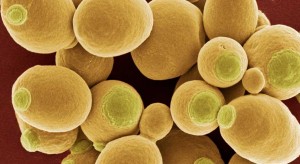 Paul uses the metaphor of yeast in a negative way making it symbolize sin and corruption. In the letter to the Galatians, he uses it in a similar manner in an aside about the few who have “prevented you from obeying the truth,” saying, “A little yeast leavens the whole batch of dough.” (Gal. 5:7,9)
 Gregory of Nyssa, one of the Cappadocian Fathers, is supposed to have said, “Concepts create idols; only wonder comprehends anything. People kill one another over concepts. Wonder makes us fall to our knees.” I think that pretty much describes what is going on in today’s Gospel lesson, and pretty much describes what has become of conversation and discussion between groups in our society. The Pharisees and the Herodians, who disagreed with one another about nearly everything, could nonetheless come together and plot to kill Jesus because his words and actions threatened both of their conceptual frameworks. They had to defend their concepts against the wonder of healing, even if it meant killing.
 I remember preaching on this text some years ago and doing a lot of research into the meaning of “new wine” as used in the Bible (tirowsh in Hebrew, oinon neon in Greek) — whether it meant fermented wine or yet-to-be-fermented newly-crushed grape juice. There is a lot of differing scholarship on the issue, both among Biblical scholars and oenologists. I came to the conclusion that all of that scholarship is an interesting waste of time. None of it matters to Jesus’ meaning in using this metaphor for the spiritual life.
 It’s a familiar story. A paralyzed man on a pallet comes to Jesus carried by his friends. They can’t get by the crowd, so they cut a hole in the roof of the house where Jesus is staying. (The first verse of the chapter says “he was at home” in Capernaum. That’s an interesting thing to say of someone who “has nowhere to lay his head,” [Matt. 8:20] but I don’t want to be distracted by that this morning.) The man on his mat is lowered through the hole and Jesus heals him. A pretty straightforward story of a miracle healing.
 Jesus’ time of temptation in the desert is related by each of the Synoptic Gospels. Luke and Matthew give us a detailed account, noting that Satan tries to get Jesus to (a) turn stones into bread, (b) throw himself from the pinnacle of the Temple so as to demonstrate his power over the angels, and (c) worship Satan who promises him world domination. (We heard Matthew’s version on Sunday morning.)

