Revised Common Lectionary for the Third Sunday of Easter, Year B: Acts 3:12-19; Psalm 4; 1 John 3:1-7; and Luke 24:36b-48
From the Gospel according to Luke:
While in their joy they were disbelieving and still wondering, he said to them, “Have you anything here to eat?” They gave him a piece of broiled fish, and he took it and ate in their presence. (Luke 24:41)
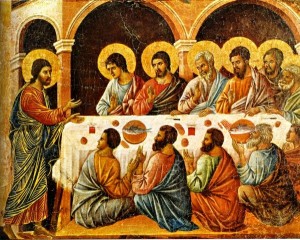 I have to admit that I would be hard-pressed to choose one of the many post-resurrection appearances of Christ as my favorite. Each one recorded in Scripture is so full of vivid imagery and meaning that it would be nearly impossible to put one above another … having said that, however, I also have to admit an especial fondness for the one described here by Luke.
There are two things about this one that I really like. First is Luke’s comment that the disciples “in their joy … were disbelieving.” It’s such a great description of what their amazement must have been; it calls to my mind some of the great, little-used emotional descriptors of our language: consternation, bewilderment, perplexity, astonishment, and (my favorite) stupefaction. I think that’s what Luke is saying in this delightful turn of phrase, that the disciples were stupefied! It’s also Luke’s way of describing something that is handled somewhat more harshly in Mark’s telling of the story, which just happens to be the gospel lesson for the Daily Office today.
Mark, with typical economy of expression, describes the scene this way:
Later he appeared to the eleven themselves as they were sitting at the table; and he upbraided them for their lack of faith and stubbornness, because they had not believed those who saw him after he had risen. (Mark 16:14)
In one ancient manuscript of Mark’s gospel that is not accepted in the received version the text continues by describing the apostles’ reply:
And they excused themselves, saying, “This age of lawlessness and unbelief is under Satan, who does not allow the truth and power of God to prevail over the unclean things of the spirits. Therefore reveal your righteousness now” – thus they spoke to Christ. (Codex Washingtonensis or Freer Logion)
I like this recorded post-resurrection appearance, apocryphal though it may be, nearly as much as the one in today’s reading from Luke’s gospel. The fact that “they excused themselves” and that they demanded of Jesus “reveal your righteousness now”. It’s nearly as good as Luke’s description of “joyful disbelief”! I absolutely love this! It’s so darned modern . . . or maybe even post-modern. You can almost hear the eleven saying something like, “Well, Jesus, that resurrection stuff may be true for you, but it’s not true for us!” When we read these to texts together, Luke and Mark, describing this scene in their different ways, we get such a wonderful picture of the apostles. Astonished but still making excuses, perplexed but still making demands, stupefied but still relativizing the situation . . . these men aren’t just First Century Palestinian Jewish fisherman; they are 21st Century Americans; they are us!
The second thing I find absolutely delightful about Luke’s telling of the story is Jesus’ question: “Have you anything here to eat?” If this scene were set in a modern home, I think we could envision it happening in the kitchen, the apostles sitting around the kitchen table, Jesus showing up, saying “Hey!” then going to the refrigerator, opening the door, and looking in like a teenager getting home from school, “Anything here to eat?” They do, as this version of Luke tells us, have that broiled fish handy, and in the King James Version (supported by some ancient manuscripts) Luke also reports that they gave him a piece of honey-comb.
There is a long line of biblical scholarship that tells us that Jesus’ asking for something to eat, and then actually eating it, is his way of proving to the stupefied disciples that he’s not a phantom. The idea is that by consuming it in front of them, Jesus proves that he has not returned as a spirit, or a ghost, or some sort of apparition; a ghost, after all, could not be touched, or have an appetite, or eat things. Lutheran pastor Doug Schmirler put it this way: “It may be Luke’s way of saying: ‘Ghost? Did you ever see a ghost chew? Did you ever see a ghost swallow? Did you ever see a ghost digest? Well, did you?'” That’s certainly a good way to look at this, but this story seen from the combined perspectives of Luke and the Freer Logion addition to Mark speaks to me in a different way.
I prefer the versions that include the honey-comb because that makes Jesus’ eating much more than a mere demonstration of non-ghost-ness; it makes it a meal. Something savory, and something sweet; an entree and a dessert. This is not just a “Look; see, I’m not a spirit”. This is Jesus once again sitting down at the dinner table with his friends, just like he had done in the home of Mary, Martha and Lazarus, just like he did once before in this upper room, just like he did with Cleopas and his companion in the inn on the road to Emmaus. This is the community once again sitting together at the kitchen table.
And just like every family, every community at every dinner table, they are talking and discussing and maybe even getting a little cross with one another if that additional bit to Mark’s Gospel is trustworthy.
There is a restaurant in San Francisco called Credo, which I’m sure you know is simply the Latin word for “creed”. On their walls are painted quotations from all sorts of philosophers, writers, politicians, and so forth. On their menus they have their business credo written out:
At Credo, we believe in nourishing both the body and the mind. Our walls depict the universality of ideas, the clash of conflicting viewpoints and the democratic nature of discussion and debate. We believe that good food and good company go hand-in-hand. We believe in the time-honored tradition of the dinner table debate and the value of impassioned points of view. We believe simple things can be wonderful, like authentic ingredients, genuine creativity and gracious hospitality.
This is what is happening here: dinner table debate, impassioned points of view, genuine creativity, and gracious hospitality. This is the glory and power of Christ’s Resurrection; the creation of community, a new community.
This is why I like this story that Luke and Mark tell from different perspectives so much; it is such a clear vision of the resurrected community. In the very human act eating of a meal, in very human condition perplexity and befuddlement, in the very human process of making excuses and making demands, these eleven, once a dispirited and possibly dying community, are resurrected. These are not simply individuals on a personal spiritual quest; they are joined together into a new community in Christ, crucified with him, now risen with him, given new life and new purpose and new mission because of his resurrection.
This new community is an on-going one, a growing one, a maturing one. As John says in the reading from his first letter this morning:
See what love the Father has given us, that we should be called children of God; and that is what we are. … What we will be has not yet been revealed. What we do know is this: when he is revealed, we will be like him, for we will see him as he is. (1 John 3:1-2)
We do know this: that his eating the fish and the honey-comb revealed him to be a real human being and that that is what we are called to be – real human beings. Carroll Simcox, who edited the Episcopal Church magazine The Living Church for many years, put it this way:
You and I shall be our real, complete selves for the first time ever. We think of ourselves now as human beings. We really aren’t that?not yet. We are human becomings. The fetus conceived only yesterday is a human becoming. If you are living in Christ, believing in him and trying to follow and obey him as the master of your life, you are by his grace, becoming ever more and more like him. (Quoted by Guy Sayle, infra)
But John does not mean that God is making us into clones or exact replicas of Jesus of Nazareth. The wonderful paradox of the Christian faith is that the more we become like Jesus, the more we become our truest selves. The hope of the Christian faith is that we can become as truly human as the Resurrected Christ. Dr. Guy Sayles, a Cooperative Baptist preacher, put it this way:
As we discover deeper dimensions of Christ-likeness, we uncover more and more of our honest-to-God selves.
Jesus is the pattern and the power, the model and the source, of authentic human life. We are meant to have what he had and has:
- a radical and liberating faith in God;
- a childlike trust in the grace of God;
- a trembling wonder before the mystery of life;
- a durable hope that, because we are in God’s hands, death and sorrow and pain and tears are not the end, but joy and wholeness and laughter are;
- an astonishing confidence that we and the world are headed, not toward midnight, but toward sunrise; and
- an undimmed awareness that the heart of all things is unconditional and compassionate love.
Those eleven disciples sitting around that dinner table, confronted by what they at first thought was an apparition, were astonished but still making excuses, perplexed but still making demands, stupefied but still relativizing the situation. They were just like us, but as church history and the Book of Acts shows, in stories like the one we heard today, they became like him, they became their truest selves, and so shall we all. That is the power and promise of the Resurrection.
Alleluia and amen!
 In some ancient manuscripts of this “longer ending” of Mark’s Gospel the text above continues with the following response by the apostles: “And they excused themselves, saying, ‘This age of lawlessness and unbelief is under Satan, who does not allow the truth and power of God to prevail over the unclean things of the spirits. Therefore reveal your righteousness now’ – thus they spoke to Christ.” Jesus says a few nearly incomprehensible words about Satan’s power ending in this age and so forth, and then the text picks up with the received version’s comments about snake-handling and poison-drinking. ~ I absolutely love this first part of that addition: the fact that “they excused themselves” and that they demanded of Jesus “reveal your righteousness now”. I love it! It’s so darned modern . . . or maybe even post-modern. I can almost hear them saying something like, “Well, Jesus, that resurrection stuff may be true for you, but it’s not true for us!” Making excuses, making demands, relativizing the situation . . . these men aren’t just First Century Palestinian Jews; they are 21st Century Americans; they are US! ~ Well, actually, they aren’t. Where they differ is that after this confrontation with the Risen Christ, they got up off their duffs and went to work. “They went out and proclaimed the good news everywhere, while the Lord worked with them and confirmed the message by the signs that accompanied it.” (Mark 16:20) Very few excuse-making, demanding, relativizing, modern American church members do anything like that! ~ For nearly forty years, since Authorized Services, 1973 (a precursor to the current American Book of Common Prayer), at every baptism, the Episcopal Church has been asking its members if they will “proclaim by word and example the Good News of God in Christ” and those members have answered affirmatively, “I will, with God’s help.” However, when we discuss evangelism, inviting people to church, talking with others about one’s faith, and similar topics, it becomes painfully clear that very few of those Episcopalians are actually doing so. And it does no good to confront them with that failure; they excuse themselves, just like the apostles! And just like the apostles, many of them make note of the fact that they don’t see much response when they try, that God doesn’t seem to be helping much. ~ Maybe we need to confront God, just like the apostles . . . maybe we need to say to God, as the apostles said to their risen Lord, “Reveal your righteousness now.” After all, when they went out and spread the gospel “the Lord worked with them and confirmed the message” with “signs” . . . we could use a few signs right now. ~ Yesterday, I made mention here of those times when it’s hard to see Jesus, when we fail to recognize him. I think we must all admit that there are times like that, when we do not see God, when we cannot feel God’s presence, when God seems to be silent. One of the most important books I read while in theological study was Hope in Time of Abandonment (Seabury 1973) by the French Protestant philosopher Jacques Ellul. In it Ellul wrote, “Hope comes alive only in the dreary silence of God, in our loneliness before a closed heaven, in our abandonment . . . Hope is a protest before this God, who is leaving us without miracles and without conversions, that he is not keeping his Word.” Hope, said Ellul, is humanity’s answer to God’s silence and it is through prayer that we demand the fulfillment of God’s promise. ~ If God is not living up to God’s promise to support the work of Jesus’ present-day apostles with confirming signs, then perhaps we Episcopalians who excuse ourselves from fulfilling our promise in the baptismal covenant are not to be faulted. Perhaps, like those first apostles we should be demanding of God in Christ, “Reveal your righteousness now!” ~ On the other hand, if God is living up to God’s promises and we just aren’t seeing that . . . .
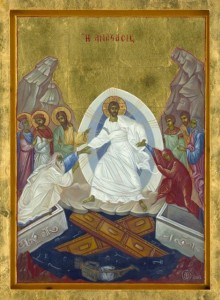 If you’ve been with us here for the services of Maundy Thursday, Good Friday, and Holy Saturday, or have been following the sermons on line, you know that we have come to Act Three of the three-act drama of redemption. In the first act, we saw the protagonist, Jesus of Nazureth, trying one last time make his disciples understand his mission and his message. Through the metaphor of bread and wine, through the enacted parable of foot-washing, through an agonized night of prayer in a garden, he tried to teach them that his was a mission of love and life, but they just didn’t seem to get it. As the curtain fell on Act One, he was being taken away to be questioned by Jewish and Roman authorities and the disciples, frightened and confused, were scattering, unsure of what was going to happen next.
 Some time in the late Fourth Century, St. John Chrysostom, Archbishop of Constantinople and an important Early Church Father known for his eloquence in preaching and public speaking (hence, the surname Chrysostom which means “golden-mouthed”), preached this sermon on Easter.
  A meal is in progress… Is it a seder, the ritual meal of remembrance of the Passover? We don’t really know; the playwrights have not made this clear; the theater critics, the scholars debate this issue. Three of the story-tellers suggest that it is but the fourth, John, tells the tale very differently. (The synoptic gospels tell the story in a similar way and, if truth be told, in the same way – Luke and Matthew based their stories on Mark’s, so to be honest there aren’t three stories, there’s only one that would make us think that this supper is a seder, but John doesn’t. In fact, John doesn’t even care about that – he spends no time at all describing the meal, for him the important thing is what happened afterward, and that comes in a later scene. So as we begin this three-day, three-act drama of redemption, since we have heard Luke’s voice narrating the story, let’s just assume that what we see in this first scene of the first act is, indeed, a seder.)
 The meal is over, the dishes have been cleared. The disciples are arguing among themselves about who is the greater among them. Jesus looks frustrated and troubled; the teachable moment has passed and they clearly have not understood! They just haven’t gotten it.
 “Stay here,” he tells them, “Stay awake while I go over there to pray.” As they settle themselves, he moves away from them, and collapses in a heap, sobbing: “O God … Father, let this pass!”
  We have just read the simple, yet dramatic story of our Lord’s Passion as related in Mark’s Gospel. But we began our worship this morning with John’s story of Christ’s triumphal entry into Jerusalem. In the span of a few minutes we covered an entire week at the end of Jesus’ earthly life. Logic and reason cannot really make sense of this, and no ten-minute homiletic exegesis of these texts can help us comprehend the enormity of those events.
  Threading a needle…. That used to be a simple task for me. I was very, very near-sighted. I could barely see a school bus twenty feet away without my pop-bottle-bottom spectacles. But I could thread a needle! I could do anything that required close-up detail work; I had marvelous up-close vision. Then one day in 1995 (I think it was 1995) my mother saw my glasses. “Good Heavens! Are your eyes that bad?” – “Yes, Mother, they always have been.” – “Why don’t you have that Lasik surgery?” – “Because I can’t afford it, Mother.” – “You get it done. I’ll pay for it.” ~ (Side comment: My mother was a depression child born in 1919. As a result of spending her formative pre-teen and teen years in the years of the Great Depression, she was one of the most tightfisted people I’ve ever known when it came to spending money on herself or her spouse, my step-father. She would not spend a dime on her own healthcare, even when she felt badly. But she was generous to a fault with her children, her grandchildren, her friends, and her church. If she’d been less generous to us and more generous to herself, she might still be alive. But that’s another story.) ~ So I talked with my ophthalmologist, who had earlier been quite negative about PK and RK and other forms of keratotomy, and he thought Lasik would be a good option. He referred me to a surgeon. A couple of weeks later, I was able to do everything without glasses … everything except thread a needle. Now I needed a pair of dime-store “cheaters” to do what had once been easy, and even though I squinted and used those magnifying lenses I had difficulty. Getting anything through the eye of a needle, much less a camel, is no mean task! ~ About thirty years before that surgery, I visited the Cathedral at Chartres on my first trip to Europe. I was 16 years old at the time. I walked the labyrinth there. Since that first time I’ve walked many replicas of that deceptively simple path and other forms of labyrinth. Threading one’s way through the labyrinthine path requires concentration (especially in a cathedral full of tourists, but really at any time, even when completely alone). It is a careful endeavor not unlike threading a needle; one might even say it is a soulful endeavor. ~ Perhaps the most famous labyrinth in history or myth is the one built on Crete to house the Minotaur. King Minos’s daughter Ariadne fell in love with Theseus, an Athenian who was to be a sacrificial victim of the Minotaur. She gave Theseus a ball of thread to unwind as he made his way through the labyrinth, which showed him the path to by which he could leave once he had done battle with the beast (assuming he killed it, which he did). It was her thread of love which helped Theseus thread his way through the labyrinth. ~ Our walk through a spiritual labyrinth is said represent our way through life. Victor Hugo once said, “He, who every morning plans the transactions of the day, and follows that plan, carries a thread that will guide him through a labyrinth of the most busy life.” I’m not so sure that’s true, however; plans are too often subject to change! Like the odd turnings of the Chartres labyrinth, we meet with obstacles which change our direction; when we seem to be headed for our goal, suddenly the way changes; even though we squint and use magnifying glasses, the way through is unclear. We may not be able to follow our plans and we may not see the way ahead, but we are threaded through the unexpected and unknown path of life if we trust and rely on God’s guidance. Like Ariadne’s thread of love, God’s love threads us through life’s labyrinthine ways. Following God’s guidance is a careful, soulful endeavor, but “with God all things are possible.”
 “They did not understand … and were afraid to ask him.” I had really hoped when I first studied this passage some years ago that the word afraid was really something like “reluctant” or “hesitant” in the original Greek of the New Testament. But, in fact, the Greek word is phobeo, the adjectival form of the word from which we get phobia in English; it really is afraid. In fact, the principal meaning of the word is to fear something to the extent of fleeing! Only secondarily does it mean the extend reverence, veneration, or respect to something or someone. I trust that Mark means the latter emotion, but I’m not sure. ~ I know there are times when I am in conversation with someone, often with several someones, and something will be said that I don’t fully understand. My usual tactic is not to ask, but rather to smile and nod, to try to look sage, and to hope that further comments will clarify things for me. I don’t want to look stupid, after all! Maybe that’s what Mark is suggesting, that the disciples were afraid of looking like idiots…. ~ Isn’t that nearly a universal feeling? Human beings just seemed predisposed to fear looking stupid; we don’t like being wrong; we don’t want to be embarrassed; we’re afraid of failure; we are constantly worried about what others think of us, especially those we respect. There is one word that describes this human condition: anxiety. ~ Paul wrote about anxiety to the Philippians: “Do not worry about anything, but in everything by prayer and supplication with thanksgiving let your requests be made known to God. And the peace of God, which surpasses all understanding, will guard your hearts and your minds in Christ Jesus.” (Philip. 4:6-7) Paul makes it sound so simple, but even those who knew Jesus first-hand, who were with him day by day, found it hard to do. “They did not understand … and were afraid to ask him.” Don’t beat yourself up if you sometimes don’t understand. Don’t beat yourself up if you are sometimes anxious. But don’t be afraid to ask; make your requests known to God!
 There’s a lot of talk of war these days, and I don’t mean about any on-going or planned military conflicts between sovereign states. Rather, harking back to at least the 1930s when FBI chief J. Edgar Hoover declared a “war on crime” and continuing in the 1960s when Pres. Lyndon Johnson declared a “war on poverty”, the war metaphor has been used again and again, officially and unofficially, until now it is ubiquitous! Pres. Nixon declared a “war on cancer” and another “war on drugs” (which Pres. Reagan later re-declared). Borrowing a phrase from philosopher William James, Pres. Carter called for the “moral equivalent of war” in dealing with the energy needs of the nation during the 1977 oil crisis. Pres. G.W. Bush declared the apparently still continuing “war on terrorism” (or “war on terror”; the exact name and nature of the enemy have never been clear). The so-called Christian Right has claimed for a few years that there’s been a “war on Christmas” being waged by the Left and now the Left is claiming that the Right is waging a “war on women” (or on women’s reproductive rights). Yesterday afternoon I happened to hear a discussion on NPR about the unfortunate killing of Trayvon Martin in Sanford, Florida; in that conversation, one of the participants asserted that “there is a war on young, black men in this country.” ~ After Congresswoman Gabby Giffords was shot in January 2011, there was a hue-and-cry for the ratcheting back of the violence and violent imagery of political rhetoric; it was and remains largely ineffectual. But I believe the underlying thought of that call was valid and worthy of continued consideration; I believe we need to give up this talk of war, this reliance on a metaphor of violence. ~ And let’s be clear, that’s what any talk of a “war on something” is! War is defined as “open armed conflict between two or more parties, nations, or states.” Wars are declared by national leaders and fought by citizens, often by citizens with no personal stake in whatever the underlying dispute between their countries’ leaders might have been, citizens who will end up either dead or wounded (emotionally if not physically), citizens who may suffer the trauma of taking another’s life. So regardless of what we or our society or our political opponents may do apropos of Christmas or drugs or women’s rights or whatever, unless it involves the actual taking up of weapons and killing people in open conflict … it’s not war! ~ Today’s reading from Exodus relates Pharoah’s orders to kill the male Hebrew children. It’s a terrible story, but nowhere does scripture suggest that Pharoah was involved in a “war on the Hebrews.” The Psalmist today complains of “those who hate me without a cause” but does not complain that they are “warring” against him. In today’s reading from Mark’s Gospel, Peter opposes Jesus’ plan to go to Jerusalem, but Jesus does not accuse him of waging a “war” on that plan. This rhetoric of “war” is overused by our political leaders and pundits; those who use it do so because they think it is the only way to get the American people “fired up” about something. That “war talk” does rally the masses, but surely it is not the only way to accomplish that. Surely the thoughtful people of our country can be energized by something other than “going to war.” In that speech (and later essay) of William James from which Pres. Carter got his phrase, the philosopher asserts: “It would be simply preposterous if the only force that could work ideals of honor and standards of efficiency into English or American natures should be the fear of being killed by the Germans or the Japanese. Great indeed is Fear; but it is not, as our military enthusiasts believe and try to make us believe, the only stimulus known for awakening the higher ranges of men’s spiritual energy.” In that same essay, James also argued, “Strenuous honor and disinterestedness abound everywhere. Priests and medical men are in a fashion educated to it, and we should all feel some degree of its imperative if we were conscious of our work as an obligatory service to the state.” ~ It’s that sense of having an “obligatory service to the state” that seems lacking in our society. It is that sense of being a “body,” such as Paul describes, in which all the parts, all the members work for the good of the whole that is missing. The church is supposed to be the model for such an understanding of community, for a society in which love and cooperation are as energizing as the politicians and pundits believe talk of fear and war to be …. but are we? When people look at the church today, do they see a body where conflict is considered counterproductive, a body which functions through the good work of all its members? Although I hope so, I sort of doubt it. Until the church fulfills that role, I’m afraid we’ll keep hearing about a “war on this” and a “war on that.”
 Jesus’ response to this Gentile woman who asks him to heal her demon-possessed daughter is very troubling. We are bothered, even angered that Jesus can be offensive, impatient, and rude. But Mark does not hesitate to show us Jesus as angry, sharp-tongued, and demanding. We are more comfortable with a tame, sentimentalized, gentle Jesus meek and mild. The Gospels and the extra-canonical tradition reveal Jesus to be a powerful and complex figure. He is, as tradition says, in every way as we are (yet did not sin), which should suggest that he shares all the complexity and emotional variety of any human being. In addition, we must remember that this man is the incarnation of a living and personal God, a passionate and sometimes angry God. We should not be surprised to find him displaying emotions that make us uncomfortable. ~ Moreover, this episode reminds us that Jesus was a Jew, a rabbi who firmly believed in the priority of the Jewish people in God’s eyes. He believed that there was an irrevocable covenant binding them to God and God to them. Jesus’ mission was to them: the message of liberation and reconciliation that he preached, taught, and lived was for them. ~ So Jesus was irritated and angry, and we are uncomfortable with that. However, given that anger is a very natural part of human life, and that Jesus was fully human, we should not be uncomfortable with those moments when Jesus got angry or irritated with the demands placed upon him. I think one reason we are uncomfortable is that we don’t want to think of Jesus as human, despite what our theology may say; we prefer to think of him as only divine, not given to the vagaries of the flesh. To deny Jesus’ temper, however, to refuse to allow him occasionally to be irritated is to deny him his full humanity. ~ The thing that is important is not that Jesus got angry, but that he was able to so without being controlled by his anger. This is important because of where we are at right now as a people. There are individuals (and groups) who are deliberately trying to irritate us because it helps them to earn their living or to push their political agenda. (Rush Limbaugh on the Right and Bill Maher on the Left both come to mind; they make their money by annoying their opponents and propping up their “bases”.) ~ We who follow Jesus, we who hope to conform our lives to his, need to emulate his example. We need to learn to not let our anger and irritation take control. Jesus obviously had learned ways to control this most troubling aspects of being human so that his divinity could shine through. As we follow Jesus, each of us must strive to do the same, and I believe we can with his help and grace. May each of us find ways (with God’s assistance) to manage our angers, our irritations, our irrationalities, to control those things within us that undermine the mission of liberation and reconciliation which was Jesus’ and which we have as Jesus’ disciples.

