====================
A “Rector’s Reflection” offered by the Rev. Dr. C. Eric Funston in the July 2016 issue of “The Epistle,” the newsletter of St. Paul’s Episcopal Church, Medina, Ohio, where Fr. Funston is rector.
====================
 The week of the summer solstice was an interesting one in the Funston household.
The night of the solstice there was what is known as a “strawberry moon,” a phenomenon which only occurs when a full moon coincides with the northern hemisphere’s summer solstice, longest day of the year. The moon takes on an amber or pinkish glow which astronomers explain is caused by the setting sun’s positioning, affecting the angle at which the sun’s rays pass through Earth’s atmosphere and, thus, the apparent coloration of the moon.
The name “strawberry moon” was given by the Native American Algonquin tribes of northern Michigan and Canada. They believed that a full moon in June signified that it was time to start picking fruits, including strawberries. It is also known as the Rose, Hot, or Honey Moon (the latter being the origin of the name given a newly married couple’s post-wedding get-away). The last time there was a “strawberry moon” was during the so-called “summer of love” in 1967.
Biblically, the summer solstice and the nearest full moon are associated with punishment and death. It was taught by the rabbis in their commentaries on Scripture that this was the time when Moses disobeyed God and was told he could not enter the Promised Land with the rest of the Hebrews, but would die instead.
I made note of the “strawberry moon” as I took Dudley for his last walk of the evening before going to bed. I also noticed a large number of fireflies winking in the trees and lawns of our neighborhood. Fireflies always remind me of two things: summers spent with my grandparents in Winfield, Kansas, during the 1950s, and burying my late brother in 1993, also in Winfield which was his home town. The night after his burial in late June, the fireflies were more numerous and more active than I had ever seen them before, nor have I ever seen that many since!
So the “strawberry moon” and the fireflies were, in a sense, a reminder of mortality. The next day, I was scheduled to visit a urologist at the request of my primary care physician. The reason: elevated prostate specific antigen levels in my blood. “Not a big deal,” I thought. I have always had a high PSA level. However, after taking my history, asking a lot of personal questions, and conducting an examination, the urologist told me that I have the classic signs and symptoms of prostate cancer and referred me for a biopsy. That will happen later this month.
“Still,” I thought, “No big deal.” Prostate cancer is slow growing and can often be left untreated without any real impact on a man’s health. However, given my family history of various sorts of cancers, it’s a matter of some (though not a lot of) concern.
I thought that would be the big medical news of the day until late that night. I had gone to bed and was sound asleep when Evie woke me up gasping for breath and obviously very anxious. We headed for the hospital where, eventually, it was discovered that she had two pulmonary emboli, blood clots, in her left lung. (See note below.)
That was yesterday. As I write, she is still in the hospital and will be for a few days while the doctors try to determine how and why she developed these clots.
So in the course of 24 hours, we have both been reminded of our own mortality and, I have to say, I think we’re taking it rather well. Several years ago, the New York Times Magazine ran an article about how we modern human beings face the reality of our own mortality (Facing Your Own Mortality, 9 Oct 1988).
The article contrasted a 60-year-old woman “stricken by two life-threatening ailments – insulin-dependent diabetes and breast cancer” – with a man in his 60s, a doctor “crippled by amyotrophic lateral sclerosis – Lou Gehrig’s disease.”
The woman, the author wrote, “stares death down every day. Despite the odds against her, she accepts the possibility of her imminent death with astonishing serenity. When she was diagnosed with cancer, she did not ask, as many patients do, ‘Why me?’ Instead, she thought, ‘Why not me? Rather than crying about your affliction, you have to live every minute you have as a gift.’”
The man, on the other hand, was described as “unable to overcome his anger at being crippled.” He “refused to acknowledge his encroaching impairment. He became hostile toward those around him. As his condition forced him to give up his practice, his anger often exploded. His wife, his full-time caretaker, bears the brunt of his fury. She has confided to friends with great sadness that she awaits the time when both of them will be released from the prison of terminal illness.”
What is it that makes it possible for some of us to face our own deaths with equanimity while others become anxious and angry? I believe the answer is faith, not necessarily the Christian (or even religious) faith, but that sense that life has meaning and that there is a greater purpose in the universe than simply our own meagre existence.
As I write on June 23 for the July issue of The Epistle, today’s Daily Office Lectionary texts included a selection from the Letter to the Romans in which Paul writes, “Suffering produces endurance, and endurance produces character, and character produces hope, and hope does not disappoint us, be-cause God’s love has been poured into our hearts through the Holy Spirit that has been given to us.” (Rom 5:3b-5) That, it seems to me, is the essence of faith, the sure and certain hope that (as Paul writes later in the same letter) “all things work together for good for those who love God.” (8:28)
I used to have a congregant (in another parish) who frequently asked me, “What will happen when I die?” I would answer her, “Martha, I don’t know and I don’t care. I don’t know because I haven’t been there yet; I don’t care because there’s not much I can do about it.” Jesus asked his followers, “Can any of you by worrying add a single hour to your span of life?” (Matt 6:27) He clearly didn’t think so, for his follow up instruction was, “Do not worry about tomorrow, for tomorrow will bring worries of its own. Today’s trouble is enough for today.”
It is that attitude of faith, to live for today and not worry about tomorrow, that I think allows some to face death with calmness and composure. I commend it to you.
Live for today! Enjoy the summer!
(Note: Yesterday, the day after this was written, I was told by the attending physician that Evie had “a lot of clots, so many clots” in both her lungs. He said that if I hadn’t brought her to the emergency room on Wednesday night, but had opted to wait until morning, she would probably have died. So, take it from me, don’t dismiss even a little unexplained shortness of breath! – Return to Text)
====================
A request to my readers: I’m trying to build the readership of this blog and I’d very much appreciate your help in doing so. If you find something here that is of value, please share it with others. If you are on Facebook, “like” the posts on your page so others can see them. If you are following me on Twitter, please “retweet” the notices of these meditations. If you have a blog of your own, please include mine in your links (a favor I will gladly reciprocate). Many thanks!
====================
Father Funston is the rector of St. Paul’s Episcopal Church, Medina, Ohio.
 Why are we here? Well, for a wedding, of course. But, more specifically, you may be wondering why an old Episcopal priest from Ohio is here in an 18th Century Puritan meeting house trying to do 21st Century Anglo-Catholic ritual. The short answer is that Chris asked me to. Chris was my music director at St Paul’s Church in Medina, Ohio, when he was a student at Oberlin (which his mother reminded me yesterday was just a few weeks ago), and we’ve been friends ever since.
  There’s a lady who’s sure
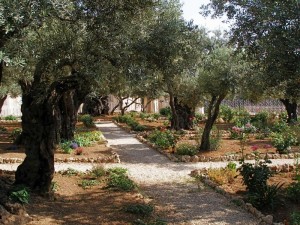 They have had their dinner during which, predicting his death, Jesus has instructed them to share bread and wine again and again in his memory. Jesus has washed their feet. He has given them his New Commandment, “Love one another.” Now, dinner ended, it is time for a stroll in the garden.
 John the Baptizer came, Luke tells us, “proclaiming a baptism of repentance for the forgiveness of sins.” (Lk. 3:3) In today’s Gospel lesson, John tells the crowds who came to him, “Bear fruits worthy of repentance.” (v. 8) Our catechism teaches us that repentance is required of us to receive the Sacraments. With regard to baptism, the catechetical requirement is that we “renounce Satan, repent of our sins, and accept Jesus as our Lord and Savior;” with regard to the Holy Eucharist, that we “examine our lives, repent of our sins, and be in love and charity with all people.” (BCP 858, 860) But John’s admonition and the Catechism’s requirements leave us wondering, “What exactly is ‘repentance’?”
  Perhaps you’ve heard about the recent advertisement that the Church of England wants to run in cinemas in the United Kingdom. It’s part of a campaign which includes the Church’s new website called
  This morning, after I took the dog for her walk and poured a cup of coffee, I turned on my computer and found a message from my friend Melania, who is from Naples but is currently working in Spain. We were students together in Ireland. This is her message:

