====================
This sermon was preached on Sunday, June 3, 2012, at St. Paul’s Episcopal Church, Medina, Ohio, where Fr. Funston is rector. (Revised Common Lectionary Readings for Trinity Sunday, Year B: Isaiah 6:1-8; Canticle 13 [BCP 1979, Page 90]; Romans 8:12-17; and John 3:1-17.)
====================
 Did you listen carefully or perhaps even follow along in the Prayer Book when I offered our opening prayer today, the Collect for Trinity Sunday? Listen to it again:
Almighty and everlasting God, you have given to us your servants grace, by the confession of a true faith, to acknowledge the glory of the eternal Trinity, and in the power of your divine Majesty to worship the Unity….
Did that make any sense to you? If not, don’t feel bad. It doesn’t make sense to a lot of people and, frankly, I don’t think it’s supposed to make sense.
Today is different from all other days in the liturgical calendar. Nearly all of our other special feast days commemorate events in the life of Jesus or events in the early history of the church or the lives of special saints, but this day, this one peculiar day, we celebrate a doctrine: the Doctrine of the Trinity. It is a day which, after many years in ordained ministry, many years preaching through the liturgical lectionary, I’ve come to realize strikes terror in the hearts of many clergy. Every year we face the same dilemma: how do we make the Doctrine of the Trinity understandable?
You know that in my sermon preparation one of the things I do is consult with other clergy. I talk with my local colleagues in bible study; I “chat” with clergy friends on the internet; I read commentaries, articles, and essays by other clergy and theologians. On one of the blogs I read pretty regularly, a Lutheran pastor summarized the Doctrine of the Trinity this way:
So let’s get right down to it, shall we? Here we go: God is 3 persons and one being. God is one and yet three. The father is not the son or the Spirit, the son is not the father or the Spirit, the spirit is not the Father or the Son. But the Father Son and Spirit all are God and God is one. …so to review. 1+1+1=1. That’s simple enough. (The Rev. Nadia Bolz Weber)
That’s really about as good a summary as I’ve read: 1+1+1=1 Wrap your head around that!
One of the folks I share things with is a priest known to many of you, Vickie H., who served in this parish a few years back. She sent me a poem that she thought she might use in her sermon entitled Dancing with the Trinity by Raymond A. Foss:
Multiple partners and yet one
all of them ready
for me to let them take the lead
to guide my steps
on the floor, on the journey
when I submit
and let them lead
Dancing with the Trinity
each of them important
all in love
in relationship
needing all
to begin to understand
the mystery that is God
That’s a lovely little bit of verse, but if I had written it the penultimate line would have been different. I wouldn’t have written “to begin to understand the mystery that is God.” One doesn’t actually understand a mystery. One experiences God; one appreciates God; one enters into relationship with God, but finite beings such as ourselves are incapable of understanding in infinite. We cannot wrap our finite heads around an infinite God! With particular regard to the Doctrine of the Trinity, the combative 17th Century Anglican preacher Robert South (who was four times offered episcopal orders and each time turned them down!) wrote, “As he that denies it may lose his soul; so he that too much strives to understand it may lose his wits.” So in Mr. Foss’s poem, I think I would have written that we begin to experience the mystery that is God. I believe that is what the Doctrine of the Trinity is all about.
Those dissidents who object to this doctrine, such as the Unitarians or the Mormons, point out that you can’t find the word “trinity” in the Bible, and they are correct. It’s not there. About the closest one can get to finding it spelled out in Scripture is in Christ’s admonition known as “The Great Commission”:
Go therefore and make disciples of all nations, baptizing them in the name of the Father and of the Son and of the Holy Spirit. (Matt. 28:19)
The revelation of God as Three-in-One and One-in-Three was understood by the church as it struggled during the first three or four centuries of its existence to grapple with questions like “Who was [or, rather, who is] Jesus?” and “What was the meaning of Jesus’ life, death, resurrection, and ascension?” and “What was it that happened to the apostles on the Feast of Pentecost?” and “Who is this Holy Spirit?” and “How does all this relate to the God of the Hebrews revealed in the Old Testament?” As theologians like Basil of Caesarea, his brother Gregory of Nyssa, their sister Macrina, and their friend Gregory of Nazianzan worked out this revelation and sought to understand it, they looked at the Hebrew Scriptures and they noticed that in creation God refers to Godself in the plural: “Let us make man in our image.” They saw that the Hebrew words for God, Elohim and Adonai, are plural nouns. They noticed things like the song of the Seraphim in our lesson from Isaiah today; they saw that the angels sang “Holy” not once but three times. They looked at Genesis and saw that when God visited Abraham and Sarah at the Oaks of Mamre God appeared in the guise of three men. They began to see God as Trinity and how God is One but also Three, how the Three Persons interrelate in a Triune community.
Ever since, theologians have been trying to make this comprehensible. I did a lot of reading in preparation for today’s sermon and I wrote down some quotations from theological articles that I thought I might be able to include in this sermon. Here’s one by a contemporary theologian named Thomas J. Scirghi. His article is entitled The Trinity: A Model for Belonging in Contemporary Society:
In the mutual relationship of the three persons of the Godhead we find the model for a human community. This relationship is characterized by kenosis and “inclusion”. Kenosis connotes the emptying, or total abandonment of oneself for a higher good, as with Jesus emptying himself for the glory of God and for the salvation of humanity (Phil. 2:5-11). “Inclusion” refers to the acceptance of others, joining them with oneself while honouring the diversity among the many, in a unity that does not seek uniformity.
Well . . . OK. But I’m not sure I understand the Trinity any better.
Another article I read was entitled Three Is Not Enough: Jewish Reflections On Trinitarian Thinking by a rabbinic scholar named David Blumenthal. Jews, of course, reject the notion that God is anything other than One. As a critique of the Trinitarian Doctrine, Blumenthal suggested, on the basis of the Jewish mystical writings, the Zohar and the Kabala, which have identified ten attributes of God that, if we’re going to do this One-in-Many Many-in-One thing, why not a “Ten-ity”? (That’s my word, not his.) But there’s a difference between Judaism and Christianity.
For rabbinic Jews, the goal and focus of religion is intellectual understanding of God, knowing God’s Laws and following them as best one can, which requires comprehension of the nature of God and God’s requirements of humankind. There’s nothing wrong with that, but for Christians the goal and focus of religion is something else; it is a personal relationship with God, not necessarily intellectual understanding. Many of us enjoy employing our intellect in that relationship and that’s not to be discouraged, but in the end relationship is not about intellectual understanding. St. Anselm once famously wrote, ” I do not seek to understand that I may believe, but I believe in order to understand.” It is belief, trust, relationship, which is primary in the Christian faith. This is why the Swiss Catholic theologian Hans Urs von Balthasar writes, “In the trinitarian dogma God is one, good, true, and beautiful because he is essentially Love, and Love supposes the one, the other, and their unity.” This is much more helpful that talk of “kenosis” or inclusion; we can begin to experience God as Trinity when we recognize that God is love and that love means relationship.
As the church was working all this out, the Latin speaking theologians settled on the word circuminsessio, which means “abiding or fixed within”, to described the way in which the all three Persons are at work in every action of God; it’s a rather static term. The Greek speaking theologians, on the other hand, chose a word you’ve heard me mention before: perichoresis. This is a much more dynamic concept. Derived from the same root as our English word “choreography”, it means “dancing around.” Isn’t that a lovely image? It’s what that poet, Raymond Foss, was picking up on. In all actions of God the Persons of the Trinity dance about together; in creation, in salvation, in sanctification, in comfort, in love . . . every action of God, every presence of God is a step in a divine dance!
As the church worked out this revelation theologically, it also began to incorporate it liturgically into its worship. In the east, particularly in the oriental orthodox churches they incorporated dance into the liturgy and they sought to act out or embody an understanding of our invitation to join in the perichoresis or heavenly dance of the Trinity. I’d like to teach you a dance still used in some of those ancient churches today.
Let’s everybody get up (those who are able to do so) and move into the aisles since we can’t dance when we’re restrained by pews. OK . . . everybody ready? First step forward with your right foot . . . now bring it back . . . step forward again . . . raise your foot . . . wiggle it about . . . now raise your hands and turn around. Now step forward with your left foot . . . now bring it back . . . step forward again . . . raise your foot . . . wiggle it about . . . now raise your hands and turn around. (The congregation begins to recognize the Hokey Pokey.)
OK . . . you get the idea. I’m having a bit of fun with you; the Hokey Pokey was not invented by the ancient oriental churches. (In fact, nobody really knows its origins.) But it makes a really good theological point. You know how it continues: you put your right arm in, then your left arm, and then various other body parts. How does it end? “You put your whole self in! . . . That’s what it’s all about!”
A few years ago there was a bumper sticker which asked this question: “What if the Hokey Pokey IS what it’s all about?” I want to suggest to you today that that is exactly the message of Trinity Sunday! That is precisely what the Doctrine of the Trinity, what the concept of perichoresis, is saying to us. Putting our whole selves into the divine dance, into which we are invited by God, IS what it’s all about!
Some of you will recall Christopher W. who was our organist here a few years back. Chris was a great fan of the music of the French composer Olivier Messiaen. Suffice to say that Chris and I parted company on that score. Messiaen’s music has never much appealed to me; it’s all very non-rhythmic and a-tonal and, frankly weird. One does not walk out of a Messiaen concert whistling the melodies! But his music is haunting and one piece in particular is amazing. It is entitled Quartet for the End of Time. Messiaen wrote it while a prisoner of the Nazis during World War II. He discovered that there were other musicians in the prison camp and they somehow rounded up a B-flat clarinet, a violin, a cello, and a piano, so he composed for those instruments. It’s a long piece of eight movements lasting about an hour. The interesting thing about it is the way he wrote instructions to the musicians. Usually, composers write things like “play slowly” or “play rapidly” (allegro or adagio in the traditional Italian). Not Messiaen! In the Quartet for the End of Time his tempo markings read “Play tenderly” or “Play with ecstasy” or “Play with love.”
In the end, that is what the Doctrine of the Trinity is all about. It’s not whether we understand it or not. It’s not how fast or how slowly we do things that church teaching may require of us. It’s whether we join the heavenly dance and move with God and the angelic chorus tenderly, ecstatically, and with love. In the end it’s not about understanding; it’s about accepting God’s invitation into the dance, into relationship, and putting our whole selves into it.
Let me shift gears here because I want to offer you something else this morning, as well. Our first lesson today is one of my favorite passages from the Old Testament. It is one of the selections of Scripture that our ordinal offers to those becoming priests for use at their ordinations; I selected it for mine. I can almost recite it from memory, this wonderful vision that Isaiah has of the heavenly throne room filled with awe and majesty, the Seraphim singing God’s praise. This scene was the inspiration for a poem by a Lutheran clergyman from Texas, a pastor named Michael Coffey. I want to leave you today with Coffey’s vision of God, an image of the God who invites us into relationship that is just a little different from those you might be used to. Pastor Coffey’s poem is entitled God’s Bathrobe:
God sat Sunday in her Adirondack deck chair
reading the New York Times and sipping strawberry lemonade
her pink robe flowing down to the ground
the garment hem was fluff and frill
and it spilled holiness down into the sanctuary
into the cup and the nostrils of the singing people
one thread trickled loveliness into a funeral rite
as the mourners looked in the face of death
and heard the story of a life truer than goodness
a torn piece of the robe’s edge flopped onto
a war in southern Sudan and caused heartbeats
to skip and soldiers looked into themselves deeply
one threadbare strand of the divine belt
almost knocked over a polar bear floating
on a loose berg in the warming sea
one silky string wove its way through Jesus’ cross
and tied itself to desert-parched immigrants with swollen tongues
and a woman with ovarian cancer and two young sons
you won’t believe this, but a single hair-thin fiber
floated onto the yacht of a rich man and he gasped
when he saw everything as it really was
the hem fell to and fro across the universe
filling space and time and gaps between the sub-atomic world
with the effervescent presence of the one who is the is
and even in the slight space between lovers in bed
the holiness flows and wakes up the body
to feel beyond the feeling and know beyond the knowing
and even as we monotheize and trinitize
and speculate and doubt even our doubting
the threads of holiness trickle into our lives
and the seraphim keep singing “holy, holy, holy”
and flapping their wings like baby birds
and God says: give it a rest a while
and God takes another sip of her summertime drink
and smiles at the way you are reading this filament now
and hums: It’s a good day to be God
 This has to be one of the most troubling bits of the Gospels. Jesus is not suggesting that one engage in self-mutilation. Any suggestion that a person should actually engage in this behavior is to be rejected. ~ Self-mutilation is a serious issue in modern society. Psychiatrist Karl Menninger suggested that self-mutilation might be an effort to heal oneself. He wrote that local self-destruction is a form of partial suicide to avert total suicide. It is now recognized as symptomatic of borderline personality disorder. So this is clearly an example of a bit of Scripture which is not to be taken literally! ~ So what is it? It is an example of semitic hyperbole. Jesus was a native speaker of Aramaic, although his words have been transmitted to us in the koine Greek of the New Testament. Speakers of semitic languages (Hebrew, Aramaic and Arabic) use hyperbole so often and in such grossly exaggerated forms that to an English speaker it almost seems to border on lying. We can assume that Jesus said this originally in Aramaic in which hyperbole was an accepted way of making a point. By exaggerating something beyond the bounds of rationality, Jesus catches our attention, stating truths in a “bigger than life” way and waking us up to the reality of our own misbehavior. ~ As G. K. Chesterton noted, Jesus was a master of the hyperbole: “Christ had even a literary style of his own . . . The diction used by Christ is quite curiously gigantesque; it is full of camels leaping through needles and mountains hurled into the sea.” ~ So, don’t tear out your eye or cut off your hand, but do be aware of your own sinfulness and misbehavior . . . and do something less drastic but effective about it!
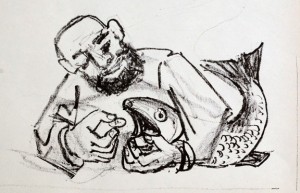 This is a weird little fish tale peculiar to Matthew’s Gospel. The temple tax about which it is told is a requirement drawn from Exodus 30:13: “Each [man] who is registered shall give: half a shekel according to the shekel of the sanctuary (the shekel is twenty gerahs), half a shekel as an offering to the Lord.” While Exodus does not make this an annual levy, most Jewish men paid the tax each year, including Jews who lived outside of Palestine. The tax provided a significant portion of the revenue needed to operate the Jerusalem Temple. There is an entire tractate of the Mishnah (Shekalim, fourth tractate in the order of Mo’ed) devoted to this tax which rather establishes its importance. Unlike Roman taxes, this tax was paid with patriotic pride by the Jews until the destruction of the temple by the Romans in A.D. 70. ~ Jesus asks Peter whether earthly kings tax their sons, to which Peter replies in the negative. Jesus seems to be implying that he, as Son of God, the King of the Temple, is exempt from the tax. However, were he to refuse to pay it, he would create a scandal, perhaps people would take his refusal to mean that he didn’t support or approve of the worship of the Temple, or that he was not loyal to the Jewish religion. They might get the idea that he didn’t think others should pay the tax. ~ So Jesus provides a way for Peter to pay the tax for him that underscores his divinity – the coin to pay the tax for both them miraculously appears in the mouth of a fish. That’s the weird part of the story. Like his walking on water and calming the storm at sea, this episode demonstrates that Jesus is the Lord of nature, but I don’t really think that’s his point here. Rather, I believe he is simply doing something that will leave an indelible impression on his disciples. ~ So there must be some lesson here for them (and for us). I think there are two. This story underscores Jesus’ humility before and on behalf of others; he declines to scandalize the community or to be a stumbling block for others. In this story he is an example of the humility we are called to exhibit, of the way in which we are to act on behalf of others, in which we are to the give up our own rights and interests for the good of others. We may not be able to produce valuable coins from the mouths of fishes, but we are able to give for others’ good even if we are not required to do so, especially when we are not required to do so!
 I try really hard not politicize these meditations, but I cannot help but think of the political rancor in our country during this election season, particularly the signs that have been paraded at so-called “tea party” rallies by persons who self-identify as “Christians” or more particularly as members of the “Christian Right”. There’s been plenty on the Left, as well, but it is from the Right that the most vile “hate speech” is heard. Just yesterday I saw a news item that Terry Jones, the pastor of the Dove World Outreach Center in Gainesville, Florida, the same fellow who threatened to burn a Qur’an several months ago, has now hung an effigy of President Obama on a gallows in front of his church. How can someone who presents himself as a Christian pastor do that? Especially in light of these words from Jesus? Especially in light of the words from Paul which are also in today’s Daily Office reading: “There is no longer Jew or Greek, there is no longer slave or free, there is no longer male and female; for all of you are one in Christ Jesus.” (Gal. 3:28) One hastens to point out to “Pastor” Jones that President Obama (despite the rantings of the far Right and no matter how one may feel about his politics) is a baptized Christian, a brother in the Lord, a fellow member of the church universal. How on earth can this man do this? ~ A couple of days ago some members of my parish and I were talking about the festival held each spring in an Ohio village near our town. It celebrates something like the return of the swallows to San Juan Capistrano in California, only in this case it is the return of the turkey vultures to Hinckley, Ohio. (You read that correctly . . . turkey vultures.) For some reason I once learned that turkey vultures (and other types of buzzard) defend themselves through the use of projectile vomiting. It occurs to me on reading this text from Matthew and considering our political discourse (especially antics like these of “Pastor” Jones) in its light, that the projectile-vomiting turkey vulture just might be the mascot of present-day American politics. May God have mercy!
 The writer of the Gospel according to Matthew may have intended this story to show Jesus’ power over nature underscoring his divinity, or at least his status as a major prophet. But I have often thought it might be considered from an allegorical perspective, as well. ~ As Jesus walks upon the waters, he transcends that which would overwhelm him; the physical act represents the indispensable gift of grace, the ability to rise above the negative elements and events of one’s time. His defiance of the natural order symbolizes his life lived according to standards higher than any human code of conduct; his reaching out to Peter and inviting him to do the same demonstrates the extending of grace to others. ~ Madeleine L’Engle once wrote, “Peter was able to walk on the water until he remembered he didn’t know how.” The hand of grace extended to us is what gives us the ability to set aside the memory of not knowing how, the ability to rise above the flood that would otherwise inundate us. ~ Creedence Clearwater Revival sang a song entitled Walk on the Water in which the singer tells of seeing a man walking on the water of the river near his home, a man calling out his name and saying “Do not be afraid.” The singer’s reaction is exactly the wrong one! “I swear I’ll never leave my home again . . . I don’t want to go; I don’t want to go. No, no, no, no. I don’t want to go.” ~ Staying at home, cowering in fear, is simply not an option. The only option is to seize the hand of grace and forget that we don’t know how to walk on the water.
 A few verses later Matthew’s Jesus will interpret this parable, though most biblical scholarship agrees that it is Matthew (or some later editor) doing the interpreting not Jeus, that the interpretation is “nondominical” (as may be the parable itself). According to that interpretation, the enemy is supposed to be the devil, that the wheat that grows from good seed are all the people who’ve heard the gospel and responded appropriately, that the weeds that sprout from the bad seed are all the people who’ve followed the devil instead, and that when it’s all gathered and sorted (the wheat for the barn – Heaven – and the tares for the fire – Hell) it’s the last judgment. Martin Luther taught that the tares are “heretics and false teachers” who are “beautifully green and hypocritical.” But then he also said this parable teaches “that our free will amounts to nothing.” I’m not sure I buy that. ~ It seems to me that the parable in this form is a plea for inclusivity and tolerance. It’s not up to us who’s in and who’s out. The weeds depicted in this parable are probably darnels. Darnels look very much like wheat until harvest time and they cannot be told apart. Furthermore, their roots intertwine with the wheat’s roots so that they cannot be removed without significant damage to the crop. We’ve all seen what happens in a community when some group of “purists” starts trying to determine who gets to stay and who has to go. Better to let all stay and let God sort things out later than to destroy the community. ~ I remember reading some years ago that other rabbis have told a similar parable in which the mixing of wheat and weeds re-occurs over the course of several years. Finally, the owner’s steward decides to find out who the enemy is and stays up at night. When “the enemy” comes to sow the bad seed, the steward is surprised to find that it is the owner himself, sleep-walking in the darkness. This version suggests that we each sow the seeds of our own troubles, that we are each responsible for the good and often for the bad in our lives. The two versions read together underscore the reality that we frequently cannot tell the wheat from the weed, the good from the bad. Best to leave it to God to sort out!
 I am truly amazed at the lengths some people go to deny that Jesus had brothers and sisters. The Greek here is adelphos (pl. adelphoi) and it means “brothers”. It could mean a countryman, a fellow employee, or someone of the same ancestral lineage in some contexts, but do any of those apply here? No! Here, some men show up in the company of Jesus’ mother and with her they are described as “your mother and your brothers”! Could anything be clearer? ~ Those who argue in favor of some alternate meaning (like “cousin”) do so because they want to preserve the supposed “perpetual virginity” of Mary. But if these men are Jesus’ cousins why wouldn’t Matthew have used the word anepsios (which means “cousin”)? The second-century writer Hegesippus, calls James and Jude “brothers of the Lord,” but he uses this word anepsios of Simeon the son of Clopas, the “cousin of the Lord”, so it is possible to distinguish the two relationships and certainly the gospellers could have done so! ~ Others argue that these men were Jesus’ half-brothers, Joseph’s boys by a first marriage. If that’s the case, where is the biblical evidence for that? Where is there even a hint that Joseph was previously married, let alone that he was bringing a bunch of kids along? ~ And as for Mary’s “perpetual virginity”, what does one do with Luke’s description of Jesus as “her firstborn son”? (Luke 2:7) Doesn’t that somehow imply that there was at least a “second born son”, if not a few others? And maybe some daughters? Both Mark and Matthew report that Jesus had sisters. (See Mark 3:32 & 6:3 and Matthew 13:56) If she’d had no other children, wouldn’t Luke have used the word “only” rather than “firstborn”? ~ And as for the virginity thing . . . . Matthew says that Mary became pregnant “before they [i.e., Joseph and Mary] lived together.” (Matthew 1:18) The Greek here is sunerchomai, which specifically refers to conjugal cohabitation! And Matthew continues, saying that Joseph “had no marital relations with her until she had borne a son.” (Matthew 1:25) I mean, really! Can the biblical witness to Mary’s non-virginal status after the birth of Jesus get any clearer? ~ Finally, there’s the cultural argument. For this “perpetual virginity” story to hold water, Joseph would have had to live a life of complete abstinence and chastity! This would not have been a societal norm and certainly wouldn’t be in accord with Jewish marital custom. Under Jewish law, sex is not considered shameful, sinful, or obscene; indeed, there is an halakhic obligation to procreate, and partners are not permitted to withhold sex from one another! Failure to abide by the law is practically unthinkable from the parents of a man who said, “Do not think that I came to abolish the Law or the Prophets ; I did not come to abolish but to fulfill. For truly I say to you, until heaven and earth pass away, not the smallest letter or stroke shall pass from the Law until all is accomplished.” (Matthew 5:17-18) ~ Why is this important? I suppose in many ways it isn’t! But for me . . . . I have this idea that the Christian church oughtn’t to promote ideas that are patently absurd. If the church has to perform all sorts of silly linguistic contortions and rely non-biblical and a-historic pious legends to support its dogmas and doctrines, can we really blame those who shrug their shoulders and walk away? ~ A virgin? Perpetually? C’mon! Get real!
 You have no idea how many times in 22-plus years of ordained ministry someone has said to me, “What exactly is the unforgivable sin of blasphemy against the Spirit? What is that?” I used to struggle to answer that question because I wasn’t sure myself. I’m not all that sure now, but I think the answer to to simply look at the context in which Jesus says these words. He has just healed a blind and mute demoniac. The Pharisees insist that “It is only by Beelzebul, the rule of demons, that his fellow casts out demons.” (Matt. 12:24) In this context it would appear that blasphemy of the Holy Spirit is saying that Jesus did his miracles by the power of the devil. It was attributing to evil the work of the Holy Spirit. ~ I wonder if doing the opposite might also be considered here – attributing to the Holy Spirit words that she didn’t say, deeds that she didn’t do, and experiences that she didn’t produce, attributing to the Holy Spirit that which is not the work of God. There are plenty of TV preachers these days attributing to God lots of things (especially political positions) that I simply cannot believe are the work or word of God. Are they flirting with blasphemy of the Holy Spirit? ~ Here’s what I think . . . attributing to evil the works of good and, in the opposite vein, calling good that which one knows to be evil, these things destroy relationships and disrupt community for no reason or purpose other than promotion of one’s own agenda. If, as we believe, the church is a community created and constantly renewed by the Holy Spirit commissioned to go into the world to do the work of Jesus, then the blasphemy against the Holy Spirit are words and actions which disorder that community and disrupt that work. ~ There are some who say that the blasphemy of the Holy Spirit can no longer be committed because it is specifically about the actions of Jesus himself; since Jesus is no longer in the world, one can no longer attribute his actions to evil. Others say that anyone who is a believer in Christ cannot commit this sin. I think they’re both wrong. I think people blaspheme the Holy Spirit on a regular basis . . . and a lot of them are (or, at least, claim to be) Christians.
 These three similes – I am like a vulture in the wilderness; I am like an owl in the ruins; I am like a lonely sparrow – intrigue me. They are metaphors of solitude but worse than solitude, of loneliness, of being completely cut off. ~ The word translated as “vulture” in the NRSV is qa’ath; older translations rendered this as “pelican”. According to the lexicon the word signifies “a ceremonially unclean bird”, but the lexicon admits that the exact meaning of the ancient Hebrew is unknown. The root of the word is qow’ which means “to vomit”. From some bit trivia learned long ago, I recall that vultures defend themselves with intentional projectile vomiting. The simile depicts one so distraught , so distressed, so stricken that she keeps others away, spewing her grief onto those who would comfort her. ~ The Hebrew word translated as “owl” is kowc: owls also are ritually unclean birds. The lexicon tells us that it is “from an unused root meaning to hold together.” This simile perhaps suggests the same thing as the English phrase “barely holding it together”; amidst the waste and devastation of his life, the psalmist is barely holding on, hanging from his last thread, unable to handle one more thing even a small expression of sympathy and support without “losing it altogether.” ~ In the third simile, the psalm uses the word tsippowr, here translated as “sparrow” although more generically it simply means “bird”. This simile holds out hope where the others do not. The same word is used by prophet Ezekiel to paint a picture Jesus will later use as an encouragement to faith: “On the mountain height of Israel I will plant [a cedar], in order that it may produce boughs and bear fruit, and become a noble cedar. Under it every kind of bird will live; in the shade of its branches will nest winged creatures of every kind.” (Ezek. 17:23) Jesus will change the cedar to a mustard tree and promise that even the smallest amount of faith, faith the size of a mustard seed, can accomplish miracles. (Matt. 13:31-32; Matt. 17:20) For the lonely sparrow on the house-top there is the hope of flocking with others in tree planted by the Lord; for the lonely sparrow there is the hope provided by faith. ~ The rest of the morning psalm expresses that hope. The psalmist acknowledges gratefully that God “will look with favor on the prayer of the homeless; he will not despise their plea” and “their offspring shall stand fast in [God’s] sight.” No matter how cast out, unclean, despairing, or distraught, even the vulture and the owl, together with the sparrow, can come and make nests in the branches of the tree planted by God.
 This is such a great verse! Matthew could have made some christological or soteriological comment about “the Son of Man” – in fact, he has done so earlier in this story and will do so again in the next chapter. But here the power and authority to heal is specifically described as being given not just to Jesus but “to human beings” . . . to you and to me! That’s great! ~ A couple of years ago the American Psychological Association reported that the first decade of the 21st Century saw a dramatic increase in the number of American adults praying about health issues. Even though attendance at formal religious services has fallen in the same period, informal and private spiritual practices such as prayer seem to be on the increase. One of the interesting results of a study by the Centers for Disease Control was that those who exercise are 25% less likely to pray than those who don’t…. One wonders if those who pray are less likely to exercise. ~ I’m not an exerciser myself. I admit that I should be; I’m just a lazy procrastinator who can’t get around to it. But I am a person who prays, and I often pray for health and healing for myself and for others. ~ The teacher of prayer who looms largest in my life is my late paternal grandfather. One of the things he taught me about prayer is “never pray for something you aren’t willing to work for.” His point was that God’s answer to your prayer just might be that God would send you into the midst of whatever the situation is to work toward a solution. I’m beginning to think that there’s a lesson here about exercise and health, too. I really shouldn’t be praying for my own physical health if I’m not willing to get off my duff and work for it. God has given me the authority to live a healthy life. I guess I’d better claim it and start doing it. ~ Tomorrow . . . maybe.

