Revised Common Lectionary for Maundy Thursday, Year B: Exodus 12:1-14; Psalm 116:1,10-17; 1 Corinthians 11:23-26; John 13:1-17, 31b-35
Redemption is a drama in three acts – three acts and a brief intermission – tonight we take part in Act One.
Act One, Scene One: The curtain rises. We see a group of people gathered in an upper room somewhere in Jerusalem.
 A meal is in progress… Is it a seder, the ritual meal of remembrance of the Passover? We don’t really know; the playwrights have not made this clear; the theater critics, the scholars debate this issue. Three of the story-tellers suggest that it is but the fourth, John, tells the tale very differently. (The synoptic gospels tell the story in a similar way and, if truth be told, in the same way – Luke and Matthew based their stories on Mark’s, so to be honest there aren’t three stories, there’s only one that would make us think that this supper is a seder, but John doesn’t. In fact, John doesn’t even care about that – he spends no time at all describing the meal, for him the important thing is what happened afterward, and that comes in a later scene. So as we begin this three-day, three-act drama of redemption, since we have heard Luke’s voice narrating the story, let’s just assume that what we see in this first scene of the first act is, indeed, a seder.)
Those present are prepared to do all that is laid out in the instructions in the book of Exodus; they have worn their sandals; they carry their staffs; they expect to eat of roasted lamb and unleavened bread and bitter herbs. They anticipate spending the night in remembrance of that which happened generations before in Egypt. If we can imagine that they celebrate as modern Jews celebrate, they expect the youngest among them to ask the questions, beginning with “Why is this night different from all other nights?” They know that the head of the household, their rabbi Jesus, will answer those questions in the prescribed way and tell the story of the Passover.
And when the youngest asks “Why do we eat the broken matzah?” they expect Jesus to answer “This is the bread of our affliction; the unleavened bread of poverty, baked and eaten in haste,” but instead he takes the bread, brakes it and says, “This bread is my body, given for you.”
Can’t you just see them in this scene, reclining in that upper room, those serving the meal coming and going, a breeze blowing through the open windows, following along in their prayer books, the Haggadah … They look up startled, glancing at one another, murmuring to each other, “What is he talking about? That’s not here! That’s not the right answer. Where is he? What page is he on?” But the moment passes, the meal moves on, until at the end he takes up the fourth and final cup of wine, the kiddush cup, which recalls God’s promise, “I will acquire you as a nation; you will be my people and I will be your God.” They expect Jesus to say, “Blessed are you, O Lord our God, sovereign of the universe, creator of the fruit of the vine,” but instead they hear, “This cup is my blood!” “What?! What is he saying???”
It is for Jesus and his disciples one of those fleeting opportunities when, because of the pupils’ confusion or frustration or grasping for understanding, the teacher can pass on to the students new information, new values, new moral understanding, a new behavior, a new skill, a new way of seeing and coping with reality; it is what we have come to call “the teachable moment” and so he teaches, yet again, “Remember! Remember,” he says, “Love one another as I have loved you.”
The curtain falls as Jesus continues to teach; the disciples look mystified.
Act One, Scene Two: The curtain rises again. We see the same group of people gathered in the same upper room somewhere in Jerusalem.
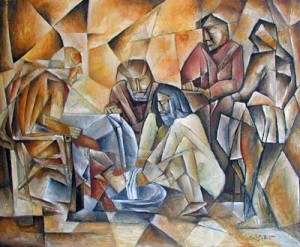 The meal is over, the dishes have been cleared. The disciples are arguing among themselves about who is the greater among them. Jesus looks frustrated and troubled; the teachable moment has passed and they clearly have not understood! They just haven’t gotten it.
“Look,” he says, “the greatest among you must become like the youngest, and the leader like one who serves. For who is greater, the one who is at the table or the one who serves? Is it not the one at the table? But I am among you as one who serves. Here, let me show you what I mean.” Getting up from the table, he takes off his robe, ties a towel around himself, pours water into a basin, and begins to wash and dry the others’ feet. Peter protests, “You will never wash my feet.” Jesus answers, “Peter, if I don’t wash you, you can’t be part of what I’m doing.” So Peter relents, “Well then, not only my feet! Wash my hands and my head, too!”
Peter speaks for us. We don’t get this foot-washing thing, do we? Washing our hands makes more sense to us, as it does to Anglican nun and poet Lucy Nanson who wrote:
Wash my hands on Maundy Thursday
not my feet
My hands peel potatoes, wipe messes from the floor
change dirty nappies, clean the grease from pots and pans
have pointed in anger and pushed away in tears
in years past they’ve smacked a child and raised a fist
fumbled with nervousness, shaken with fear
I’ve wrung them when waiting for news to come
crushed a letter I’d rather forget
covered my mouth when I’ve been caught out
touched forbidden things, childhood memories do not grow dim
These hands have dug gardens, planted seeds
picked fruit and berries, weeded out and pruned trees
found bleeding from the rose’s thorns
dirt and blood mix together
when washed before a cup of tea
Love expressed by them
asks for your respect
in the hand-shake of warm greeting,
the gentle rubbing of a child’s bump
the caressing of a lover, the softness of a baby’s cheek
sounds of music played by them in tunes upon a flute
they’ve held a frightened teenager,
touched a father in his death
where cold skin tells the end of life has come
but not the end of love,
comforted a mother losing agility and health.
With my hands outstretched before you
I stand humbled and in awe
your gentle washing in water, the softness of the towel
symbolizing a cleansing
the servant-hood of Christ.
Wash my hands on Maundy Thursday
and not my feet.
Yes, Peter speaks for us; we would rather our hands be washed. But Jesus insists, he must wash his disciples feet for only in this way does one truly honor and serve another in love, only in this way does one recall whose servant one is. He says to them, “If I, your master and teacher, have washed your feet, you must now wash each other’s feet.” Only in this way can his disciples remember his teaching that what is done for us is also to be done for others.
They don’t get the opportunity, however, for the second scene ends as Jesus becomes visibly agitated and declares, “One of you is going to betray me.”
As the curtain goes down, the disciples are looking puzzled and Judas Iscariot is leaving.
Act One, Scene Three: The curtain rises again. We see a garden and an olive grove just outside of Jerusalem. Jesus is there, accompanied by Peter, James, and John.
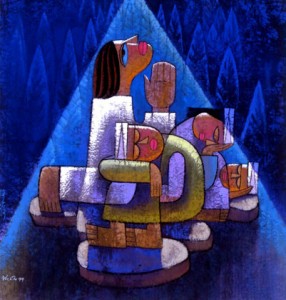 “Stay here,” he tells them, “Stay awake while I go over there to pray.” As they settle themselves, he moves away from them, and collapses in a heap, sobbing: “O God … Father, let this pass!”
Three times he returns to find them asleep; three times they rise looking sheepish and embarrassed; twice he tells them again to try to stay awake as he goes away still pleading with God for a way out. “Enough,” he says the third time, “Enough! We’re leaving.”
When they look back on that night, how must they feel? When we look back, how should we feel?
Poet Mary Oliver offers a glimpse in her poem Gethsemane:
The grass never sleeps.
Or the roses.
Nor does the lily have a secret eye that shuts until morning.
Jesus said, wait with me. But the disciples slept.
The cricket has such splendid fringe on its feet,
and it sings, have you noticed, with its whole body,
and heaven knows if it ever sleeps.
Jesus said, wait with me. And maybe the stars did,
maybe the wind wound itself into a silver tree,
and didn’t move, maybe the lake far away,
where once he walked as on a blue pavement,
lay still and waited, wild awake.
Oh the dear bodies, slumped and eye-shut, that could not
keep that vigil, how they must have wept,
so utterly human, knowing this too
must be part of the story.
Yes, this too, our utterly human inability to fully keep company with our Lord, this too must be part of the story when it is told, as we see it unfold in the church’s memory tonight, but for now the stage fills, the garden becomes crowded … Judas returns accompanied by temple guards, and Roman soldiers, and servants of the priests … and are those some of the disciples showing up? The orchard of olives suddenly is filled with angry activity, with scuffling, with fighting, with confusion. Peter calls out, “Lord, should we fight back?” and, without waiting for an answer, draws his sword and cuts off a servant’s ear.
“Stop!” cries Jesus. He reaches out and tenderly touches the servant’s head, healing his wound. He seems sadly confused, “Why have you come to arrest me with swords drawn?” he asks, “I’ve been teaching in the temple all week! You could have taken me any time.” It all seems too much for him. Certainly, it’s too much for us! Again, a poet, Ted Loder, speaks for us:
Sometimes, Lord,
it just seems to be too much:
too much violence, too much fear;
too much of demands and problems;
too much of broken dreams and broken lives;
too much of wars and slums and dying:
too much of greed and squishy fatness
and the sounds of people
devouring each other
and the earth;
too much of stale routines and quarrels,
unpaid bills and dead ends;
too much of words lobbed in to explode
leaving shredded hearts and lacerated souls;
too much of turned-away backs and yellow silence,
red rage and the bitter taste of ashes in my mouth.
Sometimes the very air seems scorched
by threats and rejection and decay
until there is nothing
but to inhale pain
and exhale confusion.
Too much of darkness, Lord,
too much of cruelty
and selfishness
and indifference.
Too much, Lord
too much,
too bloody,
bruising,
brain-washing much.
Or is it too little,
too little of compassion,
too little of courage,
of daring,
of persistence,
[too little] of sacrifice?
Jesus and his captors exit; the disciples, confused and frightened, sneak out behind them. The curtain falls. We are left in darkness….
Let us pray:
Heavenly Father, as we enter again into the mystery of these three most holy days, as we participate once again in this three-act drama of redemption, we ask you to illumine our minds and hearts with the hope and promise of Christ’s passion, death, and resurrection; satisfy our hunger and thirst not for bread and drink alone, but for love, and truth, and justice, and peace; as we share your Son’s Body and Blood, renew us and energize us to be a true community of light amid the darkness of sin and injustice in our world; as Jesus invites us to share at his Table, let us in turn invite our brothers and sisters to the table where all can share the resources of your abundance, where justice and peace reign, and where love transforms souls and societies; as the drama of redemption continues, may life conquer death, may light shine in the darkness, and may courage and compassion grow from sacrifice; in Christ’s holy Name we pray. Amen.
 When I joined the Episcopal Church in high school, the last verse of this quotation was the favorite offertory sentence of the parish priest – in the King James Version, of course: “Let your light so shine before men, that they may see your good works, and glorify your Father which is in heaven.” If he didn’t say that one, he said, “Not every one that saith unto me, Lord, Lord, shall enter into the kingdom of heaven; but he that doeth the will of my Father which is in heaven.” (Matt. 7:21 KJV) I memorized those verses not by reading them, but by hearing one or the other at every service as the invitation to make a gift to God. I learned the lesson of an active faith, of being public and “out there” with my beliefs, of doing the will of the Father, from hearing those simple but profound verses at every service. ~ I love the 1979 Book of Common Prayer and its many options for worship, but I wonder whether in our quest for variety in worship we have left behind the wisdom of simple, repetitive teaching. In our current worship practice we are directed by a rubric to offer prayers for the Universal Church, its members, and its mission; for the Nation and all in authority; for the welfare of the world; for the concerns of the local community; for those who suffer and those in any trouble; and for the departed . That’s well and good, but the way in which these prayers are offered is left up to the designers of each service or to the presiding ministers and, in fact, variety seems to be encouraged. On the other hand, in our previous prayer book (and all those that preceded it) there was one prayer “for the whole state of Christ’s church.” Every Sunday, the same prayer was offered; the same lesson of the need for prayer was taught. ~ That standard prayer included the every Sunday petition that God “inspire continually the Universal Church with the spirit of truth, unity, and concord: And grant that all those who do confess thy holy Name may agree in the truth of thy holy Word, and live in unity and godly love.” Is it possible, just the least bit possible, that some of our current discord in the church is because we’ve stopped hearing these words, stopped teaching and learning the lesson of “truth, unity, and concord”, stopped trusting God to support us in agreement, unity, and “godly love”? Have we extinguished our light, have we stopped shining that light before others because we’ve stopped offering and hearing these simple, repetitive lessons? ~ I don’t know. And I love variety in worship. But remembering those every Sunday offertory sentences, those every Sunday petitions for unity, I’m beginning to wonder.
 Another reading of that proclamation is “Repent, for the kingdom of heaven is at hand.” To my hearing, this alternative version is a bit more imperative; the kingdom seems a bit more imminent when it is “at hand” rather than simply has “come near.” We used to live in that part of northeastern Kansas known as “tornado alley”. If we said a tornado had “come near” that was as good as saying “It missed us! It didn’t hit us.” On the other had, if someone had said a twister was “at hand”, I would have thought it was coming right at our front door! So . . . theologically I prefer the latter reading, but must confess that personally I breathe a sigh of relief if the kingdom merely has come near. A miss, after all, is as good as a mile, and it gives me time to do this repenting and reforming that Jesus calls for. ~ So what is this “kingdom of heaven”? Let’s get one thing clear right off the bat – it is not something different from the “kingdom of God”. Some try to make a distinction (like the notes in the Scofield Reference Bible towards which I acknowledge great antipathy), but a comparison of the gospels demonstrates that they are the same thing (compare these verses: Matthew 4:17 with Mark 1:14-15; Matthew 5:3 with Luke 6:20; Matthew 13:31 with Mark 4:30-31). ~ This kingdom also is not a place far away or near by. The Greek here is basileia ; the Hebrew for the same concept in the Old Testament (e.g., Ps. 103:19) is malkuwth. While both can refer to a physical place, an actual nation state, they are better understood to refer to a condition or fact or authority of sovereignty or dominion; they might better be translated is “rule” or “reign”. This kingdom also is not a time – past or present or future. It isn’t some place or state or condition at which we arrive after death; it isn’t some place or state or condition which will arrive on earth at some future time. So what is it? ~ Well . . . in Luke’s gospel, Jesus is asked by the Pharisees about the signs of the kingdom’s arrival, to which he replies, “The kingdom of God is not coming with signs to be observed; nor will they say, ‘Look, here it is!’ or, ‘There it is!’ For behold, the kingdom of God is in your midst.” (Luke 17:20-21) The Greek here is entos which means (and in other versions is translated literally as) “within you”. Other things the Christian scriptures tell us are found within human beings are the “word of Christ” richly dwelling (Col. 3:16), spiritual gifts (1 Tim. 4:14), and sincere faith (2 Tim. 1:5). The Hebrew scriptures mention peace (e.g., Ps. 12:8), God’s commandments (Prov. 7:1), and “a new heart and a new spirit” (Ezek. 36:26). In other words, the kingdom is an internal, spiritual characteristic of human beings characterized by these things. That’s coming about as “near” as you can get! That’s even more imminent than being “at hand.” If it’s within me, within you, within us, right here in the midst of us . . . that’s a matter of some urgency! We’d best be paying attention to it. ~ It is also characterized by the things revealed in the eight “kingdom parables” of Matthew 13, but that is too much to write about in a short meditation on a sunny day. I’ll leave those to the reader’s own contemplation. ~ Just one final note . . . if the kingdom (in all its characteristics) is truly within a person (or within a community), it will be very apparent by that person’s (or community’s) outer actions, his or her (or their) conduct, his or her (or their) relationships with others and the whole of creation. Here, the words of the Letter of James apply: “Faith by itself, if it has no works, is dead. But someone will say, ‘You have faith and I have works.’ Show me your faith apart from your works, and I by my works will show you my faith.” (James 2:17-18) If the kingdom of heaven is truly within, truly come near, truly at hand in the lives of Christ’s followers, then it will be made clear in works of mercy. I think that’s the repentance and reformation Christ encourages here.
 You’ve got to hand it to John the Baptizer! He sure knows how to warm up and relate to a crowd. ~ What is John saying by greeting his audience thus? Is John speaking to the Pharisees and the Sadducees at all, or rather to the rest of the crowd? Or, more likely, is Matthew (who here is repeating a line found also in Luke and who later puts these same words into Jesus’ mouth) saying something to us, his later readers? ~ I grew up with snakes. In the desert wilderness of southern Nevada, pit vipers (in the form of rattlesnakes) were common even our backyards. Rattlesnakes can be dangerous, but they are also cowards. A rattler prefers to remain motionless, hoping not to be noticed. If you come too close and corner it, it will rattle a warning and stand its ground. But rattlesnakes never pursue people; they would rather flee than fight. They prefer to “flee the wrath to come”; make them aware that you’re coming and they will slither away as quickly as they can. ~ The image Matthew’s Baptizer puts before us may be that of a fearful group scattering in all directions. On the other hand, when snakes are congregated in a large group where they cannot flee, they are very dangerous. It is noteworthy that John says, “You brood of vipers” not simply “You vipers”. To me, the word brood suggests a bunch of snakes all tangled up together (as in the picture accompanying this text). When rattlers are congregated like this, they can’t and don’t flee – maybe it’s a phenomenon of “safety in numbers” – they stick together in a writhing, deadly mass. ~ Who are the vipers today? Back then, it was the religious leadership and not just those of one “party”. John addressed himself to both Pharisees and Sadducees, both the “right” and the “left” of his day. Could it be that today’s “brood of vipers” are the leaders of the churches? Could it (in my own denominational tradition) be all of the bishops and leaders of the Anglican Communion who have spent too much time tangled up, hissing and rattling at each other about issues which truly are adiaphora to the Gospel of Jesus Christ? Could it be that John’s complaint was not that the Sadducees and the Pharisees were corrupt or evil, but that they were distracted and wasting their time and effort, that his ire was worked up because rather than be about the work of God they were too busy wrangling with one another over that which was extraneous and immaterial to that work? ~ John contrasts the “brood of vipers” to the “brood of Abraham”, reminding his listeners that God could “from these stones . . . raise up children to Abraham.” God was able to raise up in the church of Christ a brood for Abraham who were not of the lineage of the Jews. Has that brood, however, slipped into the same irrelevant behavior?
 Jethro, Moses’ father-in-law, has to have been one of the wisest men in all of Holy Scripture! What he advises Moses to do is nothing less that to delegate authority and responsibility. Delegation is one of the most important management skills. Good delegation saves time, develops people, grooms successors, and motivates subordinates. Poor delegation will causes frustration,confuses subordinates, discourages others, and leads to failure of purpose. Delegation is vital for effective leadership. Jethro seems to have known this and recommended it to Moses: “Look for able men among all the people, men who fear God, are trustworthy, and hate dishonest gain; set such men over them as officers over thousands, hundreds, fifties and tens.” (Exod. 18:21) ~ Here’s the thing, though, delegation means letting go! Once you have handed over authority, you cannot dictate what is delegated nor how that delegation is to be managed. Delegation means letting go and letting go is hard. Human beings, especially talented and successful ones, are reluctant to let go of the things we do well. It’s simply human nature. But refusal to hand-over jobs to subordinates minimizes our productivity and effectiveness. We need to learn to let go. That, by the way, is the message of Christ. Jethro anticipated Jesus: “Do not worry about tomorrow, for tomorrow will bring worries of its own. Today’s trouble is enough for today.” (Matt. 6:34) In other words, let go! ~ When I was in college there was a bumper sticker popular among church-going Christians of a particular sort. It read, “Let go and let God”. And I know it’s also a catch-phrase for twelve-steppers and apparently it works for them…. but I hated it then and I don’t like it any better now! I think it misinterprets and trivializes the Christian message, what it means to be an active and responsible Christian. Jesus, in fact, never tells us to “let go and let God”. “Letting go” in this catch-phrase seems to imply that one do nothing, say nothing, feel nothing, and accept responsibility for nothing. That is neither what Jesus said, nor what Jethro advised Moses! Jethro told Moses to continue to be involved: “Let them sit as judges for the people at all times; let them bring every important case to you, but decide every minor case themselves.” (Exod. 18:22) Every good manager knows that delegation doesn’t mean complete relinquishment of responsibility, and every good Christian ought to know that “letting go” doesn’t mean just shrugging everything off onto God’s plate! Yes, we need to learn to let go, but letting go means letting go of tension, anxiety, worry . . . not of all responsibility. God has high expectations of us! That bumper sticker catch phrase fails to acknowledge that. ~ The fellow who said “Do not worry about tomorrow . . .” is also the man who said “Beware, keep alert . . .”, the man who said “[When] you did it to one of the least of these who are members of my family, you did it to me.” (Mark 13:33; Matt. 2:40) We are not to abandon our responsibilities; we are to meet them in a non-anxious way in community working with others. That is what “letting go” means. That is what God expects of us; that is what Jethro advised Moses.
 The early members of the church were prepared, I think, to be separated from the synagogue, to be cast out from Judaism, and to take the major step of becoming adherents of a new and distinct religion. The church members of the first few centuries were, I think, prepared to be persecuted, killed, martyred. Through their witness and the strength of their faith, the church overcame that separation and that persecution to become the most powerful institution in Western Europe; it was prepared to do that. That was, of course, a mixed blessing and there is a lot of historical debate about and some warranted condemnation of the church’s record as the established religion of empires and kingdoms. However, for 2,000 or so years the church, faced with and prepared for either persecution or power, flourished. ~ What the church was not and still is not prepared for is to be relegated to the sidelines, to be treated with indifference, to be seen as irrelevant to the lives of the people it is charged to reach (I’m thinking “Great Commission” here – Matthew 28:16–20). In other words, the church is not prepared for the contemporary, so-called post-modern world which it, in many ways, has helped to create. A recent book, The Millenials (B&H Books, 2011), claims that 70% of those born between 1980 and 2000 consider the church irrelevant to their lives. Meanwhile,
  This is the fifth and last Lenten sermon addressing a question posed by a parishioner and, in fact, I will try to answer succinctly two related questions that two parishioners asked. One was “What does the word catholic mean when we say it in the Nicene Creed?” and the other was “What do you (meaning me, Father Funston) mean when you describe the Episcopal Church as being ‘in the Catholic tradition’?” (If you could see the way I have typeset these sermon notes, you would see that I have capitalized the “C” in catholic in the second question, but not in the first. That’s an important point which I will address shortly. But let me start with a basic definition in answer to the first inquiry.
 The simple answer is that fasting is going without some or all food or drink or both for a defined period of time. An absolute fast is abstinence from all food and liquid for a period of at least one day, sometimes for several days. Other fasts may be only partially restrictive, limiting particular foods or substance. The fast may also be intermittent in nature; for example, Muslims fast during the daylight hours of the month of Ramadan which is intended to teach Muslims patience, spirituality, humility, and submissiveness to God. Fasting as a spiritual practice is common to all major religions. Mahatma Gandhi once noted:

