Revised Common Lectionary readings for the Seventh Sunday of Easter (Sunday after the Ascension): Acts 1:15-17, 21-26; Psalm 1; 1 John 5:9-13; and John 17:6-19.
 The story from the Acts of the Apostles this morning tells us that the apostles, in choosing a replacement for Judas Iscariot, relied on a game of chance. They couldn’t decide between two candidates so, rather than voting, they “cast lots”, drew straws, rolled the dice. Matthias got the short straw. As I was contemplating these lessons, and particularly this story, this week, I was also assaulted by radio and television advertisements for the new Horseshoe Casino in downtown Cleveland. And just like the lessons of the past few weeks, this coincidence of events triggered a memory of childhood. But this week, the memory was not of summers spent with my grandparents, it was of Saturdays spent with my father.
My father, R. York Funston, was a Certified Public Accountant in Las Vegas, Nevada. During the 1940s and 1950s one of the ways the authorities kept tabs on the gaming industry was through weekly audits of the casino records conducted by state-appointed CPAs, of which my dad was one. For some reason, the Gaming Control Board thought Saturday mornings would be the best time for the books to be collected, so that was when he would make the rounds of the five casinos he was responsible for. It was also the day my mother did her housekeeping and she didn’t want me underfoot, so I would accompany my dad as he drove through Las Vegas visiting the casinos.
The Las Vegas of the early 1950s was rather different from the city one visits today. In those days, Las Vegas as about the size of current-day Medina, Ohio. A permanent population of right around 30,000 people, a downtown like that of any other city with a Sears-Roebuck, a Rexall drug store, a locally owned department store called Ronzone’s, a movie theatre that showed double-features, and half-a-dozen or so casinos. We lived near the south edge of town in a post-war housing development called Huntridge. Just a couple blocks south of us was Sahara Boulevard, south of which was the desert and a collection of horse ranches called Paradise Valley.
Dad and I would get up and leave the house at about 6 a.m. on Saturday mornings and drive through Paradise Valley headed for the Tropicana Hotel & Casino to pick up the first set of books. Then we’d hit three other places on the strip and finish up downtown at Binny Binion’s Horseshoe, the casino which eventually became the big publicly-traded corporation now running a casino in Cleveland.
This was not, in terms of miles traveled, a very long trip, but it would take about four or five hours because at each stop my dad would have a cup of coffee and a conversation with the casino managers. At each place, I would get to spend time with a change girl or a cocktail waitress while Dad conducted his business, and sometimes I’d get to meet other people. For example, I met Frank Sinatra and Dean Martin and all the rest of the Rat Pack when I was four years old. But when we got to Binion’s, I got to do something else.
The Horseshoe was on the corner of Fremont, the downtown main street of Las Vegas, and Third Street, and the whole corner of the building was open to the street. Right at the corner, visible for everyone passing by to see, was a big glass box in which, it was said, there was $1,000,000 in U.S. currency in bills of various denominations. On either side of the box stood a uniformed guard carrying a shotgun. Casino patrons could get inside that box with all that money and large fan would blow a whirlwind around them and lift those bills so they were flying all around the person. I’m not sure how long the patron had, maybe a minute, but whatever it was, the idea was that during that period of time whatever bills the person could catch and hold on to, they got to keep. My dad would leave me there at the entrance to Binion’s Horseshoe and let me watch those people trying to catch money while he went inside and got the books. I never saw anybody catch very many bills – that’s really hard to do.
So when the Bible describes a game of chance as the means by which the apostles chose a successor to Judas, and the radio is broadcasting ads for a new casino in Cleveland, I remember those childhood visits to Binion’s Horseshoe and those silly people grabbing at those flying bills.
Luke does not tell us whether Matthias was commissioned in any way for his ministry as Judas’s replacement, but I think we can be fairly certain that he was. Elsewhere in Acts Luke describes acts of laying of hands and prayer to commission people for special ministries, and church historians assure us that from the very earliest days of the church this was the regular practice. Today we are commissioning a group of St. Paul’s members to perform a special ministry as part of what is called a Grow My Church Task Force. The “my” in “Grow My Church” refers to Christ; this title is a paraphrase of Jesus’ “Great Commission” to the Apostles, the commandment given them just before his ascension into heaven. St. Matthew reports it in these words:
Go therefore and make disciples of all the nations, baptizing them in the name of the Father and the Son and the Holy Spirit, teaching them to observe all that I commanded you; and lo, I am with you always , even to the end of the age. (Matt. 28:19-20)
Jesus refers to his intention to do this in today’s gospel from John, in what is called his “high priestly prayer” offered to God on the night of the Last Supper. In fact, this prayer is the Apostles’ commissioning by Jesus for the ministry they will be given:
Sanctify them in the truth; your word is truth. As you have sent me into the world, so I have sent them into the world. And for their sakes I sanctify myself, so that they also may be sanctified in truth. (John 17:17-19)
The word for sending here in the original Greek of the New Testament is apostello and it is from this word that we get our word apostle – an apostle is one who is sent.
In a few minutes, we will formally commission the Task Force, we will make them apostles sent to do a job, but before we do, I want to tell you what the Vestry, our parish governing board, has charged them to do. At its last meeting, the Vestry adopted this resolution:
We, the Vestry of St Paul’s Episcopal Church formally charge the members of the newly formed Grow My Church! Team, which includes Barbara Baird, Shelley Triebsch, Mark Hansen, Joe Mahn, David Muffet, Steve Rucinski, and Ray Sizemore, to help us learn more about our congregation. We commend to you the Grow My Church! course and ask that you exercise all diligence in prayer and study, and return to us with recommendations. Therefore, in the course of your study we formally charge you to develop a Congregational Growth Plan to help reinvigorate our church and better live out our role in The Great Commission. We pledge to review your recommendations, intending to fruitfully apply your work as the Holy Spirit guides us. We expect to hear back from you in four months and pledge to keep everyone involved in our prayers
The Task Force will be meeting on Monday evenings for twelve weeks. Each meeting will address a particular topic:
- Organization
- Landscape (What are the societal and community factors influencing our church?)
- Leadership (How does our governance structure work? How could it be improved?)
- Purpose (What is our mission? How well is it known to our members and to non-members?)
- Worship (Why we gather on Sunday? What do we do? What should we do?)
- Spirituality (What is our church’s relationship with God?)
- Service (What are our community outreach ministries? Are there others we should be doing?)
- Fellowship (What about the social time we spend together? Can it be improved?)
- Generosity (How do we talk about money? How do we raise it, use it, steward it?)
- Hospitality (How are we at welcoming the visitor and incorporating the newcomer?)
- Invitation (How well do we do at asking others to join us? What can we do to make our invitations more frequent and more effective?)
- Growth Plan (Putting it all together with action recommendations reported to the Vestry.)
OK … so that’s who they are, what they’ve been commissioned to do, and how they’re going to go about doing it.
Here’s what I hope they (and we) won’t do.
First, I hope they won’t be like those people in the glass box at Binion’s Horseshoe grabbing at the flying money. I sometimes feel that that is what the church has been doing for the past three or four decades. We have known that church membership has been declining, that Average Sunday Attendance has been going down, but we haven’t known what to do about it, so we stand in the whirlwind and grab at anything that flies by. We’ve had program after program that was supposed to reinvigorate the church and make us grow. We’ve had canned studies called Edge of Adventure, Living the Adventure, Faith Alive, Acts 29, and on and on. We’ve had spiritual experiences like Cursillo, Marriage Encounter, the charismatic movement, and the so-called contemporary worship craze. We’ve done Natural Church Development and we’ve done Unbinding the Gospel.
Some of these things have worked for while; some of these things have taught us lessons we ought to remember; some of these things actually have done harm. But much of it has been “like chaff which the wind blows away” or like the dollar bills flying around in that glass box. I hope this Task Force doesn’t repeat that experience but will be solidly grounded and take from the things we’ve tried and the things they study some good, reliable insights on which to make recommendations to the Vestry and to all of us. I hope that in this study this Task Force will be “like trees planted by streams of water, bearing fruit in due season.”
Second, I hope they won’t feel constrained by the past. I hope they won’t use (or even hear) two sentences. One is “We’ve never done it that way before” and the other is “We’ve always done it that way before.” There are lots of things that we (throughout the church not just in this parish) have not done that we clearly ought to be doing; and there are plenty of things that we’ve done for years that we need to abandon. Someone recently reminded me of an observation made back in the 1990s by Father Robert Farrar Capon, one of the great writers of our church. Fr. Capon, in a book entitled The Astonished Heart: Reclaiming the Good News from the Lost-and-Found of Church History, wrote:
The church can’t rise because it refuses to drop dead. The fact that it’s dying is of no use whatsoever: dying is simply the world’s most uncomfortable way of remaining alive. If you are to be raised from the dead, the only thing that can make you a candidate is to go all the way into death. Death, not life, is God’s recipe for fixing up the world.
As John wrote in today’s epistle, God intends for us to have eternal life, “and this life is in his Son,” and his Son said:
Very truly, I tell you, unless a grain of wheat falls into the earth and dies, it remains just a single grain; but if it dies, it bears much fruit. Those who love their life lose it, and those who hate their life in this world will keep it for eternal life. (John 12:24-25)
I believe that is as true for the church as a community as it is for each of us as individuals, but just as individuals must die to self in order to be born again, the church must die to all the things, the practices, the ways-we’ve-always-done-it that may have worked in the past but that are now holding us back.
Third, I hope that you won’t ignore their work. I hope you will participate in this process. As the Task Force works through these twelve weeks of study, they will be seeking your input. This white board over here will be in the hallway each week with a question or maybe two. There will be inserts in your bulletin for your answers. Please give them and put them on the board with those colored magnets you see. And sign them! The Task Force cannot respond to anonymity – they may want to get more information from you and they will want to respond to you. So give them your thoughts and take ownership of them. Have the courage of your convictions and let the Task Force have your testimony about your church.
Finally, after we commission them, we will hold them responsible for producing an action plan to report to the Vestry within four months pursuant to that resolution. I hope that they won’t just walk away from it. I hope that they, in turn, will hold us responsible to do the things in that plan. They are a Task Force and when their task is done, they will be discharged and their team disbanded, but I hope they will continue to be active in our pursuit of the Great Commission making sure that we do what they determine in this study we need to do.
The liturgy of commissioning the members of the Grow My Church! Task Force is in your bulletins. Would you please pull that out while I ask the members of the Task Force to step forward….
 I wasn’t sure whether I wanted to quote this bit or the story from Numbers 11 (also in the Lectionary cycle for today) in which Moses chose 70 men to receive a portion of the spirit and to take on some of the burden of the people. Two of the men, Eldad and Medad, did’t make it to the tent of meeting, but nonetheless received the spirit in the camp. Joshua, Moses’ assistant, protested but Moses replied, “Would that all the Lord’s people were prophets, and that the Lord would put his spirit on them!” It seems to me that Paul is saying that’s what God accomplishes in Jesus; that all people now are prophets, all have the spirit, all together are becoming a dwelling place for God. ~ Today I’m drawn to Paul’s opening words in this passage, particularly “you are citizens.” We’ve seen a lot of politicking in our country recently and a lot of talk about a citizen’s duty. Partisans on both the Left and the Right correctly assert that a citizen should ask questions, know what’s going on, and be informed. I believe this is true regardless of where one lives, whether one is a citizen of the United States, Canada, Ireland, or Cameroon. Wherever one is a citizen, one should do these things to be an active participant in one’s country. ~ If we are “citizens with the saints,” of what are we citizens. Paul answers this question elsewhere saying “our citizenship is in heaven.” (Philippians 3:20) As citizens of heaven, then, we should be as informed as possible about “that heavenly country where, with all [God’s] saints, we [hope to] enter the everlasting heritage of [God’s] sons and daughters.” (BCP 1979, p. 369) This means that throughout life we have an obligation to engage in bible study, in life-long Christian formation and education, in asking questions of clergy and church leaders and questioning the answers we receive. There should never be “graduation” from Sunday School! ~ There is much wringing of hands and gnashing of teeth today about the failure of the church and its state of decline, and much of it is warranted. At root, however, I believe part of the fault for the state of the church lies in the laps of its leadership over the past several decades, leaders who have failed to encourage the church’s members to think of themselves as spirit-filled citizens, and I believe part of the failure in all this lies with ourselves and our fellow citizens to stay truly active and informed. ~ Do I have a solution? No, not really. I offer no panacea, just encouragement to acknowledge the spirit within you, to get involved, and be an informed citizen of heaven. Like the consuls of revolutionary France I cry, “Let our citizens arise for the security of what they hold most dear, for the sacred interests of humanity!”
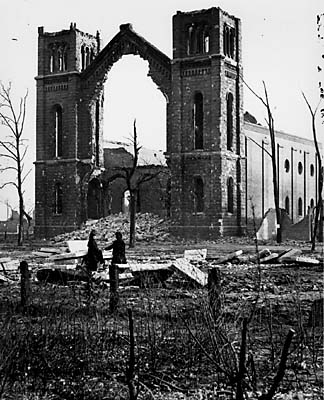 Two things happened yesterday. First, I had a conversation with my son (who is also a priest) about the future of parish ministry. Suffice it to say that we both have misgivings and considerable trepidation about that; I, for one, don’t see much future for parish ministry unless the church makes some radical changes – too many are needed to discuss in detail in a short morning meditation like this one. ~ Second, as a member of a committee charged with approving assistance grants to local congregations, I was asked yet again to approve a grant to fix a roof. The roof in question is for a parish which is not supporting itself through the giving of its membership. It seems to survive on grants and the largesse of a single, now-dead member who established a trust for its benefit; without those funding sources, it could not sustain its budget. I commented to my fellow committee members: “I wonder why we keep pumping money into maintaining buildings for marginal congregations. We ought to be investing in health and this doesn’t feel like we’re doing that.” ~ Both of those conversations came to mind when I read this gospel lesson today . . . as did an on-line (Facebook) tête-à-tête with a priest in England about car insurance rates, capitalism, and the plight of the poor in which we both suggested that force might be the only way to change the world economic system. I suggested to my colleague that our agreement on that point “means that we are acknowledging the church’s failure to accomplish its mission.” ~ And then another colleague, a younger preacher active in the “emergent church” movement reminded me of this observation from Episcopal priest and author Robert Farrar Capon: “The church can’t rise because it refuses to drop dead. The fact that it’s dying is of no use whatsoever: dying is simply the world’s most uncomfortable way of remaining alive. If you are to be raised from the dead, the only thing that can make you a candidate is to go all the way into death. Death, not life, is God’s recipe for fixing up the world.” (The Astonished Heart: Reclaiming the Good News from the Lost-and-Found of Church History, Wm. B. Eerdmans Publishing Co., 1996) ~ The rains, floods, and winds are beating against the house that is the church, especially against the houses that are the parishes of the mainstream denominations. We have got to change in radical ways. We have got to stop listening to the world and start, again, listening to Jesus! Radical, by the way, is derived from the Latin radix meaning “root”; the change we need to make is a return to our roots, to Jesus and the apostles, to early Christian understandings of what means to be church. We have to change or the church will, indeed, fall. I think Capon is right – the church as it has become has to drop dead in order to rise again, or it will fall – and if it simply falls, its fall will be great and it will not get up.
  Today is the Feast of the Ascension. Today we remember that, forty days after his resurrection, Jesus ascended into heaven, disappearing from his disciples’ sight into the clouds. Luke tells us in the Book of Acts that the disciples stood there gazing up towards heaven, and that two men, presumably angels, appeared and asked “Why do you stand looking up towards heaven? This Jesus, who has been taken up from you into heaven, will come in the same way as you saw him go into heaven.” (Acts 1:11) So we have two biblical promises: “I’m still with you” and “He’s not with you but he’ll be back.” The Christian paradox illustrated in the readings for a single day. ~ For me the meaning of the Ascension is summarized in the petition of one of the collects for the day in the American Book of Common Prayer (1979): that “we may also in heart and mind there ascend, and with him continually dwell” – or as Jesus put it in John’s gospel “that where I am, there you may be also.” (John 14:3) I don’t understand that as a future conditional promise but rather as a present permissive reality. Christ’s ascension allows us to be in God’s presence, now . . . no matter what our circumstance may be. It’s a matter of us recognizing that presence in the present, which we so often fail to do because we think of it as a future reward for some good behavior or something on our part when, in reality, it has nothing to do with our behavior or our goodness at all. The apparent paradox of the two biblical promises accurately reflects our confusion.
  This conversation troubles me. It falls at the end of a lengthy debate between Jesus and a group of biblical scholars composed of both Sadducees and Pharisees (two groups which seldom, if ever, agreed). They have challenged Jesus with three questions: the legality of paying taxes to Caesar; the status of a many-times married woman after the resurrection of the dead (whose wife will she be?); and the greatest of the commandments. Jesus has answered those questions and now asks them one of his own. It’s a trick question. It silences his critics and none of them ever again asks him a question. ~ That’s what troubles me. I don’t follow Jesus because he has the gift of witty repartee or because he has cut-and-dried answers to life’s questions or because he is a viciously effective debater who subdues his opponents. In fact, I follow Jesus for quite opposite reasons. I follow Jesus because in his footsteps I find pathways to contemplate and explore the questions of life to which there are often no solid answers. I follow Jesus because I find responses to my questions which invite and encourage further exploration, not answers which end and cut off discussion. ~ Was Jesus satisfied with the Pharisees response? Was he pleased that they sat mute and did not dare to ask a follow-up question? Matthew doesn’t tell us (nor does Mark, who tells the same story in a different fashion). But after this exchange, Jesus turns to the crowd and says to them about “the scribes and the Pharisees”, “Do not do what they do.” According to Matthew, Jesus apparently is referring to a lot of picky and burdensome ritual practices which the Pharisees heap onto others’ shoulders without lifting a finger to assist. But I wonder if he might not also be saying, “Don’t stop asking questions. Don’t stop exploring life’s issues. Don’t stop talking about God and the Messiah. Even if you don’t understand, maybe especially if you don’t understand, don’t sit there mute!” ~ On the Second Sunday of Easter the Eucharistic lectionary had us consider the story of “Doubting Thomas” (as it does every year). In my parish that was also “Children’s Sunday” when, instead of a formal recitation of the gospel and a learned sermon, the gospel is told to our children in story-book fashion with a discussion at their level of what it means. I suggested to them that it is very important to note that Jesus did not criticize Thomas for asking questions and that we should understand that to be an encouragement to ask questions of our own, and never stop doing so. So, yeah … I think Jesus may have been doing the same thing here. I think he may have been very disappointed in the Pharisees and Sadducees who did not “dare to ask him any more questions.” Don’t stop asking questions!
 There was a meme circulating the conservative blogosphere and email circuit several months ago in which folks of a certain political persuasion asserted that they were “praying” for President Obama by reciting a verse from Psalm 109: “Let his days be few, and let another take his office.” The psalm continues in the next verse: “Let his children be fatherless, and his wife become a widow.” And the petition get even worse after that. This is not what Paul is admonishing the faithful to do in his letter to the young bishop Timothy. In fact, it is clearly the very opposite. ~ What would our country and our society be like if everyone did offer “supplications, prayers, intercessions, and thanksgivings … for … all who are in high positions”? One of the things I counsel folks who come to me with issues of unresolved anger toward another is to pray for that other. Not specific intercessions just simply to offer that person’s name before God with the simple request, “In this person’s life, Lord, may your will be done.” The nearly universal experience of my counselees is that over the course of time (the length of time varies from person to person) their anger dissipates; the typical observation is that is impossible to stay angry at someone for whom you are praying. ~ The purpose of prayer is not to inform God of anything of which we believe God may be unaware, to give God our good advice, or to conform God’s will to ours. Rather, it is to relinquish our own selfish desires in acquiescence to the one “whose power, working in us, can do infinitely more than we can ask or imagine,” as we remind ourselves as the end of the Daily Office (quoting Ephesians 3:20). ~ What would our society be like if everyone prayed for our leadership, even the leaders with whom we have political disagreements or personal dislikes? What would things be like if I prayed for that jackass in Congress, or that SOB in the state house? I cannot imagine, but Paul assures me that we would all “lead a quiet and peaceable life in all godliness and dignity.” Maybe we (that really means, I) should give it a try.
 I was reminded just this morning in something else I read that there is no positive attribute “darkness”. Darkness actually is nothing; it is simply the absence of light. We cannot and do not measure darkness; we measure light and when there is no light, that’s nothing. The only purported measurement of darkness I know of is the Bortle Dark-Sky Scale, but in truth the Bortle Scale is a nine-level numeric ranking of night sky’s brightness. There is no negative side of the scale. Once one reaches the bottom of the scale where there is total absence of light, there is no greater (or perhaps one should say, lesser) degree of darkness. There are degrees of light, but not of darkness. ~ So how is that modern scientific people who know this can make sense of a phrase like “the power of darkness”? If darkness is simply the absence of light, then darkness is nothing . . . literally “no-thing”. And no-thing can have no power. I can imagine someone saying, “If darkness is no-thing, and no-thing has no power, then God’s rescue is meaningless.” Of course, I don’t believe that, but I can certainly imagine someone in today’s world working through that line of thought. ~ I think one of the failings of our age is the loss of a poetic or metaphorical understanding of reality. I know that Paul is using “darkness” as a synonym or a metaphor for evil, but the trouble is that our spiritual or religious language is so often at odds with the physical reality we know around us, and in a world which has lost an appreciation for the poetic that is a problem. The English satirist Malcom Muggeridge said, “There is no such thing as darkness; only a failure to see.” Shakespeare wrote, “There is no darkness but ignorance.” Perhaps in our time, we need to understand Paul to be saying that God rescues us from our own callowness and incomprehension. Perhaps in our time, the human problem is not so much sinfulness as it is willful stupidity! ~ American author and neurosurgeon Ben Carson once wrote, “God has given us more than fourteen billion cells and connections in our brain. Why would God give us such a complex organ system unless he expects us to use it?” I believe St. Paul would have agreed. Failure to use those brain cells in every possible way, both in science and in matters of faith, is giving into “the power of darkness” from which God has rescued us.
 Are you a music fan? A classical music fan? I am. I love the great symphonies – Beethoven’s Fifth, his Ninth, Tchaikovsky’s Fifth, Dvorak’s From the New World, and many others – they just bowl me over. I can sit down in a concert venue and no matter what emotional state I may be in, a good symphony or concerto can overcome it – cynicism, depression, grumpiness, whatever my condition may be it will be conquered by the music and I will be uplifted. It doesn’t even have to be live in a concert hall. Sometimes when I’m feeling a bit out of sorts, I’ll put on a CD and just let great music lift me up. In fact, even badly played band music can have that effect.
 I’m an Episcopalian, an Anglican. That means that, following the lead of our seminal theologian Richard Hooker (1554-1600), I look at religious questions from three perspectives using three sources of authority: Holy Scripture, tradition, and reason. On the question of whether the committed, loving relationships of couples of the same sex should be blessed by the church and recognized by the state, the scriptural perspective is usually the only one the opponents of “same-sex marriage” address. They have been answered adequately on many occasions by others much more able to debate scripture than I am. Based on their analyses, I am satisfied that the Bible does not condemn homosexual relationships. It condemns perversion of human relationships, but that is quite a different thing. There is nothing perverted about two people (whatever their sexes may be) committing themselves to a life-long, mutually supportive, loving, and committed union.
 I think I’ve heard part of this verse bandied about as good advice for my whole life: “Don’t cast your pearls before swine.” I suppose what is meant by this is that one’s good effort or good thoughts should not offered to (or wasted on) those who aren’t cultured, educated, or intelligent enough to appreciate them. A lot of biblical commentaries say the verse is a warning by Jesus to his followers that we should not offer biblical doctrine to those who are unable to value and appreciate it, but I don’t think it’s that at all . . . not when one considers the whole text. ~ This proverb appears at the end of the so-called “Sermon on the Mount”. It is preceded by the advice to take care of one’s own problems before criticizing another (“Why do you see the speck in your neighbor’s eye, but do not notice the log in your own eye?” – Matt. 7:3) It is followed by admonitions to ask, seek, and knock, and a description of God as a caring father. That which precedes and follows this proverb is clear and straight-foward; why would one not take this to be equally plainspoken? In addition, why is the warning at the end of this proverb so often ignored: “they will trample them under foot and turn and maul you”? I don’t believe this admonition is about not offering biblical doctrine to those who are unable to appreciate it, not at all! However, it might be about setting that aside for the moment while something else is attended to. ~ I have read commentary actually suggesting that what Jesus is saying to not throw to the dogs (and his hearers would have understood these to be roving packs of wild dogs), the “holy things,” are the choice parts of the animals sacrificed in the Temple, the parts that are supposed to be God’s! C’mon!!! Would a wild dog thrown a t-bone steak trample it under foot and maul the person giving it? No! The dog would devour that meat and beg for more. As a metaphor for not sharing the gospel (“biblical doctrine”), that’s rather a massive fail! Wouldn’t one want your recipients to “feed upon” the gospel and seek more? ~ And note this also, nowhere here does Jesus suggest that one shouldn’t throw something to the dogs, or cast something before the swine. ~ So here’s what I’m thinking today. What this is is good advice to consider carefully what you are throwing or casting in your mission work and outreach, and when you are throwing it. To dogs, throw that which dogs need. Dogs don’t need “holy things”. Wild dogs have very basic needs: food, water, shelter. If they have those, they might be tamed; “holy things” like companionship and affection might be offered later. I don’t know enough about wild pigs (or any pigs, for that matter), but I suspect the message is the same. Give them that which is meaningful and useful for them, and leave the jewelry for later. ~ If this admonition, this proverb is metaphorical of anything, it is a metaphor for doing for others in the way that most and best meets the needs of the moment – not the needs of the giver to “spread the gospel”, but the needs of the recipient whatever they may be. It’s just another way of saying, “Love your neighbor as yourself.” (He might have said, “Do unto the dogs and the swine as you would have others do unto you,” but that just doesn’t have that learned-rabbi ring to it, does it?)

