Revised Common Lectionary for Easter Sunday, Principal Service, Year B: Isaiah 25:6-9; Psalm 118:1-2,14-24; Acts 10:34-43; Mark 16:1-8
In the run up to Easter which is the season of Lent several of us in this parish took some time out of our everyday lives to ponder the contemporary meaning of the ancient Hebrew writers we call “the Prophets.” We were guided in that study by scholar and seminary professor Walter Brueggemann, who encouraged us to think of the Prophets as poets rather than as seers or prognosticators. Brueggemann also asked us to think of contemporary poets whom we might consider prophets. I shared with the group one of my favorites, Kentucky farmer and poet Wendell Berry. I read to the group this poem entitled Manifesto: The Mad Farmer Liberation Front:
Love the quick profit, the annual raise,
vacation with pay. Want more
of everything ready-made. Be afraid
to know your neighbors and to die.
And you will have a window in your head.
Not even your future will be a mystery
any more. Your mind will be punched in a card
and shut away in a little drawer.
When they want you to buy something
they will call you. When they want you
to die for profit they will let you know.So, friends, every day do something
that won’t compute. Love the Lord.
Love the world. Work for nothing.
Take all that you have and be poor.
Love someone who does not deserve it.
Denounce the government and embrace
the flag. Hope to live in that free
republic for which it stands.
Give your approval to all you cannot
understand. Praise ignorance, for what man
has not encountered he has not destroyed.Ask the questions that have no answers.
Invest in the millenium. Plant sequoias.
Say that your main crop is the forest
that you did not plant,
that you will not live to harvest.
Say that the leaves are harvested
when they have rotted into the mold.
Call that profit. Prophesy such returns.Put your faith in the two inches of humus
that will build under the trees
every thousand years.
Listen to carrion – put your ear
close, and hear the faint chattering
of the songs that are to come.
Expect the end of the world. Laugh.
Laughter is immeasurable. Be joyful
though you have considered all the facts.
So long as women do not go cheap
for power, please women more than men.
Ask yourself: Will this satisfy
a woman satisfied to bear a child?
Will this disturb the sleep
of a woman near to giving birth?Go with your love to the fields.
Lie down in the shade. Rest your head
in her lap. Swear allegiance
to what is nighest your thoughts.
As soon as the generals and the politicos
can predict the motions of your mind,
lose it. Leave it as a sign
to mark the false trail, the way
you didn’t go. Be like the fox
who makes more tracks than necessary,
some in the wrong direction.
Practice resurrection.
I love that poem for its critique of modern society, but mostly I love it for that last line which summarizes the whole poem: “Practice resurrection.”
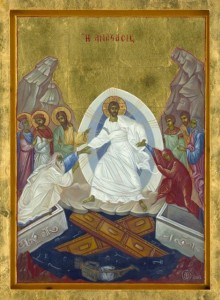 If you’ve been with us here for the services of Maundy Thursday, Good Friday, and Holy Saturday, or have been following the sermons on line, you know that we have come to Act Three of the three-act drama of redemption. In the first act, we saw the protagonist, Jesus of Nazureth, trying one last time make his disciples understand his mission and his message. Through the metaphor of bread and wine, through the enacted parable of foot-washing, through an agonized night of prayer in a garden, he tried to teach them that his was a mission of love and life, but they just didn’t seem to get it. As the curtain fell on Act One, he was being taken away to be questioned by Jewish and Roman authorities and the disciples, frightened and confused, were scattering, unsure of what was going to happen next.
That question was answered in Act Two as the Roman governor gave in to the stirred-up crowd and turned Jesus over to his soldiers who scourged him, beat him, mocked him, and finally crucified and killed him. The drama of redemption was shaping up to be a tragedy and, if that death on Calvary’s cross had been the end of it, it surely would have been. The hero dead the whole story would have tragic, and pointless, and of not much worth or interest to anyone. But of course, as we now learn in Act Three, it was not the end and, instead of a tragedy, the drama of redemption has turned out to be a comedy!
“A comedy?” you ask. “Of course,” I say, “because Easter is a joke!”
OK … I guess, perhaps, I should explain that. Well, what is a “joke”? One dictionary definition of joke is that it is an “activity characterized by good humor.” (WordNet, Princeton University, 1997.) Can you think of a better way to characterize the Resurrection of Jesus than as an “activity characterized by good humor”? The Resurrection was God’s activity of the highest and best humor! G.K. Chesterton once wrote:
Angels can fly because they take themselves lightly. Never forget that the devil fell by force of gravity … A good joke is the closest thing to divine revelation … They who have the faith have the fun.
So, Easter is joke, a very good joke! Easter reveals God as no other celebration has ever done. Only God can draw the greatest good out of the greatest evil. Of evil, Saint Thomas More once wrote, “The devil … that proud spirit … cannot endure to be mocked.” The people of the Middle Ages understood this and celebrate Easter by getting the last laugh on evil. In the 13th Century some German communities would throw a laughter party on Easter Sunday. Its purpose was simple: to celebrate God’s triumph over the devil. People would come back to church on Easter Sunday afternoon for Vespers and Benediction services. As a reward to the faithful for enduring many serious Lenten homilies, the priest would insert funny stories, poems, and even off-color jokes into his sermon and would draw moral conclusions from them.
An ancient Russian Orthodox tradition was to sit around the Easter dinner table telling jokes. Like those 13th-Century Germans, the Russians even told them in church. Why? Because Easter makes people joyous. After all, when we tell funny stories and laugh, we are imitating the cosmic joke that God pulled on Satan in the Resurrection. Satan thought he had won, but then God raised up Jesus from the dead and had the last word. As St. John Chrysostom preached in his famous Paschal Homily:
Hell grasped a corpse, and met God.
Hell seized earth, and encountered heaven.
Hell took what it saw,
and was overcome by what it could not see.Hell was in turmoil having been mocked.
And the world laughs at Satan’s chagrin. Laughing at the Devil even has a name in theological tradition; it is called the risus paschalis, “Easter laughter”.
So in Act Three the drama of redemption turns out to be a comedy; God in Christ pulls a cosmic joke on the forces of evil and we rejoice in the triumph over Death that Easter embodies. Death had been a disturbing thing. For much of human history people have had an attitude toward it somewhat like Woody Allen’s: “It’s not that I’m afraid to die,” he once said. “I just don’t want to be there when it happens.” Jesus’ Resurrection turned the tables on Death. It was a cosmic joke! Where death had once been something to shudder at, the third act of the drama shows, that there is nothing to fear. As one Sunday School student put: “When you die, God takes care of you like your parents did when you were alive … only God doesn’t yell at you all the time.”
The German Reformed theologian Jurgen Moltmann, who wrote the book The Theology of Joy, writes, “Easter laughter is rooted in the wholly unexpected and totally surprising ‘reversal of all things.’ God had brought this reversal about by raising Christ…. The expectation was for cosmic death, but what comes is eternal life.”
We North Americans, especially us folks here in the upper midwest, are too darned serious. Praying and laughing seem to be far apart in our culture, but at Easter they come together, as they do throughout Holy Scripture. In Psalm 126, the Hebrews praised God with mirth: “Then our mouth was filled with laughter and our tongue with shouts of joy” (Ps. 126:2). Jesus promised laughter to those who are favored by God: “Blessed are you who weep now, for you will laugh.” (Luke 6:21) It seems the ancients were much more aware of the relationship between prayer and laughter than are we. Some scholars believe our English word joke ultimately comes (through Latin) from the ancient Umbrian word iuka, which means “prayers”!
So, Easter is a joke, a great big cosmic joke, in which God turns the tables on Satan, turns the tables on evil, turns the tables on death! Act Three reveals that the drama of redemption is actually a comedy, and we are invited … no – more that that … we are encouraged and empowered to join in the laughter, even in what seem to be the darkest of times.
In 1875, a German passenger liner, the SS Deutschland sunk off the coast of England. Among those killed were five Franciscan nuns. In their honor, the English Jesuit poet Gerard Manley Hopkins penned a long poem at the end of which he wrote these wonderful lines:
Remember us in the roads,
the heaven-haven of the Reward
Our King back … !
Let him easter in us.
Don’t you love that use of easter as a verb? “Let him easter in us.” God eastered Christ after three days. Christ easters in us. It’s like Wendell Berry’s admonition to “practice resurrection”! Easter isn’t just a day or a season, it’s a verb! An activity! … An “activity characterized by good humor.” Resurrection isn’t just something that happened about 2,000 years ago, or something that will happen sometime in some distant, unknown future; it’s an on-going reality, happening now; a joyful, laughter-producing, cosmic turning of the tables on death in which we are all invited, encouraged, and empowered to participate!
The third act of the drama of redemption shows us that Hopkins was right; easter is a verb! To easter is a decision, a decision God made in not giving into the Crucifixion, a decision we can each make every day not giving into the forces of death and despair. To easter is to do all the things Wendell Berry set out in his Mad Farmer Manifesto: loving the Lord, loving the world, working for nothing, planting sequoias, lying down in the shade, willfully losing our minds, and looking forward to the end of the world with laughter!
To easter is to engage in the spiritual process of not giving in … not giving in to negation and death … not giving in to meaninglessness and despair … not giving in to isolation and fear … not giving in to powerlessness and incapacitation. Easter is an act of brave human existence. Not just a day-long holiday of bunnies, bonnets, and bluebirds, Easter is a daily reality, a decision Christ’s Resurrection empowers each of us to make when faced with the inevitable difficulties of life, a decision to “practice resurrection” and refuse to surrender our essential humanity even in the face of death itself.
So the drama of redemption, my friends, is a comedy; Easter is a joke, a great big cosmic joke, the ultimate act of God’s good humor, the closest thing we have to divine revelation. And we who have the faith have the fun. Practice resurrection! Let him Easter in you! Amen!
 Some time in the late Fourth Century, St. John Chrysostom, Archbishop of Constantinople and an important Early Church Father known for his eloquence in preaching and public speaking (hence, the surname Chrysostom which means “golden-mouthed”), preached this sermon on Easter.
 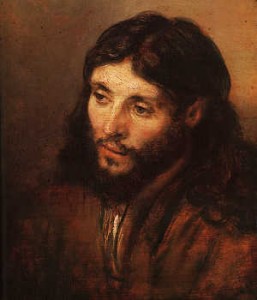 In the beginning he had been tempted by riches, by power, by idolization; all these had been offered in the desert. Now how great the temptation must have been to simply give up! Poet Denise Levertov ponders this allure in her poem Salvator Mundi: Via Crucis
 In this second act of the drama all that has gone before is recapitulated; all that we saw in yesterday’s first act, the supper in the upper room, the act of servanthood taught there, the agonized prayer in the garden, the willing surrender to unjust authority, and more. Not just yesterday’s first act, but all that has gone before from our first act of defiance in the first garden. Poet Ross Miller reminds us of that bond in his brief verse entitled Tau
 A meal is in progress… Is it a seder, the ritual meal of remembrance of the Passover? We don’t really know; the playwrights have not made this clear; the theater critics, the scholars debate this issue. Three of the story-tellers suggest that it is but the fourth, John, tells the tale very differently. (The synoptic gospels tell the story in a similar way and, if truth be told, in the same way – Luke and Matthew based their stories on Mark’s, so to be honest there aren’t three stories, there’s only one that would make us think that this supper is a seder, but John doesn’t. In fact, John doesn’t even care about that – he spends no time at all describing the meal, for him the important thing is what happened afterward, and that comes in a later scene. So as we begin this three-day, three-act drama of redemption, since we have heard Luke’s voice narrating the story, let’s just assume that what we see in this first scene of the first act is, indeed, a seder.)
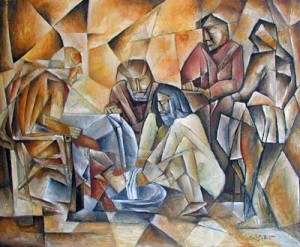 The meal is over, the dishes have been cleared. The disciples are arguing among themselves about who is the greater among them. Jesus looks frustrated and troubled; the teachable moment has passed and they clearly have not understood! They just haven’t gotten it.
 “Stay here,” he tells them, “Stay awake while I go over there to pray.” As they settle themselves, he moves away from them, and collapses in a heap, sobbing: “O God … Father, let this pass!”
  Act One, Scene One – Location: an upper room somewhere in Jerusalem.
  I’m taking a week away from doing the meditations on the Daily Office Lectionary. During Holy Week there are simply too many other things to get done. I’ll be back with more meditations on bits of the Daily Office readings after Easter.
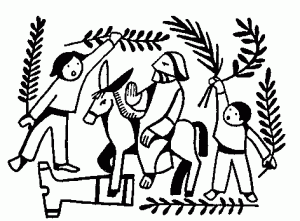 We have just read the simple, yet dramatic story of our Lord’s Passion as related in Mark’s Gospel. But we began our worship this morning with John’s story of Christ’s triumphal entry into Jerusalem. In the span of a few minutes we covered an entire week at the end of Jesus’ earthly life. Logic and reason cannot really make sense of this, and no ten-minute homiletic exegesis of these texts can help us comprehend the enormity of those events.
 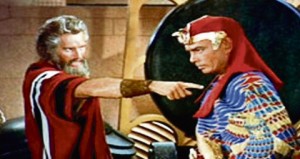 Why is Moses angry at Pharaoh? Moses (and God) have put the Egyptians through a series of miserable plagues. The people of the Nile valley have lived through water turning to blood killing all life in the river; invasions of frogs, lice, and flies; livestock diseases; painful, unhealing boils; hail and thunder; locusts; and unnatural darkness. Throughout the course of this series of events, there have been many times when Pharaoh seemed on the verge of releasing the Hebrews but then “the Lord hardened Pharaoh’s heart, and he did not let the sons of Israel go.” (Exod. 10:20) ~ Over the years, I’ve read a lot of commentary on this passage, the introduction to the slaughter of the first born which is context of the Passover. Wesley opined, “Moses hereupon was provoked to a holy indignation, being grieved, as our Saviour afterwards, for the hardness of [Pharaoh’s] heart.” Well, yeah, but who’s responsible for that? Over and over again the Scripture tells us it was God who hardened Pharaoh’s heart! Pharaoh’s not just obstinate, he’s manipulated into stubbornness by God himself! Why be angry at Pharaoh? ~ I don’t really think he is. I think he was mad at God…. ~ I think it’s OK to be mad at God. We have the freedom to express and respond to that emotion, to own up to our occasional anger with God. When parishioners come to me and “confess” being angry at God, I tell them it’s OK, that God is a big boy and can take their anger. The issue to be addressed is whether they can! Can they pray their anger honestly? Prayer is not always peaceful and serene and believing that ought to be can be a real obstacle to faith. But praying out one’s anger is unfamiliar territory; it feels awkward; it’s not much like any prayer we hear in church. ~ Do you remember the episode of The West Wing in which Pres. Bartlett’s secretary was killed by a drunk driver? Her funeral was held in the Washington National Cathedral (an Episcopal church, by the way). After the funeral, Bartlett stays behind in the quiet privacy of the cathedral to offer a personal prayer to God … not out of sadness or faith or hope. His prayer is offered out of anger. He begins by calling God a “son of a bitch” and a “feckless thug.” Then, good Roman Catholic that Josiah Bartlett was, he continued in Latin. Here’s what he said: “Am I really to believe that these are the acts of a loving God? A just God? A wise God? To hell with your punishments. I was your servant here on earth and I spread your word and I did your work. To hell with your punishments and to hell with you!” No amen – just a cigarette stamped out on the cathedral floor, after which Bartlett stalked out. Pretty clearly “in hot anger he left.” Praying our anger is not like any prayer we (usually) hear in church. ~ Scripture doesn’t tell us what Moses did in or with his anger, but we do know what followed. The story of Moses’ “hot anger” and what followed it affirms for us that anger, even anger at God, need not be destructive. It can be the source of a rebirth of hope; it can heighten our confidence in the future, and empower us to undertake the creation of a new reality. Appropriately and creatively channeled, anger, even anger at God, can lead us out of bondage and into freedom.
 I can’t read Paul’s words “treasure in clay jars” without thinking of this old Indian parable. ~ Once upon a time, there was a man who lived on a hillside high above the river. He had to fetch his water from the river every day. He did this with two large earthen jars slung from a yoke carried across his neck. The jars were heavy and it was a long path with many switchbacks down to the river, but the path was bordered by flowers and he didn’t mind the walk or the work at all. Both of the water jars were large and held several gallons, but there was a tiny crack in one so that the water would gradually leak out of that jar and splash on to the side on the path. The cracked jar was very sad that it lost half its water on the way back from the river each time. After many years the jar spoke to the man and apologized for being such a failure. “Why should you feel like that?” asked the man, ” I knew all about that crack; in fact, I made use of it.” “What do you mean?” asked the jar. “Well look,” he replied, “Do you see the flowers growing by the side of the path?” The jar looked and, sure enough, there were beautiful flowers growing all along the way. “Those flowers are there because I knew you had that small leak. I sowed some flower seeds along the side of the path and as I walked, the water leaking from your small crack watered them. For years now I’ve enjoyed those flowers as I walk, and I’ve been able to pick fresh flowers every day to decorate my home. I couldn’t have done that if you hadn’t watered them through that little crack. So, you see, I like you just the way you are. You are a very treasured water jar!” ~ Like the earthen jar carrying water, we carry in our cracked and faulty bodies the death of Jesus. And like the water that leaked from the jar, the life of Jesus flows out from us to accomplish his work in the world. This extraordinary power does not come from us, but we are the conduit (even and often when we don’t realize it). ~ As a preacher, I continue to relearn this each time someone refers to “something you said in a sermon”. I never remember my sermons! I look back on notes or scripted sermons from which I’ve preached and think, “Did I say that?” Apparently I did … and apparently it made a difference in someone’s life, watered some flowers along their path! So to preachers especially but to everyone, be assured – you are an earthen jar, probably a flawed one, carrying the death of Jesus in yourself that you may spread the life of Jesus to those around you, even though you may not realize it.
 Threading a needle…. That used to be a simple task for me. I was very, very near-sighted. I could barely see a school bus twenty feet away without my pop-bottle-bottom spectacles. But I could thread a needle! I could do anything that required close-up detail work; I had marvelous up-close vision. Then one day in 1995 (I think it was 1995) my mother saw my glasses. “Good Heavens! Are your eyes that bad?” – “Yes, Mother, they always have been.” – “Why don’t you have that Lasik surgery?” – “Because I can’t afford it, Mother.” – “You get it done. I’ll pay for it.” ~ (Side comment: My mother was a depression child born in 1919. As a result of spending her formative pre-teen and teen years in the years of the Great Depression, she was one of the most tightfisted people I’ve ever known when it came to spending money on herself or her spouse, my step-father. She would not spend a dime on her own healthcare, even when she felt badly. But she was generous to a fault with her children, her grandchildren, her friends, and her church. If she’d been less generous to us and more generous to herself, she might still be alive. But that’s another story.) ~ So I talked with my ophthalmologist, who had earlier been quite negative about PK and RK and other forms of keratotomy, and he thought Lasik would be a good option. He referred me to a surgeon. A couple of weeks later, I was able to do everything without glasses … everything except thread a needle. Now I needed a pair of dime-store “cheaters” to do what had once been easy, and even though I squinted and used those magnifying lenses I had difficulty. Getting anything through the eye of a needle, much less a camel, is no mean task! ~ About thirty years before that surgery, I visited the Cathedral at Chartres on my first trip to Europe. I was 16 years old at the time. I walked the labyrinth there. Since that first time I’ve walked many replicas of that deceptively simple path and other forms of labyrinth. Threading one’s way through the labyrinthine path requires concentration (especially in a cathedral full of tourists, but really at any time, even when completely alone). It is a careful endeavor not unlike threading a needle; one might even say it is a soulful endeavor. ~ Perhaps the most famous labyrinth in history or myth is the one built on Crete to house the Minotaur. King Minos’s daughter Ariadne fell in love with Theseus, an Athenian who was to be a sacrificial victim of the Minotaur. She gave Theseus a ball of thread to unwind as he made his way through the labyrinth, which showed him the path to by which he could leave once he had done battle with the beast (assuming he killed it, which he did). It was her thread of love which helped Theseus thread his way through the labyrinth. ~ Our walk through a spiritual labyrinth is said represent our way through life. Victor Hugo once said, “He, who every morning plans the transactions of the day, and follows that plan, carries a thread that will guide him through a labyrinth of the most busy life.” I’m not so sure that’s true, however; plans are too often subject to change! Like the odd turnings of the Chartres labyrinth, we meet with obstacles which change our direction; when we seem to be headed for our goal, suddenly the way changes; even though we squint and use magnifying glasses, the way through is unclear. We may not be able to follow our plans and we may not see the way ahead, but we are threaded through the unexpected and unknown path of life if we trust and rely on God’s guidance. Like Ariadne’s thread of love, God’s love threads us through life’s labyrinthine ways. Following God’s guidance is a careful, soulful endeavor, but “with God all things are possible.”

