Occasional thoughts of an Anglican Episcopal priest

Category: Bible (Page 110 of 111)

The Blessed Wedding in Cana

There was a wedding on An Cheathrú Rua last week. (By the way, that preposition is correct. One speaks of being on An Cheathrú Rua rather than in it. It is a peninsula, after all.) The groom was a bartender at the pub frequented by our student body and the reception, such as it was (very unlike an American wedding celebration) was held there. Anyone and everyone who happened in was a welcome guest.

I did not have an opportunity to witness the wedding, nor any of the preparations. However, when I was in Ireland in 2008, some friends and I climbed Croagh Padraig, the holy mountain in County Mayo also known as “The Reek”. There is an annual event here called “Reek Sunday” (the last Sunday of July) when the penitent climb the mountain. The truly penitent climb it barefoot. Having climbed it wearing fairly sturdy hiking shoes, I can assure you that that would be a substantial act of penitence; but little old ladies were doing just that when I climbed it (a week after Reek Sunday), and they were going up that slope faster than I was! (The background image on this blog, by the way, is Croagh Pádraig.) The hike up the mountain is in emulation of St. Patrick who is said to have climbed the mountain, cleansed it of druid religious use, and offered the Eucharist on its summit.

Another part of the meditative tradition of Croagh Padraig is to start one’s pilgrimage to the mountain at Ballintubber Abbey. Ballintubber is an Anglicization of Baile tobair Phádraig, “place of the well” – the well in question supposedly being a place where St. Patrick baptized converts. Ballintubber Abbey is about 22 miles from Croagh Padraig, so the full penitential practice is to hike cross-country on the Tóchar Phádraig (“Patrick’s Causeway”) and then climb the mountain.
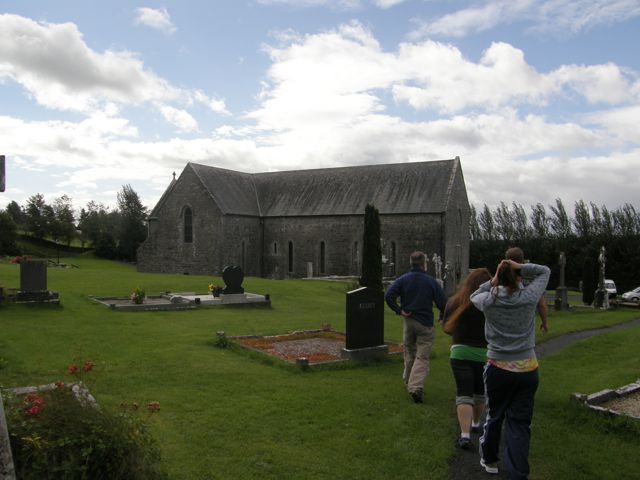
Ballintubber Abbey Church, Co Mayo, Éire

Ballintubber Abbey Church, Co Mayo, Éire

The abbey church has been beautifully restored and is the parish church for the village of Ballintubber. (The church has a lovely website here.) http://www.ballintubberabbey.ie/ My friends and I short-circuited the tradition by attending Mass at the abbey church and then driving from there to the mountain.

Ballintubber Abbey Church, Co Mayo, Éire

Ballintubber Abbey Church, Co Mayo, Éire

The grounds of the abbey church are filled with graves and with statuary, some of it very modern and very interesting, especially a set of non-representational Stations of the Cross which are abstract stone work in place of the usual pictures or statues of the fourteen steps of the way of tears; for example, the Ninth Station, Jesus’ Third Fall, is simply a fallen stone whose shape is vaguely suggestive of a human body.

Ballintubber Abbey Church, Co Mayo, Éire, Stations of the Cross, No. 9

Ballintubber Abbey Church, Co Mayo, Éire, Stations of the Cross, No. 9

The most representational of the stations is the Eleventh, the Crucifixion.

Ballintubber Abbey Church, Co Mayo, Éire, Stations of the Cross, No. 11

Ballintubber Abbey Church, Co Mayo, Éire, Stations of the Cross, No. 11

There is also a wonderful statue of the Madonna with her Child. I find the faces and the poses of the pair striking. Mary is, I believe, depicted as strong and sad; she looks both defiant and obedient, as if unwilling to turn loose of her Son and yet aware that that choice is really not hers to make. As she holds him in a cruciform pose, she seems to be both offering and protecting him at the same time. The Christ Child is depicted in the familiar cruciform manner, but his face is turned towards his mother, not toward the viewer as is more typical. He seems almost puzzled by his Mother’s expression.

Ballintubber Abbey Church, Co Mayo, Éire, Madonna and Child

Ballintubber Abbey Church, Co Mayo, Éire, Madonna and Child

Ballintubber Abbey Church, Co Mayo, Éire, Madonna and Child

Ballintubber Abbey Church, Co Mayo, Éire, Madonna and Child

I often wonder about the relationship between Mary and Jesus. We get only a few glimpses of it in the Gospels. One of my favorite episodes is the Wedding in Cana related in the Gospel of John:

On the third day there was a wedding in Cana of Galilee, and the mother of Jesus was there. Jesus and his disciples had also been invited to the wedding. When the wine gave out, the mother of Jesus said to him, “They have no wine.” And Jesus said to her, “Woman, what concern is that to you and to me? My hour has not yet come.” His mother said to the servants, “Do whatever he tells you.” (John 2:1-5, NRSV)

I have long been fascinated and intrigued by the interaction here! Mary simply assumes that Jesus will take action (and that he has the power to do something to solve the problem of no wine). He feels free to respond negatively to her implied direction, “Help them,” but in the end he does as his mother seems to insist and the result is, as John will later call it, “the first of his signs, in Cana of Galilee.” (v. 11) This multifaceted relationship (which, I suppose, was not too different from any mother-son relationship) was probably present all during Jesus’ life and is caught well, I believe, in faces of the Madonna and Child at Ballintubber.

The story from John’s Gospel brings me back to the wedding here on An Cheathrú Rua. On that particular Sunday three years ago, the church at Ballintubber was decorated for a wedding, as you can see from the accompanying photographs. Nuptial church decoration here in Ireland is pretty similar to what is done in the United States, which makes a good deal of sense since I suspect we got quite a few of our wedding customs from Irish immigrants and returning Irish probably have brought back a lot of American customs to this island.
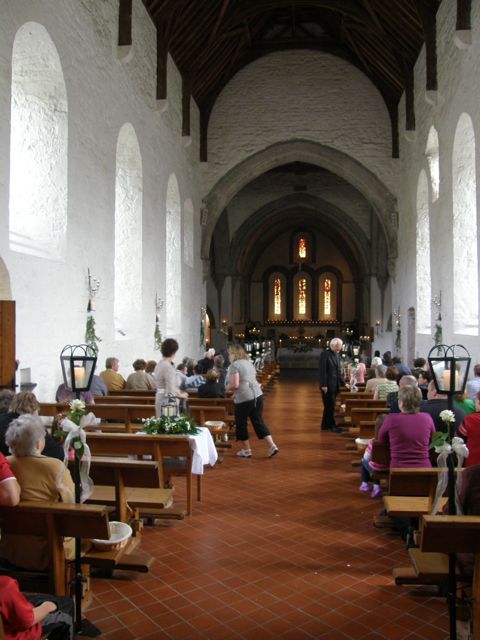
Ballintubber Abbey Church, Co Mayo, Éire, Interior, Decorated for a Wedding

Ballintubber Abbey Church, Co Mayo, Éire, Interior, Decorated for a Wedding
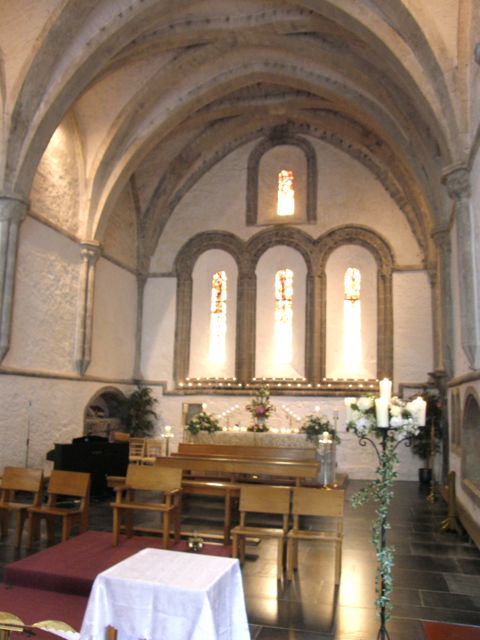
Ballintubber Abbey Church, Co Mayo, Éire, Interior, Decorated for a Wedding

Ballintubber Abbey Church, Co Mayo, Éire, Interior, Decorated for a Wedding

Ballintubber Abbey Church, Co Mayo, Éire, Interior, Decorated for a Wedding

Ballintubber Abbey Church, Co Mayo, Éire, Interior, Decorated for a Wedding

Post-wedding celebrations seem to be different – here there was no dancing (at least not in the pub), no toasts, no throwing of a bouquet or a garter, none of the typical elements of an American wedding reception – but what there was here as there is at home was joy and camaraderie, good wishes and good fun. It’s no wonder, given John’s recording of the first miracle and the human experience of wedding celebration, that the Wedding Banquet has become a lasting and indelible image of the reunion God has in store of God’s People and that the Holy Eucharist is referred to theologically as a foretaste of that heavenly banquet.

Dánta Dé includes a communion hymn specifically about the wedding feast. It is entitled The Blessed Wedding at Cana and is attributed to Maighréad ní Annagáin. Here is the original Irish text and Uná ní Ógáin’s translation of it, followed by a very free adaptation by me making use of some of the Irish hymn’s imagery and telling the story from John in meter and rhyme to be sung to the original tune.

First, the Irish original:

Ag an bpósadh bhí i gCána bhí Rí na ngrás ann i bpearsain,
É féin is Muire Máthair, is nárbh áluinn í an bhainfheis?
Bhí cuideacht ós cionn chláir ann, agun fíon orra i n-easnamh,
‘S an t-uisge bhí h-árthaibh nár bh’áluinn é bhlaiseadh?

A Dhia dhíl, a Íosa, ‘s a Rí ghil na cruinne,
D’iomchuir an choróin spíne is iodhbairt na Croise,
A stolladh is a straoilleadh idir dhaoinibh gan cumann,
Na glasa do sgaoilis, a d’iadhadh n’ár gcoinnibh.

Is ró-bhreágh an stór tá ag Rígh na glóire dúinn i dtaisge,
A chuid fola agus feóla mar lón do na peacaigh’.
Ná cuirigidh bhur ndóchas i n-ór bhuidhe nó i rachmas
Mar is bréagán mar cheó é, seachas glóire na bhFlaitheas.

Ms. ní Ógáin’s translation includes a verse not included in the Irish text of the hymnal, the second address to the Blessed Virgin:

At the marriage-[feast] in Cana
Was the King of grace in person,
He Himself and Mary Mother,
Was it not a beauteous wedding?
At the board the guests were seated,
And the wine to them was lacking,
And the water in the vessels
How delightful to taste it.

O Maiden most holy
Who to sin never yielded,
As thou wert a plant descended
From that king(a) who excelled,
[As of old], pray to Jesus,
To the glorious King of Heaven,
That He make a free way(b) for us
When we turn our steps Homewards.(c)

O dear Lord, O Jesu,
And O bright King of the Universe,
Who didst bear the Thorn-Crown,
And the sacrifice of the Cross;
Who was torn and rent asunder
Among men who were loveless,
Thou didst open the bars
That were closed against us.

Splendid is the treasure
Stored for us by the King of Glory;
His own Blood and Flesh [He giveth]
As Food for the sinful.
Put ye not your hope
In yellow gold or riches,
For as mistlike toys compare they
With the glories of Heaven.

Notes:
(c) i.e. David
(b) Lit.: or, ready road.
(c) or : That His Hand the way throw open
For our blessed home-returning.
(Westminster Irish Service-book).

And my poem derived from the Irish hymn:

King of glory,
King of love,
King of graces, guest at a wedding.
With his mother, with his friends,
seated at the marriage feast waiting.
Came the word: “There is a problem!”
Mary told her son to help them.
“What is this to me?” he asked her;
but to servants she was speaking.

“There is no wine
for the feast.
Do as he says, no hesitation.”
Empty vessels standing there
for the rites of purification.
“Fill them,” he says, “with plain water;
and then draw some for the steward.”
“What is this now?” asks the steward,
“Finest wine in the nation!”

Blessed Mary,
Virgin pure,
Mother of God, you knew that even
that your Jesus was the Christ;
that he was the High King of Heaven.
But did you know he would become
the free way for us to our home?
Through baptism buried with him,
we, too, shall all be risen!

O Lord Jesus,
glorious King,
holy savior who bore the Thorn Crown,
you were beaten, crucified,
killed, and buried, layed in the cold ground.
In fulfillment of the promise,
you broke the bars closed against us.
With your own blood you have freed us!
Death is conquered! Life is newfound!

Your own Body
and your Blood
give us sinners true liberation;
Bread of Heaven, Blessed Cup,
holy table, feast of salvation.
Giving blessings beyond measure;
wedding banquet, splendid treasure.
At the marriage feast of the Lamb,
we are God’s new creation!

Sunday, a Sermon, and Superstring Theory

Time away from the Irish (the language, not the people)….

On Sunday, 24 July 2011, I left my teach loistín (“boarding house”) and drove the 32 km from An Cheathrú Rua to Galway to attend the Sung Eucharist at the Collegiate Church of St. Nicholas, a church which formerly (pre-Reformation) was the central church of the city. That distinction is now held by the Roman Catholic Cathedral, “The Cathedral of Our Lady Assumed into Heaven and St. Nicholas”. (How the BVM was assumed into St. Nicholas, I have no idea….) But St. Nicholas Collegiate Church, now an Anglican congregation of the Church of Ireland, continues to play a central role in the life of the city. The church has marvelous acoustics and is host to a variety of concerts, dramas, conferences, and other cultural and educational events throughout the year.

Interior of St. Nicholas Collegiate Church, Galway

Interior of St. Nicholas Collegiate Church, Galway

It also plays the role of providing a place of worship for visiting tourists who do not wish to attend a Roman Catholic Mass. The Sunday morning congregation, especially during the summer, is an aggregation of Irish Anglicans, Protestants of several sorts (many of whom do not speak English), and tourists with little or no religious background at all (some of whom, I sure, wander in on Sunday morning to see the historic church and get “trapped” in the service). Such was the congregation this Sunday.

Interior of St. Nicholas Collegiate Church, Galway (from choir)

Interior of St. Nicholas Collegiate Church, Galway (from choir)

I arrived in Galway about one hour before the service, so I went to a local café and had a cup of coffee. Thirty minutes before the service, I made my way to the church and found a seat – not difficult as there were very few people there. A church warden introduced himself and offered me a leaflet which included nearly the entire service with an insert of the hymn lyrics. On learning that I am a priest, he asked if I would read one of the lessons for the day, to which I assented.

One of the transepts of the church has been closed off with a partial glass screen and made into the choir room. The choir was practicing and their music filled the church – it was grand! It put one into a prayerful mood and prepared one to enter into worship.

Transept, St. Nicholas Church, Galway (used as choir room)

Transept, St. Nicholas Church, Galway (used as choir room)

About 15 minutes before the service was to start, a woman priest vested for the day began greeting those of us seated in the nave. She was to be the presider in the absence of the rector, who is on holiday this month.

The service started on time with a procession of crucifer, choir, and clergy. Although lay eucharistic ministers would later assist with the distribution of communion, they were not vested and did not process with the altar party. The placement of choir, clergy and altar assistant was interesting and, given that everything is moveable (and moves frequently for various events), I wondered if this is a standard arrangement or if they experiment regularly with different seating plans.

The service followed a fairly familiar pattern, more similar to the American church’s liturgy than were the Church of England services I experienced a couple of weeks ago, although as in the English church, the service began with a confession and absolution before the Gloria in Excelsis. Then there were the reading of the lessons, a sermon, a variant form of the Creed (sort of a Q-&-A format), prayers, the Peace, the offertory, the Great Thanksgiving, the distribution of Holy Communion (at stations, a central position for the Bread from the priest and four cups of Wine), the final blessing, the last hymn and the dismissal. It all followed a familiar and comforting pattern.

Free-standing Altar, St. Nicholas Church, Galway

Free-standing Altar, St. Nicholas Church, Galway

The lessons for the day were those of the Revised Common Lectionary – from the Hebrew Scriptures the story of Solomon asking God for the gift of wisdom; from the Epistles Paul’s assurance in Romans that nothing can separate us from the love of God; from the Gospel’s Jesus rapid fire mini-parables that the Kingdom of God is like a mustard seed, a buried treasure, a pearl of great price, a net thrown into the sea.

Altar Window, St. Nicholas Church, Galway

Altar Window, St. Nicholas Church, Galway

The homily admonished us to do as Jesus did and look for God’s reign in the ordinary things, the ordinary places, the ordinary people of our lives. In the course of the homily, the preacher compared the structure of Jesus’ delivery of the parables to that of the Psalms referring to the Hebrew practice of parallelism as “the rhyming of ideas.” That description stuck with me.

Chancel and High Altar, St. Nicholas Church, Galway

Chancel and High Altar, St. Nicholas Church, Galway

Later in the day, I relaxed with a book, The Elegant Universe by Brian Greene. In it, describing the findings of quantum mechanics as an introduction to a discussion of superstring theory, the author writes:

Even in an empty region of space – inside an empty box, for example – the uncertainty principle says that the energy and momentum are uncertain: They fluctuate between extremes that get larger as the size of the box and the time scale over which it is examined get smaller and smaller. It’s as if the region of space inside the box is a compulsive “borrower” of energy and momentum, constantly extracting “loans” from the universe and subsequently “paying” them back. But what participates in these exchanges in, for instance, quiet empty region of space? Everything. Literally. Energy (and momentum as well) is the ultimate convertible currency. E=mc2 tells us that energy can be turned into matter and vice versa. Thus if an energy fluctuation is big enough it can momentarily cause, for instance, an electron and its antimatter companion the positron to erupt into existence, even if the region was initially empty! Since this energy must be quickly repaid, these particles will annihilate one another after an instant, relinquishing the energy borrowed in their creation. And the same is true for all other forms that energy and momentum can take – other particle eruptions and annihilations, wild electromagnetic-field oscillations, weak and strong force-field fluctuations – quantum-mechanical uncertainty tells us the universe is a teeming, chaotic, frenzied arena on microscopic scales.

As I read this I was reminded of the first words of Holy Scripture:

In the beginning when God created the heavens and the earth, the earth was a formless void and darkness covered the face of the deep, while a wind from God swept over the face of the waters. Then God said, “Let there be light”; and there was light. And God saw that the light was good; and God separated the light from the darkness. God called the light Day, and the darkness he called Night. And there was evening and there was morning, the first day.

Transfiguration Window, St. Nicholas Church, Galway

Transfiguration Window, St. Nicholas Church, Galway

People ask why I read books on particle physics, quantum mechanics, and string theory for relaxation. I really don’t have a good answer, and I have to admit that a lot of what I read, though it fascinates me, goes right over my head! But, for reasons which are probably beyond anyone’s comprehension, including my own, my idea of relaxing reading is exactly the sort of stuff that bored me to tears 40+ years ago – physics books. In the new understandings of quantum mechanics, superstring theory, the multiverse speculation, and other work seeking the “theory of everything” (or “TOE” as Greene and others call it), I see science converging with religion. As microscopic physics gets “weirder” (Greene’s term, again), it seems to me it gets more theological, as well. Every so often a passage strikes, if you will, a theological cord. This was one of them … the description of even empty space as “teeming, chaotic, frenzied” seems to me to echo, to “rhyme” (to use the preacher’s term) with the idea of the writer of Genesis that “a wind from God” (the Holy Spirit) sweeps over creation. Numerous theologians have taken off from this Genesis account to assert that the Holy Spirit “enthuses” all things; that the wind from God blows through and within all of creation … even empty space. How great it is that science’s new understanding of empty space as “teeming” and “frenzied” rhymes with faith’s vision of empty space as filled with God’s wind!

In Sunday’s sermon, the preacher reminded us to seek God in the everyday stuff of life. As scientists probe the “weirdness” of the smallest dimensions of everyday stuff, I think they’re doing just that … seeking God. They may be calling it the search for the TOE, but to from my perspective it’s just a variation of the same search human beings have been on for millennia, the search for meaning.

Baptismal Font, St. Nicholas Collegiate Church, Galway

Baptismal Font, St. Nicholas Collegiate Church, Galway

And now … back to the Irish.

The Holiness of Creation – 17 July 2011

It is said that there are forty shades of green in Ireland … there are probably more. There seem also to be at least that many shades of gray in the skies of Ireland the past couple of days. Since my arrival here, there have been clouds, wind, and rain. Irish words I learned three years ago come easily to mind: scamallach (cloudy), gaofar (windy), báisteach (rain).

Today, the wind is blowing hard enough that the trees and bushes in the front yard of my teach lóistin (boarding house) are bent far over and whipping about violently. The clouds, seeming low enough to touch, race by overhead, and throughout the day sheets of rain – some of hard, coarse droplets; some of sharp, stinging mist – have come and gone. From time to time a seagull struggles to move against the wind finding ways to travel into the blustery headwind, knowing instinctively when to rise, when to dive, when to tack.

The Windblown Skies of An Cheathrú Rua

The Windblown Skies of An Cheathrú Rua

My housemates are away today – the Acadamh has offered a bus tour to Ros Muc and the cottage in which Patrick Pearce, a hero of the founding of the modern Republic, spent his life. I have made this journey before and so I have opted not to take today’s bus ride. It has given me a chance to study grammar, review vocabulary flash-cards, and read a bit.

But the rain beats against the window and the wind blows so hard the house, though solidly built of concrete block and stone, vibrates; I am constantly distracted by this weather. “Tá an aimsir go-holc,” exclaims the bean-a-ti (literally “woman of the house”, the term – pronounced “BAN-uh-tee” – means both “housewife” and “landlady”). Yes, I think, the weather is wretched.

Olc is an interesting word: its basic meaning is “evil”, but it is used in a variety of ways which would be supplied by different words in English. (Go-holc is a form which would be translated into English by the addition of the adverb “very” to adjective.) It can be used to describe anything from simple “bad luck” to “wretched weather” to “moral evil”. Similarly, a word used to described good weather, álainn, can mean “beautiful”, “delightful”, or “perfect”.

I have been convinced for some time that a people’s spirituality is informed by their language, by its structures, by its grammar, by the alternative meanings of words.

It would, I think, be unlikely to find an English speaker describing the weather as “evil” – wretched, perhaps, and bad, certainly – but “evil” is a term we would reserve for other uses, to describe that which is morally reprehensible, something which can’t be said of the weather. Similarly, while we might describe the weather as “perfect” for some activity, we would not generally describe the weather as simply perfect in its own right.

Thinking of these descriptive terms for the weather I am reminded of a verse of scripture, Matthew 5:48, perhaps most familiar in its King James Version form: “Be ye therefore perfect, even as your Father which is in heaven is perfect.” Although álainn is not the word used in the Irish bible’s version of this admonition of Christ, I can’t help but think that the secondary meaning of the word might suggest to the Gaelic soul a link between the occasional perfection of nature and the perfection of God (or, negatively, between the “evil” of the weather and the Evil One).

Celtic Christianity views the mission of Christ less as a “redemption” of a “fallen” creation than as the “completion” of an “incomplete” creation. I believe the use of these morally and spiritually charged adjectives to describe the weather and to describe nature has contributed to the spirituality which informs this theology. There is a hymn in Dánta Dé which sings the praises of the holiness of all nature and is reflective of this Celtic spirituality.

First, the Irish:

Naomhtha cearda Mhic Mhuire;
Naomhtha ó thus A thrócaire;
Naomhtha grian is neoil nimhe,
Dhá fhiadh eoil na h-aimsire.

Naomhtha a bhfuil thall n-a thigh,
Naomhtha gach dúil dá dhúilibh,
Naomhtha an ré a’s na réaltain,
Naomhtha an Té ó dtaisbéantar.

Naomhtha na síona saobha,
Naomhtha an fhearthain Abraona;
Naomhtha an tsoinionn go ngné ghil,
Naomhtha doinionn Dé dúiligh.

Naomhtha ceathra na cruinne,
Naomhtha cloche ‘s caomh-dhuille,
Naomhtha an teine, giodh h-í ain,
‘S gach ní eile dá n-abraim.

Naomhtha an ghaoth lonn ag labhairt,
Naomhtha fairrge ‘s fíormamaint;
Naomhtha gach aon-mhaith d’ar fhégh,
Naomhtha ‘n éanlait ‘san aedhir.

Naomhtha na coillte fá chnáibh,
Naomhtha an fhíneamhain abaidh,
Naomhtha gach toradh dá dtig,
Naomhtha an talamh ó a dtáinig.

Naomhtha an tráigh ‘s an tuile,
Naomhtha fás na fiodhbhaidhe,
Gníomha naomhtha learg is luibh,
Naomhtha an Ceard do cruthaigh.

Naomhtha fós fóghar na dtonn,
Naomhtha siúbhal na srothann,
Naomhtha an riasg fraochdha ‘s an féar
Naomhtha an t-iasg ‘san aigéan.

Naomhtha A thionsgnamh ‘a A thoil,
Naomhtha oibreacha ‘n Athair,
Naomhtha A cheard ‘s A chreidiomh,
Naomhtha A fhearg ‘s A fhoighideadh.

Naomhtha teaghlach A thoighe,
Naomhtha an Trionóid tóguidhe,
Naomhtha A iomrádh ag gach aon
Naomhtha ró-ghrádh A ró-naomh.

And the English translation by Úna ní Ógáin:

Holy are the works of the Son of Mary
Holy, from the beginning, His mercy,
Holy the sun and the clouds of heaven,
Two guides of knowledge of the seasons;

Holy all yonder in His House,
Holy each creature of His creatures,
Holy the moon and the stars,
Holy He from Whom they are revealed.

Holy the wild tempests,
Holy the rain of April,
Holy the fair-weather, with bright looks,
Holy the rough-weather of God the Creator.

Holy are the quadrupeds of the Universe,
Holy the stones and the gentle leaves,
Holy the fire, though it be destructive,
And all else of which I speak.

Holy the strong wind’s speech,
Holy, sea and firmament,
Holy, each good thing which was recounted,
Holy the birds in the air.

Holy the woods bearing clusters,
Holy the ripe vine,
Holy each fruit that cometh,
Holy the earth whence it came.

Holy are the shore and the wave,
Holy the growth of the woods;
Holy works are hillock and herb,
Holy the Artificer Who created them.

Holy too the voice of the waves,
Holy the travelling of the streams,
Holy the wild moor and the grass,
Holy the fish in the ocean.

Holy are His designs and His will,
Holy, the works of the Father,
Holy His workmanship and His faith,
Holy His anger and His patience.

Holy the household of His house,
Holy the exalted Trinity;
Holy, for all, to converse of Him,
Holy, the great love of His great saints.

Neolithic Britain – 9 July 2011

Today, 9 July 2011, I walked the hills of southeastern England visiting two fascinating sites that may date back as many as 5,000 years!

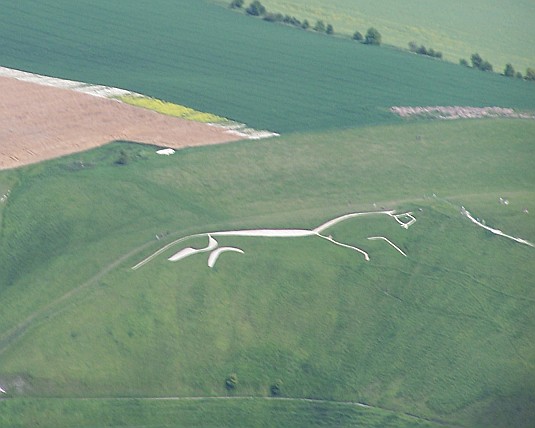
First I visited the village of Uffington, Oxfordshire, and the hill south of town on which one finds a massive depiction in white chalk of a horse. I tried to take a picture of it, but from ground level that is very difficult to do and (on this day) the site was crawling with several hundred early elementary school students on school outings. So here’s a picture from Wikicommons:

The Uffington White Horse from the Air

The Uffington White Horse from the Air

I walked up to the area where the head of the horse is seen in this picture. It was an overcast and hazy but warm day – a good thing because it was also very breezy. It was about a mile or so walk up the hill from the car park via the Ridge Path, which took me through the Uffington Castle, which isn’t what you think it is at all … not a castle in the medieval sense. Uffington Castle is all that remains of an early Iron Age hill fort. It is composed of two circular earth berms (with a circular ditch between them) surrounding about 32,000 square meters (nearly 8 acres). There is an entrance in the eastern portion, near the White Horse and another at the south (through which I entered). An entrance in the western side was apparently blocked up a few centuries after it was built. I was able to take a picture of the “castle” (although it doesn’t look like much). This picture is taken from the eastern entrance of the southeastern quadrant; the southern entrance can be seen at the right of the picture.

Uffington Castle, Oxfordshire, UK

Uffington Castle, Oxfordshire, UK

As you can see, the White Horse is a highly stylised prehistoric hill figure, 110 m long (374 feet), formed from deep trenches filled with crushed white chalk. The figure is believed, and scientific tests have shown it, to date back some 3,000 years, to the Bronze Age. The purposes of its creators is completely unknown. It is not of Celtic origin, but G.K. Chesterton used it as the setting for part of his Catholic allegorical and poetic retelling of the story of the Saxon king Alfred the Great, who defeated the invading Danes in the Battle of Ethandun in 878, which is entitled The Ballad of the White Horse.

Before the gods that made the gods
Had seen their sunrise pass,
The White Horse of the White Horse Vale
Was cut out of the grass.

Before the gods that made the gods
Had drunk at dawn their fill,
The White Horse of the White Horse Vale
Was hoary on the hill.

Age beyond age on British land,
Aeons on aeons gone,
Was peace and war in western hills,
And the White Horse looked on.

For the White Horse knew England
When there was none to know;
He saw the first oar break or bend,
He saw heaven fall and the world end,
O God, how long ago.

As retold by Chesterton, Alfred and his Saxons set out from the White Horse and Alfred gathers there three great chieftains, Mark a Roman, Eldred the Franklin who is a Saxon, and Colan who is a Celt. In describing Colan, Chesterton includes these priceless lines:

For the great Gaels of Ireland
Are the men that God made mad,
For all their wars are merry,
And all their songs are sad.

After visiting the Uffington site, I went to Avebury to see the largest “henge” in Britain (possibly the largest man-made earthwork of its kind in all of Europe). A henge (the word is derived from Stonehenge and was coined in the mid-20th Century) is an earthen berm circular with an interior circular ditch. Because the ditch is on the inside, not the outside, of the berm, henges are not considered to be defensive fortifications. One scholar, however, has suggested that they are defensive in that he believes they were built to contain something and protect those outside from what was inside – and what was inside was divine energy. The Avebury henge contains many standing stones that are laid out in peculiar formations, some circles, some straight lines, some curving formations not forming full circles. Here are some photos of the standing stones.

Standing Stones near World Heritage Center Shop, Avebury, UK

Standing Stones near World Heritage Center Shop, Avebury, UK

Stone Circle portion within the Avebury Henge

Stone Circle portion within the Avebury Henge

This is a map (from Wikimedia) showing the Avebury henge and the position of the standing stones (and theoretical stones completing the circles). It does not show the Avebury village buildings which have been built within the henge. The henge has a circumference of about 3/4 of a mile.

Map of Avebury Henge (non-free material from Wikimedia)

Map of Avebury Henge (non-free material from Wikimedia)

I am intrigued by the idea that because the ditch and bank face inward, in the opposite order that they would be placed in a defensive ring fort, something “dangerous” or “powerful” was understood to be inside the enclosure. The proposal is that henges were designed mainly to enclose ceremonial sites seen as “ritually charged” and therefore dangerous to people, that whatever took place inside the enclosures was intended to be separate from the outside. In other words, the henge may have been a means by which neolithic society set aside “sacred space” in much the same way that modern human beings do with churches, mosques, temples, and so forth.

The hymn An Aluinn Dún (The Heavenly Habitation), which was set out in an earlier post, is about sacred space (heaven, particularly). The Celts and the Gaels have a special sense about sacred places; they marked them, but did not attempt to set them off or guard against them in the way henges seem to do. In fact, holy caves and holy wells were understood to be places of refreshment, “thin places” between our world and the spiritual realm, not something to be feared, but something to enjoy, somewhere to grow closer to God.

Sermon on the Sunday I Left for Sabbatical…. (June 26, 2011)

There is a lot happening at St. Paul’s Parish this morning – it would seem to be a lot more than one might expect to find going on in a church on a summer Sunday! If this is your first visit to our parish and you are not one of the members of Medina Lodge #58, Free & Accepted Masons of Ohio, who are our guests today, you may be wondering what sort of church this is, what is all this activity! Well, let me tell you ….

First – it is the last Sunday of the month and that means that, in addition to our regular weekly offerings, we take up a collection called “the 2-cent-a-meal offering” to fund hunger relief work in this parish and throughout the Episcopal Diocese of Ohio. Nick Magee, who oversees our Free Farmers Market food pantry ministry, sent me an email yesterday with the half-year statistics on that ministry. His spreadsheet showed that yesterday 221 people were provided with food by this parish, which just happens to be the average number of clients served each week the Free Farmers Market is open. In the first half of 2011, our food pantry has provided a week’s worth of groceries to 2,646 persons; nearly twenty thousand pounds of food have been distributed. A word of congratulations to Nick and the Free Farmers Market volunteers – the food pantry was recognized by the Akron Community Foundation last month which awarded it a grant of $4,000! It continues to be a vital and necessary ministry in our community and I encourage you to be as generous as the Akron foundation.

Second – also because it is the last Sunday of the month, this is the Sunday on which we offer prayers for healing and when we bless the work of our knitting circles. For those who are ill or injured, we offer unction and the laying on of hands here at the communion rail following the distribution of Holy Communion. You can also come forward to receive unction and prayer on behalf of someone else, someone unable to be here. The knitted items are, for the most part, prayer shawls made for the comfort of those recovering from illness or injury, warm garments (hats, scarves, and gloves) for merchant marine seamen served by the Episcopal Church’s Seamen’s Institute, and baby blankets for the newborn (many of which we now have or are soon expecting in this parish, by the way. Congratulations again to Nick Magee and to his wife Sian who this week welcomed Finn Griffiths Magee into the world and into their family.)

Third – this past week marked the 20th Anniversary of my ordination into the priesthood and my wife Evelyn and our Senior Warden Barbara Baird cooked up a scheme to have a reception acknowledging that milestone during our usual “coffee hour” after this service. Ladies, I’m very grateful to you for doing so. As I said in a post on Facebook on Tuesday, the actual anniversary, I am extremely grateful and humbled by the gift and privilege of priesthood which permits those of us in this office to share with each of you and all of you the milestones of your lives, to celebrate with you in times of joy and to grieve with you in times of misfortune and sorrow, to preside at our faith’s most significant acts of worship, and to participate in all the small but meaningful ways we form community. My wife secretly arranged for our children, Caitlin and Patrick, to be here for this reception, and Patrick (who was recently ordained a deacon and in a few months will himself be ordained a priest) is serving at the altar with me today – our first time to do so together.

Fourth – later this week … to be precise in four days, seven hours, and fifteen minutes (but who’s counting?) … I will be flying to Scotland to begin three months of sabbatical studying Celtic Christianity, learning more of the Irish Gaelic language, visiting ancient British, Scottish and Irish ruins, and translating and arranging some ancient Irish hymns. So the anniversary reception is also something of a going away party. Please join us in the Parish Hall after this service for the party!

Finally – as we have done for the past few years, St. Paul’s Parish is hosting our friends from the local Masonic Lodge whom I mentioned earlier and whose custom it is to worship together on the Sunday closest to the feast of the Nativity of St. John the Baptist. Thus, we are using the lessons assigned to that feast not those of the usual Sunday lectionary, and singing songs which might seem to some more fitting for the season of Advent than for the middle of summer. The members of the Lodge do so because modern American Freemasonry regards both St. John the Evangelist and St. John the Baptist referring to them jointly as “the Holy Saints John of Jerusalem.”

Why, you may ask, would Masons, who insist that our fraternity is not a religious institution, thus venerate these saints? Why would Masons gather together in worship on this particular Sunday?

As every Mason knows, one of the symbols found in a lodge room is a certain point within a circle, bounded by two parallel lines, with the volume of sacred law displayed atop the circle. Christopher L. Hodapp, the author of the book Freemasons For Dummies, has suggested that this is one of the least understood Masonic emblems. On his internet blog, he writes:

The symbol is actually based on an old astrological and alchemical symbol. The point in the center represented the Earth, which was thought to be the center of the universe. The heavens were believed to spin around the Earth, represented by the circle. The two lines represented the summer and winter solstices, the longest and shortest days of the year. For thousands of years, these days were celebrated as pagan feast days all over the world, and they were especially important to farming societies, because they were the astronomical methods of determining planting seasons.

In about 300A.D., the [Christian] Church began to dedicate popular pagan feast days to the saints. June 24th, the longest day of the year, was declared St. John the Baptist day, while December 27th, the shortest day, was dedicated to St. John the Evangelist. Collectively, Masons refer to them as the Holy Saints John.

Operative Freemasonry was first developed when Roman Catholicism was the prevailing religion, and these feast days continued under the Church of England. It was common for guilds and other trade groups to adopt a patron saint or two. Some Masons picked both Saints John, and over the centuries Masons commonly celebrate their feast days with banquets. And curiously, even though Freemasonry today is non-denominational and non-sectarian, American Masons have retained these customs of old. ….

John the Baptist was zealous, while John the Evangelist was learned, and by picking both of them as patron saints, Masons symbolically united both passion and reason.

The symbol also shows the Volume of Sacred Law at the top. In Masonry, the point represents the individual, and the circle is the boundary of his actions. Taken as a whole, the symbol implies that a Mason should consult the sacred texts of his own religion to achieve the proper balance between passion and intensity on one side, and knowledge and education on the other. In other words, he should balance education, excitement and faith to effectively subdue his passions. In a way, it is a graphic representation of the conscience.

Zeal and learning, passion and reason, excitement and education … the effective blending of these supposed opposites into effective action and ministry … this is what is going on here at St. Paul’s Parish today.

It is all well and good to be zealous and passionate about the need to feed people, but to get it done people like Nick and the other Free Farmers’ Market leaders have to do the reasonable work, really the hard work of figuring out what’s needed, ordering it, stocking it, and organizing volunteers to actually get it done. The proper balance between passion and intensity on one side, and knowledge and education on the other, effectively accomplishes the mission of the church – people are fed.

It is all well and good to love to knit and want share what one makes with the excitement and intensity that our knitting circles display, but without someone to take on the job of learning where the shawls, the gloves and scarves, and the baby blankets are needed, and how to get them there, all that excitement and intensity goes nowhere. The proper balance between passion on one side, and knowledge and education on the other, effectively accomplishes the mission of the church – the ill are comforted and lonely seamen are kept warm.

Today, in commemorating St. John the Baptist, we honor the zealous, passionate, excited side of this equation; we honor the forerunners, the visionaries, the pioneers, the people who “dream dreams and see visions,” those who go to the mountain-top and cry out “Behold!”

It has been said of visionaries that what they do is make the untrue become true. Author Ken Zaretsky puts it this way:

If you say something you know isn’t true and just leave it at that, then you are a liar.

If you believe that untruth, then you are delusional.

On the other hand, if you say something you know isn’t true; then not only believe it but also make it true, you are a visionary! Visionaries are deserving of praise and accolades from friends, peers and the public.

There are fine lines between liars, delusional individuals and visionaries. After all, what is the difference between making something up and making something up?

The first difference is intent. A liar conjures an image. He or she might see it. He might get others to believe in it. But he doesn’t believe it himself. The liar has no intention to make anything happen.

Like the liar, the delusional person also has an image. He or she can see it and, unlike the liar, believe it. It’s possible that she can also get others to believe in it. But she doesn’t do anything beyond believing because, to the delusional person, the image already exists in reality.

A visionary has an image of the ideal. The visionary sees the image, believes it and gets other people to believe in it. Then the visionary works to make the image come to life.

Visionaries see and proclaim an inspired and inspiring positive picture of the future, with a clear sense of direction as to how to get there. They keep communicating the vision to create an energy that sometimes they, but more often others, use to bring their vision into physical reality. Nelson Mandela, for example, clearly held a positive vision of a racially harmonious South Africa during his 28 years in jail and helped bring it into reality peacefully – to the amazement of the world.

Visionaries inspire use to be better than we are and help us identify with what Lincoln called “the better angels of our nature.” This was the power of Martin Luther King’s “I have a dream” speech.

Visionaries often have the ability to see higher spiritual forces at work behind the scenes of events, and they align with the vision of these redemptive forces. Both George Washington and Winston Churchill spoke about the help they received from a “guiding hand.” Churchill said, “…we have a guardian because we serve a great cause, and we shall have that guardian as long as we serve that cause faithfully.”

Vision, it has been said, is an energy field that brings new realities into form. Visionaries tap into and transmit that energy to people, giving us a new sense of hope and confidence, helping us to believe in ourselves and work to create a better world.

More than twenty years ago I had a vision of the priesthood, a sense of call to the ministry of hope and confidence, to the work of creating a better world, to the gift of sharing with God’s people their times of joy and their times of misfortune and sorrow, to the privilege of presiding at our faith’s most significant acts of worship, and to the simple good fun of participating in all the small but meaningful ways the church forms community. I am very grateful for every minute of the twenty years that I have lived out that vision in this and other parishes, but let me be honest and tell you that after twenty years of managing tight budgets, chairing vestry meetings, rehearsing and solemnizing weddings, baptizing babies, leading bible studies, sitting beside hospital beds, and burying the dead … it’s time for a break. So I am also especially grateful for the opportunity to take these next several weeks of time away from the church.

I do so confident that this church will do just fine without me, that things will be (as I am wont to say) “Just peachy!” I know that they will be because our vestry, our lay leadership is a bunch of visionaries. They dream dreams and see visions and generate the energy make them come true. They are neither liars nor delusional, what they purpose they accomplish. They have dreamed a dream and seen a vision of a growing St. Paul’s Parish with and expanded and improved building, and they are going to see it accomplished. They have a clear sense of direction as to how to get there and over these coming weeks they will communicate that vision in way that I am sure will create the energy that they and you will use to bring that vision into reality.

Today, in commemorating St. John the Baptist, we honor the zealous, passionate, and excited leadership of the church; we honor the forerunners, the visionaries, the pioneers, the people who “dream dreams and see visions,” those who go to the mountain-top and cry out “Behold!”

The Vestry has begun closing its meetings with a prayer for vision attributed to Sir Francis Drake, the explorer who claimed North America on behalf of Queen Elizabeth the First and whose ship’s chaplain offered the first Christian worship on North American soil. I’m going to close my sermon today with that same prayer.

Let us pray:

Disturb us, Lord, when we are too well pleased with ourselves, when our dreams have come true because we have dreamed too little, when we arrived safely because we sailed too close to the shore. Disturb us, Lord, when with the abundance of things we possess we have lost our thirst for the waters of life; having fallen in love with life, we have ceased to dream of eternity and in our efforts to build a new earth, we have allowed our vision of the new Heaven to dim. Disturb us, Lord, to dare more boldly, to venture on wider seas where storms will show your mastery; where losing sight of land, we shall find the stars. We ask you to push back the horizons of our hopes, to push us into the future in strength, courage, hope, and love. Amen.

(This sermon is also posted at The Theology Diner)

Night Cramps

The Mayo Clinic defines “night cramps” as follows:

Night leg cramps are sudden, painful, involuntary contractions of muscles in your leg. In most cases, night leg cramps involve your calf muscles, but muscles in your feet or thighs may cramp as well. The risk of having night leg cramps increases with age.

Last night shortly after 2 a.m. I woke up with cramps in both of my adductor muscle groups (interior thigh). Massage didn’t relieve it so I had to get up and walk up and down the hall for the better part of half an hour. This has happened before and it’s a great way to blow a good night’s sleep!

Mayo says of the cause:

Most of the time, true night leg cramps occur for no known reason, and they’re harmless. However, in rare situations, night leg cramps can be associated with an underlying disorder, such as peripheral artery disease or diabetes.

Great! I have none of those underlying disorders (TBTG!) so these are just harmless (but painful) events. (I tore the left adductor muscle about 25 years ago in a skate-boarding incident; maybe I can blame it on that. Or maybe I can blame it on being overweight now!)

In any event, while I was walking up and down the hall in the darkness of early morning, a snippet of scripture came to mind ….

O my God, I cry in the daytime, but you do not answer; by night as well, but I find no rest.

I couldn’t remember the source of this verse, so I looked it up this morning and it turns out to be from Psalm 22. It’s verse 2. The opening line of Psalm 22 is rather more familiar:

My God, my God, why have you forsaken me?

Here we are in the midst of Lent. In just three weeks we will read that Psalm on Good Friday. I wonder if God is trying to tell me something through my nighttime leg cramps. Something more to ponder….

Eventually “capitalism … will rank with feudalism as an evil memory of mankind.” (W. Rauschenbusch)

From A Theology for the Social Gospel by Walter Rauschenbusch…. I think this speaks to what we are seeing in the evil of Corporatism (Fascism) in the United States.

“Two principles are contending with each other for future control in the field of industrial and commercial organization, the capitalistic and the co-operative. The effectiveness of the capitalistic method in the production of wealth is not questioned; modern civilization is evidence of it. But we are also familiar with capitalistic methods in the production of human wreckage. Its one-sided control of economic power tempts to exploitation and oppression; it directs the productive process of society primarily toward the creation of private profit rather than the service of human needs; it demands autocratic management and strengthens the autocratic principle in all social affairs; it has impressed a materialistic spirit on our whole civilization.

Here, I think, we have the difference between saved and unsaved organizations. The one class is under the law of Christ, the other under the law of mammon. The one is democratic and the other autocratic. Whenever capitalism has invaded a new country or industry, there has been a speeding up in labor and in the production of wealth, but always with a trail of human misery, discontent, bitterness, and demoralization. When co-operation has invaded a country there has been increased thrift, education, and neighborly feeling, and there has been no trail of concomitant evil and no cries of protest. The men in capitalistic business may be the best of men, far superior in ability to the average committee member of a co-operative, but the latter type of organization is the higher, and when co-operation has had as long a time to try out its methods as capitalism (has), the latter will rank with feudalism as an evil memory of mankind.” (pp. 113-114)

I am truly beginning to wonder if it is possible to be a Christian and a capitalist….. Actually, I’ve wondered that for some time. What I’m trying to figure out is how to do something about it without actually joining a monastery. In other words, what might a group of people (families, actually) who live in their own homes, have their own expenses, have all the sorts of obligations that people have in a society such as ours, be able to do cooperatively that would promote “the law of Christ” in opposition to “the law of mammon.” I honestly don’t know! But I feel the need to find out.

Ideas?

Preaching on Teen Suicide

The following is the text of an email I sent to some friends with whom I am part of an on-going internet community of some duration – an “email listserve” that has been in existence for several years.

This is long, but I have to write it down and share it with someone. And I apologize in advance for what I know to be offensive content below. It offended me – and I protested to the sender.

This morning I preached about the rash of recent gay teen suicides. I want to share the experience with you all. I preached ad lib with only a few notes.

I began reading John Donne’s Meditation XVII (“No man is an island, etc….”) and said that we had all been diminished recently by the suicides of Tyler Clementi (18 y.o. freshman at Rutgers), Asher Brown (13 y.o. middle school student in Houston), an unnamed 11 y.o. child in California, and Sladjana Vidovic (a Croatian immigrant student at a high school in Mentor, Ohio, age 16). Each of these children was driven to commit suicide because of bullying, teasing, oppression aimed at them because they were perceived as “different”, as outcasts. And the fault lies with each one of us because we have all participated in behaviour which has made such bullying permissible in our society. We have all sat by silently as jokes or political comments or gossip which was racist or sexist or heterosexist were uttered in our presence; we may even have told those jokes or made those remarks ourselves.

I then exegeted the lesson from Jeremiah and talked about how the Jews were the foreigners, the “other” in their exile in Babylon, and how although Jeremiah seems to be counseling assimilation, he is actually telling them to be proud of their heritage in a way that is respectful of those who are their oppressors, to pray and work for the welfare of the society in which they find themselves because in its welfare they will find their own wellbeing. And I noted how when they returned from exile, they hadn’t learned the lesson of what it is like to be “the other” in a strange society, how they had excluded the “Samaritans” from participating in the rebuilding of the Jerusalem temple and how the Jews continued, some of them even to this day, to practice religious intolerance and an exclusionary theology, noting particularly how it affected groups like women, gentiles, tax collectors, and the chronically ill (lepers) in Jesus’ day, and Palestinians today. I then moved on to the Gospel and focused on Jesus’s last words to Samaritan former leper – “your faith has made you well.”

I argued that it is our faith which can make our society well, if we will simply live up to it. Basically my message was “Stop it!” – do not in anyway participate in jokes, comments, conversations, that promote racism, heterosexism, sexism, or any other exclusionary ism. If you are with someone …who starts that kind of talk, tell them to stop it!

I made note of the fact that I had heard members of the congregation criticizing and making jokes about the President in the vilest and most racist of language, that I had heard men in the congregation make jokes about their wives or other women that were not fit to repeat, that I had heard women in the parish make jokes about gays and lesbians that were decidedly unladylike … and that I had said nothing when I had, but fair warning – no longer – if someone from now on says anything of that nature in my presence I will tell them “Stop it!”

I noted that in our Epistle Lesson, Paul warned Timothy of the power of words, of wrangling over words, and that’s basically what we have to deal with — the power of abusive, exclusionary words, of taunting and teasing and “making fun of” (a terrible euphemism if ever there was one). I made mention of James’s letter in which he notes that the tongue is a flame which can start a conflagration — and that is what we have – a conflagration of youthful suicides which result from words being spoken abusively, in a social climate which makes that acceptable behaviour. It is NOT acceptable and so we must stop it! So from now on, I will speak up and protest when I hear it. I will not do it myself … and I begged them not to do it and to speak up when they hear it.

Jesus told the outcast (the leper) that his faith had made him well – only our faith can make our society well – but that faith must be public and vocal – we must tell those who make an atmosphere of abuse acceptable through their racist, sexist, hetersexist jokes and snide remarks to STOP IT! And we must do it because that is the only way to be faithful to Jesus Christ!

That was my sermon, in a nutshell; it was longer, but that’s enough for here for now.

I expected a negative reaction from some, and I’m sure there was some. Mostly those who agreed with me told me as much, and those who didn’t avoided talking with me at all, even those very conservative members who usually do exchange pleasantries didn’t do so. Oh well….

Anyway, I came home … had lunch … checked my email.

So now I need to explain that we have a men’s group loosely affiliated with the church. It started as an attempt to create a men’s fellowship, but devolved into a poker and Scotch-sampling group and includes men whose families, for whatever reason, have left the Episcopal Church as well as members of the parish. This group meets on the 2nd Tuesday of the month and though I am usually unable to take part, I’m still on their email list. Tuesday is the next meeting and so several emails have been exchanged about where they are gathering, who’s hosting, the need to replenish the stock of various labels of Scotch, and so forth.

One of the men whose family are former members of the parish (now worshiping in a Southern Baptist church because of the couple’s very strong right-wing and Christian conservative feelings) … sent this email which I found in my in basket this afternoon:

Sorry guys, if any of you are offended by the attachment below, just couldn’t help it.

This will be my daily routine, through to 2012.

HOW TO START EACH DAY WITH A POSITIVE OUTLOOK

1. Open a new file in your computer.
2. Name it ‘Barack Obama’.
3. Send it to the Recycle Bin.
4. Empty the Recycle Bin.
5. Your PC will ask you: ‘Do you really want to get rid of ‘Barack Obama?’
6. Firmly Click ‘Yes.’
7. Feel better? GOOD! – Tomorrow we’ll do Nancy Pelosi.

Could there have been a more timely email, a better example of exactly what I was talking about? This offensive drivel was sent to about twenty men, mostly members of the parish, at least half of whom were in church this morning.

I sent this reply to the same recipients:

I am offended. This kind of nonsense is precisely what is wrong with this country. It comes from both sides of the political spectrum and it has to stop. This country and our society will only get worse if this kind of disrespect continues.

If anyone is tempted to send me anything of this nature, whether it be from the Left or the Right — Please don’t. And think about what you are doing and take my advice … don’t send it to anyone.

Stop this! Stop it now before this country sinks deeper into the abyss of incivility.

The sender very quickly sent a one-line email to the same list – “I apologize to everyone.” And I sent a quick one line, “Apology accepted. Thank you.”

It has to stop … it is this kind of incivility to those perceived as “other”, the demonizing of those that are different from ourselves, that has brought us to the point where 11 y.o. and 13 y.o. and 16 y.o. and 18 y.o. children are killing themselves because they are the targets of this sort of thing. It has to stop.

We have to stop it and we can only do that by standing up to it and demanding it stop.

The Widening Wealth Gap — Dives and Lazarus Are Even Farther Apart

A colleague recently reported that in dismissing the elderly congregation at a weekday Eucharist, her mind went blank and all she could think to say was “Go forth and multiply.” When I heard this, it occurred to me that the elderly are certainly doing that – as more and more of us join the ranks thereof on a daily basis! Hence the ever-increasing need in the US for a really good comprehensive health care program for all citizens. It occurred to me as well that the elderly poor must also be increasing in number.

I was surprised that two recent reports on the economy (actually on the economic well-being) of Americans came out in the past week and neither received a great deal of comment from the media pundits or from politicians.

The first was the publication of the ranking of what is called “The Forbes 400” – the list of the 400 wealthiest people in the US. There was some minor rearrangement of positions (with Facebook’s Zuckerberg jumping over Apple’s Jobs, etc.) but what was most shocking was that these folks, in quite a contrast to the rest of the society, actually made money (increased their wealth) in the last year while for most of us change in assets was flat or actually lessened (my spouse and I are in the latter category as our home and retirement accounts both took major hits, and we had to spend from savings because income didn’t keep pace with expenses). The cumulative wealth of these rich folk, however, increased by 8% per annum; that means that on average, the value of their assets increased by eight times the increase that was seen by the S&P 500 index! New Jersey Newsroom reported, “Forbes 400 richest Americans in 2010 total worth was up 8% to $1.37 trillion, well out-earning the 1% rise in the S&P 500 index over the same period of time.” (http://www.newjerseynewsroom.com/economy/forbes-400-richest-people-in-american-mars-and-newhouse-top-list-from-nj)

The World Socialist Web Site (yes, I read the socialist press) reported that the total worth of the Forbes 400 is higher than the GDP of India, which has become one of the world’s leading economies (I believe it currently ranks 12th among the nations of the world). The population of India, by the way, is 1.2 billion people! In addition, the Forbes 400 total worth is greater than the projected 2011 deficits of all 50 US state budgets ($1.2 trillion). There’s an old story about a clergyman who stands up before his congregation with a good-news bad-news story. “The good news,” he says, “is that there is plenty of money in this congregation to fund our ministries and programs. The bad news is that it’s all still in your pockets.” Well … here we are with the civil equivalent. The good news – the good news is there’s plenty of money in the US to fund all of the state-level programs our citizens have come to expect of state government. The bad news – it’s all in the pockets of 400 people. The population of the US, by the way, is currently 310,327,585 (according to the US “census clock”). (The URL for the socialist report is http://www.wsws.org/articles/2010/sep2010/forb-s24.shtml)

On the other hand … the second piece of information was that the number of Americans living below the poverty line increased, again. “2009 figures are likely to show a significant rate increase to the range of 14.7 percent to 15 percent. Should those estimates hold true, some 45 million people in this country, or more than 1 in 7, were poor last year. It would be the highest single-year increase since the government began calculating poverty figures in 1959. The previous high was in 1980 when the rate jumped 1.3 percentage points to 13 percent during the energy crisis.” (http://www.huffingtonpost.com/2010/09/11/poverty-rate-in-us-saw-re_n_713387.html)

In other words wealth and poverty are both multiplying but not in the same way – the wealthy are getting richer, but it is the same people simply getting more money – there are not more wealthy people. The Poor, on the other hand, are getting poorer because the number of poor people is increasing. The wealth is flowing upwards, from the working poor who are sinking below the poverty level to the wealthy who are simply accumulating more capital.

The Republicans, who used to preach “trickle-down” economics (also known as “Reaganomics”) and now just baldly assert that if we don’t tax the wealthy they will create jobs for everyone else, wish us to believe that letting these people keep more of their wealth (by extending the income tax cuts given them under the Bush43 administration) would somehow improve the lives of all Americans. In the face of this clear economic evidence to the contrary, I don’t see how they can make that claim. If the wealthy getting wealthier somehow resulted in the poor getting jobs, the number of people below the poverty line should have decreased during the time the Forbes 400 were increasing their assets. But that didn’t happen – exactly the opposite did.

The old saw is true – The rich get richer and the poor get poorer. And somehow the Republicans, the Kock-brothers-funded Tea Party, and the obscenely wealthy have convinced working, middle class Americans that this is a good thing.

As I write this, I am well aware that on the next Sunday (Sept. 26, 2010) lectionary the Gospel Lesson is the story of Dives and Lazarus:

Jesus said, “There was a rich man who was dressed in purple and fine linen and who feasted sumptuously every day. And at his gate lay a poor man named Lazarus, covered with sores, who longed to satisfy his hunger with what fell from the rich man’s table; even the dogs would come and lick his sores. The poor man died and was carried away by the angels to be with Abraham. The rich man also died and was buried. In Hades, where he was being tormented, he looked up and saw Abraham far away with Lazarus by his side. He called out, ‘Father Abraham, have mercy on me, and send Lazarus to dip the tip of his finger in water and cool my tongue; for I am in agony in these flames.’ But Abraham said, ‘Child, remember that during your lifetime you received your good things, and Lazarus in like manner evil things; but now he is comforted here, and you are in agony. Besides all this, between you and us a great chasm has been fixed, so that those who might want to pass from here to you cannot do so, and no one can cross from there to us.’ He said, ‘Then, father, I beg you to send him to my father’s house– for I have five brothers– that he may warn them, so that they will not also come into this place of torment.’ Abraham replied, ‘They have Moses and the prophets; they should listen to them.’ He said, ‘No, father Abraham; but if someone goes to them from the dead, they will repent.’ He said to him, ‘If they do not listen to Moses and the prophets, neither will they be convinced even if someone rises from the dead.'” (Luke 16:19-31 NRSV)

The question I ask myself … do I have the intestinal fortitude to stand up in front of my congregation and preach this economic truth, and tell them that our capitalist financial economic system is sinful in light of this parable? Am I willing and able to risk my position as a relatively well-paid (though increasingly in-debt) pastor by confronting the political and financial biases of our society and my congregation?

I know that the church, or someone in the church has to do this …. but do I have the guts to be the one to do it here?

What’s at the Core? (Sermon for St. John’s Day)

On June 27, 2010, my parish hosted the local Masonic Lodge at its later worship service, as explained in the sermon below. The lessons for the Revised Common Lectionary for the day (Pentecost 5, Proper 8C) were 2 Kings 2:1-2, 6-14; Psalm 77:1-2, 11-20; Galatians 5:1, 13-25; and Luke 9:51-62. At the later service, however, we used the lessons from the Episcopal Church’s Common of Saints for the Feast of the Nativity of St. John the Baptist: Isaiah 40:1-11; Acts 13:14b-26; Psalm 85:7-13; and Luke 1:57-80. The following sermon was written to preach at both services with either set of lessons.

———————–

Today at the 10:00 a.m. service we will be commemorating St. John the Baptist.

We are hosting the local lodge of Free and Accepted Masons, whose custom it is to attend church together on the Sunday closest to the Feast of the Nativity of St. John the Baptist, also called “St. John’s Day.” In the Gospel lesson for that service, John’s father, the priest Zechariah (who had been rendered mute before John’s birth), utters a prophecy on the day John is circumcised. He says to his infant son:

You, child, will be called the prophet of the Most High;
for you will go before the Lord to prepare his ways,
to give knowledge of salvation to his people by the forgiveness of their sins.
By the tender mercy of our God,
the dawn from on high will break upon us,
to give light to those who sit in darkness and in the shadow of death,
to guide our feet into the way of peace.”

Luke, the writer of the Gospel, then concludes, “The child grew and became strong in spirit, and he was in the wilderness until the day he appeared publicly to Israel.”
In our Gospel at this [our early] service, we encounter Jesus, John’s cousin and Lord, the one for whom John was the forerunner, as Jesus encounters a variety of people who offer to follow him … after taking care of other business. Again, our Gospel writer is Luke:

As they were going along the road, someone said to him, “I will follow you wherever you go.” And Jesus said to him, “Foxes have holes, and birds of the air have nests; but the Son of Man has nowhere to lay his head.” To another he said, “Follow me.” But he said, “Lord, first let me go and bury my father.” But Jesus said to him, “Let the dead bury their own dead; but as for you, go and proclaim the kingdom of God.” Another said, “I will follow you, Lord; but let me first say farewell to those at my home.” Jesus said to him, “No one who puts a hand to the plow and looks back is fit for the kingdom of God.”

These two stories from Luke’s Gospel speak to us about what is central and what is not.

Today in the Episcopal Church and the Anglican Communion, and indeed in nearly all mainline Christian denominations, we are engaged (as we have always been) in a discussion about what is central to the Christian faith … what is core doctrine and what is not?

Some centuries ago, someone in the church laid down the maxim, “In essentials unity, in non-essentials liberty, in all things charity.” This has been attributed variously to St. Augustine, to John Wesley the founder of Methodism, to John Amos Comenius the founder of the Moravian Church, and to Peter Mederlein a 16th Century Lutheran theologian. I don’t really know who first said it, but it’s a good rule to follow. The problem is in determining what is central to religion, what is essential, and what (on the other hand) is peripheral or non-essential.

Today’s Gospel stories, whether of John the forerunner or Jesus his cousin and Lord, are guides for us in considering that question.

John was the son of a priest for whom one would have thought the religious establishment was central and essential. As Luke tells us, he “grew and became strong in the spirit.” As the son of a priest, it would have been expected that he would become a priest – the priesthood in Ancient Judaism was hereditary. Like his father, he would be expected to learn the rituals and to take his regular place in the rotation of priests serving in the sanctuary of the Jerusalem Temple, to be at the very center of power in the Jewish religion. Instead, he retreated into “the wilderness until the day he appeared publicly to Israel.”

In the religious world of John’s and Jesus’s day there were two important and powerful groups of Jewish leaders, both of whom are mentioned in the Gospels: The Sadducees and the Pharisees. The Sadducees were a priestly group, Aaronites, associated with the leadership of the Temple in Jerusalem; they claimed descent from Zadok, the high priest who had anointed King Solomon. Their approach to religion focused primarily on properly performing the Temple rites; they emphasized that portion of the Law of Moses which dealt with sacrificial ritual and did not believe in an afterlife. Most importantly, they rejected the so-called “Oral Torah” or “Talmud”, which concerned the daily life of Jews and which was revered by the Pharisees. For the Sadducees the center of power and authority, the Temple and its rituals was all important. John was, by birth, a Sadducee but he rejected all of that.

The Pharisees, in contrast to the Sadducees, embraced and emphasized the “Oral Torah” and its many and detailed rules for daily life, and they did believe in a resurrection and an afterlife. The Pharisees are the ancestors of today’s Rabbinic Jews with their rules of “keeping kosher.” The Pharisees believed that all Jews in their ordinary life, and not just the Temple priesthood or Jews visiting the Temple, should observe rules and rituals concerning home life, purification, and family relationships. For them, the center of religious power and authority was the Synagogue where the everyday Jew was taught to obey, and where they the Pharisees enforced, the rules of daily living.

Jesus the Rabbi was probably a Pharisee, or at least more sympathetic to their understanding of religion than that of the Sadducees. Nonetheless, in the encounters between Jesus and the three persons who want to follow him in the regular lectionary Gospel today, we find Jesus rejecting precisely these things: he has no “home life” (for unlike a bird or a fox, he has no home!); he has no concern for purity (“let the dead bury the dead”); and he couldn’t care less about family relationships (turning back to bid a parent farewell renders one unworthy of following him). Just as John, who would blaze his trail, rejected his Saddusaic heritage and its concept of the center of religious life, Jesus rejects his Pharisaic origins and its understanding of the core of religion.

Or were they? Were they rejecting their roots entirely or were they instead rejecting those peripheral things which those traditions had wrongly placed in the center of the Jewish faith? Were they instead rejecting the non-essentials with which others had covered over and obscured the essential? The non-essentials, whether ritual temple sacrifice or kosher laws of daily life, were central to the power structures of the day, but not to religion as John and Jesus saw it.

The Sadducees had put Temple ritual and sacrificial system at the center of their version of the Jewish faith. John rejected all of that. When the Sadducees and the Pharisees came out to see what he was doing at the Jordan River, he called them both a “brood of vipers” and admonished them to “bear fruit worthy of repentance.”
“The answer to sin,” he said, “is not offering some animal on the Temple altar! The answer to sin is repentance, turning back toward God! Having a contrite heart and washing here in the Jordan is more effective than any Temple sacrifice.” “Repent!” he said, because “one who is more powerful than I is coming after me; I am not worthy to carry his sandals. He will baptize you with the Holy Spirit and fire.”

That One, his cousin Jesus, also encountered the Sadducees and the Pharisees together. On one occasion the Sadducees put to him a rather silly question about the afterlife, imagining a woman who had seven husbands: Whose wife would she be in the here-after? Jesus dealt handily with that question and was then asked by a Pharisee, “What is the greatest commandment?”

Most folks understand that question to mean “Which of the Ten Commandments is most important?” or “Which of the many many rules of daily living in the Talmud is most important?” I believe that Pharisee was asking something very different. I believe he was asking, “Is the Saddusaic emphasis on the Laws of ritual sacrifice and Temple rite the central core of our religion, or is the Pharisaic emphasis on living a pure and holy daily life with all its minute rules at the core of our faith?”

And Jesus answered in a way that made it quite clear that he and his cousin John were right on the same track. “Neither,” was his answer.
“‘You shall love the Lord your God with all your heart, and with all your soul, and with all your mind.’ This is the greatest and first commandment. And a second is like it: ‘You shall love your neighbor as yourself.’ On these two commandments hang all the law and the prophets.”

God was his answer, as it had been John’s answer and as it should be our answer.

The essential core of our faith is love of God and those whom God loves. About that we are and must be united! Everything else, temple rituals, religious rites, rules of daily living and purity of conduct, questions of whether to use vestments or not, what color they should be if we do, who can be ordained or not, who can be married or not, whether to use candles or not, whether to have music, and if we do whether it can be accompanied by musical instruments, and all the other things we debate …. those are peripheral, the non-essential. With regard to those we can disagree and we must give each other the liberty to differ. And in all things we can and must treat one another with charity and good will. As St. Paul wrote to the Galatians, “The fruit of the Spirit is love, joy, peace, patience, kindness, generosity, faithfulness, gentleness, and self-control. There is no law with regard to such things.”

“In essentials, unity; in non-essentials, liberty; in all things, charity.” Amen.

————————

(Copyright 2010, The Rev. Dr. C. Eric Funston)

« Older posts Newer posts »