====================
A homily offered by the Rev. Dr. C. Eric Funston on the 6th Sunday after the Epiphany, February 12, 2017, to the people of St. Paul’s Episcopal Church, Medina, Ohio, where Fr. Funston is rector.
(The lessons for the day are from the Revised Common Lectionary, Year A: Sirach 15:15-20 (or, alternatively, Deuteronomy 30:15-20); Psalm 119:1-8; 1 Corinthians 3:1-9; and St. Matthew 5:21-37. These lessons can be read at The Lectionary Page.)
====================
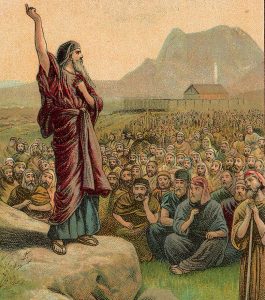 The Book of Deuteronomy tells us that when the long Exodus journey of the People of the Hebrews ended, just before they were to cross over into the Promised Land, Moses delivered a farewell address. He was not going to be going into the new land with them.
You may remember that God had been angered by the first generation of wandering Hebrews, what Jesus might have called an “adulterous and sinful generation” (Mk 8:38), who had grumbled against God, had wanted to turn back, and who had eventually been so disobedient that they had fashioned an idol (the Golden Calf) and worshiped it instead of Yahweh, their deliverer.
Furthermore, even when they worshiped and followed God, they didn’t trust God. Not believing God’s promise of the land into which they were to come, they sent spies ahead of them. This angered God, so that God had decreed that none of those who had left Egypt would enter the Holy Land (Numbers, Ch. 14). The Psalmist quotes God:
They put me to the test,
though they had seen my works.
Forty years long I detested that generation and said,
“This people are wayward in their hearts;
they do not know my ways.”
So I swore in my wrath,
“They shall not enter into my rest.” (Ps 95:9-11)
So Moses was the last of these and, in addition, he himself had been told by God that he would not enter the Promised Land because he and his brother Aaron had doubted God at Kadesh in the wilderness of Zin. God had said to him and to Aaron, “Because you did not trust in me, to show my holiness before the eyes of the Israelites, therefore you shall not bring this assembly into the land that I have given them.” (Num 20:12)
So at the brink of their entry, probably near Moab in the valley of Beth-Peor where he would be buried in an unmarked tomb, Moses gathered the children and grandchildren of the original Hebrews and summarized all that God had done for them and all that God required of them saying, “See, I have set before you today life and prosperity, death and adversity”(Deut 30:15). Follow the laws of God, have life and prosperity; disobey the commandments, death and adversity.
Throughout the discourse, Moses does an interesting thing that we can’t follow in the English translation; he intermixes the use of the plural “you” and the singular “you.” By doing so, he seems to be saying that the obligation to do good, to follow the commandments is both a communal and an individual responsibility. As a whole, the People of God must do these things, but it isn’t sufficient that they do it only as a community. The individual member can’t rely on his or her neighbor to do it for them; he or she can’t rely on the community’s leadership to do it for them. Each member of the community must do it for themselves; the individual needs the support of the community to undertake and accomplish this individual responsibility, but the individual can’t let it slide and just rely on the community to take up his or her slack, so to speak.
Also throughout the course of his speech, Moses makes it clear that though God places this choice of good or bad, life or death, prosperity or adversity, obedience or waywardness before God’s people, God does not underwrite or endorse both equally. In fact, God endorses only one. So, at the end of his address, Moses offers his own advice: “Choose life so that you and your descendants may live, loving the Lord your God, obeying him, and holding fast to him” (Dt 30:19-20).
Choose life! I can imagine Moses raising a glass and giving this counsel in the form of the great Jewish toast “l’Chaim!” – “To life!” And given what was at stake, Moses adds, “Hold fast to God,” basically saying, “And don’t mess it up!”)
Several generations later, around 200-175 BC, Shimon ben Yeshua ben Eliezer ben Sira of Jerusalem, a Jewish scribe, echoed Moses’ admonition as he wrote a text which is in the canon of writings called “the wisdom literature.” This body of literature constitutes basically a course of education for young men training for what we might call “the civil service.” The sons of the class equivalent to the “minor aristocracy” of England would be trained to function in the courts of kings throughout the ancient middle east using these writings. We heard this author’s advice to these young men in today’s reading from the Book of Sirach.
The author’s name is Simon, and he is identified as the son of Yeshua, who was the son of Eliezer, who was the son of Sirach, but some for reason we call the book by his grandfather’s, or rather his great-grandfather’s name. I suppose we do that because we think grandfathers are wiser than their sons or grandsons, although I don’t think I’ve convinced my son of that. This book is part of the Christian scriptures we call “the Apocrypha.” It is recognized as canonical by the Roman Catholic Church and the Eastern Orthodox churches, but not by Protestants. The Jews don’t recognize it as scripture because it is known only in a Greek translation discovered in Egypt; if there was a Hebrew language original (which one would assume since a scribe from Jerusalem wrote it), it has been lost to history. And since the Jews don’t accept it, the Protestants won’t recognize it, either.
Of course, we Anglicans take our usual middle way . . . we won’t based doctrine on it, but we will use it for the teaching of ethics and morality, which is pretty much the way this book has been used by the church through the ages. Another name for the text is “Liber Ecclesiasticus” or “Book of the Church” because it was used throughout the middle ages to teach clergy.
In any event, Simon the son of Yeshua, the son of Eliezer, the son of Sirach, offers advice to the trainee courtiers not at all dissimilar to that offered by Moses to the Hebrews: “If you choose, you can keep the commandments, and to act faithfully is a matter of your own choice. He has placed before you fire and water; stretch out your hand for whichever you choose. Before each person are life and death, and whichever one chooses will be given” (Sirach 15:15-17).
Simon the Scribe is a very canny fellow. He uses a metaphor for the choice of life or death, lawfulness or sinfulness; God, he says, “has placed before you fire and water.” At first glance that seems a pretty solid and clear metaphor, destructive fire versus life-giving water; but the metaphor is not all that clear. It’s really rather ambiguous. In some circumstances, yes, fire is destructive and death-dealing, but if you’re freezing to death in a winter storm, fire can be life-preserving; in some circumstances, yes, water is sustaining of life, but if you’re drowning in the sea the last thing you want is more water. Which, then, represents death and which life? One’s choices, Simon the Scribe seems to be saying, are not always clear cut and unambiguous.
And, like Moses, Simon reminds his readers that although the choices may be set before one by God, God does not underwrite or endorse both alternatives. God, he says, has a clear preference: “He has not commanded anyone to be wicked, and he has not given anyone permission to sin. ” (v. 20)
So Moses and Simon the Scribe offer their audiences, both their original audiences and us, this counsel that we have some big, important choices to made: life or death, prosperity or adversity, ethical conduct or sinful behavior. The choice may sometimes be ambiguous, but these are really big matters. And along comes Jesus in the Sermon on the Mount and complicates things by telling us that our choices aren’t just about the big stuff. “You’ve heard the commandment,” he says, “‘Thou shalt not murder.’ Well, you’re just as guilty if you think badly of another, if you insult a brother or sister, if you argue with another member of the community. You’ve heard it said, ‘Thou shalt not commit adultery.’ Well, even if you just think about about it, you’re guilty!” Remember when Jimmy Carter got into public hot water by confessing in that quaint King James language that despite his long and faithful marriage to Rosalyn he had “lusted in his heart” after other women? (Oh, for the day’s when just that was sufficient to get a candidate or politician into trouble…. )
Jesus extended Moses’ admonition and Simon the Scribe’s advice even further. Yes, there are important choices to be made. Yes, they are sometimes ambiguous. And, guess what? They come at us every day, every hour, in everything we do. Not just in the big things, but in the little everyday minutiae of human existence.
I don’t know about you, but it’s not very often I have to decide not to kill someone (only about once a week), but every day I have to decide whether let a zinger of an insult fly or bite my tongue and hold it back, whether to vent my anger over some upset or just shrug it off and let go of it. It’s not very often that I have to decide whether or not to commit adultery; in fact, never (no one seems to think I’m that attractive). But all through the day I have to make . . . we all have to make . . . these ethical and moral decisions. We have to make our choices, daily, and then stick to them as best we can. As Jesus admonishes us, let our decisions to be “Yes, yes” or “no, no.”
Interestingly, in the koine Greek in which the author of our Gospel lesson wrote, he recorded Jesus doing what the Hebrews scripture recorded Moses doing: mixing plural “yous” with singular “yous” in his discourse. Like Moses, Jesus underscores what we all know to be the truth – that none of us can do this on our own, that we have to have the support of our parents, our spouses, our brothers and sisters, our neighbors, our fellow church members.
There is a story in the Book of Deuteronomy (Chapters 27 & 28) about something that happened after the children of the Hebrews entered the Promised Land. Joshua the son of Nun, who was Moses’ assistant and took over leadership when Moses died, was directed to Moses to lead them into the valley of Shechem, the place where Jacob’s well is. Somehow I seem to recall that there were about 40,000 of them at the time, and Joshua divided them by tribes, sending half of them to the summit of Mount Gerizim and half of them to the summit of Mount Ebal on the other side of the valley. And those on Mt. Gerizim recited the blessings of keeping the Law, while those on Mt. Ebal recited the curses that came with disobedience.
I have this vision of Joshua reading the commandments, not just the “big ten” that Moses brought down from Mt. Sinai on the stone tablets, but the other 603 mitzvoth (or “statutes”) that got added to them and as he would read each one, the folks on Mt. Gerizim would shout “Obey this law and you will be blessed” and those on Mt. Ebal would shout “Disobey and you will be cursed.” Can you imagine how 20,000 voices shouting on one side of valley and another 20,000 voices shouting in response on the other side would have echoed throughout the land? Those voices also would have echoed down through time as a reminder that obedience is a communal thing, but also a personal thing, an individual obligation in which one is support by the community.
But even that is not enough. We humans individually are unable to stay in the narrow way and we are also unable to do so as communities, as churches, as nations. As our opening collect says, “in our weakness we can do nothing good without you” (BCP 1979, pg 216) and as St. Paul reminded the Corinthians it is “only God who gives the growth” (1 Cor 3:7). If we choose, we can keep the commandments, and to act faithfully is a matter of our own choice; but we can only stay the course if we are aided by our community and upheld by God.
Today and every day, the choice is before us, good or evil, obedience or sinfulness, life or death. Choose life! – l’Chaim – and rely on God (don’t mess it up)!
Amen!
(Illustration: Moses Pleading with Israel, an illustration from a Bible card published 1907 by the Providence Lithograph Company.)
====================
Father Funston is the rector of St. Paul’s Episcopal Church, Medina, Ohio.
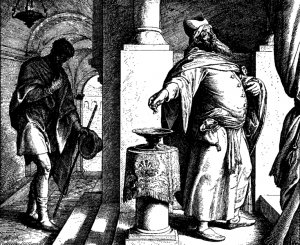 For the past couple of weeks in the Daily Office lectionary and today in the Sunday lectionary we are reading from the Wisdom of Yeshua ben Sira, some times called Sirach, sometimes called Ecclesiasticus, one of the books of the Apocrypha, those books recognized by the Roman and Eastern Orthodox churches as canonical, but rejected by Protestants. Anglicans steer a middle course and accept them for moral teaching, but not as the basis for religious doctrine. The text is a late example of what is called “wisdom literature,” instruction in ethics and proper social behavior for young men, especially those likely to take a role in governance.
 Our first lesson today is from a book with the wholly amazing title The Book of the All-Virtuous Wisdom of Joshua ben Sira, usually (and mercifully) shortened to Sirach. It is accepted as part of the Christian biblical canon by Roman Catholics, the Eastern Orthodox, and most of the Oriental Orthodox churches. In our Anglican tradition, it is not accepted as canonical, but we do read it “for example of life and instruction of manners;” however, it cannot be used to establish any doctrine. (Article VI of the Articles of Religion, 1801) The book is in the tradition known as “wisdom literature;” basically, it is a collection of ethical teachings closely resembling the canonical Book of Proverbs, and serving the same function.
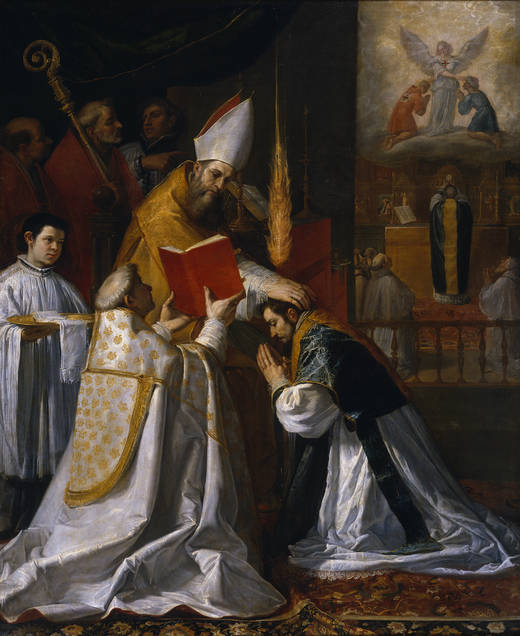 Tonight, as my diocese begins its annual governing convention in traditional fashion with a celebration of the Holy Eucharist, we will doing so in the context of an ordination – two ordinations, in fact, one to the diaconate and one to the presbyterate. This morning’s reading from Ben Sira is lengthy description of the glories of the ceremonial priesthood. One might have expected the church to have made this one of the potential readings for a presbyteral ordination, but in its wisdom, it has not.

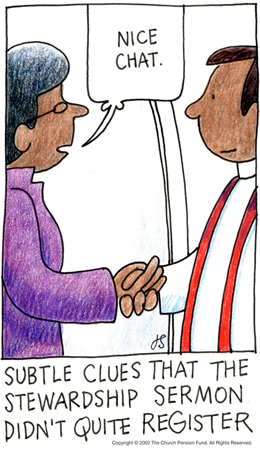 It’s about to come to an end, the annual appeal to church members everywhere to turn in a card saying how much they plan (hope, anticipate, expect, guess) to give in offerings in the coming year. Clergy everywhere are breathing both a sigh of relief that “stewardship season” is nearly done, while also wondering if there will be enough income to sustain the parish’s budget for another year. Congregational governing boards, treasurers, and budget committees are poring over the books and making plans – in some parishes they are adding new programs and new staff; in most, I suspect, they are trying to cut “fat” out of budgets already cut to the bone. I would guess there are more frowns than smiles being generated in the process of annual church budgeting.
 The shadows tonight will be full of dreams moving from house to house, door to door, seeking handouts of candy or toys or whatever with a cry of “Trick or Treat!” We hope the wind will stay away, at least until America’s children’s annual celebration of the ancient Celtic feast of Samhain is completed.
 I often wonder what (if any) thought went into the construction of various lectionaries, particularly the Daily Office lectionary of the Episcopal Church. Are the sometimes strange, sometimes enlightening, often puzzling juxtapositions of texts planned or simply fortuitous?

