Occasional thoughts of an Anglican Episcopal priest

Category: Christianity (Page 22 of 84)

Living Water: Sermon for Lent 3, RCL Year A (19 March 2017)

overflowingwellToday the lectionary gives us two stories about water. The first set in the Sinai desert where the Hebrews found themselves exhausted, thirsty, and more than a little bit feisty and quarrelsome demanding water from Moses and from God; the second set at a well in a Samaritan village where Jesus, “tired out by his journey” (Jn 4:6, NRSV), encountered a lone woman and asked her for a drink.

I sometimes think that we take the biblical metaphor water way too lightly. We live in a world which is water-abundant. Here in NE Ohio we are surrounded by the stuff! There’s that big lake up to the north of us; there are rivers and streams running nearby; and I’ll bet most of us live in neighborhoods where some of our neighbors have ponds in their back yards. There’s water everywhere.

Even in the sorts of desert places I lived as a young adult along the Southern California coast there is an abundance of water. There’s all that salt water in the ocean, of course, but that won’t sustain human life. What there is is water brought in by aqueduct from the Sacramento River or piped in from the Colorado River; without that Los Angeles and Orange and San Diego Counties could not sustain the populations that presently live there.

Continue reading

We Were There: Sermon for Lent 2 (RCL Year A) – 12 March 2017

====================

A homily offered by Mr. Donald Romanik, President of the Episcopal Church Foundation, on the Second Sunday in Lent, March 12, 2017, to the people of St. Paul’s Episcopal Church, Medina, Ohio. Mr. Romnanik led a Vestry Retreat for the Parish the previous two days and graciously agreed to preach the sermon for our congregation on Sunday morning.

(The lessons for the day are from the Revised Common Lectionary, Year A: Genesis 12:1-4a; Psalm 121; Romans 4:1-5,13-17; and St. John 3:1-17. These lessons can be read at The Lectionary Page.)

====================

We-Were-There-at-Pearl-HarborWhen I was child in my tween years, I spent a lot of time at the Public Library checking out stacks of books, with that wonderful musty library smell, to read under the big oak tree in our back yard on hot summer days. As I was a U.S. history buff both then and now, I gravitated toward a series of children’s books whose titles began with the phrase – “we were there”. For example, We Were There at Lexington and Concord, We Were There at Battle of Gettysburg and my favorite – We Were There at Pearl Harbor. The books had the same two characters – a boy and a girl around my age at the time, who happened to be living right in the middle of these key historic events. They often performed semi-heroic acts and were usually honored or congratulated by some famous person at the end of the book.

In addition to making these historic events come more alive, I was intrigued by the idea of actually being present during important times in human history and trying to imagine what I would see, say or do had I been there. I also engaged in this same exercise with bible stories, especially those involving Jesus. What would it be like to be living in first century Palestine and experience Jesus first hand? Which characters in the New Testament did I most identify with? And it was not just about being present during the most significant events in the life of Christ – his birth, death or resurrection. Sometimes I would just want to follow him along the way and watch him preach, teach and heal. And unlike the two protagonists in the “We were there” series, I didn’t even have to do or say anything – just be an innocent bystander or a proverbial fly on the wall.

Today’s Gospel passage would be a good time for me to be a fly on the wall in order to overhear the conversation between Jesus and Nicodemus. Like much of the Gospel of John, this passage is not about the action, it’s about the dialogue and Jesus has the principal speaking part. Furthermore, there isn’t a lot to see because it’s dark since Nicodemus comes to Jesus at night. So let’s set the scene and try to think about what we would hear and experience had we been there.

So far in John’s narrative, after being heralded by John the Baptist, Jesus does two main things – turning water into wine at the wedding feast and driving the moneychangers out of the temple in Jerusalem right before the Passover. Both of these events illustrate how God was acting out God’s purpose in the world in the person of Jesus – the wine as a symbol of God’s abundance and grace and the temple event suggesting that animal sacrifices were no longer necessary because human salvation was now assured through the cross and resurrection. It is with this background and in this context that Nicodemus comes to see Jesus.

In addition to dialogue, John is a master of dramatic setting and vivid imagery. Note that Nicodemus arrives at night with all of its connotations of darkness and secrecy. Nicodemus begins his encounter with a bold affirmation that clearly Jesus must have been sent by God as evidenced by his God-like actions and signs. In a somewhat typical John-like non-sequitur, Jesus responds with a pronouncement that no person can see or experience the kingdom unless being born from above, or, in some translations, born again. This is followed by back and forth interactions, confusion on part of Nicodemus on the difference between spirit and flesh, and Jesus’ somewhat glib comment that a Jewish leader and a learned scholar should be much more knowledgeable and astute. But Nicodemus’s apparent ignorance or naiveté provides Jesus with the perfect opportunity to proclaim the bold reality that the Son of Man has come from heaven to be lifted up as a sign that God loves the world and that whoever believes will have eternal life. Jesus invokes the image of Moses lifting up the serpent in the desert and portends his own lifting up on the cross at Calvary. We then hear one of the most famous and beloved passages in the Bible: “For God so loved the world that he gave his only Son, so that everyone who believes in him may not perish but have eternal life.”

All we know of Nicodemus in the Bible is contained in the Gospel of John. Nicodemus is described as a Pharisee, that group of Jews who were fastidious in keeping the letter of the law and often opposed Jesus throughout his ministry, especially when they felt he did not share their legalistic and ideological purity. Jesus criticized Pharisees on several occasions especially for their blatant hypocrisy. Nicodemus was also a member of the Sanhedrin in Jerusalem which was the final court of appeals for matters relating to Jewish law and tradition. It was the Sanhedrin that condemned Jesus to death but ultimately needed the approval of Pilate since the death penalty was beyond their jurisdiction under Roman law.

John reports that Nicodemus came to speak to Jesus at night. Some scholars speculate that since he was a Jewish leader and official, Nicodemus was afraid, or at least embarrassed, to be seen with Jesus in broad daylight. But given his position on the Sanhedrin, wasn’t it perfectly appropriate for Nicodemus to question Jesus in order to assess his theological credentials? No one should have been able to question Nicodemus’ authority or motivation for being there although his opening comment that Jesus must have been sent from God could have raised a few eyebrows back at the temple. Clearly, Nicodemus was as least curious about Jesus if not somewhat intrigued by and attracted to his ministry. Interestingly, after this incredible explanation by Jesus of his role as the Son of Man who came to reveal and demonstrate God’s love and the promise of new life, Nicodemus has no response. In fact, he simply disappears from the scene and presumably goes back to his former role as a member of the establishment – not yet ready to accept Jesus or to make a commitment to follow him and embrace his message of love. Perhaps after this encounter Nicodemus decided that he just wasn’t as curious or interested in Jesus as he thought he would be. As innocent bystanders and flies on the wall, all we are left with at the end of this passage is Jesus’ incredibly profound words.

Nicodemus reappears at two later points in John’s Gospel. In Chapter 7 he is sitting as a member of the Sanhedrin – that official body that condemns Jesus to die and offers a somewhat half-hearted defense that Jesus should at least have the right to defend himself and respond to the charges against him. In Chapter 20, however, Nicodemus accompanies Joseph of Arimathea, another secret follower of Jesus, and contributes an exorbitant quantity of spices for Jesus’ ritual burial. Can we assume that by the time of the crucifixion Nicodemus finally gets it and accepts Jesus as his Lord? Does Nicodemus finally have the conversion experience of being born from above and now able to experience God’s kingdom of love?

This passage from John’s Gospel is often used by fundamentalist, evangelical Christians to support their belief in the necessity of an actual and affirmative conversion experience – being born again – in order to be a true follower of Christ. But I think this approach sells these words of Jesus short and oversimplifies the concept of conversion. I’m sure there may be some people who truly have a dramatic experience of being born again into a new life in Christ. For most of us, including our friend Nicodemus, the process of discipleship moves much more slowly, and, may take an entire lifetime in order to be truly realized.

Let’s look at these famous words of Jesus once again – “God so loved the world that he gave his only son.” Jesus did not say that God was responding to the pleas of anguish from humankind or was acting from a sense of justice, power or expectation. God does not ask the world whether it wants to be loved. God just goes ahead and loves, and not only loves, but gives his only beloved Son over to death. God’s sending Jesus to our broken world was an act of unconditional love – plain and simple. God loves us whether we like it or not. In light of this love, however, we are called to accept it, embrace it and share it with others or, in the alternative, run away screaming. For it is virtually impossible to remain neutral or ambiguous in light of such Godly extravagance and abundance.

Notwithstanding a vivid imagination and my “we were there” reading memories from childhood, I was not present at Lexington and Concord, the Battle of Gettysburg or at Pearl Harbor on December 7, 1941. But, while I was not present with Nicodemus when he had his conversation with Jesus at night, attempted to defend him at his trial and helped prepare him for burial after his brutal passion and death, I feel that I and all of us have a lot in common with this famous Pharisee.

Ultimately, like Nicodemus, we have to choose to be followers of Christ fully mindful that the process is not easy, predictable, linear or quick. And that’s why we have Lent. Lent provides us with an incredible opportunity to step back, take a deep breath, appreciate God’s unconditional love and contemplate God’s ultimate act of redemption. What we learn from Nicodemus this morning is that being born from above takes time. And what we learn from Jesus’ interaction with Nicodemus is that God is infinitely patient, does not expect us to be perfect, loves us unconditionally and is waiting for us with open arms – dramatically symbolized by the open arms of Jesus on the cross. Amen.

====================

Donald Romanik is the President of the Episcopal Church Foundation.

Shortcut: Sermon for the First Sunday in Lent, Year A (5 March 2017)

====================

A homily offered by the Rev. Dr. C. Eric Funston on the First Sunday in Lent, March 5, 2017, to the people of St. Paul’s Episcopal Church, Medina, Ohio, where Fr. Funston is rector.

(The lessons for the day are from the Revised Common Lectionary, Year A: Genesis 2:15-17;3:1-7; Psalm 32; Romans 5:12-19; and St. Matthew 4:1-11. These lessons can be read at The Lectionary Page.)

====================

shortcutsThe First Sunday in Lent … that’s today. That means we get the story of Jesus being chased into the desert by the Holy Spirit after his baptism by John in the River Jordan, the story of Jesus being accosted in the desert by the Tempter (whom Matthew in our Gospel text today also names “the devil” – in Greek the word is diabolos meaning “accuser”), the story of Jesus refusing to give into the three temptations. We always get some version of this story on the First Sunday in Lent. And this year the Lectionary gives us a double-whammy of temptation by linking that familiar gospel tale with the equally family story of Eve and the serpent and the fruit of the tree of the knowledge of good and evil, the so-called “apple.”

Temptation writ large . . . and in reading these stories again and again over the week, I kept coming back to a single question, “What exactly is temptation?”

My colleague David Henson, in the on-going online dialog we clergy seem to have about preaching and the lessons given us to preach about, was addressing the dualistic nature of the gospel lesson, how it can be wrongly understood to suggest that God and the Tempter are equals. He rightly observed that the story of Christ’s temptations can encourage us to think that there

. . . are two powerful deities – God and Satan, good and evil – commanding from the two opposing fronts of heaven and hell and warring against each other for the territory of earth and for the soul of humankind. (The Rev. David Henson, Facebook posting, March 4, 2017)

And he correctly pointed out that that would be a gross distortion of the Christian understanding of God and creation. The Tempter, the Accuser, Satan, the Devil, the wily old serpent, is not God’s equal! In the course of that discussion, David said that one reason this story can encourage that incorrect dualistic thinking is that

. . . ultimately it makes folks profoundly uncomfortable to consider Jesus being tempted — really, really, really — wanting these things, really feeling the seductive call of comfort, power, and security.

We don’t want to think of the Savior of the world, the Incarnate Son of God, as temptable.

David’s comments, however, really stirred up for me this question about what temptation really is.

Another clergy friend, Nurya Love Parish, is an Episcopal priest who like me was born and raised in Las Vegas and who, also like me, was wasn’t raised in the church. She wrote in an article in a recent issue of The Christian Century that the three temptations offered to Jesus “stand for pride, power, and possession.” She said that when she first realized that, having read it in another essay during her pre-Christian life,

I didn’t know much about Jesus, the devil, or that desert, but I knew pride. I knew the desire for power; I knew the wish for possessions. I was familiar with all of them, from painful experience.

All of a sudden the story wasn’t just about Jesus; it was about me, too. And not just me: it was about all humanity. I knew from the history books and the newspapers that we all struggle with pride, power, and possession. People and nations fight, kill, and die over who is worthy of respect, who gets control, and who owns what. The more I thought about it, the more these three simple words seemed to be at the heart of the human experience. (Living by the Word)

When I read what Nurya wrote, I thought it was spot on, and I still do, but it occurred to me that pride, power, and possession don’t really help us, or at least they don’t help me, to understand today’s other temptation story, the tale of Eve (and Adam) and the serpent and the so-called “apple.” If the temptations of Christ represent pride, power, and possession, what does the temptation of the proto-parents in Eden represent?

Well, in the midst of contemplating that, I was also doing my reading for the Education for Ministry seminar group that I participate in each week at the Cathedral, and in this week’s readings I was reminded of the theological focus of our study this year, the idea of “deification” or (to give it its technical Greek name) theosis.

Way back in the Second Century, the Bishop of Lyons in what is now France, a man named Irenaeus, wrote a book entitled Against All Heresies (Adversus omnes Haereses) in which he said, “The sure and true Teacher, the Word of God, Jesus Christ our Lord, on account of his immense love was made what we are, so that we might become what he is.” A later bishop, Athanasius of Alexandria, about 150 years later wrote, “God became human that humans might become God.” (De Incarnatione) What these ancient writers are saying is that the ultimate end of human beings is union with the divine. This is what is meant by “deification” or theosis.

You will remember, I’m sure, the words of Genesis in which the creation of humankind is described, “God created humankind in his image, in the image of God he created them.” (Gen 1:27) The Russian Orthodox theologian Paul Evdokimov says that our creation in the image of God predestines us to theosis. Our creation in God’s image gives us a built-in longing to be united with our Creator, an innate desire for deification.

The the late-17th Century French philosopher Blaise Pascal wrote about this longing in this way:

What else does this craving, and this helplessness, proclaim but that there was once in man a true happiness, of which all that now remains is the empty print and trace? This he tries in vain to fill with everything around him, seeking in things that are not there the help he cannot find in those that are, though none can help, since this infinite abyss can be filled only with an infinite and immutable object; in other words by God himself. (Pensées VII[425])

Pascal’s formulation has been summarized by the often-heard comment that we human beings have a “God-shaped hole” in us.

So it seems to me that the temptation of Eve (and Adam) is the attempt to take a shortcut to the human destiny of deification. This is what the wily serpent promises her, “You will not die; . . . when you eat of [the fruit] your eyes will be opened, and you will be like God.” (Gen 3:4-5) You will have taken a shortcut to theosis!

Shortcuts are also what the Tempter offers to Jesus.

Have you ever baked bread? I used to bake bread every week. Back in my college days, I lived in a house with six other guys, nine dogs, and a cat. We shared the cooking responsibilities (well, the guys did – the dogs and the cat, not so much). I took on the task of making our breads. I loved to bake bread; there is something intensely satisfying about it. It’s a process: the measuring, the mixing, letting the dough rise, punching it down to rise again, forming and proofing the loaves, and then the oven . . . and what comes out! It’s heaven! I love it. I wish I had the time to do it now. The Accuser’s suggestion that Jesus turn stones into bread is a shortcut temptation; forget the process, skip the work and the effort, go straight to that wonderful stuff that comes out of the oven.

The proposal that he throw himself off the pinnacle of the Temple in a show of religious power is another temptation to shortcut. Do that, make a big splashy show of being divine, and you won’t have to go through the laborious, frustrating, and frankly painful process of calling, teaching, and leading disciples. The idea that Jesus might accept political domination of the world is nothing more than the temptation to shortcut the process of being and setting a moral example, of being and showing the love and life of God in human form.

Just as, for Eve (and Adam) the temptation to eat the fruit was a temptation to shortcut the long process of learning and growing into unity and community with their God, into theosis or deification, for the Son of God the Devil’s offerings of power, pride, and possession were temptations to shortcut the process of being incarnate, of taking part in those things which my friend Nurya correctly tagged as being “at the heart of the human experience.”

So it occurred to me that that is what temptation is. That there is really only one temptation – the shortcut. That every temptation boils down to what we in the modern world have come to call “instant gratification.”

I don’t spend all my reading time on the Bible, on Education for Ministry, or on theology. I actually do take time to read for fun and currently my leisure reading is a collection of novellas by the famous science fiction writer Ursula Leguin. They have been gathered into a single volume entitled The Found and the Lost. One of the stories is a first-person narrative called A Woman’s Liberation and tells the tale of woman raised in slavery who gains freedom and becomes a scholar. At one point, describing her education, she writes,

What I loved to learn was history. I had grown up without any history. There was nothing [where I lived] but the way things were. Nobody knew anything about any time when things had been different. Nobody knew there was any place where things might be different. We were enslaved by the present time. (Ursula Leguin, The Found and the Lost, Saga Press, New York:2016, page 389)

This is what the temptations of Eve (and Adam) and of Jesus represent: entrapment in a dead-end present where the process of growth, like the yeast in the bread, like the gathering of a community of disciples, like human development into theosis, is cut short.

To be sure, Jesus told us to live in the present. “Do not worry about tomorrow,” he said, “for tomorrow will bring worries of its own. Today’s trouble is enough for today.” (Mat 6:34) But the reason he gave that instruction was clear: he said, “Do not worry, saying, ‘What will we eat?’ or ‘What will we drink?’ or What will we wear?’ For . . . your heavenly Father knows that you need all these things. But strive first for the kingdom of God and his righteousness, and all these things will be given to you as well.” (Mat 6:31-33) Do not be enslaved by the present time; do not live in a dead-end present where you have filled your “God-shaped hole” with instant gratification because of worry over pride, power, and possession.

Live in an open-ended present where things might be different, an open-ended present that leads to the kingdom of God and his righteousness, an open-ended present that leads to deification.

So . . . I think that’s the answer to my question, “What is temptation?” Temptation is a shortcut that leads to entrapment in a dead-end present. This is why Lent is a season, a process that begins with the story of Jesus’ temptation. It reminds us to live in the open-ended present where the yeast can rise, where the community can form, where becoming is as important as being.

God became human . . . and refused the temptation to shortcut that process . . . that humans might become gods . . . despite Eve’s (and Adam’s) giving into the temptation to shortcut that process. Live into that process; live in the open-ended present, the open-ended Presence of God. Amen.

====================

Father Funston is the rector of St. Paul’s Episcopal Church, Medina, Ohio.

Listen to Him! – Sermon for the Last Sunday after Epiphany, 26 February 2017

====================

A homily offered by the Rev. Dr. C. Eric Funston on the Last Sunday after the Epiphany, February 26, 2017, to the people of St. Paul’s Episcopal Church, Medina, Ohio, where Fr. Funston is rector.

(The lessons for the day are from the Revised Common Lectionary, Year A: Exodus 24:12-18; Psalm 2; 2 Peter 1:16-21; St. Matthew 17:1-9. These lessons can be read at The Lectionary Page.)

====================

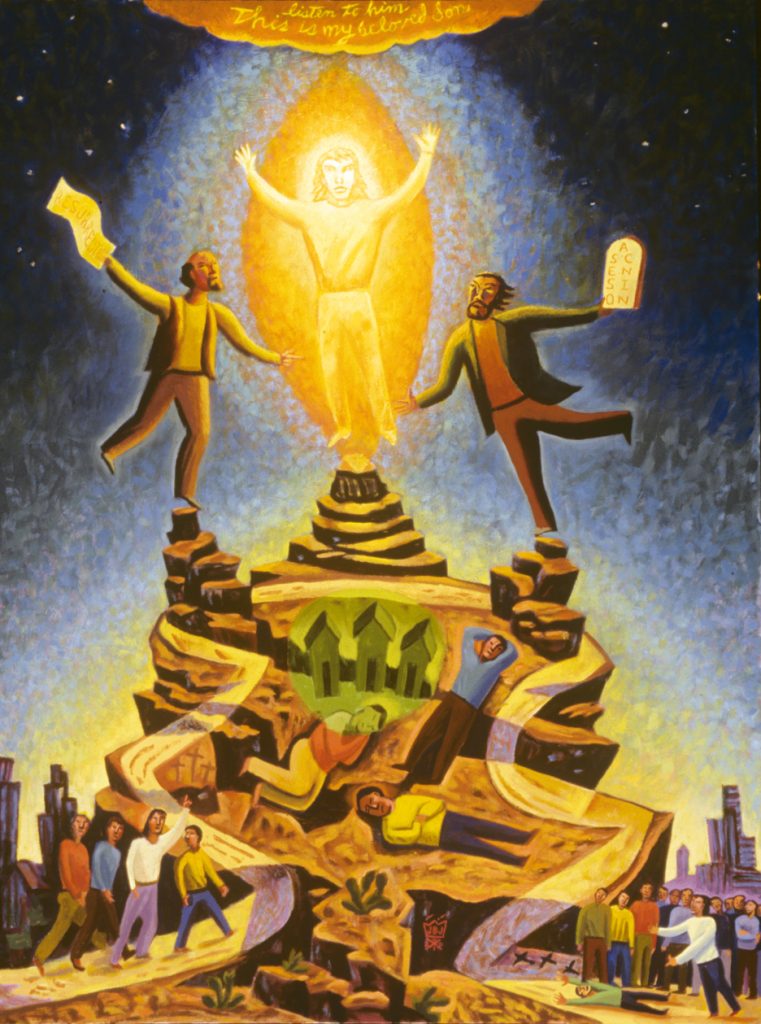
transfiguration_wLGHere we are at the end of the first period of what the church calls “ordinary time” during this liturgical year, the season of Sundays after the Feast of the Epiphany during which we have heard many gospel stories which reveal or manifest (the meaning of epiphany) something about Jesus. On this Sunday, the Sunday before Lent starts on Ash Wednesday, we always hear some version of the story of Jesus’ Transfiguration, a story so important that it is told in the three Synoptic Gospels, alluded to in John’s Gospel, and mentioned in the Second Letter of Peter.

Six days before, Jesus had had a conversation with the Twelve in which he’d asked them who they thought he was. They had said that other people thought Jesus might be a prophet and that some thought he might even be Elijah returned from Heaven or John the Baptizer returned from the dead. Jesus put them on the spot, though, and asked, “But who do you say I am?” (Mt 16:15; cf Mk 8:29; Lk 9:20) Peter answered, “You are the Messiah.”

Then they had an argument. Jesus congratulated Peter for his astute answer and then tried to explain to him and the others what that would mean predicting his own death in Jerusalem. Peter, headstrong and outspoken, had contradicted Jesus and vowed that they would never let that happen. That’s when Jesus called him “Satan” and told Peter to stop obstructing him. “Get behind me,” he said. (Mt 16:23) Then he told the rest of them that to be his disciple would mean suffering and probably death. “If any want to become my followers, let them deny themselves and take up their cross and follow me.” (Mt 16:25)

Continue reading

Be Holy, Be Perfect – Sermon for Epiphany 7, 19 February 2017

====================

A homily offered by the Rev. Dr. C. Eric Funston on the 7th Sunday after the Epiphany, February 19, 2017, to the people of St. Paul’s Episcopal Church, Medina, Ohio, where Fr. Funston is rector.

(The lessons for the day are from the Revised Common Lectionary, Year A: Leviticus 19:1-2,9-18; Psalm 119:33-40; 1 Corinthians 3:10-11,16-23; and St. Matthew 5:38-48. These lessons can be read at The Lectionary Page.)

====================

pinkperfectionWhen the Prayers of the People are offered later in this service you will hear a name you’ve never heard before, and you will hear that the person named was buried in our memory garden this week, and you will wonder, “Who is Indra?” (“Indra” is not the child’s real name.)

Indra was born on February 1, 2017. And Indra died on February 1, 2017. Whether she was stillborn or expired a few minutes after her birth is unknown. Indra suffered Turner Syndrome and was born in her parents’ automobile as they were driving to the Emergency Room. In any event, she was not living when they got to the hospital.

Because of her father’s cultural traditions, the family was not involved in her burial and do not know the whereabouts of her ashes. Only the funeral director and I were present. It was the shortest, simplest funeral I’ve ever conducted, but in many ways it was perhaps the saddest and hardest burial I have done in 27 years of ordained ministry.

I was going to start this sermon with the declaration that being a priest is hard, but then I was asked to handle Indra’s burial and I thought perhaps that telling you about her and her funeral would illustrate that better than my simply whining to you about how hard it is to be priest.

It’s not this stuff, this Sunday stuff, that is hard. This is easy. Just follow the Prayer Book, follow the Lectionary, choose some hymns that fit the lessons, ask David to pick some other music, say a few words about Scripture, and share some Bread and some Wine. That’s easy.

And funerals and weddings are usually pretty much the same. Just follow the recipe; like cooking, it all pretty much takes care of itself.

But, sometimes, it’s not. Funerals usually aren’t hard, but Indrah’s fast, simple, no-family-to-deal-with burial was incredibly hard.

Sitting with someone in hospital who is facing their death is hard; sitting with a family whose loved one is facing death is even harder. Counseling two people getting married is hard; counseling two people getting divorced is harder. Getting over being angry with God is hard; helping someone else get over being angry with God is harder.

I don’t really know how handles those situations. I don’t really know how to do this stuff and I’m never sure I’ve done it right. If putting together a Sunday service is like cooking, this sort of stuff is more like baking. I was tempted to say there are no rule books for this sort of thing, but the truth is that there are lots books. There are lots of recipes. There are too many, in fact, and they seem to all give contradictory advice.

I say it’s like baking because I am always looking for the secret to flaky pie crusts or to a successful soufflé. One of my grandmothers swore by using lard in her crusts; the other used butter. My mother said to use vinegar in the dough, but my aunt insisted that ice water was the trick. And as hard as making a good pie crust is, baking a soufflé is even worse. Follow the recipe, but get the slightest thing just a wee bit “off” and what might have been a glorious dessert is a hopeless disaster, and more often than not, you have no idea what you did wrong.

Some of being a priest, a lot of being a priest actually, is like making pie crust or baking a souffle. Do it right – everything is great. Do the slightest thing wrong – it’s a complete mess. And constantly live in fear of that slight, wrong thing.

I think the priests in Solomon’s Temple had it easier. They had Leviticus. Most of us aren’t very familiar with Leviticus. It is, for the most part, a book of rules, of very detailed rules. So we don’t read it in church very much.

We Episcopalians are fond of saying that our worship is among the most biblical of all Christian denominations. We are often criticized for not taking the Bible more seriously and those not familiar with our liturgy accuse us of ignoring it. When that happens, we often fire back that our Prayer Book is about 80% scriptural and that we read through the Bible using a Lectionary so that (and I’ve heard clergy say this) “we read all of the Bible in three years.”

Except that’s not true. We don’t read all those genealogies. There are some of the Psalms that we don’t consider appropriate for Sunday worship, although we do read them in the Daily Offices. And there’s Leviticus from which we read, I think, only two short lessons in the whole three years of the Lectionary cycle. Today is one of those two times. Nonetheless, it is a book worth knowing and knowing about. I commend it to you; it is especially good for reading late at night when you can’t get to sleep . . . .

Very briefly, this is what you’ll find in Leviticus. First, there are six chapters on various kinds of offerings and sacrifices, then two chapters instructing priests how to handle all the different sorts of offerings and sacrifices. This is followed by four chapters on the history of the Aaronic priesthood.

Next are five chapters on uncleanness with which the Temple priests were expected to deal, unclean animals, the uncleanliness of women caused by childbirth, various unclean diseases (such as leprosy) and how the priests were to cleans them, if possible, and (my favorite) unclean bodily discharges. (Maybe the Temple priests didn’t have it easier, after all. I’m quite happy that you don’t come to me with your unclean diseases, your weeping ulcerous sores, and your other bodily discharges! That would be really hard . . . .)

After the uncleanness chapters, there is one chapter detailing the Day of Atonement.

Then comes something scholars call “the Holiness Code,” ten chapters for the not-priests, for the people of God. Ten chapters of practical rules for living a righteous life. One of them, from which we heard today, concerns neighborliness and begins with this admonition, “You shall be holy, for I the Lord your God am holy.”

Do you know why I became a priest? Yes, I had that sense of call and went through the discernment “process” and all of that (twice, actually, but that’s another story). But . . . really . . . when I look back on it, I realize that I left my life as a trial lawyer and went into the ordained ministry because, as hard as it is, it’s easier than being a lay person. As hard as it sometimes is to be a priest, to be a “professional Christian” in the church, it’s harder still to be a lay Christian in the world.

There are no good rule books for priests, or too many contradictory rule books, but there are expectations and there are permissions. There is a stereotype and there are prescribed situations. There is “safety within the walls” of the church, within the set of circumstances in which a priest finds him- or herself.

That’s not true in the world. In the the wide open, free wheeling, anything-can-come-at-you-world where you not-priests have to do your ministry, you have the much harder job.

You can tell that just by look at the Book of Leviticus: there are five chapters of rules for priests, but there are ten for the not-priests! The people of God have twice as much to do as the priests of God.

And you can tell it just by reading the Catechism of the Episcopal Church (it’s in the Prayer Book back around page 845 or so, in that part of the book no one ever seems to open). It asks there who the ministers of the Church are and answers that it’s everyone: lay persons, bishops, priests, and deacons. The ministry of priests, it says, is to “share with the bishop in the overseeing of the Church; to proclaim the Gospel; to administer the sacraments; and to bless and declare pardon in the name of God.” (Book of Common Prayer, page 856)

That’s a piece of cake when you compare it to the ministry of the laity. According to the Catechism, your job, oh People of God, is “to represent Christ and his Church; to bear witness to him wherever [you] may be; and, according to the gifts given [you], to carry on Christ’s work of reconciliation in the world; and to take [your] place in the life, worship, and governance of the Church.” (BCP, page 855) Now that is hard work!

The Jewish bible scholar and rabbi Jacob Milgrom said that the point of the Book of Leviticus is that holiness is not the responsibility of priests alone. In this book, and especially in the Holiness Code, “the domain of the sacred expands, embracing the entire land, not just the sanctuary, and all of Israel, not just the priesthood.” Israel, he said, attains holiness and priests strive to sustain it. (Milgrom, J., Leviticus: A Book of Ritual and Ethics, Fortress Press, Minneapolis:2004, pp 175, 178)

Although priests are not allowed by the rules in Leviticus to make any mistake, attaining holiness takes a lot more work than sustaining it. What we priests do in the sanctuary merely sustains holiness; what the People of God do in the world, that is how holiness is attained. That’s much, much harder!

It takes love … It takes loving even people we don’t really like, even people we can’t stand! Indeed, the word used in Hebrew text is not exactly “neighbor;” it is not limited to those who are geographically nearby. The Hebrew word is more akin to “fellow” and seems to be much more expansive. Thus, when a lawyer questions Jesus about the Law, Jesus is able to cite the rule from Leviticus (19:18), “You shall love your neighbor as yourself” and then illustrate it with a story involving someone from another country, a hated foreigner, the Good Samaritan. (See Luke 10:25–37)

In our Gospel lesson today, Jesus quotes (or, actually, misquotes) the same verse from Leviticus, adding words that aren’t in the original: “You have heard that it was said,” he says, “‘You shall love your neighbor and hate your enemy.'” (Mt 5:43)

Now to be fair to Jesus, he doesn’t actually say he’s quoting Leviticus, just “you have heard it said.” That last bit about hating enemies could just be a rabbinic gloss; it could just be folk wisdom. In any event, it was (and is) the way people act. Jesus acknowledges human nature by beginning this bit of the Sermon on the Mount (and that’s what this is, the end of the first chapter of that long sermon) with commentary on what’s called “the lex talionis,” that eye-for-an-eye rule. But the lex talionis isn’t about enemies; that’s a rule of justice not of war. “An eye for an eye” deals with retribution toward a neighbor who has violated social norms. Jesus dispenses with that (saying, basically, don’t follow the lex talionis, don’t seek retribution or revenge) and now moves beyond it; he leaves the neighborhood, so to speak.

Jesus says, “Love your enemies. Love those whom you fear, even those you think might kill you, even the hated foreigner.” He’s saying that “enemy” is not really a separate class, that the world isn’t divided into neighbors and enemies. Although some people would like to do that, although some people have always done that (it’s human nature, after all), the world isn’t carved up that way. Jesus is saying (I think) that “enemies” are simply a class of “neighbors;” that enemies and neighbors are all “fellows;” that the division – neighbors here, enemies there, those we’re unsure about in some holding pen over there – doesn’t hold water.

And then, echoing Leviticus’ “Holiness Code,” especially the first verses of the neighborliness rules of Chapter 19 – “Be Holy because God is holy” – Jesus says, “Be perfect, therefore, as your heavenly Father is perfect.” (Mat 5:48)

That’s heavy stuff! And remember the Leviticus command and Jesus’ admonition are not directed to the priests; these are directives for the whole People of God, for the laity.

It’s hard work . . . but as Kathryn Schifferdecker, who teaches Old Testament at Luther Seminary in St. Paul, Minnesota, says these verses are as much promise as command:

“You shall be holy.” It is both command and promise. And to believe that promise is to begin to be formed into the people God calls us to be, a people living out in our day-to-day lives genuine love for God and for our neighbors. (Working Preacher)

You will be holy. You will be perfect. It’s a promise – so act on the promise; live as if you believe the promise. And keep this in mind, “holiness” is just another way to say “wholeness” and “perfection” is just another way to say “completion.” The promise of holiness is an instruction to strive for wholeness; the promise of perfection is a command to work toward completion.

What Leviticus and Jesus ask of us is that we be fully human, that we be as whole and complete a human being as each of us can be. And the way we do that is to love our neighbor, even the neighbor who seems to be our enemy, even the neighbor of whom we are afraid, even the neighbor we think may kill us.

When I was kid, I helped my stepdad restore old homes. I think my parents invented to the practice of “flipping,” buying old fixer-uppers, rehabbing them, and then selling them hopefully at a profit. From the time I was about 10 years old until I went away to college, we lived and fixed up in a different house every year. The last thing we would do was to paint the interiors. My stepdad encouraged me to do that very neatly and carefully because, he would say (and I had no idea that he was referencing scripture), “Paint covers a multitude of sins.”

He was parodying the First Letter of Peter, “Love covers a multitude of sins (4:8).” Peter goes on to say, “Serve one another with whatever gift each of you has received (v. 10).” Just be human, be yourself, be the best you you can be, loving your neighbor and using whatever gifts you have been given. I know that’s hard; it’s really hard. But with the help and grace of God, you can do it.

“You shall be holy, for I the Lord your God am holy.” “Be perfect, as your heavenly Father is perfect.” It is a promise more than it is a command. With the help and grace of God you will be holy; you will be perfect.

And the glorious thing is – the Gospel truth is – that through the grace of God you already are!

Amen!

(Note: The illustration is Camelia Japonica, “Pink Perfection,” a camellia cutlivar dating from the late 18th Century; it was one of the most popular flowers of the Victorian Age.)

====================

Father Funston is the rector of St. Paul’s Episcopal Church, Medina, Ohio.

Life or Death; Lawfulness or Sinfulness: Sermon for 6 Epiphany, 12 February 2017

====================

A homily offered by the Rev. Dr. C. Eric Funston on the 6th Sunday after the Epiphany, February 12, 2017, to the people of St. Paul’s Episcopal Church, Medina, Ohio, where Fr. Funston is rector.

(The lessons for the day are from the Revised Common Lectionary, Year A: Sirach 15:15-20 (or, alternatively, Deuteronomy 30:15-20); Psalm 119:1-8; 1 Corinthians 3:1-9; and St. Matthew 5:21-37. These lessons can be read at The Lectionary Page.)

====================

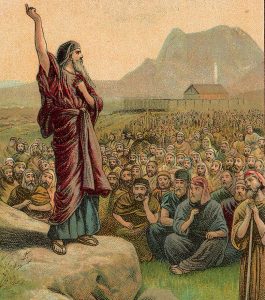
Moses_Pleading_with_IsraelThe Book of Deuteronomy tells us that when the long Exodus journey of the People of the Hebrews ended, just before they were to cross over into the Promised Land, Moses delivered a farewell address. He was not going to be going into the new land with them.

You may remember that God had been angered by the first generation of wandering Hebrews, what Jesus might have called an “adulterous and sinful generation” (Mk 8:38), who had grumbled against God, had wanted to turn back, and who had eventually been so disobedient that they had fashioned an idol (the Golden Calf) and worshiped it instead of Yahweh, their deliverer.

Furthermore, even when they worshiped and followed God, they didn’t trust God. Not believing God’s promise of the land into which they were to come, they sent spies ahead of them. This angered God, so that God had decreed that none of those who had left Egypt would enter the Holy Land (Numbers, Ch. 14). The Psalmist quotes God:

They put me to the test,
though they had seen my works.
Forty years long I detested that generation and said,
“This people are wayward in their hearts;
they do not know my ways.”
So I swore in my wrath,
“They shall not enter into my rest.” (Ps 95:9-11)

So Moses was the last of these and, in addition, he himself had been told by God that he would not enter the Promised Land because he and his brother Aaron had doubted God at Kadesh in the wilderness of Zin. God had said to him and to Aaron, “Because you did not trust in me, to show my holiness before the eyes of the Israelites, therefore you shall not bring this assembly into the land that I have given them.” (Num 20:12)

So at the brink of their entry, probably near Moab in the valley of Beth-Peor where he would be buried in an unmarked tomb, Moses gathered the children and grandchildren of the original Hebrews and summarized all that God had done for them and all that God required of them saying, “See, I have set before you today life and prosperity, death and adversity”(Deut 30:15). Follow the laws of God, have life and prosperity; disobey the commandments, death and adversity.

Throughout the discourse, Moses does an interesting thing that we can’t follow in the English translation; he intermixes the use of the plural “you” and the singular “you.” By doing so, he seems to be saying that the obligation to do good, to follow the commandments is both a communal and an individual responsibility. As a whole, the People of God must do these things, but it isn’t sufficient that they do it only as a community. The individual member can’t rely on his or her neighbor to do it for them; he or she can’t rely on the community’s leadership to do it for them. Each member of the community must do it for themselves; the individual needs the support of the community to undertake and accomplish this individual responsibility, but the individual can’t let it slide and just rely on the community to take up his or her slack, so to speak.

Also throughout the course of his speech, Moses makes it clear that though God places this choice of good or bad, life or death, prosperity or adversity, obedience or waywardness before God’s people, God does not underwrite or endorse both equally. In fact, God endorses only one. So, at the end of his address, Moses offers his own advice: “Choose life so that you and your descendants may live, loving the Lord your God, obeying him, and holding fast to him” (Dt 30:19-20).

Choose life! I can imagine Moses raising a glass and giving this counsel in the form of the great Jewish toast “l’Chaim!” – “To life!” And given what was at stake, Moses adds, “Hold fast to God,” basically saying, “And don’t mess it up!”)

Several generations later, around 200-175 BC, Shimon ben Yeshua ben Eliezer ben Sira of Jerusalem, a Jewish scribe, echoed Moses’ admonition as he wrote a text which is in the canon of writings called “the wisdom literature.” This body of literature constitutes basically a course of education for young men training for what we might call “the civil service.” The sons of the class equivalent to the “minor aristocracy” of England would be trained to function in the courts of kings throughout the ancient middle east using these writings. We heard this author’s advice to these young men in today’s reading from the Book of Sirach.

The author’s name is Simon, and he is identified as the son of Yeshua, who was the son of Eliezer, who was the son of Sirach, but some for reason we call the book by his grandfather’s, or rather his great-grandfather’s name. I suppose we do that because we think grandfathers are wiser than their sons or grandsons, although I don’t think I’ve convinced my son of that. This book is part of the Christian scriptures we call “the Apocrypha.” It is recognized as canonical by the Roman Catholic Church and the Eastern Orthodox churches, but not by Protestants. The Jews don’t recognize it as scripture because it is known only in a Greek translation discovered in Egypt; if there was a Hebrew language original (which one would assume since a scribe from Jerusalem wrote it), it has been lost to history. And since the Jews don’t accept it, the Protestants won’t recognize it, either.

Of course, we Anglicans take our usual middle way . . . we won’t based doctrine on it, but we will use it for the teaching of ethics and morality, which is pretty much the way this book has been used by the church through the ages. Another name for the text is “Liber Ecclesiasticus” or “Book of the Church” because it was used throughout the middle ages to teach clergy.

In any event, Simon the son of Yeshua, the son of Eliezer, the son of Sirach, offers advice to the trainee courtiers not at all dissimilar to that offered by Moses to the Hebrews: “If you choose, you can keep the commandments, and to act faithfully is a matter of your own choice. He has placed before you fire and water; stretch out your hand for whichever you choose. Before each person are life and death, and whichever one chooses will be given” (Sirach 15:15-17).

Simon the Scribe is a very canny fellow. He uses a metaphor for the choice of life or death, lawfulness or sinfulness; God, he says, “has placed before you fire and water.” At first glance that seems a pretty solid and clear metaphor, destructive fire versus life-giving water; but the metaphor is not all that clear. It’s really rather ambiguous. In some circumstances, yes, fire is destructive and death-dealing, but if you’re freezing to death in a winter storm, fire can be life-preserving; in some circumstances, yes, water is sustaining of life, but if you’re drowning in the sea the last thing you want is more water. Which, then, represents death and which life? One’s choices, Simon the Scribe seems to be saying, are not always clear cut and unambiguous.

And, like Moses, Simon reminds his readers that although the choices may be set before one by God, God does not underwrite or endorse both alternatives. God, he says, has a clear preference: “He has not commanded anyone to be wicked, and he has not given anyone permission to sin. ” (v. 20)

So Moses and Simon the Scribe offer their audiences, both their original audiences and us, this counsel that we have some big, important choices to made: life or death, prosperity or adversity, ethical conduct or sinful behavior. The choice may sometimes be ambiguous, but these are really big matters. And along comes Jesus in the Sermon on the Mount and complicates things by telling us that our choices aren’t just about the big stuff. “You’ve heard the commandment,” he says, “‘Thou shalt not murder.’ Well, you’re just as guilty if you think badly of another, if you insult a brother or sister, if you argue with another member of the community. You’ve heard it said, ‘Thou shalt not commit adultery.’ Well, even if you just think about about it, you’re guilty!” Remember when Jimmy Carter got into public hot water by confessing in that quaint King James language that despite his long and faithful marriage to Rosalyn he had “lusted in his heart” after other women? (Oh, for the day’s when just that was sufficient to get a candidate or politician into trouble…. )

Jesus extended Moses’ admonition and Simon the Scribe’s advice even further. Yes, there are important choices to be made. Yes, they are sometimes ambiguous. And, guess what? They come at us every day, every hour, in everything we do. Not just in the big things, but in the little everyday minutiae of human existence.

I don’t know about you, but it’s not very often I have to decide not to kill someone (only about once a week), but every day I have to decide whether let a zinger of an insult fly or bite my tongue and hold it back, whether to vent my anger over some upset or just shrug it off and let go of it. It’s not very often that I have to decide whether or not to commit adultery; in fact, never (no one seems to think I’m that attractive). But all through the day I have to make . . . we all have to make . . . these ethical and moral decisions. We have to make our choices, daily, and then stick to them as best we can. As Jesus admonishes us, let our decisions to be “Yes, yes” or “no, no.”

Interestingly, in the koine Greek in which the author of our Gospel lesson wrote, he recorded Jesus doing what the Hebrews scripture recorded Moses doing: mixing plural “yous” with singular “yous” in his discourse. Like Moses, Jesus underscores what we all know to be the truth – that none of us can do this on our own, that we have to have the support of our parents, our spouses, our brothers and sisters, our neighbors, our fellow church members.

There is a story in the Book of Deuteronomy (Chapters 27 & 28) about something that happened after the children of the Hebrews entered the Promised Land. Joshua the son of Nun, who was Moses’ assistant and took over leadership when Moses died, was directed to Moses to lead them into the valley of Shechem, the place where Jacob’s well is. Somehow I seem to recall that there were about 40,000 of them at the time, and Joshua divided them by tribes, sending half of them to the summit of Mount Gerizim and half of them to the summit of Mount Ebal on the other side of the valley. And those on Mt. Gerizim recited the blessings of keeping the Law, while those on Mt. Ebal recited the curses that came with disobedience.

I have this vision of Joshua reading the commandments, not just the “big ten” that Moses brought down from Mt. Sinai on the stone tablets, but the other 603 mitzvoth (or “statutes”) that got added to them and as he would read each one, the folks on Mt. Gerizim would shout “Obey this law and you will be blessed” and those on Mt. Ebal would shout “Disobey and you will be cursed.” Can you imagine how 20,000 voices shouting on one side of valley and another 20,000 voices shouting in response on the other side would have echoed throughout the land? Those voices also would have echoed down through time as a reminder that obedience is a communal thing, but also a personal thing, an individual obligation in which one is support by the community.

But even that is not enough. We humans individually are unable to stay in the narrow way and we are also unable to do so as communities, as churches, as nations. As our opening collect says, “in our weakness we can do nothing good without you” (BCP 1979, pg 216) and as St. Paul reminded the Corinthians it is “only God who gives the growth” (1 Cor 3:7). If we choose, we can keep the commandments, and to act faithfully is a matter of our own choice; but we can only stay the course if we are aided by our community and upheld by God.

Today and every day, the choice is before us, good or evil, obedience or sinfulness, life or death. Choose life! – l’Chaim – and rely on God (don’t mess it up)!

Amen!

(Illustration: Moses Pleading with Israel, an illustration from a Bible card published 1907 by the Providence Lithograph Company.)

====================

Father Funston is the rector of St. Paul’s Episcopal Church, Medina, Ohio.

Truth, Justice, and the American Way: A Sermon for Epiphany 4, Year A, 29 January 2017

====================

A homily offered by the Rev. Dr. C. Eric Funston on the 4th Sunday after the Epiphany, January 29, 2017, to the people of St. Paul’s Episcopal Church, Medina, Ohio, where Fr. Funston is rector.

(The lessons for the day are from the Revised Common Lectionary, Year A: Micah 6:1-8; Psalm 15; 1 Corinthians 1:18-31; and St. Matthew 5:1-12. These lessons can be read at The Lectionary Page.)

====================

supermannationaloriginsHave you ever had the experience of a long-forgotten memory rushing back upon you and just knocking you for a loop? Something like an odor or a song or a picture brings it back and the details hit you like a sledge hammer. That happened to me on Monday evening.

We were watching a biography of Rachel Carson, author of the book Silent Spring, on PBS. It was very well done. The program opened a floodgate of memory of my childhood; what did it was a segment in the show in which film of atomic bomb explosions was shown. I remembered two occasions when my father and I, with others, went out into the Nevada desert to see the mushroom clouds. The first was in the summer of 1957 when I was 4-1/2 years old: my dad, my brother, and I went to the test site at the invitation of a physics professor colleague of my father (my dad was an accountant, but he also taught math and accountancy at what was then called Nevada Southern University). The second in December of that same year, after I had started kindergarten and my class, together with several others from John S. Park Elementary School in Las Vegas, went to the test site on field trip and my father, who was self-employed and could take time to do those things, went along as a chaperone.

All the details of those excursions into the Nevada desert, and seeing those glowing clouds rise miles and miles away to the northeast from where we were watching, and my father’s reaction to them, all came rushing back.

After both of those experiences, I can remember my dad for a few weeks being what my grandmother would have called “cranky.” Things around our house got chaotic. The person who was supposed to be the adult in charge got mean and spiteful, and did things that were erratic and made no sense. My dad, the person who was supposed to be the adult in charge, just seemed to be angry and crazy all the time.

I suspect that what he was was drunk, and I suspect he was drunk because he was scared to death of nuclear war. My dad was a decorated combat veteran of World War II who had been badly wounded in the Battle of the Bulge; he’d been awarded both the Purple Heart and the Bronze Star for heroism. He was in constant pain during the short period of my life that he was a part of it. I know now, but didn’t know then, that he was an alcoholic who self-medicated his pain and his fear with booze. In March 1958, he drove away from our house after a drunken argument with my mother and never came back; he killed himself in a single-vehicle roll-over accident on the highway between Las Vegas and Kingman, Arizona. The family guesswork is that he was trying to drive back to my grandparents’ home, his childhood home, in Kansas.

Why do I share those memories with you this morning? I suppose it is because whenever I read the words, “When Jesus saw the crowds, he went up the mountain; and after he sat down, his disciples came to him. Then he began to speak, and taught them . . . .” (Mt 5:1-2) what I envision is something very like the desert hillside from which we viewed those atomic bomb blasts. And when I read St. Paul writing to the Corinthians that God “will destroy the wisdom of the wise, and the discernment of the discerning [he] will thwart” (1 Cor 1:19) and that “God’s weakness is stronger than human strength” (v. 25), it is those mushroom clouds that metaphorically come to mind.

But I have another childhood memory which is also excited by these lessons, and that is sitting down in front of our small, black-and-white television every week and hearing these words:

Yes, it’s Superman . . . strange visitor from another planet, who came to Earth with powers and abilities far beyond those of mortal men! Superman . . . who can change the course of mighty rivers, bend steel in his bare hands, and who, disguised as Clark Kent, mild-mannered reporter for a great metropolitan newspaper, fights a never-ending battle for truth, justice, and the American way!

I couldn’t help but remember that famous opening sequence each time I sat down this week to consider the words of the Prophet Micah:

He has told you, O mortal, what is good;
and what does the Lord require of you
but to do justice, and to love kindness,
and to walk humbly with your God? (Micah 6:8)

Truth, justice, kindness, humility . . . Biblical values that all seem to be jumbled together with the American way in my Superman-TV-program-educated mind, or at least I feel like they should be . . . and I am too often confronted with the reality that they are not.

This week, one thing I noticed particularly about the Superman intro that I’d not considered before is that it isn’t in the Superman persona, that incredible being who could stand right next to an exploding atomic bomb without being injured, that the alien immigrant Kal-El “fights [the] never-ending battle for truth, justice, and the American way.” No, it is in the guise of “mild-mannered reporter” Clark Kent that the refugee from the destroyed planet Krypton does so! It is the journalist character, not the superhero, “who speaks the truth from his heart” and upon whose tongue there is no guile!

So I have these two memories that rush into my consciousness when I read and consider these lessons, images of nuclear explosions and memories of my angry, alcoholic father, mythic superheroes, and “mild-mannered reporters” fighting “never-ending battles.” They color my understanding of these Scriptures and, yet, I must admit that they also clash with them for there is nothing here about war, about anger, about fighting, about battles. If anything, they seem to be quite the opposite!

The beatitudes, these statements of blessedness which we find here in Matthew and in a rather different form in Luke’s gospel, for example, raise for us the question, “Are they a programmatic outline for the church’s social justice ministry or are they simply words of comfort and encouragement for Jesus’ down-trodden original audience?” In his essay on Luke’s gospel, Southern Baptist scholar Robert H. Stein argues for the second; he writes:

Are the beatitudes to be interpreted as requirements for entering God’s kingdom or as eschatological pronouncements of blessing upon believers? In other words, are the beatitudes an evangelistic exhortation for salvation or pastoral words of comfort and encouragement, a kind of congratulation, to those who already possess faith? For several reasons they should be understood as the latter. (Stein, Robert H., Luke, The New American Commentary, Vol 24, B&H Publishing: Nashville, 1991, page 199)

On the other hand, Lutheran seminary professor Karoline Lewis takes the opposite position. “The Beatitudes,” she writes, “are not just blessings but a call to action.”

[T]he Beatitudes are a call to action to point out just who Jesus really is. Perhaps not the Jesus you want. Perhaps the Jesus who likely rubs you the wrong way. Perhaps the Jesus that tells you the truth about yourself. The Jesus who reminds you, at the most inconvenient times and places, what the Kingdom of Heaven is all about.
The Beatitudes are a call to action to be church, a call to action to make Jesus present and visible and manifest when the world tries desperately to silence those who speak the truth . . . . (Lewis, Righteous Living)

I wonder if they might be neither . . . or, perhaps, both, in the same way that nuclear energy can be both destructive weapon in the form of an atomic bomb and source of constructive power as in an electrical power plant, or in the same way that Kal-El can be both the mighty indestructible “man of steel” and the mild-mannered journalistic champion of truth. Perhaps the beatitudes are nothing more nor less than Jesus’ instruction to his disciples on how to recognize blessedness. “Not how to become blessed, or even to bless each other, but rather to recognize who is already blessed by God.” (Lose, Recognizing Blessing) Their blessings are spiritual poverty, mourning, meekness, desire for righteousness, mercy, purity of heart, peacemaking, and persecution.

Several years ago, a Disciples of Christ pastor and professor named Lance Pape wondered, “To which of these blessings do our national leaders refer when they insist that ‘God Bless[es] America!'” And he answered his own question:

To none of these, for our national creed is one of optimism (not mourning), confidence (not poverty of spirit), and abundance (not hunger or thirst of any kind), and it is in service of such things that we invoke and assume the blessing of God. And so we live by those other beatitudes:

  • Blessed are the well-educated, for they will get the good jobs.
  • Blessed are the well-connected, for their aspirations will not go unnoticed.
  • Blessed are you when you know what you want, and go after it with everything you’ve got, for God helps those who help themselves.

If we are honest, we must admit that the world Jesus asserts as fact, is not the world we have made for ourselves. (Pape, Working Preacher Commentary on Matthew 5:1-12)

In the world we have made for ourselves we see the bombs, the anger, the war, and we look for the “man of steel” to save us, to fly in singing “Here I come to save the day” (although I do know that’s a different superhero) and then taking us away to some kingdom of heaven in the sky. We know better, though, don’t we?

When Jesus teaches us to recognize blessedness in the Beatitudes, he teaches us to “recognize that God’s kingdom isn’t a place far away but is found whenever we honor each other as God’s children, bear each other’s burdens, bind each other’s wounds, and meet each other’s needs.” (Lose, Op. Cit.) He teaches us, as the Prophet Micah taught the ancient Israelites, “to do justice, and to love kindness, and to walk humbly with [our] God” (Micah 6:8). He teaches us, as the Psalmist taught in the liturgy of the ancient Temple, to lead a blameless life, to do what is right, to speak the truth from his heart, to have no guile upon our tongues, to do no evil to our friend, to heap no contempt upon our neighbors, and to reject what is wicked when we see it (Ps 15). That is the Christian way. And child of the atomic 1950s and devotee of television’s Superman that I am, I still believe it is, or at least it should be, the American way.

====================

Father Funston is the rector of St. Paul’s Episcopal Church, Medina, Ohio.

Facts, Opinions, Beliefs: Truth and the Role of the Clergy

====================

A “Rector’s Reflection” by the Rev. Dr. C. Eric Funston to be published in the February 2017 issue of The Epistle, the monthly newsletter of St. Paul’s Episcopal Church, Medina, Ohio, where Fr. Funston is rector.

====================

Introduction

moynihanIn a New York Times editorial, Frank Bruni said:

[O]ne of the fundamental challenges will be to respond to [President Trump], his abettors and his agenda in the most tactically prudent way and not just the most emotionally satisfying one. To rant less and organize more. To resist taunts and stick with facts. To answer invective with intelligence.

And to show, in the process, that there are two very different sets of values here, manifest in two very distinct modes of discourse. (The Wrong Way to Take On Trump, January 24, 2017)

In recent conversations (and, truth be told, in conversations stretching back years) about politics, about religion, about a number of things, I have found this to be true. That one must bite one’s tongue (sometimes to the point of blood) and bridle one’s temper (also to the point of bleeding) so that one does not participate in devolving the discussion into the depths of a donnybrook.

It has seemed to me most recently that a way to avoid this (the devolution, not the alliteration) is to have in mind a clear differentiation of fact, opinion, and belief. For example, I recognized some time ago that I could not discuss economics and governmental finance with a clergy colleague (not in my diocese) with whom I’ve been friends for many years. He has completely accepted the veracity of the theories of Friedrich Hayek and Ludwig von Mises, the economists behind the so-called Austrian school of economics. It is their thinking that underlies that darling of the conservative Right, “trickle-down” or “supply-side” economics.

My friend, and so many on that side of the political spectrum, hold to these theories despite the fact that they are not only unproven, they demonstrably disproven. The governmental policies based on them – tax cuts for the wealthy which were supposed to create thousands of jobs but did not, austerity policies which were to rescue failing economies such as Greece but did not, and their new incarnation in the notion of privatization of education (a favorite idea of Secretary-designate of Education DeVos) and of infrastructure (likely to be an element of the Trump administration plan) – have not worked in this or any other country in which they have been implemented.

Nonetheless, my friend and many conservative Republicans continue to hold, with an almost religious fervor, a bed-rock reliance on the Austrian school theories, policies, and programs; they are, for them, absolutely true. It seems to me, however, that they are “true” not in the sense that facts are “true,” but in the manner in which “beliefs” are “true.” They certainly hold them with a strength with which one would not hold a mere opinion. And, it seems to me, that there are many other notions held by those on both right and left which are of this nature.

As a clergyman who believes most firmly that Jesus meant what he said when speaking to “the Jews who had believed in him” saying, “You will know the truth, and the truth will make you free,” (Jn 8:31-32), and who believes it is my duty not only to proclaim truth as I understand it, but also to teach my congregants to discern truth for themselves, and also as one who agrees with Mr. Bruni, I have written (lightly and engagingly, I hope) the following essay as my “Rector’s Reflection” for the upcoming issue of our parish newsletter. In it, I try to distinguish between fact, opinion, and belief, and conclude with some ways (strategies, if you will) in which to engage in conversation that respect (or, at least, understand) the distinctions between them.

Rector’s Reflection: Facts, Opinions, Beliefs (February 2017 parish newsletter, St. Paul’s Episcopal Church, Medina, Ohio)

A short while ago I was in a conversation in which I stated a fact (see below) but to which the person I was talking with responded, “Well, that’s just your opinion.” No, I replied, it’s a verifiable scientific fact.

The conversation reminded me of the several I have had over the years with avowed atheists who have labeled my belief in God as an “opinion.” No, I reply, it’s a belief. My free-thinking friends seem not to appreciate the difference. So, too, the person with whom I was recently speaking did not seem to be aware of the difference between a fact and an opinion.

When a high presidential adviser a few days ago used the term “alternative facts” in a news interview, these conversations and this confusion about what is a fact, what is an opinion, and what is a belief came immediately to mind.

I’m not an academically trained philosopher, although I’ve taken my share (maybe more than my share) of philosophy courses in college and graduate school. I’m also not an academic theologian; I’m more a practical, arm-chair theologian sitting with (as Karl Barth might have said) the Bible in one hand, the newspaper (or, actually, my laptop computer) in the other, and trying to make sense of both armed with a little bit more than the usual amount of theological book learning. So what I’m about to write is a matter of considered and educated opinion.

It’s also something a work in progress. What I am about to write is what I think about these subjects today (January 25, 2017, by the way); I invite you to explore them with me and maybe both of us will think something rather different a month or a year or a decade from now.

So . . . there are these three things: facts, opinions, and beliefs. This is what I understand them to be.

A fact is (and this is straight from a dictionary) “something that actually exists; reality; truth.” I’m going to steer away from the last word in the definition for a moment, but I will come back to it. A fact actually exists in reality. It is something empirically and objectively provable. Water is made up of oxygen and hydrogen; that’s a fact. The earth orbits the sun; that’s a fact. I was born on September 29, 1952; that’s a fact. Everyone can agree on facts.

An opinion is defined in the dictionary as “a judgment that rests on grounds insufficient to produce complete certainty; a personal view, attitude, or appraisal.” I have edited that definition to take out the suggestion that “opinion” and “belief” are equivalent (see below). I come from a legal background in which “opinion” also means the judgment of a court which carries the force of law, making such opinions almost as solidly grounded as facts. In the course of my practice in healthcare law, I also came to rely on physicians’ medical opinions which almost carry the weight of beliefs (see below). Most of our opinions, however, are somewhere in between; they are grounded on facts, colored by our beliefs, and should represent our considered judgment about the nature of reality. Fish is generally inedible; that’s my opinion. The music of composer Olivier Messiaen is unendurable; again, my opinion. Curling is a fascinating sport; another opinion. Despite the origin of the word, opinions are certainly not flights of fantasy to be dismissed simply as “your opinion” and worthy of no consideration; opinions on matters great and small, as personal appraisals of our reality, are the way we navigate through life!

A belief is, according to the dictionary I’m looking at, “something believed; an opinion,” and the illustration given is “a belief that the earth is flat.” I’m going to flatly reject that definition and suggest that the acceptance of the notion that the earth is flat is not a “belief” nor is it an “opinion;” it is a rejection of scientifically verifiable fact; it is a delusion. So what is a belief? The dictionary also defines it to be “confidence in the truth or existence of something not immediately susceptible to rigorous proof; confidence; faith; trust.” This is an acceptable definition, particularly those last two words!

I always keep in mind that “belief” is related linguistically to the word “beloved.” The Latin word for “opinion” was opinio which carries with it a hint of unreality. I recall reading a book on Hispanic fiction which equated opinions with “the organizing principles of private fantasy” and Thomas More, author of Utopia, created the word existimation to translate it in regard to one’s self-conceived reputation. On the other hand, the Latin word for “belief” was fides (usually translated as “faith”) or confidentia (usually translated as “confidence”), while the Latin verb “to believe” is credere, meaning “to rely on” and is related (like “beloved”) to the word for “heart”: in other words, what we believe is what we stake our hearts upon. For this reason, I do not equate “opinions” with “beliefs.”

Beliefs to the believer are as fundamentally certain as facts. Beliefs are not scientifically or historically verifiable like facts, but to the one who holds them they are just as true. This is why I steered away from using the word “truth” in regard to defining “fact.” Facts are one form of truth; beliefs are another. In post-modern thought, beliefs are the truths which may differ amongst persons. Facts are objective truths on which all may agree; beliefs are subjective truths on which we may differ; neither is likely to be changed by argument. Opinions, however, may be.

Beliefs and facts share the characteristic that they are subject to disproof. For centuries human beings held as fact the notion that the sun revolved around the earth; that was an objectively observable, verifiable phenomenon everyone saw every day. But that “fact” was disputed by the ancient astronomer Aristarchus in about 270 BCE and by Nicolaus Copernicus in the 16th Century; both stricter observation and mathematics proved the “fact” to be false. Were one to accept still the notion that the earth is the center of the universe, that idea would not be a fact; it would not be a belief; it would not be an opinion. It would be a delusion.

In our conversations, let us resolve to accept objectively verifiable facts; where we are wrong about facts, we must be willing to accept correction. Let us also resolve to be respectful of one another’s beliefs remembering that these are matters of heart-invested trust. As to opinions, let us be gracious when challenged; let’s remember the title of that book written by the great theologian Snoopy, Has It Ever Occurred to You that You Might Be Wrong?

I am sure that there will be many conversations with family, friends, fellow Christians, and others in which these admonitions will be tested! Keep in mind the British motivational poster from World War II, “Keep Calm and Carry On”!

Afterward

Given what I had to say above about my clergy friend’s acceptance of the Austrian school economic theories, you’ve probably figured out that I hold his “beliefs” to be delusions. Unfortunately, I’m afraid that those who are deluded about that and many other things now hold the reins of government in this country. This is why I strongly, and fearfully, believe that Mr. Bruni was correct in his New York Times editorial when he concluded that if the level of public discourse is allowed to pass into derangement, “Trump may be victorious in more than setting newly coarse terms for our political debate. He may indeed win on many fronts, over many years.” (Ibid.)

The ministry of clergy in all traditions to proclaim the truth as we understand it and to teach our people to discern it for themselves has become even more important and urgent.

====================

Father Funston is the rector of St. Paul’s Episcopal Church, Medina, Ohio.

Get Up! Get Dressed! Go to Work! – Annual Meeting Sermon, January 22, 2017

====================

A homily offered on January 22, 2017, by the Rev. Dr. C. Eric Funston at the 200th Annual Parish Meeting of St. Paul’s Episcopal Church, Medina, Ohio, where Fr. Funston is rector.

(The lessons for the day are those for the Conversion of St. Paul the Apostle: Acts 26:9-21; Psalm 67; Galatians 1:11-24; and St. Matthew 10:16-22. These lessons can be read at The Lectionary Page.)

====================

the-conversion-of-st-paul-1528May God be merciful to us and bless us, show us the light of his countenance and come to us. (Ps. 67:1) Amen.
Have you ever been knocked off a horse? I have. Twice. Once when I was 11 and again when I was 24. Different circumstances and if you promise not to laugh, I’ll tell you about them when we have our luncheon after the business meeting. In both instances, however, one element was the same: landing flat on my back, having the wind knocked out of me, and being stunned not quite to unconsciousness. Both times it was a startling and uncomfortable experience.

The story of Paul’s conversion is told not once but four times in the pages of the New Testament; three times in the Book of Acts and once in Paul’s letter to the Galatians. Although not mentioned in any of those descriptions, artists often depict Paul falling from a horse or donkey. When I read or hear the story, therefore, I have some sympathy for Paul. In addition to being knocked flat on his back, having the wind knocked out of him, and being mentally stunned, his incident included a blinding light, an encounter with a living rabbi he was convinced was dead, and the voice of God, and it was followed by three days of blindness. Now that’s an experience!

Now this is homily is supposed to be both a sermon and the rector’s report for the 200th Annual Meeting of the parish. Were I to focus on the second purpose, I could give you a lot of history – but I did that at our Bicentennial Choral Evensong on the Feast of the Epiphany, so I won’t do that. I could give you a summary of all the good things and some of the not-so-good things that have happened in the last year – but you can read the various ministry reports and the financial statements in the Annual Journal for yourselves. I could tell you about all the wonderful things planned for the coming year – but, again, you have the Annual Journal in your hands with the bicentennial event calendar and the 2017 Budget, so there you have it.

A rector’s report would merely repeat things you already know or have available to you in that Journal. So this will be more of a homily and less of a report, more (I hope) of a proclamation of a theology for the future and much less a review of the past. I am convinced that God is merciful to us, does bless us, illumines the way with the light of his countenance, and comes to us every day. Perhaps God does not come to us as dramatically as the Risen Lord came to Paul . . . or perhaps he does and we just don’t recognize it. We may be getting knocked off our horses regularly and we may simply be too oblivious to notice.

A canon of Durham Cathedral a few years ago preaching on these same texts said:

The experience of a light, of falling, an involuntary act of submission doubtless sending him into great fear and shock, was further heightened by a voice, “Saul, Saul, why are you persecuting me?” Saul’s reply uses the divine title “Lord”, “Who are you, Lord?” He recognizes that this is something from heaven, while being unsure of exactly who it is that is speaking. The response was, “I am Jesus, whom you are persecuting”. Of course, those words are moving words; Jesus makes no distinction between himself and his disciples; in persecuting them, Saul was persecuting him. It is a narrative illustration of the kind of mystical theology that Paul was later to develop in his letters; through faith and baptism we are mystically joined to Christ, incorporated in him – we become his body; he indwells us and we indwell him. (St Paul’s Conversion, the Rev. Canon David Kennedy, Durham Cathedral, Church of England)

This is an everyday truth and if we recognized it every day, it would bowl us over, just like being knocked from a horse. I am reminded of the observation of Annie Dillard, in her book Teaching a Stone to Talk (Harper & Row 1982), makes this point in an oft-quote observation:

Does any-one have the foggiest idea what sort of power we so blithely invoke? Or, as I suspect, does no one believe a word of it? The churches are children playing on the floor with their chemistry sets, mixing up a batch of TNT to kill a Sunday morning. It is madness to wear ladies’ straw hats and velvet hats to church; we should all be wearing crash helmets. Ushers should issue life preservers and signal flares; they should lash us to our pews. For the sleeping god may wake some day and take offense, or the waking god may draw us out to where we can never return. (Dillard, Annie, Teaching a Stone to Talk: Expeditions and Encounters, Harper & Row, New York:1982, pp 40-41.)

Every time we celebrate the Holy Eucharist, after the presider has said Jesus’ words over the bread and wine – “This is my Body” – “This is my Blood” – we are invited to affirm the powerful everyday-ness and everyday power of Jesus’ presence, “Therefore we proclaim the mystery of faith:”

Christ has died.
Christ is risen
Christ will come again (BCP 1979, p 363)

These words remind us that Jesus is here with us now:

The person Jesus and his story are now.
The forgiveness and hope he offers are now.
The invitation and the expectation for us to change and to grow through his love and presence are with us are now.
The renewal, vision and hope that transformed Paul from bigotry and narrow-mindedness are open to us now.
But, only if we have the faith and the courage to respond: to get up and follow Jesus. (Sermon at All Saints, the Rev. Alan Wynne, Parish of Poplar, Church of England)

You know . . . the getting up part is really important! Getting knocked of the horse isn’t the whole of Paul’s conversion; it was just the beginning. In Paul’s own description of his conversion in our reading from Galatians we can see that it took some time; including going into retreat in the Arabian desert and then a three-year delay before he went to Jerusalem to meet the original apostles. In the early church, entry into the worshiping community replicated Paul’s experience. The training for baptism, called “catechesis,” often took years, typically three, before someone was “exposed to the very real risks and challenges of full membership of the Christian faith” and admitted to full participation in the mysteries of the Holy Communion and full responsibility for the mission and ministry of the church. As English priest David Rowett says,

Conversion isn’t some once-and-for-all process, over in a blinding flash, not even for the Pharisee from Tarsus. It is a life-long process of deepening and learning which may begin in one moment – with or without a donkey – but then requires working out throughout the rest of our lives, and in the company of other pilgrims. (Conversion of St Paul, the Rev. David Rowett, St Mary’s Church, Barton-on-Humber, Church of England)

Our conversion is an on-going and everyday truth and if we recognized it every day, it would bowl us over. Like Paul, however, we couldn’t just lie there stunned. Jesus would say to us as he said to Paul . . . indeed, Jesus does say to us, “Get up, you will be told what you have to do.”

In the Gospel lesson today, Jesus promised his first twelve followers that they would be handed over to councils, flogged in religious institutions, and dragged before secular rulers, but he told them not to worry about making a defense because, in words similar to those he would say to Paul on the Damascus Road, “What you are to say will be given to you at that time.”

I think it helpful to remember who Jesus is talking to in both stories. Talking to the Twelve he is not talking to the stained-glass saints they have become; he is talking to hide-bound, conservative, Law-abiding Jews. He is talking to Peter who, even after spending all that time with Jesus and going through the events of Jesus’ trial, execution, burial, and resurrection, would say, “I have never eaten anything that is profane or unclean” and would refuse to eat with Gentile Christians. He is talking to Thomas who is portrayed as a skeptic, a doubter, and something of a pessimist. He is talking to Simon the Zealot, who may have been a member of that Jewish sect noted for its uncompromising opposition to Rome and pagan practices. And on the road to Damascus, he is addressing Saul of Tarsus, a Pharisee set upon the path of persecuting and, indeed, destroying the fledgling Christian church.

Jesus in both the Gospel lesson and in the story from Acts is speaking to men who exhibit an attitude we still see in the church and in our society today – it is nothing new – an attitude characterized by bigotry, zeal, closed-mindedness, tunnel vision, intolerance, and exclusivity. “In varying degrees it may be present in each one of us:

our lack of openness to new ideas;
our total certainty that in all matters of faith, morality or ritual we are right and others are wrong;
the ease with which we judge or condemn those who see things differently;
the way we cling uncritically to the traditions and practices of the past;
our failure to see God’s continuing presence and work in creation;
our desire to contain God in our pockets and limit him to our shrines where he can be controlled and we can be cosy and unchallenged;
the way we call Jesus “Lord” and ignore the most basic of his teachings about love and respect for others.” (Alan Wynne, op. cit.)

When we discussed this Gospel passage during our bible study time at Monday’s last meeting of the 2016 Vestry, someone suggested that Jesus seems to be foreshadowing what would happen later to himself. While that is true, he is also, by forecasting this experience, demonstrating his authority and intimacy with God. His words assure the Twelve and us that:

Opposition is not a sign of failure or that Jesus was not trustworthy as a leader. And
Paradoxically, getting arrested is the only way you will have a chance to speak to the elites, so use it to testify. And [again]
Don’t worry about what you will say – God’s Spirit will speak through you. (Holy Textures, the Rev. David Ewart, United Church of Canada)

Quite a while after the event in today’s Gospel lesson, “the disciples came to Jesus and asked, ‘Who is the greatest in the kingdom of heaven?’ He called a child, whom he put among them, and said, ‘Truly I tell you, unless you change and become like children, you will never enter the kingdom of heaven. Whoever becomes humble like this child is the greatest in the kingdom of heaven.'” (Matt 18:1-4)

In the last sermon he ever preached, Dr. Martin Luther King, Jr., said of this story:

Jesus gave us a new norm of greatness. If you want to be important – wonderful. If you want to be recognized – wonderful. If you want to be great – wonderful. But recognize that he who is greatest among you shall be your servant. That’s a new definition of greatness . . . . It means that everybody can be great because everybody can serve. You don’t have to have a college degree to serve. You don’t have to make your subject and your verb agree to serve. You don’t have to know about Plato and Aristotle to serve. You don’t have to know Einstein’s theory of relativity to serve. You don’t have to know the second theory of thermodynamics in physics to serve. You only need a heart full of grace, a soul generated by love. And you can be that servant. (Drum Major Instinct, Dr. Martin Luther King, Jr., preached February 4, 1968)

You can be that servant. You are that servant. “Get up, you will be told what you have to do.” “Do not worry about how you are to speak or what you are to say; for what you are to say will be given to you.”

Two hundred years ago a few men and women living in Weymouth, Ohio, heard God speaking to them and founded this parish. In Annie Dillard’s words, the waking god drew them out to where they could never return. They got up because they heard the call of Jesus telling them what they had to do, and here we are as a result. I firmly believe that everyday Jesus is still speaking to his Church – to you and to me – still knocking us off of our horses and then saying “Get up, you will be told what you have to do.”

On Friday morning, Donald J. Trump was sworn in as the 45th President. You may feel that’s a good thing; you may feel that’s a bad thing. But feelings and opinions are irrelevant; it is a fact; it is reality. He and his party colleagues in the congress will change the spending priorities of our government; this is the way our democratic system works. Already his administration has announced plans to cut funding to and to cancel a variety of government programs including some which support the arts and humanities, some which fund educational endeavors, some which fund housing projects, some which fund health care, some which fund food assistance programs. You may feel that this budget-cutting is a good thing; you may feel that it’s a bad thing. But feelings and opinions are irrelevant; it is reality.

We can all agree on reality – that there are hungry people to feed, sick people to care for, homeless people to house, and students to educate. And this reality means that if there are fewer government-funded programs to do these things, charities and charitable institutions, such as churches, church-run schools, nonprofit hospitals and clinics, volunteer food banks, and the like, are very likely to be called upon to take up new ministries to replace what is no longer being done by government-funded agencies. Whether we think this a good thing or a bad thing, it is reality. It is as real as being knocked off a horse, and like Paul we – the church – can’t just lay there. “Get up, you will be told what you have to do.” There are hungry people to feed, sick people to care for, homeless people to house, and students to educate. “And the king will answer, ‘Truly I tell you, just as you did it to one of the least of these who are members of my family, you did it to me.’” (Matt 25:40)

During this last week, two lessons in the Lectionary have stood out for me: one is the Old Testament lesson for the Fourth Sunday after the Epiphany (that’s next Sunday and, yes, clergy do read ahead) and the other is yesterday’s Epistle lesson for the Daily Office. They speak to me, and I hope to you, about what it is we have to get up and do. The first is this from the Prophet Micah:

He has told you, O mortal, what is good;
and what does the Lord require of you
but to do justice, and to love kindness,
and to walk humbly with your God? (Micah 6:8)

The other is from Paul’s letter to the Ephesians:

Stand . . . and fasten the belt of truth around your waist, and put on the breastplate of righteousness. As shoes for your feet put on whatever will make you ready to proclaim the gospel of peace. With all of these, take the shield of faith, with which you will be able to quench all the flaming arrows of the evil one. Take the helmet of salvation, and the sword of the Spirit, which is the word of God. (Eph 6:14-17)

Two hundred years ago, that small band of Episcopalians in Weymouth got up because there was work to be done. Now it is our turn. Every day it is our turn. Get up! Get dressed! There is work to be done. And we have been told what we have to do.

We stand at the beginning of a new century for our parish, at the beginning of a new administration for our country. We pray for the new President and we pray for ourselves. May God be merciful to us and bless us, show us the light of his countenance and come to us. Amen.

(Note: The illustration is The Conversion Of St Paul by Girolamo Francesco Maria Mazzola, a/k/a Parmigianino, (1527-1528). It hangs in the Kunsthistorisches Museum, Vienna, Austria.)

====================

Father Funston is the rector of St. Paul’s Episcopal Church, Medina, Ohio.

Praying for Presidents: Sermon for Epiphany 2, Year A – 15 January 2017

====================

A homily offered by the Rev. Dr. C. Eric Funston on the 2nd Sunday after the Epiphany, January 15, 2017, to the people of St. Paul’s Episcopal Church, Medina, Ohio, where Fr. Funston is rector.

(The lessons for the day are from the Revised Common Lectionary, Year A: Isaiah 49:1-7; Psalm 40:1-12; 1 Corinthians 1:1-9; and St. John 1:29-42. These lessons can be read at The Lectionary Page.)

====================

prayer-in-church“The Lord called me before I was born, while I was in my mother’s womb he named me.” (Isa. 49:1b) What a powerful statement that is that the prophet makes in today’s reading. We name this prophet Isaiah; scholars name him Deutero-Isaiah or Second Isaiah. We don’t really know his name . . . but God did! God named him before he was born. Gave him personhood and human identity.

In many ancient and pre-scientific cultures names hold a very special significance; this was so in the near-Eastern cultures from which our Bible comes at the time of Second Isaiah and right down to and after the time of Jesus. Far from merely identifying a person, names in ancient Jewish culture revealed a person’s essential character and, it was believed, their destiny. So it is that this same Second Isaiah prophesies the name of the messiah, Immanuel – “God with us” (Isa 7:14), and the angel of the Annunciation instructs Joseph to name Mary’s child Jesus – “God saves” (Matt 1:21). Jesus does this with Simon in today’s Gospel lesson when he tells him: “You are to be called Cephas (which is translated Peter).” (Jn 1:42) This name, Cephas or Peter, means “rock” and Simon Peter did, indeed, become a rock anchoring the fledgling Christian church after Jesus’ death, resurrection, and ascension.

Furthermore, it was believed that to know a person’s name was to have a certain power over that person. This is why the name of God is never spoken by devout Jews; indeed, it is never read even when written in Scripture. We Anglicans have continued that tradition even into our Prayer Book and our service bulletins; if you look at today’s Gradual, Psalm 67, in the Book of Common Prayer, and as we have reprinted it in today’s bulletin, you will see that the word “LORD” is printed in all upper-case letters.

The reason for this is that Jews developed the idea that God’s name was so holy that it could not be uttered. When Jews read from the Hebrew Scriptures and get to the name of God, written only with four consonants and no vowels, “YHWH,” they will not try to pronounce it as “Yahweh;” instead, they will say “Adonai,” which means “Lord.” The Psalter in the Book of Common Prayer continues this tradition.

When the Old Testament was translated into English, the translators continued to signify the holiness of God’s name: when they came to “YHWH” in the Hebrew text, they wrote “LORD” instead. If you look through the Authorized Version of the Old Testament you will see this done many times – over 6000 times in fact. In every case, the original Hebrew says “YHWH,” but it is translated “LORD.”

In the Gospel lesson today, John the Baptizer names Jesus, “the Lamb of God who takes away the sin of the world.” (Jn 1:29) If ever there was a naming which revealed a destiny, that was it. Names have power. To know and to use someone’s name, or to refuse to use someone’s name, is always an act of power: sometimes an act of domination; sometimes an act of submission; sometimes an act of collaboration; and sometimes an act of dismissal.

Rabbi Andrew Davids, head of the Beit Rabban Jewish School in New York, commenting on the first few chapters of the Book of Genesis, writes:

God gave human beings the ability and power to name. Just as God separates light from darkness and dry land from water, [the biblical creation story] affirms that humans – created in the image of God – may seek to bring order to our chaotic and dynamic world through the process of naming. The power to name can be experienced in our everyday lives; for example, nothing grabs the attention of a misbehaving child more effectively than a parent – the bestower of the child’s names – calling him [or her] by . . . first, middle, and last names.

The rabbis caution us, however, to use the power of our voices and our words wisely. We must make certain that we use the divine gift of naming in a moral, appropriate, and thoughtful manner. (The Power Of A Name: The Power Of Naming)

In a commentary on that event recorded in Genesis when Jacob wrestles with the Angel of God and gets his named changed to Israel (“one who wrestles with God and prevails”), David Lose, President of Lutheran Theological Seminary in Philadelphia, challenged preachers to challenge their congregations about names. He wrote:

The task before us . . . Working Preacher, is to invite our people to confess their names. Whether silently or by writing them down on a paper, ask them first to answer this one question: Who are you? Really. What is your name? What is it that others call you? More importantly, what is it that you call yourself? What is that name you can scarce speak for fear or shame? Scoundrel, cheat, or phony like Jacob? Unworthy, irresponsible, unfaithful? Discouraged or burnt-out? Divorced, deserted, or widowed? Coward or bully? Unloved or unloving? Disappointed or disappointing? Abused or abuser? Ugly or abnormal? (Working Preacher Commentary, October 14, 2013)

And he continues, “Names, as we know, can limit us, hurt us, even kill. But so also can they heal and make alive. And so a part of what [the church does each week], is to invite people to come and be reminded once again of our true name and new identity so that we may go out into the world as new persons, as God’s own beloved child.”

One of the things that happens when human beings are angry with one another is that we stop using names; by doing so, we deprive the other of personhood. One of the greatest offenses you can give a person is to not use their name. It’s dehumanizing. It takes away that precious gift that God gave to Second Isaiah even before he was born! So, in my pastoral counseling with persons dealing with anger issues, one of the first things I suggest to them is to pray for the person with whom they are angry by name. Nothing elaborate, just a simple prayer; something as simple as, “Lord, I pray for [fill in the blank].” Doing so does not endorse the person’s behavior or validate what it is about them that has angered you, but it does create an intimacy which can defuse the anger. Praying for the person by name, naming the person, brings them into your sphere of being.

One of the saints of our church, Dr. James DeKoven, a priest who taught Church history at Nashotah House seminary in Wisconsin in the 19th Century, wrote that prayer brings the one for whom we pray present to us “in the deep, hidden bonds” that link persons together. (From a letter written just before his death, March 1879.) Although he was writing of prayer for deceased loved ones, I believe his observation is true of prayers for the living, as well.

I bring this up because an event is about to happen which has caused some consternation and debate in our denomination and in others. It is something that we have already addressed in this congregation and which we will not change so long as I am the rector and the one charged by tradition and canon with making liturgical decisions.

When I came to St. Paul’s Parish in the summer of 2003, although the President of the United States was being prayed for in the generic manner set out in the standard forms of the Prayer Book, George W. Bush (who was then the president) was not being named. I began to name him and to instruct prayer leaders to do so. Some people not of Mr. Bush’s political persuasion objected. When he left office and Barack Obama was elected, we began praying for him by name. Some people not of Mr. Obama’s political persuasion objected. When we started distributing the sheets with the additional petitions to be read by members of the congregation, some people refused to read the petition including Mr. Obama’s name. Now that Donald Trump has been elected and we have added his name as president-elect, some people have refused to read that petition.

On Friday, Mr. Trump will be sworn in as the 45th President of the United States. Some of us are pleased as punch about that. Some of us are appalled. Most of us are somewhere in between. And many are debating about whether or not to pray for him by name. What an incredibly silly thing to argue about! And what a terrible thing to do, to refuse to pray for someone by name.

In St. Paul’s First Letter to Timothy, he writes:

First of all, then, I urge that supplications, prayers, intercessions, and thanksgivings be made for everyone, for kings and all who are in high positions, so that we may lead a quiet and peaceable life in all godliness and dignity. This is right and is acceptable in the sight of God our Savior, who desires everyone to be saved and to come to the knowledge of the truth. For there is one God; there is also one mediator between God and humankind, Christ Jesus . . . . (1 Tim. 2:1-5)

In this parish on Sunday morning, as a congregation, will pray for the president and “all who are in high positions” by name. To do otherwise is to deprive them personhood, to dehumanize them, and in doing that we dehumanize ourselves.

In our Gospel lesson today, when the Baptizer named Jesus the Lamb of God, two of John’s disciples took off following Jesus. They asked him what to us sounds like an impertinent, but really quite inessential, question, “Rabbi, where are you staying?” (Jn 1:38)

[T]he English obscures the significance of the phrase. The Greek verb is meno: abide, remain, endure, continue, dwell, in the sense of permanence or stability. John the Baptist recognizes Jesus when the Holy Spirit remains (meno) upon him (John 1:32). After Jesus provides bread enough to satisfy a crowd, with plenty left over, he cautions the people to work not for the food that perishes, but for the food that endures (meno) for eternal life (John 6:27). He promises that he will abide (meno) in those who abide (meno) in him (John 15:4-10). Wherever Jesus stays (meno), people have the opportunity to believe (John 4:40; 10:40). (Audrey West, Working Preacher Commentary, January 15, 2017)

The Lord abides; the Lord endures: earthly rulers do not. The Psalms remind us:

It is better to rely on the LORD *
than to put any trust in flesh.
It is better to rely on the LORD *
than to put any trust in rulers. (Ps 118:8-9)

and again

Put not your trust in rulers, nor in any child of earth, *
for there is no help in them. (Ps 146:2)

Presidents come and presidents go; Jesus Christ, “the Lamb of God who takes away the sin of the world,” endures. (The dude abides!) “He will . . . strengthen [us] to the end.” (1 Cor 1:8) So we rely on the Lord . . . and we pray for presidents.

By name.

Amen.

====================

Father Funston is the rector of St. Paul’s Episcopal Church, Medina, Ohio.

« Older posts Newer posts »