Occasional thoughts of an Anglican Episcopal priest

Category: Christianity (Page 23 of 84)

A Bicentennial Epiphany: Sermon at Evensong – 6 January 2017

====================

A homily offered by the Rev. Dr. C. Eric Funston on the Feast of the Epiphany, January 6, 2017, to the people of St. Paul’s Episcopal Church, Medina, Ohio, where Fr. Funston is rector and which inaugurated at the service its Year of Celebration marking the parish’s bicentennial.

(The lessons for the day are the Episcopal Church’s Daily Office Lectionary, Year 1: Psalms 96 & 100;
Isaiah 52:7-10; and St. Matthew 12:14-21.)

====================

St Paul's Church -- December 2013We are here tonight for two reasons. First, because this is the Feast of the Epiphany, one of the major feasts of the Christian Church and one we too often ignore, and second, because this is the inaugural event of our Year of Celebration during which we will mark the 200th anniversary of the founding of this parish.

Epiphany is one of those weird Greek-based words that is so weakly translated into English that we misunderstand its power. Generally, the word is translated as “manifestation” and by it we refer to the manifestation of God in Christ Jesus. In the western church, this Feast of the Epiphany has come to focus on the visitation of the Magi – in some places it is even called “Three Kings Day” or just “Kings Day” – and it is followed by a season of Ordinary Time during which other “manifestations” of Christ are the focus of the weekly gospel lessons: his baptism by John with the descent of the Spirit and the voice of the Father, his first miracle of changing water to wine at the wedding in Cana, the calling of the Twelve, and so forth. In the eastern church, it is called the Theophany, usually translated as “manifestation of God,” and it is the principal feast of the Incarnation in the eastern tradition where the focus is primarily on either Jesus’ birth or his baptism.

These words epiphany or theophany, however, mean so much more than what is suggested by the translation “manifestation.” They are compound words made up of, in the first case, the preposition epi– meaning “on” or “onto,” and in the second case, theo meaning “god,” combined with phanos,

… a word familiar to [us] from the English ‘fantasy’ and ‘fantastic’ and all that is suggested by the ‘light shows’ with which modern electronics have made [us] familiar – the word epiphany speaks to [us] of showing forth, breaking through, letting light shine forth. * * * This is a time to look up and out, to shine forth, to witness to something quite literally spectacular and that, of course, is the presence in our midst of the Light of the World. [1]

So that is one reason we gather to celebrate this evening, to celebrate the fantastic, spectacular manifestation of God in Christ, the Epiphany of our Lord!

You may wonder why, if this is Three Kings Day, none of our lessons mentioned the visitation of the Magi: we heard neither Psalm 72, which speaks of the kings of Tarshish, of the isles, of Arabia, and of Saba paying tribute and offering gifts, nor Matthew’s story of the wise men from the East bearing myrrh, frankincense, and gold. Instead, we have Isaiah’s prophecy praising the beauty of messengers’ feet and another story from Matthew’s gospel in which Jesus heals a crowd of people but then “order[s] them not to make him known.”

The simplest answer, of course, is that those lessons about kings and wise men are reserved for the celebration of the Eucharist, while the lessons we have heard are part of the daily rotation of Scripture for use at the Daily Offices of Morning and Evening Prayer, the latter of which being the service we are offering tonight.

The more complicated, or perhaps deeper, answer is that tonight’s lessons remind us of the ministry of God’s People, a ministry of epiphany described in our Catechism as “represent[ing] Christ and his Church” and “bear[ing] witness to him wherever [we] may be.”[2] For that is what those beautiful footed messengers of Isaiah’s did with their proclamation of God’s reign and his comfort for a people in ruins, and it is what those people in Matthew’s gospel story did despite Jesus’ pleading with them not to do so; they manifested God, proclaimed God to those around them.

Which brings us to the second reason we gather this evening, to remember the founding of this parish and begin our year of celebration during which we will, in a number of ways, commemorate the first 200 years of the life of St. Paul’s Episcopal Church of Medina, Ohio, and look forward to our third century of proclaiming the Gospel of Jesus Christ in this community.

So let us look back for moment some 200 years ago . . . rather let’s look back 241 years ago for the story of our congregation really has its beginnings in the origins of our republic. Had the Revolution of 1776 not happened, we very likely would not be here today. You know the story, of course, how some American colonists came to the reluctant conclusion that their government, the King, his ministers, and the parliament in London, England, were acting in tyrannical ways and that they were unlikely to change their behavior; how those American colonists decided that the only remedy was to rebel, over throw that government’s dominion in the thirteen colonies, and establish a new sort of local government; and how, against the odds and nearly everyone’s expectations, they succeeded.

You know all of that, but did you know that 32 of the 56 men who signed the Declaration of Independence where members of the Church of England? That’s nearly 60% of the Founders who were Anglicans like you and me! And did you know that their chaplain, the chaplain of the Continental Congress which adopted that Declaration was the rector of a parish in Philadelphia, a man named William White?

Those men, those Anglicans, were reared in a religious tradition of public service, schooled in a theology of society, a peculiar worldview which teaches that the point of one’s life is not to locate oneself in some particular position of privilege, but rather to contribute to the transformation of the social order. Because of their Anglican ethos, they believed that the nation, whether it be the old Mother Country or the new nation they were conceiving, should reflect the merciful purposes of God: the comfort among the ruins of which Isaiah’s beautiful-footed messengers spoke, the healing of the sick which Matthew describes in this evening’s gospel, God’s everlasting mercy about which our Psalm sings today.

When they acted to sever their civil and political society from England, which they believed had fallen away from that tradition and that theology, they also severed their religious lives from the Church which had taught them that worldview. This was a serious matter for these men who were, many of them, vestrymen and leaders in their parishes. They belonged to a church which had preserved the ancient three-fold model of Holy Orders – bishops, priests, and deacons – which had preserved the traditional seven Sacraments – which believed with the ancient theologian Ignatius of Antioch in the centrality of the Eucharist and the unique role of the bishop in preserving the unity of the church. It was a serious matter because there were no Anglican bishops in North America, neither in what would become the United States nor in the still-loyal-to-Britain colonies of Canada.

After the Revolutionary War was ended and the new country was established, many of these men therefore turned their attention to the organization of Anglican Christianity in the new nation. In 1782, William White wrote a pamphlet entitled The Case of the Episcopal Churches in the United States Considered, in which he proposed a structure very similar to that which eventually came to be.

It is said that William White was the chief architect of our new kind of Anglican polity, a uniquely American, democratic way of being church. “Hierarchical rule [would be replaced] with egalitarian, democratic government,”[3] and bishops would be elected by majority vote of the laity and the clergy to be “servants of the Church and not its lords.”[4]

In 1784, the churches in Connecticut elected Samuel Seabury who sailed off for the United Kingdom and was eventually ordained a bishop by the Scottish Episcopal Church; he returned to Connecticut in August of 1785. In September 1785, the first General Convention of the Episcopal Church was held in Philadelphia, but it was a meeting only of the House of Deputies made up of lay and presbyteral representatives, Bishop Seabury not being in attendance; Mr. White presided.

In 1786, the churches in New York elected Samuel Provoost, who had fought in the Revolution and had succeeded William White as Chaplain of Congress, and the churches in Pennsylvania elected Mr. White. A year later, first Provoost and then White were ordained bishops at Lambeth Palace with the Archbishop of Canterbury presiding. In 1789, what is considered to be the third General Convention was held; it was the first in which a House of Bishops would meet. Bishop White presided, making him both the first President of the House of Deputies and the first Presiding Bishop. He later surrendered the chair to Bishop Seabury who served until his death about two-and-a-half years later; Seabury was succeeded by Provoost who also served for about two and a half years. He was then succeeded in 1795 by Bishop White, who thereby became not only the first Presiding Bishop but also the fourth. He served in that office for almost 41 years until his death in 1836!

During Presiding Bishop White’s tenure, some important things happened. Ohio was admitted to the Union in 1803 as the 17th State. Medina County was created in 1812.

In 1814, at the XIth General Convention of the Episcopal Church, the Rector of St. Peter’s Church in Plymouth, Connecticut, made an impassioned plea for the funding of mission activity and church planting in Ohio. His name was Roger Searle. Thereafter, with the blessing and support of the Bishop of New York, the Rt. Rev. John Henry Hobart, and of Presiding Bishop White, Searle left Connecticut and began planting churches in northeastern Ohio. In March of 1817, he met with a group of people living in the village of Weymouth who decided to organize themselves as the congregation of St. Paul’s Episcopal Church of Medina County; some of them may have been old enough to have been members of the Church of England before the Revolution. A month later, they built a small log cabin to serve as their church on Sundays and as a schoolhouse for the children of Weymouth during the week. That was the beginning of our parish!

On January 5, 1818, representatives of St. Paul’s, Medina would join with other Ohio congregations to adopt the constitution of the Episcopal Church and formally organized the Diocese of Ohio, the first diocese formed outside the borders of the thirteen original states. Although some hoped that Mr. Searle might be the first bishop of the new diocese, he supported the Rev. Philander Chase, who was elected as Ohio’s first bishop and consecrated to that office in 1819.

What they started here was a congregation and a diocese of the Episcopal Church, a manifestation (if you will) of that unique form of American Anglicanism championed by Bishop White, a way of being Christian that former Presiding Bishop Katharine Jefferts Schori has described as “holding together in tension polarities that some [might be] eager to resolve,” a sort of “both/and” thinking and living “that keeps our hearts pumping and mission thriving. [T]he kind of tension that drives some of us crazy – what’s more important? – justice or mercy? inclusion or orthodoxy? ministry grounded in bishops or in baptism?” Our American Anglican way of following Christ takes “the long view [that] says that if we insist on resolving the tension we’ll miss a gift of the Spirit, for truth is always larger than one end of the polarity. Tension is where the Spirit speaks. Truth has something to do with that ongoing work of the Spirit, and it can only breathe in living beings capable of change and growth.”[5]

We are indebted to Presiding Bishop White, to Bishop Hobart, to the Rev. Mr. Searle, and to the men and women who formed that first congregation of St. Paul’s Church in Weymouth 200 years ago. They bequeathed to us that sometimes tense, but living and breathing, changing and growing, Anglican sort of Christian faith which emphasizes reason in religion; which advocates an alliance of religion and science supporting scientific developments and believing that true philosophy can never hurt sound divinity; which seeks to make the church as inclusive as possible by providing toleration for dissent; and which teaches that constraining inquiry and the freedom of the believer is neither necessary nor salutary. It is a Christian witness which insists on a practical, public morality which comforts those whose lives are in ruins, heals those who are sick, feeds those who are hungry, shelters those who are homeless, and embraces the Gospel with the innocence of the children it educates. This is the legacy bequeathed to us by White and Searle and those Weymouth Episcopalians two centuries ago.

For 200 years this parish, St. Paul’s Episcopal Church of Medina, Ohio, has been an epiphany, shining forth in our peculiar American Anglican way, and witnessing to that fantastic, spectacular truth that present in our midst is the Light of the World.

As we celebrate the Epiphany of our Lord Jesus Christ tonight, we look forward to continuing that ministry, “represent[ing] Christ and his Church” and “bear[ing] witness to him” into the next century. May God continue to bless us abundantly as we do. Amen.

====================

Father Funston is the rector of St. Paul’s Episcopal Church, Medina, Ohio.

Notes:

[1] Byron, William J., SJ, Epiphany, The Word Proclaimed: A Homily for Every Sunday of the Year – Year A (Paulist Press: Mahwah, NJ, 2013).

[2] American BCP 1979, Page 855.

[3] Podmore, Colin, A Tale of Two Churches, International Journal for the Study of the Christian Church, Vol. 8:2, pp 124-54, 2008.

[4] Gundrum, James R., The General Convention: Understood Authority or Ecclesiastical Chaos, Arrington Lectures, University of the South, 1982.

[5] Closing Sermon, General Convention 2009.

Daily Habits: Sermon for Holy Name Day, 1 January 2017

====================

A homily offered by the Rev. Dr. C. Eric Funston on the Feast of the Holy Name of Jesus, January 1, 2017, to the people of St. Paul’s Episcopal Church, Medina, Ohio, where Fr. Funston is rector.

(The lessons for the day are the second set of readings from the Revised Common Lectionary for Holy Name Day in Year A: Numbers 6:22-27; Psalm 8; Philippians 2:5-11; and St. Luke 2:15-21. These lessons can be read at The Lectionary Page.)

====================
holy_name_picToday on the secular calendar is New Year’s Day, but that’s not true in the church. We celebrated a new church year several weeks ago on the First Sunday of Advent. In the church, January 1, being eight days after the Feast of the Incarnation, is the day on which we celebrate Jesus’ Jewishness. We call it, these days, the Feast of the Holy Name of Jesus; it was formerly called the Feast of the Circumcision of Christ because that is what Luke’s Gospel tells us was done. It was a very Jewish thing to do.

We sometimes forget (and there are people who would like to completely ignore) that Jesus was a Jew, a very devout and observant Jew. Apparently his parents were, as well. They had him circumcised on his eighth day of life in accordance with Leviticus 12:3. The ceremony is called a “bris milah” (which means “Covenant of Circumcision”):

While the circumcision is performed, the child is held by a person called a sandek. In English, this is often referred to as a godfather. It is an honor to be a sandek for a bris. The sandek is usually a grandparent or the family rabbi. Traditionally, a chair (often an ornate one) is set aside for Elijah, who is said to preside over all circumcisions. Various blessings are recited, including one over wine, and a drop of wine is placed in the child’s mouth. The child is then given a formal Hebrew name.

It is not necessary to have a minyan for a bris, but it is desirable if feasible. (Judaism 101)

It’s kind of disappointing that Luke doesn’t tell us who the sendak was or whether there was a minyan or (if there was) who the ten men were.

Luke does tell us that later, thirty-three days to be exact, Mary and Joseph took the child to the Jerusalem Temple where they made the mandatory sacrifice of two pigeons, since they were too poor to afford a lamb. We celebrate this event on February 2 in a feast called by some churches the Presentation of Christ in the Temple and by others the Purification of the Blessed Virgin. Luke tells us also that every year Mary and Joseph would go to Jerusalem for the feast of Passover; it was on one of these trips when Jesus was 12 years old that he was inadvertently left behind and was later found in learned conversation with the doctors of the Law. Luke tells us all of these things in the second chapter of his gospel.

What Luke, and to a lesser extent the other gospels, demonstrate is that Jesus came from a very devoted and observant Jewish family and that he himself continued that pattern throughout his life. He regularly attended synagogue services on the Sabbath. He prayed frequently. He commended observance of the Law and declared that “not one letter, not one stroke of a letter, [would] pass from the law until all is accomplished.” (Mt 5:18; cf Lk 16:17) In his devotion to his Jewish faith, what Jesus modeled and taught was the regular practice of religion, the cultivation of a habit of religious observance, a life of spiritual discipline.

But, we might think, Jesus was and is God! One would think that if anyone could take a pass on spiritual discipline, it would be God. However, as Paul writes in our selection from the letter to the Philippians this morning, he “emptied himself, taking the form of a slave, being born in human likeness. And being found in human form, he humbled himself.” (Philip 2:7-8) Part of his human humility was this habit of regular religious and spiritual practice.

Our gradual this morning speaks of human existence in terms that seem somewhat at odds with a sense of human humility:

What is man that you should be mindful of him? *
the son of man that you should seek him out?
You have made him but little lower than the angels; *
you adorn him with glory and honor;
You give him mastery over the works of your hands; *
you put all things under his feet . . . . (Ps 8:5-7, BCP Version)

Whenever I read this psalm, my mind immediately skips to lines from William Shakespeare, to words spoken by the character Hamlet in Act II, Scene 2, of that play:

What a piece of work is a man! How noble in reason, how infinite in faculty! In form and moving how express and admirable! In action how like an Angel! In apprehension how like a god! The beauty of the world! The paragon of animals!

I have always been certain that Shakespeare was glossing on Psalm 8.

The psalm, in our Prayer Book version, speaks of human mastery over creation; the New Revised Standard Version of the Bible translates this as “dominion.” The Hebrew word is mashal, which is sometimes translated as “authority.”

Presbyterian pastor and theologian Matthew Stith argues that our dominion or authority over the creation should “look like the loving stewardship,” though it seldom has (Stith). Episcopal theologian Elizabeth Webb makes the same point when she writes:

To be human is to be responsible for our fellow creatures, and we must take that responsibility with the utmost seriousness. * * * [A]t the same time that Psalm 8 recognizes our dominion, it also reminds us of our humility. We are each still that awestruck person gazing in wonderment at the stars. We bear the image of God; we are not God. Our finitude and fallibility must be kept in mind as we exercise our responsibility. We are also reminded that we are a part of the creation over which God has granted us dominion. We do not stand apart from our fellow creatures, but we stand with them. (Webb)

Perhaps this is why Shakespeare’s Hamlet does not stop where I ended quoting the character. Instead, he tells Guildenstern and Rosencrantz that “Man delights not me; no, nor Woman neither” declaring humankind to be nothing more than the “quintessence of dust.”

And, yet, this is dust which God blesses. God instructed Moses to teach his brother Aaron the priest a particular blessing, one we heard in our reading from the Book of Numbers, one which I’m sure is familiar to all of us:

The LORD bless you and keep you;
the LORD make his face to shine upon you, and be gracious to you;
the LORD lift up his countenance upon you, and give you peace. (Num 6:24-26)

This blessing is taught as part of the instructions for the Hebrews’ preparations for leaving Mt. Sinai where they have been camped for almost a year. This blessing is designated for their journey from Sinai to the land of promise; it was to be said daily throughout their journey.

Terence E. Fretheim, Professor Emeritus of Old Testament at Luther Seminary in Saint Paul, Minnesota, tells us that the climactic word of the benediction, shalom, has wide-ranging connotations. Citing Professor Dennis Olson’s commentary on the Book of Numbers, Fretheim says the richness of the word includes “prosperity (Psalm 37:11; Proverbs 3:2), longevity, happiness in a family (Psalm 128:6), safety, security (Psalm 4:9; 122:6-8), good health (Psalm 38:4), friendship (Jeremiah 38:22), and general well-being.” (Fretheim, quoting Olson, Numbers, [Louisville: John Knox, 1996] 42-43)

That the Aaronic blessing was to be said over the Jewish people daily brings us back to the teaching and model of Jesus put before us by Luke the Evangelist: a devout and observant Jew who cultivated the daily habit of spiritual and religious practice. Today, in this Feast of the Holy Name of Jesus, this Feast of the Circumcision of Christ, we celebrate his Jewishness, his daily devotion to his faith. Today, as we celebrate our secular New Year, let us resolve to follow his example and renew in the coming year our own daily devotion to God. As you do so, everyday

The LORD bless you and keep you;
the LORD make his face to shine upon you, and be gracious to you;
the LORD lift up his countenance upon you, and give you peace.

Amen!

====================

Father Funston is the rector of St. Paul’s Episcopal Church, Medina, Ohio.

A Christmas Lamb Chop: Sermon for Christmas Eve 2016

====================

A homily offered by the Rev. Dr. C. Eric Funston on Christmas Eve, December 24, 2016, to the people of St. Paul’s Episcopal Church, Medina, Ohio, where Fr. Funston is rector.

(The lessons for the day are the second set of readings from the Revised Common Lectionary for Christmas in Year A: Isaiah 62:6-12; Psalm 97; Titus 3:4-7; and St. Luke 2:1-20. These lessons can be read at The Lectionary Page.)

====================

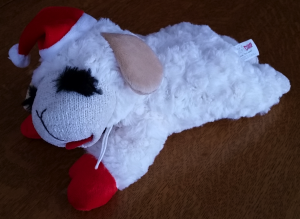
lambchop1I was in the pet supply aisle at Giant Eagle several days ago getting food for the Archbishop (that’s our black cocker spaniel, Lord Dudley of Ballycraic, the Archbishop Canine of Montville) when I found, right in front of the Beneful which is his favorite meal, a bin filled with these: dog toys in the likeness of a lamb dressed for Christmas. And not just any lamb! This is Lamb Chop, the somewhat snarky puppet introduced to the world by the late Shari Lewis in 1957.

As many of you know, this is something I do every year for this Christmas Eve sermon . . . find something to be a sort of “focus object” or trigger for our Christmas Eve meditations. Lamb Chop just seemed perfectly suited. This Christmas toy suggested four poetic associations to me: one is the title given Jesus by John the Baptizer, “the Lamb of God;” a second was a familiar nursery rhyme; the third was a romantic English poem; and the fourth, a song that Lamb Chop sang on the Shari Lewis television show, all of which can help us explore and understand the Incarnation of God in Christ Jesus.

So, the first thing that comes immediately to mind when we look at a lamb, whether Lamb Chop the puppet dressed up for Christmas or an actual lamb in the fields is the statement made by John the Baptizer in the Gospel of John: “[John] saw Jesus coming toward him and declared, ‘Here is the Lamb of God who takes away the sin of the world!’” (Jn 1:29) That seems an odd way to refer to a grown man, which Jesus was at the time.

The 20th-century bible scholar Joachim Jeremias suggested that a way to understand John’s statement is that he probably used the Aramaic word talya. Jeremias says that “lamb” (amnos in the Greek in which the gospel is written) is a translation of this Aramaic word, which can also be translated “boy,” “child” or “servant.” When Jesus was described as the talya of God, Aramaic speakers of the earliest church would have heard “child” of God, or “son” of God, or “servant” of God, or “lamb” of God. When that gospel story was written after Jesus’ Crucifixion and Resurrection, the image of the sacrificial lamb of the Hebrew tradition resonated with the author. (See America)

According to some widely accepted Christian theologies, the sacrifice of the cross is the very reason for which Jesus was born. I’m not entirely sure that’s the case; I suspect that God the Father would much rather have had Jesus followed than killed, but certainly God made use of Jesus’ Crucifixion and through it opened for us the way of salvation. In any event, some people think that the nursery rhyme Mary Had a Little Lamb, the second thing called to mind by our Christmas Lamb Chop, is about Jesus’ birth as the sacrificial lamb of God. You know the one:

Mary had a little lamb,
a little lamb, a little lamb
Mary had a little lamb,
Its fleece was white as snow.

It’s not really about the Virgin Mary and the birth of Jesus, however. It was written by Sarah Josepha Hale of Sterling, Massachusetts, in 1830, and is said to describe an actual event of a pet lamb visiting the local schoolhouse. (See Wikipedia) Nonetheless, we can learn something about our Christian faith by considering the lamb of that story.

The rhyme continues that the lamb followed Mary and “everywhere that Mary went the lamb was sure to go.” Although I don’t believe that the Son of God was born necessarily or primarily to be a sacrifice, I am sure he was born to be followed; I’m certain Christ came into Creation to teach us how to live life God’s Way. He is the Word given to us to lead us to salvation. The little lamb in the nursery rhyme trusted Mary and followed her, and that is what God wants us to do, to trust and follow the Son so that, with the Son, we may live the abundant life of the Kingdom of Heaven that God constantly offers us. This is what makes his birth so important to us and why we celebrate the Incarnation in our many special ways.

So, anyway, I picked up this Christmas Lamb Chop dog toy and the first thing I did was check to see where it was made. I’m very careful not to give the Archbishop, Lord Dudley, anything made overseas. (I’m sure you’ve heard about the toxins found in dog toys and treats made, for example, in China.) Doing so, I thought of another bit of lamb-inspired poetry, one by the English Romantic poet William Blake. You may know it; it is entitled simply The Lamb. It is, in essence, a question asked of a lamb by a child:

Little Lamb who made thee
Dost thou know who made thee
Gave thee life & bid thee feed.
By the stream & o’er the mead;
Gave thee clothing of delight,
Softest clothing wooly bright;
Gave thee such a tender voice,
Making all the vales rejoice!
Little Lamb who made thee
Dost thou know who made thee

Little Lamb I’ll tell thee,
Little Lamb I’ll tell thee!
He is called by thy name,
For he calls himself a Lamb:
He is meek & he is mild,
He became a little child:
I a child & thou a lamb,
We are called by his name.
Little Lamb God bless thee.

Blake’s poem is a deceptively naive child’s song. Beginning with a descriptive, pastoral stanza, it moves quickly to focus on the abstract spiritual matter of Creation. The child’s guileless but profound question – “Who made thee?” – echoes the deep and timeless question that all human beings have about our origin. It reminds us of the opening lines of John’s Gospel with its abstract account of the Incarnation:

In the beginning was the Word,
and the Word was with God,
and the Word was God.
He was in the beginning with God.
All things came into being through him,
and without him not one thing came into being.
And the Word became flesh and lived among us,
and we have seen his glory,
the glory as of a father’s only son,
full of grace and truth
(Jn 1:1-3,14)

In Blake’s poem, this profound truth is presented with the naiveté of a child’s puzzle revealing the child’s confidence in a simple and innocent Christian faith. Our Christmas Lamb Chop reminds us that “whoever does not receive the kingdom of God as a little child will never enter it.” (Mk 10:15) Christmas is a time for us all to experience once again our childlike wonder at the simple beauty that is the Incarnation.

But our Christmas dog toy can trick us! We have to beware of oversimplifying the Incarnation. I read recently about “a Christmas display . . . at [a shopping] mall: giant plush bears robed as Mary and Joseph, beaming at a swaddled Baby Jesus bear in the manger.” Theologian Fredrica Mathewes-Green, who described this display, said of it,

If there was once grand mystery around the Incarnation, it has long since dispersed. Three jolly bears now convey everything we know or expect to know. It is a scene plump with stupidity. Jesus as a cookie. God as a pet. (Patheos)

This, she says, “is very bad news,” because “a circle of cuddly bears is useless at helping us deal with pain. It cannot help us grasp searing heartbreak.” Neither can a puppet, even a nice Christmas Lamb Chop puppet, but it can serve as a warning and a reminder!

Tracy Dugger, an Episcopal priest in Florida, has written about what she calls “meat puppet theology,”

. . . the idea that our bodies are machines simply being utilized and driven around by our minds. The mind/soul is the control, and the body is subservient. This way of thinking about the mind/body connection is wrong, and leads us into some pretty wrongheaded [ideas]. (The Young Anglican)

“The ultimate example of why bodies are important,” she says, is the simple fact that “JESUS HAD ONE! Jesus was Incarnate. Not only was Jesus, Son of God, begotten by the Holy Spirit, He was knit together in Mary’s womb. Jesus was a man of flesh and blood, as well as God from God, light from light.”

Mathewes-Green puts it this way:

God came down in a suit of skin and bones, and walked and talked and offended people, and finally they tortured him to death. And by that death he destroyed death; he rescued us and gave life everlasting and every other good thing. Into this universe crammed with pain we say that God came down, because he loves us with the kind of love that we can only understand by thinking of how a parent loves. (Patheos)

In an Advent meditation offered earlier this week, Brother Mark Brown of the Society of St. John the Evangelist reminded us that parental love and every act of kindness is an action of the body. He wrote: “The Spirit of God animates us, but it all happens in the flesh: every deed of kindness, every act of generosity, every word of encouragement happens in the flesh. Every embodiment of Christ’s grace or truth or love happens in the flesh – or it doesn’t happen.”

Tonight, tomorrow, as we celebrate the Word becoming flesh, we celebrate that bodily parental love . . . the love of mother and father tending their newborn child; the eternal love of the Father sending the Son to redeem us. As we celebrate the birth of Jesus to Mary, we celebrate also the truth we recite every Sunday (and this evening) in the Nicene Creed:

We believe in one Lord, Jesus Christ,
the only Son of God,
eternally begotten of the Father . . .
(BCP 1979, Pg 358)

Jesus was born in Bethlehem once for all time; the Son of God is eternally begotten of the Father and both, as we say in the Creed, for our salvation.

lambchop2Which brings me to the fourth and last bit of poetry our Christmas Lamb Chop brought to mind, which is a song Lamb Chop and Shari Lewis taught their viewers during the 1992 season of the PBS show Lamb Chop’s Play-Along. Some of you may know the song and can sing along:

This is the song that doesn’t end
Yes, it goes on and on my friends
Some people started singing it
Not knowing what it was
And they’ll continue singing it
Forever just because . . .
(Repeat)

There is a contemporary Christmas carol by Canadian folksinger Bruce Cockburn entitled The Cry of a Tiny Babe which expresses the timelessness and eternality of Jesus’ birth in its refrain:

Like a stone on the surface of a still river
Driving the ripples on forever
Redemption rips through the surface of time
In the cry of a tiny babe
(Cry of a Tiny Baby YouTube)

In the last book of the bible, St. John of Patmos recorded his many visions, the last of which was of the Lamb:

I saw no temple in the city, for its temple is the Lord God the Almighty and the Lamb. And the city has no need of sun or moon to shine on it, for the glory of God is its light, and its lamp is the Lamb. The nations will walk by its light, and the kings of the earth will bring their glory into it. Its gates will never be shut by day – and there will be no night there. People will bring into it the glory and the honor of the nations. * * * Nothing accursed will be found there any more. But the throne of God and of the Lamb will be in it, and his servants will worship him; they will see his face, and his name will be on their foreheads. And there will be no more night; they need no light of lamp or sun, for the Lord God will be their light, and they will reign for ever and ever. (Rev 21:22-26,22:3-5)

Our Christmas Lamb Chop reminds us that salvation is a song that doesn’t end, that “redemption rips through the surface of time,” and that our Christmas carols are but a faint echo of the multitude’s song of worship before the throne of the Lamb for ever and ever. Mary had a little lamb, the Lamb of God, the Word made flesh through Whom all things were made, Who came down for our salvation, and Whose song of redemption doesn’t end. Yes, it goes on and on, my friends.

Merry Christmas!

====================

Father Funston is the rector of St. Paul’s Episcopal Church, Medina, Ohio.

Complicated Joseph: Sermon for Advent 4 – 18 December 2016

====================

A homily offered by the Rev. Dr. C. Eric Funston on the Fourth Sunday of Advent, December 18, 2016, to the people of St. Paul’s Episcopal Church, Medina, Ohio, where Fr. Funston is rector.

(The lessons for the day are from the Revised Common Lectionary for Advent 4 in Year A: Isaiah 7:10-16; Psalm 80:1-7,16-18; Romans 1:1-7; and St. Matthew 1:18-25. These lessons can be read at The Lectionary Page.)

====================

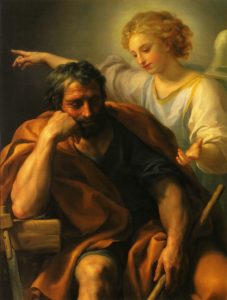
angel-appears-to-joseph-in-a-dream1In these few verses, Matthew opens up for us the complexity of Joseph as a human being. He hints at, and we can imagine, Joseph’s distress, his sense of betrayal, his disappointment, and all the other emotions he must have experienced. We can imagine also the fear and hurt that Mary probably would have felt as she and her betrothed sorted out the complications caused by the divine intrusion into their relationship.

Unlike Luke’s pastorally pleasing story of the manger, the angels, and the shepherds, Matthew gives us a direct and simple story of Mary and Joseph as human beings, not characters frozen in a stained-glass window, but flesh and blood people, people like us dealing with a serious complication in their relationship. Thus, we can see ourselves to be people like them, people who live complex lives, who have all sorts of experiences, some of them quite detrimental, and yet whom God invites nevertheless to accomplish God’s purposes.

Poets have explored the complex humanity of Joseph and his possible reactions to the news given by the angel in his dream. For example, in Joseph’s Suspicion, Rainer Maria Rilke envisions Joseph arguing with the angel, forcefully refusing to believe even that Mary is pregnant, raising his fist to the angel defending Mary’s honor:

The angel spoke and patiently tried to
convince the man, who met him with clenched fists:
Can you not see that in every way
she is as cool as God’s first morning mist?

And yet the man looked at him glowering with
suspicion, murmuring: what has brought about her change?
But then the angel cried in anger: Carpenter!
Do you not yet perceive the hand of God’s own doing?

Because you handle wood and know your trade,
do you in arrogance call Him to task
who from the self-same wood you handle now
can make green leaves appear and swelling buds?

He understand. And as he raised his eyes;
now full of fear, to meet the angel’s face,
he was gone. Slowly Joseph removed his cap.
Then he began to sing his song of praise.

In his Christmas oratorio, For the Time Being, W.H. Auden envisions Joseph asking for “important and elegant proof” that Mary’s word is true; the angel refuses and, instead, demands that Joseph simply have faith in what Auden clearly considers a scientific impossibility.

JOSEPH:
Where are you, Father, where?
Caught in the jealous trap
Of an empty house I hear
As I sit alone in the dark
Everything, everything,
The drip of the bathroom tap,
The creak of the sofa spring,
The wind in the air-shaft, all
Making the same remark
Stupidly, stupidly,
Over and over again.
Father, what have I done?
Answer me, Father, how
Can I answer the tactless wall
Or the pompous furniture now?
Answer them . . .
GABRIEL:
No, you must.
JOSEPH:
How then am I to know,
Father, that you are just?
Give me one reason.
GABRIEL:
No.
JOSEPH:
All I ask is one
Important and elegant proof
That what my Love had done
Was really at your will
And that your will is Love.
GABRIEL:
No, you must believe;
Be silent, and sit still.

The Narrator of the oratorio then compares Joseph’s dilemma to that of Adam believing Eve and eating the apple, and traces the spiritual relationship of men and women through the ages, ending with this advice to Joseph:

You must behave as if this were not strange at all.
Without a change in look or word,
You both must act exactly as before;
Joseph and Mary shall be man and wife
Just as if nothing had occurred.
There is one World of Nature and one Life;
Sin fractures the Vision, not the Fact; for
The Exceptional is always usual
And the Usual exceptional.
To choose what is difficult all one’s days
As if it were easy, that is faith. Joseph, praise.

The Jesuit poet John Lynch in his narrative poem A Woman Wrapped in Silence, writes of what we do not know, capturing through our ignorance what Joseph and Mary might really have been to each other in their mutual consternation:

What source we have of knowledge of her days
Is sparing, and has left us many days
Still veiled, and if there is enough to find
What Joseph found, and a few dear treasured words,
We must have more to lead us where our love
Would seek to go. And there is one sweet place
That distant watching eyes could fondly wish
To see and ponder on. Did Joseph come,
And with his sobs seek pardon for his fears?
And did he see how, suddenly, his love
Was greater than he knew and could be carried
Now along new pathways with his prayers?
God’s kingdom now was four, and claimed again
Another life to be with Zachary,
To listen with Elizabeth, and then
With her to serve. O, glad, he was for strength,
And glad for honor, and for nmae, and glad
His hand was skilled enough to fashion walls
And build the smallness of a crib that now
Would cradle more than all the world could hold.
Dreams of all his fathers fell on him
In one bright dream, and all bright hopes were clear.
We may not know for sure, and yet, and yet,
May we not see how quietly he came
And spoke no word. And Mary saw him come,
Finding a new thing shining in his eyes.
And when quick tears of gladness and relief
Were done, she saw him kneel, lift up his hands,
Two hands that held invisibly, his life.
She may have reached her own pale fingers out
And found them . . . callused, generous, and strong.

Alyce M. McKenzie, Professor of Preaching and Worship, Perkins School of Theology, in her commentary on this gospel entitled The Fear of Betrayal offers not a poem, but a vignette offering another possible conversation between Joseph and the angel:

On this night, as much as on Christmas Eve, an angel hovered near, whispering a message from God into Joseph’s sleeping ear. The angel interrupted the nightmare visions of accusation and estrangement that played in the theater of Joseph’s dreams. The angel replaced them with a manger scene and visions of a boy growing and becoming strong.

“Here,” whispered the angel, “is the key that unlocks your dilemma. Believe her unbelievable story. Marry her, and become the father of God’s child. He will need a father to be accepted by others as he grows to manhood. He will need, not just any father, but a father like you, capable of nurturing him, and giving him a name. ‘Immanuel — God with us.’

“He will need a father like you to teach him to take risks like the one you are about to take, for he will be tempted not to take them.

“He will need a father like you to teach him to withstand the disapproval of others, as you will soon have to withstand it.

“He will need a father like you to teach him what to do in situations like this one, when all hope seems lost and only pain remains; to model how to believe the unbelievable good news and to walk ahead in faith.

“If you do not walk the hard road to Bethlehem, who will teach him how to climb the cruel hill to Calvary?”

In this way, I imagine the father of our Lord was born that night.

These writers through their imaginative treatments show us what Matthew hints at in his simple story: that Joseph was a complex man, a human being like any of us, entrusted by God with the ominous responsibility of fostering God’s own son. We can imagine that his response to that invitation might have been as fearful and as conflicted as any of ours would have been and yet, although Joseph soon disappears from the gospel narratives, we can be assured that he accomplished that ministry with skill and grace. From that we can take the comfort that when God invites us to accomplish his purposes, as God surely does, we too will be able to do so with skill and grace.

====================

Father Funston is the rector of St. Paul’s Episcopal Church, Medina, Ohio.

Superbloom: Sermon for Advent 3 – 11 December 2016

====================

A homily offered by the Rev. Dr. C. Eric Funston on the Third Sunday of Advent, December 11, 2016, to the people of St. Paul’s Episcopal Church, Medina, Ohio, where Fr. Funston is rector.

(The lessons for the day are from the Revised Common Lectionary for Advent 3 in Year A: Isaiah 35:1-10; Psalm 146:4-9; James 5:7-10; and St. Matthew 11:2-11. These lessons can be read at The Lectionary Page.)

====================

01-death-valley-super-bloomMost of the time when we hear this story of John’s disciples coming to Jesus we focus on John’s question – “Are you the one who is to come, or are we to wait for another?” (Mt 11:3) – and on Jesus’ answer to it which is neither a “yes” nor a “no” but a pointing to the evidence – “the blind receive their sight, the lame walk, the lepers are cleansed, the deaf hear, the dead are raised, and the poor have good news brought to them” (Mt 11:5).

But the lesson adds a second conversation, one that happens after John’s followers leave. Jesus turns to the crowd and asks them a question, “What did you go out into the wilderness to look at?” (Mt 11:7)

Whenever I read this gospel and encounter that question (especially when I read it in one of the translations that renders it as “What did you go out into the desert to see?”) I remember my childhood and early adult life in southern Nevada, where we would often “go out into the desert to see” something. Today’s prophecy from the Book of Isaiah – “The wilderness and the dry land shall be glad, the desert shall rejoice and blossom; like the crocus it shall blossom abundantly, and rejoice with joy and singing” (Isa 35:1-2) – reminds of those times when we would go out to see the wild flowers in bloom.

There is a phenomenon that occurs only rarely in the desert when there is sufficient rain, a blossoming of the wild flowers called a “superbloom.” You may have seen the news of a superbloom in Death Valley last year, in the fall of 2015. It’s an amazing sight to see! The desert bursts with color as thousands of plants come to life; coaxed to blossom by the rains, the flowers create intricate tapestries, the blues and purples of desert lavender, sand verbena, and Arizona lupine, the red of the California poppies, the brilliant orange of the Mariposa lily, and the yellow explosion of a stand of Palo Verde trees in full bloom. It is truly a vision worthy of Isaiah’s prophecy, “The desert shall rejoice and blossom!” It is what we would go out into the wilderness to see.

Most of the time, though, we go out into the desert and we see . . . wilderness, a “reed shaken in the wind,” as Jesus says (Mat 11:7). We go out into the wilderness with our expectations of wild flowers in blossom, of superblooms carpeting the desert with color, and we are disappointed. We miss the truly remarkable splendor of the “fields and floods, rocks, hills and plains” that “repeat the sounding joy” of God’s creation. (I. Watts, Joy to the World) We dismiss the gray-greens of cactus and sage, failing to see that there’s “not a plant or flower below but makes [God’s] glories known.” (I. Watts, I Sing the Mighty Power) We fail to see the stark native beauty of the wilderness for what it is because it doesn’t meet our superbloom expectations.

That was the problem for John, and it was the problem for the religious authorities whom John opposed. They looked at Jesus but did not see; this Galilean peasant messiah was not what they expected and so John sent his disciples to ask, “Are you the one who is to come, or are we to wait for another?” If we are honest – and the point of the season of Advent is to call us to that sort of honesty – there are times we have seen and heard the work of God but called it something else, not recognizing it for what is. Like the Romans, like the religious authorities, like John the Baptize sitting weary in prison, we mistake what we see. Somehow, it just doesn’t match what we had in mind.

There is a danger during Advent – while we are preparing for the annual celebration of the winter solstice that we call “Christmas”, while we are hosting teas and attending office parties and going to school Christmas plays – there is a danger that we will create the Jesus we want, and miss the Jesus who really is. As Methodist campus minister Deborah Lewis at the University of Virginia notes, we can be confused by and miss “God’s willful, wily, wonderful ways of showing up in the world.” She advises us:

Don’t get carried away in your waiting, in your anticipation. Keep alert and keep paying attention. We’re called not to create and conjure the Prince of Peace but to recognize and welcome him when he arrives, when we see and hear what he’s doing. In the remaining weeks of Advent and when you go home to family and friends and a Christmas you’ve been expecting for a while now, remember what it was you came to see. Remember that wilderness vision and pay attention to how it might look and sound as it is revealed in new places and people. (Deborah Lewis)

Advent, as I said, calls us to be honest. It calls us, as Jesus called his first followers, to “keep awake, for [we] do not know on what day [our] Lord is coming.” (Mat 24:42) It calls us to “beware [and] keep alert, for [we] do not know when the time will come.” (Mk 13:33) We must be alert to the many cultural messages which obscure the Truth of Jesus Christ, cultural messages which lead us to expect something other than the Truth that Jesus offers. “Advent calls us to be honest about the values and beliefs that we hold because of cultural convenience, rather than the values and beliefs [of] our faith.” (Roman Catholic Bishop Paul D. Etienne)

So for the next couple of weeks, keep awake, be alert, be honest. Look to the wilderness beyond the teas, the office parties, and the Christmas plays. Look to the wilderness beyond the decorated trees, the colorful lights, and the blow-up displays in the neighbors’ yards. Look to the wilderness.

Look for God in works of mercy, healing, hope . . . .
Look for God in those who strive for justice and peace . . . .
Look for God in those who mourn and suffer . . . .
Look for God in your own heart. Go there. Into the wilderness. Follow the leading star of your longing for a closer relationship with God, a closer walk with Christ. There is where you hear the still small voice of the Holy Spirit. There you begin to see.
Three times Jesus asks the gathered crown: What then did you go out to see? Ask yourself the same question this week, and not only at church, but at any time or place: what did I come here to see?
Ask yourself the same question . . . .
(The Rev. Dr. Matthew Calkins)

Answer honestly and you will see the superbloom of God’s Presence!

Note: The illustration is from the article Marveling at the Super Bloom in the March 2016 issue of Vogue Magazine.

====================

Father Funston is the rector of St. Paul’s Episcopal Church, Medina, Ohio.

Building a Modern Creche: A Poem – 2 December 2016

enptycreche

Building a Modern Creche

Let’s build a new creche
a new nativity scene
that’s built with
elements
of our lives
reflecting our modern world.

The Incarnate God
can’t be born
in a stable
no one has stables any longer
(well, some do, most don’t).
What do we have instead?
Garages . . . God will born in a garage.

No! That won’t do!
Nobody would send
a pregnant young girl
to spend a night in a garage!
A homeless shelter, maybe
A charity hospital, maybe
What would Joseph try to do
in modern America?

He’d go to a church:
“Please, pastor, we’re on the road.
My wife is pregnant.
We need some money for a motel.”
A voucher, they’d get a voucher,
for the local cheap motel
the Super 8 Motel 6 Ameristar
Interstate Inn with free cable
and maybe wifi.
That’s where God would be born,
in a seedy highway motel.

And for our Christ Child
what baby doll shall we use?
Black brown yellow red white?
That would be too particular,
wouldn’t it? It would make
the Holy Infant
too much like some
not enough like others
maybe we need a non-human thing,
a metaphoric Baby Jesus?

I know! The toy from
the dog food aisle
a plush green googly-eyed frog
in a Santa hat!
That’s not too particular
no one could claim
such a Holy Infant
looked too much
or too little like
anyone!
So it will be
green googly-eyed
Santa froggy Jesus!

And Mary, who to be Mary?
Everyday I drive past a
young woman who makes
a Christmas appearance
every year
in this little town of ours.
A plywood Lucy van Pelt.
Eight feet tall if she’s an inch
and holding a Christmas wreath.
Eternally young but worn a bit
with age
she has stood in that yard
every year for more
than a decade.
A perfect blend of childhood
innocence and world-weary
wisdom in a cartoon Mary
for our creche,
that’s plywood Lucy van Pelt.

And her husband, the foster father?
If I drive the other route to work
another neighbor’s yard
displays a nylon blow-up
snowman who wavers
and leans and then gets
a spine and stands straight
only to slump again with
uncertainty not at all sure
what he’s doing where he is.
Joseph, anxious Joseph,
wanting to do the right thing
but needing the windy support
of the Spirit to buck him up
like the snowman’s
electric fan spine.
We have our Joseph!

So now plywood Lucy Mary
and blow-up Snowman Joseph
lay their newborn
green googly-eyed froggy
Santa Jesus
into his make-shift crib
his manger . . . .

No, wait again! This isn’t a stable!
No mangers at Super 8 Motel 6
Ameristar Interstate Inn.
What can they use?
What can they find?
A cardboard box
the copy paper carton from the office
the one that holds the registration
forms and receipts from
the local print shop.
That will do!
And diaper our Holy Child
in the thread-bare barely absorbant
motel bathroom towels
too small for an adult
but fine to swaddle
God Incarnate in
googly-eyed froggy splendor.

Our creche is complete.
The Holy Family awaits
the modern-day shepherds
the night workers:
the 24-hour convenience store
graveyard-shift cashiers,
the midnight linemen
keeping the power lines up
and working in wind
and snow and ice,
the waitress at the Waffle House
both hoping for and dreading
the next customer.
“Glory!” they will think they hear
“Glory!” angels will cry trying
to get their attention.
“Tidings of great joy!”
they will endeavor to push
through the jade and jaundice
of darkened spirits,
and plywood Lucy Mary
and blow-up Snowman Joseph
and froggy Santa Jesus
will wait, and wait, and wait,
hoping that eventually
the waiting
will be fruitful

Maybe some kings or the like
will show up.
Not Melchior, Caspar, or Balthazar.
Perhaps our wise people will be
Barak, or Donald, or Hillary,
or Vladimir, or Bibi, or Angela,
or Bashir, or Xinping, or . . .
who knows?
And perhaps not,
perhaps in a modern nativity
there are no wise men,
no wise women seeking
the newborn froggy
Incarnate God,
there is only
the Holy Family
while somewhere nearby
late night workers
are not sure they have heard
“Glory!” and
wonder what wisdom is
and if anyone possesses it.

= 2 December 2016
C. Eric Funston

Our Immigrant Lord: For the Parish Newsletter, December 2016

====================

A “Rector’s Reflection” offered by the Rev. Dr. C. Eric Funston in the December 2016 issue of The Epistle, the newsletter of St. Paul’s Episcopal Church, Medina, Ohio, where Fr. Funston is rector.

====================

thirstednot-jesusindesert2A few years ago I read an essay about the trials and tribulations of relocation, particularly from region to region within our country. In it the author made the comment that when relocating to the South, there were two invariably asked questions of the newcomer: “Who are your people?” and “Where do you go to church?” These, he said, are quintessentially Southern inquiries which serve to position the interrogated in a place’s social network and milieu. The assumptions, of course, are that no one would relocate to a town where they did not have “people” (i.e., family members) and that everyone goes to church somewhere.

I’m not sure, after making several regional locations myself, that those are only Southern questions. They seem to be universally asked, in one form or another, of newcomers to every American community. In fact, they may be quintessentially human questions asked around the world!

In 2005, when Evelyn and I made our first trip to Ireland, one of my goals was to find distant relatives, members of the Funston clan whose ancestors had stayed there when my great-great-grandfather had come to America. So we visited the places I believed he might have come from, the Funston township lands of Counties Donegal, Tyrone, and Fermanagh. During our stay in the city of Donegal we happened to visit a woolen goods store run by a delightful man named Sean McGinty. We entered the shop just as Sean was closing up for the day and he graciously stayed open so we could peruse his sweaters, tweeds, and other goods. Of course, that meant he was going to be late to dinner . . . and, as a result, his wife Mary came looking for him.

We’d been in conversation with Sean before Mary arrived and told him of my search for Funstons. He said he thought there might be some living in Pettigo, a small village on the border of County Donegal and County Fermanagh. When Mary came into the shop, he drew her into our conversation and asked her, “Mary, you’re from Pettigo. Were there any Funstons living there?” She thought for a moment and then replied, “Aye! But they weren’t our people.” I knew immediately what she meant: they weren’t members of the Catholic Church. And that would have been right! My ancestor was a member of the Anglican Church of Ireland and his descendants are still Anglicans!

So there were those same two concerns: “Who are your people?” and “Where do you go to church?” They are the questions still being asked of newcomers to our communities wherever we may be, whether we are in the South of the United States, in Ohio, or somewhere in Europe. As so many people are on the move because of war, political unrest, and economic necessity, as so many are labeled “immigrant” and “refugee,” they are increasingly divisive and exclusive questions.

“Who are your people?” . . . “Where do you worship?” . . . What is your ethnic background? . . . What is your religion? . . . Instead of being asked to position the newcomer within the social milieu of his or her new home, the questions and their answers too often lead to the erection of social barriers, sometimes even physical walls. Instead of being welcoming questions of inclusion, they are the defensive or belligerent interrogations of exclusion.

Recently in the Christian press, particularly those journals which cater to a more conservative audience, there has been a lot of discussion about the assertion that Jesus was an immigrant and refugee. It is a common enough hermeneutic drawn from the story of the Holy Innocents and the flight of the Holy Family into Egypt as related in Matthew’s Gospel: “An angel of the Lord appeared to Joseph in a dream and said, “Get up, take the child and his mother, and flee to Egypt, and remain there until I tell you; for Herod is about to search for the child, to destroy him.” (Matt 23:13 NRSV) It occurred to me that it may be a useful reminder that the Son of God was an immigrant from the very start, that he was not and is not a native resident of our world; he is from elsewhere, from heaven, from the very Throne of God.

As Dr. John Marshall, a Southern Baptist minister in Missouri, recently wrote: “Our Savior was an immigrant. He left His home in Heaven to become a stranger in the very world He created. There was no room for Him in the Bethlehem inn (Lk 2:7). He came to His own people, but they received Him not (Jn 1:11).” (Marshall) As we prepare once again to welcome him in the annual celebration of his Incarnation, we do well to remember that and to remember that he remained an immigrant and a refugee throughout his life.

Jesus was born in Bethlehem of Judea, a land dominated by the Roman empire through a client ruler named Herod the Great. Apparently Mary, Joseph, and Jesus remained there for a couple of years before fleeing to Egypt where they lived until Herod died about four to six years after that. When they left Egypt, they returned not to Bethlehem but to Nazareth in Galilee, which was under the rule of Herod’s son, Herod Antipas, Tetrarch of Galilee. Jesus grew up, then, as a resident of Galilee; when he undertook his ministry to Jerusalem (which is in Judea), although he was returning to the country of his birth, he was an immigrant into Judea.

Judea, by the way, during Jesus’ life and ministry was ruled not by a local king but directly by the Romans. Herod the Great was succeeded by his son Archelaus, who had the title of “Ethnarch of Judea.” Archelaus died less than ten years after succeeding his father. After his death, a series of Roman governors or “Prefects” ruled, the last of whom during Jesus’ life was Pontius Pilate.

In truth, Jesus spent most of his time on the move. Both Matthew and Luke report him saying to a potential follower, “Foxes have holes, and birds of the air have nests; but the Son of Man has nowhere to lay his head.” (Matt 8:20; Lk 9:58) Jesus was not a settled person and, interestingly enough, neither are his followers (us) supposed to be. This goes back to the Jewish roots of our faith, a reminder of which is found in the Torah’s instructions for eating the Passover feast: “You shall eat it [with] your loins girded, your sandals on your feet, and your staff in your hand; and you shall eat it hurriedly.” (Ex 12:11) We are always to be ready to be on the move.

Our parish patron, St. Paul, takes up this theme in his letters. He reminded the Philippians that we are not to set our mind on earthly things because “our citizenship is in heaven.” (Philip 3:19-20) And he promised the Ephesians that we are “citizens with the saints and also members of the household of God.” (Eph 2:19) Theologians Stanley Hauerwas and William Willimon expanded on this notion in their book Resident Aliens (Abingdon, 1989), arguing that today the church is not “a service club within a generally Christian culture,” but rather “a colony within an alien society.” (pg. 115)

How might this inform and shape our Advent preparations and our Christmas celebrations? What if we understood that we are not getting ready to welcome Jesus into our settled existence, our cozy homes and our warm hearths, our abundant feasts and our lovely dining rooms? Rather, we should be preparing for our immigrant Lord Jesus to invite us to join him on the road, to eat with him hastily consumed meals wearing our sandals and holding our walking sticks, to sleep with him in places where we have no place to put our heads. What might we do differently to get ready for the anniversary of his Incarnation and for his promised return? What might we do differently for all who, like him, are refugees and immigrants?

Who are our people? The people of God whoever they are and wherever they may be, temporarily settled in “a colony within an alien society” or on the road. Where do we worship? Wherever we find our Lord, in church, in a refugee camp, in places we cannot even imagine. Every year Advent and Christmas challenge us with what Hauerwas and Willimon call “the greatest challenge facing the church in any age” which is to be “a living, breathing, witnessing colony of truth.”

May that challenge be our blessing in 2016! May each of us, and all of us together, be living, breathing witnesses to the Truth!

(Note: The image is a digital painting by an internet blogger calling himself Horseman. I could find no further information about it or him.)
====================

A request to my readers: I’m trying to build the readership of this blog and I’d very much appreciate your help in doing so. If you find something here that is of value, please share it with others. If you are on Facebook, “like” the posts on your page so others can see them. If you are following me on Twitter, please “retweet” the notices of these meditations. If you have a blog of your own, please include mine in your links (a favor I will gladly reciprocate). Many thanks!

====================

Father Funston is the rector of St. Paul’s Episcopal Church, Medina, Ohio.

Swords into Ploughshares, But No Rapture: Sermon for Advent 1, 27 November 2016

====================

A homily offered by the Rev. Dr. C. Eric Funston on the First Sunday of Advent, November 27, 2016, to the people of St. Paul’s Episcopal Church, Medina, Ohio, where Fr. Funston is rector.

(The lessons for the day are from the Revised Common Lectionary for Advent 1 in Year A: Isaiah 2:1-5; Psalm 122; Romans 13:11-14; and St. Matthew 24:36-44. These lessons can be read at The Lectionary Page.)

====================

swordsploughsharesrockefeller“Two will be in the field; one will be taken and one will be left. Two women will be grinding meal together; one will be taken and one will be left. Keep awake therefore, for you do not know on what day your Lord is coming.” (Matt 24:40-42) You probably have friends who have told you these verses from Matthew’s Gospel describe something called “the Rapture.” You may have read the Left Behind books or seen the movies. So you may think you have a handle on what these verses mean and why they are offered to us as we begin our Advent preparation to celebrate the anniversary of Christ’s Incarnation and to look forward to his return, his “Second Coming.”

Well… just hold that thought for a moment and let’s explore the first reading before we get back to it.

This is such a great passage from the Prophet Isaiah that we have this morning. It’s got those wonderful verses that are carved into the wall of the broad plaza across the street from the United Nations building in New York City:

They shall beat their swords into ploughshares,
and their spears into pruning-hooks;
nation shall not lift up sword against nation,
neither shall they learn war any more. (Isa 2:4, NRSV)

It’s got all that wonderful imagery of the nations of the world streaming toward the Temple of the Lord in Jerusalem, at peace with one another. It’s a wonderful, wonderful vision.

We keep waiting for it, don’t we?

Isaiah saw this vision during the reign of King Uzziah of Judah about 750 years before Jesus’ time. Isaiah promulgated what is known as “Zion theology,” a religious understanding of Jerusalem as the center of the world and the Temple as the center of Jerusalem. The Lord will come to it and its mount, Holy Zion, will be the most prominent mountain. The nations will all come to Jerusalem to learn divine teaching. Yahweh, enthroned in the Temple, will mediate and end all international conflict. The waging of war will cease.

Of course, none of that has ever happened, but for nearly eight centuries after Isaiah the son of Amoz this was the belief and hope of Israel, of all Jews. The realities of this text exist in the realms of promise, hope, and faith.

Or at least they did until about forty years after Jesus’ death and resurrection.

Here’s a little First Century history lesson:

Jesus was born sometime around the year we might think of as “Zero” – in truth, we think he was born about the year now designated 4 B.C. (The calendar designations we use were developed by a man named Dionysus Exiguus – Dennis the Short – around the year 525 A.D. Dennis made a couple of miscalculations and so our calendar is just a bit off; it really doesn’t start with the birth of Jesus.) He lived to about his mid-thirties; the most popular dating of the crucifixion is April 3 of the year 33 A.D.

The Gospels were written several years after Jesus’ Ascension. Folks apparently thought it would be a good idea to get things written down because the original followers of Jesus were dying off. So Mark’s gospel was compiled a few years before 70 A.D., perhaps in the mid-60s. Matthew’s gospel is believed to have come next, about 80 A.D., perhaps as late as 90 A.D. Luke wrote his gospel and the Book of Acts at about the same time. John’s gospel comes along about the year 100 A.D.

These dates are important because of what happened in Jerusalem in 70 A.D.

Around the year 64 A.D. the Jews of Jerusalem rebelled against the then-ruling Roman Procurator, a man named Gessius Florius, who had tried to take the Temple treasury for his own use. They succeeded in expelling Florius from the city, but only after nearly 4,000 Jews had been killed. Then they got into a battle amongst themselves. There was essentially a civil war between the forces of Herod Agrippa, the grandson of Herod the Great, who claimed to be king, and Eliezer ben-Hananiah, who was the high priest.

This division between the Jews allowed the Roman Procurator of Syria Cestius Gallius to lay siege to the city for four years between 66 and 70 A.D. and basically starve the Jews. In the late summer of 70 A.D. the Roman general Titus Flavius successfully breached the city walls and destroyed the city and the Temple. The contemporary Jewish historian Joseph ben Matityahu reported that more than a million Jews were killed.

That is when the Zion theology of Isaiah took a nearly fatal blow. There was no longer a Temple to which (as the Psalmist put it)

the tribes [could] go up,
the tribes of the Lord,
the assembly of Israel,
to praise the Name of the Lord. (Ps 122:4, BCP 1979 Version)

This was also the background, the context within which Matthew’s and Luke’s gospels were written. When the authors set about to record the story of Jesus, they look back to view him through the smoke of burning Jerusalem, across the rubble of the destroyed Temple.

Thus, they remembered things that Jesus had said about the Temple’s destruction. They remembered things that Jesus had said about his own probable death. They remembered and interpreted and wrote about many things in light of what was happening and had happened in the world around them. Of course they did! They were just as human as you and me, and the way they saw things and understood things and reported things was influenced by their experiences.

“The impact of this catastrophe cannot be overestimated. The loss of the war was itself devastating. The loss of the city of Jerusalem, the symbolic unifier of the Jewish people and the physical link to the memories that make Jews distinctively Jewish, tying them together all the way back to David, who ruled from this city, this loss shook the people deeply.” (Prof. Richard W. Swanson) Including the followers of Jesus, who at that time still thought of themselves as Jews.

Which brings us back to those verses from today’s gospel reading . . . that much cited and much misinterpreted text! When they remembered Jesus saying, “Then two will be in the field; one will be taken and one will be left. Two women will be grinding meal together; one will be taken and one will be left” (Matt 24:40-41), the evangelists didn’t think he was talking about something that would happen in some future when he would return. They believed, probably correctly, that he was talking about something that had already happened to them and to their families and to their country. They had lived through a devastating and now inescapable loss. As a result of the Roman destruction of Jerusalem and the Temple, which they had 800 years of regarding as the center of the universe, “every extended family [had] lost many members.” (Swanson)

In Luke’s version of this story, by the way, the disciples ask a follow-up question: Jesus says, “I tell you, on that night there will be two in one bed; one will be taken and the other left. There will be two women grinding meal together; one will be taken and the other left.” (Lk 17:34-35) Then his followers ask, “Where, Lord?” and Jesus them to look for the ones taken “Where the corpse is,” where “the vultures will gather.” The authors of the gospels were not looking forward to this happening; they had already been through it. (See Benjamin Corey)

It wasn’t until a crazy Irish Anglican priest named John Darby took these verses out of context and mashed it together with something Paul wrote to the Thessalonians about being “caught up in the clouds together with [the risen dead] to meet the Lord in the air” (1 Thes 4:17), and stirred it all together with some crazy imagery from the Book of Revelation, that we get the notion of a “rapture.” That “pointless [and] weird theology has . . . produced some strange bumper stickers (In case of Rapture this car will be driverless, etc.), and bad movies (you know which ones), [but] it is not what these words are about.” (Swanson)

These words are about hope even in the worst possible of circumstances. As Professor Arland Hultgren of Luther Seminary says:

The message of Christ’s return is not meant to frighten us. It is to give us hope. ~ The Christ who is to come is the Christ who once lived among us on earth, and who is known in the gospel story as the friend and healer of those in need. Moreover, living in hope, expecting Christ’s return, is integral to the Christian faith, for by it we insist that there is more to the human story and God’s own story than that which has been experienced already. (Hultgren)

There is another prophet whose words convey this message, the Prophet Habakkuk who shouted his intent to praise the Lord even when everything had gone bad. He wrote:

Though the fig tree does not blossom, and no fruit is on the vines; though the produce of the olive fails, and the fields yield no food; though the flock is cut off from the fold, and there is no herd in the stalls, yet I will rejoice in the Lord; I will exult in the God of my salvation. God, the Lord, is my strength; he makes my feet like the feet of a deer, and makes me tread upon the heights. (Hab 3:17-19a)

This is the hope of Advent, the hope that lets us believe, indeed lets us know with certainty that although Jerusalem may be destroyed, although the Temple may be in ruins, although war may rage around us, still there will be a time when

they shall beat their swords into ploughshares,
and their spears into pruning-hooks;
nation shall not lift up sword against nation,
neither shall they learn war any more. (Isa 2:4)

“Therefore you also must be ready, for the Son of Man [who will usher in that time of peace] is coming at an unexpected hour.” Amen.

Note: The illustration is “Swords into Plowshares” by Lee Oscar Lawrie at the International Building, Rockefeller Center, NYC, NY.

====================

Father Funston is the rector of St. Paul’s Episcopal Church, Medina, Ohio.

Two Poems for Thanksgiving: November 24, 2016

====================

In place of a homily, the Rev. Dr. C. Eric Funston offered the congregation two poems by contemporary poets on Thanksgiving Day, November 24, 2016, at St. Paul’s Episcopal Church, Medina, Ohio, where Fr. Funston is rector.

(The lessons for the day are from the Revised Common Lectionary for Thanksgiving Day in Year C: Deuteronomy 26:1-11; Psalm 100; Philippians 4:4-9; and St. John 6:25-35 These lessons can be read at The Lectionary Page.)

====================

the_first_thanksgiving_cph-3g04961

My Work is Loving the World
by Mary Oliver

My work is loving the world
Here the sunflowers, there the hummingbird..
Equal seekers of sweetness,
Here the quickening yeast; there the blue plums,
Here the clam deep in the speckled sand.

Are my boots old? Is my coat torn?
Am I no longer young, and still not half-perfect?
Let me keep my mind on what matters,
Which is my work

Which is mostly standing still and learning to be astonished.
The phoebe, the delphinium,
The sheep in the pasture, and the pasture.
Which is mostly rejoicing, since all the ingredients are here,

Which is gratitude, to be given a mind and a heart and these body-clothes
A mouth with which to give shouts of joy to the moth and the wren, to the sleepy dug-up clam
Telling them all, over and over, how it is that we live forever.

* * * * * * * *

Thanksgiving
by Malcolm Guite

Thanksgiving starts with thanks for mere survival,
Just to have made it through another year
With everyone still breathing. But we share
So much beyond the outer roads we travel;
Our interweavings on a deeper level,
The modes of life embodied souls can share,
The unguessed blessings of our being here,
The warp and weft that no one can unravel.

So I give thanks for our deep coinherence
Inwoven in the web of God’s own grace,
Pulling us through the grave and gate of death.
I thank him for the truth behind appearance,
I thank him for his light in every face,
I thank him for you all, with every breath.

====================

Image: The First Thanksgiving 1621, oil on canvas by Jean Leon Gerome Ferris (1899). It’s a painting filled with misconceptions and misinformation about the first Thanksgiving, but it’s lovely and romantic and fills our imaginations on this day.

====================

Father Funston is the rector of St. Paul’s Episcopal Church, Medina, Ohio.

Faith Leaders Call on Congress to reject Mr. Trump’s Cabinet of Bigotry

Faith Leaders Call on Congress to reject Mr. Trump’s Cabinet of Bigotry

Note: This is a Google Document which you can join in signing by clicking the above title.

Dear Members of Congress,

As a community of faith, we stand firmly and morally opposed to the dangerous and divisive voices that President-elect Trump is elevating into positions of great power. White supremacy has no place in the West Wing or any other rung of leadership.

We object not only to one individual, but to a clear pattern that Mr. Trump is building a cabinet founded on bigotry and a racial ideology that degrades religious minorities, immigrants and people of color.

Senator Jeff Sessions has a long history of bigoted comments towards people of color and civil rights organizations, including the NAACP and the Southern Christian Leadership Conference. In 1984 Sen. Sessions tried to prosecute three Alabama civil rights workers for their voter registration work. This politically motivated case not only failed, but also led to Congress rejecting him as unfit for judicial office. It is an outrage for Sessions to oversee the civil rights division of the Department of Justice.

Steve Bannon, formerly led the far-right website Breitbart News, which has ceaselessly promoted racist, sexist, anti-Semitic and homophobic rhetoric that degrades the human dignity of millions of Americans.

Kris Kobach, a member of Mr. Trump’s transition team, has a horrifying record on civil rights and has advanced policies that disenfranchise people of color and discriminate against immigrants, and has called for a registry that would single out Muslims and other religious minorities.

While we respect Michael Flynn’s military service, he has called Islam ‘a Cancer’ and used social media to stoke fears of Jews and Muslims. National security experts know that such divisive fear-fueled rhetoric only leads to senseless hate crimes here in America, and needlessly puts at risk our men and women in uniform.

As proud Americans committed to defending the Bill of Rights and freedom of religion, we oppose putting in powerful positions these individuals who have stoked truly dangerous bigotry.

All of our faith traditions teach us to love our neighbors as we love ourselves. After a painful and contentious election, the future of our nation rests in our ability to unite and work collaboratively for the common good of all people. But we cannot coalesce around these ambassadors of hatred, bigotry and intimidation.

We are a country founded on the principle that all people are created equal. As the future of our nation is shaped by its new president, we must cling strongly to those values that make our nation great — liberty, justice and freedom for all.

In the coming days, our prayer is that you call on President-elect Trump to reject these white supremacists and appoint advisers who understand that forging a more tolerant, united and inclusive America is the best way forward. We urge you not to remain silent at such a time as this for through your silence you suggest agreement.

Click here to sign this document.

« Older posts Newer posts »