Occasional thoughts of an Anglican Episcopal priest

Category: Christianity (Page 30 of 84)

JOLT! – A Sermon for Proper28B, Pentecost 25, November 15, 2015

====================

A sermon offered on Twenty-Fifth Sunday after Pentecost (Proper 28B, Track 1, RCL), November 15, 2015, to the people of St. Paul’s Episcopal Church, Medina, Ohio, where Fr. Funston is rector.

(The lessons for the day are 1 Samuel 1:4-20; 1 Samuel 2:1-10; Hebrews 10:11-25; and Mark 13:1-8. These lessons may be found at The Lectionary Page. The collect for the day, referenced in the sermon, is found at the same site.)

====================
JOLTWhen you sit there in the pew and I stand here in the pulpit and say to you “The Bible says this . . . .” or “The Church teaches that . . . .”, how do you know that I’m telling you the truth? When the writer of the Letter to Hebrews admonishes you to “approach [the sanctuary of God] with a true heart in full assurance of faith,” how do you have that assurance? When that writer, again, encourages you to “hold fast to the confession of our hope without wavering,” how do you know what that confession is? And when Jesus commands you, “Beware that no one leads you astray,” how do you make the judgment to exercise that caution?

I submit to you that all of those questions have one answer: on-going Christian formation, lifelong Christian learning, adult Christian education, call it what you will it boils down to the same thing – using, on a regular basis, the sense, reason, and intellect with which God has endowed us to enter into ever-deepening understanding of our faith. And it begins, as our opening collect suggested, with hearing, reading, marking, learning, and inwardly digesting the Holy Scriptures.

Blessed Lord, who caused all holy Scriptures to be written for our learning: Grant us so to hear them, read, mark, learn, and inwardly digest them, that we may embrace and ever hold fast the blessed hope of everlasting life, which you have given us in our Savior Jesus Christ; who lives and reigns with you and the Holy Spirit, one God, for ever and ever. Amen. (Proper 28, The Book of Common Prayer 1979, page 236)

One of the first things Thomas Cranmer, the first Reformed Archbishop of Canterbury, did after being appointed in 1533 was to convince King Henry VIII to publish an English translation of the Holy Bible and to authorize its public use. Cranmer hired Myles Coverdale to undertake the task and between April of 1539 and December of 1541 seven printings of this translation were made. Because of its large physical size, it was called The Great Bible. Copies of it were distributed to every church in England, chained to pulpits or lecterns, and there made available to any literate person who wished to come and read the Holy Scriptures for themselves. In addition, a reader was provided in every church so that the illiterate could hear the Word of God in plain English.

Cranmer then undertook, with the assistance of other bishops and scholars, to translate the church’s liturgy from medieval Latin into the common English of the day. He is the chief architect of The Book of Common Prayer, the first edition of which was published in 1549. Cranmer’s vision was of an English national church gathered in household units each morning and evening, gathered in parish churches each Sunday morning, reading through most of the Bible each year. His vision was of a Christian people who would be, in the words of one of our Lenten prayers, “fervent in prayer and in good works.” (Preface for Lent, BCP 1979, page 379) Fervent – on fire – energized for their mission “to represent Christ and his Church; to bear witness to him wherever they may be; and . . . to carry on Christ’s work of reconciliation in the world.” (Catechism, BCP 1979, page 855)

Our church continues that tradition with that same vision today through a Daily Office lectionary which leads us through almost the whole of Scripture over the course of two years and a Eucharistic lectionary (which we now share with many other mainstream Christian denominations) that guides us through most of the New Testament in a three-year cycle and much of the Old Testament in a six-year cycle. In this, we continue what Australian priest and author Adam Lowe calls the “extremely strong tradition” of “Anglican openness to the Bible.” (Blog entry October 29, 2010)

When Cranmer and his colleagues devised the annual cycle of prayer and reading embodied in the Prayer Book, they created also the cycle of weekly collects which begin Sunday worship services. On the First Sunday of Advent each year, their calendar of collects bid the church pray for God’s grace to “cast awaye the workes of darknes, and put upon us the armour of light.” (BCP of 1549) We still offer that same prayer on Advent 1. On the Second Sunday of Advent, they prescribed the original version of the collect which we now pray on this, the penultimate Sunday of the church year.

Although the “collect of the day” is (according to the rubrics in the BCP) normally said only by “the Celebrant,” today I asked that we all read that prayer together. I did so to underscore the corporate nature of that and every prayer said during worship; the Presider does not pray alone. The word “Amen,” in which the congregation joins at the end of every prayer, is a Hebrew word meaning “So be it.” It means, “Yes! We agree. We said that prayer with you. That’s our prayer.” So, this morning, we made it our prayer not only in agreement but in fact, our prayer and our commitment that we, each one of us and all of us together, will “hear [the holy Scriptures], read, mark, learn, and inwardly digest them.” We Anglicans have all been making that commitment, at least once a year, for 466 years!

We’ve been making that commitment, but let’s be honest, we’ve not been very good at keeping it. Even though our church teaches (in the Charter for Lifelong Christian Formation) that “faith formation . . . is a lifelong journey with Christ, in Christ, and to Christ,” a lifelong process of “growth in the knowledge, service, and love of God as followers of Christ . . . informed by scripture, tradition, and reason,” I’ve been told by adult members of our church that (and I quote) “I don’t need any adult education.” Well . . . I can only tell you my experience.

When I moved back to Las Vegas as an adult in 1976 and, after a half-dozen years of not being active in the church, decided to attend Christ Episcopal Church, one of the first things I was invited to do was attend an adult education class. I’m glad I accepted the invitation. For the next dozen years I took part in at least one adult study every year, then I read for Holy Orders and got ordained, and for the last quarter century as a professional clergy person I have studied Scripture and church tradition nearly every day . . . and I still learn things. In fact, preparing for this sermon this past week I learned some things about The Great Bible that I hadn’t known before.

As I told you last week, because of my study of Scripture and church tradition, I believe that “God Loves Everyone – No Exceptions” is unqualifiedly true; for the same reason, I believe that “I don’t need any adult education” is unqualifiedly false. No one is ever too young, too old, or too knowledgeable to learn. And when we don’t make the effort and take the opportunity to do so, our fervor diminishes, the fire dies, the energy dissipates, and (in the words of our Ash Wednesday litany) we “fail to commend the faith that is in us” (BCP 1979, page 268).

So we have prayed every year for the grace to “hear, read, mark, learn, and inwardly digest” the Holy Scriptures, and by so praying have committed ourselves to undertake the lifelong Christian formation that that implies, but what do these five educational activities entail? English priest and poet Malcolm Guite has called them “five glorious verbs” which “deepen as they follow one another in intensity of engagement.” (Blog entry December 8, 2012)

Of hearing, Guite writes that this is “where most people, at the time of [our opening collect’s] composition would start; with hearing! Most people weren’t literate, and though the reformers had made sure a Bible ‘in a language understanded of the people’ was set in every church, most people had to hear it read aloud by someone else.” And many people are still there, at the hearing stage. We may hear the words proclaimed in worship and preached on from the pulpit, but though we may have a Bible in our homes, it is seldom opened. We really have to take the next step of our commitment: we have to read Holy Scripture ourselves.

Guite correctly notes that “the translation of the Bible into English was the single greatest spur to the growth of literacy in the English-speaking world and Bible translation remains today one of the great drivers of literacy and education with all the good that follows.” It was the Renaissance scientist Galileo Galilei who said, “I do not feel obliged to believe that the same God who has endowed us with sense, reason, and intellect has intended us to forgo their use.” (Letter to the Grand Duchess Christina, 1615) When we fail to read the Bible, we do forego their use, but when we study Scripture and tradition for ourselves we honor these gifts of God, with all the literacy, education, and good that flow from them.

The third verb in our prayer is “mark,” which in Cranmer’s day meant simply to “pay attention.” I’m one of those people who actually does mark pages as I read. My books (including my study Bible) are filled with color-coded highlights and marginal notations. Guite suggests that the action flows in both directions, that when we study the words of God they “underscore in us those passages which are marked out by God to make their particular mark in us.”

We all know what “learning” is; it happens when (as the dictionary tells us) we “acquire knowledge of or skill in [something] by study, instruction, or experience.” Guite reminds us, though, that we often talk of “learning by heart” and drawing on that he describes learning ascreating pathways in and through our hearts. He tells the story of visiting an elderly woman suffering dementia when he was newly ordained:

At a loss as to how to pray I began to recite the 23rd psalm. Suddenly I became aware of a voice beside me, faint at first but growing stronger. It was the old woman joining in through laboured breath. I had a strong sense that the person speaking these words was not the wandered old lady but the little girl who had learnt them all those years ago. We made it to the end of the psalm together and she died peacefully as I was saying the Gloria. “I will dwell in the house of the Lord forever” were the last words on her lips.

Though dimmed with age and dementia, the fervor, the fire, the energy of her learning still coursed the pathways in and through her heart.

And, finally, our collect commits us to “inwardly digest” what we hear, read, mark, and learn. Guite reminds us of Jesus words to Satan, “One does not live by bread alone, but by every word that comes from the mouth of God.” (Mt 4:4) Says Guite, “We are to live on, and be sustained by scripture just as we live on and are sustained by bread, to take it in daily till it becomes transformed into part of the very substance of who we are, giving us new strength.” Daily, lifelong learning gives us the fervor, the fire, the energy needed for life.

Adam Lowe, whom I mentioned earlier, insists that this commitment to inwardly digest Scripture demands that we study it corporately. He suggests that the three spheres in which we encounter the Bible – personal study and devotion, in small study groups, and as a worshiping community – are not separate but complementary, and that we need all three to fully “digest” the Scriptures. We learn best when we learn together. Lowe says, “We are to read [Scripture] in fullness and in depth, with each other, and also with God; with our hearts, heads, and hands. Not just that the sound may reach our ears, but be so inwardly digested that it transforms our lives and is reflected outwards and onwards.”

This is the goal of the Episcopal Church’s commitment to lifelong Christian formation, fostering and sustaining spiritual transformation so that we, individually and corporately, may live “into the reality that we are all created in the image of God and carry out God’s work of reconciliation, love, forgiveness, healing, justice, and peace.” (Charter for Lifelong Faith Formation) To that end, I am delighted that our vestry has taken seized opportunity for us to be one of five parishes working with the Vibrant Faith consultancy group to pilot a program of event-centered intergenerational Christian learning that we at St. Paul’s, Medina, are calling JOLT! – The Joy Of Learning Together!

The goal of JOLT! is to (in the words of our parish vision statement) “Set Hearts on Fire with Jesus Christ” so that all of us may

  • Grow in our relationship with God;
  • Live as disciples of Jesus in all areas of our lives;
  • Develop an understanding of the Bible;
  • Deepen our spiritual lives and practices;
  • Engage in service and mission to the world; and
  • Participate in the life and ministries of the church.

In short, the goal of JOLT! is to continue and to live into the vision of Archbishop Cranmer, the vision with which our Anglican tradition began, to form us into a people “fervent in prayer and good works,” a people who “hear, read, mark, learn, and inwardly digest” the Holy Scriptures, a people who when admonished to “hold fast to the confession of our hope without wavering” know exactly what that means, a people who when commanded to “beware that no one leads you astray” know very well how to exercise that caution.

I encourage you to be a part of JOLT! Participate in the first JOLT! Event on December 9, because it is unqualifiedly true that no one is ever too young, too old, or too knowledgeable to learn, and we learn best when we learn together.

Amen.

====================

A request to my readers: I’m trying to build the readership of this blog and I’d very much appreciate your help in doing so. If you find something here that is of value, please share it with others. If you are on Facebook, “like” the posts on your page so others can see them. If you are following me on Twitter, please “retweet” the notices of these meditations. If you have a blog of your own, please include mine in your links (a favor I will gladly reciprocate). Many thanks!

====================

Father Funston is the rector of St. Paul’s Episcopal Church, Medina, Ohio.
Here’s to Veterans! – From the Daily Office Lectionary

Here’s to Veterans!

From the Daily Office Lectionary for Wednesday in the week of Proper 27, Year 1 (Pentecost 23, 2015)

Nehemiah 8:4 ~ The scribe Ezra stood on a wooden platform that had been made for the purpose; and beside him stood Mattithiah, Shema, Anaiah, Uriah, Hilkiah, and Maaseiah on his right hand; and Pedaiah, Mishael, Malchijah, Hashum, Hash-baddanah, Zechariah, and Meshullam on his left hand.

Some years ago I was presiding at the Eucharist when this verse was in the Old Testament lesson. Unfortunately, the lector who had not previously reviewed the lesson. He came to this verse and stopped at the word “stood”. After a brief pause, he continued, “. . . and beside him stood some men on his right hand; and some other men on his left hand.”

I’ve used that story as a cautionary tale when training new lay readers and lectors: “Always read the lesson ahead of time.” But today it occurs to me that it is also a story of light-footedness and quick thinking. Rather than stumble over the strange and difficult names, the reader deftly edited “on the fly,” danced past them, and kept on going. Had he tried to read them, mispronounced and made a hash of them, his poor reading would have been what people remembered about the worship service. As it was, only he and I knew what he had done and no one’s experience of the Holy Liturgy was disrupted.

The reader that day was a former U.S. Marine, a combat veteran of the Vietnam War. Today is Veteran’s Day (or Armistice Day or Remembrance Day, take your pick of its many names). It seems fitting to remember him and his liturgical nimbleness. I suspect that that sort of quick thinking and ability to improvise on the spot is what kept him alive to be a veteran and not a casualty of war. I know it is a characteristic by father also had; he was a veteran of WW2, whose quick thinking on the battlefield kept him alive though gravely wounded with shrapnel and won him the Bronze Star and the Purple Heart.

So, today, here’s to nimble, light-footed, quick thinking . . . and to veterans!

Caring vs Rules: A Sermon for Proper 27B, Pentecost 24 (8 Nov 2015)

====================

A sermon offered on Twenty-Fourth Sunday after Pentecost (Proper 27B, Track 1, RCL), November 8, 2015, to the people of St. Paul’s Episcopal Church, Medina, Ohio, where Fr. Funston is rector.

(The lessons for the day are Ruth 3:1-5;4:13-17; Psalm 127; Hebrews 9:24-28; and Mark 12:38-44 . These lessons may be found at The Lectionary Page. The collect for the day, referenced in the sermon, is found at the same site.)

====================

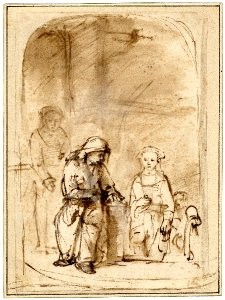
The Widow's Mite by RembrandtI get letters. Sometimes they’re really nice letters. And sometimes they’re not. Today, I want to tell you about a letter and how it caused me to rethink the two stories of women in today’s lectionary readings: First, the end of the story of Ruth from the biblical book named for her, and second, the story of Jesus watching and commenting upon the sacrificial giving of a widow in the Jerusalem temple.
The Book of Ruth is a very simple story. As Dr. Alphonetta Wines, a Methodist theologian, has said:

The genius of the book of Ruth begins with its literary simplicity. In chapter one, Naomi’s troubles are relentless as one by one, famine, displacement, and bereavement steal her joy, turning her into a bitter woman. In chapter two Ruth ekes out a living for Naomi and herself. Both are abundantly blessed in the process. In chapter three, Ruth, at Naomi’s bidding, encounters Boaz on the threshing floor. In chapter four, the birth of Ruth’s child Obed brings Naomi joy that she thought would never be hers again. What began in misfortune has turned out to be a blessing for generations to come. (Working Preacher Commentary)

It’s simplicity, however, obscures for us its very radical messages: one of hope for women in a patriarchal society where the rules are all stacked against them, and another for inclusion of the stranger and the alien for it tells us this foreign woman, Ruth the Moabite, was the great grandmother of Israel’s King David and, thus, an ancestor of his descendent whom we believe to be the Son of God.

The story of the widow in the temple is another study in simplicity. Jesus is in the temple teaching, very clearly teaching against the scribes whom he criticizes for their opulent and self-serving ways. Having just criticized the scribes for “devouring widows’ houses,” he watches this particular widow turn over to those same scribes everything she possesses. Jesus seems to praise her for giving “out of her poverty . . . everything she had,” while criticizing wealthier donors who merely “contribute out of their abundance.”

This story has been used countless times a “stewardship sermon” text to encourage sacrificial giving by modern Christians. However, while I certainly want to encourage your generosity to the church, I think that’s a misuse of the text. Elsewhere, Jesus has encouraged such giving (as when he tells the wealthy young man to “sell all you have and give the money to the poor”) but I don’t believe that that is his intent here. Rather, in this story he is (I believe) teaching a lesson about two approaches to religion, a lesson also taught by the whole story of Ruth.

I came to this conclusion on Friday. Two things happened on Friday. The first was my practice of reading every morning from Daily Office lectionary; the second was the letter I just mentioned, which was delivered to the church office by our mailman on Friday afternoon.

The Daily Office Old Testament readings for the past couple of weeks have been from the books of Ezra and Nehemiah telling the story of the return of Jerusalem’s exiles from Babylonia and their rebuilding of the Temple; the Gospel readings have been from Matthew’s Gospel. On Friday, the latter was the story of the feeding of the 5,000 with two fish and five loaves of bread, while the lesson from Ezra told of the sacrifice made in thanksgiving for the completion and dedication of the restored temple:

At that time those who had come from captivity, the returned exiles, offered burnt-offerings to the God of Israel, twelve bulls for all Israel, ninety-six rams, seventy-seven lambs, and as a sin-offering twelve male goats; all this was a burnt-offering to the Lord. (Ezra 8:35)

In my Daily Office meditation on Friday, I wrote that the contrast between the grossly exorbitant – one is tempted to say “wasteful” – sacrifice in the story from Ezra and the frugal but plentiful picnic in Matthew is a striking illustration of two very different understandings of religion: on the one hand, religion as rules; on the other, religion as caring.

In our contemporary society and for the past several years, it’s been fashionable amongst some people to make a distinction between being “spiritual” and being “religious.” Those who study modern religion, such as the Pew Institute, even have a classification, “SBNR,” as one of their demographic categories, the “spiritual but not religious.” That distinction, I think, is what is addressed by our bible stories today; I don’t think Ruth or Naomi or Jesus or the widow in the temple would ever make that distinction, however. They would never divorce spirituality from religion. They might, however, make a distinction between these two kinds of religious practice: religion as rules versus religion as caring.

You know that I love looking into word origins, what is technically called “etymology”. Usually when I do this in a sermon I ask you to consider the original Greek of the New Testament, or the Hebrew of the Old Testament, but today I want to look at the English word religion, its root and derivation, and what we mean by it. If we look in the dictionary we will find that it is defined as “an organized system of beliefs, ceremonies, and rules used to worship a god or a group of gods.” (Merriam-Webster) Wikipedia, the online encyclopedia, offers this definition: “A religion is an organized collection of beliefs, cultural systems, and world views that relate humanity to an order of existence.”

The British Broadcasting Corporation, as part of their web presence, has a really good subsection for reporting religious news from all over the world. On the homepage of that religious news section, the BBC includes this statement:

Religion can be explained as a set of beliefs concerning the cause, nature, and purpose of the universe, especially when considered as the creation of a superhuman agency or agencies, usually involving devotional and ritual observances, and often containing a moral code governing the conduct of human affairs. (BBC.co.uk)

Notice what is common to all these definitions: beliefs about gods (or at least the supernatural), regulations of conduct, and ritual ceremonies. In other words, they are all about religion as rules. Only at the end, and only as a optional element, does the BBC definition include anything about morality or social behavior or anything that could be called “religion as caring”.

These definitions apply fully to the conduct of the scribes Jesus talks about in the Gospel lesson: they “like to walk around in long robes, and to be greeted with respect in the marketplaces, and to have the best seats in the synagogues and . . . for the sake of appearance say long prayers.” They also apply to the Israelite society into which Naomi and Ruth come from Moab, a patriarchal society dominated by religious regulations, the Law of Moses, which denied independent livelihood to women. Beliefs, regulations, rituals: religion as rules.

The first recorded use of the word religion in the English language was in the 12th Century to describe the state of life of those bound by monastic vows and only later to describe the pious conduct all persons, lay and “religious” alike, but in both uses the emphasis is on religion as rules. Our word religion derives from the Latin word religionem which Roman philosophers, such as Cicero and Lactantius, used to connote a respect for the sacred and reverence for the gods; St. Jerome used it in the Latin vulgate translation of the Bible to render a Greek word meaning “religious ceremonies” (threskeia, Acts 26:5 & James 1:26-27).

The root of the Latin word religionem, however, was a matter of some dispute amongst those same Roman writers. Some believed it came from the verb religare which means “to bind up,” which is what rules do. Others, however, argued that it derived from relegere meaning “to read again” or “to read carefully,” that it is related to the word religiens meaning “careful”, the opposite of negligens, or negligent. This second derivation suggests that religion is less about rules than it is about caring.

The beliefs-rules-and-rituals understanding of religion is the way a lot of people, like the temple scribes and like early Israelite patriarchal society, understand religion. When this is our understanding, we end up following rules that lead the grossly over-the-top sacrifice of nearly 200 head of livestock described in Friday’s Old Testament reading, we end up following rules that leave widowed women unable to provide for themselves, and we end up with religious leaders who make a show of their piety but who “devour widows’ houses.” Religion, understood as a set of binding rules proscribing behavior and prescribing rituals and ceremonies, produces such results . . . and it produces that second thing that happened on Friday, this letter delivered to the church office by our mailman that afternoon. [Note: the letter may be viewed here as a PDF file; the highlighting is in the original as delivered.]

In the November issue of our parish newsletter, we published an article about applauding during worship services which my colleague, the Rev. Peter Faass of Christ Church, Shaker Heights, had written. In it Fr. Faass commented that he invites applause when introducing married couples and, in that, made oblique reference to the fact that following this summer’s General Convention the Episcopal Church now offers marriage to same-sex couples. He recommended, however, that most of the time applause should not be offered during worship because what we do in the liturgy is not done as a performance for the congregation, but rather as an offering to God. What Peter suggested was that

instead of applause it would be best to offer a moment of silence after a pleasing offering; a moment when we may reflect on the gifts God has given to the person who is offering them up in the liturgy. In that silence let’s offer thanks. In that stillness let’s hear God’s applauding approval. [Note: Fr. Faass’s entire article can be read in PDF format in the parish newsletter here.]

Apparently we have a neighbor who reads our newsletter and who often drives by our building because that’s who this letter is from. In it, our neighbor takes us to task not only for Fr. Faass’s points, but also for our sign on which we have, from time to time, put the statement which has become a sort of unofficial motto of our diocese: “God Loves Everyone. No Exceptions.”

The letter begins, “It seems that Episcopalians are proud of being Episcopalians, but ashamed to be Christian. That explains why they find it so easy to stray from Scriptures, and hold so tightly to ‘tradition.'” The writer condemns us as “heavily influenced by popular culture” and then goes on to proof-text from Scripture why, in our correspondent’s opinion, same-sex marriage is contrary to his understanding of religion citing particularly the story of Adam and Eve. He then suggests that Fr. Faass is incorrect about God’s applause saying, “It may very well be that God is not only not applauding, but is sickened by ‘the liturgy,'” and he cites the prophets Amos and Isaiah who condemned the festivals, sacrifices, and assemblies of unfaithful Israel.

With respect to our sign, our neighbor informs us that “God Loves Everyone. No Exceptions” is simply not true, that there are, in fact, human beings whom God not only doesn’t love but whom God positively abhors. He cites one of the Psalms for this proposition.

This [the letter] is religion understood as that which binds, religion as rules; this is Scripture understood as a set of binding regulations proscribing behavior, prescribing some rituals and prohibiting others, and denying not only basic dignity but even the love of God to many of God’s children. This is the religion of the temple scribes.

To this sort of religion, Jesus contrasted the religion of the widow in the temple. No law, no rule required her make her offering of “two small copper coins, which are worth a penny.” This is not her tithe (that would have been paid at a different time and in a different way). This is not a sin offering or a burnt offering (that would have entailed the sacrifice of some animal). This is nothing more nor less than a gift of thanks, given “out of her poverty” because she cared for the God on whose blessings she depended, because she cared for the faith that was in her. Because she cared, she gave; “out of her poverty [she] put in everything she had.” This is religion as caring.

I could answer this letter. I could write to our neighbor and tell him that the Episcopal Church believes that when Jesus told Nicodemus, “God so loved the world that he gave his only son” (Jn 3:16) he didn’t put any qualifications or restrictions on that statement. I could write to our neighbor and tell him that the Episcopal Church believes with our parish patron, St. Paul, that “neither death, nor life, nor angels, nor rulers, nor things present, nor things to come, nor powers, nor height, nor depth, nor anything else in all creation, will be able to separate [any of] us from the love of God in Christ Jesus our Lord.” (Rom 8:38-39) I could do that. I could answer this letter, but I think the better response is for us as a church community to continue doing what we are called to do, to continue living a religion that emphasizes caring rather than rules.

Our correspondent admonished us that it is incumbent upon every Christian “to set the good example of following after Christ,” and he referenced the Letter of James: “Religion that is pure and undefiled before God, the Father, is this: to care for orphans and widows in their distress, and to keep oneself unstained by the world.” (Jm 1:27 NRSV) What James is saying is that religion is caring, and the Episcopal Church could not agree more strongly!

Imagine how different this world might be if the caring, rather than the binding rules aspect, were the general understanding of religion! If we understood religion to mean “caring,” rather than “an organized system of beliefs, ceremonies, and rules used to worship a god or a group of gods,” I really don’t think there would be any people who would describe themselves as “spiritual but not religious.” When the story of Ruth is understood not as a story about the rules of ancient Israelite society but, as Dr. Wines suggested, as the story of “a blessing for [all] generations to come” . . . when the story of the widow in the temple is understood not as a story about following the rules of stewardship, but as a story of giving as an act of caring . . . when the whole Bible is understood not as a book of rules and regulations, but as a collection of stories about God’s love . . . then it is clear that, contrary to our neighbor’s letter, Episcopalians do not “stray from Scripture.”

Our calling as “Episcopalians [who] are proud of being Episcopalians, [and who are positively delighted] to be Christian” is to demonstrate, to live out, and to invite others into what our new Presiding Bishop likes to call “the Jesus Movement,” a religion of caring, not a religion of rules. Like the widow in the temple, we are called to give out of our poverty all that we have and all that we are, and to invite into our self-giving not only those who are like ourselves, but also and especially those are different, the stranger, the alien, the one who is not like us, without regard to his or her social status, race, sex, sexual orientation, nationality, or anything else because nothing “in all creation, [is] able to separate [any of] us from the love of God in Christ Jesus our Lord,” because “God Loves Everyone. No Exceptions.”

Amen.

====================

A request to my readers: I’m trying to build the readership of this blog and I’d very much appreciate your help in doing so. If you find something here that is of value, please share it with others. If you are on Facebook, “like” the posts on your page so others can see them. If you are following me on Twitter, please “retweet” the notices of these meditations. If you have a blog of your own, please include mine in your links (a favor I will gladly reciprocate). Many thanks!

====================

Father Funston is the rector of St. Paul’s Episcopal Church, Medina, Ohio.

Religion Is Caring – From the Daily Office Lectionary

Religion Is Caring

From the Daily Office Lectionary for Friday in the week of Proper 26, Year 1 (Pentecost 23, 2015)

Ezra 8:35 ~ At that time those who had come from captivity, the returned exiles, offered burnt-offerings to the God of Israel, twelve bulls for all Israel, ninety-six rams, seventy-seven lambs, and as a sin-offering twelve male goats; all this was a burnt-offering to the Lord.

Matthew 14:19b-20 ~ Taking the five loaves and the two fish, he looked up to heaven, and blessed and broke the loaves, and gave them to the disciples, and the disciples gave them to the crowds. And all ate and were filled; and they took up what was left over of the broken pieces, twelve baskets full.

I don’t usually quote from two of the Daily Office lessons in these little private meditations of mine (they “feel” private, anyway; I seldom get any replies or comments). Today, however, the contrast between the grossly exorbitant – one is tempted to say “wasteful” – sacrifice in the story of Ezra and the frugal but plentiful picnic in Matthew is so striking, I had to mention it. It seems to me that what these two contrasting lessons do is illustrate two different understandings of religion.

“Religion” as a concept seems to be pretty universally understood as a set of beliefs, to which may be attached ceremonies, rituals, and moral codes. Just take a look at a few of the definitions or comments one finds on major websites:

“A religion is an organized collection of beliefs, cultural systems, and world views that relate humanity to an order of existence.” (Wikipedia)

“An organized system of beliefs, ceremonies, and rules used to worship a god or a group of gods.” (Merriam-Webster)

“Religion can be explained as a set of beliefs concerning the cause, nature, and purpose of the universe, especially when considered as the creation of a superhuman agency or agencies, usually involving devotional and ritual observances, and often containing a moral code governing the conduct of human affairs.” (BBC.co.uk)

“For good or for evil, faith factors into our everyday functioning: We’ve evolved to believe. Religion can help us make sense of our world, provide motivation, and bind us together.” (Psychology Today)

The Psychology Today comment ends with an oblique reference to the commonly understood origin of the English word “religion” which is, I think, instructive in considering the different pictures or religion in today’s lessons.

If one delves into the etymology of the word, one finds its earliest use in Anglo-French, first, to describe the state of life bound by monastic vows, and only later to describe the pious conduct all persons, lay and “religious” alike, indicating a belief in a divine power, and still later to describe the institutions which foster and encourage such pious behavior.

It is derived from the Latin “religionem” which connotes a respect for the sacred and reverence for the gods. Roman philosophers and other writers used it, also, to refer to conscientiousness, sense of right, moral obligation, modes of worship, and the ritual observances of cults. However, they seem in disagreement about its origins.

The Roman grammarian Servius (“ad Virgil”) and the Christian philosopher Lactantius (“De Rerum Natura”) both believed it came from “religare” which means “to bind up.”

Cicero (De Natura Deorum), however, argues that it comes from “relegere” meaning “to read again” or “to go over again in reading, speech, or thought.”

Another source of the English word, perhaps another stream flowing into its meaning, comes from a Germanic root, “rak” through the Old English “reck” meaning “to have a care for.” The Latin word, “religiens” meaning “careful” (as the opposite of “negligens,” negligent) would support this understanding, and give credence Cicero’s derivation which implies careful consideration.

Which brings us back to the two stories in today’s lectionary readings. It seems to me that they illustrate these two alternative approaches to religion. Ezra’s over-the-top sacrifice of nearly 200 head of livestock results from religion understood as a set of binding rules proscribing behavior and prescribing rituals and ceremonies. Jesus’ feeding of the multitude with a few fish and loaves of brad illustrates religion understood as caring.

Obviously, the general understanding of “religion” in English-speaking countries comes from the “bind up” perspective. The dictionary definition, “an organized system of beliefs, ceremonies, and rules used to worship a god or a group of gods,” makes that abundantly clear.

How different might all those definitional quotations above might be if the “caring”, rather than the “binding” aspect, were the general understanding of religion. And how sad that it is not. One is reminded of James’s admonition: “Religion that is pure and undefiled before God, the Father, is this: to care for orphans and widows in their distress, and to keep oneself unstained by the world.” (Jm 1:27 NRSV)

Next time I am asked “What is religion?” my answer will be “Religion is caring.”

We Built This – From the Daily Office Lectionary

We Built This

From the Daily Office Lectionary for Wednesday in the week of Proper 26, Year 1 (Pentecost 23, 2015)

Matthew 13:58 ~ And he did not do many deeds of power there, because of their unbelief.

Jesus is in Nazareth, the town he grew up in, the town where his family still lives. After spending some time in a peripatetic ministry wandering about the countryside, visiting villages, preaching his gospel, healing the sick, and gathering followers, he has come home. Instead of a warm welcome for the “local boy done good,” the Nazarenes belittle him (“He’s just the carpenter’s son”) and take “offense at him.” Matthew ends his short description of this sad situation with this sentence: Jesus is unable to work any deeds of power “because of their unbelief.”

If nothing else, this sentence underscores and highlights the need of community support in any endeavor. For all of us, a major element of any success we may enjoy is the cooperation and assistance we have from others. We live in an interconnected, interdependent society in an interconnected and interdependent world.

In my humble opinion, one of the most surprising and offensive developments in America in recent years is the libertarian movement and, most especially, the phenomenon we witnessed a couple of years ago when our president said, “If you’ve got a business, you didn’t build that. Somebody else made that happen.” Instead of acknowledging the interdependent, interconnected truth behind that statement, inartfully stated though it may have been (and lifted out of context as it clearly was), his opponents opened a barrage of “I built that” stories, tales of small business owners who achieved success “entirely on their own,” of “entrepreneurs whose success came from hard work and personal creativity.” (I’m quoting one of the president’s political opponents.) The constant refrain was, “I built this without any help from anyone.”

Such claims overlook the enormous infrastructure of public roads, utilities, communications and postal systems, health care systems, insurance and banking economies, markets and trading centers, freight and shipping systems, and so forth which pre-existed the entrepreneurs’ start-ups, to say nothing of the work and effort of the employees on whose labor their businesses have come to rely. Not a single American entrepreneur can claim to have completely independently achieved anything given the huge foundation of the pre-existing economy. The president was correct, “Somebody else made that happen.”

The offensiveness of the “I built this” movement is found in its hubris. In this little story of Jesus’ visit to Nazareth we are confronted by the simple, but often overlooked fact, that even Jesus could do very little “entirely on his own.” In fact, he seldom, if ever, claimed to do any deeds of power by himself: again and again when working a miracle of healing he gives credit to the faith of the person healed or the faith of that person’s loved one. And when confronted with a community filled with unbelief, he is unable to “do many deeds of power.” If even the Son of God, the incarnation of the Word which has been with God from the very beginning of creation, of the Word which is God, is unable to do his work without the support and cooperation of others, how on earth can some business owner have the arrogance to claim “I built this” with no assistance from the society around them?

Only one Person, ever, since the beginning of everything can truly say “I built this,” and interestingly enough, even on the seventh day when that Person rested, there is no record of those words ever being spoken . . . instead when human beings were led to try and describe how all that is came to be, they were inspired write of a Companion, Holy Wisdom, who said:

“Ages ago I was set up, at the first, before the beginning of the earth. When there were no depths I was brought forth, when there were no springs abounding with water. Before the mountains had been shaped, before the hills, I was brought forth – when he had not yet made earth and fields, or the world’s first bits of soil. When he established the heavens, I was there, when he drew a circle on the face of the deep, when he made firm the skies above, when he established the fountains of the deep, when he assigned to the sea its limit, so that the waters might not transgress his command, when he marked out the foundations of the earth, then I was beside him, like a master worker; and I was daily his delight, rejoicing before him always, rejoicing in his inhabited world and delighting in the human race.” (Prov. 8:23-31)

Nowhere does Scripture record God the Creator, nor God the Redeemer, nor God the Sustainer ever saying “I built this.” If the God whose incarnate deeds of power depended on the faith and belief of others were to say anything like that, it would most likely be “We built this.”

Era of Delusion – From the Daily Office Lectionary

Era of Delusion

From the Daily Office Lectionary for Monday in the week of Proper 26, Year 1 (Pentecost 23, 2015)

Nehemiah 6:8 ~ Then I sent to him, saying, “No such things as you say have been done; you are inventing them out of your own mind.”

Sanballat, Tobiah, and Geshem, enemies of Nehemiah and opponents of the rebuilding of Jerusalme, wrote to Nehemiah and tried by various means to end his efforts. Finally, Sanballat wrote warning Nehemiah that he would write to King Artaxerxes of Persia, Nehemiah’s patron, that Nehemiah was planning to set himself up as a rival king. It is in response to that threat that Nehemiah writes this letter.

Today, the national news services reported that representatives of the campaigns of several of the presidential candidates vying for one of our two major party’s nomination had met about the format and conduct of debates. The candidates, it is said, are unhappy about the way earlier debates, hosted by their party’s national committee and moderated by reporters from different news services, have been handled. Their complaint (in my opinion) boils down to the simple fact that they don’t like the questions they have been asked and the challenges the news people have made, some of them sounding occasionally like, “No such things as you say have been done; you are inventing them out of your own mind.”

We live in an era of delusion. Candidates make things up; one candidate made the statistically outrageous claim that 92% of job losses during the current president’s first term were suffered by women (never mind that the cause of those losses were the policies of the former president elected from her party). When challenged, she refused to justify her claim, later making the absurd defense that the numbers might have been wrong when she claimed them but had been right an earlier time, and finally today acknowledging that they were erroneous all along. Her initial defense, however, was that she and her questioner simply had a difference of opinion.

This is a frequently heard defense when challenges are made to factually inaccurate claims, that it is all just a matter of belief or interpretation and that one is entitled to one’s own opinion. The often heard retort to that is, “Yes, you are entitled to your own opinion, but not to your own facts.” You are not entitled to go around “inventing them out of your own mind.” Someone who does that is delusional and not fit to lead or govern.

Sanballat, who was a Samaritan, was never able to defeat Nehemiah. He is believed to have retreated to a village at the base of Mt. Gerizim and to be the Samaritan leader responsible for the building of the Samaritan temple on that mountain. It is this temple to which the Samaritan woman at the well, with whom Jesus converses in John’s gospel, refers.

From the time of the exiles return up to Jesus’ time and even into our own times, there has been “bad blood” between Jews and Samaritans. There are many reasons for that and not a few of them can be laid at the feet of the Jews. But among them are the simply untrue assertions of Sanballat, the things invented out of his own mind. This is what happens when people refuse to acknowledge and agree on facts, on the reality which jointly confronts them. Opinions may differ, but facts are facts; if we cannot agree on the facts, there is no foundation for mutual trust, no foundation for reconciliation.

In our era of delusion, with politicians and their supporters inventing things out of their own minds, is there any hope for mutual trust, for mutual governance and shared leadership . . . or are we doomed to generations, to centuries of our Nehemiahs battling with their Sanballats?

Fully Human: A Baptismal Sermon for All Saints Day, November 1, 2015

====================

A sermon offered on All Saints Day, Sunday, November 1, 2015, to the people of St. Paul’s Episcopal Church, Medina, Ohio, where Fr. Funston is rector.

(The lessons for the day are Isaiah 25:6-9; Psalm 24; Revelation 21:1-6a; and John 11:32-44. These lessons may be found at The Lectionary Page.)

====================

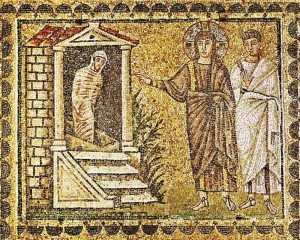
The Raising of Lazarus, Basilica di Sant'Apollinare Nuovo, Ravenna, Italy, 6th centuryFor some reason, although I know that the Lectionary is a three-year cycle and thus that the lessons are not the same every year, when All Saints Sunday rolls around I’m surprised when the lessons do not include John the Divine’s vision of the multitude in white robes standing before the Lamb’s Throne in heaven (Rev 7:9-17) or Jesus preaching the Beatitudes in the Sermon on the Mount (Mt 5:1-12). Those were the lessons, the only lessons provided for this feast in prior editions of the Book of Common Prayer. I’ve preached the “new” Lectionary for thirty years, so you’d think I’d be used to it . . . but each time the raising of Lazarus pops up as the Gospel lesson I think, “Well, what’s up with that?” You may have had that thought this morning, as well: “It’s All Saints Day. We’re doing a baptism. What’s up with this Lazarus story?”

So I want to delve briefly into a couple details of the story.

First of all, let’s remember who this family is, Mary, Martha, and their deceased brother Lazarus. They are clearly people who believe in Jesus and in his mission, but their belief is much, much more than simply signing on to his program, a new approach to religion. These people seem to know Jesus; he apparently stayed with them on several occasions. He lodged with them, ate with them, taught in their home. Earlier in this story, Lazarus is described to Jesus as “he whom you love” when Jesus is told of his illness. (John 11:3) These people are close to Jesus; they are practically family, may even be family.

Secondly, we’re told that the family is accompanied by “Jews.” That seems a bit odd, doesn’t it? After all, aren’t they all Jews? Mary, Martha, Lazarus, Jesus, the whole lot of them? Of course they are! So many scholars suggest that we should better understand John’s term Ioudaiou to mean “Judeans,” that is people native to the Jerusalem area; these scholars suggest that Mary, Martha, and Lazarus, like Jesus, were Galileans who had moved to Judea and been accepted into this southern community. This strengthens the suggestion that they may have been members of Jesus’ extended family.

Next, when both of the sisters greet Jesus (Martha’s greeting is earlier in the story), the very first thing each says is, “If you had been here, he wouldn’t have died.” (vv. 21 & 32) Not “Hi, how are you?” Not “Welcome back.” Not “I’m so sorry we have to tell you.” What the sisters say is not really a greeting; it’s an angry, accusative confrontation. “You could have prevented this!”

In the portion we read, we’re told that Jesus’ response to this is that he is “greatly disturbed in spirit and deeply moved.” That’s a fine translation, but it’s also a bit misleading. The word rendered “disturbed” – embrimesato – very literally means he “snorted with anger”; and the word translated “deeply moved” – etaradzen – means “stirred up” and implies a certain physicality, not simply an emotionalism. Jesus response to the sisters’ confrontations, to Lazarus’ death, to the whole situation is to become indignant and sick to his stomach.

Angry and physically ill, Jesus wept. Some of the Judeans, John tells us, interpreted this as a sign of Jesus’ love for Lazarus; “See how he loved him!” they said. While I’ve no doubt that that is true, I suggest we consider another way to understand what is happening in this story.

In a few moments, we will baptize two young men, Aiden and his brother Carson, and together with them we will affirm the Baptismal Covenant beginning with a recitation of the Apostle’s Creed in which we will claim that Jesus, the Son of God, was “conceived by the power of the Holy Spirit and born of the Virgin Mary” (BCP 1979, p 304). In the Nicene Creed, which we recite most Sundays during the Holy Eucharist, we go further and declare that he “became incarnate . . . and was made man,” that is, that he became a flesh-and-blood human being. (BCP 1979, p 358). In the Definition of Chalcedon, which you can find on page 864 of the Prayer Book, the church goes even beyond that and asserts its conviction that Jesus is “truly [human] . . . like us in all respects, apart from sin.”

I believe that standing before that tomb where his beloved friend Lazarus had been buried four days earlier, feeling the anger and frustration of his close friends Mary and Martha, surrounded by Judeans muttering “couldn’t he have prevented this,” and perhaps physically exhausted from traveling from the other side of the Jordan valley where he was when he got the news, Jesus’ humanity hit him like a ton of bricks. In that moment, everything that it meant to be human came crashing in on him: the way human beings settle for easy answers, half-truths, and superficial relationships; the injustice, oppression, and exploitation we impose on one another; the pain, rejection, hunger, and war we endure . . . but, also, the love, friendship, community, family, support, and every other good thing about being a human being; it all come together in that moment standing at that grave.

Why do I think that? Because that’s what I feel every time I stand at a grave. The first time I did that, I was 5-1/2 years old. I remember standing between my mother and my paternal grandmother watching two members of the US Army fold the flag that had draped my father’s coffin, feeling loss, grief, anger, confusion, and emotions I couldn’t even name. But there was also the love of family, pride in my father’s military service, a sense of community with extended family and friends, all the comfort that comes from our common humanity. And every time I have stood beside a grave, I have felt that again, and I can surely imagine our Lord experience something very like that. No wonder Jesus – the fully-human, like-us-in-all-respects Jesus – wept.

We should feel that same way when we welcome a new member into the household of God through the Sacrament of Baptism. Symbolically, baptism is burial; in the oldest tradition of the church, full immersion baptism, we go down under the water in the same way a body is buried in the earth, then we come up out of the water as Lazarus came from his tomb, as Jesus came from his grave. Baptism is death, burial, and restoration to life all encapsulated in one short liturgical act. As the Prayer Book says in the blessing of the baptismal water, “In it we are buried with Christ in his death. By it we share in his resurrection. Through it we are reborn by the Holy Spirit” (BCP 1979, p 306). As he called Lazarus from to rise from his funeral wrappings, through Holy Baptism Jesus calls us “from the bondage of sin into everlasting life” (ibid), into a new life of full humanity joined with “those who have clean hands and a pure heart, [those] who have not pledged themselves to falsehood nor sworn by what is a fraud, [those who] shall receive a blessing from the Lord and a just reward from the God.” (Ps 24:4-5)

The Creation story in Genesis tells us that “God created humankind in his image, in the image of God he created them; male and female he created them.” (Gn 1:27) The story of the Fall reminds us that somehow that divine likeness has been marred, that on our own we fail to live up to that image; we fail to fully live up to the potential God created in humankind. Through baptism, the divine image is restore; through our baptism into the life, death, and resurrection of Jesus Christ, a process of transformation begins and God restores us to who and what we were meant to be – fully human.

When John the Divine witnessed his Revelation, he saw that multitude of human beings in white robes standing before the Lamb’s Throne in heaven. He was told who they were – those “who have come out of the great ordeal; they have washed their robes and made them white in the blood of the Lamb” (Rev. 7:14) – and why they were there, and nowhere in that description did the Elder who spoke to him say anything about the saints having agreed to a doctrine. When the voice spoke from the throne and said, “See, the home of God is among [human beings]. He will dwell with them as their God; they will be his peoples, and God himself will be with them” (Rev. 21:3), not a word was said about assent to a creedal formula. Nonetheless, when we baptized someone, we ask them (and ourselves) some questions that sound a lot like doctrine; we ask questions which are taken directly from the creedal formulation we call “the Apostle’s Creed,” to which I referred earlier.

Recently, a commission of Anglican theologians representing you and me and all Anglicans everywhere agreed with a similar group of theologians representing Orthodox Christians that three words could be removed from the Nicene Creed, three words that theologians and liturgists call “the filioque clause.” Filioque is a Latin word meaning “and the Son.” It refers to that place in the Creed where we say, “We believe in the Holy Spirit . . . who proceeds from the Father and the Son.” Those three words (or that single Latin word) were added to the Nicene Creed by the Third Council of Toledo in 589 CE, a council in which no Eastern bishops took part; that additional phrase, which the East rejected, was one of the causes of the schism between Eastern Orthodoxy and Western Catholicism. The theologians’ agreement is part of the on-going work to heal the rift between Eastern and Western Christianity.

As you might imagine, that agreement has excited no little amount of discussion amongst us clergy. In one of our conversations, another priest said this about the Creed which I think applies equally these doctrinal statements we require of baptismal candidates:

For the past couple of years, I have introduced the creed with, “Using the words of the Nicene Creed, we proclaim our faith and trust in the God . . . .” Last Sunday . . . I asked people to substitute “We trust in” for each “We believe in” as we said the Creed, since the original Greek word . . . could have been translated either way. I wonder if the Body of Christ would be far less chopped up, if we had used “trust”. There might have been far less of, “You don’t believe exactly what I believe, so I’m out of here,” or, “You don’t believe exactly what I believe, so you are out of here”, and another denomination is created. Also, there is that “in” . . . we are doing a whole lot more than expressing belief. We are expressing a deep community whether we say, “We believe in . . .” or “We trust in . . .” Maybe you don’t believe exactly the same things I believe, but we both believe/trust in the same God.

In that same discussion, another of our colleagues objected to what he called the distinction between “faith as trust and faith with content.” “It’s always struck me as a strange distinction,” he said. “If, for example, faith as trust is about relationship [and not about content], it is like someone saying to a prospective marriage partner, ‘I love you and I want to marry you, but I’m not certain who you are.'” I suggested to him, however, and I suggest to you now that this distinction really doesn’t exist, that faith as trust or as relationship necessarily implies and includes “faith with content.” One cannot place trust in another person, such as the Father, the Son, and the Holy Spirit named in the Creed, without assenting to that person’s existence and properties; to say, “I trust you” or “I love you” and not also agree that you exist makes very little sense.

This is why we ask those questions of baptismal candidates. When we say, “Do you believe in” the three Persons of the Holy Trinity, we are not merely asking if the candidates (and the congregation who join them in answering) are assenting to certain doctrines about them; we are asking if they claim to be in a relationship of trust and love with them, and through them with the full community of human beings whom God loves, with whom God will live, from whose eyes God will wipe every tear, and for whom God will spread that glorious and eternal feast described by the Prophet Isaiah.

That relationship, I believe, is why Jesus wept. To be sure, he grieved the death of his friend Lazarus, but he knew he was about to do something to change that; there was no reason to cry about that. But that in-rushing crash of realization of what it is to be a human being, of what it is to be fully human, that is enough to make anyone cry. The story of the raising of Lazarus is a story about Jesus’ full humanity, the full humanity he shares with and promises to us. It is into that promise that we baptize Carson and Aiden today. And that is what’s up with the Lazarus story!

In the words of a popular Franciscan blessing, let us pray that, as these boys grow into the full humanity into which they are initiated today, God will bless them with discomfort at easy answers, half-truths, and superficial relationships, so that they may live deep within their hearts; that God will bless them with anger at injustice, oppression, and exploitation of people, so that they may work for justice, freedom, and peace; that God will bless them with tears to shed for those who suffer from pain, rejection, hunger, and war, so that they may reach out their hands to comfort others and turn their pain into joy; and that God bless them with enough foolishness to believe that they can make a difference in this world, so that they can do what others claim cannot be done, to bring justice, kindness, and love to all.

May God bless them with the gift and the commission to be, like Christ, fully human. Amen.

====================

A request to my readers: I’m trying to build the readership of this blog and I’d very much appreciate your help in doing so. If you find something here that is of value, please share it with others. If you are on Facebook, “like” the posts on your page so others can see them. If you are following me on Twitter, please “retweet” the notices of these meditations. If you have a blog of your own, please include mine in your links (a favor I will gladly reciprocate). Many thanks!

====================

Father Funston is the rector of St. Paul’s Episcopal Church, Medina, Ohio.

Seeds of Destruction – From the Daily Office Lectionary

Seeds of Destruction

From the Daily Office Lectionary for Friday in the week of Proper 25, Year 1 (Pentecost 22, 2015)

Matthew 13:24 ~ [Jesus] put before them another parable: “The kingdom of heaven may be compared to someone who sowed good seed in his field; 25but while everybody was asleep, an enemy came and sowed weeds among the wheat, and then went away.”

Years ago I heard a sermon in which the preacher told us that the parable of the wheat and the tares may not have been original to Jesus, that it was a common story used by other First Century rabbis and that discussion of it could be found in the early rabbinic literature. One gloss on the story tells of how, when the master planted a second field, the servants mounted a guard to be sure the enemy did not come and sow more weeds there. To the servants’ surprise, it was the master who came, walking in his sleep and unaware of what he was doing, and sowed the poisonous seeds.

In three decades of preaching, of leading bible studies, and of researching Scripture I have yet to find the rabbinic commentary to which that preacher was referring. Still, it’s too good a story to have forgotten and sounds much too rabbinic not to have at least the possibility of truth, so I continue to look for it and continue to find it helpful as an interpretive tool.

I don’t know if Karl Marx was the first to use the term, but in a speech to the central committe of the Communist League in London, England, in 1850, he said, “The rule of the bourgeois democrats, from the very first, will carry within it the seeds of its own destruction. . . .” What is true of political systems, the rabbinic gloss suggests, is true of individuals: we all carry and sow the seeds of our own destruction. Each of us is (or, at least, can be) our own worst enemy.

I’m overweight. That’s the nice way to put it. Medically, I’m obese. I hate that word, but it’s the truth. In fact, on Body Mass Index charts my height and weight intersect at the cusp moving from “obesity” to “extreme obesity.” Not good, I know this.

And yet . . . offered a lovely piece of raspberry coulis topped New York cheesecake . . . there is no way I am going to turn that down! My excess weight is the furthest thing from my mind when that happens; I might as well be sleep-walking through my wheat field scattered the seeds of poisonous darnel. Only by become self-conscious and self-aware (I believe those are two different things, by the way) and making the decision to take action about my excess weight will I cease sowing the seeds of my own destruction.

Perhaps this morning’s meditation is a wake-up call, a time to stop the enemy from walking through my field.

Cupbearers and Butlers – From the Daily Office Lectionary

Cupbearers and Butlers

From the Daily Office Lectionary for Thursday in the week of Proper 25, Year 1 (Pentecost 22, 2015)

Nehemiah 1:11c ~ At the time, I was cupbearer to the king.

“Cupbearer” sounds like such a lowly position, but I’m given to understand that just the opposite is true. Cupbearers to monarchs in the ancient world were people of high rank, greatly trusted by their royal patrons. It was the cupbearer’s job to guard the king against poisoning cup, often by risking his own death by swallowing some of the king’s wine before serving it. The cupbearer’s close relationship to the king often gave him great influence at court.

In some translations of Scripture, the Hebrew word “mashkeh” is translated as “butler,” which perhaps makes the relationship of television’s currently most popular butler, the indomitable Mr. Carson, to Robert Crawley, 7th Earl of Grantham, Viscount Downton, the master of Downton Abbey, come to mind. Or, perhaps the relationship of Lord Grantham and his manservant, the unflappable (and apparently occasionally deadly) Mr. Bane. If Nehemiah was to King Ataxerxes as one of these gentlemen are to Robert Crawley, then one can understand how a “cupbearer” could be appointed the governor of Jerusalem.

Every Sunday (and often on other days of the week) I stand at the Table and bear the Cup, so it occurs to me that there may be something here worth considering. But . . . to whom am I cupbearer? It strikes me as inaccurate (perhaps even inappropriate) to claim to be cupbearer to my king. My king has no need of someone to taste his wine and test for poison; my king has no need of advice from a trusted servant; my king has no need of a sounding board or confidant from amongst the common folk. To whom, then, am I, the parish priest, cupbearer?

There is only one other possible candidate. I am cupbearer to the church, to the Body of Christ which gathers, worships, engages in fellowship, lives its life and its life-crises in the community of the parish church. I am Carson, or perhaps Bane, to the parishioners’ Lord Grantham.

The International Guild of Professional Butlers describes the duties of a Butler as follows:

“A Butler typically: Oversees the household staff usually of one residence. Understands concepts like being anticipatory, friendly not familiar, privacy and confidentiality, invisible and available. Answers residence phone, receives guests at the door and supervises the reception of visitors. Assists with staff training and organizes the duties and schedule of domestic staff. May assist or be charged with keeping the household budgets and inventory supplies. May schedule and oversee vendors of contracted services. May assist with household and family security measures. Oversees family packing and travel preparations. Understands social etiquette and formal service. Assists with planning and organizing parties and events in the home. Oversees and participates in proper table settings and entertainment prep. Serves meals and drinks and performs wait services related thereto. Knowledgeable about wines and spirits and oversees the wine cellar and liqueur inventory. May also serve as personal valet to the household and/or gentleman of the house. Performs light housekeeping duties. Coordinates with other staff as needed as well as with other parts of the employer’s organization.”

With only a few changes of language, much said in that job description can apply to a parish priest! Like any metaphor, it is partial, incomplete, and ultimately misleading, but also illuminating, instructive, and intriguing if not indulged too far. Perhaps it’s time to get a cut-away coat and some winged-collar shirts.

Home Demolition – From the Daily Office Lectionary

Home Demolition

From the Daily Office Lectionary for Wednesday in the week of Proper 25, Year 1 (Pentecost 22, 2015)

Ezra 6:11 ~ Furthermore, I decree that if anyone alters this edict, a beam shall be pulled out of the house of the perpetrator, who then shall be impaled on it. The house shall be made a dunghill.

In the Sixth Century BCE, the Jews returned from the Exile and rebuilt the Jerusalem Temple under the patronage of Darius the Great, the reigning Persian Achaemenid emperor. This line is found in the decree which was issued by Darius instructing his governors to see that the temple work was completed despite the opposition of the Samaritans, who had offered to be part of the rebuilding effort but whom the Jews would not permit to do so because they considered them unclean. (Samaritans were descendants of Israelites who had been left behind and who had intermarried with non-Jewish peoples. Although they kept the Law of Moses, the returning Jews did not consider them pure enough to take part in the restoration.)

The destruction of the homes of those who oppose the actions of Jews in the Holy Land is not merely an historic or biblical footnote. It is a present reality. In 2014 the Civil Administration of the Israel Defense Force destroyed the homes of 969 Palestinians on the West Bank. In January of this year, Israel destroyed 77 buildings belonging to Palestinians in the West Bank, leaving 110 people, roughly half of whom were children, homeless. Home demolition has been a frequent occurrence reported in Palestinian news throughout the year, although it is seldom mentioned in American media. Often the justification is that one member of the household has been accused (not proven, simply accused) of actions in opposition to Israeli occupation.

This morning I wonder if the inspiration for home demolition, or at least part of the inspiration, might be this obscure biblical passage. I don’t know, but it’s something to ponder . . . . So much terrible behavior can be justified by reference to ancient scriptures. When will we learn that these stories are not necessarily models of how we should act today; often they are stories of modes of being we are called to grown beyond and to leave behind. I suspect this is true of the decrees of a foreign king who, though he made the restoration of the Temple possible, was not a spokesman for the God who made hospitality, generosity, and forgiveness part of his Law. Home demolition surely violates that Law.

« Older posts Newer posts »