Occasional thoughts of an Anglican Episcopal priest

Category: Christianity (Page 62 of 84)

City on the Hill, Obscured – Sermon for the 5th Sunday after Epiphany, Year A – February 9, 2014

====================

This sermon was preached on the Fifth Sunday after Epiphany, February 9, 2014, at St. Paul’s Episcopal Church, Medina, Ohio, where Fr. Funston is rector.

(The lessons for the day were: Isaiah 58:1-12; Psalm 112:1-10; 1 Corinthians 2:1-16; and Matthew 5:13-20. These lessons can be read at The Lectionary Page.)

====================

The Mythical City on the Hill by Colej_ukListen again to the words of the Prophet Isaiah:

Is not this the fast that I choose:
to loose the bonds of injustice,
to undo the thongs of the yoke,
to let the oppressed go free,
and to break every yoke?
Is it not to share your bread with the hungry,
and bring the homeless poor into your house;
when you see the naked, to cover them,
and not to hide yourself from your own kin?
Then your light shall break forth like the dawn,
and your healing shall spring up quickly;
your vindicator shall go before you,
the glory of the Lord shall be your rear guard.
Then you shall call, and the Lord will answer;
you shall cry for help, and he will say, Here I am.
If you remove the yoke from among you,
the pointing of the finger, the speaking of evil,
if you offer your food to the hungry
and satisfy the needs of the afflicted,
then your light shall rise in the darkness
and your gloom be like the noonday.

Listen again to the words of our Savior Jesus Christ:

You are the salt of the earth; but if salt has lost its taste, how can its saltiness be restored? It is no longer good for anything, but is thrown out and trampled under foot. You are the light of the world. A city built on a hill cannot be hid. No one after lighting a lamp puts it under the bushel basket, but on the lampstand, and it gives light to all in the house. In the same way, let your light shine before others, so that they may see your good works and give glory to your Father in heaven.

If you read my blog of meditations on the Daily Office readings which I post to the internet everyday and offer to this parish and to others through Facebook, you will already have read some of what I have to say this morning. This is because earlier this week the Daily Office lectionary included the story of the near-sacrifice of Isaac by his father Abraham, at the end of which, after Abraham has shown himself willing to do this humanly unthinkable thing at the command of God and thus demonstrated his faithfulness to God, the angel of the Lord addresses Abraham saying, “By your offspring shall all the nations of the earth gain blessing for themselves, because you have obeyed my voice.” It is the first mention in Scripture of the over-arching purpose of God’s People, the ministry that will be Israel’s and then will be the church’s: to be a source of blessing for all people, not just to be the recipients of blessing, but to be the source of blessing for all nations, to be (as Jesus says in this morning’s gospel) salt and light for the world.

This is and has always been the mission of God’s People; it is repeated again and again throughout the Old Testament. Isaiah prophesied to Israel that “in days to come the mountain of the Lord’s house shall be established as the highest of the mountains, and shall be raised above the hills; all the nations shall stream to it.” (Isa. 2:2) Psalm 72 includes the prayer for the king of Israel that all nations may be blessed in him (v. 17), and Psalm 87 proclaims that God will say of all people from every nation that “this one was born” in Zion (v. 6). Ben Sira refers to the promise to Abraham when he writes, “To Isaac also he gave the same assurance for the sake of his father Abraham. The blessing of all people and the covenant he made to rest on the head of Jacob.” (Ecclus. 44:22-23)

We were reminded last Sunday that this mission was inherited by Jesus when old Simeon took the infant Christ in his arms and proclaimed that he was to be “a light for revelation to the Gentiles and for glory to your people Israel.” (Lk 2:32) And now this week, as an adult rabbi, Jesus passes on that mission to his church, the new Israel (as St. Paul would later call it). Jesus instructs his disciples, those present at the Sermon on the Mount and all those to follow them through the ages, right down to you and me, to “let your light shine before others, so that they may see your good works and give glory to your Father in heaven.” (Mt 5:16) He has commissioned us to be “the salt of the earth” and “the light of the world,” and reminds us that “a city built on a hill cannot be hid.” (v. 14)

The Puritan preacher John Winthrop, who became governor of the Massachusetts Bay Colony, took up that image when he proclaimed the Puritan colonists’ covenant aboard the vessel Arbella in 1630; he admonished his band of pilgrims to set an example of righteousness for the world. He concluded a very long sermon with these words:

Now the only way . . . to provide for our posterity, is to follow the counsel of Micah, to do justly, to love mercy, to walk humbly with our God. For this end, we must be knit together, in this work, as one man. We must entertain each other in brotherly affection. We must be willing to abridge ourselves of our superfluities, for the supply of others’ necessities. We must uphold a familiar commerce together in all meekness, gentleness, patience, and liberality. We must delight in each other; make others’ conditions our own; rejoice together, mourn together, labor and suffer together, always having before our eyes our commission and community in the work, as members of the same body. So shall we keep the unity of the spirit in the bond of peace. The Lord will be our God, and delight to dwell among us, as His own people, and will command a blessing upon us in all our ways, so that we shall see much more of His wisdom, power, goodness, and truth, than formerly we have been acquainted with. We shall find that the God of Israel is among us, when ten of us shall be able to resist a thousand of our enemies; when He shall make us a praise and glory that men shall say of succeeding plantations, “may the Lord make it like that of New England.” For we must consider that we shall be as a city upon a hill. The eyes of all people are upon us. So that if we shall deal falsely with our God in this work we have undertaken, and so cause Him to withdraw His present help from us, we shall be made a story and a by-word through the world. We shall open the mouths of enemies to speak evil of the ways of God, and all professors for God’s sake. We shall shame the faces of many of God’s worthy servants, and cause their prayers to be turned into curses upon us till we be consumed out of the good land whither we are going.

And to shut this discourse with that exhortation of Moses, that faithful servant of the Lord, in his last farewell to Israel, Deut. 30. “Beloved, there is now set before us life and death, good and evil,” in that we are commanded this day to love the Lord our God, and to love one another, to walk in his ways and to keep his Commandments and his ordinance and his laws, and the articles of our Covenant with Him, that we may live and be multiplied, and that the Lord our God may bless us in the land whither we go to possess it. But if our hearts shall turn away, so that we will not obey, but shall be seduced, and worship other Gods, our pleasure and profits, and serve them; it is propounded unto us this day, we shall surely perish out of the good land whither we pass over this vast sea to possess it.

Therefore let us choose life,
that we and our seed may live,
by obeying His voice and cleaving to Him,
for He is our life and our prosperity.

Presidents John F. Kennedy and Ronald Reagan made use of the “city on the hill” metaphor in their inaugural addresses; Reagan conflated it with Jesus’ lamp on a lampstand by adding the adjective “shining” . . . America, said President Reagan, should be a “shining city on the hill.”

Now, I would be the last person to stand in a pulpit and tell you that I believe the United States of America was founded to be a “Christian nation.” I know my history far too well to offer that canard. America was not founded to be a Christian nation; it was founded to be a religiously free nation, a pluralist nation, a spiritually diverse nation. But America is a Christian majority country; it is a nation in which Christians have had influence; it is a nation in which Christians still have influence; and it is a nation in which Christians should act like Christians! It is we, the Christians — the followers of Jesus Christ — to whom Jesus gave the mission to be the “city on the hill,” to “let our light shine before others.”

Governor Winthrop, in his address to Puritan pilgrims, made reference to the Prophet Micah and made specific reference to that prophet’s proclamation: “[God] has told you, O mortal, what is good; and what does the Lord require of you but to do justice, and to love kindness, and to walk humbly with your God?” (Mic. 6:8) Isaiah’s prophecy read today puts flesh on the bones of Micah’s admonition: we do justice, love kindness, and walk with God when we feed the hungry, house the homeless, and clothe the naked.

We Episcopalians are pretty good at those material things. We run food pantries like our own Free Farmers’ Market. We run soup kitchens like the phenomenal ministry at Church of the Holy Apostles in New York City. We plant public gardens like our brothers and sisters at our own diocesan cathedral have done. We support shelters for the homeless and the abused, like our local Battered Women’s Shelter. We provide financial backing and volunteer labor to programs like Habitat for Humanity. Our own youth group and their adult supporters have traveled on mission trips to the Gulf Coast, to Appalachia, to central Pennsylvania, and to north-central Ohio to participate in housing improvement projects. We participate in Blanket Sunday programs to provide warm blankets and clothing to those in need. Our own knitting groups make shawls for the sick, and mittens, scarves, and woolen caps for merchant seamen. And we are just one of thousands of parishes around the country doing these things and many others.

We Episcopalians are pretty good, really, at the material mercies of feeding, housing, and clothing those in need.

But Isaiah didn’t stop fleshing out Micah’s call to justice, kindness, and humility with only those material ministries. He added that we have to “remove the yoke from among [us], the pointing of the finger, [and] the speaking of evil.” This is what Governor Winthrop was addressing when he said:

We must uphold a familiar commerce together in all meekness, gentleness, patience, and liberality. We must delight in each other; make others’ conditions our own; rejoice together, mourn together, labor and suffer together, always having before our eyes our commission and community in the work, as members of the same body. So shall we keep the unity of the spirit in the bond of peace.

I’m not so sure we Episcopalians . . . I’m not so sure that we mainstream American Christians of any denomination . . . have done such a good job in these areas.

Last Sunday was notable not only as the Feast of the Presentation, on which we heard that story of Simeon declaring the infant Jesus to be the light of the world, it was also Super Bowl Sunday. During the broadcast of that game, Coca-Cola offered an advertisement featuring several people of differing ethnicities singing in a variety of languages a rendition of the song America the Beautiful. It was, I thought, a lovely commercial. I enjoyed it. It reminded me of the same company’s ad from nearly 40 years ago when a crowd of folks on hillside proclaimed their desire to “teach the world to sing in perfect harmony.”

Apparently, however, there were others who saw the ad differently. Almost immediately after its showing, the internet social media was flooded with statements of outrage demanding that the Coca-Cola singers “speak American,” condemning the singing of “our national anthem” in any language other than English, and threatening a boycott of Coke. (As much as I might want to, I’m not going to address the issues that are raised by someone referring to the English language as “American” or by someone not knowing that America the Beautiful is not the national anthem of the United States.)

I must admit that I was both shocked and puzzled that people whom I believe would claim to be Christian, and who clearly claim to be Americans, would be upset with a successful American corporation advertising its product in a commercial in which people from all over the world extol the beauty of our country. The only explanation I can conceive is some sort of misunderstanding of what national unity is, and a misapprehension that uniformity of language promotes such unity. Indeed, that is the tenor of many remarks I’ve seen in the internet social media since the Super Bowl advertisement was aired. In many of those comments, the old image of America as a “melting pot” has been invoked.

Many of us may remember that image from grade school and junior high civics lessons; I remember a junior high school civics and history instructor who suggested another image. Our society is not and never has been a melting pot, he told us. A melting pot, he said, blends everything together. If our country was a melting pot, there wouldn’t be Hispanic barrios, black ghettos, Little Italies, Chinatowns, Levittowns, lace-curtain Irish neighborhoods, and all the other ethnic enclaves that have existed for decades and even centuries. We’re not a melting pot, he said. We are a tossed salad, a lively, tasty, vibrant, salty (to use Jesus’ metaphor) tossed salad. It is our diversity that makes us exciting and makes us strong, unity in diversity, not uniformity, which is what the critics of the Coca-Cola ad seem to want.

Ethnic diversity, however, is the biblical model. All the nations of the world receive a blessing through Abraham and his descendants, but they do not become Israel; they do not become Jews. Even as the nations stream to the mountain of God as Isaiah prophesied, even as God enrolls them as Psalm 87 describes declaring their birth in Zion, they remain Rahab, Babylon, Philistia, Tyre, Ethiopia, and all the other nations of the world. As immigrants come to be part of America, even as they may become naturalized citizens, they retain their histories and identities as Moroccan, Thai, Xosa, French, Maori, and all the rest, with cultural heritages to be honored, languages to be spoken and sung, and diversity to be celebrated. The shining city on the hill shines with diversity, the diversity shown in the Coke commercial!

I hope you saw the ad. I hope you enjoyed as much as I did. I hope you didn’t send any of those tweets and other messages condemning it and calling for people to “speak American.” I hope you didn’t receive any of those messages from acquaintances, but I have to tell you that I did. And I have to confess to you that it wasn’t until a few days later that I was able to reply to them. I have to confess to you that in failing to immediately respond and to gently rebuke, I failed to “remove the yoke from among [us], the pointing of the finger, [and] the speaking of evil.” I failed to “uphold a familiar commerce in meekness, gentleness, patience, and liberality.” I failed to “keep the unity of the spirit in the bond of peace.” And in that failure I allowed the bushel of hatred and malice to cover the light set upon the lampstand; I allowed the darkness of injustice and oppression to obscure the city on the hill.

And . . . I’m sorry to say . . . I don’t think I’m untypical as an Episcopalian, even as a mainstream American Christian. We are very good at the material ministries of food, housing, and clothing. Not so good at the spiritual ministries of unity and peace. We need to get better — I need to get better — at expressing the Christian faith in public. When someone tells a joke that is racist or sexist or homophobic, when someone makes a statement that demeans another, when someone speaks in any way that promotes injustice or oppression, we need — I need — to not be silent, but to respond immediately with “all meekness, gentleness, patience, and liberality.” Otherwise all of our material works of mercy, all the feeding, all the housing, all the clothing, will be obscured; the city on the hill will be hidden; our light will not shine for all to see; and none will glorify our Father in heaven.

Let us pray:

Grant, O God, that your holy and life-giving Spirit may so move every human heart and especially the hearts of Christian people throughout our country — especially our own hearts — that any barriers which divide us may crumble, suspicions disappear, and hatreds cease; that we recognize that diversity is not division and that unity does not require uniformity. Help us to confront injustice and oppression without hatred or bitterness, to struggle for justice and truth with gentleness and patience, and to work with everyone with forbearance and respect, that our city on the hill may not be obscured and that our light may shine before others so that they glorify you, our Father in heaven, through your Son, our Savior Jesus Christ. Amen.

====================

A request to my readers: I’m trying to build the readership of this blog and I’d very much appreciate your help in doing so. If you find something here that is of value, please share it with others. If you are on Facebook, “like” the posts on your page so others can see them. If you are following me on Twitter, please “retweet” the notices of these meditations. If you have a blog of your own, please include mine in your links (a favor I will gladly reciprocate). Many thanks!

====================

Father Funston is the rector of St. Paul’s Episcopal Church, Medina, Ohio.
Interviewing with Jesus – From the Daily Office – February 8, 2014

From the Gospel of John:

[Jesus said,] “Do not judge by appearances, but judge with right judgment.”

(From the Daily Office Lectionary – John 7:24 (NRSV) – February 8, 2014.)

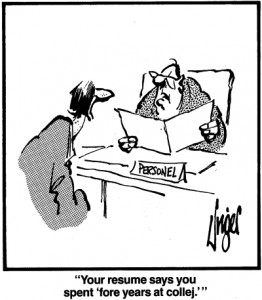
Interview CartoonMy grandmother was a great fan of that old shibboleth, “Don’t judge a book by its cover.” We all know what it means: you have to get to know someone (“read the book”) before you can make any judgment about them. “Appearances,” goes another, “can be deceiving.” Until you have worked passed and through the surface, you cannot know and make judgments about what lies underneath. Until, as the Native American teaching goes, you have walked a mile in another person’s moccasins, you have no basis on which to render judgment.

On the other hand, we all know how incredibly difficult it is to avoid doing exactly what Jesus here counsels against, how very hard not to do what the old sayings say we shouldn’t. Everyone makes “snap decisions” based on very little evidence, and everyone is influenced by their first impressions of others. I’ve been acutely aware of this during the past week while interviewing applicants for a part-time job at my church office.

Since the job is part-time (and not particularly well-paid), I’ve not done the same kind of extensive job-skills testing, or background and reference checking, that I would do with a full-time, high responsibility job. I’ve relied mostly on first impressions gained during the course of a brief interview and a quick review of resumes and letters of recommendation.

When I was first in the job market as a professional, I was counseled on the value of a good first impression. I learned about something called “the halo effect,” which is the psychological phenomenon in which our perception of positive traits about one aspect of a person gives rise to the perception or expectation of similar qualities in the individual as a whole. For example, you might be impressed with how tastefully and neatly dressed a person is and, thus, perceive them as organized and knowledgeable in their work; they may, of course, be nothing of the sort.

First impressions matter, but eventually substance will prevail. While dressing well may predispose an interviewer to think the applicant must be a good worker because she creates a competent first impression, the effect will wear off if she turns out to be a poor secretary. “Time will tell,” advises another old shibboleth.

So I have tried even more this week not to make judgments on first impressions. The person I hire will be working not just with me, but with every member of the congregation. It’s important that I choose wisely. A snap decision just wouldn’t be a good idea!

Jesus is quite obviously right to counsel against judging by appearances. But it’s awfully hard advice to follow! Sometimes Jesus says some really hard things: “If your right hand causes you to sin, cut it off and throw it away” (Mat. 5:30), comes immediately to mind. I find, however, that his “hard sayings” are less difficult to follow than when he’s simply giving reasonable advice! It’s when Jesus sounds like my grandmother, that it’s hardest of all.

====================

A request to my readers: I’m trying to build the readership of this blog and I’d very much appreciate your help in doing so. If you find something here that is of value, please share it with others. If you are on Facebook, “like” the posts on your page so others can see them. If you are following me on Twitter, please “retweet” the notices of these meditations. If you have a blog of your own, please include mine in your links (a favor I will gladly reciprocate). Many thanks!

====================

Father Funston is the rector of St. Paul’s Episcopal Church, Medina, Ohio.

Yeast Infection – From the Daily Office – February 7, 2014

From the Psalter:

When my mind became embittered,
I was sorely wounded in my heart.
I was stupid and had no understanding;
I was like a brute beast in your presence.
Yet I am always with you;
you hold me by my right hand.
You will guide me by your counsel,
and afterwards receive me with glory.

(From the Daily Office Lectionary – Psalm 73:21-24 (BCP Version) – February 7, 2014.)

The Pillsbury Doughboy suffers a massive yeast infectionSeldom has depression been so artfully described as in these few lines of Hebrew poetry. Translated in the Prayer Book as “embittered,” the Hebrew is chamets which refers to yeast. It means “to be leavened” or “to be sour.” Most versions of the Scriptures translate it with some version of “bitterness,” a few use “grieved,” and the Complete Jewish Bible renders the verse, “when I had a sour attitude.” I rather like that last one, closest to the Hebrew, best; it describes depression perfectly.
Several years ago, sixteen to be exact, I went through a severe depressive episode requiring treatment with medication and cognitive therapy. Both of those were helpful but of most value was my work was a spiritual director, really learning the discipline of daily prayer. In the course of that episode, I learned about psychological rumination, how to recognize its early stages, and how to get myself out of it.

The word rumination is borrowed by psychology from biology; it derives from the Latin ruminare meaning “to chew again.” It is the process by which ruminants (animals like cows, goats, sheep, giraffes, yaks, deer, and camels) digest their food. Having consumed and swallowed it, they regurgitate it together with digestive juices, chew it again to thoroughly mix it (“chewing the cud” we call that), and swallow it again.

In psychology, and especially with regard to depression, it refers to the process of returning again and again to replay in one’s mind, think over, regret, and obsess about some small but painful incident. It describes a useless but harmful feedback loop of negative emotion.

The Hebrew language’s and, thus, the psalm’s use of leavening to describe this process is nothing short of brilliant; it is wisdom. The process of rumination is exactly like the process of leavening. As the yeast fills the lump of bread dough, the negative emotions of rumination fill one’s every thought, every moment. The result, as the psalm says, is that one becomes “stupid” (ba`ar — ” brutish”) and “ignorant” (lo-yada — “lacking understanding”). In my own experience, when I would get stuck in a rumination cycle I simply became unable think outside of the feedback loop of negative thoughts; sometimes I couldn’t even think at all — I would simply “zone out.” Talk about “brutish” and “ignorant” — that was me in those ruminant moments!

But as the psalm suggests, there is a way out: God holds me by my right hand; God guides me by God’s counsel. For me, the structures of Prayer Book liturgy provided a way out of the cycle of rumination. If I could just get my hands on a Prayer Book and begin to read the Daily Office, or the prayers and thanksgivings section, the cadences of prayer would break through the obsessive replaying and over-thinking of whatever had triggered the cycle. I found, in fact, that the older language forms of the Rite One liturgies (or the 1928 Book of Common Prayer) were best for this purpose.

Depression is an awful thing. (As I contemplated it this morning — in a non-ruminative fashion — in light of the Hebrew linkage to leavening, I was tempted write something about a “yeast infection of the spirit” . . . but decided not to get there. I’ll just plant that image and leave it for later contemplation.) It is an awful thing, but there are ways to deal with it and ways to get out of it. I know, from personal experience. The best way is the one today’s psalm reminds us of — the guidance and counsel of God.

====================

A request to my readers: I’m trying to build the readership of this blog and I’d very much appreciate your help in doing so. If you find something here that is of value, please share it with others. If you are on Facebook, “like” the posts on your page so others can see them. If you are following me on Twitter, please “retweet” the notices of these meditations. If you have a blog of your own, please include mine in your links (a favor I will gladly reciprocate). Many thanks!

====================

Father Funston is the rector of St. Paul’s Episcopal Church, Medina, Ohio.

Costly Funeral – From the Daily Office – February 6, 2014

From the Book of Genesis:

Abraham bowed down before the people of the land. He said to Ephron in the hearing of the people of the land, “If you only will listen to me! I will give the price of the field; accept it from me, so that I may bury my dead there.” Ephron answered Abraham, “My lord, listen to me; a piece of land worth four hundred shekels of silver — what is that between you and me? Bury your dead.” Abraham agreed with Ephron; and Abraham weighed out for Ephron the silver that he had named in the hearing of the Hittites, four hundred shekels of silver, according to the weights current among the merchants. So the field of Ephron in Machpelah, which was to the east of Mamre, the field with the cave that was in it and all the trees that were in the field, throughout its whole area, passed to Abraham as a possession in the presence of the Hittites, in the presence of all who went in at the gate of his city.

(From the Daily Office Lectionary – Genesis 23:12-18 (NRSV) – February 6, 2014.)

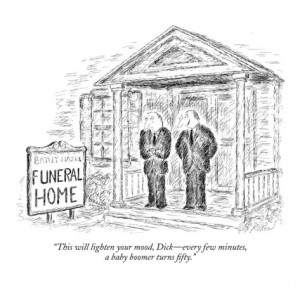
Funeral Home CartoonI seem to recall from studying Genesis each time I have had to preach on it that this purchase of the cave at Machpelah has been a subject of much rabbinic speculation over the centuries. Why, the rabbis seem to wonder, is Abraham willing to pay what is clearly an exorbitant price for the cave and the field (a field he doesn’t even actually want)?

“Four hundred” is sort of Old Testament code for “a whole bunch,” and when it comes to this particular episode it means something like 10 pounds of silver for this tiny piece of real estate. (On today’s market — I looked it up this morning — silver is going for $20 per ounce; so this purchase price would be about $3,200. That doesn’t seem terribly high, but clearly it was “back then,” whenever “then” was.) An interesting note is the relationship of the price to the location where the deal is struck, Kiriath Arba. The name means “the City of Four,” so the number 400 would be significant to the residents and the Hittites — 100 times the “number” of their city, 100 times the value? In any event, Abraham is willing to pay a whole lot of money for a burial plot.

My favorite of the rabbinic flights of fancy is the kabbalistic notion that the cave was known to Abraham to be the burial place of Adam. As the story goes, after God tossed Adam and Eve out of Eden, God carved out a cave that he would use to bury the first man and, after him, the patriarchs of God’s Chosen People. Sure enough, when Adam died, God buried him there as planned; God lit an eternal candle whose light would be visible only to certain humans and the presence of Adam’s body gave the cave the scent of Eden which, like the light, could be detected only by that select group.

Eons later, when Abraham was visited by three men (who turned out to be angels of God) at the oaks of Mamre (Gen. 18) he served them a roasted calf. The story goes that he had to chase the calf, which ran into this very cave where Abraham saw the light of the candle and perceived the scent of Eden. He also heard a voice saying, “Adam is buried here, and Abraham, Isaac and Jacob should be prepared for this place as well.” So, that day he became determined to eventually take possession of the cave and Sarah’s death ended up being the opportunity to do so. (One of the rabbis who tells this story asserts that he did not do so earlier so as to avoid arousing suspicion.)

There are other (mostly less outlandish) rabbinic speculations, but none of them strike me as anymore likely than the most obvious. Abraham is grief-stricken. He has lost his life partner, his wife of several decades, the mother of his son and heir. He simply is not thinking straight. He seems to be, but he’s just going through the motions. He doesn’t even try to bargain with Ephron! This is Abraham, for pity’s sake, a man who has bargained with God, and he doesn’t haggle one bit over the excessive price of the cave.

I’ve seen it time and time again, particularly with the death of a spouse or a child. The survivors, left to figure things out, to go on alone, to honor their departed loved one, spare no expense on the funeral. An entire industry has grown up and become profitable — highly profitable — catering to (preying on?) the grief of the American people.

Don’t get me wrong, I respect most of the funeral directors with whom I have worked. They are good people trying to be of help at a difficult time. But, let’s be honest, the costs associated with burial today can be outrageous — they put Abraham’s paltry ten pounds of silver to shame. You might get a casket for that value, but then there’s the plot, the embalming, the hearse and limousine rental, the flowers, and on and on and on . . . . Funerals are costly — and when someone is numb with grief, they can be even more so!

That’s why I’ve made pre-arrangements and planned my own funeral, and why I counsel parishioners and friends to do the same. Abraham would have been much better off if he and Sarah had purchased Ephron’s cave ahead of time. (Although that would have meant that we wouldn’t have some really fantastic and outlandish rabbinic tall tales to enjoy.)

====================

A request to my readers: I’m trying to build the readership of this blog and I’d very much appreciate your help in doing so. If you find something here that is of value, please share it with others. If you are on Facebook, “like” the posts on your page so others can see them. If you are following me on Twitter, please “retweet” the notices of these meditations. If you have a blog of your own, please include mine in your links (a favor I will gladly reciprocate). Many thanks!

====================

Father Funston is the rector of St. Paul’s Episcopal Church, Medina, Ohio.

Bravo Coca-Cola – From the Daily Office – February 5, 2014

From the Book of Genesis:

The angel of the Lord called to Abraham a second time from heaven, and said, “By myself I have sworn, says the Lord: Because you have done this, and have not withheld your son, your only son, I will indeed bless you, and I will make your offspring as numerous as the stars of heaven and as the sand that is on the seashore. And your offspring shall possess the gate of their enemies, and by your offspring shall all the nations of the earth gain blessing for themselves, because you have obeyed my voice.”

(From the Daily Office Lectionary – Genesis 22:15-18 (NRSV) – February 5, 2014.)

During the Super Bowl broadcast last Sunday Coca-Cola offered an advertisement featuring several people of differing ethnicities singing in a variety of languages a rendition of the song America the Beautiful. Almost immediately, the twitterverse was flooded with tweets of outrage demanding that the Coca-Cola singers “speak American,” condemning the singing of “our national anthem” in any language other than English, and threatening a boycott of Coke. (As much as I might want to, I’m not going to address the ignorance of referring to the English language as “American” or of not knowing what the national anthem of the United States actually is.)

That little tempest in a tea pot came to mind when I read God’s promise to Abraham that “by your offspring shall all the nations of the earth gain blessing for themselves.” This is the mission of God’s People. Isaiah prophesied that “in days to come the mountain of the Lord’s house shall be established as the highest of the mountains, and shall be raised above the hills; all the nations shall stream to it.” (Isa. 2:2) Psalm 72 includes the prayer for the king of Israel, “May all nations be blessed in him” (v. 17) and Psalm 87 proclaims that God will say of all people from every nation that “this one was born” in Zion (v. 6). Ben Sira refers to the promise to Abraham when he writes, “To Isaac also he gave the same assurance for the sake of his father Abraham. The blessing of all people and the covenant he made to rest on the head of Jacob.” (Ecclus. 44:22-23)

As we were reminded on Sunday morning, this mission was inherited by Christ and his church, the new Israel (as St. Paul said). Old Simeon took the infant Jesus in his arms and proclaimed that he was to be “a light for revelation to the Gentiles and for glory to your people Israel.” (Lk 2:32) As an adult rabbi, Jesus would instruct his disciples to “let your light shine before others, so that they may see your good works and give glory to your Father in heaven” (Mt 5:16) having commissioned them to be “the light of the world,” and reminding them that “a city built on a hill cannot be hid.” (v. 14)

The Puritan preacher John Winthrop took up that image when, preaching to the Massachusetts Bay colonists aboard the vessel Arbella in 1630, he admonished them to set an example of righteousness to the world. Presidents Kennedy and Reagan made use of the “shining city on the hill” metaphor in their inaugural addresses.

So I am puzzled why people who claim to be conservative, Christian, free market Americans would be upset with a successful American corporation advertising its product in a commercial in which people from all over the world extol the beauty of America . . . . the only explanation is a misunderstanding of unity and a misapprehension that uniformity of language promotes that unity. And, indeed, that is the tenor of many conversations I’ve seen on Facebook and Twitter since the Super Bowl advertisement was aired. In many of those conversations, the old image of America as a “melting pot” has been invoked.

Although many of us may remember that image from grade school civics lessons, I remember a junior high school civics and history instructor who sought to disabuse us of the notion. Our society is not and never has been a melting pot, he told us. If we had been, there wouldn’t be barrios, black ghettos, Little Italies, Chinatowns, Levittowns, lace-curtain Irish neighborhoods, and all the other ethnic enclaves that have existed for decades and even centuries. We’re not a melting pot, said my civics teacher, we are a tossed salad. It is our diversity that makes us exciting and makes us strong, unity in diversity, not uniformity, which is what a melting pot creates, which is what an enforced uniformity of language would promote.

Ethnic diversity, in fact, is the biblical model. All the nations of the world receive a blessing through Abraham and his descendents, but they do not become Israel; they do not become Jews. Even as God enrolls the nations in Psalm 87 declaring their birth in Zion, they remain Rahab, Babylon, Philistia, Tyre, Ethiopia, and all the other nations of the world. As immigrants come to be part of America, even as they may become naturalized citizens, they retain their histories and identities as Moroccan, Thai, Xosa, French, Maori, and all the rest, with cultural heritages to be honored, languages to be spoken and sung, and diversity to be celebrated. The shining city on the hill shines with diversity!

So, bravo, Coca-Cola, bravo!

====================

A request to my readers: I’m trying to build the readership of this blog and I’d very much appreciate your help in doing so. If you find something here that is of value, please share it with others. If you are on Facebook, “like” the posts on your page so others can see them. If you are following me on Twitter, please “retweet” the notices of these meditations. If you have a blog of your own, please include mine in your links (a favor I will gladly reciprocate). Many thanks!

====================

Father Funston is the rector of St. Paul’s Episcopal Church, Medina, Ohio.

Bread? Circus? – From the Daily Office – February 4, 2014

From the Gospel of John:

[Jesus said,] “I am the bread of life. Your ancestors ate the manna in the wilderness, and they died. This is the bread that comes down from heaven, so that one may eat of it and not die. I am the living bread that came down from heaven. Whoever eats of this bread will live for ever; and the bread that I will give for the life of the world is my flesh.”

(From the Daily Office Lectionary – John 6:48-51 (NRSV) – February 4, 2014.)

Bread and Circuses T-ShirtSunday, February 2, was significant for three things. It was the Feast of the Presentation of Jesus in the Temple, also called the Purification of Mary, also called Candlemas, a principal feast in the Christian faith and one that rarely falls on a Sunday. It was Groundhog Day, a very silly secular holiday in the United States and the inspiration for one of the more profound movies about personal growth and maturity, 1993’s Groundhog Day starring Bill Murray. It was Super Bowl Sunday.
The National Football League’s Super Bowl is a really big deal. For reasons that have almost nothing to do with the quality of the football played in this alleged championship match, millions of people plan their lives (at least on that day) around this game even though it is typically not a very good game. This year’s match between the Seattle Seahawks and the Denver Broncos was no exception; Seattle beat the crap out of the Broncos 43 to 8. Almost from the very first minutes, it was no contest. Nonetheless, millions of dollars changed hands, millions of people paid attention, and millions of other people were inconvenienced.

For all of my life as an ordained person, I have been aware of the Super Bowl’s effect on church attendance. The first parish I served as a priest was in the Pacific Time Zone and there I learned very early on that one does not schedule the annual membership business meeting on Super Bowl Sunday; you might not have enough people in church to constitute a quorum! Even now, when I minister with a congregation in the Eastern Time Zone where the game isn’t shown until the evening hours, I have come to expect low attendance; people are preparing either to host or to attend a Super Bowl party and (apparently) it takes more than eight hours to do so.

In commentary about the game this year, it has been suggested that one-third of the American populace watched all or a significant part of the game at home, at a Super Bowl party, or at their local sports bar. That would be more than 100 million people! In many of those commentaries, the term “bread and circuses” has been mentioned. This is a reference to a Latin expression from ancient Rome, panem et circenses, a phrase coined by the satirical poet Juvenal, who wrote

Already long ago,
from when we sold our vote to no man,
the People have abdicated our duties;
for the People who once upon a time
handed out military command,
high civil office, legions — everything,
now restrains itself and anxiously hopes
for just two things:
bread and circuses.

The reference is to the Roman practice, both republican and imperial, of gaining political power and keeping the masses in check by providing free wheat to the citizens, as well as costly entertainments, such as the circus gladiatorial games.

I don’t know, and in this space do not want to opine, whether the Super Bowl is, in fact, a “circus” offered by the leaders of our society to keep the population docile. I don’t want to opine here about the means, or failure of the means, by which society provides bread to those in need. But I am struck by today’s gospel reading and Jesus claim that he, his flesh, is the Bread which will let one live forever; in light of Sunday’s low turnout, one would have to admit that the Bread lost out to the circus.

The immediate gratification of the NFL circus — the parties and bar gatherings, the fun of cheering on one’s team, the camaraderie of the fans, the food, and the beer — is clearly more attractive than the gospel of eternal life. Why is that? I truly wish I knew. I’m not a sports fan and I don’t understand the attraction. But someone in the church needs to figure that out for the rest of us. Please. Soon.

====================

A request to my readers: I’m trying to build the readership of this blog and I’d very much appreciate your help in doing so. If you find something here that is of value, please share it with others. If you are on Facebook, “like” the posts on your page so others can see them. If you are following me on Twitter, please “retweet” the notices of these meditations. If you have a blog of your own, please include mine in your links (a favor I will gladly reciprocate). Many thanks!

====================

Father Funston is the rector of St. Paul’s Episcopal Church, Medina, Ohio.

Joyful Noise – From the Daily Office – February 2, 2014

From the Psalter:

My heart is firmly fixed, O God, my heart is fixed;
I will sing and make melody.
Wake up, my spirit; awake, lute and harp;
I myself will waken the dawn.

(From the Daily Office Lectionary – Psalm 57:7-8 (BCP Version) – February 3, 2014.)

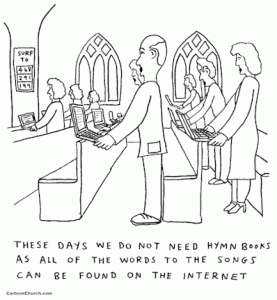
Internet Hymns Cartoon by Dave WalkerI am neither a musician nor a singer. Years ago (in public junior high school) I took instruction on the B-flat clarinet and the bass clarinet, but then I attended a private high school which had a drum-and-bugle corps rather than a full band with woodwinds, so no further playing of the reeds. As an adult, I tried to learn to play the guitar, the piano, and the bassoon, all with the same result: I do not play any instrument.

Although, as a result of all those attempts at music instruction, I can read music, I cannot vocally reproduce what I see on the page. I am in awe of those who can look at a sheet of music and start singing a piece they’ve never heard before! My eyes, brain, and vocal cords just are not connected in that way. I have to hear a piece at least once (usually several times) in order to reproduce it in any recognizable form. And don’t ask me to sing any part other than the melody; if I try to sing something else, I will inevitably wander back to the melody line.

And yet, I love music! I love to sing. I don’t understand people who won’t sing. That tired old excuse, usually put in their heads by some cruel music teacher in grade school, “I can’t carry a tune in a bucket,” should be banned from the church. Everyone can sing! The human voice is the instrument God gave every one of us. Every human being should join the chorus.

We may not all be able, like David or like those talented sight-readers, to “sing and make melody,” but we can all “waken the dawn.” God’s commandment about vocal praise is not “sing beautiful on-key harmonizations pleasing to your neighbor’s ear;” the commandment is “Make a joyful noise unto the Lord!” (Ps. 100:1, KJV) We can all make noise! In the narthex (entryway) of my last parish we hung a sign reading, “If you can’t sing good, sing LOUD!” Mark a joyful noise!

====================

A request to my readers: I’m trying to build the readership of this blog and I’d very much appreciate your help in doing so. If you find something here that is of value, please share it with others. If you are on Facebook, “like” the posts on your page so others can see them. If you are following me on Twitter, please “retweet” the notices of these meditations. If you have a blog of your own, please include mine in your links (a favor I will gladly reciprocate). Many thanks!

====================

Father Funston is the rector of St. Paul’s Episcopal Church, Medina, Ohio.

I Saw the Light! – Sermon for the Feast of the Presentation – February 2, 2014

====================

This sermon was preached on the Feast of the Presentation (“Candlemas”), February 2, 2014, at St. Paul’s Episcopal Church, Medina, Ohio, where Fr. Funston is rector.

(The lessons for the day were: Malachi 3:1-4; Psalm 24:7-10; Hebrews 2:14-18; and Luke 2:22-40. These lessons can be read at The Lectionary Page.)

====================

Simeon's Moment by Ron DiCianni

Lord, now lettest thou thy servant depart in peace, *
according to thy word;
For mine eyes have seen thy salvation, *
which thou hast prepared before the face of all people,
To be a light to lighten the Gentiles, *
and to be the glory of thy people Israel.
(BCP 1979, p. 66)

Some texts just need to be recited in the language of an earlier era. I have said that canticle almost every night since I was 14 years old and first became an Episcopalian, and although I find the truth perhaps better spoken in the more modern translations that we find in the New Revised Standard Version of the Bible and in the modern language of the Rite II Evening Prayer service, there is an elegance to the poetry of the earlier Books of Common Prayer. Simeon’s song is known liturgically as the Nunc Dimittis, and I find it comforting as a bedtime prayer.

Old Simeon had been hanging around the Temple for many years, a devout and orthodox Jew, hoping to see the coming of the Messiah; indeed, he believed he had been promised by God that he would not die before seeing the Messiah. One day, this young couple of poor, country folk came in to perform the sacrifices of purification and redemption, the restoration of Mary to ritual purity following childbirth and the pydion haben or redemption of their first-born male child. As soon as he saw them and the baby they brought, he knew his hope was realized, that God had kept God’s promise.

I’ve always heard behind the older translation, “now lettest thou thy servant depart in peace,” a hint of Simeon’s own death, a sort of “now I can die happy” statement. The more modern translation of the NRSV, however, has none of that dark foreshadowing: “Now you are dismissing your servant” has no hint of death in it, but it lacks the exuberance of the Prayer Book’s Rite II version, “You now have set your servant free to go in peace as you have promised.” In Simeon’s encounter with the Child, he is set free! I can almost hear him breaking into Hank Williams’ joyful country hymn I Saw the Light:

I saw the light; I saw the light;
No more darkness, no more night.
Now I’m so happy, no sorrow in sight.
Praise the Lord! I saw the light!

I can just see him dancing in the Temple holding this Holy Infant! Simeon is not just dismissed; he is set free, not to die, but to live! He can, of course, die happy; but before that he can live free. He is among the first of the redeemed.

In bringing the infant Jesus to the Temple, Mary and Joseph are continuing what they began at his circumcision; they are raising this child to be an observant Jew, they are teaching him to be a child of the Law, a participant in the Covenant from birth on. Mary comes to be restored after giving birth, which according to the Torah, rendered her ritually unable to participate in the religious life of her people. The Law of Moses in the Book of Leviticus, Chapter 12, prescribes:

If a woman conceives and bears a male child, she shall be ceremonially unclean seven days . . . . On the eighth day the flesh of his foreskin shall be circumcised. Her time of blood purification shall be thirty-three days; she shall not touch any holy thing, or come into the sanctuary, until the days of her purification are completed. . . . When the days of her purification are completed . . . she shall bring to the priest . . . a lamb in its first year for a burnt offering, and a pigeon or a turtledove for a sin offering. . . . If she cannot afford a sheep, she shall take two turtledoves or two pigeons, one for a burnt offering and the other for a sin offering.

With this ritual, Luke conflates the ritual of redemption, the pydion haben. In Exodus, Chapter 13, God says, “You shall set apart to the Lord all that first opens the womb. . . . Every firstborn male among your children you shall redeem.” (vv. 12-13) In the third chapter of Numbers, this command is repeated: “All the firstborn are mine; when I killed all the firstborn in the land of Egypt, I consecrated for my own all the firstborn in Israel, both human and animal; they shall be mine. I am the Lord.” (Num. 3:13) The price of redemption is then set at five “shekels of the sanctuary, a shekel of twenty gerahs.” (v. 47) Luke leaves out this detail, but it is very likely that Mary and Joseph carried through as required by the Law.

Joseph and Mary, as my colleague Juan Oliver has noted, “are the embodiment of the majority of Jews, who, illiterate and too poor to offer any sacrifice, lived perennially in a state of ritual defilement or ‘sin.'” We observe in their adherence to these rituals, in their making of these offerings, the lowliness of Jesus’ family and their marginalized position in society, but more importantly their participation in the full life of their faith. It is from that fullness of faith that Jesus’ self-understanding and his mission flows. Because of his parents’ faithfulness to the Law, Simeon sees in this infant “a light to lighten the Gentiles, and to be the glory of [God’s] people Israel.” Hope flows even from places of extreme poverty when those with the least embrace the rituals of an abundant life.

We began our worship this morning with one of our own “rituals of an abundant life.” From very early on in the life of the Christian community, it has been a tradition to carry candles on this day, and to bless the candles that the church will use throughout the coming year. For that reason, an alternative name of this Feast of the Presentation is “Candlemas,” the Mass of the candles. The tradition of blessing the candles dates to the mid-Fifth Century, and the candle procession is first attested to in the Diary of Egeria which describes such a procession in Jerusalem in middle of the Fourth Century.

An 11th Century Cistercian abbot, Blessed Guerric of Igny (c.1070-1157), preached of the symbolism of the Candlemas procession:

Behold then, the candle alight in Simeon’s hands. You must light your own candles by enkindling them at his, those lamps which the Lord commanded you to bear in your hands. So come to him and be enlightened that you do not so much bear lamps as become them, shining within yourself and radiating light to your neighbors. May there be a lamp in your heart, in your hand, and in your mouth: let the lamp in your heart shine for yourself, the lamps in your hand and mouth shine for your neighbors. The lamp in your heart is a reverence for God inspired by faith; the lamp in your hand is the example of a good life; and the lamp in your mouth are the words of consolation you speak.

Go forth then from this place and, like Simeon, speak of the freedom Jesus gives us, speak words of consolation, spread the light of Christ, the light to enlighten the Gentiles. Go forth and sing, “I saw the light! I saw the light! No more sorrow! No more night! Praise the Lord! I saw the Light!” Amen.

====================

A request to my readers: I’m trying to build the readership of this blog and I’d very much appreciate your help in doing so. If you find something here that is of value, please share it with others. If you are on Facebook, “like” the posts on your page so others can see them. If you are following me on Twitter, please “retweet” the notices of these meditations. If you have a blog of your own, please include mine in your links (a favor I will gladly reciprocate). Many thanks!

====================

Father Funston is the rector of St. Paul’s Episcopal Church, Medina, Ohio.

Chaotic Water – From the Daily Office – February 1, 2014

From the Gospel of John:

When evening came, his disciples went down to the lake, got into a boat, and started across the lake to Capernaum. It was now dark, and Jesus had not yet come to them. The lake became rough because a strong wind was blowing. When they had rowed about three or four miles, they saw Jesus walking on the lake and coming near the boat, and they were terrified. But he said to them, “It is I; do not be afraid.” Then they wanted to take him into the boat, and immediately the boat reached the land towards which they were going.

(From the Daily Office Lectionary – John 6:16-21 (NRSV) – February 1, 2014.)

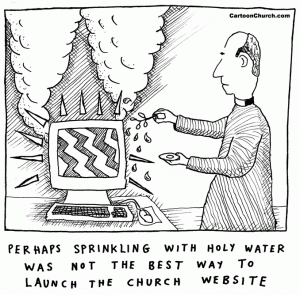
Blessing the Church Computer copyright Dave WalkerToday, February 1, is the ancient Irish feast of Imbolc, considered the beginning of spring and sacred to the goddess Brigid; it has become the commemoration of St. Brigid of Kildare, sometimes called Ireland’s “other patron saint.” (The lesson from John’s Gospel, however, is simply the Daily Office reading, not specific to the saint’s day.) Among the traditions of Imbolc (and, thus, of St. Brigid’s feast) is the visiting of holy wells, walking around them in prayer, and taking some of their water to be used to bless people and things.

For ancient peoples, the sea and other large bodies of water were vast, chaotic, and frightening places. In the ancient middle east, the sea was deified as Tiamat, goddess of primordial chaos and mother of the gods. In Irish mythology, the chaotic and dangerous sea separates the land of the living from the Otherworld, called Tír na nÓg (“Land of Youth”). Holy wells are viewed as places where the chaotic, spiritual dimension breaks into the everyday world.

Jesus’ walking on the water is a story told in three of the Gospels: Mark, Matthew, and John — Matthew adds Jesus inviting Peter to join him. It is a demonstration of the Lord’s mastery over the chaotic; Matthew’s addition of the invitation to Peter and Peter’s being able to do so until, as writer Madeleine L’Engle put it, “he remembered he didn’t know how” is symbolic of the empowerment Christ offers us to do the same.

Quantum Space-TimeIn a sense, we walk on the surface of chaos all the time. One of the learnings from quantum mechanics is that things are not nearly as solid as they seem. The everyday world seems to “float” on what has been called a “quantum foam.” The Greeks posited that if we continue to divide matter we get to atoms; if we divide atoms, we get electrons, neutrons, and other subatomic particles; if we try to divide subatomic particles, eventually we get to get quantum fields and even multidimensional vibrating strings. At the quantum level, reality is a quivering mass of quantum chaos. We walk on the surface of chaos all the time!

The story of Jesus (and Peter) walking on the water and the reality of the quantum chaos beneath our everyday lives should remind us that we do know how to do this. Water as a symbol of blessing is also a reminder of that; when we bless water and then use it to bless other things, like the Irish use the water from holy wells, we are declaring that we have the power and ability to deal with the chaos and to control the chaos in our lives.

====================

A request to my readers: I’m trying to build the readership of this blog and I’d very much appreciate your help in doing so. If you find something here that is of value, please share it with others. If you are on Facebook, “like” the posts on your page so others can see them. If you are following me on Twitter, please “retweet” the notices of these meditations. If you have a blog of your own, please include mine in your links (a favor I will gladly reciprocate). Many thanks!

====================

Father Funston is the rector of St. Paul’s Episcopal Church, Medina, Ohio.

Meeting Together – From the Daily Office – January 31, 2014

From the Letter to the Hebrews:

Let us hold fast to the confession of our hope without wavering, for he who has promised is faithful. And let us consider how to provoke one another to love and good deeds, not neglecting to meet together, as is the habit of some, but encouraging one another, and all the more as you see the Day approaching.

(From the Daily Office Lectionary – Hebrews 10:23-25 (NRSV) – January 31, 2014.)

Social Media Cartoon by NakedpastorAttendance is down. No one in the church really needs to be told this, although church ministry pundits have been making a good living for the last couple of decades reporting on it and diagnosing the reasons for it.

A recent New York Times op-ed piece pointing it out (and repeating a lot of old complaints that supposedly explain it) has been reprinted and shared electronically a lot the past few weeks; I must have seen it posted on Facebook at least twenty times.

It’s not news, however. Over the past several years (for a few decades, in fact) attendance figures in all mainline churches have been falling. Some congregations have bucked the trend, but even they are beginning to notice that fewer people are filling the pews, chairs, couches, or whatever seating alternative is provided.

For a while, the various denominations looked inward for the problem. My own Episcopal Church went through a period of fairly rapid change starting in the 1970s — prayer book revision, ordination of women, acceptance of LGBT persons, ordination of LGBT persons — which erupted in internal conflict. Episcopal pundits pointed to each of these developments, or to the conflict that arose over them, or to the allegedly heretical theology behind them and blamed these interiorities for declining memberships and lower attendance.

Being of a fairly ecumenical bent, I read the press from other denominations. During the same period of time the other American mainline churches were experiencing the same sort of decline and — guess what? — their denominational press was laying the blame at the feet of whatever their particular conflict du jour might have been.

Then along came a secular sociologist, Robert Putnam, who pointed out that it was happening across the board . . . and not only among churches! Fraternal and public service organizations, social clubs, and even bowling leagues were all experiencing the same sort of decline. Putnam’s book Bowling Alone graphically demonstrates the congruence of membership growth-and-decline curves for all organizations that depend on and sustain what he calls “social capital.” Every church leader should read it!

Unfazed, the church growth-and-decline “experts” are at it again, this time laying the blame at the feet of age cohorts. The ecclesial blogosphere is rife with punditry blaming the Boomers, Gen-X, Gen-Y, or Millennials. And for every such essay there are a dozen or more answering pieces explaining why it isn’t “my generation’s” fault! It seems like everyone in the church is singing this old song by The Who from nearly 50 years ago:

People try to put us down
(Backbeat line: Talkin’ ’bout my generation)
Just because we get around
Things they do look awful cold
I hope I die before I get old

My generation
This is my generation, baby

Why don’t you all fade away
Don’t try to dig what we all say
I’m not trying to cause a big sensation
I’m just talkin’ ’bout my generation

My generation
This is my generation, baby

Why don’t you all fade away
And don’t try to dig what we all say
I’m not trying to cause a big sensation
I’m just talkin’ ’bout my generation

My generation
This is my generation, baby
My, my, my, my generation

People try to put us down
Just because we get around
Things they do look awful cold
Yeah, I hope I die before I get old

My generation
This is my generation, baby
My, my, my, my generation

Talkin’ ’bout my generation
(My generation)
Talkin’ ’bout my generation
(My generation)
Talkin’ ’bout my generation
(Is my generation baby)
Talkin’ ’bout my generation
(This is my generation)

Somehow, somewhere someone is going to knock this off! Active church people have to stop pointing the finger of blame and start working with one another on solutions. We’ve had enough punditry diagnosing (or misdiagnosing) the causes — now we need to work on reframing the Christian message for a new generation that hasn’t heard it. In the words of the writer of the Letter to the Hebrews we have to “meet together . . . encouraging one another.”

What “meet together” means in the 21st Century is another issue, however. With social media of all the various sorts, and newer versions developing nearly every day, and existing versions being tweaked and modified — Facebook seems to change hour by hour — it’s an on-going, and never-ending struggle to keep up and figure that out. But “meeting together” probably no longer means (as a colleague puts it) “butts in the pews.” “Average Sunday attendance” may have become a meaningless metric (if it ever was one).

There is value, of course, in face-to-face meeting, in getting to know one another as physical beings, in joining together in (what another colleague once called) “meat space;” for those of us for whom sharing the Bread and Wine of Holy Communion is of paramount importance, it’s imperative! But if that isn’t happening on Sunday morning, let’s accept that it isn’t, move on, and find new and different ways to be church, new and different ways to mark and follow the admonition in Hebrews. It’s time for the hand-wringing, finger-pointing, blame-calling, and excuse-making to end, and for creative solutions to begin. It’s time for us to meet together . . . somewhere, sometime . . . and encourage one another!

(The social media cartoon is by David Hayward aka Nakedpastor.)

====================

A request to my readers: I’m trying to build the readership of this blog and I’d very much appreciate your help in doing so. If you find something here that is of value, please share it with others. If you are on Facebook, “like” the posts on your page so others can see them. If you are following me on Twitter, please “retweet” the notices of these meditations. If you have a blog of your own, please include mine in your links (a favor I will gladly reciprocate). Many thanks!

====================

Father Funston is the rector of St. Paul’s Episcopal Church, Medina, Ohio.

« Older posts Newer posts »