Revised Common Lectionary for Maundy Thursday, Year B: Exodus 12:1-14; Psalm 116:1,10-17; 1 Corinthians 11:23-26; John 13:1-17, 31b-35
Redemption is a drama in three acts – three acts and a brief intermission – tonight we take part in Act One.
Act One, Scene One: The curtain rises. We see a group of people gathered in an upper room somewhere in Jerusalem.
 A meal is in progress… Is it a seder, the ritual meal of remembrance of the Passover? We don’t really know; the playwrights have not made this clear; the theater critics, the scholars debate this issue. Three of the story-tellers suggest that it is but the fourth, John, tells the tale very differently. (The synoptic gospels tell the story in a similar way and, if truth be told, in the same way – Luke and Matthew based their stories on Mark’s, so to be honest there aren’t three stories, there’s only one that would make us think that this supper is a seder, but John doesn’t. In fact, John doesn’t even care about that – he spends no time at all describing the meal, for him the important thing is what happened afterward, and that comes in a later scene. So as we begin this three-day, three-act drama of redemption, since we have heard Luke’s voice narrating the story, let’s just assume that what we see in this first scene of the first act is, indeed, a seder.)
Those present are prepared to do all that is laid out in the instructions in the book of Exodus; they have worn their sandals; they carry their staffs; they expect to eat of roasted lamb and unleavened bread and bitter herbs. They anticipate spending the night in remembrance of that which happened generations before in Egypt. If we can imagine that they celebrate as modern Jews celebrate, they expect the youngest among them to ask the questions, beginning with “Why is this night different from all other nights?” They know that the head of the household, their rabbi Jesus, will answer those questions in the prescribed way and tell the story of the Passover.
And when the youngest asks “Why do we eat the broken matzah?” they expect Jesus to answer “This is the bread of our affliction; the unleavened bread of poverty, baked and eaten in haste,” but instead he takes the bread, brakes it and says, “This bread is my body, given for you.”
Can’t you just see them in this scene, reclining in that upper room, those serving the meal coming and going, a breeze blowing through the open windows, following along in their prayer books, the Haggadah … They look up startled, glancing at one another, murmuring to each other, “What is he talking about? That’s not here! That’s not the right answer. Where is he? What page is he on?” But the moment passes, the meal moves on, until at the end he takes up the fourth and final cup of wine, the kiddush cup, which recalls God’s promise, “I will acquire you as a nation; you will be my people and I will be your God.” They expect Jesus to say, “Blessed are you, O Lord our God, sovereign of the universe, creator of the fruit of the vine,” but instead they hear, “This cup is my blood!” “What?! What is he saying???”
It is for Jesus and his disciples one of those fleeting opportunities when, because of the pupils’ confusion or frustration or grasping for understanding, the teacher can pass on to the students new information, new values, new moral understanding, a new behavior, a new skill, a new way of seeing and coping with reality; it is what we have come to call “the teachable moment” and so he teaches, yet again, “Remember! Remember,” he says, “Love one another as I have loved you.”
The curtain falls as Jesus continues to teach; the disciples look mystified.
Act One, Scene Two: The curtain rises again. We see the same group of people gathered in the same upper room somewhere in Jerusalem.
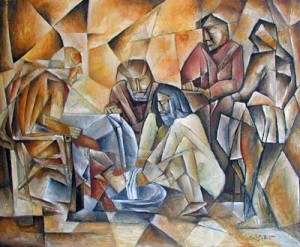 The meal is over, the dishes have been cleared. The disciples are arguing among themselves about who is the greater among them. Jesus looks frustrated and troubled; the teachable moment has passed and they clearly have not understood! They just haven’t gotten it.
“Look,” he says, “the greatest among you must become like the youngest, and the leader like one who serves. For who is greater, the one who is at the table or the one who serves? Is it not the one at the table? But I am among you as one who serves. Here, let me show you what I mean.” Getting up from the table, he takes off his robe, ties a towel around himself, pours water into a basin, and begins to wash and dry the others’ feet. Peter protests, “You will never wash my feet.” Jesus answers, “Peter, if I don’t wash you, you can’t be part of what I’m doing.” So Peter relents, “Well then, not only my feet! Wash my hands and my head, too!”
Peter speaks for us. We don’t get this foot-washing thing, do we? Washing our hands makes more sense to us, as it does to Anglican nun and poet Lucy Nanson who wrote:
Wash my hands on Maundy Thursday
not my feet
My hands peel potatoes, wipe messes from the floor
change dirty nappies, clean the grease from pots and pans
have pointed in anger and pushed away in tears
in years past they’ve smacked a child and raised a fist
fumbled with nervousness, shaken with fear
I’ve wrung them when waiting for news to come
crushed a letter I’d rather forget
covered my mouth when I’ve been caught out
touched forbidden things, childhood memories do not grow dim
These hands have dug gardens, planted seeds
picked fruit and berries, weeded out and pruned trees
found bleeding from the rose’s thorns
dirt and blood mix together
when washed before a cup of tea
Love expressed by them
asks for your respect
in the hand-shake of warm greeting,
the gentle rubbing of a child’s bump
the caressing of a lover, the softness of a baby’s cheek
sounds of music played by them in tunes upon a flute
they’ve held a frightened teenager,
touched a father in his death
where cold skin tells the end of life has come
but not the end of love,
comforted a mother losing agility and health.
With my hands outstretched before you
I stand humbled and in awe
your gentle washing in water, the softness of the towel
symbolizing a cleansing
the servant-hood of Christ.
Wash my hands on Maundy Thursday
and not my feet.
Yes, Peter speaks for us; we would rather our hands be washed. But Jesus insists, he must wash his disciples feet for only in this way does one truly honor and serve another in love, only in this way does one recall whose servant one is. He says to them, “If I, your master and teacher, have washed your feet, you must now wash each other’s feet.” Only in this way can his disciples remember his teaching that what is done for us is also to be done for others.
They don’t get the opportunity, however, for the second scene ends as Jesus becomes visibly agitated and declares, “One of you is going to betray me.”
As the curtain goes down, the disciples are looking puzzled and Judas Iscariot is leaving.
Act One, Scene Three: The curtain rises again. We see a garden and an olive grove just outside of Jerusalem. Jesus is there, accompanied by Peter, James, and John.
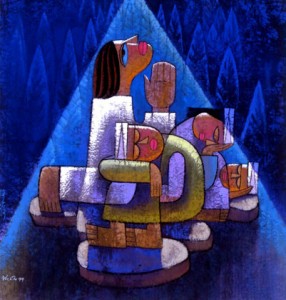 “Stay here,” he tells them, “Stay awake while I go over there to pray.” As they settle themselves, he moves away from them, and collapses in a heap, sobbing: “O God … Father, let this pass!”
Three times he returns to find them asleep; three times they rise looking sheepish and embarrassed; twice he tells them again to try to stay awake as he goes away still pleading with God for a way out. “Enough,” he says the third time, “Enough! We’re leaving.”
When they look back on that night, how must they feel? When we look back, how should we feel?
Poet Mary Oliver offers a glimpse in her poem Gethsemane:
The grass never sleeps.
Or the roses.
Nor does the lily have a secret eye that shuts until morning.
Jesus said, wait with me. But the disciples slept.
The cricket has such splendid fringe on its feet,
and it sings, have you noticed, with its whole body,
and heaven knows if it ever sleeps.
Jesus said, wait with me. And maybe the stars did,
maybe the wind wound itself into a silver tree,
and didn’t move, maybe the lake far away,
where once he walked as on a blue pavement,
lay still and waited, wild awake.
Oh the dear bodies, slumped and eye-shut, that could not
keep that vigil, how they must have wept,
so utterly human, knowing this too
must be part of the story.
Yes, this too, our utterly human inability to fully keep company with our Lord, this too must be part of the story when it is told, as we see it unfold in the church’s memory tonight, but for now the stage fills, the garden becomes crowded … Judas returns accompanied by temple guards, and Roman soldiers, and servants of the priests … and are those some of the disciples showing up? The orchard of olives suddenly is filled with angry activity, with scuffling, with fighting, with confusion. Peter calls out, “Lord, should we fight back?” and, without waiting for an answer, draws his sword and cuts off a servant’s ear.
“Stop!” cries Jesus. He reaches out and tenderly touches the servant’s head, healing his wound. He seems sadly confused, “Why have you come to arrest me with swords drawn?” he asks, “I’ve been teaching in the temple all week! You could have taken me any time.” It all seems too much for him. Certainly, it’s too much for us! Again, a poet, Ted Loder, speaks for us:
Sometimes, Lord,
it just seems to be too much:
too much violence, too much fear;
too much of demands and problems;
too much of broken dreams and broken lives;
too much of wars and slums and dying:
too much of greed and squishy fatness
and the sounds of people
devouring each other
and the earth;
too much of stale routines and quarrels,
unpaid bills and dead ends;
too much of words lobbed in to explode
leaving shredded hearts and lacerated souls;
too much of turned-away backs and yellow silence,
red rage and the bitter taste of ashes in my mouth.
Sometimes the very air seems scorched
by threats and rejection and decay
until there is nothing
but to inhale pain
and exhale confusion.
Too much of darkness, Lord,
too much of cruelty
and selfishness
and indifference.
Too much, Lord
too much,
too bloody,
bruising,
brain-washing much.
Or is it too little,
too little of compassion,
too little of courage,
of daring,
of persistence,
[too little] of sacrifice?
Jesus and his captors exit; the disciples, confused and frightened, sneak out behind them. The curtain falls. We are left in darkness….
Let us pray:
Heavenly Father, as we enter again into the mystery of these three most holy days, as we participate once again in this three-act drama of redemption, we ask you to illumine our minds and hearts with the hope and promise of Christ’s passion, death, and resurrection; satisfy our hunger and thirst not for bread and drink alone, but for love, and truth, and justice, and peace; as we share your Son’s Body and Blood, renew us and energize us to be a true community of light amid the darkness of sin and injustice in our world; as Jesus invites us to share at his Table, let us in turn invite our brothers and sisters to the table where all can share the resources of your abundance, where justice and peace reign, and where love transforms souls and societies; as the drama of redemption continues, may life conquer death, may light shine in the darkness, and may courage and compassion grow from sacrifice; in Christ’s holy Name we pray. Amen.
 Some time in the late Fourth Century, St. John Chrysostom, Archbishop of Constantinople and an important Early Church Father known for his eloquence in preaching and public speaking (hence, the surname Chrysostom which means “golden-mouthed”), preached this sermon on Easter.
 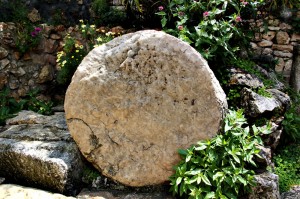 Something strange is happening – there is a great silence on earth today, a great silence and stillness. The whole earth keeps silence because the King is asleep. The earth trembled and is still because God has fallen asleep in the flesh and he has raised up all who have slept ever since the world began. God has died in the flesh and hell trembles with fear.
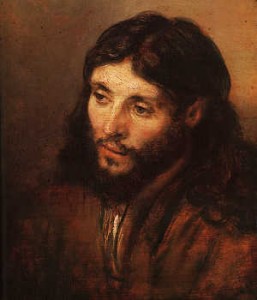 In the beginning he had been tempted by riches, by power, by idolization; all these had been offered in the desert. Now how great the temptation must have been to simply give up! Poet Denise Levertov ponders this allure in her poem Salvator Mundi: Via Crucis
 In this second act of the drama all that has gone before is recapitulated; all that we saw in yesterday’s first act, the supper in the upper room, the act of servanthood taught there, the agonized prayer in the garden, the willing surrender to unjust authority, and more. Not just yesterday’s first act, but all that has gone before from our first act of defiance in the first garden. Poet Ross Miller reminds us of that bond in his brief verse entitled Tau
 Act One, Scene One – Location: an upper room somewhere in Jerusalem.
 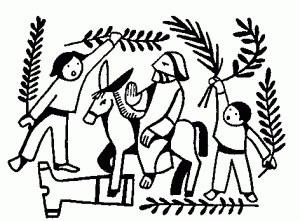 We have just read the simple, yet dramatic story of our Lord’s Passion as related in Mark’s Gospel. But we began our worship this morning with John’s story of Christ’s triumphal entry into Jerusalem. In the span of a few minutes we covered an entire week at the end of Jesus’ earthly life. Logic and reason cannot really make sense of this, and no ten-minute homiletic exegesis of these texts can help us comprehend the enormity of those events.
 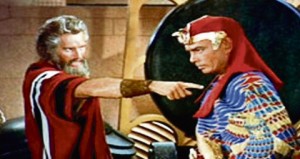 Why is Moses angry at Pharaoh? Moses (and God) have put the Egyptians through a series of miserable plagues. The people of the Nile valley have lived through water turning to blood killing all life in the river; invasions of frogs, lice, and flies; livestock diseases; painful, unhealing boils; hail and thunder; locusts; and unnatural darkness. Throughout the course of this series of events, there have been many times when Pharaoh seemed on the verge of releasing the Hebrews but then “the Lord hardened Pharaoh’s heart, and he did not let the sons of Israel go.” (Exod. 10:20) ~ Over the years, I’ve read a lot of commentary on this passage, the introduction to the slaughter of the first born which is context of the Passover. Wesley opined, “Moses hereupon was provoked to a holy indignation, being grieved, as our Saviour afterwards, for the hardness of [Pharaoh’s] heart.” Well, yeah, but who’s responsible for that? Over and over again the Scripture tells us it was God who hardened Pharaoh’s heart! Pharaoh’s not just obstinate, he’s manipulated into stubbornness by God himself! Why be angry at Pharaoh? ~ I don’t really think he is. I think he was mad at God…. ~ I think it’s OK to be mad at God. We have the freedom to express and respond to that emotion, to own up to our occasional anger with God. When parishioners come to me and “confess” being angry at God, I tell them it’s OK, that God is a big boy and can take their anger. The issue to be addressed is whether they can! Can they pray their anger honestly? Prayer is not always peaceful and serene and believing that ought to be can be a real obstacle to faith. But praying out one’s anger is unfamiliar territory; it feels awkward; it’s not much like any prayer we hear in church. ~ Do you remember the episode of The West Wing in which Pres. Bartlett’s secretary was killed by a drunk driver? Her funeral was held in the Washington National Cathedral (an Episcopal church, by the way). After the funeral, Bartlett stays behind in the quiet privacy of the cathedral to offer a personal prayer to God … not out of sadness or faith or hope. His prayer is offered out of anger. He begins by calling God a “son of a bitch” and a “feckless thug.” Then, good Roman Catholic that Josiah Bartlett was, he continued in Latin. Here’s what he said: “Am I really to believe that these are the acts of a loving God? A just God? A wise God? To hell with your punishments. I was your servant here on earth and I spread your word and I did your work. To hell with your punishments and to hell with you!” No amen – just a cigarette stamped out on the cathedral floor, after which Bartlett stalked out. Pretty clearly “in hot anger he left.” Praying our anger is not like any prayer we (usually) hear in church. ~ Scripture doesn’t tell us what Moses did in or with his anger, but we do know what followed. The story of Moses’ “hot anger” and what followed it affirms for us that anger, even anger at God, need not be destructive. It can be the source of a rebirth of hope; it can heighten our confidence in the future, and empower us to undertake the creation of a new reality. Appropriately and creatively channeled, anger, even anger at God, can lead us out of bondage and into freedom.
 I can’t read Paul’s words “treasure in clay jars” without thinking of this old Indian parable. ~ Once upon a time, there was a man who lived on a hillside high above the river. He had to fetch his water from the river every day. He did this with two large earthen jars slung from a yoke carried across his neck. The jars were heavy and it was a long path with many switchbacks down to the river, but the path was bordered by flowers and he didn’t mind the walk or the work at all. Both of the water jars were large and held several gallons, but there was a tiny crack in one so that the water would gradually leak out of that jar and splash on to the side on the path. The cracked jar was very sad that it lost half its water on the way back from the river each time. After many years the jar spoke to the man and apologized for being such a failure. “Why should you feel like that?” asked the man, ” I knew all about that crack; in fact, I made use of it.” “What do you mean?” asked the jar. “Well look,” he replied, “Do you see the flowers growing by the side of the path?” The jar looked and, sure enough, there were beautiful flowers growing all along the way. “Those flowers are there because I knew you had that small leak. I sowed some flower seeds along the side of the path and as I walked, the water leaking from your small crack watered them. For years now I’ve enjoyed those flowers as I walk, and I’ve been able to pick fresh flowers every day to decorate my home. I couldn’t have done that if you hadn’t watered them through that little crack. So, you see, I like you just the way you are. You are a very treasured water jar!” ~ Like the earthen jar carrying water, we carry in our cracked and faulty bodies the death of Jesus. And like the water that leaked from the jar, the life of Jesus flows out from us to accomplish his work in the world. This extraordinary power does not come from us, but we are the conduit (even and often when we don’t realize it). ~ As a preacher, I continue to relearn this each time someone refers to “something you said in a sermon”. I never remember my sermons! I look back on notes or scripted sermons from which I’ve preached and think, “Did I say that?” Apparently I did … and apparently it made a difference in someone’s life, watered some flowers along their path! So to preachers especially but to everyone, be assured – you are an earthen jar, probably a flawed one, carrying the death of Jesus in yourself that you may spread the life of Jesus to those around you, even though you may not realize it.
 Threading a needle…. That used to be a simple task for me. I was very, very near-sighted. I could barely see a school bus twenty feet away without my pop-bottle-bottom spectacles. But I could thread a needle! I could do anything that required close-up detail work; I had marvelous up-close vision. Then one day in 1995 (I think it was 1995) my mother saw my glasses. “Good Heavens! Are your eyes that bad?” – “Yes, Mother, they always have been.” – “Why don’t you have that Lasik surgery?” – “Because I can’t afford it, Mother.” – “You get it done. I’ll pay for it.” ~ (Side comment: My mother was a depression child born in 1919. As a result of spending her formative pre-teen and teen years in the years of the Great Depression, she was one of the most tightfisted people I’ve ever known when it came to spending money on herself or her spouse, my step-father. She would not spend a dime on her own healthcare, even when she felt badly. But she was generous to a fault with her children, her grandchildren, her friends, and her church. If she’d been less generous to us and more generous to herself, she might still be alive. But that’s another story.) ~ So I talked with my ophthalmologist, who had earlier been quite negative about PK and RK and other forms of keratotomy, and he thought Lasik would be a good option. He referred me to a surgeon. A couple of weeks later, I was able to do everything without glasses … everything except thread a needle. Now I needed a pair of dime-store “cheaters” to do what had once been easy, and even though I squinted and used those magnifying lenses I had difficulty. Getting anything through the eye of a needle, much less a camel, is no mean task! ~ About thirty years before that surgery, I visited the Cathedral at Chartres on my first trip to Europe. I was 16 years old at the time. I walked the labyrinth there. Since that first time I’ve walked many replicas of that deceptively simple path and other forms of labyrinth. Threading one’s way through the labyrinthine path requires concentration (especially in a cathedral full of tourists, but really at any time, even when completely alone). It is a careful endeavor not unlike threading a needle; one might even say it is a soulful endeavor. ~ Perhaps the most famous labyrinth in history or myth is the one built on Crete to house the Minotaur. King Minos’s daughter Ariadne fell in love with Theseus, an Athenian who was to be a sacrificial victim of the Minotaur. She gave Theseus a ball of thread to unwind as he made his way through the labyrinth, which showed him the path to by which he could leave once he had done battle with the beast (assuming he killed it, which he did). It was her thread of love which helped Theseus thread his way through the labyrinth. ~ Our walk through a spiritual labyrinth is said represent our way through life. Victor Hugo once said, “He, who every morning plans the transactions of the day, and follows that plan, carries a thread that will guide him through a labyrinth of the most busy life.” I’m not so sure that’s true, however; plans are too often subject to change! Like the odd turnings of the Chartres labyrinth, we meet with obstacles which change our direction; when we seem to be headed for our goal, suddenly the way changes; even though we squint and use magnifying glasses, the way through is unclear. We may not be able to follow our plans and we may not see the way ahead, but we are threaded through the unexpected and unknown path of life if we trust and rely on God’s guidance. Like Ariadne’s thread of love, God’s love threads us through life’s labyrinthine ways. Following God’s guidance is a careful, soulful endeavor, but “with God all things are possible.”
 Last Sunday the Year B Revised Common Lectionary for the 5th Sunday in Lent called for a reading from the Prophet Jeremiah which included these words from God, “I will put my law within them, and I will write it on their hearts.” (Jer. 3:33) My son Patrick, who is a priest in Kansas, preached

