Occasional thoughts of an Anglican Episcopal priest

Category: Church (Page 112 of 116)

A Choir Anthem: The Trinity of Friendship

This is a picture of stone found at (and now on exhibit at) the monastic ruins of Clonmacnoise in County Offaly, Éire. In the center of the cross is a design known as a “Celtic triskele.” This symbol appears in many places and periods, it is especially characteristic of the Celtic art of the continental La Tène culture of the European Iron Age (a Celtic society which predates Celtic Ireland).

Inscribed Stone with Center Triskele from Clonmacnoise, Co. Offaly, Éire

Inscribed Stone with Center Triskele from Clonmacnoise, Co. Offaly, Éire

This symbol was often used in the artwork of the early Irish Christians as a symbol of the Holy Trinity. Often seen in Irish art is a triskele of three conjoined spirals. Although it is considered a Celtic symbol, this type of triskele is in fact pre-Celtic; the triple spiral motif is a Neolithic symbol in Western Europe. It is found, for example, carved into the rock of a stone lozenge near the main entrance of the prehistoric Newgrange burial monument in County Meath, Ireland. Newgrange which was built around 3200 BCE, well before the arrival of the Celts in Ireland.

This is another example of an inscribed cross with a triskele in the center, also from Conmacnoise:

Inscribed Stone with Center Triskele from Clonmacnoise, Co. Offaly, Éire

Inscribed Stone with Center Triskele from Clonmacnoise, Co. Offaly, Éire

Another familiar Celtic symbol of the Trinity is the triquetra or “Celtic Trinity knot”. One finds items of jewelry bearing this symbol for sale in all the tourist trinket shops in this country, and variations of both the triskele and the triquetra grace the Book of Kells and other Irish illuminated manuscripts.

A Triquetra Pendant

A Triquetra Pendant

Celtic Christianity is exuberantly Trinitarian, as these designs suggest. However, getting a real “handle” on a settled Celtic theology of the Trinity is quite difficult. One of the earliest Celtic theologians was Pelagius, a 4th Century British contemporary of St. Augustine of Hippo. Unfortunately, we have few, if any, original texts by Pelagius, only Augustine’s assertions about what Pelagius taught and a few quotations from Pelagius in other sources. In any event, the heresy which now bears Pelagius’ name (whether he actually taught it or not) was quite at odds with Augustine’s own teaching of “original sin”. According to Augustine, Pelagius taught that human nature is basically good and refuted the concept of original sin; people, said Pelagius (according to Augustine), have the ability to fulfill the commands of God by exercising the freedom of human will apart from the grace of God. This teaching was condemned by the church and early Celtic theology is remembered today mostly only as the source of this heresy called “Pelagianism”. (Whether Pelagius or the Celtic church were truly Pelagian or not, it has been suggested that Pelagianism is “the besetting sin of British theology.” “British theology,” theologian Karl Barth once remarked, “is incurably Pelagian.”)

In any event, Pelagius did produce a treatise on the Trinity entitled On Faith In The Trinity: Three Books of which one scholar has said:

By the time of Pelagius then, there were two accepted doctrines which had been hammerred out against the heretics and laid down by the Church in black and white, those of the Incarnation and the Trinity. No one could, or did, accuse Pelagius of denying these two fundamental doctrines; on the contrary, his teachings show that he lost no opportunity of attacking any who had done so, and not even Augustine claimed that his christology was other than orthodox. (Pelagius: Life and Letters, B.R. Rees, 1988, pp. 24-25)

A second influential Celtic theologian was Johannes Scotus Eriugena in the 9th Century; his name means “John, the Irishman, born in Ireland.” He has been called the Celtic world’s most significant philosophical thinker; Bertrand Russell called him “the most astonishing figure of the early Medieval period.” Unfortunately, like Pelagius before him, he was condemned as a heretic. Perhaps ahead of this time, he constantly wrote of God as “nothing”; for example, Eriugena called God nihil per excellentiam (“nothing on account of excellence”) and nihil per infinitatem (“nothing on account of infinity”). By using the term “nothing” (more accuretly, “no thing”), Eriugena seems to have meant that God transcends all created being. He also insisted on describing God as “nature which creates”; this eventually got him condemned as a pantheist and a heretic, and his books were burned in the 13th Century.

Nonetheless, we do have quotations from Eriugena which show that like Pelagius, he was thoroughly a Trinitarian:

The Father, the Son, and the Holy Spirit consume our sins together, and by theosis convert us, as though we were a holocaust, into their unity.

and

From the deformity of our imperfection after the fall of the first human being, the Holy Trinity brings us up to the perfect human being and trains us for the fullness of Christ’s time.

From the known writings of these two important Celtic theologians, then, we know that early Celtic Christians honored the Triune God. There is a pious legend (probably dating from no earlier than the 1700s) that St. Patrick brought the doctrine of the Trinity to Ireland and explained it to his converts using the shamrock as an illustration. When I was hiking with him through the bogs of County Galway a few weeks ago, historian and archeologist Michael Gibbons scoffed at that notion. The shamrock is relatively uncommon, even though in the 19th Century it became a symbol of rebellion against the English. Gibbons suggested that if Patrick used any plant, it was probably the trifoliate bogbean, which grows in profusion.

The Celts were probably predisposed to easily accept the doctrine of the Trinity. Irish (and other Celtic) folk lore is replete with proverbs (seanfhocail) in the form of triadic sayings. Here are a few:

There are three kingdoms of the happy: the world’s good word, a cheerful conscience, and firm hope of the life to come.

Three leaderships of the happy: being good in service, good in disposition, and good in secrecy; and these are found united only in those with a noble heart.

In three things a person may be as the Divine: justice , knowledge , and mercy.

Three things lovable in a person: tranquillity, wisdom, and kindness.

Three things excellent in a person: diligence, sincerity, and humility.

Three things which show a true human: a silent mouth, an incurious eye, and a fearless face.

[There are many websites dedicated to these triads; one of the best is Trecheng Breth Féne – The Triads of Ireland.]

Other evidence of a solid Trinitarian theology in Celtic Christianity includes the hymn bearing Patrick’s name, St. Patrick’s Breastplate. This hymn is a long invocation of the Trinity in the poetic form known as a lorica, a Druidic incantation for protection on a journey. It is best known in the metrical translation by Cecil Frances Alexander found in many hymnals (including The Hymnal 1982 of the Episcopal Church). The first lines in her translation are:

I bind unto myself today
the strong Name of the Trinity,
by invocation of the same,
the Three in One, and One in Three.

This hymn also appears in Dánta Dé, where one finds these lines translated by Douglas Hyde in this way:

I arise to-day
In strong power, strong prayer to the Trinity,
And in powerful faith in the Three,
In humble pure confession of the Unity,
High Creator of all elements.

In Celtic poetry, therefore, is a strong sense of the power of the Triune God, but there is also an amazing sense of the intimacy of the Trinity. Belief in the Trinity in Celtic thought is closely bound with a sense of the closeness, the friendship of God. In Dánta Dé is a hymn described as a “folk song for the morning” in which God is addressed as a Rí na gcarad. I translate this as “the King of friends” and Dr. Hyde has rendered it “the King of friendship.” One finds a similar sense of God as companion in a morning invocation from the Carmina Gadelica, a collection of folk charms, songs, and prayers collected by Alexander Carmichael in Scotland at the end of the 19th Century. In fact, this is the piece with which Carmichael begins his collection:

I am bending my knee
In the eye of the Father who created me,
In the eye of the Son who purchased me,
In the eye of the Spirit who cleansed me,
In friendship and affection.

This sense of intimacy in and with the Holy Trinity is similar to the theology and practices of Eastern Orthodoxy with which the Celtic Christians were very familiar. When St. Augustine of Canterbury arrived in Britain at the end of the 6th Century, his missionaries found that Christianity was already there and had been since probably the late 2nd or early 3rd Century! (The martyrdom of St. Alban, first martyr of Britain, has been dated by some scholars to as early at 209; St. Patrick’s missionary activity in Ireland was accomplished in the middle of the 5th Century.)

The Roman missionaries found that the Celts used a very early system to determine the celebration of Easter, a system they had learned centuries before from Eastern Christians. They also found the Celts using an order of service for baptism similar to the Eastern Orthodox service. Furthermore, although the Celtic Christians had celibate monks and nuns, they had married priests in keeping with ancient tradition which still exists in Orthodoxy and which was reclaimed in the West by the reformed churches.

So it is not surprising that we find in Celtic Christian belief and practice a sense of the Trinity not dissimilar to that of the Eastern church. Ian Bradley in The Celtic Way writes:

The Celts saw the Trinity as a family … For them it showed the love that lay at the very heart of the Godhead and the sanctity of family and community ties. Each social unit, be it family, clan or tribe, was seen as an icon of the Trinity, just as the hearthstone in each home was seen as an altar. The intertwining ribbons of the Celtic knot represented in simple and graphic terms the doctrine of perichoresis – the mutual interpenetration of Father, Son, and Holy Spirit. (The Celtic Way, 2007, p. 44)

Perichoresis is term from Eastern Orthodox theology which describes our understanding that in all actions of God each of the Persons of the Holy Trinity takes part. Anglican theologican Alister McGrath writes that it “allows the individuality of the persons to be maintained, while insisting that each person shares in the life of the other two.” (Christian Theology: An Introduction, 3rd ed., 2001, p. 325)

The word itself is a compound word with two Greek roots: peri, which means “around”, and choreia, which means “dance”. Thus, it describes the Holy Trinity as eternally dancing: Father, Son, and Holy Spirit moving and flowing together in creation, in redemption, in sanctification, and drawing life from one another in a dance of perfect love. John of Damascus, who was influential in developing the doctrine of the perichoresis, described it as a “cleaving together”. It is an image of intimate friendship.

In Dánta Dé there are two short morning hymns with which I’ve been particularly taken. The first is the one to which I alluded earlier naming God as the “King of friendship”. Ms. ní Ógáin attributes the English translation in the hymnal’s appendix to Dr. Hyde:

O King of friendship, our Saviour’s Father art Thou;
O keep me erect, until the evening shall cool my brow.
O teach and control, lest I unto any sin should bow,
Save Thou my soul from the foe who follows me now.

O King of the world, Who lightest the sun’s bright ray,
Who movest the rains that ripen the fruit on the spray;
I look unto Thee, my transgressions before Thee I lay,
O keep me from falling deeper and deeper away.

The second is entitled An Réalt (“The Star”) and is described as an “old song of Ireland”. This is my translation of the Irish:

O Jesus, be in my very heart’s memory every hour,
O Jesus, be in my very heart’s quick repentance,
O Jesus, be in my very heart’s unfailing fellowship,
O Jesus, true God, do not cut yourself off from me.

Without Jesus my thoughts are not pleasing to myself,
Without Jesus neither my writing nor the words of my mouth;
Without Jesus my actions in life are not good
O Jesus, true God, be before me and behind me.

Jesus is my very King, my friend, and my love;
Jesus is my refuge from sin and from death;
Jesus is my joy, my constant mirror,
O Jesus, true God, do not part from me forever

Jesus, always be in my heart and on my lips,
Jesus, always be first in my understanding,
Jesus, always be in my memory like readings,
O Jesus, true God, do not leave me by myself.

Inspired by these two hymns and their melodies, I’ve written new lyrics picking up some images from the originals, together with the metaphor of the dance, and set them to a combined arrangement of the music. This is my poetry and below it a link to a five-minute MP3 of the arrangement. The music is synthesized piano and a synthesized SATB choir. I have neither a piano, nor a choir, nor recording facilities in the 300-year-old farm house cottage in which I am on retreat, so a computer synthesis will have to do. Unfortunately, the synthetic sounds are not as good as I would like and the playback is a bit uneven. Still, it gives an idea of the sort of thing I’ve been working on during this sabbatical. I look forward to polishing this up and working with a real choir and accompanist on this piece.

Be in our world, O Father, our refuge and our king.
Be in our world, O Father, forever sheltering.
Before us and behind, from sin and death our souls protecting.
O Father, the source of grace, our refuge and our king.

O author of friendship, the One, Holy Trinity,
In the dance of creation you formed us for community.
With your love lead and guide us, as you invite us to the dance ev’ry day.
We follow your lead for we trust in your saving way.

Be in our hearts, O Jesus, with your unfailing power.
Be in our hearts, O Jesus; be with us ev’ry hour.
Do not leave us alone, our constant friend and our companion,
O Jesus, the Son of love, with your unfailing power.

Be in our minds, O Spirit, and always in our praise.
Be in our minds, O Spirit, our actions and our ways.
Be first upon our lips, first in our thoughts and understanding.
O Spirit, our unity, always be in our praise.

O author of friendship, the One, Holy Trinity,
In the dance of creation you formed us for community.
With your love lead and guide us, as you invite us to the dance ev’ry day.
We follow your lead for we trust in your saving way.

O Trinity of friendship, always be in our lives;
O Trinity of friendship, surrounding us with light.
Community of love forever offering us welcome,
O Trinity, our Lord and God, always be in our lives.

O author of friendship, the One, Holy Trinity,
In the dance of creation you formed us for community.
With your love lead and guide us, as you invite us to the dance ev’ry day.
We follow your lead for we trust in your saving way.

O Father of grace, Son of love, Spirit of unity,
In the dance of salvation you show what you call us to be;
As we join in the fellowship of your dance, loving you as we ought,
O Trinity of friendship always be in our hearts.
O Trinity, our Lord and God, always be in our hearts.

Click on the title, Trinity of Friendship, to listen to the synthesize piano and choir.

Snoring, Gardening, and Prayer

I wear a mask at night when I sleep … it is connected to an air pump called a “CPAP machine”. CPAP stands for “continuous positive air pressure.” The members of my congregation may remember that I used my CPAP machine as a sermon illustration on Christmas Eve. (That sermon may be found online here.)

This machine is supposed to keep me breathing by preventing the collapse of my airway during sleep; it also prevents snoring….

Out of curiosity, I went looking to see if there might be a particular saint one would invoke with regard to snoring. St. Blaise is invoked with regard to illnesses of the throat including coughs, but I’m not sure that would include the airway. Prayers to St. Winnoc supposedly also can cure coughs, and also Sts. Walburga and Quentin. St. Bernardine of Siena has jurisdiction over the lungs and respiratory problems; St. Casimir of Poland, who died of some lung disease, is also invoked for cure of these. But no saint seems to have been given particular responsibility for snoring itself as a separate matter.

You’d think there would be a “patron saint of snoring”! After all, snoring has been around a long-time, probably longer than human beings. (Many animals snore – my dog snores up storm!) Consider the Reeve’s Tale from Chaucer’s Canterbury Tales in which a husband and wife are described as snoring together:

This meller hath so wysely bybbed ale,
That as an hors he snortith in his sleep,
Ne of his tail behind took he no keep.
His wyf bar him a burdoun a ful strong,
Men might her rowtyng heeren a forlong;
The wenche routeth eek, par companye.
Alleyn the clerk, that herd this melody,
He pokyd John and seyde, ‘Slepistow?
Herdistow ever silk a sang er now?’

[Modern English translation:
This miller had so roundly bibbed his ale
That, like a horse, he snorted in his sleep,
While of his tail behind he kept no keep.
His wife joined in his chorus, and so strong,
Men might have heard her snores a full furlong;
And the girl snored, as well, for company.
Alain the clerk, who heard this melody,
He poked at John and said: “Asleep? But how?
Did you hear ever such a song ere now?”]

Chaucer’s duet notwithstanding, it is a particularly important thing for a married person not to snore! One’s spouse (unless he or she joins in like the miller’s wife) tends to lose sleep because of one’s snoring and this can make him/her cranky. According to Peter Beresford Ellis in A Brief History of the Celts, writing about the Brehon Laws of ancient Ireland: “One reason a woman could divorce in Irish law was if her husband snored.”

Although I doubt it is codified anywhere, snoring still seems to be a cause and grounds for divorce. One writer on sleep disorders asserts that it is a major cause of marital dissolution: “Snoring is the number one medical cause for divorce. Snoring is cited as the third most frequent cause of divorce between couples following only financial problems and infidelity.”

Monks are often depicted in literature as snorers. There is a famous Buddhist story of enlightenment called “the tale of the snoring monk.” It is said that before he was killed (accidentally or purposely is unknown and the subject of historical debate) by being shot with an arrow during a hunt, William II of England received a letter from the Abbot of Gloucester warning him that one of the friars had had a prophetic dream of the king’s demise. The king read the letter just prior to the hunt, but burst out laughing, refusing to believe in what he called “the dreams of snoring monks.”

I wonder if the early eremitic monks of Ireland sought solitude in their beehive cells not so much because of a desire to pray in privacy as to get away from someone else’s snoring? There’s no record of that reason, that I know of, but there were plenty of monks who went away to be alone.

One of them was St. Fiachra, the patron saint of gardeners. (He’s also invoked in prayer for the cure of venereal diseases. Supposedly this is because of his reputed aversion to women, as well as his skills with medicinal herbs, but I’ve found no further justification for his link to venereal disease.)

Lake at St. Fiachra's Garden, Irish National Stud, Kildare

Lake at St. Fiachra's Garden, Irish National Stud, Kildare

Here in Ireland, on the grounds of the Irish National Stud (a thoroughbred horse breeding facility in Kildare owned by the Irish Government) one finds St. Fiachra’s Garden (the saint is also known by the French spelling of his name “Fiacre”). It is a rather wild and unkempt garden which includes a lake, a modern recreation of a beehive cell (in which there is an in-ground crystal sculpture created by Waterford Crystal), and a statue of St. Fiachra contemplating a seed. My daughter Caitlin, her friend Jeff, and I recently visited St. Fiachra’s Garden.

Crystal Sculpture inside Beehive Cell, St. Fiachra's Garden

Crystal Sculpture inside Beehive Cell, St. Fiachra's Garden

St. Fiachra is not mentioned in earlier Irish calendars, but it is said that he was one of the Celtic church saints, born in Ireland early in the 7th Century. Initially, he lived his monk’s life in a hermitage in County Kilkenny, but his fame has an herbalist and healer led to his being sought out be too many people. he went France in quest of greater solitude in which to devote himself to God without the distractions of the world.

Beehive Cell, St. Fiachra's Garden, Irish National Stud, Kildare

Beehive Cell, St. Fiachra's Garden, Irish National Stud, Kildare

In Meaux, Bishop Faro gave him a solitary dwelling in a forest which was his personal property. According to legend the bishop offered him as much land as he could turn up in a day and St. Fiachra, instead of driving his furrow with a plough, turned the top of the soil with the point of his staff. The legend goes on to say that a local woman complained that he was digging too quickly and so, in anger, he decreed that no woman could enter the enclosure of his hermitage, and he extended this prohibition even to his chapel. Apparently this prohibition continued after this death, as there is a story that in 1620 a lady of Paris, who claimed to be above this rule, going into the oratory lost her mind upon the spot and never recovered her senses!

Fiachra cleared the ground of trees and briers, made himself a cell with a garden, built an oratory in honor of the Virgin Mary, and made a hospice for travelers which has developed into the village of Saint-Fiacre in Seine-et-Marne. It is said that any resorted to him for advice and for relief from diseases. His hagiography records that his charity moved him to attend cheerfully those that came to consult him; and in his hospice he entertained all comers, serving them with his own hands, and sometimes miraculously restored to health those that were sick.

St. Fiachra and Caitlin Funston in Contemplation

St. Fiachra and Caitlin Funston in Contemplation

I don’t know if Fiachra snored, nor if any snorer ever consulted him about the problem, but I’m quite sure that his ministrations must have been successful, else his fame would not have continued so long that he is still known to us. I’m also sure that prayer, in addition to application of medicaments (whether herbs or modern medicines), is an effective part of the healing process.

The Dánta Dé hymnal includes many songs and charms in which God’s healing power is invoked, including this short piece, an anonymous Christmas prayer which Ms. ní Ógáin tentatively dates to the 18th Century:

A sholus-Mhic fuair crochadh ar chrois an chrainn-chéasta,
Dár dtabhairt-ne ó dhochar-bhruid na bhfír-phéine,
Ós follas duit sinn-ne i mbochtaine ‘s i ndaor-ghéibhinn,
Ó fortaigh sinn ‘san Nodlaig-se le Do chaoin-daonnacht.

A Dhéig-Mhic na Maighdine beannuighthe breágha,
Léighis-se ár dteinn-luit is cneasuigh ár gcneádha;
Tabhair deimhin-fhios is foighde dhúinn, cneas-dacht is grádha,
Le n-a ragham ar Do thealghach go flaitheas na ngrásta.

This translation is Ms. ní Ógáin’s:

O radiant Son, Who wast crucified on the Cross of the Rood,
To bring us from the hard oppression of true pain,
Since our poverty and bondage are clear of Thee,
Comfort us this Christmas with They gentle humanity.

O Good Son of the Maiden blesséd and beauteous,
Heal our sore hurts and close our wounds;
Give sure knowledge and patience to us, honesty and love,
Whereby to come to Thy home-hearth, to Heaven of the graces.

St. Fiachra, by the way, is also the patron saint of cab-drivers, especially those of Paris. French cabs are called fiacres because the first business set up to let coaches on hire, in the middle of the seventeenth century, was established in Paris on the Rue Saint-Martin near to and possibly in connection with the Hôtel de Saint-Fiacre.

So the next time you have an issue with snoring, or with gardening, or with a taxi-cab (I’m hoping none of my readers will have any problems with venereal diseases!), consider invoking the intercession of St. Fiachra.

Circles of Protection: The Dúns and Cahers of Ireland, and the Christian Community

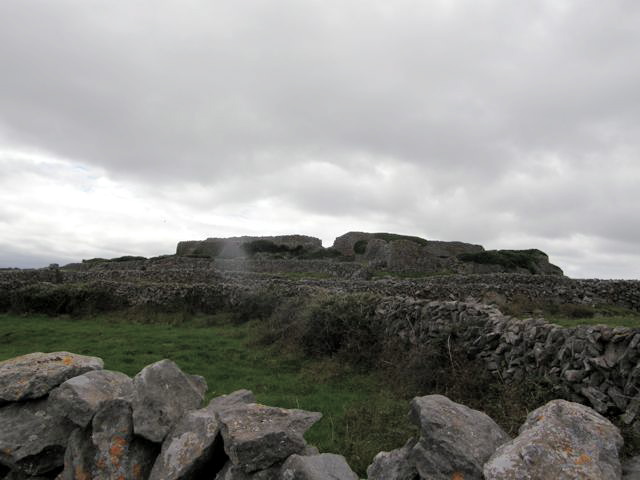
One of the places I visited with my daughter Caitlin and her friend Jeff was the Caherconnell Ring Fort in the Burren of County Clare. A ring fort is an early medieval farmstead enclosed by one or more roughly circular dry stone walls or earthen banks. Although called “forts”, these dwelling-places are believed to have not been designed for defense. Rather, the role of the walls was to give shelter and security to the family, their livestock, and their possessions. The scale and complexity of the banks or walls may also have served as an indicator of the occupier´s status.

Caherconnell, according to an archeologist quoted on its website, “is a large and perfect fort 140-145 feet in external diameter, nearly circular in plan. It is 12 feet thick and from 6-14 feet high. The masonry consists of large blocks many 3 feet long and 2 ft. 6 in. high. The inner face is almost perfect.” It is a large and impressive place believed to have been originally built circa 400-600 AD and inhabited (and possibly rebuilt) up to the 15th or 16th Century.

Caherconnell Ring Fort

Caherconnell Ring Fort

Gateway of the Caherconnell Ring Fort, from Outside the Fort

Gateway of the Caherconnell Ring Fort, from Outside the Fort

Gateway of the Caherconnell Ring Fort, from Inside the Fort

Gateway of the Caherconnell Ring Fort, from Inside the Fort

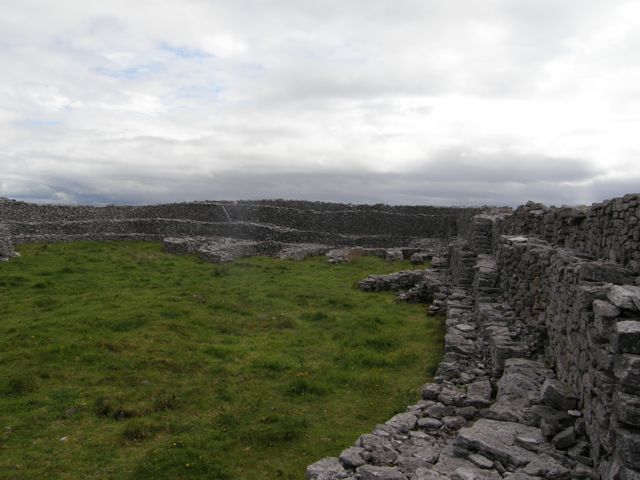
The interior of the fort was divided by a stone wall and there are foundations of buildings which may have been dwellings, workshops, livestock enclosures, or for other purposes.

Interior of the Caherconnell Ring Fort with Remains of Dividing Wall

Interior of the Caherconnell Ring Fort with Remains of Dividing Wall

Caitlin and Jeff Studying the Caherconnell Ring Fort Interior

Caitlin and Jeff Studying the Caherconnell Ring Fort Interior

Archeological Dig Currently Underway inside Caherconnell Ring Fort

Archeological Dig Currently Underway inside Caherconnell Ring Fort

Although Caherconnell and the other ring forts of the Burren (it is estimated there may be as many as 450 in that area) date from the middle of the first millennium AD, this style of stone enclosure is quite ancient in Ireland. A few years ago, my wife Evelyn and I visited Dún Aonghasa on Inis Mór (the largest of the Aran Islands), and a couple of years after that, with a class from Acadamh na hOllscolaíochta Gaeilge, I visited Inis Meán (the middle island) where one finds Dún Chonchúir. These forts are believed to date from pre-Christian times, perhaps the 2nd Century BC.

Dún Chonchúir, Inis Meáin, Exterior

Dún Chonchúir, Inis Meáin, Exterior

Dún Chonchúir, Inis Meáin, Interior

Dún Chonchúir, Inis Meáin, Interior

Notice that the names of these earlier structures include the term dún which means “fort” and was sometimes used to describe a castle. The later structures, the ring forts of the Burren, are named with the term “caher”, an Anglicized form of the Irish word cathair, which seems to have originally meant “a dwelling place” and in modern Irish means “city”. Both are terms for shelter and protection. St. Augustine used the image of a city as a metaphor for heaven in his treatise The City of God. In an earlier post, Translating Hymns (Part 3) (22 June 2011), I posted a hymn from Dánta Dé entitled An Dún Áluinn (“The Beauteous Fort”) in which the 13th Century Irish bard Donnchadh Mór O Dálaigh (who may also have been Abbot of Boyle Abbey) used the image of a dún as a metaphor for heaven. Both, of course, are drawing on the imagery of the Book of Revelation in which John of Patmos received a vision of heaven as a walled city: “And I John saw the holy city, New Jerusalem, coming down from God out of heaven, prepared as a bride adorned for her husband.” (Revelation 21:2)

John continues:

I heard a loud voice from the throne saying, “See, the home of God is among mortals. He will dwell with them; they will be his peoples, and God himself will be with them; he will wipe every tear from their eyes. Death will be no more; mourning and crying and pain will be no more, for the first things have passed away.” (Revelation 21:3-4)

Again, shelter and protection are the dominant themes, just as they were the purpose of the circular dúns and cathairs of Ireland.

Earlier this year Christian leaders in the United States, including the Presiding Bishop of my own tradition, the Episcopal Church, issued a statement entitled A Circle of Protection. In it, they remind our political leaders that “budgets are moral documents, and how we reduce future deficits are historic and defining moral choices.” As leaders of and spokespersons for the larger Christian community, they “urge Congress and the administration to give moral priority to programs that protect the life and dignity of poor and vulnerable people in these difficult times, our broken economy, and our wounded world.” The statement includes these key principles:

  1. The nation needs to substantially reduce future deficits, but not at the expense of hungry and poor people.
  2. Funding focused on reducing poverty should not be cut. It should be made as effective as possible, but not cut.
  3. We urge our leaders to protect and improve poverty-focused development and humanitarian assistance to promote a better, safer world.
  4. National leaders must review and consider tax revenues, military spending, and entitlements in the search for ways to share sacrifice and cut deficits.
  5. A fundamental task is to create jobs and spur economic growth. Decent jobs at decent wages are the best path out of poverty, and restoring growth is a powerful way to reduce deficits.
  6. The budget debate has a central moral dimension. Christians are asking how we protect “the least of these.” “What would Jesus cut?” “How do we share sacrifice?”
  7. As believers, we turn to God with prayer and fasting, to ask for guidance as our nation makes decisions about our priorities as a people.
  8. God continues to shower our nation and the world with blessings. As Christians, we are rooted in the love of God in Jesus Christ. Our task is to share these blessings with love and justice and with a special priority for those who are poor.
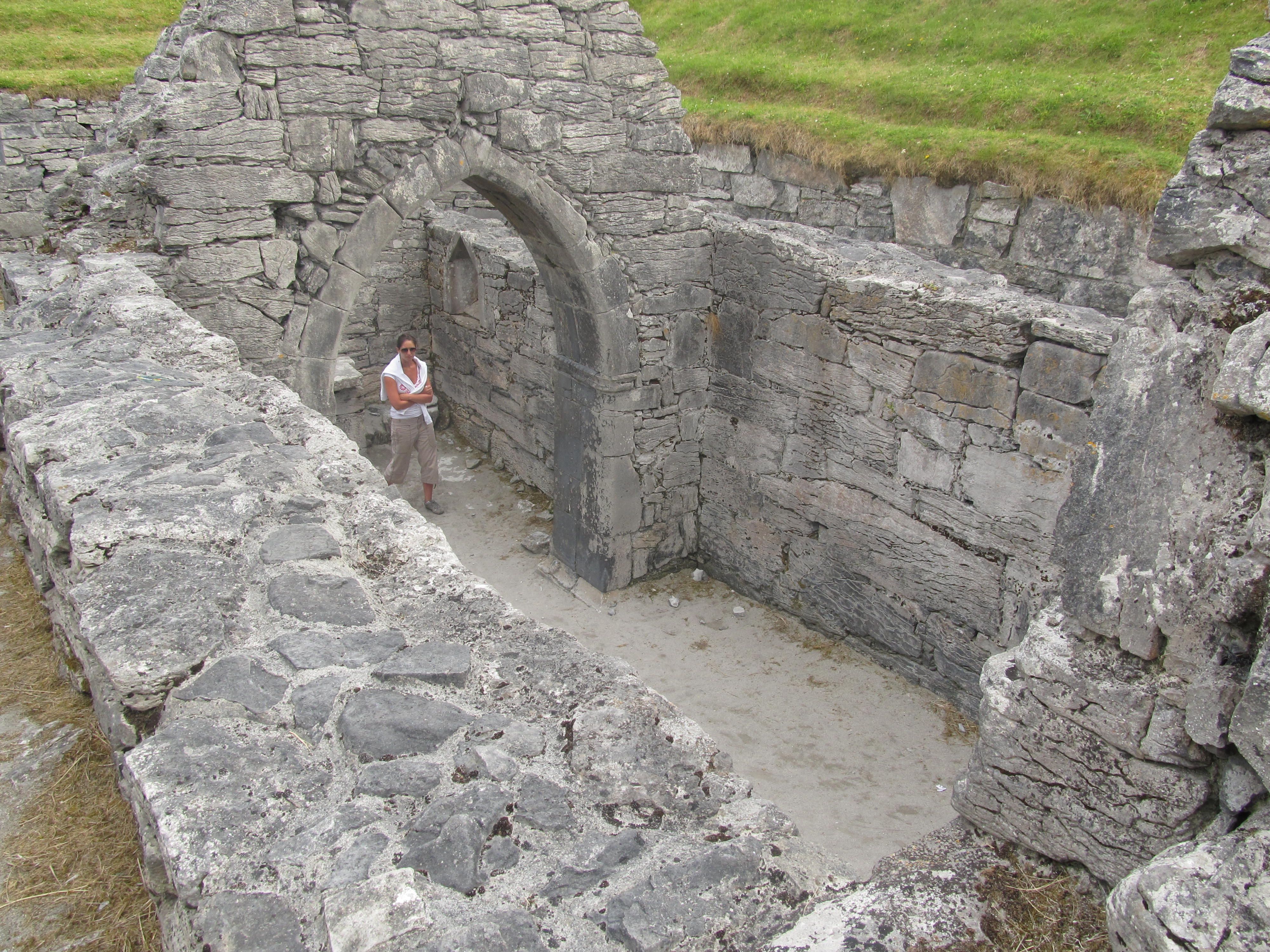
Among the morning hymns of Dánta Dé is a short prayer for shelter and protection. In the spirit of the Circle of Protection statement, I offer it here on behalf of the poor and hungry. It is set out below in the original Irish, in the translation by Úna ní Ógáin, and in my own translation:

Rí na naomh dár ndíon gach lae
Ar shaoigheadaibh daora an dhiabhail
Noch bhís go gear ar tí gach naoimh
De chlainn bhoicht Éabha riamh
Mo mhile lean-sa claoidhte faon
Faoi gach éiliomh dian,
Acht tríot-sa, a aon-mhic dhilis dé,
Go dtigeam-na saor ó phian

Ms. ní Ógáin’s translation:

The King of the saints be our shelter each day,
Against the dangerous darts of the devil,
Who is ever keenly pursuing each saint
Of the poor children of Eve
My thousand sorrows, worn, exhausted,
Because of each hard temptation;
But through Thee, o dear Only Son of God,
May we come safe from pain.

My own translation:

King of the saints, our shelter every day
Against the furious arrows of the devil
Who is [constantly] sharply pursuing each saint
Of the poor children of Eve
Our thousand sorrows, worn down, helpless
Because of each severe corruption
But through you, God’s only true Son,
May we come free of pain.

Just as the dúns and cathairs of ancient Ireland provided circles of protection for those who lived within them, the Christian community is to be a circle of protection. The difference between the church and the dúns and cathairs is that the circle of protection drawn by the Christian is to be inclusive of all, those without as well as those within. Archbishop William Temple, who was Archbishop of Canterbury during the Second World War, once wrote these words: “The Church is the only society that exists for the benefit of those who are not its members.” And I am reminded of the poem Outwitted by American poet Edwin Markham:

He drew a circle that shut me out —
Heretic, rebel, a thing to flout.
But Love and I had the wit to win:
We drew a circle that took him in.

Two Monastic Foundations (Co. Wicklow) – Part Two

While I was in County Wicklow (Contae Chill Mhantáin), as I have earlier reported, I visited two very different monastic ruin sites: Glendalough, where Naomh Caoimhín (St. Kevin) established a “monastic city” in the 6th Century, and Baltinglass Abbey, a Cistercian foundation established in 1148 by Dermot McMurrough, king of Leinster. The former is now a very large national park with an impressive visitors center and a four-star hotel; the latter is tucked away in a forgotten corner of the town of Batlinglass in the churchyard of a minor Church of Ireland parish behind a national school, with no accommodation for visitors as all.

St. Mary's - Baltinglass, Church of Ireland, on Whose Grounds the Abbey Is Located

St. Mary's - Baltinglass, Church of Ireland, on Whose Grounds the Abbey Is Located

This is the second part of a two-part entry; the first part was a description of my visit to Glendalough. This is a description of Baltinglass Abbey.

Baltinglass Abbey

Baltinglass Abbey

Baltinglass was the second house to be colonized from the Cistercian (also known as “Trappist”) stronghold at Mellifont Abbey. The first was Bective Abbey in Co. Meath founded in 1147.

Mellifont itself was founded in 1142. Known in Irish as An Mhainistir Mhór, literally “the big abbey”, it thrived for 400 years until it was disestablished in 1556. Thereafter, it was used as a Tudor manor house until it was finally abandoned in 1727. New Mellifont Abbey was founded in 1938 and is now an active Trappist monastery. It is located in County Louth, north of Dublin.

Baltinglass was a successful abbey and, in its turn, colonized other foundations, including the more famous Jerpoint Abbey in County Kilkenny in 1180.

Baltinglass Abbey

Baltinglass Abbey

The construction of the permanent buildings at Baltinglass began only a few years after the initial foundation and the church was raised relatively quickly. The buildings are typical of the Irish versions of the Cistercian Romanesque style.

One of the abbots built himself a “tower house” or castle in the late middle ages, and in 1541 it was reported that Baltinglass owned castles at Graungeforth, Knocwyre, Mochegraunge, Graungerosnalvan, Grangecon, and Littlegraunge among others.

Tower House within Baltinglass Abbey

Tower House within Baltinglass Abbey

In the early 16th Century the annual income of the abbey was estimated at £76 in time of war and £126 in peace time. These may not seem like large figures until one considers the comparative value of the pound in the early 16th Century. That pound (actually a monetary unit known as the Angel at the time) would have a current value of £4,910 (or $8,105). Thus, annually the war time income of Baltinglass Abbey would have been £373,000 (about $616,000); peace time income, £620,000 (about $1,023,000). This made Baltinglass one of the richest Cistercian abbeys in Ireland at the time.

Perhaps its financial success is the reason Baltinglass was one of the first five Irish Trappist monasteries suppressed in the first round of closures during Henry VIII’s Dissolution in 1536-37.

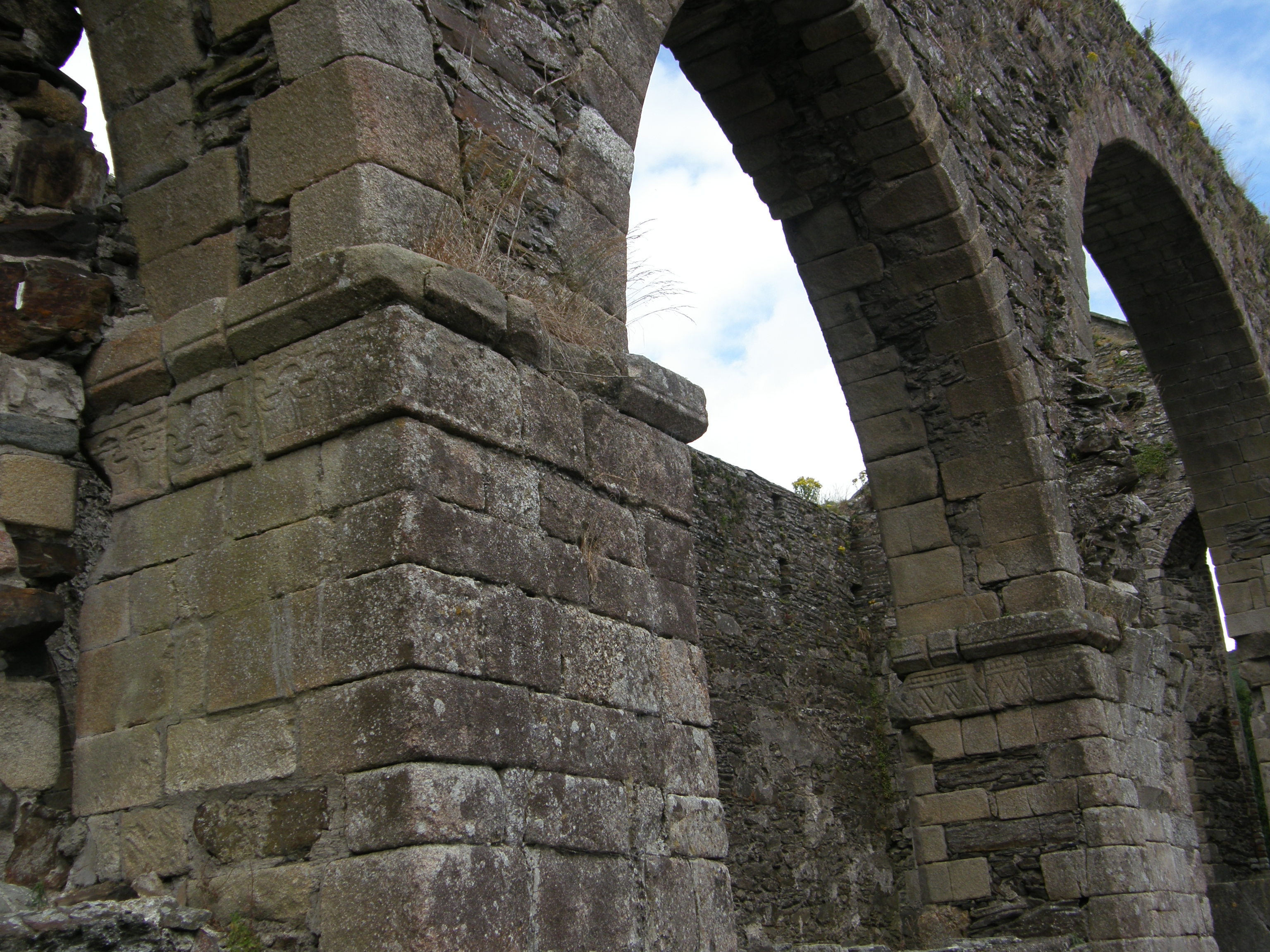
Although none of the conventual buildings survive, the abbey church remains relatively unscathed. The church is considered one of the finest examples of Romanesque architecture in Ireland. The church contains a rich array of carvings, including some with animals and human figures. The northeast crossing pier is decorated with a lion and foliage ornaments. The nave of the church is aisled with alternating cylindrical and square piers, which are of English origin, the bases of which are decorated with a range of unusual designs.

Romanesque Arches at Baltinglass Displaying Decorative Carving

Romanesque Arches at Baltinglass Displaying Decorative Carving

Nave Arches at Baltinglass, Note the Alternating Cylindrical & Square Piers

Nave Arches at Baltinglass, Note the Alternating Cylindrical & Square Piers

These were crafted by the so-called “Baltinglass Master” who subsequently worked on the abbey at Jerpoint. A series of tiles have also been discovered at the site; one design depicts a warrior thrusting forward with a circular shield.

Baltinglass Tile showing Ornate Celtic Knotwork

Baltinglass Tile showing Ornate Celtic Knotwork

Other features of interest are the bases of two Romanesque doorways in the nave aisle and the well-preserved sedilia in the presbytery.

The Sedilia (Inset Clergy Seating) at Baltinglass Abbey

The Sedilia (Inset Clergy Seating) at Baltinglass Abbey

An odd and very out-of-place addition to the site is a great pyramid style granite mausoleum, built in 1832 as a tomb for the Stratford family who were powerful estate owners in the area.

The Stratford Family Mausoleum

The Stratford Family Mausoleum

One wonders why, if a leading Irish architecture magazine (Archiseek) has declared that Baltinglass Abbey is “considered one of the finest examples of Romanesque architecture in Ireland,” this site is not better preserved and presented. I have some thoughts, not all of them complimentary to the Irish people or the Irish church….

First, I would note that Baltinglass Abbey was not an indigenous Irish foundation – it was Cistercian, an order from France. Glendalough, on the other hand, was founded by a beloved indigenous, early Celtic saint. Now this alone is not a reason for it to be so ignored in its little corner of Co. Wicklow. There are plenty of well-preserved and better presented Trappist foundations; Baltinglass’s daughter house, Jerpoint Abbey, is one example.

Second, I think it more important in this regard to not that Baltinglass is not held and administered by the Office of Public Works, Heritage Ireland, or another state agency as the better presented sites are. Rather, it is (as noted) on the grounds of a parish of the Church of Ireland. All of the historic church properties of Ireland after the reformation (especially after the dissolution of the monasteries) became the property of the established church – although this country was a part of the English Crown’s domain at the time, this was not the Church of England. Rather the Church of Ireland came into existence as a reformed church independent of the Roman Catholic Church in 1536 when the Irish Parliament declared Henry VIII to be the Supreme Head of the Church on earth (i.e. Head of the Church of Ireland); Henry actually became head of the Irish church before becoming king of the Irish nation! He was not declared King of Ireland until 1541. (Previously, his title, one granted English kings by the Pope, was Lord of Ireland. The declaration that he was King of Ireland was, therefore, part of the Anglo-Irish ecclesio-political reform.)

The Church of Ireland was disestablished by The Irish Church Act of 1896, which empowered the commissioners of the Church of Ireland to transfer all important churches and ecclesiastical buildings into the care of the Irish State, to be preserved as national monuments and not to be used as places of public worship. One hundred thirty-seven ancient buildings, apparently not including Baltinglass Abbey, were listed for transfer to the Commissioners of Public Works. The paramount consideration was the saving of the nation’s architectural heritage. Had Baltinglass Abbey been transferred to the Public Works department, there would be a better chance of it having a better presentation.

Why do I think this would be the case? Two reasons. First, the Church of Ireland is not a wealthy church by any stretch of the imagination. I believe it is incapable of properly funding the support of its aging buildings, especially those which are not in regular use. In my travels around this country, I have been distressed to see the poor state of repair of many Anglican churches. If I were asked (and I haven’t been, admittedly) I would recommend to the Church of Ireland that it undertake a program of building renewal and refurbishment, and in some cases of building divestment – including divesting itself of antiquities it cannot properly maintain.

Second, the Church of Ireland is a minority church; in 2006 (latest year for which I can find statistics) less than 3% of the people of the Irish Republic declared themselves members of the Anglican church here. Nearly 87% declared themselves Roman Catholic. The other ten percent are shared among other Christian traditions and other religious faiths, as well as a large group (more than half the size of the Church of Ireland) who state they are non-religious. Despite being a modern, secular state (although one with heavy involvement from the majority religious body, especially in the area of education), Ireland is a very divided culture.

I remember being in Donegal and asking about the whereabouts of members of the Funston family there or in neighboring counties. The very lovely and gracious lady with whom we were talking was from the village of Pettigo and recalled that there were Funstons living there, “but they weren’t our people,” by which she clearly meant they weren’t Roman Catholic. (As it turned out, the Funstons we did eventually meet were Anglicans.)

I believe this divide deprives Church of Ireland antiquity sites like Baltinglass Abbey of the broader publicity and support they might otherwise get. I was surprised to find that, although there is public signage to other places in the village of Blatinglass (including Roman Catholic churches), there is none indicating where one can find the Abbey! (Remember, this is a place “considered one of the finest examples of Romanesque architecture in Ireland”!) I had to stop at a petrol station to ask how to find it….

I may be wrong … but the difference in the treatment of these two monastic sites in the same county suggests to me that the Republic of Ireland still has a long way to come in the dealing with the divide between “Catholic” and “Protestant” (which Anglicans are here considered to be … and for now I won’t get into that debate).

Nonetheless, having visited both Glendalough and Baltinglass Abbey during my stay in County Wicklow, I give thanks to God for the witness of the men and women who lived and worked in such foundations. I offer in celebration of their faith the closing doxology of the Dánta Dé hymnal, first in Irish and then in translation:

Dennacht ocus étrochta,
Ecna, altugud buide,
A mórnert is comachta
‘Con Ríg comic na huile.

Glóir is cáta is caendúthracht,
Molad, airfitiud adbal,
Rográth ón uile chride
Do Ríg nime ocus talman.

Forsin Trínóid togaide
Ré cách, iar cách, do ellacht
Bennacht ocus bithbennacht,
Bithbennacht ocus bennacht.

And the English translation:

Blessing and radiance,
Wisdom and thanksgiving,
Great power and might,
Be to the King who rules over all.

Glory and honor and sweet-devotion,
Praise and wondrous music
Ardent love from every heart
To the King of heaven and earth.

To the exalted Trinity
Before all, after all, hath pertained
Blessing and eternal blessing,
Blessing-eternal and blessing.

Two Monastic Foundations (Co. Wicklow) – Part One

While I was in County Wicklow (Contae Chill Mhantáin), as I have earlier reported, I visited two very different monastic ruin sites: Glendalough, where Naomh Caoimhín (St. Kevin) established a “monastic city” in the 6th Century, and Baltinglass Abbey, a Cistercian foundation established in 1148 by Dermot McMurrough, king of Leinster. The former is now a very large national park with an impressive visitors center and a four-star hotel; the latter is tucked away in a forgotten corner of the town of Batlinglass in the churchyard of a minor Church of Ireland parish behind a national school, with no accommodation for visitors as all.

This will be a two-part entry consisting first of a description of my visit to Glendalough.

The name Glendalough comes from the Irish Gleann Dá Locha, meaning “Glen of Two Lakes”, so as you might guess, the site is quite large. It is encompasses the two lakes, several ruined buildings, and a round tower. I spent nearly three hours there and saw only a small part of site. (It was a cloudy day, so my pictures are rather dark.)

One enters the “monastic city” by way of a gateway which is unique among Irish monastic ruins. Other monasteries or abbeys may have had such gateways, but this seems to be the only one that has been preserved. The gateway originally may have been roofed over for several meters. The gateway signified that one was entering a place of sanctuary or refuge.

Entering the Monastic City through the Gateway

Entering the Monastic City through the Gateway

Gateway to Monastic City Seen from within the City

Gateway to Monastic City Seen from within the City

As one enters the monastic city now, what one mostly sees are gravestones. Like nearly all ruined monastic cites (and many ruined churches) it has continued to be considered holy ground and thus an appropriate place for the burial of the faithful. Most of the buildings that would have comprised the city at its largest size were probably thatch-roofed wattle-and-daub structures which are long gone. The monastery in its heyday would have included workshops, areas for manuscript writing and copying, guest houses, an infirmary, and farm buildings and dwelling for both monks and a large lay population. What remain are a few stone structures, including a “cathedral” and a round tower. Most of the surviving buildings probably date from between the 10th and 12th Centuries.

The round tower is constructed of mica-slate and granite; it is about 30 meters high, with an entrance 3.5 meters from the base. At one time it was thought that these high entrances to round towers were for defensive purposes, but it is now believed that they are that high simply to provide the most solid possible foundation for the structure, to prevent leaning or collapse.

Round towers were meant to be seen; they were built to provide a landmark for pilgrims making their way to the monasteries. There are 52 known round towers in Ireland, all associated with monasteries, abbeys, and cathedral churches, places of pilgrimage. They were probably also meant to be heard. The Irish word for a round tower is cloigtheach, which means “bell house”.

The Round Tower at Glendalough

The Round Tower at Glendalough

The largest structure on the site is the “cathedral”. It is constructed of mica-shist and granite. It is thought that a smaller structure was replaced in the 12th or 13th Century with the current building.

Interior of the Glendalough Cathedral

Interior of the Glendalough Cathedral

A few steps from the front door of the cathedral is “the priest’s house”. The original purpose of this building is unknown, though it is thought that it may have housed the relics of St. Kevin. It’s current name comes from the practice of interring priests here during the 18th and 19th Centuries.

The Priest's House

The Priest's House

The only roofed structure on the site is St. Kevin’s Church, also called St. Kevin’s Kitchen. It is a nave-and-chancel church from the 12th century. It has a small round belfry above the west doorway, which apparently was added to the church after the original construction. Only the foundations now remain of the chancel, and beside it still stands the stone-roofed sacristy.

St. Kevin’s Kitchen

St. Kevin’s Kitchen

Passing St. Kevin’s Kitchen, one makes ones way to the 1.4 km pathway along the mountain-side of the lower lake (a 1.6 km boardwalk path is available along the other side).

Oak Forest through with the Pathway Runs

Oak Forest through with the Pathway Runs

At the upper lake (which is the prettier of the two lakes) are additional ruins – the Reefert Church, St. Kevin’s Cell (remains of a stone beehive hut), St. Kevin’s Bed (a man-enlarged cave), and Teampall na Skellig (the latter two reachable only by boat) – and natural wonders such as Poulanass Falls.

The Upper Lake

The Upper Lake

Stream from Poulanass Falls

Stream from Poulanass Falls

The only one of these that I visited is the Reefert Church. (My right ankle on which I had Achilles tendon surgery a couple of years ago was complaining by the time I got to the upper lake, so further mountain trails were not inviting). The name derives from Righ Fearta, meaning the burial place of the Kings. Reefert Church is set on the mountain side and is approached by a steep path and a stone stairway.

Reefert Church

Reefert Church

Reefert Church

Reefert Church

I walked back to the monastic city by way of the boardwalk, a longer but easier path.

Boardwalk along the Lower Lake

Boardwalk along the Lower Lake

As one approaches the monastic city, one sees the Round Tower as an approaching pilgrim may have seen it. (In the foreground of the following picture is St. Mary’s Church, a ruin not accessible to visitors.)

The Round Tower Seen from the Boardwalk

The Round Tower Seen from the Boardwalk

St. Kevin’s monastic city thrived from its founding in the 6th Century until it was sacked by English forces in 1398. However it continued as a church of local importance and a place of pilgrimage. Descriptions of Glendalough in the 18th and 19th Centuries include reference to occasions of “riotous assembly” on the feast of St. Kevin (June 3).

Today, it is a tourist attraction as well as a place of pilgrimage. There were tour groups from many nations while I was there (I heard French, Spanish, Italian, and German spoken along the path as I walked between the lakes). There was also a group from Ecuador singing and praying inside the cathedral during my visit. The monastic ruins at Glendalough are an active place!

Not so the ruins at Baltinglass which I will describe in part two of this entry.

Memories and Good-Byes

I received word yesterday that Earl, a long-time parishioner and good friend back home, had passed away. This was not a surprise; he had been diagnosed with lung cancer some months ago and we expected that he would die while I was on sabbatical. Still, it has filled the day with sadness. I think of his wife, his children, his grandchildren, all of whom I know, and I know that today is a hard one for them. No matter how prepared for a loved one’s death we believe we are, we aren’t. It’s that simple. Death is never easy.

My father died suddenly and unexpectedly when I was not quite six years old; we weren’t prepared. My mother and step-father both died after long and protracted illnesses; we weren’t prepared either time. My mother-in-law passed away after several years of decline into the living death that is Alzheimer’s Disease; even with that long and difficult course, we weren’t prepared. Through the years other friends and family members have died. Parishioners and parishioners’ loved ones have died and I have officiated at their burials and celebrated the Requiem Masses for the repose of their souls. The one thing all of these passings has taught me … no matter how prepared for a loved one’s death we believe we are, we aren’t.

The Irish live with death closer at hand than any other people I’ve encountered. Oh, for sure, there are places where the physical reality of death is nearer at the present; places where famine reigns, places like Somalia and in recent years Ethiopia and other north African countries from which we see the pictures of emaciated corpses and children with malnutrition-distorted bodies. The Irish lived through times like those 165 and more years ago; as the saying goes, they’ve been there, done that.

I’ve written earlier about the famine houses and how they are a living, daily memory of that time. I didn’t write in that entry that in addition to the abandoned homes, there are famine houses that were tombs. Starving families would simply close their door and huddle together in a corner of the house and die. There was no food; there was nothing else to do. (I’m told that there are recorded instances of cannibalism during the famine years. I’ve not read those records myself.) The Irish have been there, done that.

The famine houses are not the only reminders of mortality on this island. There are also the ruins of churches, of small parish churches, of missionary encampments, of great monasteries dating back to the first days of Christianity in Ireland. The names of some are well known: Ballentubber Abbey, a ruin now restored as a parish church and described in another post on this blog; Clonmacnoise in County Offaly which dates from the middle of the 5th Century; the Rock of Cashel, the remains of a 12th Century monastery on a site reputed to have been used by Patrick for the baptism of the kings of Ireland in the 5th Century; Glendalough founded in the Wicklow Mountains by St. Kevin in the 6th Century.

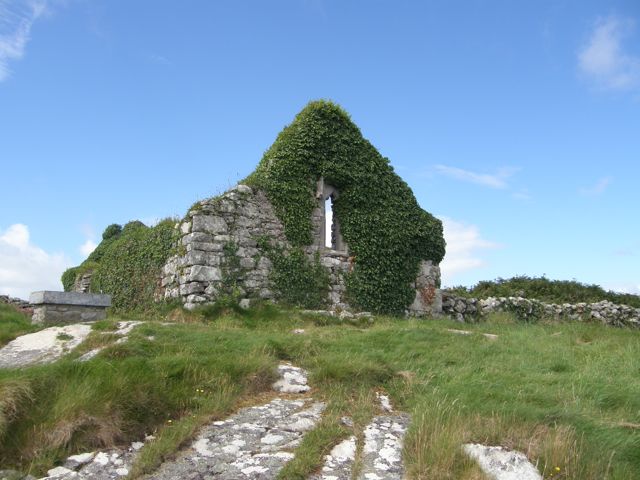
Others are not so well known; Teampall Mhic Ádhaimh (“Church of the Son of Adam”) is a local ruin here on An Cheathrú Rua. Local tradition has it that it was built by a Saint Smochan and archeological and architectural evidence points to a 15th Century construction date. This church is located near the water’s edge at Trá na Reilige (“Beach of the Burial Ground”) at Barr an Doire (“Oaktree Point”).

Teampall Mhac Ádhaimh (Church of the Son of Adam), An Cheathrú Rua

Teampall Mhac Ádhaimh (Church of the Son of Adam), An Cheathrú Rua

Teampall Mhac Ádhaimh (Church of the Son of Adam), An Cheathrú Rua

Teampall Mhac Ádhaimh (Church of the Son of Adam), An Cheathrú Rua

Another is Teampall Chaomháin (“St. Kevin’s Church”), the buried church on Inis Oírr, the smallest of the Aran Islands. These churches probably came into ruin as a result of “the Penal Years” when the practice of Roman Catholicism in Ireland was outlawed by the English. They came into ruin, but not disuse.

Teampall Chaomháin, Inis Oírr (photo from Ciara Grogan)

Teampall Chaomháin, Inis Oírr (photo from Ciara Grogan)

Teampall Chaomháin, Inis Oírr (photo from Ciara Grogan)

Teampall Chaomháin, Inis Oírr (photo from Ciara Grogan)

Like many local (and monastic) ruins throughout Ireland, these ruined churches were considered holy ground and so they became burial grounds.

Burial Ground at Teampall Chaomháin, Inis Oírr (photo from Ciara Grogan)

Burial Ground at Teampall Chaomháin, Inis Oírr (photo from Ciara Grogan)

Burial Ground at Teampall Chaomháin, Inis Oírr (photo from Ciara Grogan)

Burial Ground at Teampall Chaomháin, Inis Oírr (photo from Ciara Grogan)

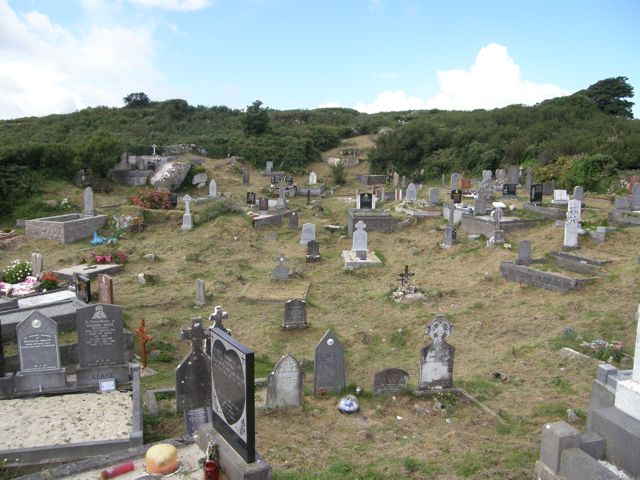
Burial Ground at Teampall Mhac Ádhaimh, Barr an Doire, An Cheathrú Rua

Burial Ground at Teampall Mhac Ádhaimh, Barr an Doire, An Cheathrú Rua

Burial Ground at Teampall Mhac Ádhaimh, Barr an Doire, An Cheathrú Rua

Burial Ground at Teampall Mhac Ádhaimh, Barr an Doire, An Cheathrú Rua

I wandered through the graveyard at Barr an Doire and photographed some of the gravestones, many carved in beautiful Gaelic text. This one marks the grave of Bairbre Nic Donncha, who died April 20, 1960, her husband Peadar, who followed her two days later, and their son Peadar, who died a few days before Christmas in 1995. The blessing on the marker reads, Ar deis De go raibh anam – A chlann a thog, which means “May their souls be at the right hand of God, their family prays.”

Gravestone at Teampall Mhac Ádhaimh, Barr an Doire, An Cheathrú Rua

Gravestone at Teampall Mhac Ádhaimh, Barr an Doire, An Cheathrú Rua

The next stands over the tomb of Chóilín Phádraig Pheatsín, who died April 2, 1959, and his wife Nora, who joined him on March 1, 2002. The prayer reads Taispeáin dúinn, a Thiarna, do trócaire agus tabhair do shlánú (“Show us, Lord, your mercy and grant us your salvation”).

Gravestone at Teampall Mhac Ádhaimh, Barr an Doire, An Cheathrú Rua

Gravestone at Teampall Mhac Ádhaimh, Barr an Doire, An Cheathrú Rua

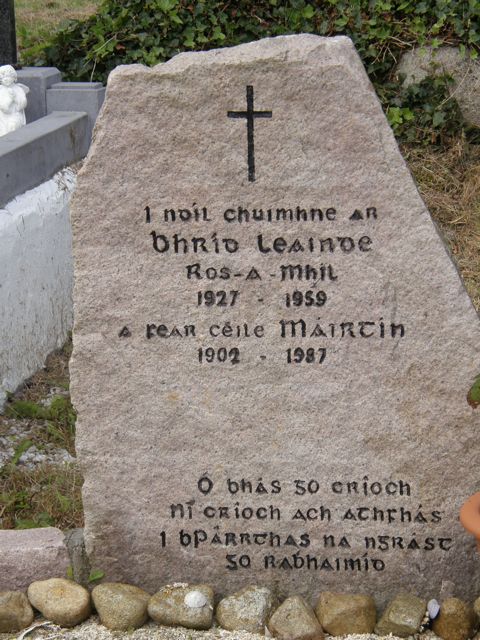
And finally this marker over the grave of Bhrid Leainde, who passed away at the young age of 32 in 1959 and was followed by her husband Máirtín, who died at the age of 85 in 1987. I really like the sentiment expressed on this gravestone: Ó bhás go críoch ní críoch ach athfhas i bPárrthas na ngrast go rabhaimíd (“From death to an end not an end but new growth, we go to the Paradise of grace”).

Gravestone at Teampall Mhac Ádhaimh, Barr an Doire, An Cheathrú Rua

Gravestone at Teampall Mhac Ádhaimh, Barr an Doire, An Cheathrú Rua

Though surrounded by reminders of the deaths of the famine years and by the ruins of churches and the graves they contain, I’m sure Bairbre’s and Peadar’s family, that Chóilín’s and Nora’s children, that Bhrid’s and Máirtín’s loved ones were not prepared for their deaths. No matter how prepared for a loved one’s death we believe we are, we aren’t. And yet we are sustained by faith, by the faith that assures us that death is not an end, but the beginning of new growth in a paradise of grace where, through the Lord’s mercy, we enjoy the fruits of salvation and sit at God’s right hand.

There is a poem by Máirtín Ó Direáin inscribed on a stone plaque dated August 2000 at Teampall Chaomháin on Inis Oírr. The plaque includes a verse of scripture (Is mise an t-aiséirí agus an bheatha – “I am the resurrection and the life”) and a prayer (Suaimhneas sioraí dar muintir a d’migh uainn – “Eternal peace to the people who have left us”). The poem is entitled Cuimhní Cinn (“Memories”). I’ve tried to find a translation, but failing that have translated it myself.

Stone Plaque at Teampall Chaomháin, Inis Oírr (photo from Ciara Grogan)

Teampall Chaomháin, Inis Oírr (photo from Ciara Grogan)

Their memory still lives in my mind:
A white jacket and a bright shirt,
a blue shirt and a green vest,
trousers and drawers of homespun;
our honored old men
traveling to Sunday morning Mass,
a long journey on foot
wakening in my youth my own thoughts:
our ground, our earth, still our blessing.

Their memory still lives in my mind:
Long red choir robes,
blue coats dyed with indigo,
neat knitting women
now in heavy shawls up from Galway
traveling to Mass in the same way;
and although they are going out of fashion
their memory still lives in my mind.
Certainly life will come to me from this land.

Earl’s memory lives in my mind – a tweed sport coat, a purple shirt, two canes, a bushy beard, and ready smile. We knew this was coming, but no matter how prepared for death we believe we are, we aren’t. Being in community, traveling together to Mass memories alive in everyone’s minds, helps us get through that unpreparedness. I’m sorry I can’t be there with our church community to say “Good bye”.

May he rest in peace and rise in glory.

A Word about Signs

Signs are ubiquitous – they are everywhere! Do you remember that old rock-and-roll song by the Five Man Electrical Band (and I do mean old, like 40 years old!)?

And the sign said “Long-haired freaky people need not apply”
So I tucked my hair up under my hat and I went in to ask him why
He said “You look like a fine upstanding young man, I think you’ll do”
So I took off my hat, I said “Imagine that. Huh! Me workin’ for you!”
Whoa-oh-oh

Sign, sign, everywhere a sign
Blockin’ out the scenery, breakin’ my mind
Do this, don’t do that, can’t you read the sign?

And the sign said “Anybody caught trespassin’ would be shot on sight”
So I jumped on the fence and yelled at the house,
“Hey! What gives you the right?
To put up a fence to keep me out or to keep mother nature in
If God was here, he’d tell you to your face, Man, you’re some kinda sinner”

Sign, sign, everywhere a sign
Blockin’ out the scenery, breakin’ my mind
Do this, don’t do that, can’t you read the sign?

Now, hey you, mister, can’t you read?
You’ve got to have a shirt and tie to get a seat
You can’t even watch, no you can’t eat
You ain’t supposed to be here
The sign said you got to have a membership card to get inside
Unh!

And the sign said, “Everybody welcome. Come in, kneel down and pray”
But when they passed around the plate at the end of it all,
I didn’t have a penny to pay
So I got me a pen and a paper
and I made up my own little sign.
I said, “Thank you, Lord, for thinkin’ ’bout me. I’m alive and doin’ fine.”
Wooo!

Sign, sign, everywhere a sign
Blockin’ out the scenery, breakin’ my mind
Do this, don’t do that, can’t you read the sign?

Sign, sign, everywhere a sign
Sign
Sign, sign

They are everywhere! There aren’t a lot of commercial advertising signs in the UK or in Ireland (well, there are a lot in Ireland, but they are mostly small and local). One of my favorites is this on one the local pier (Caladh Tadgh – “the stone pier”):

Sign at Caladh Tadhg, An Cheathrú Rua, Co. na Gaillimhe, Éire

Sign at Caladh Tadhg, An Cheathrú Rua, Co. na Gaillimhe, Éire

I actually have no idea at all what this sign is saying, but I love the wording of it and all the things it suggests to a strange mind like my own.

Here’s another sign one sees a lot of in this part of Ireland these days:

Irish Real Estate "For Sale" Sign

Irish Real Estate "For Sale" Sign

Le Diol is Irish for “For Sale.” If I had the money, I’d be very tempted to buy one of the properties where a sign like this is posted. (The one in this picture is a bed-and-breakfast property in An Cheathrú Rua. I wonder what it would be like to run a B&B….)

There is a sign one sees in the UK and here in Ireland that is similar to a sign we see along roads in the USA:

UK - Ireland Road Sign showing a Camera

UK - Ireland Road Sign showing a Camera

In the States, the sign that is sort of like this (in that it depicts a camera) generally indicates a scenic view-point from which one can take nice photographs. I first saw this sign in southern Scotland, but it never seemed to be at a place where there was anything to see or, if it was, there was never a convenient place to pull over and take a photograph. So I was puzzled by these signs. Since I couldn’t see any scenic view-point pullouts, I began to ignore them.

Then in Derbyshire, I saw the sign together with a sign warning of the presence of pedestrians:

Camera Sign together with Pedestrian Sign

Camera Sign together with Pedestrian Sign

So I was all the more confused. Surely, these signs must be pointing to something worth seeing, and I was missing these scenic views! But there were still no places to pull over where the signs were posted and I didn’t want to just stop in the road way!

Then, near the home of my friends in Penn, High Wycombe, I saw a sign with the same camera image but accompanied by explanatory words:

Speed Cameras Sign

Speed Cameras Sign

Oh! They aren’t signs about scenic views at all! They are signs warning speeding motorists that they are being photographed and their license plate numbers recorded!

Thank heaven I was driving at or below the speed limit (not always true at home, I admit) in the UK and continue to do so here in Ireland. (Of course, I’m of the opinion that anyone who exceeds the speed limit – or, in some places, even drives as fast as the limit – on these roads is completely nuts!)

The lesson of this sign is that we ignore signs, especially those we don’t really understand, at our own peril. That’s true spiritually as surely as it is in driving through a country not one’s own. Being unable to read a sign reminds me of an incident in Matthew’s Gospel:

The Pharisees and Sadducees came, and to test Jesus they asked him to show them a sign from heaven. He answered them, “When it is evening, you say, ‘It will be fair weather, for the sky is red.’ And in the morning, ‘It will be stormy today, for the sky is red and threatening.’ You know how to interpret the appearance of the sky, but you cannot interpret the signs of the times. An evil and adulterous generation asks for a sign, but no sign will be given to it except the sign of Jonah.” Then he left them and went away. (Matthew 16:1-4)

Matthew does not further explain “the sign of Jonah,” but Luke quotes Jesus as explaining the symbolism in his version of this story, “Just as Jonah became a sign to the people of Nineveh, so the Son of Man will be to this generation.” (Luke 11:30) Generally, the “sign of Jonah,” the witness of Jonah as prophet to the ancient Israelites is taken to mean that if Israel would not repent, God would take away the power and strength he had given them and give it to a another nation or people, and that nation would (in turn) humiliate and punish Israel.

So when we fail to appreciate, to understand and heed those signs that appear in our lives, we run the risk of losing that with which we have been entrusted. We run the risk of losing the ministry and the benefits we have been given, and find ourselves in need. We have all been given gifts, and we are expected to use them to the benefit of others; failing to do this, we run the risk of losing them. “From everyone to whom much has been given, much will be required; and from the one to whom much has been entrusted, even more will be demanded.” (Luke 12:48)

Pay attention to the signs in your life!

I’ve not been back to Caladh Tadhg since shooting that first photograph, but when I do I’ll be sure to disinfect!

The Morning Star – Another Musical Bit

I’m experimenting with and learning more about the music software. I’ve put together another selection from the Dantá Dé hymnal which I am calling The Morning Star as a working title. My earliest translation of the lyrics that go with this tune was sung by one of our choristers as a solo at church a couple of years ago; I’m scrapping that translation and starting over. But in the meantime, here’s a simulated four-part choir accompanied by piano with the melody.

The Morning Star

The Blessed Wedding in Cana

There was a wedding on An Cheathrú Rua last week. (By the way, that preposition is correct. One speaks of being on An Cheathrú Rua rather than in it. It is a peninsula, after all.) The groom was a bartender at the pub frequented by our student body and the reception, such as it was (very unlike an American wedding celebration) was held there. Anyone and everyone who happened in was a welcome guest.

I did not have an opportunity to witness the wedding, nor any of the preparations. However, when I was in Ireland in 2008, some friends and I climbed Croagh Padraig, the holy mountain in County Mayo also known as “The Reek”. There is an annual event here called “Reek Sunday” (the last Sunday of July) when the penitent climb the mountain. The truly penitent climb it barefoot. Having climbed it wearing fairly sturdy hiking shoes, I can assure you that that would be a substantial act of penitence; but little old ladies were doing just that when I climbed it (a week after Reek Sunday), and they were going up that slope faster than I was! (The background image on this blog, by the way, is Croagh Pádraig.) The hike up the mountain is in emulation of St. Patrick who is said to have climbed the mountain, cleansed it of druid religious use, and offered the Eucharist on its summit.

Another part of the meditative tradition of Croagh Padraig is to start one’s pilgrimage to the mountain at Ballintubber Abbey. Ballintubber is an Anglicization of Baile tobair Phádraig, “place of the well” – the well in question supposedly being a place where St. Patrick baptized converts. Ballintubber Abbey is about 22 miles from Croagh Padraig, so the full penitential practice is to hike cross-country on the Tóchar Phádraig (“Patrick’s Causeway”) and then climb the mountain.

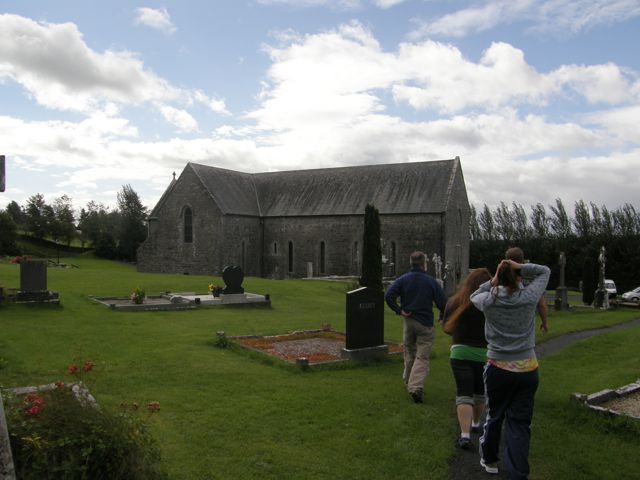
Ballintubber Abbey Church, Co Mayo, Éire

Ballintubber Abbey Church, Co Mayo, Éire

The abbey church has been beautifully restored and is the parish church for the village of Ballintubber. (The church has a lovely website here.) http://www.ballintubberabbey.ie/ My friends and I short-circuited the tradition by attending Mass at the abbey church and then driving from there to the mountain.

Ballintubber Abbey Church, Co Mayo, Éire

Ballintubber Abbey Church, Co Mayo, Éire

The grounds of the abbey church are filled with graves and with statuary, some of it very modern and very interesting, especially a set of non-representational Stations of the Cross which are abstract stone work in place of the usual pictures or statues of the fourteen steps of the way of tears; for example, the Ninth Station, Jesus’ Third Fall, is simply a fallen stone whose shape is vaguely suggestive of a human body.

Ballintubber Abbey Church, Co Mayo, Éire, Stations of the Cross, No. 9

Ballintubber Abbey Church, Co Mayo, Éire, Stations of the Cross, No. 9

The most representational of the stations is the Eleventh, the Crucifixion.

Ballintubber Abbey Church, Co Mayo, Éire, Stations of the Cross, No. 11

Ballintubber Abbey Church, Co Mayo, Éire, Stations of the Cross, No. 11

There is also a wonderful statue of the Madonna with her Child. I find the faces and the poses of the pair striking. Mary is, I believe, depicted as strong and sad; she looks both defiant and obedient, as if unwilling to turn loose of her Son and yet aware that that choice is really not hers to make. As she holds him in a cruciform pose, she seems to be both offering and protecting him at the same time. The Christ Child is depicted in the familiar cruciform manner, but his face is turned towards his mother, not toward the viewer as is more typical. He seems almost puzzled by his Mother’s expression.

Ballintubber Abbey Church, Co Mayo, Éire, Madonna and Child

Ballintubber Abbey Church, Co Mayo, Éire, Madonna and Child

Ballintubber Abbey Church, Co Mayo, Éire, Madonna and Child

Ballintubber Abbey Church, Co Mayo, Éire, Madonna and Child

I often wonder about the relationship between Mary and Jesus. We get only a few glimpses of it in the Gospels. One of my favorite episodes is the Wedding in Cana related in the Gospel of John:

On the third day there was a wedding in Cana of Galilee, and the mother of Jesus was there. Jesus and his disciples had also been invited to the wedding. When the wine gave out, the mother of Jesus said to him, “They have no wine.” And Jesus said to her, “Woman, what concern is that to you and to me? My hour has not yet come.” His mother said to the servants, “Do whatever he tells you.” (John 2:1-5, NRSV)

I have long been fascinated and intrigued by the interaction here! Mary simply assumes that Jesus will take action (and that he has the power to do something to solve the problem of no wine). He feels free to respond negatively to her implied direction, “Help them,” but in the end he does as his mother seems to insist and the result is, as John will later call it, “the first of his signs, in Cana of Galilee.” (v. 11) This multifaceted relationship (which, I suppose, was not too different from any mother-son relationship) was probably present all during Jesus’ life and is caught well, I believe, in faces of the Madonna and Child at Ballintubber.

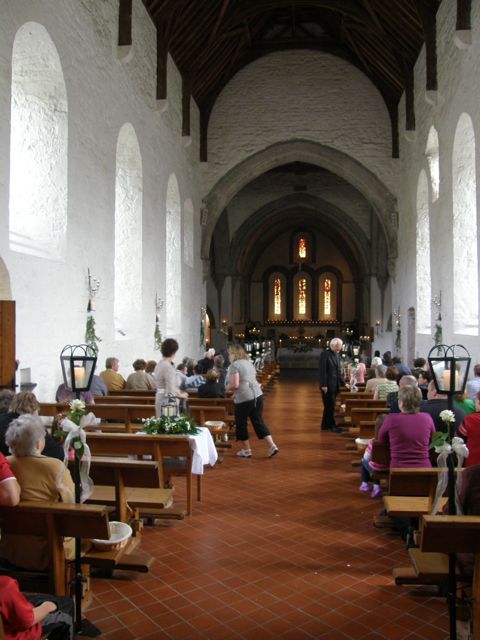
The story from John’s Gospel brings me back to the wedding here on An Cheathrú Rua. On that particular Sunday three years ago, the church at Ballintubber was decorated for a wedding, as you can see from the accompanying photographs. Nuptial church decoration here in Ireland is pretty similar to what is done in the United States, which makes a good deal of sense since I suspect we got quite a few of our wedding customs from Irish immigrants and returning Irish probably have brought back a lot of American customs to this island.

Ballintubber Abbey Church, Co Mayo, Éire, Interior, Decorated for a Wedding

Ballintubber Abbey Church, Co Mayo, Éire, Interior, Decorated for a Wedding

Ballintubber Abbey Church, Co Mayo, Éire, Interior, Decorated for a Wedding

Ballintubber Abbey Church, Co Mayo, Éire, Interior, Decorated for a Wedding

Ballintubber Abbey Church, Co Mayo, Éire, Interior, Decorated for a Wedding

Ballintubber Abbey Church, Co Mayo, Éire, Interior, Decorated for a Wedding

Post-wedding celebrations seem to be different – here there was no dancing (at least not in the pub), no toasts, no throwing of a bouquet or a garter, none of the typical elements of an American wedding reception – but what there was here as there is at home was joy and camaraderie, good wishes and good fun. It’s no wonder, given John’s recording of the first miracle and the human experience of wedding celebration, that the Wedding Banquet has become a lasting and indelible image of the reunion God has in store of God’s People and that the Holy Eucharist is referred to theologically as a foretaste of that heavenly banquet.

Dánta Dé includes a communion hymn specifically about the wedding feast. It is entitled The Blessed Wedding at Cana and is attributed to Maighréad ní Annagáin. Here is the original Irish text and Uná ní Ógáin’s translation of it, followed by a very free adaptation by me making use of some of the Irish hymn’s imagery and telling the story from John in meter and rhyme to be sung to the original tune.

First, the Irish original:

Ag an bpósadh bhí i gCána bhí Rí na ngrás ann i bpearsain,
É féin is Muire Máthair, is nárbh áluinn í an bhainfheis?
Bhí cuideacht ós cionn chláir ann, agun fíon orra i n-easnamh,
‘S an t-uisge bhí h-árthaibh nár bh’áluinn é bhlaiseadh?

A Dhia dhíl, a Íosa, ‘s a Rí ghil na cruinne,
D’iomchuir an choróin spíne is iodhbairt na Croise,
A stolladh is a straoilleadh idir dhaoinibh gan cumann,
Na glasa do sgaoilis, a d’iadhadh n’ár gcoinnibh.

Is ró-bhreágh an stór tá ag Rígh na glóire dúinn i dtaisge,
A chuid fola agus feóla mar lón do na peacaigh’.
Ná cuirigidh bhur ndóchas i n-ór bhuidhe nó i rachmas
Mar is bréagán mar cheó é, seachas glóire na bhFlaitheas.

Ms. ní Ógáin’s translation includes a verse not included in the Irish text of the hymnal, the second address to the Blessed Virgin:

At the marriage-[feast] in Cana
Was the King of grace in person,
He Himself and Mary Mother,
Was it not a beauteous wedding?
At the board the guests were seated,
And the wine to them was lacking,
And the water in the vessels
How delightful to taste it.

O Maiden most holy
Who to sin never yielded,
As thou wert a plant descended
From that king(a) who excelled,
[As of old], pray to Jesus,
To the glorious King of Heaven,
That He make a free way(b) for us
When we turn our steps Homewards.(c)

O dear Lord, O Jesu,
And O bright King of the Universe,
Who didst bear the Thorn-Crown,
And the sacrifice of the Cross;
Who was torn and rent asunder
Among men who were loveless,
Thou didst open the bars
That were closed against us.

Splendid is the treasure
Stored for us by the King of Glory;
His own Blood and Flesh [He giveth]
As Food for the sinful.
Put ye not your hope
In yellow gold or riches,
For as mistlike toys compare they
With the glories of Heaven.

Notes:
(c) i.e. David
(b) Lit.: or, ready road.
(c) or : That His Hand the way throw open
For our blessed home-returning.
(Westminster Irish Service-book).

And my poem derived from the Irish hymn:

King of glory,
King of love,
King of graces, guest at a wedding.
With his mother, with his friends,
seated at the marriage feast waiting.
Came the word: “There is a problem!”
Mary told her son to help them.
“What is this to me?” he asked her;
but to servants she was speaking.

“There is no wine
for the feast.
Do as he says, no hesitation.”
Empty vessels standing there
for the rites of purification.
“Fill them,” he says, “with plain water;
and then draw some for the steward.”
“What is this now?” asks the steward,
“Finest wine in the nation!”

Blessed Mary,
Virgin pure,
Mother of God, you knew that even
that your Jesus was the Christ;
that he was the High King of Heaven.
But did you know he would become
the free way for us to our home?
Through baptism buried with him,
we, too, shall all be risen!

O Lord Jesus,
glorious King,
holy savior who bore the Thorn Crown,
you were beaten, crucified,
killed, and buried, layed in the cold ground.
In fulfillment of the promise,
you broke the bars closed against us.
With your own blood you have freed us!
Death is conquered! Life is newfound!

Your own Body
and your Blood
give us sinners true liberation;
Bread of Heaven, Blessed Cup,
holy table, feast of salvation.
Giving blessings beyond measure;
wedding banquet, splendid treasure.
At the marriage feast of the Lamb,
we are God’s new creation!

Dé Domhnach sa Teach Lóistín

The title of this post means “Sunday in the Boarding House” which is how I have spent this day. I did not go to church today – my choices for worship on An Cheathrú Rua are either Roman Catholic Mass as Gaeilge (“in Irish”) or Roman Catholic Mass as Gaeilge le ceol as Gaeilge (“in Irish with music in Irish”). Since I don’t follow Irish well enough to comprehend the sermon or the music, and I’m not permitted by the Catholic Church’s rules to receive Communion, neither of those options is terribly inviting. There are no non-Roman churches of any sort in this area.

The closest Anglican (Church of Ireland) parishes are St. Nicholas in Galway or the parish in Roundstone. Each is a minimum of 45 minutes driving time away (and could be longer with bad weather or traffic). Traffic was a guarantee in regard to Galway today because this is the last day of the Galway Races, an annual major horse racing event; I drove to Galway yesterday (having forgotten about the races) and experienced huge pedestrian crowds and bumper-to-bumper traffic. In the other direction (which I had driven on Friday) there was weather; today was a rainy, windy day in the Connemara! So I decided to chill and to study all day, which I basically did. Not sure how much of my flashcard review will stick and then become accessible in conversation, but it seemed a good use of the day.

During the afternoon a couple of magpies showed up in the garden outside my window and spent a long time in what appeared to be play. Eurasian magpies are striking birds with contrasting black and white feathers. The black feathers occasionally flash an iridescent green. I didn’t take a picture of them, but here is a picture from Wikicommons showing off the striking contrasting coloring of a magpie in flight.

Eurasian Magpie in Flight (from Wikicommons)

Eurasian Magpie in Flight (from Wikicommons)

Back now to the studies … flashcard, flashcard, flashcard….

« Older posts Newer posts »