Occasional thoughts of an Anglican Episcopal priest

Category: Church (Page 113 of 116)

Sunday, a Sermon, and Superstring Theory

Time away from the Irish (the language, not the people)….

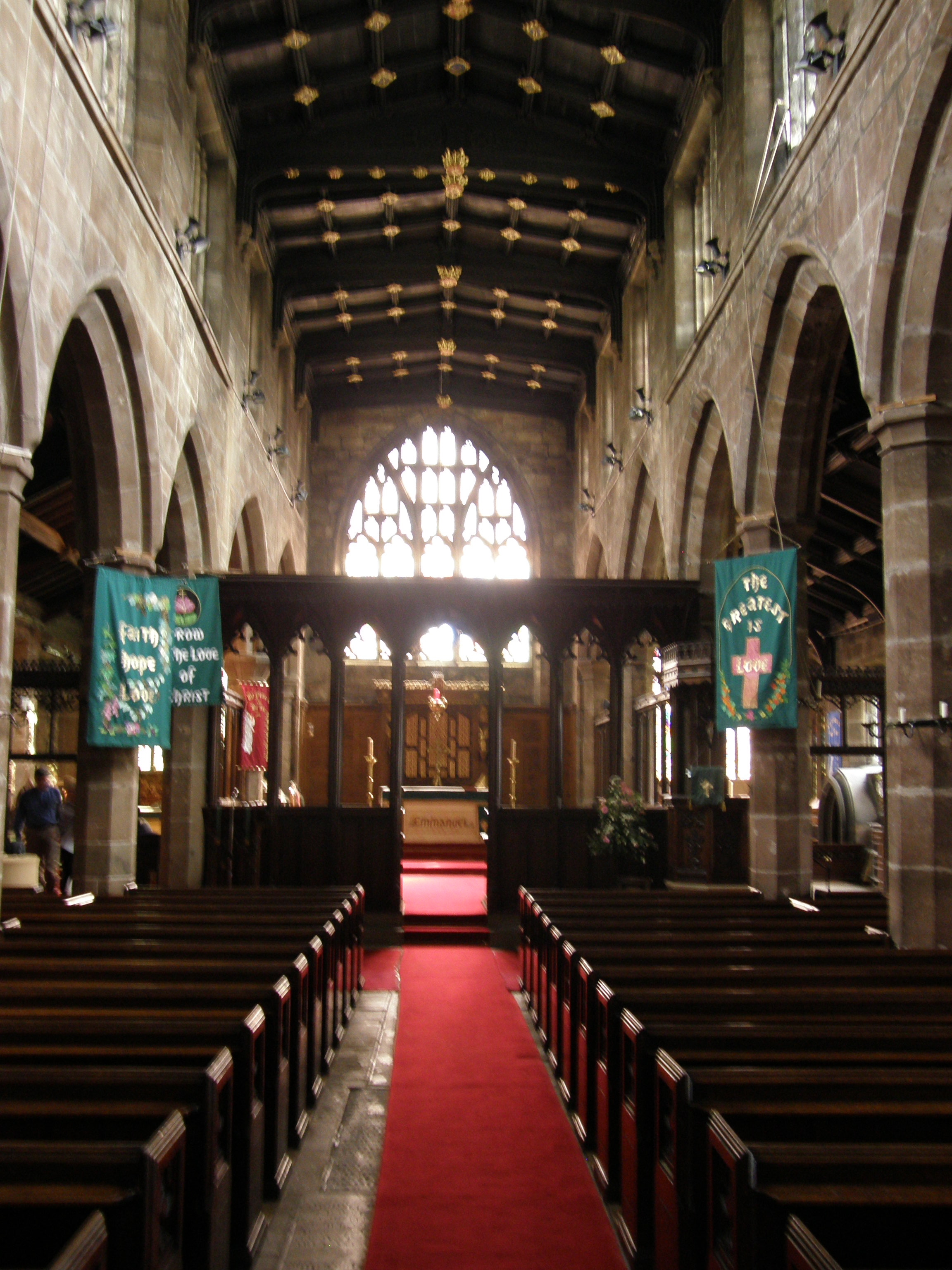
On Sunday, 24 July 2011, I left my teach loistín (“boarding house”) and drove the 32 km from An Cheathrú Rua to Galway to attend the Sung Eucharist at the Collegiate Church of St. Nicholas, a church which formerly (pre-Reformation) was the central church of the city. That distinction is now held by the Roman Catholic Cathedral, “The Cathedral of Our Lady Assumed into Heaven and St. Nicholas”. (How the BVM was assumed into St. Nicholas, I have no idea….) But St. Nicholas Collegiate Church, now an Anglican congregation of the Church of Ireland, continues to play a central role in the life of the city. The church has marvelous acoustics and is host to a variety of concerts, dramas, conferences, and other cultural and educational events throughout the year.

Interior of St. Nicholas Collegiate Church, Galway

Interior of St. Nicholas Collegiate Church, Galway

It also plays the role of providing a place of worship for visiting tourists who do not wish to attend a Roman Catholic Mass. The Sunday morning congregation, especially during the summer, is an aggregation of Irish Anglicans, Protestants of several sorts (many of whom do not speak English), and tourists with little or no religious background at all (some of whom, I sure, wander in on Sunday morning to see the historic church and get “trapped” in the service). Such was the congregation this Sunday.

Interior of St. Nicholas Collegiate Church, Galway (from choir)

Interior of St. Nicholas Collegiate Church, Galway (from choir)

I arrived in Galway about one hour before the service, so I went to a local café and had a cup of coffee. Thirty minutes before the service, I made my way to the church and found a seat – not difficult as there were very few people there. A church warden introduced himself and offered me a leaflet which included nearly the entire service with an insert of the hymn lyrics. On learning that I am a priest, he asked if I would read one of the lessons for the day, to which I assented.

One of the transepts of the church has been closed off with a partial glass screen and made into the choir room. The choir was practicing and their music filled the church – it was grand! It put one into a prayerful mood and prepared one to enter into worship.

Transept, St. Nicholas Church, Galway (used as choir room)

Transept, St. Nicholas Church, Galway (used as choir room)

About 15 minutes before the service was to start, a woman priest vested for the day began greeting those of us seated in the nave. She was to be the presider in the absence of the rector, who is on holiday this month.

The service started on time with a procession of crucifer, choir, and clergy. Although lay eucharistic ministers would later assist with the distribution of communion, they were not vested and did not process with the altar party. The placement of choir, clergy and altar assistant was interesting and, given that everything is moveable (and moves frequently for various events), I wondered if this is a standard arrangement or if they experiment regularly with different seating plans.

The service followed a fairly familiar pattern, more similar to the American church’s liturgy than were the Church of England services I experienced a couple of weeks ago, although as in the English church, the service began with a confession and absolution before the Gloria in Excelsis. Then there were the reading of the lessons, a sermon, a variant form of the Creed (sort of a Q-&-A format), prayers, the Peace, the offertory, the Great Thanksgiving, the distribution of Holy Communion (at stations, a central position for the Bread from the priest and four cups of Wine), the final blessing, the last hymn and the dismissal. It all followed a familiar and comforting pattern.

Free-standing Altar, St. Nicholas Church, Galway

Free-standing Altar, St. Nicholas Church, Galway

The lessons for the day were those of the Revised Common Lectionary – from the Hebrew Scriptures the story of Solomon asking God for the gift of wisdom; from the Epistles Paul’s assurance in Romans that nothing can separate us from the love of God; from the Gospel’s Jesus rapid fire mini-parables that the Kingdom of God is like a mustard seed, a buried treasure, a pearl of great price, a net thrown into the sea.

Altar Window, St. Nicholas Church, Galway

Altar Window, St. Nicholas Church, Galway

The homily admonished us to do as Jesus did and look for God’s reign in the ordinary things, the ordinary places, the ordinary people of our lives. In the course of the homily, the preacher compared the structure of Jesus’ delivery of the parables to that of the Psalms referring to the Hebrew practice of parallelism as “the rhyming of ideas.” That description stuck with me.

Chancel and High Altar, St. Nicholas Church, Galway

Chancel and High Altar, St. Nicholas Church, Galway

Later in the day, I relaxed with a book, The Elegant Universe by Brian Greene. In it, describing the findings of quantum mechanics as an introduction to a discussion of superstring theory, the author writes:

Even in an empty region of space – inside an empty box, for example – the uncertainty principle says that the energy and momentum are uncertain: They fluctuate between extremes that get larger as the size of the box and the time scale over which it is examined get smaller and smaller. It’s as if the region of space inside the box is a compulsive “borrower” of energy and momentum, constantly extracting “loans” from the universe and subsequently “paying” them back. But what participates in these exchanges in, for instance, quiet empty region of space? Everything. Literally. Energy (and momentum as well) is the ultimate convertible currency. E=mc2 tells us that energy can be turned into matter and vice versa. Thus if an energy fluctuation is big enough it can momentarily cause, for instance, an electron and its antimatter companion the positron to erupt into existence, even if the region was initially empty! Since this energy must be quickly repaid, these particles will annihilate one another after an instant, relinquishing the energy borrowed in their creation. And the same is true for all other forms that energy and momentum can take – other particle eruptions and annihilations, wild electromagnetic-field oscillations, weak and strong force-field fluctuations – quantum-mechanical uncertainty tells us the universe is a teeming, chaotic, frenzied arena on microscopic scales.

As I read this I was reminded of the first words of Holy Scripture:

In the beginning when God created the heavens and the earth, the earth was a formless void and darkness covered the face of the deep, while a wind from God swept over the face of the waters. Then God said, “Let there be light”; and there was light. And God saw that the light was good; and God separated the light from the darkness. God called the light Day, and the darkness he called Night. And there was evening and there was morning, the first day.

Transfiguration Window, St. Nicholas Church, Galway

Transfiguration Window, St. Nicholas Church, Galway

People ask why I read books on particle physics, quantum mechanics, and string theory for relaxation. I really don’t have a good answer, and I have to admit that a lot of what I read, though it fascinates me, goes right over my head! But, for reasons which are probably beyond anyone’s comprehension, including my own, my idea of relaxing reading is exactly the sort of stuff that bored me to tears 40+ years ago – physics books. In the new understandings of quantum mechanics, superstring theory, the multiverse speculation, and other work seeking the “theory of everything” (or “TOE” as Greene and others call it), I see science converging with religion. As microscopic physics gets “weirder” (Greene’s term, again), it seems to me it gets more theological, as well. Every so often a passage strikes, if you will, a theological cord. This was one of them … the description of even empty space as “teeming, chaotic, frenzied” seems to me to echo, to “rhyme” (to use the preacher’s term) with the idea of the writer of Genesis that “a wind from God” (the Holy Spirit) sweeps over creation. Numerous theologians have taken off from this Genesis account to assert that the Holy Spirit “enthuses” all things; that the wind from God blows through and within all of creation … even empty space. How great it is that science’s new understanding of empty space as “teeming” and “frenzied” rhymes with faith’s vision of empty space as filled with God’s wind!

In Sunday’s sermon, the preacher reminded us to seek God in the everyday stuff of life. As scientists probe the “weirdness” of the smallest dimensions of everyday stuff, I think they’re doing just that … seeking God. They may be calling it the search for the TOE, but to from my perspective it’s just a variation of the same search human beings have been on for millennia, the search for meaning.

Baptismal Font, St. Nicholas Collegiate Church, Galway

Baptismal Font, St. Nicholas Collegiate Church, Galway

And now … back to the Irish.

A Music Sample

This is a sample of the music I am arranging. This hymn is called Holy Trinity Protect Me. I made this audio with Sibelius 6 and converted the Sibelius audio to MP3 format. I’m having some difficulty getting it to play in the Firefox on my MacBook Pro, but it plays fine in Safari. Hopefully, it will play in whatever browser you are using. The link will open a new tab or a new window depending on how your browser treats the target=”_blank” attribute in the link tag.

Úna ní Ógain arranged this for soprano accompanied by piano – I’ve arranged it for SATB choir – the audio from Sibelius makes use of synthesized voices and, of course, does not include the words.

Holy Trinity Protect Me

St. Bartholomew’s Wilmslow – 13 July 2011

Let’s back up a few days and consider St. Bartholomew’s Church in the Parish of Wilmslow; it is one of two congregations in the Parish, the other being St. Anne’s Church. Though I visited both, I was able only to get photographs at the first.

A church has been on the site of St. Bartholomew’s building since 1264, but the current building was built in the early 16th Century; all that remains of the earlier structure is a crypt below the altar of the current church. The current building also incorporates a structure from the 1400s which now forms the base of the church’s bell tower. The building is made of local sandstone which the Parish’s guidebook acknowledges is “weather-blackened”; I rather think the black discoloration is more from industrial pollution than simply from the “weather”. Wilmslow is quite close to Manchester, center of the English Industrial Revolution, and has its own very large cotton mill which used coal-fired steam to power its spinning jennies and looms; coal smoke is most likely the cause of the blackening.

This photo was taken from the city park across the street. One enters the building through a porch to the viewer’s left; the altar and crypt are at the end to your right.

St. Bartholomew's, Wilmslow

St. Bartholomew's, Wilmslow

One enters the church grounds through the “lichgate”, although there are other entrances as well. I’m told that all funeral processions begin here, the officiant leading the pall bearers with the casket and the congregation following behind. According to the dictionary, a lichgate is “a roofed gate to a churchyard, formerly used as a temporary shelter for the bier during funerals.”

St. Bartholomew's, Wilmslow, Lichgate

St. Bartholomew's, Wilmslow, Lichgate

I visited the church on a Wednesday morning just a few minutes before the midweek Eucharist. I had limited time to take pictures and, with church people preparing prayerfully for worship, forebore using flash. As a result many of my interior pictures simply didn’t turn out.

On entering the church one finds a very dark interior, typically English Gothic but with Victorian emmandations which, frankly, are a detraction! I apologize for the blurriness of this photo; given the dark lighting conditions, it was the best I could get. Notice in the ceiling a larger-than-usual golden boss (a blur really, sorry). I tried to get a picture of this, but none came out. Such bosses, whether stone or wood, usually depict stylized flowers or angels … this one is the Devil! According to the church’s history, “It is meant to show the Devil nailed in perpetuity to the roof and obliged to listen helplessly to the congregation insistently singing the praises of God.”

St. Bartholomew's, Wilmslow, interior

`St. Bartholomew's, Wilmslow, interior

Notice the screen separating the congregation from the choir and chancel; although part of this is an original 16th Century rood screen, it was incorporated into an 1865 restoration in which all the pews in the church were replaced by the current pews and this “vestry chapel” in the choir was installed. This provided “more dignified” seating and a place for the governing board to meat. The individual, upholstered seats are labeled with brass plaques inscribed in Latin for the various offices of the board.

St. Bartholomew's, Wilmslow, interior

St. Bartholomew's, Wilmslow, interior

The church council has tried get permission from the diocese and the historical preservation authorities to remove this chapel, moving the seats to exterior walls and the screen to the base of the bell tower in order to restore a more original appearance to the church; unfortunately, that permission has been denied. If the screen were moved to the bell tower, a floor could be built at the same height as its top on which the bell ringers could stand; as things are now, the bell ringers stand on the ground floor and thus block entrance through the main door which is in the bell tower.

In the bell tower is an engraved stone plaque bearing these words: “John, son of Robert and Penelope Hunt, was killed by the first bell on Sunday, August the 30th 1767.” Apparently, the 13-year-old boy was fatally injured when the treble or smallest of the six bells broke loose from its mounting and fell on him! Those six bells are still in use today.

I was able to take pictures of some of the stained glass windows and here are a few of those.

St. Bartholomew's, Wilmslow, interior

St. Bartholomew's, Wilmslow, interior

St. Bartholomew's, Wilmslow, interior

St. Bartholomew's, Wilmslow, interior

St. Bartholomew's, Wilmslow, interior

St. Bartholomew's, Wilmslow, interior

St. Bartholomew's, Wilmslow, interior

St. Bartholomew's, Wilmslow, interior

I was unable to film the crypt, which is a very small, cramped space below the altar. It is believed to date from the original 13th Century church. In more modern times it fell into disuse, was filled with rubble and forgotten. During repairs to the church in the 1970s, it was rediscovered. In 1979, the Lebanese Consul in Manchester, Christian Emile Fadil, paid for its restoration in memory of his late wife. Now a chapel, the altar there is made of Lebanese cedar and on the wall are three glass panels engraved with golden lettering reading, “Pease I give unto you” in English, Arabic, and Hebrew. It has become the custom of the church that, following the Saturday evening Easter Vigil service, the clergy of the parish and others who wish to join them keep the rest of the overnight vigil in this chapel until the festival service on Easter morning.

St. Bartholomew’s is a lovely church building which evidences the faith of generations, even centuries of Wilmslow’s residents. It shows how each generation alters the church building to meet its needs to make the structure a more suitable tool for the ministry appropriate to their circumstance. It is, I believe, unfortunate that those more interested in historic preservation than in living ministry are blocking the current congregations efforts to continue in that tradition. As I was discussing this situation with my friend who is on the congregation’s ministry team, I was reminded of Jaroslav Pelikan’s aphorism, “Tradition is the living faith of the dead; traditionalism is the dead faith of the living.”

Shrewsbury Abbey – 12 July 2011

Several years ago a woman named Edith Mary Pargeter began writing a series of murder mysteries set in the Middle Ages under the pseudonym of Ellis Peters. The “detective” protagonist of these mysteries was a monk named Cadfael. When dramatized by the BBC the actor Derek Jacobi played Brother Cadfael. Brother Cadfael’s monastic community was Shrewsbury Abbey, which is a real place. The abbey church of Shrewsbury Abbey still stands and is a functioning congregation of the Church of England. I visited the Abbey Church the morning of 12 July 2011.

Initially a small Saxon church, the Church of Saints Peter and Paul which was founded by Roger de Montgomery, a relative of William the Conqueror in 1083. It subsequently became a Benedictine Abbey and during the following 450 or so years it grew to become one of the most important and influential abbeys in England. In 1147, the relics of a Welsh Saint, Winefride, were brought to the Abbey and his shrine became an important place of pilgrimage. In 1283, the first English Parliament in which the Commons had a legal share took place in the Abbey Chapter House, and in 1398 Richard II summoned the Great Parliament in the Abbey. The Abbey was surrendered to the Crown in January of 1540 when Henry VIII disestablished the monasteries. Although much was destroyed, the nave continued to serve, as it does today, as the place of worship for the Parish of the Holy Cross.

In the nineteenth century plans for restoration of the Abbey were drawn up, but financial constraints compelled the building of only part of the plan; everything to the east of the pulpit and lectern are the work of the Gothic Revival architect John Loughborough Pearson, best known for designing Truro Cathedral; his work dates from 1886. The Pearson plans were put on hold and never completed because of the intervention of World War I.

Here are some pictures of the church:

This is the façade of the church seen from the small car park for the church staff:

Facade of Shrewsbury Abbey Church

Facade of Shrewsbury Abbey Church

This is the side of the church along which a major highway now runs (in the city of Shrewsbury this street is called Abbey Foregate, but it is national highway A5191 with lots of traffic). This would have been the side on which the cloister, dormitory, and other living spaces of the monastic community were built; you can see the ragged edges where the broken-down walls once adjoined the structure. The building is made of a red sand-stone native to the Shropshire area.

The interior of the church is quite large and spacious and, despite the dark stone from which it is built, natural light from the clerestory windows makes it quite bright. A very handsome painted reredos in the chancel (with a much gilt) fairly glows, and below it the altar is draped with a heavily embroidered frontal:

Nave of Shrewsbury Abbey Church

Nave of Shrewsbury Abbey Church

Reredos of Shrewsbury Abbey Church

Reredos of Shrewsbury Abbey Church

Altar Frontal, Shrewsbury Abbey Church

Altar Frontal, Shrewsbury Abbey Church

Around the side aisles of the church are tombs, such as these. The first picture is the tomb of a medieval priest; the second, of an Elizabethan couple.

Medieval Tomb, Shrewsbury Abbey Church

Medieval Tomb, Shrewsbury Abbey Church

Elizabethan Tomb, Shrewsbury Abbey Church

Elizabethan Tomb, Shrewsbury Abbey Church

There are numerous stained glass windows, old and new, such as these two. The first dates from the Middle Ages and shows the Adoration of the Magi; the second is of quite recent vintage and celebrates the Brother Cadfael series!

Adoration of the Magi Window, Shrewsbury Abbey Church

Adoration of the Magi Window, Shrewsbury Abbey Church

Brother Cadfael Window, Shrewsbury Abbey Church

Brother Cadfael Window, Shrewsbury Abbey Church

The ladies of Shrewsbury Abbey church were quite gracious when I visited. They have a small shop set up just inside the entrance to the church and a small coffee and tea bar at the rear of the left aisle. It was quite astonishing and rather funny to see a kitchen sink and countertop with modern appliances set up right next to an Elizabethan tomb, but this sort of “repurposing” is something the church needs to do and needs to do more frequently!

As I was about to leave, one of the ladies asked where I was from. I said, “Near Cleveland in the state of Ohio.” “Of course, you’re from America,” she said, “you such a lovely accent!” I nearly burst out laughing … I thanked her and went on my way, hoping to see a neolithic ring fort at Old Oswestry about an hour away. Unfortunately, road construction, indecipherable signage, and a GPS error made that impossible.

Leaving the UK

I’ve got some great photos of Shrewsbury Cathedral, St. Bartholomew’s Church (Wilmslow Parish), and the Quarry Bank Mill (in Wilmslow), I just haven’t had the time to process them and get a blog post or two written! I hope to do that in the next few days in Ireland. Today I fly to Dublin, rent another car, deal with the cell phone situation (transfer coverage from a UK company to an Irish company), and then drive to the village of An Cheathrú Rua (“Carraroe”), Co. na Gaillimhe (“County Galway”). I am to stay with Lucia and Ciaran Uí Fátharta, the same family I stayed with three years ago. (They didn’t have internet access when I was there before and I had to use the hub at the school, which was only available certain hours of the day. I’m hoping that situation has changed.) In any event, more is coming to the blog as soon as possible.

Visiting Wilmslow

I’ve driven from Hay-on-Wye to Wilmslow (near Manchester) to visit friend Sally M. She’s taken me on a whirlwind tour of the area focusing on the two churches of the Parish, St. Bartholomew’s and St. Anne’s. Both lovely church facilities. Take a look at their website, which includes a virtual tour of the older church (St. Bartholomew’s).

One the way, I stopped in Shrewsbury and saw the Abbey, then drove on to Oswestry where I had planned to visit the neolithic round fort at Old Oswestry, but somehow got lost and never made it.

Now I’m here for my last night in England (tomorrow I’ll be back in Scotland and the next day off to Ireland). More later….

My Day in Wales (Part 3)

This post concludes the tale of this day begun in Part 1 and continued in Part 2.

Llanthony Priory was a monastery of Augustinian Canons nine miles south of Hay-on-Wye. St. David is said to have lived in the area as a hermit, but this tradition lacks confirmation.

The story of the Priory is that around the year 1100 the ruins of a chapel and cell, supposed to have been that occupied by St. David, were discovered by a retainer of Hugh de Lacy, Baron of Herefordshire, named William. He thereupon decided to quit the world and become a hermit himself. He was later joined by Ernisius, chaplain to Queen Maud, wife of Henry I. These two anchorites became famous and their story reached Baron de Lacy, who in 1107 founded and endowed a monastery for them, dedicated to St. John the Baptist. The rule of the Canons Regular of St. Augustine was adopted. In the course of time, the severity of the climate, the poverty of the soil, and the persecution of the Welsh natives combined to make life there impossible. In 1134 the entire community, numbering about forty, abandoned the monastery and took refuge in the palace of Robert, Bishop of Hereford. After two years a new monastery was built for them near Gloucester by Milo, Earl of Hereford, which was called Llanthony Secunda. Only a few canons lived from time to time in the original monastery, and both houses were governed by one prior, who resided at Gloucester.

The buildings at Llanthony fell gradually into decay and passed into private hands when Henry VIII dissolved the monasteries in 1539. In 1807 the property was bought by Walter Savage Landor. It still belongs to his descendents, the habitable portion of it having been added to and converted into an inn during Queen Victoria’s reign. The church is in ruins, but the western towers, part of the central one, and some of the nave piers and arches are standing.

Here are a few pictures of Llanthony Priory taken today, 11 July 2011:

Llanthony Priory, Black Mountains, Wales

Llanthony Priory, Black Mountains, Wales

Llanthony Priory, Black Mountains, Wales

Llanthony Priory, Black Mountains, Wales

Llanthony Priory, Black Mountains, Wales

Llanthony Priory, Black Mountains, Wales

Llanthony Priory, Black Mountains, Wales

Llanthony Priory, Black Mountains, Wales

And this is the Inn built into the Priory ruins by the Landor family:

Victorian Inn at Llanthony Priory, Black Mountains, Wales

Victorian Inn at Llanthony Priory, Black Mountains, Wales

There is also a functioning Anglican Church in Wales parish church on the site of the Priory, St. Davids, Llanthony. The structure first seen in this picture is a cottage attached to the church, presumably intended to be the vicarage:

St Davids Parish Church, Llanthony, Wales

St Davids Parish Church, Llanthony, Wales

This is the interior of the church:

Interior of St Davids Parish Church, Llanthony, Wales

Interior of St Davids Parish Church, Llanthony, Wales

Notice the pulpit … it is built into the wall and cannot be accessed from the congregation’s side of a wall and arch that separates the congregation from the choir and chancel.

Pulpit of St Davids Parish Church, Llanthony, Wales

Pulpit of St Davids Parish Church, Llanthony, Wales

I entered the pulpit through this door. I almost couldn’t fit in and getting back out was a really spine-bending challenge!

Pulpit Doorway of St Davids Parish Church, Llanthony, Wales

Pulpit Doorway of St Davids Parish Church, Llanthony, Wales

All things considered, it was a good day in Wales. After visiting the parish church, I made my way back to the B&B in Hay-on-Wye by way of a “single track lane with passing areas” about which I’ve written earlier.

My Day in Wales (Part 1)

Noswaith dda!

Noswaith dda is Welsh for “Good evening” – do not try to pronounce it – whatever you guess will be wrong, I assure you.

I drove a circle through the Brecon Beacons today – I almost drove to St. David’s – but five hours of driving (two to get there from where I was just west of Swansea and three to get back from there to my B&B in Hay-on-Wye) didn’t seem like a good idea, so I didn’t. Instead I went to St. Illtuds in Llantwit Major, then to the Penderyn Distillery, then to Llanthony Priory … and then walked the streets of Hay-on-Wye and looked at lots of old books. It was overwhelming, even for a bibliophile like me … there are too many books … and some of the shops are simply disorganized. Many have the books categorized by subject, shelved alphabetically by author, etc. But some are just disorganized heaps of books – I think even the owners don’t know where anything is.

I was disappointed in St. Illtud’s Church and the ruins at Llantwit Major. The modern Welsh-English name comes from the old Welsh name Llanilltud Fawr. Llan means “monastery” and you can see St. Illtud’s name in the rest of that first word. The second word, fawr, means “great”. So the name is something like “Illtud’s Great Monastery” which was founded in the early 5th Century by St. Illtud as a center of learning … but it’s not so great any longer.

This is a very important site in Celtic Christian history and it’s not cared for very well at all. The monastic community here, over which St. Illtud and St. Samson were priors, was once so important in the formation of monks, priests, missionaries, and bishops that it has been called “The University of Celtic Saints.” St. David of Wales was educated and ordained there, and he is not the only one: in addition to St. David, St. Samson, St. Paul Aurelian, St. Gildas, St. Tudwal, St. Baglan and King Maelgwn ap Cadwallon (King of Gwynedd and apparently High King of Wales in the middle of the 5th Century) are said to have studied at the Cor Tewdws or “divinity school”.

The Scots and the Irish seem to have a sense of reverence for their ancient Christian monastic sites, but apparently not so the Welsh (or at least not the people of Llantwit Major). Although inside the church there is a poster about a fund raising effort to preserve what’s left and build a visitor center, it’s pretty clear it’s not going anywhere – the poster is a few years old. And in the old chapel, there are dustbins and a composting thing set up….

Here are some pictures of the Church of St. Illtud’s and what remains of the medieval buildings that were once found at this site. Of course, the earlier Celtic site has long since disappeared. First, the church as seen from the town’s public car park and then a couple of photos of the building from the church yard.

St. Illtuds Church, Llantwit Major, from town car park

St. Illtuds Church, Llantwit Major, from town car park

St. Illtuds Church, Llantwit Major, from church yard

St. Illtuds Church, Llantwit Major, from church yard

St. Illtuds Church, Llantwit Major, from church yard and showing ruined monastic chapel at west end

St. Illtuds Church, Llantwit Major, from church yard and showing ruined monastic chapel at west end

There is a ruined chapel affixed to the functioning church directly out the west door; in this chapel are currently housed dustbins (trash cans, to an American) and a green plastic composting container!

St. Illtuds, ruined chapel with composting bin

St. Illtuds, ruined chapel with composting bin

On the grounds was also a ruined chantry which has now been turned into a memory garden:

St. Illtuds, ruined chantry memory garden

St. Illtuds, ruined chantry memory garden

Inside the church there are some stones with Celtic carving and Latin inscriptions which may date from the early Celtic monastery:

St. Illtuds, Celtic Cross bearing name of Illtud

St. Illtuds, Celtic Cross bearing name of Illtud

St. Illtuds, Celtic carved stones

St. Illtuds, Celtic carved stones

And, of course, the Victorians got to the place and their influence is seen in the chancel of the church and the reredos:

St. Illtuds, chancel, altar and reredos

St. Illtuds, chancel, altar and reredos

After surveying the church at Llantwit Major (which didn’t really take as much time as I thought it would), I gave serious consideration to driving the 101 miles from there to St. David’s where the primatial Cathedral of the Church in Wales is located. It really is a lovely cathedral and there are well-preserved ruins of a monastery founded by St. David there. (Here is a link to the Cathedral’s website.) In fact, I got onto the M4 motorway and started to do just that, but a little bit west of Swansea, stopping for petrol and a Diet Coke, discretion got hold of me and I realized that I really didn’t want to spend two hours driving there and then to face three hours getting back to Hay-on-Wye. So I went back to my original plan, which was to drive to the village of Penderyn and visit the only whisky distillery in Wales. (See My Day in Wales (Part 2) for more about that.)

(Later in the day I visited Llanthony Priory, another monastic ruin, in the Black Mountains south of Hay-on-Wye. Read My Day in Wales (Part 3) for that story and more photos.)

Neolithic Britain – 9 July 2011

Today, 9 July 2011, I walked the hills of southeastern England visiting two fascinating sites that may date back as many as 5,000 years!

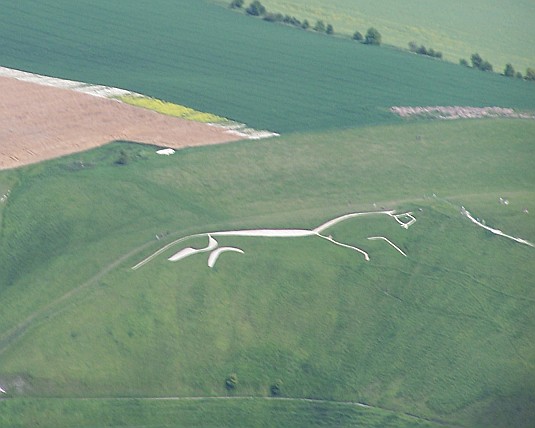
First I visited the village of Uffington, Oxfordshire, and the hill south of town on which one finds a massive depiction in white chalk of a horse. I tried to take a picture of it, but from ground level that is very difficult to do and (on this day) the site was crawling with several hundred early elementary school students on school outings. So here’s a picture from Wikicommons:

The Uffington White Horse from the Air

The Uffington White Horse from the Air

I walked up to the area where the head of the horse is seen in this picture. It was an overcast and hazy but warm day – a good thing because it was also very breezy. It was about a mile or so walk up the hill from the car park via the Ridge Path, which took me through the Uffington Castle, which isn’t what you think it is at all … not a castle in the medieval sense. Uffington Castle is all that remains of an early Iron Age hill fort. It is composed of two circular earth berms (with a circular ditch between them) surrounding about 32,000 square meters (nearly 8 acres). There is an entrance in the eastern portion, near the White Horse and another at the south (through which I entered). An entrance in the western side was apparently blocked up a few centuries after it was built. I was able to take a picture of the “castle” (although it doesn’t look like much). This picture is taken from the eastern entrance of the southeastern quadrant; the southern entrance can be seen at the right of the picture.

Uffington Castle, Oxfordshire, UK

Uffington Castle, Oxfordshire, UK

As you can see, the White Horse is a highly stylised prehistoric hill figure, 110 m long (374 feet), formed from deep trenches filled with crushed white chalk. The figure is believed, and scientific tests have shown it, to date back some 3,000 years, to the Bronze Age. The purposes of its creators is completely unknown. It is not of Celtic origin, but G.K. Chesterton used it as the setting for part of his Catholic allegorical and poetic retelling of the story of the Saxon king Alfred the Great, who defeated the invading Danes in the Battle of Ethandun in 878, which is entitled The Ballad of the White Horse.

Before the gods that made the gods
Had seen their sunrise pass,
The White Horse of the White Horse Vale
Was cut out of the grass.

Before the gods that made the gods
Had drunk at dawn their fill,
The White Horse of the White Horse Vale
Was hoary on the hill.

Age beyond age on British land,
Aeons on aeons gone,
Was peace and war in western hills,
And the White Horse looked on.

For the White Horse knew England
When there was none to know;
He saw the first oar break or bend,
He saw heaven fall and the world end,
O God, how long ago.

As retold by Chesterton, Alfred and his Saxons set out from the White Horse and Alfred gathers there three great chieftains, Mark a Roman, Eldred the Franklin who is a Saxon, and Colan who is a Celt. In describing Colan, Chesterton includes these priceless lines:

For the great Gaels of Ireland
Are the men that God made mad,
For all their wars are merry,
And all their songs are sad.

After visiting the Uffington site, I went to Avebury to see the largest “henge” in Britain (possibly the largest man-made earthwork of its kind in all of Europe). A henge (the word is derived from Stonehenge and was coined in the mid-20th Century) is an earthen berm circular with an interior circular ditch. Because the ditch is on the inside, not the outside, of the berm, henges are not considered to be defensive fortifications. One scholar, however, has suggested that they are defensive in that he believes they were built to contain something and protect those outside from what was inside – and what was inside was divine energy. The Avebury henge contains many standing stones that are laid out in peculiar formations, some circles, some straight lines, some curving formations not forming full circles. Here are some photos of the standing stones.

Standing Stones near World Heritage Center Shop, Avebury, UK

Standing Stones near World Heritage Center Shop, Avebury, UK

Stone Circle portion within the Avebury Henge

Stone Circle portion within the Avebury Henge

This is a map (from Wikimedia) showing the Avebury henge and the position of the standing stones (and theoretical stones completing the circles). It does not show the Avebury village buildings which have been built within the henge. The henge has a circumference of about 3/4 of a mile.

Map of Avebury Henge (non-free material from Wikimedia)

Map of Avebury Henge (non-free material from Wikimedia)

I am intrigued by the idea that because the ditch and bank face inward, in the opposite order that they would be placed in a defensive ring fort, something “dangerous” or “powerful” was understood to be inside the enclosure. The proposal is that henges were designed mainly to enclose ceremonial sites seen as “ritually charged” and therefore dangerous to people, that whatever took place inside the enclosures was intended to be separate from the outside. In other words, the henge may have been a means by which neolithic society set aside “sacred space” in much the same way that modern human beings do with churches, mosques, temples, and so forth.

The hymn An Aluinn Dún (The Heavenly Habitation), which was set out in an earlier post, is about sacred space (heaven, particularly). The Celts and the Gaels have a special sense about sacred places; they marked them, but did not attempt to set them off or guard against them in the way henges seem to do. In fact, holy caves and holy wells were understood to be places of refreshment, “thin places” between our world and the spiritual realm, not something to be feared, but something to enjoy, somewhere to grow closer to God.

St. Alban’s Cathedral

The other cathedral church I visited on 8 July 2011 was that in the town of St. Albans. It might not actually be a town. British law makes distinctions between hamlets, villages, towns, and cities – and perhaps other urban designations (I don’t really know). There are also parishes (of two types, ecclesiastical and legal), boroughs, and counties. Each of these legal geographies has its own council or other form of government, and their interactions (amongst themselves and between them and the national government) are the stuff of much news commentary. In any event, there is a place called St. Albans and I’ll call it a town whether it legally is one or not.

St. Albans was founded by the Romans who called it Verulamium. The town now has a really lovely public park call Verulamium Park and parts of the old Roman town’s wall are on display there. There are also lovely rolling green hills, huge willows and other shade trees, and a delightful pond which is the home of swans, geese, and ducks who are regularly fed by the citizenry. Here are a couple of pictures of the park (including the wall):

Pond at Verulamium Park, St. Albans

Pond at Verulamium Park, St. Albans

Roman Wall, Verulamium Park, St. Albans

Roman Wall, Verulamium Park, St. Albans

St. Albans Cathedral seen through the Roman Wall, Verulamium Park

St. Albans Cathedral seen through the Roman Wall, Verulamium Park

The cathedral is dedicated to, and the town gets its current name from, St. Alban, first martyr of Britain. The story is that Alban was a pagan Roman soldier. According to James Kiefer’s hagiography, “he gave shelter to a Christian priest who was fleeing from arrest, and in the next few days the two talked at length, and Alban became a Christian. When officers came in search of the priest, Alban met them, dressed in the priest’s cloak, and they mistook him for the priest and arrested him. He refused to renounce his new faith, and was beheaded. He thus became the first Christian martyr in Britain. The second was the executioner who was to kill him, but who heard his testimony and was so impressed that he became a Christian on the spot, and refused to kill Alban. The third was the priest, who when he learned that Alban had been arrested in his place, hurried to the court in the hope of saving Alban by turning himself in. The place of their deaths is near the site of St. Alban’s Cathedral today.”

Front porch, Cathedral Church of St. Alban, St. Albans, UK

Front porch, Cathedral Church of St. Alban, St. Albans, UK

The shrine of St. Alban is inside the cathedral. It forms a separate chapel behind the “screen” or reredos behind the high altar (and before the Lady Chapel which takes up what an American church member would think of as the “chancel” area of the building). While I was photographing the shrine, one of the cathedral guides came up and engaged me in conversation. In the course of our discourse she said, “We have a bone you know?” – “I thought the saint’s whole body was here!” – “Oh, no! The bones were taken away when Henry the Eighth abolished the monasteries! Most of his bones were taken to the continent and an awful lot of them were taken to the cathedral in Cologne. A few years ago the Bishop of Cologne visited and he brought us a bone – Alban’s right shoulder bone! Of course, we’re Anglicans so we’re not much on relics … but we said, ‘Thank you very much’ and accepted his bone.” – “Oh… well, where is this bone?” – “It’s in a lovely box under the shroud on the shrine!” So here’s a picture of the shrine … under that red cover somewhere is a “lovely box” contained a shoulder bone, allegedly Alban’s…..

Shrine of St. Alban, St. Albans Cathedral

Shrine of St. Alban, St. Albans Cathedral

The reason I visited this particular place, other than it’s Roman history connection (there’s no Celtic connection that I know of), is that I was ordained on the feast of St. Alban (well… the eve, actually, but we used the Propers for St. Alban’s feast), so I consider him the patron of my priesthood.

« Older posts Newer posts »