 You all know the truth of the statement, “You can’t take it with you.” What you may not know is that that sentiment is straight out of the New Testament! St. Paul, writing to the young new bishop Timothy, says, “We brought nothing into the world – it is certain that we can take nothing out of it.”[1] Once upon a time a man who died was given a dispensation from this truth. Before his death he was given a very special suitcase into which he could put one thing to bring with him to heaven. He gave it a lot of thought and over a period of years, as he led a successful life, he made his final decision and loaded up his suitcase. He put it under his bed waiting for that last day. When he finally died, he showed up at the Pearly Gates carrying his special suitcase with his one important thing. Word spread through heaven and all the angels gathered around him wanting to know what he had brought. So he knelt down and, with great flourish, opened the valise to reveal bright shining bricks of gold. The angels were stunned; they just stood there, staring silently at the man and at his suitcase. Finally, Michael Archangel, the commander of God’s army and spokesman for the angels, in a disappointed and incredulous tone of voice asked, “Pavement? You brought pavement?”
Category: Church (Page 17 of 116)
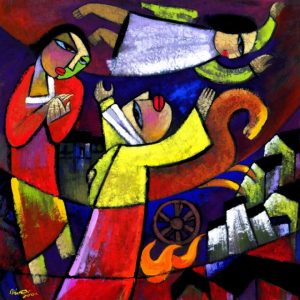 “The Lord your God will raise up for you a prophet like me from among your own people; you shall heed such a prophet.”[1] So said Moses in his farewell address to the Hebrews, to those who were about to enter the Promised Land and begin to become the nation of Israel. As that nation grew and developed it was ruled by tribal leaders and “judges,” by military leaders and priests, by kings (who were occasionally themselves ruled by queens), some of whom were mostly good and others of whom were mostly not-so-good. Throughout all that time, God raised upon not merely “a prophet,” but many prophets: Samuel, Ezekiel, Elijah, Elisha, Isaiah, Jeremiah, Micah, Hosea, Amos, and many, many others.
And there were others who claimed to be prophets but turned out to be either false prophets or prophets of other gods. These were the ones of whom God decreed through Moses, “Any prophet who speaks in the name of other gods, or who presumes to speak in my name a word that I have not commanded the prophet to speak—that prophet shall die.”[2] The Hebrew Scriptures tell us of some of these prophets and their deaths: I think particularly of the 450 prophets of Ba’al who served Queen Jezebel with whom Elijah did battle. When their god failed them the people rose up at Elijah’s bidding and killed them.
 A couple of months ago, I was part of a conversation among several parishioners about the set-up for our celebrations of the Nativity. We looking at our plans for Christmas services, and a member of our altar guild exclaimed, “That’s the problem! Things are always changing around here!”
A few days later at the November vestry meeting, as we were discussing our preliminary work on the 2018 budget and looking over the church’s calendar for the coming year, one of our vestry persons expressed some frustration saying, “That’s the problem! Nothing ever changes around here!”
 Introductory Comment:
Before I offer my homily this morning, I want to say something about a verse I have chosen not to address. Nathanael asks, “Can anything good come from Nazareth?” Many of my clergy colleagues this week have made note of the question the president has been quoted as asking about Haiti and other countries, and they have chosen to focus their sermons this morning on issues of immigration. I have not; I had already chosen my focus verse for today and decided not to make any change. Nonetheless, I want join my colleagues in pointing out that in the First Century, the hometown of our Lord and Savior was regarded in much the same way that Mr. Trump is said to have considered the countries of the Caribbean, of Latin America, and of Africa. Can anything good come from such places? I encourage you in your prayerful meditations on the Gospel, regardless of how you may feel about the president, about his immigration policies, or his alleged remarks, to remember Nathanael’s question and the answer that has echoed through the centuries.
 Why do we do this? Why do we gather when a loved one dies and hold assemblies like this? Most human beings believe that death is not the end of the person who has passed away. Except for the few human beings who really strongly subscribe to an atheist philosophy, and they truly are a minority of our race, everyone on earth belongs to some faith group which teaches that we continue on, whether it is by reincarnation or in the Elysian Fields or the happy hunting grounds, as a guiding ancestral spirit or at rest in the presence of our Lord. So why do we do this?
 Christmas is now done. It ended Friday on Twelfth Night. I am sure than none of you, good Anglican traditionalists that we all are, put away any of your decorations before then, but have by now put them all away.
Yesterday, of course, was the Feast of the Epiphany, the day on which we remember especially the visitation of the Magi. We don’t know exactly when they visited the Holy Family, but most scholars seem certain that it was a lot more than 13 days after Jesus’ birth! More likely, it was about two years. We’ve left the Creche in place this morning and you’ll notice that the Wise Men have made their way from the table at the rear of the Nave up the Epistle side aisle, have visited Joseph, Mary, and Jesus, and are now heading back down the Gospel side aisle, returning to “their own country (as Matthew tells us) by another road.”1
 “In the beginning was the Word . . . .” The Prologue of John’s Gospel echoes the opening words of the Bibe, “In the beginning God said . . . .” Our God is a god who communicates, who speaks, whose Word creates.
The collect for blessing the Christmas Créche begins, “O God our Creator, to restore our fallen race you spoke the effectual word, and the Eternal Word became flesh . . . .” (Book of Occasional Services 2003, page 37) I’ve always like that turn of phrase, “the effectual word” . . . the word that accomplishes something, the word that has power.
In his magisterial work on the poetry of the Indian sage Rabindranath Tagore, Dr. S.K. Paul wrote of powerful words:
If we think of poetry as the use of especially powerful words, then there may reason to suppose that poetry was more important in the prehistoric, preliterate past than it is today – in song, in ritual, in myth – with the structure and choice of words compensating for the impossibility of any written record. Some have even suggested that in the beginning was poetry – in the evolution of language each new word was a poem, the outward expression of a new inward perception. (The Complete Poems of Rabindranath Tagore’s Gitanjali: Texts and Critical Evaluation, Sarup & Sons: New Dheli, 2006, page 318)
At the Christ Mass on December 25, 2017, I offered this poem as a meditation for the congregation at St. Paul’s Episcopal Church, Medina, Ohio.
Skin by Godfrey Rust
That Christmas
God treated himself to a new coat.
Till then he’d not really been dressed for visiting—
he’d nothing dull enough to wear.
Quite early he had come to realise
his appearance didn’t put people at ease.
Even the very first ones were nervous—
when he took an afternoon stroll round the garden
they would run and hide.
I believe for every drop of rain that falls
A flower grows
I believe that somewhere in the darkest night
A candle glows
I believe for everyone who goes astray, someone will come
To show the way
I believe, I believe
I believe above a storm the smallest prayer
Can still be heard
I believe that someone in the great somewhere
Hears every word
Every time I hear a new born baby cry,
Or touch a leaf or see the sky
Then I know why, I believe1
Those are the lyrics of a song written the year after I was born and which was very popular in the early 1950s. Frankie Laine, the Four Letterman, Elvis Presley, and many others recorded versions of it. It was even arranged in combination with Gounod’s Ave Marie as a Christmas choral piece.
In place of an original sermon at the 2017 Advent 4 services, I offered this Lawrence Ferlinghetti poem as a meditation:
Christ Climbed Down
Christ climbed down
from His bare Tree
this year
and ran away to where
there were no rootless Christmas trees
hung with candycanes and breakable stars


