====================
A homily offered by the Rev. Dr. C. Eric Funston on the 7th Sunday after the Epiphany, February 19, 2017, to the people of St. Paul’s Episcopal Church, Medina, Ohio, where Fr. Funston is rector.
(The lessons for the day are from the Revised Common Lectionary, Year A: Leviticus 19:1-2,9-18; Psalm 119:33-40; 1 Corinthians 3:10-11,16-23; and St. Matthew 5:38-48. These lessons can be read at The Lectionary Page.)
====================
 When the Prayers of the People are offered later in this service you will hear a name you’ve never heard before, and you will hear that the person named was buried in our memory garden this week, and you will wonder, “Who is Indra?” (“Indra” is not the child’s real name.)
Indra was born on February 1, 2017. And Indra died on February 1, 2017. Whether she was stillborn or expired a few minutes after her birth is unknown. Indra suffered Turner Syndrome and was born in her parents’ automobile as they were driving to the Emergency Room. In any event, she was not living when they got to the hospital.
Because of her father’s cultural traditions, the family was not involved in her burial and do not know the whereabouts of her ashes. Only the funeral director and I were present. It was the shortest, simplest funeral I’ve ever conducted, but in many ways it was perhaps the saddest and hardest burial I have done in 27 years of ordained ministry.
I was going to start this sermon with the declaration that being a priest is hard, but then I was asked to handle Indra’s burial and I thought perhaps that telling you about her and her funeral would illustrate that better than my simply whining to you about how hard it is to be priest.
It’s not this stuff, this Sunday stuff, that is hard. This is easy. Just follow the Prayer Book, follow the Lectionary, choose some hymns that fit the lessons, ask David to pick some other music, say a few words about Scripture, and share some Bread and some Wine. That’s easy.
And funerals and weddings are usually pretty much the same. Just follow the recipe; like cooking, it all pretty much takes care of itself.
But, sometimes, it’s not. Funerals usually aren’t hard, but Indrah’s fast, simple, no-family-to-deal-with burial was incredibly hard.
Sitting with someone in hospital who is facing their death is hard; sitting with a family whose loved one is facing death is even harder. Counseling two people getting married is hard; counseling two people getting divorced is harder. Getting over being angry with God is hard; helping someone else get over being angry with God is harder.
I don’t really know how handles those situations. I don’t really know how to do this stuff and I’m never sure I’ve done it right. If putting together a Sunday service is like cooking, this sort of stuff is more like baking. I was tempted to say there are no rule books for this sort of thing, but the truth is that there are lots books. There are lots of recipes. There are too many, in fact, and they seem to all give contradictory advice.
I say it’s like baking because I am always looking for the secret to flaky pie crusts or to a successful soufflé. One of my grandmothers swore by using lard in her crusts; the other used butter. My mother said to use vinegar in the dough, but my aunt insisted that ice water was the trick. And as hard as making a good pie crust is, baking a soufflé is even worse. Follow the recipe, but get the slightest thing just a wee bit “off” and what might have been a glorious dessert is a hopeless disaster, and more often than not, you have no idea what you did wrong.
Some of being a priest, a lot of being a priest actually, is like making pie crust or baking a souffle. Do it right – everything is great. Do the slightest thing wrong – it’s a complete mess. And constantly live in fear of that slight, wrong thing.
I think the priests in Solomon’s Temple had it easier. They had Leviticus. Most of us aren’t very familiar with Leviticus. It is, for the most part, a book of rules, of very detailed rules. So we don’t read it in church very much.
We Episcopalians are fond of saying that our worship is among the most biblical of all Christian denominations. We are often criticized for not taking the Bible more seriously and those not familiar with our liturgy accuse us of ignoring it. When that happens, we often fire back that our Prayer Book is about 80% scriptural and that we read through the Bible using a Lectionary so that (and I’ve heard clergy say this) “we read all of the Bible in three years.”
Except that’s not true. We don’t read all those genealogies. There are some of the Psalms that we don’t consider appropriate for Sunday worship, although we do read them in the Daily Offices. And there’s Leviticus from which we read, I think, only two short lessons in the whole three years of the Lectionary cycle. Today is one of those two times. Nonetheless, it is a book worth knowing and knowing about. I commend it to you; it is especially good for reading late at night when you can’t get to sleep . . . .
Very briefly, this is what you’ll find in Leviticus. First, there are six chapters on various kinds of offerings and sacrifices, then two chapters instructing priests how to handle all the different sorts of offerings and sacrifices. This is followed by four chapters on the history of the Aaronic priesthood.
Next are five chapters on uncleanness with which the Temple priests were expected to deal, unclean animals, the uncleanliness of women caused by childbirth, various unclean diseases (such as leprosy) and how the priests were to cleans them, if possible, and (my favorite) unclean bodily discharges. (Maybe the Temple priests didn’t have it easier, after all. I’m quite happy that you don’t come to me with your unclean diseases, your weeping ulcerous sores, and your other bodily discharges! That would be really hard . . . .)
After the uncleanness chapters, there is one chapter detailing the Day of Atonement.
Then comes something scholars call “the Holiness Code,” ten chapters for the not-priests, for the people of God. Ten chapters of practical rules for living a righteous life. One of them, from which we heard today, concerns neighborliness and begins with this admonition, “You shall be holy, for I the Lord your God am holy.”
Do you know why I became a priest? Yes, I had that sense of call and went through the discernment “process” and all of that (twice, actually, but that’s another story). But . . . really . . . when I look back on it, I realize that I left my life as a trial lawyer and went into the ordained ministry because, as hard as it is, it’s easier than being a lay person. As hard as it sometimes is to be a priest, to be a “professional Christian” in the church, it’s harder still to be a lay Christian in the world.
There are no good rule books for priests, or too many contradictory rule books, but there are expectations and there are permissions. There is a stereotype and there are prescribed situations. There is “safety within the walls” of the church, within the set of circumstances in which a priest finds him- or herself.
That’s not true in the world. In the the wide open, free wheeling, anything-can-come-at-you-world where you not-priests have to do your ministry, you have the much harder job.
You can tell that just by look at the Book of Leviticus: there are five chapters of rules for priests, but there are ten for the not-priests! The people of God have twice as much to do as the priests of God.
And you can tell it just by reading the Catechism of the Episcopal Church (it’s in the Prayer Book back around page 845 or so, in that part of the book no one ever seems to open). It asks there who the ministers of the Church are and answers that it’s everyone: lay persons, bishops, priests, and deacons. The ministry of priests, it says, is to “share with the bishop in the overseeing of the Church; to proclaim the Gospel; to administer the sacraments; and to bless and declare pardon in the name of God.” (Book of Common Prayer, page 856)
That’s a piece of cake when you compare it to the ministry of the laity. According to the Catechism, your job, oh People of God, is “to represent Christ and his Church; to bear witness to him wherever [you] may be; and, according to the gifts given [you], to carry on Christ’s work of reconciliation in the world; and to take [your] place in the life, worship, and governance of the Church.” (BCP, page 855) Now that is hard work!
The Jewish bible scholar and rabbi Jacob Milgrom said that the point of the Book of Leviticus is that holiness is not the responsibility of priests alone. In this book, and especially in the Holiness Code, “the domain of the sacred expands, embracing the entire land, not just the sanctuary, and all of Israel, not just the priesthood.” Israel, he said, attains holiness and priests strive to sustain it. (Milgrom, J., Leviticus: A Book of Ritual and Ethics, Fortress Press, Minneapolis:2004, pp 175, 178)
Although priests are not allowed by the rules in Leviticus to make any mistake, attaining holiness takes a lot more work than sustaining it. What we priests do in the sanctuary merely sustains holiness; what the People of God do in the world, that is how holiness is attained. That’s much, much harder!
It takes love … It takes loving even people we don’t really like, even people we can’t stand! Indeed, the word used in Hebrew text is not exactly “neighbor;” it is not limited to those who are geographically nearby. The Hebrew word is more akin to “fellow” and seems to be much more expansive. Thus, when a lawyer questions Jesus about the Law, Jesus is able to cite the rule from Leviticus (19:18), “You shall love your neighbor as yourself” and then illustrate it with a story involving someone from another country, a hated foreigner, the Good Samaritan. (See Luke 10:25–37)
In our Gospel lesson today, Jesus quotes (or, actually, misquotes) the same verse from Leviticus, adding words that aren’t in the original: “You have heard that it was said,” he says, “‘You shall love your neighbor and hate your enemy.'” (Mt 5:43)
Now to be fair to Jesus, he doesn’t actually say he’s quoting Leviticus, just “you have heard it said.” That last bit about hating enemies could just be a rabbinic gloss; it could just be folk wisdom. In any event, it was (and is) the way people act. Jesus acknowledges human nature by beginning this bit of the Sermon on the Mount (and that’s what this is, the end of the first chapter of that long sermon) with commentary on what’s called “the lex talionis,” that eye-for-an-eye rule. But the lex talionis isn’t about enemies; that’s a rule of justice not of war. “An eye for an eye” deals with retribution toward a neighbor who has violated social norms. Jesus dispenses with that (saying, basically, don’t follow the lex talionis, don’t seek retribution or revenge) and now moves beyond it; he leaves the neighborhood, so to speak.
Jesus says, “Love your enemies. Love those whom you fear, even those you think might kill you, even the hated foreigner.” He’s saying that “enemy” is not really a separate class, that the world isn’t divided into neighbors and enemies. Although some people would like to do that, although some people have always done that (it’s human nature, after all), the world isn’t carved up that way. Jesus is saying (I think) that “enemies” are simply a class of “neighbors;” that enemies and neighbors are all “fellows;” that the division – neighbors here, enemies there, those we’re unsure about in some holding pen over there – doesn’t hold water.
And then, echoing Leviticus’ “Holiness Code,” especially the first verses of the neighborliness rules of Chapter 19 – “Be Holy because God is holy” – Jesus says, “Be perfect, therefore, as your heavenly Father is perfect.” (Mat 5:48)
That’s heavy stuff! And remember the Leviticus command and Jesus’ admonition are not directed to the priests; these are directives for the whole People of God, for the laity.
It’s hard work . . . but as Kathryn Schifferdecker, who teaches Old Testament at Luther Seminary in St. Paul, Minnesota, says these verses are as much promise as command:
“You shall be holy.” It is both command and promise. And to believe that promise is to begin to be formed into the people God calls us to be, a people living out in our day-to-day lives genuine love for God and for our neighbors. (Working Preacher)
You will be holy. You will be perfect. It’s a promise – so act on the promise; live as if you believe the promise. And keep this in mind, “holiness” is just another way to say “wholeness” and “perfection” is just another way to say “completion.” The promise of holiness is an instruction to strive for wholeness; the promise of perfection is a command to work toward completion.
What Leviticus and Jesus ask of us is that we be fully human, that we be as whole and complete a human being as each of us can be. And the way we do that is to love our neighbor, even the neighbor who seems to be our enemy, even the neighbor of whom we are afraid, even the neighbor we think may kill us.
When I was kid, I helped my stepdad restore old homes. I think my parents invented to the practice of “flipping,” buying old fixer-uppers, rehabbing them, and then selling them hopefully at a profit. From the time I was about 10 years old until I went away to college, we lived and fixed up in a different house every year. The last thing we would do was to paint the interiors. My stepdad encouraged me to do that very neatly and carefully because, he would say (and I had no idea that he was referencing scripture), “Paint covers a multitude of sins.”
He was parodying the First Letter of Peter, “Love covers a multitude of sins (4:8).” Peter goes on to say, “Serve one another with whatever gift each of you has received (v. 10).” Just be human, be yourself, be the best you you can be, loving your neighbor and using whatever gifts you have been given. I know that’s hard; it’s really hard. But with the help and grace of God, you can do it.
“You shall be holy, for I the Lord your God am holy.” “Be perfect, as your heavenly Father is perfect.” It is a promise more than it is a command. With the help and grace of God you will be holy; you will be perfect.
And the glorious thing is – the Gospel truth is – that through the grace of God you already are!
Amen!
(Note: The illustration is Camelia Japonica, “Pink Perfection,” a camellia cutlivar dating from the late 18th Century; it was one of the most popular flowers of the Victorian Age.)
====================
Father Funston is the rector of St. Paul’s Episcopal Church, Medina, Ohio.
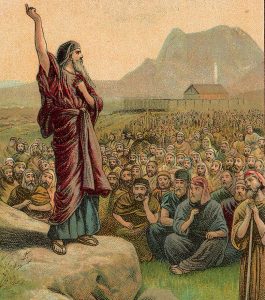 The Book of Deuteronomy tells us that when the long Exodus journey of the People of the Hebrews ended, just before they were to cross over into the Promised Land, Moses delivered a farewell address. He was not going to be going into the new land with them.
  Have you ever had the experience of a long-forgotten memory rushing back upon you and just knocking you for a loop? Something like an odor or a song or a picture brings it back and the details hit you like a sledge hammer. That happened to me on Monday evening.
  In a New York Times editorial, Frank Bruni said:
 May God be merciful to us and bless us, show us the light of his countenance and come to us. (Ps. 67:1) Amen.
 “The Lord called me before I was born, while I was in my mother’s womb he named me.” (Isa. 49:1b) What a powerful statement that is that the prophet makes in today’s reading. We name this prophet Isaiah; scholars name him Deutero-Isaiah or Second Isaiah. We don’t really know his name . . . but God did! God named him before he was born. Gave him personhood and human identity.
 We are here tonight for two reasons. First, because this is the Feast of the Epiphany, one of the major feasts of the Christian Church and one we too often ignore, and second, because this is the inaugural event of our Year of Celebration during which we will mark the 200th anniversary of the founding of this parish.
 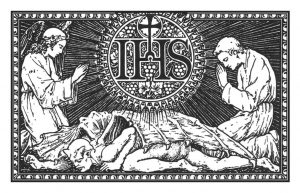 Today on the secular calendar is New Year’s Day, but that’s not true in the church. We celebrated a new church year several weeks ago on the First Sunday of Advent. In the church, January 1, being eight days after the Feast of the Incarnation, is the day on which we celebrate Jesus’ Jewishness. We call it, these days, the Feast of the Holy Name of Jesus; it was formerly called the Feast of the Circumcision of Christ because that is what Luke’s Gospel tells us was done. It was a very Jewish thing to do.
 I was in the pet supply aisle at Giant Eagle several days ago getting food for the Archbishop (that’s our black cocker spaniel, Lord Dudley of Ballycraic, the Archbishop Canine of Montville) when I found, right in front of the Beneful which is his favorite meal, a bin filled with these: dog toys in the likeness of a lamb dressed for Christmas. And not just any lamb! This is Lamb Chop, the somewhat snarky puppet introduced to the world by the late Shari Lewis in 1957.
 Which brings me to the fourth and last bit of poetry our Christmas Lamb Chop brought to mind, which is a song Lamb Chop and Shari Lewis taught their viewers during the 1992 season of the PBS show Lamb Chop’s Play-Along. Some of you may know the song and can sing along:
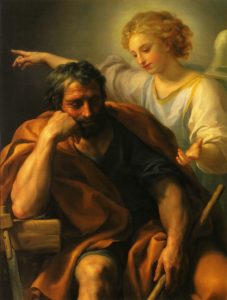 In these few verses, Matthew opens up for us the complexity of Joseph as a human being. He hints at, and we can imagine, Joseph’s distress, his sense of betrayal, his disappointment, and all the other emotions he must have experienced. We can imagine also the fear and hurt that Mary probably would have felt as she and her betrothed sorted out the complications caused by the divine intrusion into their relationship.

