Occasional thoughts of an Anglican Episcopal priest

Category: Church (Page 42 of 116)

We Do Not Have The Privilege – Sermon for Advent 1 – November 30, 2014

====================

On the First Sunday of Advent, Year B, November 30, 2014, this sermon was offered to the people of St. Paul’s Episcopal Church, Medina, Ohio, where Fr. Funston is rector.

(The lessons for the day, RCL Advent 1B, were Isaiah 64:1-9; Psalm 80:1-7, 16-18; 1 Corinthians 1:3-9; and Mark 13:24-37. These lessons can be read at The Lectionary Page.)

====================

Racism Is So YesterdayWhen Philip told Nathanael that he had found the Messiah and that he was the son of a carpenter from Nazareth, Nathanael’s immediate response was, “Can anything good come from Nazareth?” (Jn 1:46). Obviously Nazareth had a reputation, and not a good one. I often wonder if, as Jesus was making his way through the Holy Land, especially early in his ministry when he wasn’t well-known, people would ask him, “What was it like growing up in Nazareth?”

All of my life, whenever I tell my story to folks, they have asked, “What was it like growing up in Las Vegas?” And I have always answered, “Like growing up anywhere else. Las Vegas, when you get off the Strip, was just like anywhere else. It was hometown America.” Las Vegas at the time was smaller than Medina is today; the population of Las Vegas in the early 1950s was only about 25,000 people.

Although there was an airport by then, visitors to Las Vegas usually either drove across the desert or rode the Union Pacific Railroad. The line from Salt Lake City to Los Angeles went through Las Vegas; the railroad ran through town north-to-south and the business and hotel district now know as “the Las Vegas Strip” grew up parallel to, and east of, the tracks.

That’s the side of the tracks I grew up on; on the other side, “the Westside,” was where black people lived. Whites didn’t go there, and Negroes (as black Americans were then politely called) didn’t come to the east side of the tracks except to work, mostly in low paying service jobs as janitors, maids, cooks, porters, and doormen. Yes, indeed, the Las Vegas of my childhood was hometown America. Just like any other town in this country was, and just like many still are. Need I mention the St. Louis metropolitan area and its suburb of Ferguson? Need I mention the Cleveland metroplex and the westside neighborhood near the Cuddell Recreation Center? Need I mention, even, Medina itself?

Yes, I think I need to. A few years ago, our nation elected a black man to be president and many proclaimed that we now lived in a “post-racial” world, that racism is “so yesterday.” Throughout the whole of Barack Obama’s presidency, however, the rhetoric and behavior of many have demonstrated just how wrong that judgment was. We do not live in a “post-racial” society. The shooting deaths of black men and boys, Michael Brown in Ferguson, MO, John Crawford in Beavercreek, OH, and Tamir Rice in Cleveland, OH, all by white police officers, and the choke-hold death of Eric Garner, a black man in the custody of white officers of the New York Police Dept., together with the perceived failures of the justice system and the social unrest which have followed, have demonstrated just how wrong that judgment was. We do not live in a “post-racial” world.

“Keep awake!” said Jesus, “Keep alert!”

Elsewhere, ISIS in Iraq and the Taliban in Afghanistan murder those who differ from themselves, Jewish nationalists in Israel pass laws denying basic human rights to Palestinian Arabs, and Buddhist monks in Myanmar threaten to kill Muslim children, demonstrating just how wrong that judgment continues to be not only in our own country but throughout the world. We do not live in a “post-racial” world. Racism is not “yesterday;” it is today!

“Keep awake!” said Jesus, “Keep alert!”

Meanwhile, epidemics such as the ebola crisis in Africa have caused social upheaval, ethnic conflict, and calls for borders to be closed and walls to be raised between nations. Really quite silly notions about vaccines have led people to refuse them and diseases once thought nearly eradicated are being seen again, such as polio and bubonic plague.

“Keep awake!” said Jesus, “Keep alert!”

Weather extremes are being felt throughout the world and sea levels are rising threatening populations in low-lying areas in the South Pacific Islands, southeast Asia, various parts of Africa and South America, and even in our own country, and these things seem to be the result of our poor stewardship of the earth’s environment. At least, that’s what the great majority of the world’s climate scientists tell us.

“Keep awake!” said Jesus, “Keep alert!”

Jesus said, “Nation will rise against nation, and kingdom against kingdom; there will be earthquakes in various places; there will be famines . . . Brother will betray brother to death, and a father his child, and children will rise against parents and have them put to death . . . There will be suffering, such as has not been from the beginning of the creation . . . [and] after that suffering, the sun will be darkened, and the moon will not give its light, and the stars will be falling from heaven, and the powers in the heavens will be shaken.” (Mk 13:8,12,19,24-25)) Therefore, “Keep awake!” said Jesus, “Keep alert!”

Are we seeing the end-times? Are these things that are happening – the racial and ethnic conflicts, the wars, the epidemics, the weather crises, the floods – are these those fig-tree signs that “when [we] see these things taking place, [we] know that [the Son of Man] is near, at the very gates”? (Mk 8:29) I don’t think so, but who’s to say? As Jesus made quite clear, “about that day or hour no one knows, neither the angels in heaven, nor the Son, but only the Father.” (v. 32)

So I don’t know if these are the signs of the end, but I do know this, that these are the signs of things that displease God. And when God is displeased, watch out! When God is displeased, God “tear[s] open the heavens and . . . the mountains . . . quake at [God’s] presence.” (Is 64:1) It is when God is angry that stars fall from heaven and the powers of the heavens are shaken. We do not want to face an angry God!

And yet we cannot dismiss God’s indignation. We would like to. We would like to focus only on the loving God proclaimed by Jesus, not that angry God that Isaiah and the Psalmist remind us of. We would like to, but we can’t because when we blind ourselves to the potential of God’s anger, we blind ourselves to the things that provoke God’s anger. We fail to see (and thus to deal with) the racism which is endemic our society; we fail to see (and thus to deal with) our poor stewardship of creation; we fail to see (and thus to deal with) the illnesses and diseases which are pandemic among populations less fortunate than ourselves.

I’ll be honest with you. I don’t want to talk about the shooting of Michael Brown in Ferguson, MO, the shooting of John Crawford in Beavercreek, Ohio, the shooting of Tamir Rice in Cleveland, Ohio, or the chokehold death of Eric Garner in New York City. I don’t want to talk about the response of the justice system to those deaths and whether or not it functioned properly in not punishing, in some way, the police officers responsible for those deaths. I don’t want to.

In the same way, I don’t want to remember that when my father’s client and friend Sammy Davis, Jr., came to Las Vegas to perform in the Strip casino showrooms he was not allowed to enter those casinos through the front door but had to come in through the service entrance. I don’t want to remember that when Louis Armstrong and Duke Ellington played in Las Vegas they were not allowed to stay in the hotels that hired them but had to put up at boarding houses on the Westside. I don’t want to remember that when Cab Calloway played at a casino bar in Las Vegas in 1954 he was refused a drink at that same bar during a break in the performance.

I don’t want to talk about or remember these things and, I suspect, neither would most people in this church this morning. Frankly, a large fraction of the white society in which we live would, likewise, prefer that we not do so. We believe that we enjoy the privilege of not talking about, remembering, or doing anything about those things, that those things really don’t affect us, that they really aren’t any of our business. The families of Michael Brown, John Crawford, Tamir Rice, and Eric Garner, and the communities within which they lived, however, do not have that privilege. Black performers who succeeded Davis, Armstrong, Ellington, and Calloway, who now can enter the casino through the front door, stay in the hotel, and drink at the bar, who are the beneficiaries of the groundbreaking they did, do not have that privilege.

And, truth be told, neither do we. If we do not remember and talk about these things, we will have failed to see and deal with the racism, the conflict, the poor stewardship of humankind that is all around us; we will have failed to follow Jesus’ admonition in today’s Gospel to “keep alert” and to “keep awake.” We will have failed to follow the second great commandment to “love our neighbors as ourselves.” We will have failed to heed to word of God recorded in the law of Moses: “You shall not wrong a stranger or oppress him” (Ex 22:21); “The stranger who resides with you shall be to you as the native among you, and you shall love him as yourself” (Lev. 19:34); “You shall not pervert the justice due to [anyone]” (Deut. 24:17). We simply are not allowed to think of or to treat any human being differently from ourselves. We do not have the privilege not to talk about, not to remember, not to do something about the injustices done to others, whatever their race or color, whatever their religion, whatever their sex or sexual orientation.

Nathanael asked Philip, “Can anything good come out of Nazareth?” The world today is asking, “Can anything good come out of Ferguson? Out of Beavercreek? Out of Cleveland? Can anything good come of the shooting deaths of young black men by white police officers?” I pray that it can: we have had enough of the bread of tears; we have had enough of the derision of neighbors; we have had enough of the laughter of scorn. Some good must come from these things and it must start with our realization that we do not have the privilege to stand by and think these things have nothing to do with us.

We do not have the privilege to think of or to treat anyone differently from ourselves. We do not have the privilege not to talk about, not to remember, not to do something about the injustices done to others. If we do that, we fail to keep alert and to keep awake, and we risk the anger of the God who tears open the heavens and makes the mountains quake.

Are the things we are seeing signs of the end-times? No, I don’t think so. Are they signs to which we need to pay attention? Things we need to do something about? Oh, yes! Very much so!

“O Lord, you are our Father; we are the clay, and you are our potter; we are all the work of your hand. Do not be exceedingly angry, O Lord, and do not remember [our] iniquity forever.” (Is 64:8-9) “Restore us, O Lord God of hosts; show the light of your countenance, and we shall be saved.” (Ps. 80:18)

Amen.

====================

A request to my readers: I’m trying to build the readership of this blog and I’d very much appreciate your help in doing so. If you find something here that is of value, please share it with others. If you are on Facebook, “like” the posts on your page so others can see them. If you are following me on Twitter, please “retweet” the notices of these meditations. If you have a blog of your own, please include mine in your links (a favor I will gladly reciprocate). Many thanks!

====================

Father Funston is the rector of St. Paul’s Episcopal Church, Medina, Ohio.

Anticipating an Ordination – From the Daily Office – November 7, 2014

From the Wisdom of Jesus, Son of Sirach:

The leader of his brothers and the pride of his people
was the high priest, Simon son of Onias,
who in his life repaired the house,
and in his time fortified the temple.
When he put on his glorious robe
and clothed himself in perfect splendor,
when he went up to the holy altar,
he made the court of the sanctuary glorious.

(From the Daily Office Lectionary – Eccesiasticus 50:1,11 (NRSV) – November 7, 2014)

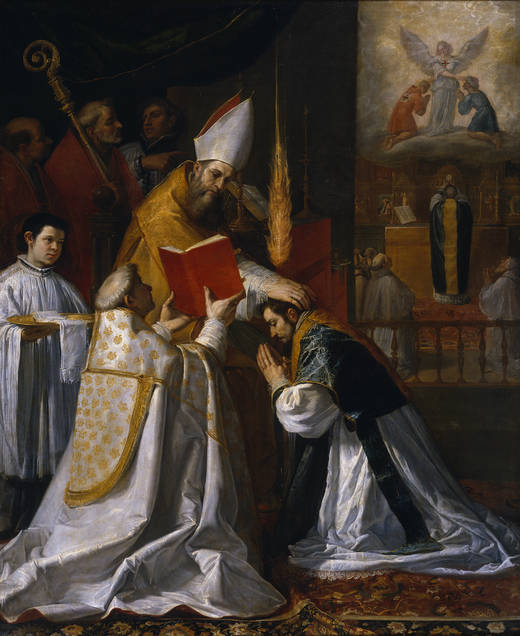
Ordination and First Mass of Saint John of Matha by Vincenzo CarducciTonight, as my diocese begins its annual governing convention in traditional fashion with a celebration of the Holy Eucharist, we will doing so in the context of an ordination – two ordinations, in fact, one to the diaconate and one to the presbyterate. This morning’s reading from Ben Sira is lengthy description of the glories of the ceremonial priesthood. One might have expected the church to have made this one of the potential readings for a presbyteral ordination, but in its wisdom, it has not.

My personal religious background is as the child of an inactive, not-quite-thoroughly-unchurched mixed marriage of a Disciple of Christ and a Methodist, the disinterested products of two decidedly American expressions of protestant evangelical Christianity. Until I was in high school my church attendance depended on which set of grandparents I was visiting; at home, church was out of the question. My grandparents’ churches were proudly non-ceremonial; the closest anyone came to wearing a vestment was the Methodist pastor’s doctoral gown.

In high school, I encountered the Episcopal Church in an Anglo-Catholic diocese. Bells, smells, chants, rich vesture . . . I knew I had come home! As I read the entire lesson today from Ecclesiasticus, I can almost remember every detail of that first encounter with the ritual of religion.

But the rubrics of the ordination service for a priest of the Episcopal Church do not permit or recommend Ben Sira’s soaring description of ceremonial liturgy and priestly elegance! Instead, we are given these choices from the Hebrew Scriptures:

  • Isaiah 6:1-8, in which the soon-to-be-commissioned prophet cries, “Woe is me! I am lost, for I am a man of unclean lips, and I live among a people of unclean lips,” and has his lips seared with a burning coal; or
  • Numbers 11:16-17,24-25, in which Moses is instructed to recruit seventy elders to “bear the burden of the people along with you so that you will not bear it all by yourself.”

And then there are the choices from the Psalter:

  • Psalm 43 in which we ask, “Why are you so full of heaviness, O my soul? and why are you so disquieted within me?” or
  • Psalm 132:8-19 in which we beg God “do not turn away the face of your Anointed.”

In the New Testament readings, Peter reminds us, “Do not lord it over those in your charge, but be examples to the flock” (1 Pt 5:3), a rather different vision than Ben Sira’s description of the magnificent Simon, son of Onias. Paul warns us through his words to the Ephesians to not “be children, tossed to and fro and blown about by every wind of doctrine, by people’s trickery, by their craftiness in deceitful scheming” (Eph 4:14), and in his admonition to the church in Philippi he instructs us, “Let your gentleness be known to everyone.” Again, a contrast to the picture of priesthood in this morning’s reading.

Don’t get me wrong! I love the ritual and the ceremonial. I love great vestments, incense, chant, trumpets, the clanging of bells – it’s all great show and great fun and adds to the experience of religion for me. But the priesthood is much, much more than all of that.

In my vesting sacristy hangs a simple frame with a printed copy of an address by an Englishman who was a bishop in Africa in the early years of the 20th Century. The Rt. Rev. Frank Weston, Bishop of Zanzibar, in his concluding address to the Anglo-Catholic Congress of 1923, finished with these words:

If you are Christians then your Jesus is one and the same: Jesus on the Throne of his glory, Jesus in the Blessed Sacrament, Jesus received into your hearts in Communion, Jesus with you mystically as you pray, and Jesus enthroned in the hearts and bodies of his brothers and sisters up and down this country. And it is folly – it is madness – to suppose that you can worship Jesus in the Sacraments and Jesus on the Throne of glory, when you are sweating him in the souls and bodies of his children. It cannot be done.

There then, as I conceive it, is your present duty; and I beg you, brethren, as you love the Lord Jesus, consider that it is at least possible that this is the new light that the Congress was to bring to us. You have got your Mass, you have got your Altar, you have begun to get your Tabernacle. Now go out into the highways and hedges where not even the Bishops will try to hinder you. Go out and look for Jesus in the ragged, in the naked, in the oppressed and sweated, in those who have lost hope, in those who are struggling to make good. Look for Jesus. And when you see him, gird yourselves with his towel and try to wash their feet.

Every time I put on my fine silk vestments from Whipple or Almy, the hand-made stoles and chasubles commissioned from private tailors, or the humble offerings created by members of the congregation, I read those words. The priesthood is not about Simon’s glorious robes and perfect splendor; it’s not about trumpets and thuribles and magnificent altars. That’s just the fun stuff we are privileged to enjoy. As the ordination readings and Bishop Weston remind us, priesthood is about serving God’s people in whom we find the living Jesus.

====================

A request to my readers: I’m trying to build the readership of this blog and I’d very much appreciate your help in doing so. If you find something here that is of value, please share it with others. If you are on Facebook, “like” the posts on your page so others can see them. If you are following me on Twitter, please “retweet” the notices of these meditations. If you have a blog of your own, please include mine in your links (a favor I will gladly reciprocate). Many thanks!

====================

Father Funston is the rector of St. Paul’s Episcopal Church, Medina, Ohio.

Singing of the Senate – From the Daily Office – November 6, 2014

From the Wisdom of Jesus, Son of Sirach:

Let us now sing the praises of famous men,
our ancestors in their generations.
The Lord apportioned to them great glory,
his majesty from the beginning.
There were those who ruled in their kingdoms,
and made a name for themselves by their valor;
those who gave counsel because they were intelligent;
those who spoke in prophetic oracles;
those who led the people by their counsels
and by their knowledge of the people’s lore;
they were wise in their words of instruction;
those who composed musical tunes,
or put verses in writing;
rich men endowed with resources,
living peacefully in their homes —
all these were honored in their generations,
and were the pride of their times.
Some of them have left behind a name,
so that others declare their praise.
But of others there is no memory;
they have perished as though they had never existed;
they have become as though they had never been born,
they and their children after them.
But these also were godly men,
whose righteous deeds have not been forgotten;
their wealth will remain with their descendants,
and their inheritance with their children’s children.*
Their descendants stand by the covenants;
their children also, for their sake.
Their offspring will continue for ever,
and their glory will never be blotted out.
Their bodies are buried in peace,
but their name lives on generation after generation.
The assembly declares their wisdom,
and the congregation proclaims their praise.

(From the Daily Office Lectionary – Eccesiasticus 44:1-15 (NRSV) – November 6, 2014)

I don’t usually set out the entire text of one of the Daily Office lessons in these morning ramblings of mine, but long before I had read and appreciated the rest of the Book of Ben Sira, I knew of these “hymn to the ancestors.” Twenty-one years ago, as a fledgling priest with just two years of presbyteral ministry under my belt, I was called upon to cobble together a grave-side service for the burial of my older brother, Richard York Funston, a dis-churched former member of the Lutheran Church – Missouri Synod. I chose to use this as the only reading from Scripture because it seemed to suit both the occasion and the person.

Rick had been a professor of political science and, at the time of his untimely death at age 49, the Dean of Faculty and Academic Vice President of a major west coast university. He had studied the famous and the forgotten political figures of our American political past, those “whose righteous deeds have not been forgotten,” and whose descendants (you and me) ” stand by the covenants” they have made over the generations of the republic.

He loved politics as much as he loved sports; presidential debates and election night coverage were as much entertainment to him as the Super Bowl or the NCAA basketball championships. I often wonder what he would have made of the rise of the “Tea Party.” His specialty was the study of the U.S. Supreme Court and its impact on electoral politics – what would he have thought of Citizens United?

Anyway, in the aftermath Tuesday’s election, my older brother was on my mind and it seemed more than serendipitous that this text should be the Old Testament lesson for today.

One of the things Rick and I once talked about was the nature of the Senate and how it has changed over the decades. Senators were originally selected by State legislatures, but the Seventeenth Amendment approved in 1913 transferred that decision to the popular electorate. Once that was done, the politics of the Senate changed in the sense that the Senators became much better known to the people within the states they represented. The advent of mass communication – radio then television and now the internet ¬ has made them better known to the nation as a whole. For example, I now know at least as much and possibly more about Joni Ernst, the Senator-elect from Iowa, than I do the Senators from the state in which I live! (I might, perhaps, wish that I didn’t!) Senators now seem to play on a national stage to a national (possibly even international) audience with more concern for their egos and their personal agendas than for the people of their several states or even the people of the nation!

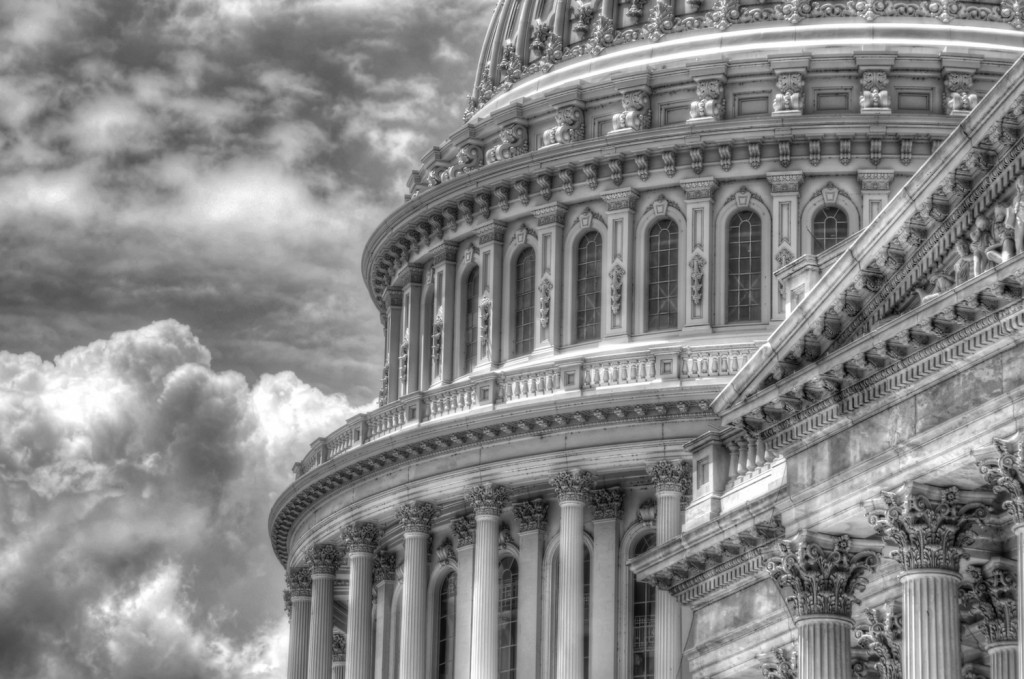
US Capitol Dome with Clouds

They are well-known now, but how many will go down in history to be remembered even a decade from now if they are defeated in their next senatorial election. How many will stay multiple terms to make a significant mark on the American political landscape? Since the founding of the republic there have been 1,950 Senators. How many can you name? I can’t name very many, of them “there is no memory; they have perished as though they had never existed.”

Remembered or forgotten, however, their predecessors have and they will contribute to some extent to the political tenor of this country and to its future. We may fear what some of them would do individually but the theoretical beauty of the system is that the legislative body is wiser than any individual in it; the collective group-think of the hive-mind tones down the outrageous outspoken craziness of some and amplifies the softly spoken cool-headedness of others. The assembly may momentarily “declare the wisdom” of the individual, but eventually it is the wisdom of the assembly than prevails.

My late brother the political scientist had great faith in the system. He always insisted that, in the end, when the system works, it works well, and that when it works badly, there is hope for change. I pray that he his faith was not misplaced! The Book of Common Prayer of the Episcopal Church includes this prayer for the Congress; I have said it daily for the past several weeks leading up to the election. Now that we have its results, I plan to continue it as a daily discipline:

O God, the fountain of wisdom, whose will is good and gracious, and whose law is truth: We beseech thee so to guide and bless our Senators and Representatives in Congress assembled, that they may enact such laws as shall please thee, to the glory of thy Name and the welfare of this people; through Jesus Christ our Lord. Amen. (BCP 1979, page 821)

I hope that we will be able to praise these famous people, those who are remembered and those who are not, because for good or ill their deeds will not be forgotten. Ben Sira was right about that!

====================

A request to my readers: I’m trying to build the readership of this blog and I’d very much appreciate your help in doing so. If you find something here that is of value, please share it with others. If you are on Facebook, “like” the posts on your page so others can see them. If you are following me on Twitter, please “retweet” the notices of these meditations. If you have a blog of your own, please include mine in your links (a favor I will gladly reciprocate). Many thanks!

====================

Father Funston is the rector of St. Paul’s Episcopal Church, Medina, Ohio.

The Midterm Zombie Apocalypse – From the Daily Office – November 5, 2014

From the Apocalypse of John of Patmos:

The fifth angel poured his bowl on the throne of the beast, and its kingdom was plunged into darkness; people gnawed their tongues in agony, and cursed the God of heaven because of their pains and sores, and they did not repent of their deeds.

(From the Daily Office Lectionary – Revelation 16:10-11 (NRSV) – November 5, 2014)

The Republicans won control of the Senate. Facebook and other social media this morning are rife with Democrats and other self-styled progressives writhing in agonized self-blaming (or furious finger-pointing). You’d think the fifth angel’s bowl was poured out yesterday on the United States and that we’d been plunged into darkness.

Pah!

Last night my Education for Ministry group did a theological reflection on an image from culture. (EfM folks will have a better understanding of what that means. If you aren’t an EfM participant, I can’t really go into the EfM model of theological reflection here: I recommend you find an EfM group in your area and enroll.)

Our image: Zombies. We talked about the old “voodoo” horror movie model of zombie; the George Romero “living dead” movie version; the AMC television program “The Walking Dead” version; and the new Syfy Channel “Z Nation” version. Zombies, apparently, have changed over the years from living people under the spiritual control of an evil voodoo shaman into dead corpses reanimated by a virus which (I didn’t know this because I don’t watch the television programs) infects everyone! So, everyone dies and everyone comes back as a zombie! Now there’s a metaphor for something; I’m not sure what and I’m not sure it’s spiritually edifying, but there it is.

Zombie Attack

Anyway, we had great fun deeply considering the world of zombies then moving from the culture source into the Christian tradition source, the personal position (belief) source, and the personal experience (action) source. When we reached the end of the evening and came to the application exercise – “How will I apply this reflection? What will I now do?” – one of our thoughts was, “Just go home and shoot myself in the head.” Apparently that prevents one’s coming back as a zombie.

I had no idea I would wake this morning to so many liberal friends and colleagues having that same sort of reaction to the midterm election!

Chill out, folks! The world has not been plunged into a zombie-filled darkness filled with creatures gnawing at their tongues and covered with rotting sores.

One party has taken control of the Congress by a narrow margin in the upper house, but it is a party at war with itself. I think it will actually be fun to see if Mr. McConnell (presumably the new majority leader) can control his caucus any better than Mr. Boehner has controlled his. The split between old line Republicans and the new “Tea Party” Republicans may just grow wider and hamstring the legislative branch even more so than it has done for the past four years. Furthermore, even if they unite, the Democrats hold enough votes to defeat things by fillbuster (an old GOP tactic they will now have to contend with on the receiving end) and a Democratic president still holds the veto power. (See this analysis by the UK’s The Guardian newspaper.)

It’s not John’s end of the world! Nor are Zombies flooding the streets.

I hope that something good can come of this. The New York Times this morning editorializes that there might be greater opportunity for compromise than there has been. Personally, I think they’re wrong; I believe we are in for two-years of mind-numbingly pointless political theater. My prayer is that it is not also spirit-numbing!

The “zombies” in John’s vision did not “repent of their deeds.” My hope and prayer is that we, the “zombies” of the 2014 midterm election, whatever our party or political persuasion, will do so. We are where we are (and we would be here if the Democrats had held onto the Senate, by the way) because, as a nation, we have allowed ourselves to be tribalized and polarized. To a certain extent, when it comes to politics, we are all “zombies,” infected by the unrelenting virus of our political positions and unwilling (perhaps by this time unable) to see any positive in the positions of others.

We need to repent and return to the ways of civility, negotiation, compromise, and actually getting the work of society done.

====================

A request to my readers: I’m trying to build the readership of this blog and I’d very much appreciate your help in doing so. If you find something here that is of value, please share it with others. If you are on Facebook, “like” the posts on your page so others can see them. If you are following me on Twitter, please “retweet” the notices of these meditations. If you have a blog of your own, please include mine in your links (a favor I will gladly reciprocate). Many thanks!

====================

Father Funston is the rector of St. Paul’s Episcopal Church, Medina, Ohio.

Political Rainbow – From the Daily Office – November 4, 2014

From Ecclesiasticus:

Look at the rainbow, and praise him who made it; it is exceedingly beautiful in its brightness. It encircles the sky with its glorious arc; the hands of the Most High have stretched it out.

(From the Daily Office Lectionary – Sirach 43:11-12 (NRSV) – November 4, 2014)

Today in the US is the midterm election. I live in a decidedly “red” state with very little chance than any state office or congress seat currently held by the GOP will go to another party, partly because the Democrats chose a less-than-stellar gubernatorial candidate, partly because of gerrymandering, and partly because the Republicans simply predominate in most of the rural ad small-town electorate. Nonetheless, I will go to the polls and cast my “progressive” ballot and hope that elsewhere in the country things may be different.

What I hope most (and pray for) is that at some time in our national political future there will be a rainbow! That there will be an end to the rancorous, uncivil, winner-take-all, scorched-earth, no-compromise politics that has characterized this country for the past two decades, or longer…. When did it start, this deluge of polarization? I think it’s probably always been there at the fringes, but it seems to me it began moving to the center during the Nixon administration, arrived center-stage during the Clinton years, and has simply parked there ever since, the way a weather system can park over an area for days (in this case decades) at a time, bringing wave after wave of torrential downpour.

One of my favorite poems about rain is The Rainy Day by Rabindranath Tagore, who paints a dismal and scary picture of a village in monsoon season:

Sullen clouds are gathering fast
over the black fringe of the forest.
O child, do not go out!
The palm trees in a row by the lake
are smiting their heads
against the dismal sky;
the crows with their dragged wings
are silent on the tamarind branches,
and the eastern bank of the river
is haunted by a deepening gloom.
Our cow is lowing loud, tied at the fence.
O child, wait here till I bring her into the stall.
Men have crowded into the flooded field
to catch the fishes
as they escape from the overflowing ponds;
the rain-water is running in rills
through the narrow lanes like a laughing boy
who has run away from his mother to tease her.
Listen, someone is shouting for the boatman at the ford.
O child, the daylight is dim,
and the crossing at the ferry is closed.
The sky seems to ride fast upon the madly rushing rain;
the water in the river is loud and impatient;
women have hastened home
early from the Ganges
with their filled pitchers.
The evening lamps must be made ready.
O child, do not go out!
The road to the market is desolate,
the lane to the river is slippery.
The wind is roaring and struggling
among the bamboo branches
like a wild beast tangled in a net.

My feeling is that our monsoon of incivility, our rainy season of political polarization has had a similar effect on our national village; our sky is sullen, our roads are desolate, our lanes are slippery, and madly rushing political “rain” has made the river of democracy loud, impatient, and dangerous. My hope and my prayer is that it will end and we will see a rainbow.

My main thought for the day is contrary to Tagore’s, however: “O child, do go out!” Go out and vote!

Rainbow over Farm Landscape

====================

A request to my readers: I’m trying to build the readership of this blog and I’d very much appreciate your help in doing so. If you find something here that is of value, please share it with others. If you are on Facebook, “like” the posts on your page so others can see them. If you are following me on Twitter, please “retweet” the notices of these meditations. If you have a blog of your own, please include mine in your links (a favor I will gladly reciprocate). Many thanks!

====================

Father Funston is the rector of St. Paul’s Episcopal Church, Medina, Ohio.

Divisive Prayer – From the Daily Office – November 3, 2014

From Luke’s Gospel:

Jesus said, “Do you think that I have come to bring peace to the earth? No, I tell you, but rather division! From now on, five in one household will be divided, three against two and two against three.”

(From the Daily Office Lectionary – Luke 12:51-52 (NRSV) – November 3, 2014)

Ballot BoxThis isn’t what we want or expect to hear from “the Prince of Peace,” but here it is! Jesus is not going to let us “make nice” and “all get along.” He insists that we acknowledge and confront the reality of interpersonal conflict, that we admit that even good news can bring division.
Tomorrow America will go through its regular spasm of national political division and pretend that it is otherwise, that what we do on the first Tuesday of November is a demonstration of unity when we all know it is very much the opposite. In these times of what seems to be ever increasing polarization, families are divided over politics, “father against son and son against father, mother against daughter and daughter against mother, mother-in-law against her daughter-in-law and daughter-in-law against mother-in-law.” (v. 53) We make a joke of it and try to laugh it off, but we all know families (perhaps even our own) where there is discord and disagreement over electoral politics.

Here’s an exercise in frustration: using Google (or whatever your favorite search engine may be) look for the words “election day prayer” on the internet. There are many prayers and many of them begin with lovely words asking God’s blessing upon us as “faithful citizens,” as “brothers and sisters,” but then in amongst the glowing words are the red-flags . . . “cries of children unborn,” “evils of abortion,” “sanctity of marriage,” “Christian nation” on the one side, “reproductive rights,” “marriage equality,” “nation of many cultures” on the other. Prayers ostensibly seeking God’s blessing on national unity phrased in the very terms of division and discord.

I may be prejudiced, but I can think of no better prayer for an election than that found in the Episcopal Church’s Book of Common Prayer

Almighty God, to whom we must account for all our powers and privileges: Guide the people of the United States (or of this community) in the election of officials and representatives; that, by faithful administration and wise laws, the rights of all may be protected and our nation be enabled to fulfill your purposes; through Jesus Christ our Lord. Amen. (BCP 1979, page 822)

“Five in one household will be divided, three against two and two against three.” We are divided by politics and when the votes are counted one side or the other will “win,” at least until the next election. Whichever it may be, let us indeed pray that “the rights of all may be protected.” Amen!

====================

A request to my readers: I’m trying to build the readership of this blog and I’d very much appreciate your help in doing so. If you find something here that is of value, please share it with others. If you are on Facebook, “like” the posts on your page so others can see them. If you are following me on Twitter, please “retweet” the notices of these meditations. If you have a blog of your own, please include mine in your links (a favor I will gladly reciprocate). Many thanks!

====================

Father Funston is the rector of St. Paul’s Episcopal Church, Medina, Ohio.

Stewardship Smiles – From the Daily Office – November 1, 2014

From Ecclesiasticus:

Be generous when you worship the Lord,
and do not stint the first fruits of your hands.
With every gift show a cheerful face,
and dedicate your tithe with gladness.
Give to the Most High as he has given to you,
and as generously as you can afford.

(From the Daily Office Lectionary – Sirach 35:10-12 (NRSV) – November 1, 2014)

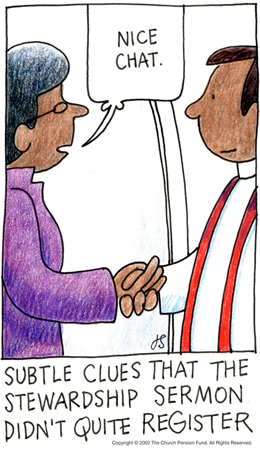
Stewardship Sermon by Jay SidebothamIt’s about to come to an end, the annual appeal to church members everywhere to turn in a card saying how much they plan (hope, anticipate, expect, guess) to give in offerings in the coming year. Clergy everywhere are breathing both a sigh of relief that “stewardship season” is nearly done, while also wondering if there will be enough income to sustain the parish’s budget for another year. Congregational governing boards, treasurers, and budget committees are poring over the books and making plans – in some parishes they are adding new programs and new staff; in most, I suspect, they are trying to cut “fat” out of budgets already cut to the bone. I would guess there are more frowns than smiles being generated in the process of annual church budgeting.

And the Daily Office lectionary gives us this, Ben Sira’s admonition to cheerfulness and gladness in connection with first-fruit offerings and tithes . . . .

In my “Rector’s Reflection” column in our parish newsletter this month, I made note of the annual campaign and its coincidence with Thanksgiving Day:

How exactly do we give thanks to God? Primarily, it is through our songs of praise, our prayers of thanksgiving, our participation in worship. Secondarily, it is through sharing the blessings we have received. Most of us, I’m sure, are familiar with the phrase “time, talent, and treasure.” Those three “buzzwords” have been a staple of annual parish pledge campaigns for decades. They underscore that stewardship (a word we mistakenly often apply only to sharing of wealth) is a life activity, not simply a financial activity. We share all that we have been given, including our time and the talents with which we are blessed, not simply a portion of our income. But this time of year we focus on that financial piece as the church begins the process of budgeting for the next fiscal year. I will be the first to admit that we should do a better job of teaching about whole-life stewardship the entire year ‘round.

Perhaps there would be more smiles and fewer frowns, less stinting and more generous giving if we did less annual fund raising and more year-round stewardship education in the church. Let’s give that try.

In any event, smile . . . whatever this year’s outcome, it’s about to come to an end.

====================

A request to my readers: I’m trying to build the readership of this blog and I’d very much appreciate your help in doing so. If you find something here that is of value, please share it with others. If you are on Facebook, “like” the posts on your page so others can see them. If you are following me on Twitter, please “retweet” the notices of these meditations. If you have a blog of your own, please include mine in your links (a favor I will gladly reciprocate). Many thanks!

====================

Father Funston is the rector of St. Paul’s Episcopal Church, Medina, Ohio.

Dreams of Samhain – From the Daily Office – October 31, 2014

From Ecclesiasticus:

The senseless have vain and false hopes,
and dreams give wings to fools.
As one who catches at a shadow and pursues the wind,
so is anyone who believes in dreams.

(From the Daily Office Lectionary – Sirach 34:1-2 (NRSV) – October 31, 2014)

Samhain IllustrationThe shadows tonight will be full of dreams moving from house to house, door to door, seeking handouts of candy or toys or whatever with a cry of “Trick or Treat!” We hope the wind will stay away, at least until America’s children’s annual celebration of the ancient Celtic feast of Samhain is completed.

As much as I like Ben Sira, I think he is too dismissive of dreams in this passage. He’s right to sound a note of caution against self-delusion (or buying into the fantasies and fallacies of others), but dreams are also the stuff of hope and aspiration. Young Joseph, son of Israel, became overseer of Egypt because of his ability to correctly interpret dreams. Another Joseph received the message that he would be foster-father to the Son of God in a dream. Dreams can be substantial!

So, parting company with Ben Sira, I say, “Believe in your dreams! Chase them!” Yesterday I wrote about using our imaginations and playing with metaphors to better understand the words of Scripture. Following our dreams is a further exercise of imagination. Imagination, as I see it, is our only way forward; without dreams and imagination we have no way to envision the future.

Forty-five years ago, when I was in college, I read a newly published book by Scottish anthropologist Victor Turner entitled The Ritual Process in which the author explored the idea of liminality, the experience of standing on a threshold leaving behind a known, accepted reality and entering into an as-yet-unknown, new reality. (I was reminded of that book this week when I found it cited in the footnotes of another, a text on the use of imagination in biblical exegesis and preaching.) That threshold is the place of shadows and wind; it can be a frightening place. To stand at that threshold demands that we dream and imagine; otherwise, we will never move through it.

Ben Sira is right, dreams give wings, not just to fools, but to everyone. Have the imagination and the courage to take those wings and fly! Fly through the threshold of shadow and wind into the unknown future.

I hope that is what the costumed children, the living dreams wandering the shadows tonight will do.

====================

A request to my readers: I’m trying to build the readership of this blog and I’d very much appreciate your help in doing so. If you find something here that is of value, please share it with others. If you are on Facebook, “like” the posts on your page so others can see them. If you are following me on Twitter, please “retweet” the notices of these meditations. If you have a blog of your own, please include mine in your links (a favor I will gladly reciprocate). Many thanks!

====================

Father Funston is the rector of St. Paul’s Episcopal Church, Medina, Ohio.

Metaphors – From the Daily Office – October 30, 2014

From Luke’s Gospel:

Jesus said, “Beware of the yeast of the Pharisees, that is, their hypocrisy.”

(From the Daily Office Lectionary – Luke 12:1 (NRSV) – October 30, 2014)

MetaphorsI often wonder what (if any) thought went into the construction of various lectionaries, particularly the Daily Office lectionary of the Episcopal Church. Are the sometimes strange, sometimes enlightening, often puzzling juxtapositions of texts planned or simply fortuitous?

Today Jesus uses yeast as a metaphor for what he considers to be the corrupt teachings of the Pharisees. Meanwhile, over in the Old Testament department (actually the Apocrypha department these past several days) we have a note from Ben Sira about wine; although he admonishes his reader not to get intoxicated and quarrelsome, he praises wine in moderation saying:

Wine is very life to human beings
if taken in moderation.
What is life to one who is without wine?
It has been created to make people happy.
Wine drunk at the proper time and in moderation
is rejoicing of heart and gladness of soul.
(Sirach 31:27-18)

Yeast, of course, is necessary for the creation of this good wine. In fact, wine makers are often very protective of their particular yeast strains. (Once when I was in college, my roommates and I decided to brew some beer. One of my roommates had a friend who worked for a very famous maker of California champagne – yes, I know, it’s just sparkling wine if not made in France – and was able to obtain – illegally, I admit – a quantity their proprietary champagne yeast. We thought that we’d be super-cool making beer with champagne yeast, that our beer would be magnificent; we weren’t and it wasn’t. But I did learn about proprietary wine yeast.)

So the metaphor of yeast is, like all metaphors, an ambiguous one, as is the metaphor of wine which is also used as a symbol of teaching in the Bible (consider Jesus’ parable of new wine and old wineskins). While Jesus uses yeast here to represent to corrupt teachings of the Pharisees, and Paul will later use it as a symbol of sin and malice (I Cor 5:7-8), Jesus also uses leaven as parabolic of the kingdom of heaven (Mt 13:33; Lk 13:21). Metaphorical ambiguity is the name of the game!

And as a game is how metaphors should be approached. I tell my Education for Ministry students to play with metaphors. Look around the room, pick an object (just on my desk this morning there are a pair of eyeglasses, a stapler, a coffee mug, and a concert ticket, for example). Now say, “The kingdom of God is like [that object]” or “Beware the [object] of the Pharisees,” and begin to explore what that might mean: “The kingdom of God is like a concert ticket” – “Beware the eyeglasses of the Pharisees.” Play with that.

Whoever put together the Daily Office lectionary probably had no intention to link “bad” yeast with “good” wine, but using our theological imagination to play with the metaphors, we can do so. I think we should: we should explore and have fun with biblical metaphors and, in the process, learn something.

====================

A request to my readers: I’m trying to build the readership of this blog and I’d very much appreciate your help in doing so. If you find something here that is of value, please share it with others. If you are on Facebook, “like” the posts on your page so others can see them. If you are following me on Twitter, please “retweet” the notices of these meditations. If you have a blog of your own, please include mine in your links (a favor I will gladly reciprocate). Many thanks!

====================

Father Funston is the rector of St. Paul’s Episcopal Church, Medina, Ohio.

A Third Tongue – From the Daily Office – October 29, 2014

From Ecclesiasticus:

Slander has shaken many,
and scattered them from nation to nation;
it has destroyed strong cities,
and overturned the houses of the great.
Slander has driven virtuous women from their homes,
and deprived them of the fruit of their toil.
Those who pay heed to slander will not find rest,
nor will they settle down in peace.

(From the Daily Office Lectionary – Sirach 28:14-16 (NRSV) – October 29, 2014)

In law school I learned that slander is the spoken form of defamation; defamation in print is called libel. I doubt the translators of Ben Sira were making any such fine distinction; Ben Sira certainly does not. The Greek original reads, Glossa trite, meaning “a third tongue.” The British Greek scholar G.T. Emery translates this text not as “slander” but as “unrestrained talk of a third party,” which carries no particular suggestion of falsehood or defamation; gossip could be the subject, as well. In any event, our current preferred translation suggests some element of prevarication.

Which brings me to political advertising and clergy relocation . . . .

I don’t know if it’s still the case but several years ago, right after the Roman Catholic Church’s troubles with pedophilia and child sexual abuse perpetrated by clergy became big news, it became mandatory for Episcopal Church clergy seeking new callings to be background checked. One company in particular seemed to corner the market on these reviews and were used by nearly every diocese of the church; maybe they had a contract with the national hierarchy (I really don’t know). The covers of their reports had a box, a big red-flag check box, labeled something like “has been accused of sexual misconduct.” If that box was checked, it was unlikely the clergy person’s file would even be opened or looked at for a new position; their file would be tossed into the rejection stack without even a cursory review.

Note that the big red-flag check box’s label didn’t say “proven” or “shown” or “convicted” or anything of that nature, just “accused.” One unrestrained, possibly even untrue flap of “a third tongue” and one’s service as clergy was essentially done. I knew people who fell victim to slander of that sort. Accusations of misconduct are serious and should be looked into, but accusations are simply that – unproved assertions – and until proven they should be treated with great care.

The same is true of political advertisements. Elections in our country have become a farce (in my humble opinion) because of political advertisements run without regard to truth or verification. Anonymous groups run overwhelmingly negative ads making suggestions about “the other side” which may or may not be grounded in fact. They are like great big red-flag check boxes labeled “is accused of inflammatory nonsense we don’t ever have to prove,” and that’s enough to sway the electorate.

Is this any way to run a church? Is this any way to run a country? Ben Sira would suggest otherwise – our “great houses” are apt to fall if we continue to do so. Possibly they have already fallen and we just haven’t noticed.

N.Y. Time Op-Ed illustration

====================

A request to my readers: I’m trying to build the readership of this blog and I’d very much appreciate your help in doing so. If you find something here that is of value, please share it with others. If you are on Facebook, “like” the posts on your page so others can see them. If you are following me on Twitter, please “retweet” the notices of these meditations. If you have a blog of your own, please include mine in your links (a favor I will gladly reciprocate). Many thanks!

====================

Father Funston is the rector of St. Paul’s Episcopal Church, Medina, Ohio.

« Older posts Newer posts »