Occasional thoughts of an Anglican Episcopal priest

Category: Church (Page 63 of 115)

Gimmicks Distract – From the Daily Office – January 11, 2014

From the Psalter:

Hallelujah!
Praise God in his holy temple;
praise him in the firmament of his power.
Praise him for his mighty acts;
praise him for his excellent greatness.
Praise him with the blast of the ram’s-horn; *
praise him with lyre and harp.
Praise him with timbrel and dance;
praise him with strings and pipe.
Praise him with resounding cymbals;
praise him with loud-clanging cymbals.
Let everything that has breath
praise the Lord.
Hallelujah!

(From the Daily Office Lectionary – Psalme 150 (BCP Version) – January 11, 2014.)

Clown Presiding at CommunionThe musical Godspell debuted in 1971 (my junior year in college); in it, Christ is portrayed as a clown. Whether it was an expression of or the catalyst for the phenomenon of offering clown eucharists as an edgy, avant-garde presentation of the Christian Mysteries, I really don’t know. The two are inextricably linked in my memory.

And . . . to be honest, I never cared for either. And . . . being further honest, that may be because I have never like clowns. I find them creepy. On the other hand, a bishop of whom I was very fond and for whom I had great respect, loved Clown Eucharists. He had a set of clown-decorated vestments made; he offered a clown eucharist at least once each year (often at diocesan convention) throughout his episcopate. They may have resonated for him because, unlike me, he loved clowns.

But I didn’t (and don’t) and so the clown eucharist was, for me, a distraction. I couldn’t get passed the gimmick, the clown images and the circus music, to the Christ at the center of mass. The clown gimmick, not the foolishness of God to which it was supposedly pointing, took over and seemed to be the point of the whole thing.

Some years later, when the music of U2 became popular and new generation were finding spiritual meaning in the band’s lyrics, someone put together a celebration of the Holy Mysteries in which that music played a part — the major part — it was the only music — and promoted the event as a U2charist.

“Right,” I thought. “The clown eucharist in a new guise.” Again, for me, the gimmick (the U2 music) distracts from the principal focus. I attended a U2charist and, for me, all I heard was the band’s music; I didn’t hear the gospel. That’s not to say it wasn’t there; it may have been. I just couldn’t hear it through the distraction of the soundtrack.

Since then I have heard of (but not attended) celebrations of Holy Communion in which the music was all from the Beatles canon, or all “oldies” from the 1960s, or all Broadway show tunes . . . and I wouldn’t be surprised if there have been other similar “thematic” eucharists. All, I think, the descendants of the clown masses of the 1970s — attempts to package the Christian Mysteries in edgy and avant-garde ways to present them to a target audience, to sneak the gospel message in under the guise of entertainment.

Now, don’t get me wrong. Let me hasten to say that I think entertainment is fine. If clowns float your boat, go the circus! If you like the music of U2 (and I do), listen to it! If you like Broadway musicals (and I do), go to the theater! And if you find something of spiritual import in those entertainments (and I do), great! Make use of it in your spiritual life and, even, in church services and celebrations.

The last of the psalms encourages the people of God to make use of many forms of entertainment, symbolized by musical instruments — trumpets and horns (the ram’s horn), stringed instruments, percussion, wood winds — and dance, in their worship. So I believe it’s fine to make use of clowns, to use of U2’s music, to sing the Beatles’ lyrics, to offer the tunes from Broadway shows as part of the liturgy.

But when these things become the reason for the service, when we name the service for the clowns or the bands or the theater district, the tool meant to be used for praising God has become the object of praise. The psalm says, “Praise God with strings and pipe,” not “Praise the strings and pipe;” “Praise God with resounding cymbals,” not “Praise the cymbals.”

Others, I am quite certain, will have found the U2charists a path to God. Other, I know, will have found in the Beatles mass and in the Broadway eucharists the truth of the gospel. After all, that bishop whom I really did love found Christ in clowns no matter how creepy I may have found them!

But for me, these feel “gimmicky” — one or two Beatles songs might be used to good effect, but nothing but Beatles music through the whole service? Not so much. U2’s Gloria could certainly stand as a liturgical piece, but all U2 music throughout the mass? Too much of a good thing. I’m not sure that I can say anything positive about clowns . . . but someone might, perhaps. My point is that themed eucharists like these, in which the theme predominates, feel like gimmicks. It feels to me like we have stopped praising God with the clowns and have started praising the clowns; the gimmick distracts. Praise God with the gimmick, but don’t praise the gimmick!

====================

A request to my readers: I’m trying to build the readership of this blog and I’d very much appreciate your help in doing so. If you find something here that is of value, please share it with others. If you are on Facebook, “like” the posts on your page so others can see them. If you are following me on Twitter, please “retweet” the notices of these meditations. If you have a blog of your own, please include mine in your links (a favor I will gladly reciprocate). Many thanks!

====================

Father Funston is the rector of St. Paul’s Episcopal Church, Medina, Ohio.

WYSIWYG World – From the Daily Office – January 10, 2014

From the Letter to the Colossians:

Therefore do not let anyone condemn you in matters of food and drink or of observing festivals, new moons, or sabbaths. These are only a shadow of what is to come, but the substance belongs to Christ.

(From the Daily Office Lectionary – Colossians 2:16-17 (NRSV) – January 10, 2014.)

Green-on-Black TextI sometimes wonder to what extent Paul, as an educated Jewish citizen of a Greek-speaking empire, was schooled in the classical Greek philosophers. Had he read Plato’s Republic? Was he aware of the conversation portrayed in Book VII between Socrates and Glaucon in which the allegory of the cave is laid out?

In the dialog, Socrates describes a prison cave in which the inmates have lived all of their lives chained in such a way that all they can see is a blank wall. The prisoners watch shadows formed on the wall by things passing between them and a fire behind them. They recognize the shadows, give them the names of the things which cast them, and believe them to actually be those things. The shadows, says Socrates, are as close as the inmates get to viewing reality. According to Socrates, a philosopher is like a prisoner who is loosed, sees the real forms casting the images, and comes to understand that the shadows are not reality at all. He is aware of the true form of reality, not the shadows seen by the chained inmates. The story illustrates Plato’s “Theory of Forms,” which holds that things in the material world perceivable through sensation are mere “shadows” of ideal “forms.” These “forms,” not the “shadows,” possess the highest and most fundamental reality.

When Paul writes things like “these are only a shadow . . . the substance belongs to Christ,” he seems to be buying into this Platonic idea. His famous line from the first letter to the church in Corinth seems to do so as well: “For now we see in a mirror, dimly, but then we will see face to face. Now I know only in part; then I will know fully, even as I have been fully known.” (1 Cor. 13:12) Take these sorts of Pauline statements and mix them with the Letter to the Hebrews (“They offer worship in a sanctuary that is a sketch and shadow of the heavenly one.” – Heb. 8:5) and even a bit of James (“Every generous act of giving, with every perfect gift, is from above, coming down from the Father of lights, with whom there is no variation or shadow due to change.” – James 1:17), and one can see where the Neoplatonists and even the Gnostics get the notion that the material world is less than ideal, fallen, corrupt, or even evil. That’s a position that, unfortunately in my opinion, has made a significant impact on Christian theology.

It is also not a view to which the Hebrew Scriptures lend much support and one doubts very much that it was the opinion of Jesus of Nazareth! Oh sure, there are hints of it in Hebrew poetry and prayer. For example, King David prays with the assembly of the people: “For we are aliens and transients before you, as were all our ancestors; our days on the earth are like a shadow, and there is no hope.” (1 Chron 29:15) And Bildad the Shuhite advises Job: “For we are but of yesterday, and we know nothing, for our days on earth are but a shadow.” (Job 8:9) And from time to time the Psalms say things like the description of human beings as “like a breath; their days are like a passing shadow.” (Ps. 144:4) But on the whole, the Old Testament and (I suggest) the Christian faith declare a much different understanding of reality!

Just read the accounts of creation in Genesis! God is not shown to be casting shadows; God is creating hard, physical reality and, at each step along the way, declares it good. In the second account (which is probably the older of the two), God gets God’s hands dirty in all that good, hard, physical reality molding human beings out of the clay. I’m particularly fond of poet James Weldon Johnson’s retelling of that story (which I quoted in last Sunday’s sermon):

Up from the bed of the river
God scooped the clay;
And by the bank of the river
He kneeled Him down;
And there the great God Almighty
Who lit the sun and fixed it in the sky,
Who flung the stars to the most far corner of the night,
Who rounded the earth in the middle of His hand;
This Great God,
Like a mammy bending over her baby,
Kneeled down in the dust
Toiling over a lump of clay
Till He shaped it in His own image;
Then into it He blew the breath of life.

(“The Creation”, from God’s Trombones)

When I was a second-year student at law school I was a member of the law review where we used some very early word processing equipment and software in which one had to enter the codes for changes in typeface, indentation, and so forth (not too dissimilar from writing HTML code, frankly). What you looked at on the green-on-black computer screen bore no resemblance to what (you hoped) the printer would produce. The next year, when I became an editor, we purchased a new computer and were introduced to a new concept – “WYSIWYG” (pronounced “wissy-wig”) – What You See Is What You Get. What was on the screen looked like what the printer produced!

I believe that’s the kind of world we have been given, one in which what we perceive is real. Yes, I know that quantum mechanics and superstring theory bring that into some question, that at some super-micro-nano-reality level things are not quite what they seem; but that is a different issue than this philosophical nothing-is-really-real shadow-world construct of Plato’s, and a far cry from the fallen, corrupt, evil world of some Christian theologies. We live in a real, physical world, one in which God was pleased to take on flesh and dwell among us (John 1:1-14).

When I see beautiful winter hillside covered with glistening snow, when I taste a sweet-tart bite of homemade cherry pie, when I kiss my wife or hug my daughter, when I listen to a Vivaldi concerto, I am seeing/tasting/feeling/hearing what I get, not some shadow of an unseen and unknowable “ideal form.” Like that mammy bending over her baby, what I am experiencing is real and good; it is the ideal. We live in a WYSIWYG world!

====================

A request to my readers: I’m trying to build the readership of this blog and I’d very much appreciate your help in doing so. If you find something here that is of value, please share it with others. If you are on Facebook, “like” the posts on your page so others can see them. If you are following me on Twitter, please “retweet” the notices of these meditations. If you have a blog of your own, please include mine in your links (a favor I will gladly reciprocate). Many thanks!

====================

Father Funston is the rector of St. Paul’s Episcopal Church, Medina, Ohio.

An Anglo-Catholic Procession in a Midwestern Church – A Poem

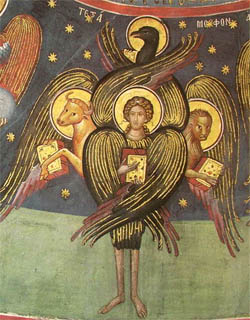
Procession of Re-ordained in a Church

An Anglo-Catholic Procession in a Midwestern Church

Wearing his cope like a leather jacket and jeans,
the priest steers the procession,
a diesel truck with an oversized trailer
turning left through the narrow
two-laned small-town streets
of the congregation’s protestant piety,
heedless of the fenders of their faith
hastily backed away
from the crosswalk of the center aisle.

The thurible-swinging acolyte,
like the chrome-plated grill of a monstrous tractor
giving notice of the behemoth’s approach,
barrels on toward his goal,
smoke like diesel exhaust billowing
around and over the crucifer’s head.
If I pump my right fist arm raised high
like a kid in a passing Coupe de Ville,
will he let out with the shriek of an air horn?

The choir swings wide, rolling off the pavement,
leaving a deep polyphonic rut
in the garden sensibilities of the faithful
at the edge of the road.
Slightly over-correcting, they get back on track
and find the coda in the choir loft.
Torch-bearers and eucharistic ministers,
sub-deacon and deacon,
shudder and stumble to their places,
an 18-wheeler with defective air brakes.

“Blessed be God . . . ”
intones the trucker celebrant;
“And blessed be his kingdom . . . ”
sighs the relieved assembly.

(By C. Eric Funston)

Illustration: Procession of re-ordained in a church by Paolo Uccello (1469)

Sweetgum Balls – From the Daily Office – January 9, 2014

From the Psalter:

Have mercy upon us, O Lord, have mercy,
for we have had more than enough of contempt,
Too much of the scorn of the indolent rich,
and of the derision of the proud.

(From the Daily Office Lectionary – Psalm 123:4-5 (BCP Version) – January 9, 2014.)

Sweetgum Balls on SnowThere’s a lot of talk these days about “class warfare,” most of it sheer nonsense. There is, it must be admitted, a growing class divide, an increasing gap between the wealthiest Americans and the rest of us. One might be tempted to write about that in light of this psalm’s reference to the “scorn of the indolent rich” and the “derision of the proud.” But, let’s face it . . . scorn, derision, contempt, and generally obnoxious conduct transcend class and other distinctions.

Prickly, disagreeable people come in all income groups, all races, all genders and sexual preferences, all religions . . . in any grouping of human beings you care to make. Indeed, everyone of us can be and are, from time to time, prickly and unpleasant. A lot of the time, we are completely oblivious to our own unpleasantness.

Driving past our town square yesterday afternoon, I noticed that a sweet gum tree had shed its empty seedpods, the hard, prickly fruit littering the snow all around the trunk. I rolled down the car window, pulled out my smartphone and took this picture (which came out a bit unfocussed). I thought I might use it as inspiration (or illustration) for a poem. And then this psalm came up on the lectionary rotation and the sweet gum was an obvious metaphor.

Unpleasant people drop little bombs of scorn, little grenades of derision all around them. They mar the world around them the same way the sweet gum tree’s seedpods mar the snow around the tree. But like the tree, they are unaware (or uncaring) of the damage they are doing and seem unable (or unwilling) to bend; they lack the flexibility to remedy the mess they create around them.

The psalmist is right to pray for deliverance from such folk . . . but more importantly we should pray for change in ourselves, that we not be prickly, contemptuous, and scornful towards those around us. Jesus once said to his listeners:

Why do you see the speck in your neighbor’s eye, but do not notice the log in your own eye? Or how can you say to your neighbor, “Let me take the speck out of your eye,” while the log is in your own eye? You hypocrite, first take the log out of your own eye, and then you will see clearly to take the speck out of your neighbor’s eye. (Matt. 7:3-5, NRSV)

In terms of the tree on square . . . deal with your own prickly seedpods of contempt, scorn, or derision before criticizing another’s.

====================

A request to my readers: I’m trying to build the readership of this blog and I’d very much appreciate your help in doing so. If you find something here that is of value, please share it with others. If you are on Facebook, “like” the posts on your page so others can see them. If you are following me on Twitter, please “retweet” the notices of these meditations. If you have a blog of your own, please include mine in your links (a favor I will gladly reciprocate). Many thanks!

====================

Father Funston is the rector of St. Paul’s Episcopal Church, Medina, Ohio.

Be Glad – From the Daily Office – January 8, 2013

From the Psalter:

This is the day that the Lord has made; let us rejoice and be glad in it.

(From the Daily Office Lectionary – Psalm 118:24 (NRSV) – January 8, 2014.)

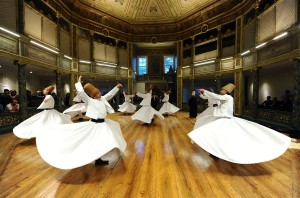
Whirling DervishesMy wife and I met at a Cursillo three-day weekend event. I was a part of the team (one of the cooks) putting on the Cursillo; she was “making” her Cursillo (as the lingo has it). She claims we’d met before at a fund-raiser fair at my parish (she attended elsewhere), but I was very busy during the fair and don’t recall that. I remember meeting her at the Cursillo weekend.

The Cursillo movement and the Cursillo community became an important of the early years of our marriage. We married about six months after meeting and in another six months we relocated to another state where I attended law school. There was an active Cursillo community in that location and we became involved.

An eye-opening move, that was. We discovered that the Cursillo community in our original home had been doing things incorreclty! Not just different. They’d been wrong. They’d been violating of the agreement between the Episcopal Church and the Roman Catholic Cursillo Movement, which had licensed the Cursillo method to the Episcopalians. And, we later learned, they knew they’d been doing so.

This comes to mind today because one of the major elements of a Cursillo weekend is music. In those communities, it was the sort of music that today might be called “praise choruses” or “church folk” or “contemporary.” Simple, easily remembered, repetitive songs accompanied by guitars, banjos, tambourines, bongos. One song common to both communities was based on this verse; in fact, it was this verse so far as I can remember.

There may have been verses and this may simply have been the chorus, but all I can recall is this verse: “This is the day, this is the day, that the Lord has made, that the Lord has made. We will rejoice, we will rejoice, and be glad in it, and be glad in it.” A catchy, bouncy little tune to which one could dance a formless dance, whirling like a dervish! It was easy to get caught up in and it demonstrated to me the spiritual power of music, simple melodies, and physical movement. Whirling and spinning and experiencing the power of the Spirit!

When my wife and I returned to our original home after three years in law school, we were asked to be the leaders of a coeducational three-day Cursillo event. We agreed, but we said we wanted to try to abide by the agreement between our church and the Roman Catholics, to discontinue those practices which violated the accord, to keep faith with our brothers and sisters who had gifted us with the Cursillo as a tool for deepening the faith of mature Christians.

There was push-back. In fact, there was outright rebellion. Members of the community refused to sponsor candidates to the weekend we were to lead; others refused to contribute to the cost of the event. Evelyn and I resigned from leadership and felt we had no choice but to withdraw from the community.

What had been an important support for us in the early years of married life became a source of grief and sadness. It still is. We miss being a part of that community and we miss the nearly automatic entry being in the Cursillo community gave us to a wider circle of church friends when we relocated. Where we live now, there is no active Cursillo community so the sharpness of the grief is dulled; there are no “Reunions,” nor “Ultreyas” (as the regular get-togethers of Cursillistas are called), so no constant reminders that we are no longer a part of Cursillo.

And yet we rejoice that we were fortunate to have been called to that community. It’s where we met; it sustained us. Like each day the Lord makes, it has passed. When it was here, we rejoiced in it and we were glad. And we look back on it still with gratitude. When I think of it, I think of this verse and that danceable chorus, and my soul comes alive in the Spirit, whirling and spinning, and expressing the joy that community gave us . . . and how grateful I am to that experience for the gift of my wife and the family we have created.

Everyday is a new day that the Lord has made; we will rejoice and be glad in it, whirling and spinning in the power of the Spirit.

====================

A request to my readers: I’m trying to build the readership of this blog and I’d very much appreciate your help in doing so. If you find something here that is of value, please share it with others. If you are on Facebook, “like” the posts on your page so others can see them. If you are following me on Twitter, please “retweet” the notices of these meditations. If you have a blog of your own, please include mine in your links (a favor I will gladly reciprocate). Many thanks!

====================

Father Funston is the rector of St. Paul’s Episcopal Church, Medina, Ohio.

A Theology of Gift Giving – Sermon for the Second Sunday of Christmas – January 5, 2014

====================

This sermon was preached on the Second Sunday of Christmas, January 5, 2014, at St. Paul’s Episcopal Church, Medina, Ohio, where Fr. Funston is rector.

(The Revised Common Lectionary, Christmas 2A: Jeremiah 31:7-14; Ephesians 1:3-6,15-19a; Psalm 84; and Matthew 2:1-12. These lessons can be read at The Lectionary Page.)

====================

Gifts of the Wise MenVery recently in the church office mail there was this small envelope addressed to me personally — the address has been typed out on a separate sheet of paper, cut therefrom, and glued onto the envelope. There is no return address and the postmark is a Cleveland, OH, cancelation. Inside there was no personal note of any kind, just a page torn from the last quarter’s Forward Day by Day devotional. One side, as you can see, has been scribbled all over; clearly not the side I am supposed to read. The other is the meditation for October 30, 2013, which begins:

Have you ever suffered because you sat through a really boring, abstract, incoherent, and disconnected sermon? Most of us have. Believe it or not, some people report that after enduring something like that, they decide never to go back to that particular church or any church at all. Sermons can make or break some people’s relationship with the church.

(The entire meditation can be read at Forward Day by Day.)

I have to be honest — my first reaction on receiving this was to think, “Well, that’s not something I wanted to get!” And immediately I was reminded of one Christmas when our children were quite young.

Our family tradition is to wait until Christmas morning to open our packages, so even if we’d been to the Midnight Mass we would rise early to see what Santa had brought. On the Christmas I recalled, our daughter rushed down the stairs from her second-floor room to the tree set up in our first-floor den and tore open the largest of her gifts, ripping to shreds the wrapping paper with obvious excitement. However, when she saw what was under the wrapping her expression changed to disappointment and she cried out, “That’s not what I wanted!” I don’t remember what she had wanted; I don’t even remember what we had given her. But I remember that reaction.

It got me to thinking about the reasons we give things to one another, the how of it and the why of it. What is the “theology of gift giving?” The gifts of the wise men to the Christ-child help us to explore that question.

The first element of such a theology would be the recognition that the giving of gifts is perfectly acceptable! There are some who teach that it is not, but we have plenty of examples in Scripture including, of course, the very story we are told in today’s gospel reading of the visitation of the Magi. More basically, we have God’s own example starting with the gift of life to plants, animals, and human beings as described in the Creation stories and exhibited most clearly in God’s self-giving in Jesus Christ. Generosity and charity are fundamental to an active Christian faith. Giving is the very thing that defines our belief: God-made-human gave himself entirely so that we might be free to give ourselves entirely back to God. As James said, “Every generous act of giving, with every perfect gift, is from above, coming down from the Father of lights.” (James 1:17, NRSV) Gift-giving, in a sense, is the purpose of the Incarnation, so it is something strongly encouraged.

The second element of a theology of gift giving is that giving gifts allows us to be ministers of grace, the free and undeserved help of God. The gifts of the wise men were symbolic: the hymn “We Three Kings” lays out in verse what these are. Gold is a symbol of kingship, frankincense (used for incense in worship) is a symbol of deity, and myrrh (an embalming oil) is a symbol of death. (By the way, did you know that that hymn is quintessentially Episcopalian? It was written by John J. Hopkins in 1857 for a Christmas pageant at General Theological Seminary, the Episcopal Church divinity school in New York City.) In other words, they are symbolic of the full grace and mercy of God incarnate in Jesus. Every gift we receive, especially those from God but really from anyone, is a demonstration of God’s grace because, after all, grace is undeserved. How many times have you opened a present and sat there with the gift still in the box, looking at the giver with eyes and thinking to yourself, “What done to deserve this?” That question, of course, is rhetorical. The answer is “Nothing.” Gift giving is a form of grace by which we imitate the behavior of God and model the character of God.

The third element of a theology of gift giving is that it give us opportunity to display the love of God. “Each one must give as he has decided in his heart, not reluctantly or under compulsion, for God loves a cheerful giver,” wrote Paul to the Corinthians. (2 Cor. 9:7, ESV) And, of course, “God so loved the world that he gave his only Son.” (John 3:16, NRSV) Every gift should be a reflection of that love. If a gift is a real gift it is given with no thought of return. It’s not about starting an endless series of gift exchanges. It’s not about buttering someone up. It’s not about impressing someone or trying to get someone to do something for you. A real gift is an act of unconditional love, with no demands, no hints, no requirements of any return. Love, as Paul reminds us in the First Letter to the Corinthians,

is patient; love is kind; love is not envious or boastful or arrogant or rude. It does not insist on its own way; it is not irritable or resentful; it does not rejoice in wrongdoing, but rejoices in the truth. (1 Cor. 13:4-6)

Our gift-giving character should be one of genuine love. By giving a gift, we are symbolically recalling the gift of Christ for our salvation because “God so loved the world.”
The final element of a theology of gift giving, the element to which the first three point, is that it is relational. When the Magi encountered the Christ-child, they worshiped him: “On entering the house, they saw the child with Mary his mother; and they knelt down and paid him homage.” Worship is an expression of relationship at its deepest. However we define the word worship, it has its center in how we relate to God; it is the very reason, Scripture tells us, that we were created.

As I think I’ve mentioned before, one of my favorite poets is the African American James Weldon Johnson. At funerals, I often use one the poems from his collection God’s Trombones: Seven Negro Sermons in Verse. Another poem in that book is entitled The Creation; it explores this truth of our creation. The poem begins —

And God stepped out on space,
And he looked around and said:
“I’m lonely —
I’ll make me a world.”

The poem continues, as Genesis does, detailing the creation of earth, the seas, the plants, the animals . . . and then goes on —

Then God walked around,
And God looked around
On all that He had made.
He looked at His sun,
And He looked at His moon,
And He looked at His little stars;
He looked on His world
With all its living things,
And God said, “I’m lonely still.”

Then God sat down
On the side of a hill where He could think;
By a deep, wide river He sat down;
With His head in His hands,
God thought and thought,
Till He thought, “I’ll make me a man!”

Up from the bed of the river
God scooped the clay;
And by the bank of the river
He kneeled Him down;
And there the great God Almighty
Who lit the sun and fixed it in the sky,
Who flung the stars to the most far corner of the night,
Who rounded the earth in the middle of His hand;
This Great God,
Like a mammy bending over her baby,
Kneeled down in the dust
Toiling over a lump of clay
Till He shaped it in His own image;
Then into it He blew the breath of life,

And man became a living soul.
Amen. Amen.

“Like a mammy bending over her baby . . . .” We are created for relationship — relationship with God and relationship with each other. Like the gift giving of the Magi, that’s what our gift giving to one another is all about. It is a tangible expression of relationship; although gifts are given out of love with no expectation of reciprocation, they do provoke a response. They are relational, and in the way we relate to each other, especially in our giving of gifts to each other, we exhibit how we relate to God.

I’ll be honest. I was upset by this anonymous gift. But in the end I’m grateful for it because it is a reminder of this most important element of the theology of gift giving, this relational aspect. After that rather brutal opening paragraph, the Forward Day by Day meditation examines what it calls “Jesus’ methodology” of preaching by story-telling and then concludes, “In spite of all of our media gadgets, communications systems, and technological tools, we still need to truly perceive, listen, and understand.”

My mentor, the late Fr. Karl Spatz, taught me to think of a sermon as a conversation and as a gift. A sermon is not a lecture and it has many participants. Preaching is grounded in community, and like gift giving is relational. Preaching is not me or any clergy person standing in the pulpit telling you what we think that you should hear. A sermon is an exploration of the things we all struggle to understand, the troubles we all have to deal with, the things we all try to do better, the joys we all celebrate. A sermon is a priest’s prayerful and considered reflection upon these things, offered humbly as a gift to the gathered community. The congregation’s part in the conversation is to receive the gift and, as the meditation says, make the effort “to truly perceive, listen, and understand.” That may sometimes mean that we continue the conversation at a later time, perhaps through notes like this one — but we can only really continue the conversation that if I know who you are . . . .

When all is said and done, any gift giving (including any preaching) is an imperfect thing. It is an imperfect thing that seeks the perfection of the one true gift, the gift of Jesus for the salvation of the world. Amen.

====================

A request to my readers: I’m trying to build the readership of this blog and I’d very much appreciate your help in doing so. If you find something here that is of value, please share it with others. If you are on Facebook, “like” the posts on your page so others can see them. If you are following me on Twitter, please “retweet” the notices of these meditations. If you have a blog of your own, please include mine in your links (a favor I will gladly reciprocate). Many thanks!

====================

Father Funston is the rector of St. Paul’s Episcopal Church, Medina, Ohio.
Technical Support – From the Daily Office – January 4, 2013

From the Psalter:

Restore us then, O God our Savior;
let your anger depart from us.
Will you be displeased with us for ever?
will you prolong your anger from age to age?
Will you not give us life again,
that your people may rejoice in you?

(From the Daily Office Lectionary – Psalm 85:3-6 (BCP Version) – January 4, 2014.)

Help KeyLate yesterday I created and posted a “meme” on Facebook and then put it on this blog as well . . . a picture of a sack lunch with words from the early 1970s humor piece entitled The Deterioriata: “

Gracefully surrender the things of youth:
The birds, clean air, tuna, Taiwan . . .
And let not the sands of time
Get in your lunch.

I edited the posting this morning to include the whole text of The Deteriorata. It’s a parody. It’s humor. It’s not the way I actually see the universe functioning. Let’s make that clear. But another part of the piece strikes awfully close to home:

Therefore, make peace with your god
Whatever you conceive him to be —
Hairy thunderer, or cosmic muffin.
With all its hopes, dreams, promises, and urban renewal
The world continues to deteriorate.

There is ample evidence that the world does continue to deteriorate, even more so than when that piece was written in 1972 as a part of a National Lampoon comedy record! Economic injustice and wealth inequality, increased pollution and anthropogenic climate change, wars and civil wars . . . you can complete the list. So perhaps making peace with one’s god is a good idea.

And that’s the line that gets to me this morning, the bit about “whatever you conceive him to be.”

And the line (or, actually, the word) that got my attention in the morning psalm is “Restore…”

Here’s why.

For several hours yesterday and this morning, when I would try to access this site (a family domain I set up several years ago and host with a company whose servers and technical support staff are in . . . God knows where), I could not do so. I would get strange error messages. It would tell me that the “resource limit” had been exceeded; it would claim there was a “database error;” it would give me an HTTP 500 error saying that it had “encountered an unexpected condition that prevents fulfilling the request by the client;” it would give me an HTTP 404 error – “Page not found!”

My only recourse when these things happen is to go to my hosting company’s website and complete a “support ticket” detailing the error received and saying something very much like “Restore us then, O hosting company.”

Before reading the Daily Office this morning, I checked the weather. In our area we are experiencing very cold winter temperatures and in this morning’s prediction there was a “Winter Wind Chill Watch” for the next few days. Beginning early Monday morning and continuing through mid-day on Tuesday, there are predicted temperatures at Zero Degrees Fahrenheit or below, blowing snow showers (winds of 20-25 mph), and wind chills of -25 to -40 . . . . Not being a fan of cold, snowy winters in the first place, the Psalm’s plea, “Restore us then, O God our Savior; let your anger depart from us” seemed to me particularly appropriate; bad winter weather will screw up a whole lot of plans that I have made!

But then I had to pull myself up short and ask myself, “How are you conceiving God to be? Hairy thunderer, cosmic muffin, universal weatherman, celestial technical support department?” All might be good metaphors to help us understand the divine in bible study, but as with any metaphor they are of limited use in most circumstances, and especially in these.

Faced with glitches and bugs in the programs we’ve tried to write for our own lives, what do we do? Call on God as some sort of master IT technician to come fix them? Or do we knuckle down and do the hard work of reading through the code line-by-line and fixing things ourselves, relying on the tools and skills that God has already given us.

In my own life, I’m trying to do the latter, but I must confess that every once in a while I really do just want to throw up my hands and submit a “support ticket” to the heavenly technician, and then gripe about how slowly he gets around to fixing things: “Will you be displeased with us for ever?”

No, better not to call on technical support; best to work things out for ourselves and with the help and support of our communities to the extent we can. And we will find out that that extends really pretty far!

====================

A request to my readers: I’m trying to build the readership of this blog and I’d very much appreciate your help in doing so. If you find something here that is of value, please share it with others. If you are on Facebook, “like” the posts on your page so others can see them. If you are following me on Twitter, please “retweet” the notices of these meditations. If you have a blog of your own, please include mine in your links (a favor I will gladly reciprocate). Many thanks!

====================

Father Funston is the rector of St. Paul’s Episcopal Church, Medina, Ohio.

Chaotic Disorderliness – From the Daily Office – January 3, 2014

From the First Book of Kings:

Now there was a great wind, so strong that it was splitting mountains and breaking rocks in pieces before the Lord, but the Lord was not in the wind; and after the wind an earthquake, but the Lord was not in the earthquake; and after the earthquake a fire, but the Lord was not in the fire; and after the fire a sound of sheer silence. When Elijah heard it, he wrapped his face in his mantle and went out and stood at the entrance of the cave. Then there came a voice to him . . . .

(From the Daily Office Lectionary – 1 Kings 19:11-13 (NRSV) – January 3, 2014.)

The Crowning by Sara StarIt’s almost over . . . nine ballerinas or lady ballroom champions or something are supposed to show up to join the eight milkmaids who came yesterday; then, ten leaping lords are to show up tomorrow. I’m not sure why the dancers are scheduled to get here before the musicians, but the pipers and the drummers won’t get here until the end. In any event, the familiar carol promises that the end of Christmas will be even more noisy and confusing than its beginning.

Thinking of Elijah standing at the mouth of his cave through all the turbulence of storm and temblor and conflagration, but not perceiving God until the “sound of sheer silence,” I am reminded again of how odd I find our (basically) northern European fantasies of the birth of Jesus to be. I sometimes wonder what “first world” Christianity would be like if we’d never developed the notion that the Savior was born on a quiet, snowy night.

We did, though, and church congregations play that up in spades! And, I must confess, my own parish and our liturgical planning for Christmas Eve and the Christ Mass of Christmas Day went right along.

At the Midnight Mass, as a sequence hymn, we sang O Little Town of Bethlehem with that line, “How silently, how silently, the wondrous gift is given . . . .” The Choir sang an anthem version of the Christina Rossetti — Gustav Holst hymn In the Bleak Midwinter with its gorgeous portrayal of a dark winter night:

In the bleak midwinter, frosty wind made moan,
earth stood hard as iron, water like a stone;
snow had fallen, snow on snow, snow on snow,
in the bleak midwinter, long ago.

And we finished off with the lights dimmed, the candles flickering, and everyone singing Silent Night! We bought right into it! More than likely it’s completely wrong, but we did it anyway.

I think passages like this story of Elijah encourage us to envision the Nativity of Jesus as this peaceful, very-quiet-if-not-silent, nighttime event; this story and others make dark silence the normative setting for God’s interaction with humans. There’s Samuel’s late night call from God (1 Sam. 3:1-18). There are the Josephs (Jacob’s son and Jesus’ foster father) who both received dream messages while sleeping (Gen. 37:5-10; Matt. 1:18-25). There is Jacob who encountered God at night at Peniel, although wrestling with God through the night could hardly have been a silent affair (Gen. 32:24-30).

We’re also fooled by the Magi being led by a star. “There’s a star? Must have been at night,” we think, but the Magi were astrologers whose lives and actions, not just their travel plans, were “led” by the stars and constellations regardless of the time of day (Matt. 2:1-12). (Let’s not even mention the fact that the wholesale slaughter of the Holy Innocents suggests that their visit was several months, if not a couple of years, later so the star is completely irrelevant to Jesus’ actual birth!) And we’re told by Luke that shepherds were in the area keeping watch over the flocks “by night” when the angel told them of the birth, but the angel’s message is, “To you is born this day in the city of David a Savior, who is the Messiah, the Lord.” (Luke 2:8-20, emphasis added) Couldn’t the birth have been earlier? During daylight hours, perhaps? To be honest, there is just no indication when the actual birth of Jesus took place.

And that “when” is bigger than time of day! There’s no indication of what time of year, either. As we all know (since the anti-religious crowd loves to tell us every year, just in case we don’t already know or had forgotten since they told us last year), the December 25 date of Christmas was originally the Roman feast of Saturnalia simply taken over by the church. When someone tries to disprove the Christian story by telling me this, my standard response is “So what?” We don’t celebrate the birthday of Jesus; we celebrate the birth of Christ, the Incarnation of God. We can and do that all the time; it doesn’t matter what day of the year we choose to do so in a particular and special way.

Except that we get this cold, bleak, quiet, silent, peaceful, midwinter, snow-on-snow, everyone-bundle-up northern European picture of Jesus’ birth.

I’ve attended births; I was present when both our children were born in the comfort of hospital birthing centers. Neither was quiet, silent, or peaceful! There was panting, grunting, crying, exclamations, excited utterances, anxiety, frustration, elation . . . and my wife was making noise, too! I can’t imagine that the biblical delivery in a stable would have been any less raucous! I’d be surprised if, with the farm animals provoked by all the goings on, Joseph excited, and Mary in the throes of childbirth (and possibly the owner of the stable and members of his family coming and going), it wasn’t a very noisy place!

I am thoroughly convinced that God was present in all the fuss and noise of my children’s births, so I am just as sure that God was present in all the fuss and noise of God’s own Son’s birth! I am pretty certain that God is present in the fuss and noise of all human affairs. So I would not be surprised, therefore, if the Deuteronomic historian responsible for redacting the First Book of Kings and recording this story of Elijah in the cave was just wrong. Perhaps it would have been accurate to say that Elijah did not perceive God in the wind, the earthquake, or the fire, but I think it is simply inaccurate to say that “the Lord was not in” any or all of those. God is with us in all the noisy, chaotic disorderliness of life.

I don’t have a clue what the Christian faith would be like if it were grounded by a more realistic narrative of Jesus’ birth, but I do know that God is there in the midst of turmoil, in the midst of chaos, in all the cacophony of human existence. That’s the truth the Christian faith teaches. So bring on the dancing ladies, the leaping lords, the pipers, and the drummers! Enough of this sheer silence! God’s twelve-day party is nearly over; let’s make the most of it!

====================

A request to my readers: I’m trying to build the readership of this blog and I’d very much appreciate your help in doing so. If you find something here that is of value, please share it with others. If you are on Facebook, “like” the posts on your page so others can see them. If you are following me on Twitter, please “retweet” the notices of these meditations. If you have a blog of your own, please include mine in your links (a favor I will gladly reciprocate). Many thanks!

====================

Father Funston is the rector of St. Paul’s Episcopal Church, Medina, Ohio.

Biblical Arithmetic – From the Daily Office – January 2, 2013

From John’s Gospel:

They sat down, about five thousand in all. Then Jesus took the loaves, and when he had given thanks, he distributed them to those who were seated; so also the fish, as much as they wanted. When they were satisfied, he told his disciples, “Gather up the fragments left over, so that nothing may be lost.” So they gathered them up, and from the fragments of the five barley loaves, left by those who had eaten, they filled twelve baskets.

(From the Daily Office Lectionary – John 6:10b-13 (NRSV) – January 2, 2014.)

Mathmatical SymbolsLet’s just be clear: this is biblical arithmetic. If this were a “word problem” on a school math quiz, we would reduce the story to a simple equation:

(5 + 2) ÷ 5000 = 12

Now, granted, this is the story of one of Christ’s miracles (or, as John prefers to call them, “signs”), but even so, reading a story like this I cannot help but wonder how anyone can take the Bible as “historically factual” and “totally inerrant.” It’s not! It’s just not!

The Bible is a human document, filled with all the potential for error and mistake as the human beings who produced it. That doesn’t mean, however, that we dismiss it, anymore than we would dismiss any work of humanity. The great writer, theologian, and faithful Episcopalian Madeleine L’Engle once wrote, “I take the Bible too seriously to take it all literally.” The same quotation is often attributed to Karl Barth, but like many “facts” in the Bible that can’t be verified.

The Bible is a library filled with a variety of genres. I can think of at least two books of the Bible which are obviously fiction – Job and Esther. And though obvious fiction, they are clearly true. They may not be factual, but as William Faulkner is said to have remarked, “The best fiction is far more true than any journalism.” And Canadian novelist Keith Oatley, who is also a cognitive psychologist, has said that “a literary work can be truthful, not just generally but in relation to a specific reader and to that reader’s own understandings of self and others.”

In other words, the “truthfulness” of literature, especially biblical literature, is not dependent on its factual accuracy. Phyllis Tickle, in a talk I heard her give in Memphis, drew a distinction between recognizing the “actual truth” of scripture and insisting on its “factual truth,” which (she said) reduces it to the confines and strictures of human understanding. When we insist on the factual accuracy of biblical stories, we conform them to our beliefs instead of conforming our beliefs to the witness of scripture.

So I’m fine with biblical arithmetic! Even if it makes no mathematical sense, it’s full of truth!

====================

A request to my readers: I’m trying to build the readership of this blog and I’d very much appreciate your help in doing so. If you find something here that is of value, please share it with others. If you are on Facebook, “like” the posts on your page so others can see them. If you are following me on Twitter, please “retweet” the notices of these meditations. If you have a blog of your own, please include mine in your links (a favor I will gladly reciprocate). Many thanks!

====================

Father Funston is the rector of St. Paul’s Episcopal Church, Medina, Ohio.

Wild Bells – From the Daily Office – January 1, 2013

From Matthew’s Gospel:

Now the birth of Jesus the Messiah took place in this way.

(From the Daily Office Lectionary – Matthew 1:18a (NRSV) – January 1, 2014.)

BellsThe first day of the year on the Church’s calendar has a variety of names:

The Feast of the Circumcision, in honor of the Jewish tradition of circumcising a male infant on his eighth day of life: “After eight days had passed, it was time to circumcise the child; and he was called Jesus, the name given by the angel before he was conceived in the womb.” (Luke 2:21)

The Feast of the Holy Name: The angel said to Joseph in a dream, “She will bear a son, and you are to name him Jesus, for he will save his people from their sins.” (Matt. 1:21)

The Solemnity of Mary, Mother of God, a celebration of Mary’s motherhood of Jesus.

I think it is occasionally the Feast of the Holy Family (the first Sunday of the Christmas season in the Roman tradition), although that one may get translated if it falls on January 1; I’m not sure about that.

What all of these share with the secular observance of the New Year is an emphasis on beginnings: a newly-minted Jew, a newly-named child, a new mother, a new family. All the promise of the tabula rasa, the pristine, empty tablet waiting to be filled with all the narratives of life.

I don’t make resolutions, primarily because I am simply so bad at keeping them. But I do look forward making changes. There is a tradition in Stockholm, Sweden (of all places), of reading a poem by Alfred, Lord Tennyson, at midnight on New Year’s Eve. Looking forward to another year of trying to be more Christ-like, I follow the Swedish tradition and read this poem myself at midnight. Midnight is passed, but I offer the poem again this morning as we welcome the New Year:

Ring out, wild bells, to the wild sky,
The flying cloud, the frosty light
The year is dying in the night;
Ring out, wild bells, and let him die.

Ring out the old, ring in the new,
Ring, happy bells, across the snow:
The year is going, let him go;
Ring out the false, ring in the true.

Ring out the grief that saps the mind,
For those that here we see no more,
Ring out the feud of rich and poor,
Ring in redress to all mankind.

Ring out a slowly dying cause,
And ancient forms of party strife;
Ring in the nobler modes of life,
With sweeter manners, purer laws.

Ring out the want, the care, the sin,
The faithless coldness of the times;
Ring out, ring out thy mournful rhymes,
But ring the fuller minstrel in.

Ring out false pride in place and blood,
The civic slander and the spite;
Ring in the love of truth and right,
Ring in the common love of good.

Ring out old shapes of foul disease,
Ring out the narrowing lust of gold;
Ring out the thousand wars of old,
Ring in the thousand years of peace.

Ring in the valiant man and free,
The larger heart the kindlier hand;
Ring out the darkness of the land,
Ring in the Christ that is to be.

====================

A request to my readers: I’m trying to build the readership of this blog and I’d very much appreciate your help in doing so. If you find something here that is of value, please share it with others. If you are on Facebook, “like” the posts on your page so others can see them. If you are following me on Twitter, please “retweet” the notices of these meditations. If you have a blog of your own, please include mine in your links (a favor I will gladly reciprocate). Many thanks!

====================

Father Funston is the rector of St. Paul’s Episcopal Church, Medina, Ohio.

« Older posts Newer posts »