Occasional thoughts of an Anglican Episcopal priest

Category: Church (Page 74 of 116)

Worthy of Double Honor? – From the Daily Office – May 24, 2013

From the First Letter to Timothy:

Let the elders who rule well be considered worthy of double honor, especially those who labor in preaching and teaching; for the scripture says, “You shall not muzzle an ox while it is treading out the grain,” and, “The laborer deserves to be paid.” Never accept any accusation against an elder except on the evidence of two or three witnesses.

(From the Daily Office Lectionary – 1 Tim. 5:17-19 (NRSV) – May 24, 2013.)

Dinner TableDuring the past decade the Episcopal Church has monkeyed about with its scheme for clergy discipline, the bunch of rules and canons and procedures that are lumped together in what we call “Title 4.” As a member of the Bar and a former diocesan chancellor who had had to assist a bishop in facing some clergy discipline situations, as well as from my standpoint as a priest, I didn’t think the extensive revisions (indeed, the word “overhaul” would apply) were necessary. But there they are. Whether they have done any good and whether they are actually working as the revisers apparently hoped is anybody’s guess.

A few days ago, a friend (a retired lay church professional) called just to chat. My friend lives in another area of the country but the Episcopal Church is a small denomination, really, and we have a lot of mutual acquaintances, including some clergy who have been subjected to the new disciplinary plan and their current whereabouts and goings-on came up. In the course of our conversation, he told me that in the diocese where he now lives something like twenty congregations and their clergy are at some point along the spectrum of investigations and activities that compromise the discipline and dissolution processes of Title 4. Twenty congregations in one diocese!

In my current diocese, there have been a couple of disciplinary matters over the past few years. One resulted in a cleric being suspended; the other, in the priest renouncing holy orders and leaving the Episcopal Church’s ordained ministry. Across the church (and across denominational lines) I have been told by colleagues that they live in fear of being subjected to discipline, not because they think they’ve done anything wrong, but simply because their careers could be ruined by an accusation. A Lutheran spouse recently published an internet essay critical of the lack of support given pastors by their hierarchical superiors and detailing the devastating effect of an accusation on the clergy family. I have friends who have moved from one jurisdiction to another because they felt they couldn’t trust their bishop (or bishop-equivalent) to back them up if an accusation was made.

I could not help but think of that conversation and these other instances when I read St. Paul’s advice to the young bishop Timothy regarding the compensation and then, immediately, the discipline of the presbyters (elders) in his jurisdiction. These pastors, he says, especially the preachers and teachers, are to be honored and compensated and, if an accusation is made against them, it must be supported by the corroborating testimony of other witnesses. The linkage of honor, compensation, accusation, and discipline in this text is probably purely circumstantial; I’d bet that Paul was dictating this letter to a scribe and just thinking of things “off the top of his head,” and yet now inscribed in Holy Writ for all time, the linkage is there.

Last week, my wife and I were invited to a parishioner couple’s home for an informal dinner. Just the four of us, a bottle of wine and a couple pizzas. It was great! We all had a good time; we talked about our experiences raising kids and now being parents of adults in their late 20s and early 30s. We shared stories of vacations, of illnesses, of family crises, of joys, and of disappointments. And it later occurred to me how rarely my wife and I have enjoyed this sort of intimate dinner in a parishioner’s home. In fact, I can count on the fingers of one hand the number of parishioner households who have hosted us for dinner in the last three years (not counting church group get-togethers, which I would suggest are a different category of event).

When I was a kid we didn’t go to church, so I have no nuclear family experience of dinners with clergy, but I do know that my Methodist grandparents (with whom I spent summer vacations) and my Disciples of Christ grandparents (who took care of me after school in the early elementary grades) both entertained their pastors and their wives on a regular basis. When I became an active Episcopalian adult, I was aware that our rector and his spouse regularly socialized with parishioners, and once I was ordained and began working as his assistant, my wife and I were often invited to join parishioners socially. Of course, those parishioners were also long-time friends as I had been a lay member of the congregation for about seventeen years before joining its clergy staff. So maybe that was an out-of-the-ordinary experience.

When we left that church and I took my first parish as rector, a very small parish in the rural exurbs of a midwestern city, we socialized often with parishioners. Then we came to Ohio. During our first couple of years, there were dinner invitations . . . but they tapered off and now they are, as I suggested above, rare.

Now I’ll admit that maybe I’m just not a likeable person and that it may just be that people don’t want to eat with me. That’s a distinct possibility. (It couldn’t possibly be my wife; she’s the sweetest person in the world.) But in my conversations with colleagues, I’ve been told that their experience is the same. Few of them, they tell me, are asked to socialize with their parishioners in the manner and to the extent that we might have been a few years ago, and certainly not to the extent that our predecessors seem to have been.

Back when I was practicing law, well actually before it – when I was a paralegal, I would socialize with the secretaries and other non-lawyer personnel of the law firm, but not so much with the attorneys, and then only with associates never with partners. Then I went to law school, passed the Bar exam, and became an associate. I still socialized with the secretaries and the paralegals, but more and more often with the other associates and occasionally with the partners. And then I became a partner. I’m not sure when it happened, but somewhere along the way in my early years of being a partner, it became clear (in fact, a senior partner made it explicit) that partners did not socialize with the secretaries. You didn’t invite “the help” to dinner; they didn’t invite you.

I wonder if that’s what’s happening in the church. For years we (the clergy, at least) have fought the idea that priests are “hired.” We are “called,” we insist. Our relationship with our congregations is not that of employer-employee. It’s more like a marriage or a partnership; we are colleagues in a ministry which is mutual and reciprocal. Of course, the one colleague (the parish) pays the other colleague (the priest) a salary, and we have letters of agreement and denominational policies requiring a pretty good array of benefits . . . but we are not, we insist, employees!

Are the discontinuance of social invitations, the increase of concern about disciplinary schemes, the upsurge in instances of clergy discipline cases, all symptomatic of a sea change in the church’s unspoken understanding of the priest-parish relationship? Is it all because clergy are no longer seen as respected elders “worthy of double honor?” Are we just “the help?”

Maybe so. There may be many reasons for such a paradigm shift. In a brief meditation on a short sentence of scripture one doesn’t have the time or the space to consider what all of them might be. All I can do here is suggest that these apparently disparate phenomena — changes in clergy disciplinary rules, a rise in the number of discipline cases, clergy moving out of fear, and a downturn in clergy-parishioner socializing — may be symptomatic of a change in the way the church community functions.

I admit that I don’t really know. But if my morning musing is even close to correct, I’m sorry to see the decline of the former model, the model of the pastor who could also be the social friend of those in his or her flock. I don’t believe an employment model is as conducive to mutual respect between priest and congregation, nor as supportive of relationships between bishops and clergy. I hope someday to see the church return to the earlier paradigm — or maybe find a new one; at any rate, we need to find a paradigm for this relationship with less of the fear that seems to pervade the one we have now.

====================

A request to my readers: I’m trying to build the readership of this blog and I’d very much appreciate your help in doing so. If you find something here that is of value, please share it with others. If you are on Facebook, “like” the posts on your page so others can see them. If you are following me on Twitter, please “retweet” the notices of these meditations. If you have a blog of your own, please include mine in your links (a favor I will gladly reciprocate). Many thanks!

====================

Father Funston is the rector of St. Paul’s Episcopal Church, Medina, Ohio.

Climax on the Threshing Floor – From the Daily Office – May 23, 2013

From the Book of Ruth:

At midnight the man was startled, and turned over, and there, lying at his feet, was a woman!

(From the Daily Office Lectionary – Ruth 3:8 (NRSV) – May 23, 2013.)

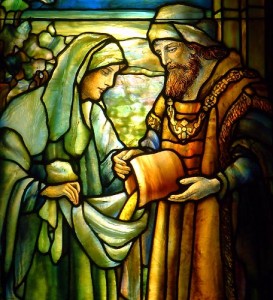
Stained Glass of Ruth and BoazThere are some parts of the Bible that I am thankful I don’t generally have to read aloud in public. The story of Ruth seducing Boaz is one of them, especially this verse. I get to this verse and I’m “laughing out loud” – I mean, really, I’m like LOL! A guy falls asleep on his threshing floor and wakes up to find a woman “lying at his feet,” and not only that, he finds that she has undressed him!
The whole thing is simply ridiculous, especially with that “fun Bible fact” that adult class Sunday School teachers love to share with their students:

Naomi tells Ruth to uncover Boaz’s “feet” (or the place where his feet are), rather than his “nakedness,” but the word translated feet is also commonly used as a euphemism meaning “private parts.” (New Interpreter’s Bible, Vol. II, pg 926)

Everyone giggles like school girls.

What is this story doing in the Bible? What are we to learn from the Book of Ruth? I’m no scholar and I haven’t studied the text extensively, but I think what the book and this tale of seduction is all about is the redemption of everyday life. The book is a story of secular redemption focusing on a Jewish tradition of property restoration – it is, in that sense, about Naomi (Ruth’s Jewish mother-in-law) getting her family property back. But as a “sacred” text it is an allegory for the redemption of God’s People through the actions of an outsider; Ruth is a Moabite, a non-Jew, a member an ethnic group specifically excluded by Jewish law. It teaches us that no one is excluded from God’s universe.

That’s a pretty good lesson to learn from a story whose climax (pun intended) is a seduction on a threshing floor, as outlandish and outrageously funny as that climax may be.

====================

A request to my readers: I’m trying to build the readership of this blog and I’d very much appreciate your help in doing so. If you find something here that is of value, please share it with others. If you are on Facebook, “like” the posts on your page so others can see them. If you are following me on Twitter, please “retweet” the notices of these meditations. If you have a blog of your own, please include mine in your links (a favor I will gladly reciprocate). Many thanks!

====================

Father Funston is the rector of St. Paul’s Episcopal Church, Medina, Ohio.

The Kingdom of God Is Like – From the Daily Office – May 22, 2013

From the Gospel according to Luke:

[Jesus] said therefore, “What is the kingdom of God like? And to what should I compare it?”

(From the Daily Office Lectionary – Luke 13:18 (NRSV) – May 22, 2013.)

Jesus used parables and metaphors and analogies to try to explain the kingdom of God to his followers and sometimes they got it and sometimes they didn’t. Those of us who follow Jesus as clergy and as preachers have joined him in that struggle for 2,000 or so years. To a greater or lesser extent, every sermon preached is an attempt to answer the question, “What is the reign of God like?” And so we clergy always seem to be on the lookout for “sermon illustrations.”

Monday’s tragic tornado in Moore, Oklahoma, in the southern suburbs of Oklahoma City, has provided two visual parables.

The kingdom of Heaven is like ten pins in a bowling alley in the midst of a tornado. The winds blew at 200 mph; debris swirled around them and buildings fell. But those pins withstood the storm and endured.

Ten Pins in Moore, Oklahoma

Then, again, the kingdom of God is like a pet found in the debris of a tornado.

Ubi caritas et amor, Deus ibi est.
Congregavit nos in unum Christi amor.
Exsultemus, et in ipso jucundemur.
Timeamus, et amemus Deum vivum.
Et ex corde diligamus nos sincero.

Where charity and love are, God is there.
Christ’s love has gathered us into one.
Let us rejoice and be pleased in Him.
Let us fear, and let us love the living God.
And may we love each other with a sincere heart.

====================

A request to my readers: I’m trying to build the readership of this blog and I’d very much appreciate your help in doing so. If you find something here that is of value, please share it with others. If you are on Facebook, “like” the posts on your page so others can see them. If you are following me on Twitter, please “retweet” the notices of these meditations. If you have a blog of your own, please include mine in your links (a favor I will gladly reciprocate). Many thanks!

====================

Father Funston is the rector of St. Paul’s Episcopal Church, Medina, Ohio.

Life Is Like Time Magazine – From the Daily Office – May 20, 2013

From the Book of Ruth:

In the days when the judges ruled, there was a famine in the land, and a certain man of Bethlehem in Judah went to live in the country of Moab, he and his wife and two sons. The name of the man was Elimelech and the name of his wife Naomi, and the names of his two sons were Mahlon and Chilion; they were Ephrathites from Bethlehem in Judah. They went into the country of Moab and remained there. But Elimelech, the husband of Naomi, died, and she was left with her two sons. These took Moabite wives; the name of one was Orpah and the name of the other Ruth. When they had lived there for about ten years, both Mahlon and Chilion also died, so that the woman was left without her two sons or her husband.

(From the Daily Office Lectionary – Ruth 1:1-5 (NRSV) – May 20, 2013.)

Time Magazine cover, December 23, 1929And there you have it, ten years in the lives of six people, and the deaths of three of them, put to rest in five short Bible verses. As Antonio said to Sebastian, “What’s past is prologue” (The Tempest, Act 2, Scene 1) and for the author of Ruth apparently not very interesting prologue. The storyteller is (pardon the pun) ruthlessly efficient in his introduction (I assume the author was “he” – maybe not). He clears away the unnecessary detail of sixty “person-years” of life to set the stage for what is to follow.

When I realized that, it hit me pretty hard. I’m sixty years old! Could the sum-total of my life be as easily summarized and shuffled off simply as prologue for something else? I suppose it could, but I would hope not.

Recently I was at a gathering with a bunch of other clergy and at some point during our deliberations comments were made about the use and organization of time; someone else made a remark about how we compartmentalize the different areas of our lives; and then I heard someone say something about a magazine. I have to be honest and admit that (a) I wasn’t paying close attention and (b) I don’t know if these comments were all made in the context of the same conversation. In my head, though, they merged into a rumination about Time magazine as a metaphor for a human life.

I used to be a very faithful subscriber to and reader of Time magazine. I took out my first subscription when I was in high school (1967) and didn’t stop subscribing until I attended seminary in 1991. And before that, my parents and my brother had been subscribers, so I’d been reading that magazine for a long time. It didn’t change much in all those years and I suppose it still hasn’t, at least insofar as the magazine is organized.

The classic issue of Time magazine is a study in compartmentalization. There are “departments” for all the areas of news, or if you prefer the areas of life (although Life is a different, if related publication): U.S., World, Politics, Sports, Lifestyle, Religion, Fashion, Tech, Science, and so forth. Which departments appeared in a given weekly issue depended on what was making news that week. There were always overlaps between these departments, of course, and I suppose the editors would have to determine if a story about regulation of new oil technologies fit better under Politics or Tech or Science; one would guess that the decision would be based on which subject predominates.

Life (life, not Life magazine) is a lot like a Time magazine. We have “departments” – Family, Job, School, Church, Friends, Hobbies, Politics, and so forth – and somehow, like the editors of Time magazine, we decide how all the stories of our lives get organized. We decide what order they are put in and how, like the magazine, they are arranged; we put some things closer to the front cover of our lives, where the public is most apt to see them, and other things we bury in the back pages. Then stories are neatly bound for our presentation of self to the world.

Time magazines were held together with staples through the spines. Sometimes, the pages would come loose from the staples. First, the four center pages would come away. You’d put them back in and hope the magazine would hang together until you finished reading all the articles of interest, but it wouldn’t always work out that way. Sometimes someone would take the magazine apart because they needed a picture for a school report, or wanted to send an article to someone in a letter, or whatever . . . sometimes the staple would get pulled out or work its way out on its own, and then all the pages would be loose. If you weren’t careful, the pages would get mixed up in a mishmash. As you were sitting out by the pool, a breeze would come along and blow them away, and you’d chase them across the yard hoping to gather them all. Some would blow into the pool and get soaking wet; some would blow into the neighbor’s yard on the other side of the fence and you couldn’t get them because of the vicious dog; some would take flight and get caught in the branches of trees. The articles would be all jumbled and some pages would be missing and the stories would be incomplete and not make sense.

And sometimes life can be a lot like that unstapled, jumbled, blown apart, partly missing, chaotic Time magazine, too.

Suppose someone actually did report on everything you did everyday for a week, on every work related task, about every friend or co-worker or family member with whom you talked, on every school assignment, every leisure activity, every television program you watched, on everything. Suppose they wrote it all out, organized it into departments, bound it with a staple, and produced a magazine of your week. Suppose they did that every week. Suppose those magazines were stacked week after week, month after month, year after year. Can you visualize those stacks? Can you see the piles and piles of magazines with your face and your name on the cover like the Time magazine Person of the Year?

Now think about this . . . if Antonio was right that “what’s past is [simply] prologue” and some storyteller were going to summarize what’s in those stacks of magazines, those piles of stories as foreword to a new story, would five verses be enough? Do you think it could even be done in a way that would honor your existence? I don’t.

I think life is a lot more like Time magazine and a lot less like the introduction to the Book of Ruth! And I believe the Author of life is a lot more interested in the stories of our lives than the author of Ruth was in the stories of Elimelech, Mahlon, and Chilion. And for that, I’m grateful.

====================

A request to my readers: I’m trying to build the readership of this blog and I’d very much appreciate your help in doing so. If you find something here that is of value, please share it with others. If you are on Facebook, “like” the posts on your page so others can see them. If you are following me on Twitter, please “retweet” the notices of these meditations. If you have a blog of your own, please include mine in your links (a favor I will gladly reciprocate). Many thanks!

====================

Father Funston is the rector of St. Paul’s Episcopal Church, Medina, Ohio.

Y’All Ain’t Gonna Believe This! – Sermon for Pentecost Sunday – May 19, 2013

====================

This sermon was preached on the Feast of Pentecost, May 19, 2013, at St. Paul’s Episcopal Church, Medina, Ohio, where Fr. Funston is rector.

(Revised Common Lectionary, Pentecost (Year C): Genesis 11:1-9; Psalm 104:25-35,37; Acts 2:1-21; and John 14:8-17,25-27. These lessons can be read at The Lectionary Page.)

====================

Iconic Fresco of the scattering at the Tower of BabelI was told once that there is a difference between Yankee fairy tales and Northern fairy tales, and the difference is found in the way they begin. Yankee fairy tales start off, “Once upon a time . . . . ” Southern fairy tales begin, “Y’all ain’t gonna believe this!”

We sort of have two stories of those sorts given to us today to go along with the lesson from the Gospel of John. Now, I’m not suggesting that the stories from Genesis and the Book of Acts are fairy tales . . . but the story of the Tower of Babel is a sort of “Once upon a time” story, and the story of the first Christian Pentecost is a “Y’all ain’t gonna believe this” story.

Sometimes I think that the entire Book of Acts was written with a sort of understood “Y’all ain’t gonna believe this” underlying all of its history of the earliest Christian community. The author of this book is the same person who wrote the Gospel of Luke, so we’ll call him “Luke”. Luke was writing to someone he addresses as “Theophilus”; I don’t know if that was his correspondent’s actual name – the word means “God lover” so it may not have been. In any case, Luke writes to Theophilus and in the introduction to Acts, Luke says something along the lines of, “In the first book, Theophilus, I wrote about all that Jesus did and taught from the beginning until the day when he was taken up to heaven, after giving instructions through the Holy Spirit to the apostles whom he had chosen.” (Acts 1:1-2) “Now, I’m going to tell you about what happened afterward with his followers . . . and y’all aint gonna believe this!” And then he goes on to tell all the things that the apostles and disciples did – healing people, raising people from the dead, living peacefully in community, supporting one another, spreading the Gospel, and growing the Christian community. It’s a pretty amazing story!

In today’s Gospel, Jesus promised Philip and the other apostles that, because he was going to the Father and because they would receive the Holy Spirit, they would do greater things than he had done. In the Book of Acts, this “ya’ll ain’t gonna believe this” story, Luke tells Theophilus that that promise had been fulfilled.

The “once upon a time” story that we get to go along with the Pentecost story is the tale of the Tower of Babel. In Jewish literature, this story is not called that. Jews prefer to call this “the story of the generation of division,” which is really a better title because it focuses on what’s important about the tale, the effect of building the tower, not the tower itself.

Now again, I’m not suggesting this is a fairy tale, but I would suggest to you that it is a myth, a word that I use in the strictest technical sense. This story is the last of the tales in what some scholars call the “prehistory” or “primeval stories” section of the Old Testament, Chapters 1 through 11 of the Book of Genesis, which deal with four large “themes” or theological issues at the heart of the Jewish faith and, thus, of our Christian religion, as well. They are myths in the sense that the writer Joseph Campbell hinted at when he said, “Myths are clues to the spiritual potentialities of the human life.” A myth, as defined by the Encyclopedia Britannica, is

a symbolic narrative, usually of unknown origin and at least partly traditional, that ostensibly relates actual events and that is especially associated with religious belief.

The church historian and theologian Phyllis Tickle makes a distinction between Scriptural stories which are “actual” and those which are “factual.” These mythic theological narratives of Genesis are actually true, even though they may not be factual. We don’t know when, or even if, they happened . . . “Once upon a time” . . . myths may not tell us any facts, but they convey great and central truths.

In Chapter 1 of Genesis, of course, we find the theme of creation, the great cosmic story of how everything came to exist, of how God created “in six days” all that is, seen and unseen. In Chapters 2 through 5, the story of Eden and of Adam and Eve, we learn how and why humankind is distinctive within creation; how and why men and women have knowledge, reason, and skill; how and why we are different from the other animals in the world. The themes here are knowledge and self-awareness. In part of this story, the subplot of Cain and Abel, the themes of evil and separation are brought in; the story seeks to answer the question, “Why — when given all this wonderful world, when blessed by God with memory, rationality, and talent — why do human beings nonetheless behave badly and hurt one another?” Chapters 6 through 10, the story of the Flood and of Noah and his family, the themes of obedience, disobedience, and sin, and of God’s response to them, become the focus.

And then we come to this story in Chapter 11. This story forms a sort of bridge between the mythic pre-history and the historic tales of the Jewish people themselves, beginning with the calling of Abram from his home in Ur of the Chaldees to become Abraham, the father of nations, the first of the Hebrews, and the spiritual ancestor of all Jews, Christians, and Muslims. This story treats of the question of diversity: why — if all humans came from one family, first from Adam and Eve, and then after the Flood from Noah and his brood — why are there so many different nations and races, so many different languages? But the theme here is not diversity.

Once upon a time, the story goes, all these people settled in the plain of Shinar (which would be in modern day Iraq, by the way), and they decided to build a city and, in that city, to build a tower that could reach to the heavens. They were united by one language and they shared a single purpose. But God objected! “We’re not going to allow that,” God said. One wonders, or at least I do, what’s the problem? These people are unified; they are functioning well as a community. They are doing the best they can – that’s the whole point of the storyteller pointing out that they used oven-fired bricks and “bitumen” (which is tar) to build the tower; these were the finest materials available in that place. But for some reason, God objected.

The source of God’s objection is revealed to us in the reason the people stated among themselves for undertaking this mighty building project. “Let us make a name for ourselves; otherwise we shall be scattered abroad upon the face of the whole earth.” (Gen. 11:4) This is not about unity of purpose, nor is it about religious faith, even though their goal is make a tower to reach to heaven. (Note that the Lord is not mentioned by these people, these tower-builders; God, the Lord, does not figure into their plans at all.)

No, this is not about unity, or community, or religion. This is about power. In the ancient middle east having a name meant having power. Having a name meant that you were somebody. Having a name meant that you have a position on the stage of the drama that is the world. Having a name might even mean that you were center stage. And knowing someone else’s name – that was about power, too.

Remember the story of Moses meeting God in the burning bush? Moses asks God’s name, and God basically says, “Nope. Not going to tell you. I am who I am and that’s name enough for you to use. As far as you’re concerned, that is my name for all time.” (See Exodus, Ch. 3) Knowing someone’s name in that time and place was believed to give you power over that other, and having a name of your own meant being the central power of your own life. The issue here, the great theme of this “Once upon a time” story is not about having unity; the theme is not about religion. The theme is about power and about who or what is central on the stage of human existence.

There is a secondary theme, as well, a theme that echoes the theme of the Flood story. When God created the first humans in the cosmic creation story of Genesis, Chapter 1, God commanded them: “Be fruitful and multiply, and fill the earth, and subdue it; and rule over the fish of the sea and over the birds of the sky and over every living thing that moves on the earth.” (Gen. 1:28) And after the Flood, God repeated this command to Noah and his family: ” God blessed Noah and his sons and said to them, ‘Be fruitful and multiply, and fill the earth.'” (9:1) These folks on the plain at Shinar wanted power to avoid “filling the earth.” They wanted to not be “scattered abroad,” but rather to remain in that one place; a direct violation of God’s mandate.

So God thwarted their designs. The story is a tale of folk etymology. The name of the place was “Babel” or Babylon, and no one really knows the origin of that name. But the Jews, in telling these stories, as they often did, linked the name to a word in their language, the word “balel,” a word meaning “confusion.” The story says the name of the place is “Babel” because it was there that God confused them by changing their speech, by creating a diversity of languages so that they no longer understood one another. They could not work together and in their confusion, they scattered, accomplishing God’s design that humankind fill the earth. They attempted to place themselves and their power at the center of the story, and they suffered the consequences.

The four human themes of the theological narratives of Genesis 1-11 are knowledge and self-awareness, evil and separation, obedience and sin, and power. Over-arching them all, though, is the theme of God’s creative spirit and of God’s grace. In the words of Psalm 99, “You were a forgiving God to them, and yet an avenger of their evil deeds;” the God who brought everything into being responds again and again with forgiveness and grace.

Coptic Icon of PentecostWhich brings us to the second story, the “y’all ain’t gonna believe this” story of the first Christian Pentecost. The twelve (with the addition of Matthias a few days before) who would become known as the Apostles were again together in the Upper Room, perhaps together with several other disciples including all those women, Joanna, Suzanna, Mary the mother of James, Mary Magdalen, and the other Mary, those women who “used to follow him and provided for him when he was in Galilee.” (Mark 15:41) The first ECW! They were there in that room where they’d shared that last supper, that Passover meal with Jesus, that room where they had cowered in fear on the day of the crucifixion and the next day hiding from the Jewish authorities and the Roman police, that room where the risen Jesus had come to them not once but twice and had allowed Thomas to feel his wounds, that room where Jesus had told them to wait for “the Advocate, the Holy Spirit, whom the Father will send in my name, will teach you everything, and remind you of all that I have said to you.” (John 14:26) There they were, in that room, probably as confused and bewildered as all those people on the plain at Shinar when the Lord scattered them with confused speech.

All of a sudden it happened, there was the sound a mighty rushing wind and . . . y’all ain’t gonna believe this . . . they all caught fire! Or, at least, that’s what it looked like. “Tongues, as of fire, appeared among them, and a tongue rested on each of them. All of them were filled with the Holy Spirit and began to speak in other languages.” (Acts 2:3) And they went out into the streets and began to preach the story of Jesus, the Good News of God’s salvation of humankind, to everyone there. It was the feast of Shavuot, called Pentecost in Greek. Fifty days after the Passover (that’s what Pentecost means in Greek, “fiftieth day”), this was an agricultural festival when Jews came from all over to make the offerings of the First Fruits at the Temple in Jerusalem. So there were Jews and proselytes from all the known world — from Pamphylia and Phrygia, from Egypt and Mesopotamia, from Libya and Crete, from Greece and Rome — people who spoke a bewildering variety of languages. Yet when the disciples went out into the streets, each of these heard the Gospel preached in his or her own language.

Now language, which had once divided and scattered the people, united them. The difference was in what was put at the center. Where the people on the plain at Shinar, the people who tried to build that great city and that tower reaching to the heavens, had put themselves and their own name, their own power, at the center, the disciples and those who heard their message, put God incarnate in Jesus Christ, God active in the Holy Spirit, at the center. From here they would go out — Andrew to Greece, Jude to Persia, Thomas to India, Mark to Egypt, Matthew to Ethiopia, Peter to Rome, Philip to Asia Minor, and others to many other places — they would fill the earth with the Good News of Jesus, healing the sick, raising the dead, creating the beloved community wherever they went. All because they put God at the center.

And this is the message for us in these two stories on this Pentecost Sunday, this birthday of the Church, this celebration of the coming of the Holy Spirit promised by Jesus in our reading from the Gospel of John.

Once upon a time we human beings put ourselves and our name and our power at the center of our lives . . . and look where that got us. But if we put God at the center? Y’all ain’t gonna believe this . . . . !

Amen!

====================

A request to my readers: I’m trying to build the readership of this blog and I’d very much appreciate your help in doing so. If you find something here that is of value, please share it with others. If you are on Facebook, “like” the posts on your page so others can see them. If you are following me on Twitter, please “retweet” the notices of these meditations. If you have a blog of your own, please include mine in your links (a favor I will gladly reciprocate). Many thanks!

====================

Father Funston is the rector of St. Paul’s Episcopal Church, Medina, Ohio.

Something Is Wrong! Something Is Broken! – From the Daily Office – May 16, 2013

From the Psalter:

They asked, and quails appeared, and he satisfied them with bread from heaven.

(From the Daily Office Lectionary – Psalm 105:40 (BCP Version) – May 16, 2013.)

Grocery ShelvesOnce again I find this serendipitous connection between one verse in the Daily Office psalm and a news item in the daily papers. Psalm 105 is divided into two parts and our lectionary bids us read the first at Morning Prayer and the second at Evening Prayer. The psalm describes the Hebrews sojourn in Egypt. Part One (vv. 1-22) describes the captivity of Joseph and his later elevation to leadership in the pharaoh’s court, which occasioned the children of Israel taking refuge in “the land of Ham” where they were subsequently enslaved. Part Two (vv. 23-45) tells the story of Moses, the Exodus, and the Hebrews coming into the Promised Land.

So hunger and famine, deprivation and want surface as themes both as a cause of the Israelites residence and ensuing slavery in Egypt, and as a consequence of their journey through the Sinai desert escaping from that servitude. The quoted verse celebrates God’s provision of food during their desert trek.

In today’s Los Angeles Times there is an article which begins with this question, “What happens to the 40% of food produced but never eaten in the U.S. each year, the mounds of perfect fruit passed over by grocery store shoppers, the tons of meat and milk left to expire?”

Twice a month about 100 families line up in the parking lot and hallways of my church to receive a few bags of food. As a distribution point for the local food bank system, our pantry operation offers canned goods, fresh vegetables, meats, bread, and other staples, as well as such things as paper towels, toilet paper, and personal hygiene products, to those unable to afford them in the stores. On the last Saturday of each month we see our biggest crowds as the month’s Social Security, WIC, food stamps, and other assistance funds have diminished.

In light of that monthly experience, I read the L.A. Times’ opening question and all I can do is shake my head in wonder! 40% of food produced in this country is never eaten? And yet there are these hundreds of people lining up for a food hand-out in my church . . . and that scene is repeated across the country in countless venues, and on an almost daily basis. Something is wrong! Something is broken!

The partial answer to the Times’ question is that some of it goes into the production of electrical power. The article is about the Kroger grocery company (through its Ralph’s and Food4Less divisions) composting the “garbage” food and producing methane gas to power generators. While I applaud this environmentally sound disposal solution, I can’t help but wonder, “Wouldn’t it be better if the food didn’t go to waste? Wouldn’t it be better if, instead of allowing the food to become inedible, it was distributed to those who are hungry?”

In the story of the Exodus, the food provided by God – the quail and the manna – could not spoil because it could not be kept. It was to be gathered and eaten; whatever wasn’t eaten simply didn’t hang around – the quail flew off – the manna evaporated. So neither the psalm nor the longer story in Exodus provide guidance for what to do with leftovers. Common sense, I think, has to fill that in. And common sense, I think, suggests that instead of letting food go bad and become fodder for a methane generator, it ought to be used to feed the hungry. I also think that that would be more attuned to the Gospel imperative.

Turning old food into electricity is at least a sounder decision than that reported a few months ago in Augusta, Georgia, where the inventory of a bankrupt supermarket was simply thrown away – in the presence of hungry people hoping for a handout! The needy poor, according to an article in the Augusta Chronicle, stood in the parking lot and “watched marshals stand guard as food was tossed into the trash” and hauled away to the city dump. “Some people even followed the truck to the landfill and were still turned away,” GreenLeft reported.

God provided food for the people. God satisfied them with quail and bread. God still provides food for the people. How we use it or misuse it is up to us. We don’t seem to be doing a very good job. Something is wrong! Something is broken!

====================

A request to my readers: I’m trying to build the readership of this blog and I’d very much appreciate your help in doing so. If you find something here that is of value, please share it with others. If you are on Facebook, “like” the posts on your page so others can see them. If you are following me on Twitter, please “retweet” the notices of these meditations. If you have a blog of your own, please include mine in your links (a favor I will gladly reciprocate). Many thanks!

====================

Father Funston is the rector of St. Paul’s Episcopal Church, Medina, Ohio.

Dwelling in Cinderella’s Castle – From the Daily Office – May 15, 2013

From the Psalter:

Those who act deceitfully shall not dwell in my house, and those who tell lies shall not continue in my sight.

(From the Daily Office Lectionary – Psalm 101:7 (BCP Version) – May 15, 2013.)

Cinderella's CastleThere’s a homiletic maxim attributed to Karl Barth that clergy should preach with the Bible in one hand and a newspaper in the other. These days, that sort of describes how I say the Daily Office. I use my laptop computer (I’m still not hip enough to have a “tablet” device) to access the Online Book of Common Prayer and the lessons of the Lectionary, and then having completed the Office and my prayers, I move on to scanning the media sites, and then to Facebook.

I don’t often comment in these meditations on any linkage between the two, but today I couldn’t help but note how apropos the quoted verse from Psalm 101 (the first of two morning psalms today) was to New York Post article offered by a colleague on his Facebook wall. The headline reads, Rich Manhattan moms hire handicapped tour guides so kids can cut lines at Disney World. According to the first paragraph,

Some wealthy Manhattan moms have figured out a way to cut the long lines at Disney World — by hiring disabled people to pose as family members so they and their kids can jump to the front, The Post has learned. The “black-market Disney guides” run $130 an hour, or $1,040 for an eight-hour day.

One mom boasted that her child, through this cynical manipulation of Disney’s compassion for the disabled, waited only one minute for a ride, while other children stood in line for 2-1/2 hours.

This goes beyond deceit and falsehood; this is more than the mere telling of lies. This is trafficking in human flesh. This is prostitution; there’s no other word for it. Granted there’s no sex involved, but let’s be honest about what is going on here. The children of these wealthy moms are being taught that it is perfectly all right to purchase another person’s body for their pleasure. These disabled persons are offering their handicapped flesh in the service of the child’s desire for entertainment and gratification (instant gratification, in fact).

I am really blown away and disheartened by this report. I struggle to be positive about humankind. I try every day to eschew my natural inclination toward cynicism; theologically, I reject the Calvinist (some would say Augustinian) notion that as a consequence of Adam’s Fall, every person born into the world is morally corrupt, enslaved to sin and, apart from God’s grace, utterly unable to choose good. And then along comes something like this, and my cynicism bursts its bounds and this idea of “total depravity” (as this Calvinist doctrine is called) looks awfully accurate!

Or maybe it’s not my cynicism! I did a little mathematical calculation based on the fees listed in the article and figure out that a “black-market Disney guide” who “works” only 15 days a month (and takes two months of the year off) would have an annual income of $156,000! I don’t begrudge anyone income honestly made; nor do I criticize anyone for making the best and highest use of the abilities (or disabilities?) they have been given. But come on! Is this income honestly made? Is this the best and highest use of human potential? Is there anything more cynical, more depraved than this callous use of a handicap or disability? I don’t think so.

“Those who act deceitfully shall not dwell in my house, and those who tell lies shall not continue in my sight.” But apparently they will dwell in Cinderella’s Castle and continue to the head of the line at Disney World.

====================

A request to my readers: I’m trying to build the readership of this blog and I’d very much appreciate your help in doing so. If you find something here that is of value, please share it with others. If you are on Facebook, “like” the posts on your page so others can see them. If you are following me on Twitter, please “retweet” the notices of these meditations. If you have a blog of your own, please include mine in your links (a favor I will gladly reciprocate). Many thanks!

====================

Father Funston is the rector of St. Paul’s Episcopal Church, Medina, Ohio.

Evil Lies in Our Own Voice – From the Daily Office – May 14, 2013

From the Gospel according to Luke:

[Jesus said to his disciples] “Whoever listens to you listens to me, and whoever rejects you rejects me, and whoever rejects me rejects the one who sent me.”

(From the Daily Office Lectionary – Luke 10:16 (NRSV) – May 14, 2013.)

Church WindowI’ve been thinking a lot about this listen to voices stuff. A few weeks ago, the Fourth Sunday of Easter (April 21, 2013), we heard one of the “good shepherd” lessons in which Jesus says, “My sheep hear my voice. I know them, and they follow me.” (John 10:27). Now, he says, we hear his voice in the voices of his apostles, those whom he has sent. (This verse is taken from his instructions to and commissioning of the Seventy who are sent out to preach the Good News and heal those who come to them.)
And elsewhere he suggests that we hear his voice in the pleas of the needy for help. In Jesus’ explanation of the eschaton (end time) when the king shall separate the goats from the sheep, those who fail to help the needy from those who provide aid, he says, “Truly I tell you, just as you did it to one of the least of these who are members of my family, you did it to me.” (Matt. 25:40) Clearly, in some sense, those who render assistance have “listened” to those in need; the needy speak on behalf of Christ when they seek relief.

On the other hand, it is often said that God normally speaks to us through our consciences. That “still, small voice” that Elijah heard (1 Kings 19:12, KJV), that voice that speaks within the heart of a person is understood to be the voice of God. This is why prayer is described as a conversation with God, why prayer is understood to be as much (if not more) an activity of listening as of speaking. The thoughts that come to me in those moments of prayer, the promptings expressed by that “small voice,” however, sound like me. I hear my conscience in my own voice.

At a conference in the past few days, I heard a recovering alcoholic say, “I have a disease which lies to me in my own voice.” He went on to suggest that this is true of the power of evil in general, that it lies to us in our own voice. That interior voice we hear speaking to us may not, in fact, be God.

I’ve learned through the years that anything I hear in that “still, small voice” (which, I must admit, always sounds like my own voice) needs to be tested. I need to take those promptings and subject them to examination in the light of Scripture, but (again) that’s usually just me and my own voice doing the examining. I also need to take those promptings and lay them before one or more trusted advisors; I need to listen to those whom God sends into my life to aid in discernment. These may be family members, fellow clergy, lay leaders and members of the church, a spiritual director, or the hierarchs of my denominational tradition. Whomever, they help me to figure out if what I am hearing in my own voice is from God, from the power of evil, or from my own ego and wishful thinking.

“Whoever listens to you listens to me,” but whoever listens only to his or her own voice may not be doing so. Yes, God speaks to us in our own still, small voice, but the power of evil lies to us in our own voice. Inner promptings must be tested by community discernment.

====================

A request to my readers: I’m trying to build the readership of this blog and I’d very much appreciate your help in doing so. If you find something here that is of value, please share it with others. If you are on Facebook, “like” the posts on your page so others can see them. If you are following me on Twitter, please “retweet” the notices of these meditations. If you have a blog of your own, please include mine in your links (a favor I will gladly reciprocate). Many thanks!

====================

Father Funston is the rector of St. Paul’s Episcopal Church, Medina, Ohio.

Economic Excrement, Financial Feces – From the Daily Office – May 13, 2013

From the Prophet Ezekiel:

[God said to Ezekiel] “You shall eat it as a barley-cake, baking it in their sight on human dung.”

(From the Daily Office Lectionary – Ezekiel 4:12 (NRSV) – May 13, 2013.)

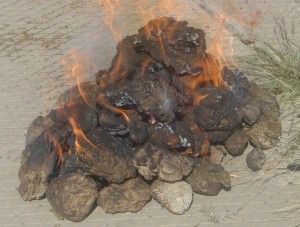
Dung FireToday’s Old Testament reading is a disturbing piece in which the Prophet Ezekiel is instructed to lie down for several days (in fact, for more than a year) as a sign of the number of years Israel and then Judah will be punished.

While lying down, he is to make grain cakes from specific measures of spelt, millet, wheat, barley, lentils, and beans, and he is to drink specific measures of water each day. This is to symbolize that during their punishments, the Israelites and the Judeans will lack bread and water; they will experience poverty and deprivation, and “look at one another in dismay, and waste away under their punishment.” (v. 17)

The selected verse is from God’s instructions to Ezekiel on how he is to prepare and bake his grain cakes, representative of the way in which the soon-to-be-exiled People of God will have to cook their food during their banishment.

The very thought of cooking with excrement must have been shocking to Ezekiel who objected and was given leave to use cow dung rather than human excreta. It would have been shocking in the extreme to people whose God had commanded them to cover their bodily wastes immediately after defecation because the very sight of it was offensive to God:

You shall have a designated area outside the camp to which you shall go. With your utensils you shall have a trowel; when you relieve yourself outside, you shall dig a hole with it and then cover up your excrement. Because the Lord your God travels along with your camp, to save you and to hand over your enemies to you, therefore your camp must be holy, so that he may not see anything indecent among you and turn away from you.

The “designated area outside the camp,” though initially commanded as the latrine, was where everything unclean was to be disposed: the offal of sacrificed animals, warriors’ garments soiled with the blood the enemy, the stones of houses in which plague has been found, and the idols and altars of other nations are all commanded in the Law to be taken there. Persons deemed unclean because of leprosy, menstruation, issue of semen, or slaughter of animals were sent outside the camp. The “designated area outside the camp” was a place of defilement, uncleanness, impurity, corruption, dirtiness, filthiness, pollution, contamination, condemnation, punishment, rejection, castigation, and reproach. It is where disease, dung, and death were. To cook one’s food over excrement wasn’t simply distasteful, it was to imbue one’s nourishment with everything foul and unholy from the “designated area.” The smoke from a cooking fire of whatever fuel flavors anything cooked upon it; the smoke from a fire of human feces would pollute everything cooked over it.

In modern kitchens where we cook on electric burners or over clean natural gas flames, we no longer appreciate how the cooking fuel affects the flavor of the food. Many years ago, the summer of 1969 to be exact, I went to study in Florence, Italy. Upon arrival, I discovered that my pensione (boarding house) would not have a room for me until the next day. So, I checked into a small bed-and-breakfast hotel where I was offered an evening meal of chicken cacciatore. Having no other plans, I accepted. Unfortunately, the hotel kitchen used a kerosene stove. Chicken cacciatore cooked over kerosene is inedible; so too (I discovered the next morning) is coffee.

On the other hand, several years later, I had occasion to rent a cottage near the River Shannon in Ireland. It was heated by a peat stove and on that stove I could also boil water for my breakfast tea. Although I prefer coffee, one does want to be traditional occasionally when living in a 200-year-old, turf-fire-heated Irish farm cottage. My tea tasted of peat, which was an odd flavor, but not an inedible one (like kerosene). By the end of my month there everything I owned – my luggage, my books, all my clothing – smelled of peat. A couple of weeks later, touring a whisky distillery on the Isle of Skye, I discovered that good Scotch whisky (the malt for which is toasted over open peat fires) reminds me of my Irish cottage and, especially, of my morning tea.

I cannot imagine what food cooked over human feces might taste like, and I certainly do not want to find out! Apparently I’m not alone: a couple of years ago, a Japanese scientist perfected a method of making a vegan meat substitute using proteins extracted from human waste. Of over 12,500 who responded to an internet survey, 76% said there was no way they would even try the substance and another 11% said they were unsure whether they would. We can be very sure that the Israelites and the Judeans would not have wanted to; even the thought (or the threat) of eating food cooked over excrement was a religious affront to them.

However it might have tasted, the prophetic meaning is clear: food cooked over human feces is a symbol of abject poverty and want. It is a symbol of something unclean and contaminated to be avoided, not only for ourselves but for everyone. Poverty and deprivation are an abomination; any system which creates them should be viewed as corrupt and filthy, as economic excrement, as financial feces. It does not matter what name we may give such systems — capitalist or communist, socialist or fascist — if the success of the financial institutions created by those systems depends upon human beings being made destitute, those institutions and the system which creates them should be relegated to the “designated area outside the camp.” Like the smoke from a cooking fire of human dung, they pollute everything they touch. They are, simply put, shit not fit for human society.

====================

A request to my readers: I’m trying to build the readership of this blog and I’d very much appreciate your help in doing so. If you find something here that is of value, please share it with others. If you are on Facebook, “like” the posts on your page so others can see them. If you are following me on Twitter, please “retweet” the notices of these meditations. If you have a blog of your own, please include mine in your links (a favor I will gladly reciprocate). Many thanks!

====================

Father Funston is the rector of St. Paul’s Episcopal Church, Medina, Ohio.

The Crisis of Lifelong Learning – From the Daily Office – May 11, 2013

From the Letter to the Hebrews:

For though by this time you ought to be teachers, you need someone to teach you again the basic elements of the oracles of God.

(From the Daily Office Lectionary – Hebrews 5:12 (NRSV) – May 11, 2013.)

Jesus TeachingAs I read this verse from the Letter to the Hebrews, continuing education in the faith (an “adult Christian formation” program) has apparently been an issue in the church for quite a while. There is certainly a crisis of lifelong learning – or the lack of it – in the church today!

Despite the fact that the Episcopal Church declares that Christian formation is a lifelong process in which each persons should grow in his or her relationships with God, self, others, and all creation, and encourages participation in adult education, it doesn’t happen. It doesn’t happen in my congregation, despite my best efforts and despite the efforts of good lay people to offer and sustain Bible study groups; and if my colleagues in other congregations are being truthful, it’s not happening in other places either.

That strikes me as tragic in a denomination which has published a charter for life-long learning which asserts that God continually invites God’s People

  • To enter into a prayerful life of worship, continuous learning, intentional outreach, advocacy and service.
  • To hear the Word of God through scripture, to honor church teachings, and continually to embrace the joy of Baptism and Eucharist, spreading the Good News of the risen Christ and ministering to all.
  • To respond to the needs of our constantly changing communities, as Jesus calls us, in ways that reflect our diversity and cultures as we seek, wonder and discover together.
  • To hear what the Spirit is saying to God’s people, placing ourselves in the stories of our faith, thereby empowering us to proclaim the Gospel message.

Over a year ago, my seminary classmate the Rev. LeeAnne Watkins, offered a video confession of the “failure” in on-going education in her parish. It struck a chord with clergy throughout our denomination, and in the past couple of weeks I have seen some Presbyterian and Lutheran colleagues make reference to her video on their Facebook pages, so I know that chord is resonating in the broader mainstream.

I don’t know what the solution is. What I do know, from reading this verse from the Letter to the Hebrews, is that the crisis of lifelong learning and the problem of sustaining on-going Christian formation has been around a long time!

====================

A request to my readers: I’m trying to build the readership of this blog and I’d very much appreciate your help in doing so. If you find something here that is of value, please share it with others. If you are on Facebook, “like” the posts on your page so others can see them. If you are following me on Twitter, please “retweet” the notices of these meditations. If you have a blog of your own, please include mine in your links (a favor I will gladly reciprocate). Many thanks!

====================

Father Funston is the rector of St. Paul’s Episcopal Church, Medina, Ohio.

« Older posts Newer posts »