Occasional thoughts of an Anglican Episcopal priest

Category: Church (Page 78 of 116)

Health Is a Human Right – From the Daily Office – March 6, 2013

From the Prophet Jeremiah:

Is there no balm in Gilead? Is there no physician there? Why then has the health of my poor people not been restored?

(From the Daily Office Lectionary – Jeremiah 8:22 (NRSV) – March 6, 2013.)

Good Health SignWhy has the health of the people not been restored? This is God’s question of the leadership of ancient Israel, but it could certainly be the question asked of modern America! Other questions could also be asked, even in the aftermath of the healthcare reform debates, the passage of the Affordable Care Act, and its vindication as constitutional by the U.S. Supreme Court. Why is it that, in the practice of medicine, we do not have equal treatment for everybody? Why is that every American is guaranteed a lawyer, but not a doctor? Why don’t we (even now) have guaranteed health care for everyone?

By an odd coincidence, on the Episcopal sanctorale calendar today is the commemoration of two pioneering physicians and their sons who followed in their footsteps, William W. Mayo and Charles F. Menninger. Among the readings prescribed for their celebration is Sirach 38:8: “God’s works will never be finished; and from him health spreads over all the earth.” Health is an endowment of the Creator to every person; it is a natural right. Why has it been taken from the people, and why has it not been restored?

The human right to good health should mandate a system of preventive health care and medical care for everyone. Every human being should be guaranteed the right to good quality health care, to living conditions that enable each to be as healthy as possible, to adequate food, to good housing, and to a healthy environment. Arguments about reforming our health care and medical treatment delivery system framed in terms of markets, costs, competition, or insurance are red herrings rooted in presumptions that deny this basic truth. A for-profit, market-driven medical care model treats health as a commodity to be bought and sold, and leads to inequities, to severely decreased well-being, and to needless loss of life. The Affordable Care Act is, at best, a stop-gap measure. What is required is a complete re-imagining of our health care system.

Any debate about medical treatment and health care should be structured and waged within the realm of human and civil rights, within the realm of morality and spirituality. A reform of our medical delivery system must take it out of the false model of markets (“competition” in health and medical delivery is a myth!) and place it squarely in the realm of human rights. Good health and medical care are basic rights recognized in the Declaration of Independence’s assertion that “life, liberty, and the pursuit of happiness” are guaranteed by God, protected by the penumbra of the U.S. Constitution, and explicitly spelled out in the United Nations’ Universal Declaration of Human Rights, a statement adopted in 1948 with strong American encouragement.

As Christians, we are called to remember the poor and those less fortunate than ourselves. Assuring that all enjoy their right to health care is basic to honoring life. Those without good preventive care and medical treatment when needed live shorter and sicker lives. Failure to work for universal health care sends the message that only those with the wealth to afford private health care really matter. This is a message squarely opposed by the Gospel of Jesus Christ who made it clear that we are called to care for “the least of these who are members of my family.” (Matthew 25:40 NRSV)

Recently, the Episcopal bishops of the two dioceses in the State of Ohio wrote to the state’s governor and other elected officials in support of the expansion of Medicaid coverage. In their public letter they set out the teaching of our church in this area:

The Episcopal Church affirms the following principles as they pertain to health care:

  • health care, including mental health care, should be available to all persons in the United States;
  • access to health care should be continuous;
  • health care should be affordable for individuals, families, and businesses;
  • national and state health care policy should be affordable and sustainable for society;
  • health care should enhance health and well-being by promoting access to high-quality care that is effective, efficient, safe, timely, patient-centered and equitable; and
  • health care providers should not be expected to assume a disproportionate share of the cost of providing care.

“God’s works will never be finished; and from him health spreads over all the earth.” . . . “Why then has the health of my poor people not been restored?” Good health is not a commodity to be bought and sold. It is a gift of God, and adequate preventive health care and good medical treatment are the right of every human being.

====================

A request to my readers: I’m trying to build the readership of this blog and I’d very much appreciate your help in doing so. If you find something here that is of value, please share it with others. If you are on Facebook, “like” the posts on your page so others can see them. If you are following me on Twitter, please “retweet” the notices of these meditations. If you have a blog of your own, please include mine in your links (a favor I will gladly reciprocate). Many thanks!

====================

Father Funston is the rector of St. Paul’s Episcopal Church, Medina, Ohio.

Wells of Spirituality – From the Daily Office – March 5, 2013

From the Gospel according to John:

On the last day of the festival, the great day, while Jesus was standing there, he cried out, “Let anyone who is thirsty come to me, and let the one who believes in me drink. As the scripture has said, ‘Out of the believer’s heart shall flow rivers of living water.'”

(From the Daily Office Lectionary – John 7:37-38 (NRSV) – March 5, 2013.)

St Mary's Well Cefn Meiriadog WalesScholars and commentators seem to agree (and a computer search of various translations confirms) that there is no single verse of the Hebrew scriptures saying what John says Jesus quoted. It seems to be an amalgam or summary of several different bits of the prophets. When I read this story of John’s, however, it isn’t a prophet that comes immediately to mind. Instead, I think of a portrayal of Lady Wisdom in the Book of Proverbs:

Wisdom has built her house, she has hewn her seven pillars. She has slaughtered her animals, she has mixed her wine, she has also set her table. She has sent out her servant-girls, she calls from the highest places in the town, “You that are simple, turn in here!” To those without sense she says, “Come, eat of my bread and drink of the wine I have mixed. Lay aside immaturity, and live, and walk in the way of insight.” (Proverbs 9:1-6 NRSV)

John’s picture of Jesus standing in the streets of Jerusalem calling out an invitation to all comers is very reminiscent of Proverbs’ picture of Wisdom calling “from the highest places in the town.” They may be using different metaphors for spiritual nourishment, but the offer is the same. And, since John has clearly dipped into the Wisdom tradition in Jewish thought in his Prologue (John 1:1-18), the parallel imagery is understandable.

Of course, a prophet, Isaiah, also comes to mind especially when this Gospel is read in the context of Morning Prayer. The canticle called The First Song of Isaiah (Isaiah 12:2-6) includes these words:

Surely, it is God who saves me; *
I will trust in him and not be afraid.
For the Lord is my stronghold and my sure defense, *
and he will be my Savior.
Therefore you shall draw water with rejoicing *
from the springs of salvation. (BCP translation)

When I consider the words of this Gospel together with Isaiah’s song, I come to the conclusion that the springs of salvation are in the believer’s heart, that we draw living waters from deep inside ourselves. I must confess that I am predisposed to that conclusion. Several years ago I was introduced to the observation of St. Bernard of Clairvaux, “Everyone has to drink from his own well,” by the writing of liberation theologian Gustavo Gutierrez. In his book We Drink from Our Own Wells, Gutierrez wrote, “Spirituality is like living water that springs up in the very depths of the experience of faith.” From that deep experience we “live, and walk in the way of insight.”

Frank Griswold, a former Presiding Bishop of the Episcopal Church, once said that Anglican spirituality emphasizes the progressive nature of grace, carefully considering our human experience of the divine. “Christ happens to us over time,” he wrote. “The One who makes use of water, bread and wine to mediate his presence can make use of the stuff of our lives and relationships to address us and draw us more deeply into his life, death, and resurrection.” From being drawn deeply into the on-going life of Christ we drink from that well, we develop insight, and “the stuff of our lives” becomes the spring from which the living waters of grace flow out to others.

====================

A request to my readers: I’m trying to build the readership of this blog and I’d very much appreciate your help in doing so. If you find something here that is of value, please share it with others. If you are on Facebook, “like” the posts on your page so others can see them. If you are following me on Twitter, please “retweet” the notices of these meditations. If you have a blog of your own, please include mine in your links (a favor I will gladly reciprocate). Many thanks!

====================

Father Funston is the rector of St. Paul’s Episcopal Church, Medina, Ohio.

Deceptive Words – From the Daily Office – March 4, 2013

From the Prophet Jeremiah:

Here you are, trusting in deceptive words to no avail.

(From the Daily Office Lectionary – Jeremiah 7:8 (NRSV) – March 4, 2013.)

Trust Me I'm LyingI’ve been thinking about this all day and there is so much to say . . . but this cuts so deeply into so many areas of life that I cannot bring myself to say any of them.

I can only ask every person a question: If you are truly honest with yourself, can you identify the deceptive words – in church, in politics, in the economy, in your work, in your family, in your personal life – that you trust to no avail?

The most important ones, the deceptive words to be most honest about, are the ones we say to ourselves. They are also the most deceptive.

Be honest . . . you know there are many.

====================

A request to my readers: I’m trying to build the readership of this blog and I’d very much appreciate your help in doing so. If you find something here that is of value, please share it with others. If you are on Facebook, “like” the posts on your page so others can see them. If you are following me on Twitter, please “retweet” the notices of these meditations. If you have a blog of your own, please include mine in your links (a favor I will gladly reciprocate). Many thanks!

====================

Father Funston is the rector of St. Paul’s Episcopal Church, Medina, Ohio.

Reverence and Intimacy: The Burning Bush – Sermon for the Third Sunday in Lent – March 3, 2013

====================

This sermon was preached on Sunday, March 3, 2013, at St. Paul’s Episcopal Church, Medina, Ohio, where Fr. Funston is rector.

(Revised Common Lectionary, Lent 3, Year C: Exodus 3:1-15; Psalm 63:1-8; and Luke 13:1-9. These lessons can be read at The Lectionary Page. At St. Paul’s Parish, during Lent, we are using the Daily Office of Morning Prayer as our antecommunion; therefore, only these two lessons and the psalm were read. The epistle lesson, 1 Corinthians 10:1-13, was not used.)

====================

Red Berry BushSome years ago, during the summer of 2000 to be exact, I was one of about a dozen adults who chaperoned 87 teenagers on a ten-day tour of northern Italy. One of the pieces of advice given our group by the organizing tour guide was that the young ladies would not be allowed into Italian cathedrals wearing shorts or tank-tops. She suggested that they take with them, and always have on hand a light-weight over-blouse and a large scarf that they could tie around their waist to form a sort of skirt. This caused no amount of amusement among our group 17- and 18-year-old, Twenty-First Century, American girls, but it only took one time being escorted out of a church by a stern Italian nun for them to realize how serious the advice was and to never again forget to put on their overshirts and their wrap-around skirts.

On one occasion at the Duomo in Milan, I had to intercede when one of our young ladies was being hustled out of the church even though she appeared to be appropriately dressed. It turned out that she had slipped off her shoes to cool her feet on the chilly marble floor. Bare feet, it seemed, were as unacceptable as bare legs or bare shoulders.

Continue reading

The Holy Families – From the Daily Office – March 2, 2013

From the Gospel of John:

After this Jesus went about in Galilee. He did not wish to go about in Judea because the Jews were looking for an opportunity to kill him. Now the Jewish festival of Booths was near. So his brothers said to him, “Leave here and go to Judea so that your disciples also may see the works you are doing; for no one who wants to be widely known acts in secret. If you do these things, show yourself to the world.” (For not even his brothers believed in him.) Jesus said to them, “My time has not yet come, but your time is always here. The world cannot hate you, but it hates me because I testify against it that its works are evil. Go to the festival yourselves. I am not going to this festival, for my time has not yet fully come.” After saying this, he remained in Galilee.

(From the Daily Office Lectionary – John 7:1-10 (NRSV) – March 2, 2013.)

Holy Family IconThirty or so years before the episode described here by John, Mary “gave birth to her firstborn son and wrapped him in bands of cloth, and laid him in a manger, because there was no place for them in the inn” in a town called Bethlehem. (Luke 2:7) We are told here and elsewhere that Jesus had brothers, and his brothers were named “James and Joseph and Simon and Judas.” (Matthew 13:55) He had sisters, too, but their names are not reported in Scripture.
We know next to nothing about his family life. His siblings are not mentioned in the two stories we have from his childhood and adolescence. One supposes it was pretty typical of his time and place. We are told that a Jewish man in First Century Palestine live a life of hard, physical labor either in the farm fields or in the workshop. His wife prepared meals, kept the house, made and washed clothing, and bore and cared for the children. Babies were breastfed, and weaned after 18 months to 3 years. At the age of 13, boys entered adulthood and were apprenticed to learn a craft. Although there is no evidence that boys at the time underwent a ritual bar mitzvah as current Jewish adolescents do, Shmuel ha-Katan a Talmudic scholar writing at the close of the First Century AD does indicate that the completion of the 13th year marked the age for responsibility to the Law. Girls assisted their mothers with domestic work and rearing the younger children; at the age of 12 they were eligible to marry.

If we assume Mary’s and Joseph’s family followed this pattern Jesus and his siblings lived together for at least their formative years. Furthermore, it appears from this story (and others in the Gospels) that as adults the children lived nearby. This seems to have been a tightknit family, although maybe one with some issues. Modern psychology has shown that first born children hold the exclusive attention of the parents and grandparents until the birth of the next child. This is believed to allow for the development of a confident individual who is certain of his place and does fear competition. Jesus would certainly seem to live up to this expectation.

Eventually, the first born does have to deal with the challenge of newcomers. The second born usually ends up in a fight for attention that starts even before he or she is weaned. The expectation that the second will achieve the same standards as the older sibling can result in self-undercutting behavior or in over-achieving behavior in competition with the elder sibling. We don’t know who was the second child in this family; if the listing of Jesus’ brothers’ names in Matthew’s Gospel is in birth order, perhaps it was James. Given that James later became the first Bishop of Jerusalem, that is an interesting possibility.

The arrival of more brothers and sisters may lead second and later children to “middle child syndrome” where the child, being neither youngest nor oldest strives to find a rational role to fill within the family. The youngest children of a large family can face a variety of confusing relationships. Could this be the reason that “not even his brothers believed in him?”

Of course, all this is speculation. We don’t, as I said before, really know anything about Jesus’ early family life. Nor do we have any basis for supposing that the family of Joseph and Mary conformed to these modern psychological stereotypes. What we do know is that Jesus grew up in the bosom of a family, reared by a loving mother and foster father, surrounded by brothers and sisters. In doing so, he sanctified family life in whatever form it may come – large families like his own, childless couples, single-parent households, same-sex couples with or without children – in whatever configurations human beings may form themselves into household units, those families are holy families because each, in its own way, replicates the family in which the Son of God was reared.

The Book of Common Prayer (1979) of the Episcopal Church includes a traditional prayer for families. I’ve edited it to be more inclusive than the original:

Almighty God, our heavenly Father, you set the solitary in families: We commend to your continual care the homes in which your people dwell. Put far from them, we pray, every root of bitterness, the desire of vainglory, and the pride of life. Fill them with faith, virtue, knowledge, temperance, patience, godliness. Knit partners together in constant affection. Turn the hearts of the parents to the children, and the hearts of the children to the parents; and so enkindle fervent charity among us all, that we may evermore be kindly affectioned one to another; through Jesus Christ our Lord. Amen.

====================

A request to my readers: I’m trying to build the readership of this blog and I’d very much appreciate your help in doing so. If you find something here that is of value, please share it with others. If you are on Facebook, “like” the posts on your page so others can see them. If you are following me on Twitter, please “retweet” the notices of these meditations. If you have a blog of your own, please include mine in your links (a favor I will gladly reciprocate). Many thanks!

====================

Father Funston is the rector of St. Paul’s Episcopal Church, Medina, Ohio.

Mean Spiritedness and Holy Scripture – From the Daily Office – March 1, 2013

From the Gospel of John:

Jesus said: “You search the scriptures because you think that in them you have eternal life; and it is they that testify on my behalf. Yet you refuse to come to me to have life. I do not accept glory from human beings. But I know that you do not have the love of God in you. I have come in my Father’s name, and you do not accept me; if another comes in his own name, you will accept him. How can you believe when you accept glory from one another and do not seek the glory that comes from the one who alone is God? Do not think that I will accuse you before the Father; your accuser is Moses, on whom you have set your hope. If you believed Moses, you would believe me, for he wrote about me. But if you do not believe what he wrote, how will you believe what I say?”

(From the Daily Office Lectionary – John 5:39-47 (NRSV) – March 1, 2013.)

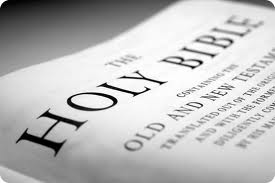
Bible Title PageIt’s called bibliolatry and it’s been around a long, long time. The dictionary definition of bibliolatry is “excessive reverence for the Bible as literally interpreted.” What I most enjoy about modern bibliolatry is that it denies that it is bibliolatry in the most circular and bibliolatrous of ways.
For instance, this is from a website that claims its stance on Holy Scripture is not bibliolatry because of what Scripture says about itself:

It is important to understand what the Bible says about itself. Second Timothy 3:16-17 declares, “All Scripture is God-breathed and is useful for teaching, rebuking, correcting and training in righteousness, so that the man of God may be thoroughly equipped for every good work.” So, if the Bible is “God-breathed,” and “God does not lie” (Titus 1:2), then every word in the Bible must be true. Believing in an inerrant, infallible, and authoritative Bible is not bibliolatry. Rather, it is simply believing what the Bible says about itself. Further, believing what the Bible says about itself is in fact worshipping the God who breathed out His Word. Only a perfect, infallible, omnipotent, omnipresent, and omniscient God could create written revelation that is itself perfect and infallible.

In so many words what this says is, “The Bible is inerrant and infallible because it says it is.” It doesn’t actually (that is not a valid interpretation of Second Timothy or Titus), but is anything else (other than, perhaps, the holy books of other religions) given that kind of reverence? Is any other source of information permitted that sort of self-validation without question?

The Jews of Jesus’ day did not (and to this day do not) view Scripture as inerrant, but those to whom Jesus was speaking did rely on the Torah quite heavily; they gave it, perhaps, excessive reverence. The Pharisees did search the scriptures for rules of behavior and piety because they thought that in them they would find eternal life. In this regard, I believe, the evangelical literalists resemble them with their approach to the Bible as inerrant and infallible.

At a meeting of the Evangelical Theological Society, Professor J.P. Moreland of Biola University said:

In the actual practices of the Evangelical community in North America, there is an over-commitment to Scripture in a way that is false, irrational, and harmful to the cause of Christ. And it has produced a mean-spiritedness among the over-committed that is a grotesque and often ignorant distortion of discipleship unto the Lord Jesus.

It’s that mean spiritedness that concerns me. It has spread throughout the Christian community, not simply among Evangelicals. It seems to me that we are all, to one extent or another, bibliolatrists. We may not consider the Bible inerrant and infallible, but we have our favorite bits of Scripture that we emphasize and hold in “excessive reverence” . . . and when our particular position on some issue is challenged, we can all be mean-spirited and often are. When that happens, the Scriptures are our accuser. Just as Jesus said to the Jews about the Torah, so we should think of the New Testament:

“This is my commandment, that you love one another as I have loved you.” (John 15:12 NRSV)

“Be of the same mind, having the same love, being in full accord and of one mind.” (Philippians 2:2 NRSV)

“You do well if you really fulfill the royal law according to the scripture, ‘You shall love your neighbor as yourself.'” (James 2:8 NRSV)

“Finally, all of you, have unity of spirit, sympathy, love for one another, a tender heart, and a humble mind.” (1 Peter 3:8 NRSV)

“Little children, let us love, not in word or speech, but in truth and action.” (1 John 3:18 NRSV)

“May mercy, peace, and love be yours in abundance.” (Jude 1:2 NRSV)

In our several liberal denominations, we may not take the Bible literally; we may not consider it completely authoritative in all spheres of life. I, for one, do not. The Bible is not a scientific text; it is not a history book. When poetry in the Bible says that mountains skipped like rams or hills like lambs (Ps. 114), I do not take that as a literal fact. When the creation stories of Genesis say that God created everything in six days or made humans out of mud, I do not take that as scientific fact. When the Bible says the sun stood still and the moon stopped for a day, I don’t take that to be a historical reality. (Joshua 10:13) I take these tales seriously. I believe that they reveal truth, but I do not believe they are factual. In the same way, I take John, Paul, James, Peter, and Jude seriously.

If we give into mean spiritedness, it is they who will accuse us. And we will be convicted.

====================

A request to my readers: I’m trying to build the readership of this blog and I’d very much appreciate your help in doing so. If you find something here that is of value, please share it with others. If you are on Facebook, “like” the posts on your page so others can see them. If you are following me on Twitter, please “retweet” the notices of these meditations. If you have a blog of your own, please include mine in your links (a favor I will gladly reciprocate). Many thanks!

====================

Father Funston is the rector of St. Paul’s Episcopal Church, Medina, Ohio.

(Re)Learning Stewardship of Space – From the Daily Office – February 28, 2013

From the Psalms:

Your adversaries roared in your holy place;
they set up their banners as tokens of victory.
They were like men coming up with axes to a grove of trees;
they broke down all your carved work with hatchets and hammers.
They set fire to your holy place;
they defiled the dwelling-place of your Name and razed it to the ground.
They said to themselves, “Let us destroy them altogether.”
They burned down all the meeting-places of God in the land.
There are no signs for us to see; there is no prophet left;
there is not one among us who knows how long.
How long, O God, will the adversary scoff?
will the enemy blaspheme your Name for ever?

(From the Daily Office Lectionary – Psalm 74:4-9 (BCP version) – February 28, 2013.)

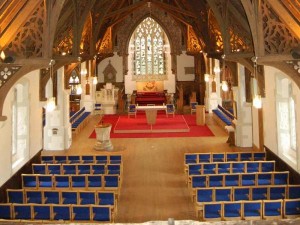
St Margaret’s Church, Leiston, UKDespite the tradition that the Psalms were written by King David, any good commentary will tell you that this Psalm was written probably in the first decades of the Sixth Century BC, at around the time of the fall of Jerusalem to the Babylonians circa 598 BC. Some scholars would even suggest that it was written as late as the Maccabean era (circa 165 BC). Personally, I tend to go with the earlier date; the Psalm’s description of wide spread destruction of religious meeting places seems more in line with the pre-Exilic invasion.

The first deportation of the Jewish leadership followed almost immediately; two more deportations would occur. Those who were taken away were separated from their land and from the temple, central elements in their identity as the People of God. Loss of their homeland and, more importantly, the loss of their exclusive worship space, the temple made a critical impact on their experience and understanding of God. Could they worship God in a foreign land? Where was God in this alien land? For that matter, who was God? Their confusion is expressed in Psalm 137:

By the waters of Babylon we sat down and wept,
when we remembered you, O Zion.
. . .
How shall we sing the Lord’s song
upon an alien soil? (vv. 1,4 BCP version)

Today’s evening Psalm expresses the dismay of those left behind, those who are still in the land but whose places of assembly and worship have been destroyed. Both groups face the same issue: how to worship God without the traditional, exclusive-use worship spaces? Could it even be done?

They learned the lesson that God is not tied to land or temple, that God’s rule extends everywhere. They learned that their appreciation of God’s presence was not dependent on there being the traditional, exclusive-use worship place, that they could worship God anywhere. This is, unfortunately, a lesson that God’s People have forgotten and need to learn again.

We in the Christian church are tied to our buildings, especially those of us who are part of highly liturgical traditions. Our custom (or perhaps we would be better to call it a habit or even an addiction) of structured, even majestic worship with processions, high altars, choirs, fancily vested clergy, and pipe organs seems to demand special spaces in which to indulge it. We forget that these spaces are simply tools for ministry; instead, we treat them as holy themselves and we use them exclusively for worship. We call them “houses of worship” or, even more telling, “houses of the Lord.”

In the spring of 2009 in Cleveland, Ohio, near where I live, the Roman Catholic bishop announced the closure of 52 parish church buildings because the parishes were deemed financially nonviable. The outcry was deafening; the members of many of these congregations could not imagine being the church without their historic building. The Cleveland Plain Dealer reported that the pastor of one of the closed churches tried to teach his flock that the “building is a beautiful building. A magnificent building, but the bottom line is, it isn’t the church. We are.”

Buildings are simply tools and tools should be properly used. While they are useful tools, the loss of buildings and property could actually be a blessing in disguise to such congregations. In American church culture, many churches, like these Roman Catholic parishes, have developed an unwholesome attachment to their buildings and locations. Loss of their building and property could free a congregation to discover its identity as the Body of Christ. The threat of loss could also be salutary; it can encourage a rethinking of our stewardship and use of space.

Proper stewardship of space would encourage the use of our worship locations for other, additional purposes. Flexible space could allow the area used for worship a few hours each Sunday to be used, for example, as a soup kitchen on weekdays. This is exactly what an historic Episcopal church in New York has done. Church of the Holy Apostles‘ nave becomes a dining room where thousands of people are fed. The church which worships there has come to understand that space is not holy because “God lives there.” It is holy because they worship there, and it is no less holy when used for other purposes, such as feeding the poor. After all, “just as you did it to one of the least of these who are members of my family, you did it to me.” (Matthew 25:40 NRSV) Thirteen of the closed Roman Catholic parishes successfully appealed the closure order to the Vatican and the bishop was ordered to reopen the buildings, which occurred late in 2012. Whether the parishes will make any changes in the way they do outreach ministries in their neighborhoods remains to be seen.

The Babylonians destroyed the holy places, but the People of God learned a lesson about their need of holy space . . . that they didn’t need an exclusive-use worship space . . . and they lived on. Today’s economy is, perhaps, making exclusive worship places nonviable, but the People of God can live on without them, or they can live on while making faithful multiple uses of them. The lesson learned by the Jews during the Exile must constantly be relearned.

====================

A request to my readers: I’m trying to build the readership of this blog and I’d very much appreciate your help in doing so. If you find something here that is of value, please share it with others. If you are on Facebook, “like” the posts on your page so others can see them. If you are following me on Twitter, please “retweet” the notices of these meditations. If you have a blog of your own, please include mine in your links (a favor I will gladly reciprocate). Many thanks!

====================

Father Funston is the rector of St. Paul’s Episcopal Church, Medina, Ohio.

“Be” not “Go” 24/7 – From the Daily Office – February 27, 2013

From the Gospel of John:

The man [from the pool at Beth-zatha] went away and told the Jews that it was Jesus who had made him well. Therefore the Jews started persecuting Jesus, because he was doing such things on the sabbath. But Jesus answered them, “My Father is still working, and I also am working.” For this reason the Jews were seeking all the more to kill him, because he was not only breaking the sabbath, but was also calling God his own Father, thereby making himself equal to God.

(From the Daily Office Lectionary – John 5:15-18 (NRSV) – February 27, 2013.)

I go to vs I am GraphicRecently, a graphic has been making the rounds on Facebook. I received it from another church and posted it on my parish’s Facebook page about 24 hours ago with the caption, “Something to think about.” As of the moment I am writing, this graphic has been “liked” 235 times. It has been shared 1,412 times. And according to Facebook’s calculations, it has been seen over 132,400 times. That’s only as originating our page. It is being posted and shared on other pages and, no doubt, has even larger numbers than these at some of those other pages.

The graphic in question is the illustration of this meditation. It suggests a distinction between what it calls “the consumer church” and “the missional church.” The first is characterized by an attitude in its members of “I go to church;” the second, by a realization that “I am the church.”

“My Father is still working, and I also am working.”

When I read these words, they spoke to me of the same thing, the difference in paradigm between “going to church” and “being church.” For Jesus, his ministry on this earth among the People of God was not simply something he was doing; it’s who he was. It wasn’t work he could walk away from, go home from at night, take a day off, or go away on a long weekend. His Father was working “24/7” and, so, so was he. This is the difference between “going to” and “being.”

Theologically, this difference is most often discussed in connection with ordained ministry, in distinguishing between a “functional” view of ordination and an “ontological” theology of Holy Orders.

Ontology deals with the nature or substance of thing. It answers the question, “What is it?” The ontological view holds that ordination works a permanent and indelible change in the character of the deacon, priest, or bishop ordained. It is a sacrament which, like baptism, cannot be repeated, nor can Holy Orders be conferred temporarily. The ontological view is that ordination places one in an exclusive position in the community of the church, not a better or privileged place, but one from which the clergy person is to live exclusively in service of the people of God. This view is summarized in the aphorism “Once a priest always a priest.”

Orthodox theology holds that this is also the nature of baptism, the sacrament of membership in the church. According to St. Gregory of Nyssa, a real metaphysical, ontological change takes place in the baptized person, if the baptized person lives a virtuous life and makes his or her baptism effective in faith. Again, the church’s understanding is that once one is baptized, one remains forever baptized.

At the other end of the spectrum of understandings of these sacraments is the “functional” or “relational” view. As to ordination, it is a view that the sacrament is nothing more than a license to perform the functions of ordained ministry within the context of the local church community; apart from his or her relation to that community, the ordained minister is nothing and possesses nothing. According to the functional view, any of the tasks normally performed by the ordained could be performed by others within the church if properly authorized by the local community. When the ordained minister ceases to function in that role, he or she ceases to be ordained.

However, there is no “functional” theology of baptism. To the best of my knowledge, all Christian traditions hold that once a person has been baptized with water “in the name of the Father and of the Son and of the Holy Spirit” (Matthew 28:19 NRSV), they are then and forever baptized. They may quibble about whether immersion is needed; they may describe the effect of baptism differently, as the “washing away of sin” or as conferring an indelible “mark” or “seal.” But once baptized, always baptized: “There is one body and one Spirit, just as you were called to the one hope of your calling, one Lord, one faith, one baptism, one God and Father of all, who is above all and through all and in all.” (Ephesians 4:4-6 NRSV)

At least that’s the theology . . . the lived reality is often something different. For many church members, baptism is something that “was done” to them; they do not view it as defining who they are. For these Christians, church is a place they “go” not a Body to which they belong, not something they “are.” This morning, a member of my parish governing board brought this up in the context of contributions and offerings, budgets and bills. She made particularly note of the many church members who make an offering when they attend, but do not consider the church’s financial need when they are absent. “They are like people buying a service,” she said. Church is a place they “go;” church is not who they “are.”

I think this is why the graphic has proven so popular. There are many, many church members who “are the church,” who do not merely “go to church.” The graphic resonates with them. They realize that their Father is always working and that they, like Jesus, are also always working. Their Christian identity is a 24/7 thing.

In baptism, says The Book of Common Prayer, by water and the Holy Spirit God bestows upon God’s servants the forgiveness of sin and raises them to the new life of grace. The newly baptized person is “sealed by the Holy Spirit in Baptism and marked as Christ’s own for ever.” (BCP 1979, page 308)

During this season of Lent, as the baptized are invited to observe “a holy Lent, by self-examination and repentance; by prayer, fasting, and self-denial; and by reading and meditating on God’s holy Word” (page 265), I hope that all baptized persons will come to believe that church is who they are, not simply someplace they go.

====================

A request to my readers: I’m trying to build the readership of this blog and I’d very much appreciate your help in doing so. If you find something here that is of value, please share it with others. If you are on Facebook, “like” the posts on your page so others can see them. If you are following me on Twitter, please “retweet” the notices of these meditations. If you have a blog of your own, please include mine in your links (a favor I will gladly reciprocate). Many thanks!

====================

Father Funston is the rector of St. Paul’s Episcopal Church, Medina, Ohio.

Reason and Consensus: Biblical Political Values – From the Daily Office – February 26, 2013

From the Psalms:

How long will you assail a person,
will you batter your victim, all of you,
as you would a leaning wall, a tottering fence?
Their only plan is to bring down a person of prominence.
They take pleasure in falsehood;
they bless with their mouths,
but inwardly they curse.

(From the Daily Office Lectionary – Psalm 62:3-4 (NRSV) – February 26, 2013.)

U.S. CapitolAs I read the lessons and Psalms of the Daily Office lectionary for today, this was the passage that spoke loudest to me, but I did not want to write about it. I tried to reflect upon and author a meditation about some other bits of the Scriptures appointed for today, but my thoughts kept returning to this one.

I’m fairly confident that my comments about it will not be readily accepted by, will indeed by rejected by some of my readers, including not a few of my parishioners. But I have to be honest in my understanding and exegesis of the Bible, and its application to our modern world.

I usually use the version of the Psalms from The Book of Common Prayer in these meditations, but today I’ve chosen to use the New Revised Standard Version because the translation is more accurate. The Prayer Book puts these words in the first person, “How long will you assail me . . . ?” The NRSV is closer to the Hebrew which is in the third person, “How long will you assail a man . . . ? The Hebrew is ‘iysh which can mean a male human being, but can also be translated as gender neutral, so the NRSV is not wrong to do so.

The theologian Karl Barth, in an interview with Time Magazine in 1963 advised theologians “to take your Bible and take your newspaper, and read both. But interpret newspapers from your Bible.” Three years later, in another interview, he said, “The Pastor and the Faithful should not deceive themselves into thinking that they are a religious society, which has to do with certain themes; they live in the world. We still need – according to my old formulation – the Bible and the Newspaper.”

When I read these words from the Bible, I cannot help but remember these words from the news: “I hope he fails. . . . . I hope Obama fails.” (Radio commentator Rush Limbaugh, The Rush Limbaugh Show, January 16, 2009)

I cannot help but remember these words from the news: “The single most important thing we want to achieve is for President Obama to be a one-term president.” (Senate Minority Leader Mitch McConnell, R-Ky, National Journal interview, October 23, 2010)

I cannot help but remember these words from the news: “We’re going to do everything — and I mean everything we can do — to kill it, stop it, slow it down, whatever we can.” (Speaker of the House John Boehner, R-Oh, Politico, concerning President Obama’s first-term agenda, October 28, 2010)

I cannot do anything but what Professor Barth admonished and interpret these newspaper reports from my Bible, especially when my Bible decries and condemns those whose “only plan is to bring down a person of prominence.”

I make no bones of that fact that I am politically a progressive. I’ve never hidden that from anyone and in today’s current American political climate, especially since I live in a “swing state”, that means that I voted for President Obama, twice. My congregation knows that. In the first election, I put no political bumper stickers on my car, but my wife had an Obama/Biden sticker on hers. In the second election, we both did. If I’d had my druthers, I’d rather have voted for the Green Party but, as I said, I live in a swing state and a vote for the Greens would have been, effectively, a vote for the Republican candidates. I voted for President Obama.

So there they are; my political cards are on the table. In politics, economics, and social values, I’m on the “left” of the spectrum. No secrets.

But this isn’t about left or right, Democrat or Republican. It isn’t really about politics, at all. It’s about consensus building and governing with with reason; it’s about values that are not only political but Biblical.

I take the Bible seriously; I’m fairly conservative when it comes to exegeting Holy Scripture. When a Psalm negatively portrays the sorts of politics we see in modern America, I take it seriously.

I can remember a time, not so long ago, when this wasn’t the way our leaders conducted the country’s business. For example, although I was not (and never will be) a member of his party, I remember with affection and respect Senator Everett Dirksen, R-Ill. His was a voice of reason and compromise; his skillful working with Senators Hubert Humphrey (D-Mn) and Mike Mansfield (D-Mt) led to the end of a Republican filibuster and passage of the Civil Rights Act 1964.

It was a Republican who spoke of “the need to maintain balance in and among national programs – balance between the private and the public economy, balance between cost and hoped for advantage – balance between the clearly necessary and the comfortably desirable; balance between our essential requirements as a nation and the duties imposed by the nation upon the individual; balance between actions of the moment and the national welfare of the future. Good judgment seeks balance and progress; lack of it eventually finds imbalance and frustration.” That Republican was President Dwight D. Eisenhower giving his farewell address to the nation on January 17, 1961.

President Eisenhower worked well with a Democratic Senate leader, Lyndon B. Johnson, D-Tx. They both had a fondness for government by consensus and reached across party lines to form a close working relationship. One of Johnson’s favorite sayings was “Come, let us reason together;” he spoke it often after he became president himself. It is a quotation from Scripture:

“Come now, and let us reason together,” says the Lord, “Though your sins are as scarlet, they will be as white as snow; though they are red like crimson, they will be like wool. If you consent and obey, you will eat the best of the land; but if you refuse and rebel, you will be devoured by the sword.” Truly, the mouth of the Lord has spoken. (Isaiah 1:18-20, NAS)

Our political parties do not have to play the sort of political games currently being played. They have worked together in the past; they can do so again. Planning only to bring down one’s opponent, refusing to work toward consensus, failing to reason together . . . these are not only bad politics, they are unfaithful.

Scripture is filled with admonitions to work together:

Oh, how good and pleasant it is, when brethren live together in unity! (Ps 133:1, BCP version)

Now I appeal to you, brothers and sisters, by the name of our Lord Jesus Christ, that all of you be in agreement and that there be no divisions among you, but that you be united in the same mind and the same purpose. (1 Cor. 1:10, NRSV)

Lead a life worthy of the calling to which you have been called, with all humility and gentleness, with patience, bearing with one another in love, making every effort to maintain the unity of the Spirit in the bond of peace. (Eph. 4:1-3, NRSV)

Make my joy complete: be of the same mind, having the same love, being in full accord and of one mind. (Philip. 2:2, NRSV)

Our political leaders who claim the Christian faith should not be governing (in truth, failing to govern) on the basis of “bringing down a person of prominence.” Any who do should be taken to task, but not on the basis of their politics, because on politics people of faith can disagree. No, they should be taken to task because such behavior is unfaithful; it betrays the Biblical witness and the admonitions of Scripture to reason together. Reason and consensus are not only political values; they are Biblical values.

====================

A request to my readers: I’m trying to build the readership of this blog and I’d very much appreciate your help in doing so. If you find something here that is of value, please share it with others. If you are on Facebook, “like” the posts on your page so others can see them. If you are following me on Twitter, please “retweet” the notices of these meditations. If you have a blog of your own, please include mine in your links (a favor I will gladly reciprocate). Many thanks!

====================

Father Funston is the rector of St. Paul’s Episcopal Church, Medina, Ohio.

Holy Wit: Humor in the Bible – From the Daily Office – February 25, 2013

From the Prophet Jeremiah:

The word of the Lord came to me, saying, “Jeremiah, what do you see?” And I said, “I see a branch of an almond tree.” Then the Lord said to me, “You have seen well, for I am watching over my word to perform it.”

(From the Daily Office Lectionary – Jeremiah 1:11-12 (NRSV) – February 25, 2013.)

Buddy Jesus, from the movie DogmaThese two verses have probably caused any number of people to scratch their heads in bewilderment over the centuries. Those who read them in English without looking behind the translation to the original language wonder, “What on earth does this mean?” Those who read them in Hebrew wonder, “How can God have such a terrible sense of humor?”

This is a pun. The Hebrew word for “almond” or “almond tree” is shaqed, while that for “watching” is shaqad. God is playing with words and images in order to impress upon Jeremiah’s mind the seriousness of God’s watchfulness. It worked; Jeremiah remembered (and wrote about) it.

The Irish satirist (and Anglican clergyman) Jonathan Swift said of punning that it “is an art of harmonious jingling upon words, which, passing in at the ears, excites a titillary motion in those parts; and this, being conveyed by the animal spirits into the muscles of the face, raises the cockles of the heart.” Essayist Charles Lamb considered the pun “a noble thing per se. It fills the mind, it is as perfect as a sonnet; better.”

Such praise, however, is far from universal. Often quoted is English poet John Dryden’s aphorism that the pun is the “lowest and most groveling kind of wit,” or Ambrose Bierce’s derision of it as a “form of wit to which wise men stoop and fools aspire.” In all of her work, Jane Austen includes puns in only one, Mansfield Park, and there only to demonstrate the low moral character of the offender, the shallow and evil Mary Crawford.

Holy Scripture, on the other hand, is full of puns and other word play, such as double-entendres. The Law and the Prophets are full of them; Jesus uses them in the Gospels. The problem for modern American readers, however, is that they are in Hebrew and Greek, and simply don’t translate into English. In addition, Scripture is chock full of other forms of humor, including sarcasm and irony, humorous imagery and exaggerations, and plays on the names of people and places. Again, these do not translate well from one language to another.

Although there are no jokes per se in the Bible, the Scriptures are replete with humor; there is an abundance of wit in Holy Writ. Perhaps not all, but most of this humor can only be appreciated if read in the original Hebrew or Greek. To the believer, the conservative believer especially, the Bible is a moral document, not a storybook, so the presence of humor in it comes as a shock to many; in fact, some would deny that there is anything funny about the Holy Book. The philosopher Alfred North Whitehead, for example, claimed that “the total absence of humour from the Bible is one of the most singular things in all of literature.” Many Christians seem to think the Bible is only a solemn and serious book, full of timeless wisdom but definitely containing nothing even remotely funny. I recently read a sermon by a preacher from the “Christian Right” which derided the use of humor in preaching; among his assertions was this:

There is no amusement in Jesus, nor is there in any of the 66 books of the Bible. God expects his saints to be quite content with straight forward fellowship and sound teaching. Any time the saints seem to get overloaded with good things, the solution is to sing Psalms and spiritual songs. Anything else is mongrel Christianity.

I remember reading a report a couple of years ago of a study by two psychologists which suggested that political conservatives have much less of a sense of humor than do liberals, and another which, disturbingly, showed that conservative evangelical Christians are more likely than not to support torture of suspected terrorists. And I wonder if there is some connection between failure to appreciate the humor in Holy Scripture and Christian conservatism.

As a Christian who generally leans towards political liberalism, I enjoy the word play, the sarcasm, the irony, and all the other humor in the Bible. I believe that humor brings us closer to God and that the holy wit in Holy Writ brings God closer to humankind. The Protestant theologian Karl Barth is reported to have said, “Laughter is the closest thing to the grace of God.” And the Catholic theologian and writer G.K. Chesterton wrote, “It is the test of a good religion whether you can joke about it.” I believe they are right, because “he whose throne is in heaven is laughing.” (Psalm 2:4a, BCP translation)

Maybe God’s doing so because of all those awful puns one finds in God’s book.

====================

A request to my readers: I’m trying to build the readership of this blog and I’d very much appreciate your help in doing so. If you find something here that is of value, please share it with others. If you are on Facebook, “like” the posts on your page so others can see them. If you are following me on Twitter, please “retweet” the notices of these meditations. If you have a blog of your own, please include mine in your links (a favor I will gladly reciprocate). Many thanks!

====================

Father Funston is the rector of St. Paul’s Episcopal Church, Medina, Ohio.

« Older posts Newer posts »