Occasional thoughts of an Anglican Episcopal priest

Category: Church (Page 81 of 116)

One Today – From the Daily Office – January 21, 2013

From the Letter to the Ephesians:

There is one body and one Spirit, just as you were called to the one hope of your calling, one Lord, one faith, one baptism, one God and Father of all, who is above all and through all and in all.

(From the Daily Office Lectionary – Ephesians 4:4-6 (NRSV) – January 21, 2013.)

One SunI held off offering a meditation on this Inauguration Day, the Martin Luther King, Jr., holiday, for a variety of reasons. Throughout the day, however, this particular bit of St. Paul’s Letter to the Church at Ephesus kept returning to my mind. The Episcopal Church uses this in dialogue form in our baptismal liturgy, so it is familiar to us. The idea that we are all in some way united is a part of our Anglican ethos.

In the celebration of President Barack Obama’s second inauguration, poet Richard Blanco focused also on our unity. I think his poem bears repeating here in celebration of unity.

One Today by Richard Blanco

One sun rose on us today, kindled over our shores,
peeking over the Smokies, greeting the faces
of the Great Lakes, spreading a simple truth
across the Great Plains, then charging across the Rockies.
One light, waking up rooftops, under each one, a story
told by our silent gestures moving behind windows.

My face, your face, millions of faces in morning’s mirrors,
each one yawning to life, crescendoing into our day:
pencil-yellow school buses, the rhythm of traffic lights,
fruit stands: apples, limes, and oranges arrayed like rainbows
begging our praise. Silver trucks heavy with oil or paper —
bricks or milk, teeming over highways alongside us,
on our way to clean tables, read ledgers, or save lives —
to teach geometry, or ring-up groceries as my mother did
for twenty years, so I could write this poem.

All of us as vital as the one light we move through,
the same light on blackboards with lessons for the day:
equations to solve, history to question, or atoms imagined,
the “I have a dream” we keep dreaming,
or the impossible vocabulary of sorrow that won’t explain
the empty desks of twenty children marked absent
today, and forever. Many prayers, but one light
breathing color into stained glass windows,
life into the faces of bronze statues, warmth
onto the steps of our museums and park benches 2
as mothers watch children slide into the day.

One ground. Our ground, rooting us to every stalk
of corn, every head of wheat sown by sweat
and hands, hands gleaning coal or planting windmills
in deserts and hilltops that keep us warm, hands
digging trenches, routing pipes and cables, hands
as worn as my father’s cutting sugarcane
so my brother and I could have books and shoes.

The dust of farms and deserts, cities and plains
mingled by one wind — our breath. Breathe. Hear it
through the day’s gorgeous din of honking cabs,
buses launching down avenues, the symphony
of footsteps, guitars, and screeching subways,
the unexpected song bird on your clothes line.

Hear: squeaky playground swings, trains whistling,
or whispers across café tables, Hear: the doors we open
for each other all day, saying: hello / shalom,
buon giorno / howdy / namaste / or buenos días
in the language my mother taught me — in every language
spoken into one wind carrying our lives
without prejudice, as these words break from my lips.

One sky: since the Appalachians and Sierras claimed
their majesty, and the Mississippi and Colorado worked
their way to the sea. Thank the work of our hands:
weaving steel into bridges, finishing one more report
for the boss on time, stitching another wound
or uniform, the first brush stroke on a portrait,
or the last floor on the Freedom Tower
jutting into a sky that yields to our resilience.

One sky, toward which we sometimes lift our eyes
tired from work: some days guessing at the weather
of our lives, some days giving thanks for a love
that loves you back, sometimes praising a mother
who knew how to give, or forgiving a father
who couldn’t give what you wanted.

We head home: through the gloss of rain or weight
of snow, or the plum blush of dusk, but always — home,
always under one sky, our sky. And always one moon
like a silent drum tapping on every rooftop
and every window, of one country — all of us —
facing the stars
hope — a new constellation
waiting for us to map it,
waiting for us to name it — together.

We are one today.

====================

A request to my readers: I’m trying to build the readership of this blog and I’d very much appreciate your help in doing so. If you find something here that is of value, please share it with others. If you are on Facebook, “like” the posts on your page so others can see them. If you are following me on Twitter, please “retweet” the notices of these meditations. If you have a blog of your own, please include mine in your links (a favor I will gladly reciprocate). Many thanks!

====================

Father Funston is the rector of St. Paul’s Episcopal Church, Medina, Ohio.

Choose a Party over Purity – Sermon for the 2nd Sunday after Epiphany – January 20, 2013

====================

This sermon was preached on Sunday, January 20, 2013, at St. Paul’s Episcopal Church, Medina, Ohio, where Fr. Funston is rector.

(Revised Common Lectionary, Epiphany 2, Year C: Isaiah 62:1-5; Psalm 96:1-10; 1 Corinthians 12:1-11; John 2:1-11. These lessons can be read at The Lectionary Page.)

====================
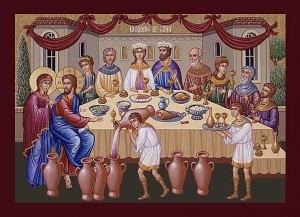
Icon of the Wedding Feast of CanaIn our gospel lesson today, Jesus turns water into wine. He does so, somewhat unwillingly it seems, because he and his mother are at a wedding banquet and the couple is about to run out of wine for their guests. Mary brings this to Jesus’ attention because she apparently believes he can do something to save the hosts from embarrassment. At first, however, he seems disinclined to do anything about it. Not the least bit phased by her son’s reluctance, Mary tells the servants to do whatever he tells them, and she goes back to the party. I have always imagined that as she turned away Mary gave Jesus the same sort of look my mother would give me when I tried to not do as she wanted, the same sort of look I’ve seen my wife give our children. So . . . Jesus turns water into wine, and (as you will see) not just any water into not just any wine, but really good wine! Now, one supposes that Jesus could have done something else to assist the wedding couple, but he chooses to do this, to turn water into wine.

Wine is a very special sort of drink, especially in the Jewish tradition and, thus, in our own Christian faith. Wine gets a special mention in Psalm 104, which is a long song of praise to God for all the things God has created, especially those things that are good for human beings. Along about the middle of the psalm, the singer gives praise to the Almighty that among the “plants to serve mankind” are those from which we get “wine to gladden our hearts.” (Ps 104:15-16) In Jewish tradition, grape wine is considered such a gift to humankind that it alone of all alcoholic beverages has a special prayer of thanksgiving: Barukh atah Adonai Eloheinu Melekh ha’olam, bo’re p’ri ha’gafen (“Blessed are you, O Lord our God, Sovereign of the universe, who creates the fruit of the vine”).

I would like you to keep that in mind. I’ll return to the subject of wine and glad hearts in a short while, but first I want to share with you a news story that crossed my desk a couple of days after Christmas. It is from the Jewish publication, The Tablet:

Climate change has been blamed for a host of devastating events, from Hurricane Sandy to the evaporation of Greenland’s glaciers. But earlier this year, a dramatic weather event had a small but important impact on the Jewish community: In July, as a drought brought the effects of global warming to the Midwest, the only mikveh in Omaha, Neb., went dry.

The mikveh, a ritual bath, is an essential part of any Orthodox Jewish community, so when one goes dry, it’s a serious issue — especially in Omaha, where the next nearest mikveh is a state away. “The mikveh is one of the most basic institutions of any Jewish community,” explained Jonathan Gross, the rabbi of Beth Israel Synagogue, Omaha’s Orthodox congregation. “How are you supposed to have young families if you don’t have a mikveh?”

Refilling a mikveh isn’t a simple matter of turning on a faucet; there are rules about what kind of water can and cannot be used. The community in Omaha prayed for rain – one of the approved methods for replenishing the water in a mikveh – and their prayers were eventually answered. But by the time those rains came, another solution was already in place, a solution that involved one ton of ice.

Mikvehs typically serve multiple purposes. The first and most important is as a place for women to purify themselves after completing their menstrual cycles; immersion in a mikveh is a critical part of the laws of Taharot HaMishpacha, family purity, and without immersion a woman is forbidden to have sex with her husband. New vessels, like pots and pans, must be immersed before they can be considered kosher and thus usable. And converts need to immerse to conclude their conversions. Customarily, men also dunk, before holidays and before their wedding day, although this isn’t mandated by modern Jewish law.

Like many mikvehs, the Omaha Community Mikvah is composed of two below-ground pools. The first pool fills with rainwater through a hole in the roof, and the second, larger pool is used for the actual bathing. To be considered halachically valid, a mikveh is required to have at least 40 se’ah of natural water. A se’ah, a unit of halachic measurement, corresponds to roughly five gallons of water, according to one stringent opinion – meaning that 200 gallons of natural water are required for a kosher mikveh. The water must fill the mikveh through naturally occurring sources, either by rain or through a connection to a spring or river. Water that is transported to the mikveh through direct human means – in buckets, for instance – is called she’uvim, drawn water, and cannot be used to fill a mikveh. Tap water is also forbidden, though this wasn’t always the case—and tap water can be added to the mikveh once the required 200 gallons of natural water are present.

[Preacher’s Note: The author is being generous in equating 40 se’ah to 200 gallons. A se’ah is 12.128 litres. Doing the math yields a more accurate conversion of 40 se’ah to just under 130 gallons. This is the approximate volume of water changed to wine in today’s gospel lesson. See The Jewish Encyclopedia.]

In July, Omaha’s mikveh was accidentally emptied when a maintenance crew member thought that cleaning the mikveh meant emptying it completely. In most circumstances, a mikveh can be refilled relatively easily through rain or snow, but this summer’s drought made that impossible. “Had this happened in January with all the snow we would have been filled up in a week!” Gross lamented on his blog.

The mikveh was out of service for almost two months. Women traveled to the next closest mikveh in Des Moines, Iowa, or Kansas City, Kan., each more than two hours away. Dishes went unpurified. The receptionist at the Rose Blumkin Jewish Home, where Omaha’s mikveh is located, received calls every time it rained an inch, asking if the pool had somehow miraculously filled. As the weeks passed, different ideas were thrown around: The supervising rabbi of the mikveh suggested the community pray for rain. They did. Another rabbi tried to open up a larger hole in the roof to allow more water, but that didn’t work. Some scientific-minded congregants suggested lighting giant Bunsen burners, evaporating water and then allowing it to condense over the mikveh; this was deemed impractical and was never tried.

The town finally turned to Rabbi Yaakov Weiss, 34, the pastoral service coordinator of the Blumkin Home and one of the supervisors of the mikveh. Another rabbi brought up the idea of using ice to fill the mikveh, and Weiss began looking into it. Using ice was a sort of loophole or leniency: Since the ice was solid and not liquid, if it was moved into the mikveh while still in its frozen state, when it melted it would be considered non-she’uvim water, and the mikveh would be kosher. This procedure, while not common, is almost universally accepted.

“I know it had been done in Nova Scotia once, but I had never heard much about it prior or since,” Weiss said.

Weiss called Rabbi Hershel Schachter and Rabbi Zvi Sobolofsky, two important legal minds at Yeshiva University in New York. They referred him to a mikveh expert, Rabbi Yirmiya Katz, who went through the exact requirements of filling the mikveh with ice.

Weiss’ first thoughts were to use the large ice machines in the Blumkin Home, but that plan was quickly vetoed since the ice would have melted too much by the time they put it in the mikveh. Weiss, with Katz’s help, figured out that he’d need a lot of very frozen ice put in the mikveh very fast.

Weiss called every ice company in Omaha (“Did you know that while there are many ice companies – Arctic Ice, Omaha Ice, Glacier Ice – they are all actually the very same place?” he wrote on Gross’ blog) and finally found one that could deliver the required amount: 250 10 pound blocks of ice. The ice was paid for by the Jewish Federation of Omaha, on whose campus the Blumkin Home is located.

On Friday, Aug. 24, Weiss and a group of volunteers wearing special gloves that wouldn’t melt the ice amassed outside the mikveh at 8:15 in the morning. But the truck showed up an hour late, and by the time Weiss opened the first package, the ice melted in his hands.

“Apparently this was their version of solid blocks of ice: It was a block of crushed ice pushed together in a brick,” explained Weiss. “It doesn’t stay as cold as a real block of ice.”

Weiss went back to the drawing board where he found Muzzy Ice, an ice company that makes blocks of ice for ice sculptures. He had found them earlier but decided against using them given the large size of their ice blocks. “I didn’t want to risk damaging our mikveh,” Weiss said, but he relented once he realized that was the only option.
Three weeks later, on Sept. 11, a Muzzy Ice truck pulled up to the mikveh. Inside the truck were seven 300-pound blocks of ice. An extra 100 pounds of dry ice was shoved inside the truck to ensure that nothing melted.

In less than an hour, staff members of the Jewish Federation moved the ice into the mikveh. Along the way, little pieces of ice would chip off and fall on the stairs; Weiss and a colleague would rush to pick them up to make sure that the chips wouldn’t liquefy and contaminate the mikveh water. “It was very intense and very stressful,” recalled Weiss. “[But] it was quite an experience. I’ve never dealt with a ton of ice in a small contained area.”

Once all seven 300 pound blocks were moved, the question became how long the ice would take to melt. Estimates ranged from two days to a week.

They never got to find out.

The next evening a huge torrential storm hit the Midwest. In several hours, the bor z’reih, the place where the rainwater collected, was filled to capacity and the first pool was filled. “I went in the next day and said, ‘Wow.’ ” Weiss told me. “Now our only problem was our mikveh was filled with ice.”

Both Weiss and Gross said that the whole effort pulled Omaha’s roughly 6,000 Jews together and led to a newfound curiosity about the mikveh, even among those who don’t really use it.

“Was it a waste of energy and time? Or conversation and money?” Weiss considered. “We often say that our efforts and actions have repercussions for good and bad and perhaps this was a repercussion. It’s a community mikveh and it’s integral to us. Perhaps by showing how much it means to us, I think . . . we saw a response or sign from God. For our action, we have God’s reaction: ‘I’ll give you the rainfall you were looking for.’ ” (The Day the Mikveh Went Dry, The Tablet, December 27, 2012)

I wanted to read that article to you because it gives you a picture of how seriously the Orthodox Jews of our time treat what John in today’s gospel lesson calls “the Jewish rites of purification.” Modern Orthodox Judaism is the direct descendent of, and the closest thing we have in our world to, the village religion of Jesus’ time and place. The seriousness with which the Orthodox Jews of Omaha, Nebraska, dealt with the filling of their mikvah gives us clue to how gravely the Jews of Cana, and Jesus himself, would have regarded the 130 or so gallons of water that Jesus just sort of willy-nilly turns into wine for the wedding banquet.

OK. Yes, I’m being facetious. There is nothing willy-nilly about this. Jesus isn’t just turning water into wine. Jesus is doing something called an “enacted parable”. An “enacted parable” is one told through actions rather than words. The prophet Hosea, for example, married a prostitute to illustrate the unfaithfulness of Israel; the prophet Jeremiah wore a yoke to symbolize the oppression of the Babylonians. An “enacted parable” has been described as “an extravagant action which upsets the conventions of life” (A. Richardson, Westminster Dictionary of Christian Theology, Westminster:1983, p. 426). This is precisely what Jesus is doing when he changes the water of ritual purification into wine to celebrate newlywed love; he is upsetting the religious conventions of Jewish life.

Jesus is enacting the distinction that St. Paul will later explicate into a theological contrast between Law and Grace. Now don’t get me wrong, Jesus is not overthrowing the Jewish religion! Jesus was, himself, a good and faithful Jew, and the Law’s insistence upon ritual purity is not, in and of itself, a bad thing. But the point Jesus seems to be making here is that given a choice between Law and love . . . choose love! Given a choice between worrying about water for purification on the one hand or enjoying wine to gladden the heart on the other . . . choose gladness. By changing the water intended for the mikvah into wine for the party, Jesus is saying that joy ranks higher in the scheme of things than purity. Given a choice between celebration and seriousness, says this action . . . choose celebration.

Judaism, of course, is not a religion entirely of Law, ritual purity, and seriousness. As anyone who has been to a Passover supper or a Chanukah party or a Jewish wedding feast knows, there are occasions of great merriment and fun, of joy and celebration. Here, at the beginning of his public ministry, the Son of God makes it plain, that these are the higher ranking values of the reign of God. He will do so again at the end of his earthly life when, in the joyful context of the Passover banquet, he will take bread and wine, wine which gladdens the human heart, and tell his friends to do the same again and again, “whenever you do it,” in his memory.

One of my very favorite motion pictures is Auntie Mame starring Rosalind Russell; I just love that movie. There is a scene in it in which Mame is speaking to her stenographer Miss Agnes Gooch (played by Peggy Cass):

Mame — Oh, Agnes! Here you’ve been taking my dictations for weeks and you haven’t gotten the message of my book: live!
Agnes — Live?
Mame — Yes! Live! Life’s a banquet and most poor suckers are starving to death!

I want to suggest to you today that Mame was preaching the gospel, that that is a Christian sentiment fully in keeping with miracle at the Wedding in Cana of Galilee, that it is a Christian sentiment fully in keeping with Lord’s Passover supper in the Upper Room, that it is a Christian sentiment fully in keeping with our weekly gathering for the Lord’s Supper in Holy Communion.

Choose wine over water, choose love over Law, choose gladness over worry, choose joy over gravity, choose celebration over seriousness, choose a party over purity! Life’s a banquet! Enjoy it! Amen.

Far More Than We Can Ask Or Imagine – From the Daily Office – January 19, 2013

From the Letter to the Ephesians:

Now to him who by the power at work within us is able to accomplish abundantly far more than all we can ask or imagine, to him be glory in the church and in Christ Jesus to all generations, for ever and ever. Amen.

(From the Daily Office Lectionary – Ephesians 3:20-21 (NRSV) – January 19, 2013.)

IMAGINATION by archanNEpiscopalians who say the Daily Office are familiar with this text; a variation of it is one of the options for the Grace at the end of both Morning and Evening Prayer. Each time I recite those words at the end of the office, I am reminded how limited our imaginations are!

Yesterday, I wrote here about seeking ways to incorporate the cutting-edge practices of the “emerging church” into the life and ministry of the “inherited church”. I received one response which asked, “so there is no place for people who have grown up in the Church, then?” Of course there is, I replied. Something new is not a threat to that which is old, it is simply new. Are our imaginations are so limited that we cannot envision there being something new in the church without also thinking that means the loss of something old and valued? Are our churches and church structures so limited that they cannot encompass both old and new together?

We are bounded by our questions; our imaginations are limited by what we ask. It is not without good reason that St. Paul phrased this doxology to say that God can accomplish “more than we can ask or imagine.” What we ask limits what we can imagine. How we ask frames our expectations. The sorts of questions we pose determine the limits of our thinking. When we ask the right questions, we get the right answers; with the right questions, we expand our thinking and with expanded thinking, we broader horizons.

There are many trite and hackneyed sayings about imagination: “All things are possible to those who believe.” — “What the mind can conceive, it can achieve.” The thing about the trite and the hackneyed, however, is that it’s true; we say these things again and again because we recognize their validity. Just consider what human imagination has wrought: humankind has gone to the moon; heavier-than-air contraptions carry human beings through the sky at supersonic speeds; kidneys, lungs, hearts, hands, and faces have been transplanted from one body to another; we carry small light-weight devices with which we can access all the knowledge human beings have ever accumulated. These things were the stuff of science fiction not too long ago; they are now science fact.

So why is our imagination so limited when it comes to the future of the church? In our spiritual and religious life we should be even more imaginative. “Ask, and it will be given you; search, and you will find; knock, and the door will be opened for you.” (Matthew 7:7) Ask anything you like, said Jesus. Tell trees to be uprooted! Cause mountains to be thrown into the sea! For God’s sake, use your imagination! We are made, the Genesis story tells us, in the image of God. The novelist Henry Miller once wrote, “Imagination is the voice of daring. If there is anything godlike about God, it is that. He dared to imagine everything.” If there is anything godlike about us, it is that we have that same voice of daring. “Use it,” is the command of our Lord.

God is able to do far more than we can ask or imagine. The funny thing is, so are we.

====================

A request to my readers: I’m trying to build the readership of this blog and I’d very much appreciate your help in doing so. If you find something here that is of value, please share it with others. If you are on Facebook, “like” the posts on your page so others can see them. If you are following me on Twitter, please “retweet” the notices of these meditations. If you have a blog of your own, please include mine in your links (a favor I will gladly reciprocate). Many thanks!

====================

Father Funston is the rector of St. Paul’s Episcopal Church, Medina, Ohio.

Bursting The Old Wineskin – From the Daily Office – January 18, 2013

From the Gospel according to Mark:

Jesus said, “No one sews a piece of unshrunk cloth on an old cloak; otherwise, the patch pulls away from it, the new from the old, and a worse tear is made. And no one puts new wine into old wineskins; otherwise, the wine will burst the skins, and the wine is lost, and so are the skins; but one puts new wine into fresh wineskins.”

(From the Daily Office Lectionary – Mark 2:21-22 (NRSV) – January 18, 2013.)

Bursting WineskinFor the past few years, I’ve been reading some of the folks who are writing about “emerging Christianity,” primarily Brian McLaren and Phyllis Tickle, but others as well. So last weekend I went to an event called an “Emergence Christianity conversation,” which was really a kick off for Ms. Tickle’s latest book. I was one of 400 or so participants, many of whom had been to earlier “emergence” events or are members of “emerging church” communities or both. Since I have not and am not, I was at most a johnny-come-lately to the conversation and at least an outsider. Nonetheless, I took part as I hoped to learn more about this (as Ms. Tickle put it) new tributary in the river that is Christianity.

My reason for doing so was, frankly, practical. What, I wanted to know, is happening on the ground in those places where “emerging Christianity” has taken the form of viable communities and working ministries? What might we in the historic, institutional church (what the emergent community calls “the inherited church”) learn from them?

I got fewer answers to those questions than I had hoped. The major presentations of this conversation were more about “framing the discussion” of the emerging church than about the practical ministries of emerging congregations. However, in smaller gatherings and in private conversations, I did pick up some ideas.

The practical question is how one can incorporate these new ways of being Christian into the life of an established, institutional congregation with a nearly 200-year history: how to, in the words of Jesus’ metaphors today, sew new cloth onto an old garment, how to pour new wine into an old wineskin. The emerging church conversation yields no answers to these questions because most of these experiments in doing new things (or old things a new way) are “start ups” outside of traditional church structures. Those few that are within older institutions are from less structured denominations with fewer restrictions (real or perceived) than our Anglican/Episcopal tradition, and even they show the signs of strain Jesus’ parable suggests.

Of course, we’re not dealing with old cloth or old leather . . . we’re dealing with people and, unlike cloth or leather, people can make the conscious decision to change, to be more flexible, to give up old ways and old notions. Henry Ford has been quoted (probably inaccurately) as saying, “I’m looking for a lot of people who have an infinite capacity to not know what cannot be done.” That’s the kind of people who aren’t old cloth or old leather. People who won’t say, “Oh, it can’t be done,” or “We’ve never done it that way,” but who will say, “Hey, anything’s possible. If the Lord is with us, let’s give it a shot.” The cloth wouldn’t tear and the wineskin wouldn’t burst if they were able to think like that.

Although I’m also thinking that maybe bursting the old wineskin of the church wouldn’t be a bad thing . . . .

====================

A request to my readers: I’m trying to build the readership of this blog and I’d very much appreciate your help in doing so. If you find something here that is of value, please share it with others. If you are on Facebook, “like” the posts on your page so others can see them. If you are following me on Twitter, please “retweet” the notices of these meditations. If you have a blog of your own, please include mine in your links (a favor I will gladly reciprocate). Many thanks!

====================

Father Funston is the rector of St. Paul’s Episcopal Church, Medina, Ohio.

Understanding the Citizenship Metaphor – From the Daily Office – January 17, 2013

From the Letter to the Ephesians:

So [Christ] came and proclaimed peace to you who were far off and peace to those who were near; for through him both of us have access in one Spirit to the Father. So then you are no longer strangers and aliens, but you are citizens with the saints and also members of the household of God, built upon the foundation of the apostles and prophets, with Christ Jesus himself as the cornerstone. In him the whole structure is joined together and grows into a holy temple in the Lord; in whom you also are built together spiritually into a dwelling-place for God.

(From the Daily Office Lectionary – Ephesians 2:17-22 (NRSV) – January 17, 2013.)

Ant HillFor many years, I have rather liked Paul’s citizenship metaphor for our participation in the household of God. It made sense . . . but I’m not sure it makes sense any longer because I’m not sure we understand any longer what citizenship is!

A historical review of the understanding of citizenship going back to the earliest Greek city-states suggests that there are two basic classical theories: the humanist and the individualist.

The humanist conception of citizenship emphasizes our political nature viewing citizenship as an active process of involvement in the affairs of the state. Under this theory, being a citizen means being active in government affairs; citizens and the government are mutually interrelated. An ideal citizen is one who exhibits good civic behavior and acts out of a commitment to civic duty and virtue. The individualist view, on the other hand, assumes that human beings act not out of civic morality, but out of enlightened self-interest. Citizens are seen as essentially passive politically, as sovereign, morally autonomous beings primarily focused on their own economic betterment. Nonetheless, between citizen and state there is a mutuality of obligation. The citizen is expected to pay taxes, obey the law, engage in business, and defend the nation if it comes under attack; the state has the duty to respect and protect the civil and political rights of the citizen.

The Enlightenment vision of citizenship, which gave rise to modern democratic republics like the United States, incorporates both of these classical models.

At the recent Emergence Christianity conversation, Phyllis Tickle used the examples of a beehive and an anthill to contrast traditional and emerging notions of leadership. Beehives are hierarchies with a controlling matriarch, the “queen”, and all workers exist to serve her needs and follow her direction. Anthills have “queens” but they are non-directive. The ant queen serves her function in the community (producing young) but does not control what others do. Instead, anthills exhibit a collective intelligence which does not depend upon the decision-making or direction of any one individual or even small group of individuals; in fact, there are no individuals, only the collective. Ms. Tickle suggested that because of the increase in knowledge and communication, which the internet and social media perhaps exemplify best, human society is moving away from the beehive and toward the anthill. One might say we are becoming “ant-i-fied”.

She may be right . . . and that’s the problem with the “citizenship” metaphor now. Neither the beehive nor the anthill understands the concept of “citizen” and if modern human society has been or is becoming patterned on either, Paul’s use of the term to describe our relationship with one another and with God in the context of the church becomes meaningless. Furthermore, if we human beings are becoming nothing more than “ants” in a collective intelligence, there is push back against that, and that push back is also counter to the classical notions of citizenship. The reaction to the “ant-i-fying” of human society is equally destructive of the citizenship metaphor because it has emphasized the individual over against society rather than the individual within and mutually related to society.

We are, Paul wrote, citizens with the saints and members of the household of God. If we do not understand what it is to be citizens of a human society, if we are all simply workers in a beehive hierarchy, or faceless units in an anthill collective, or individuals over against a society, can we make sense of this metaphor? Let us hope we can so that our understanding of Paul’s citizenship model will shape not only the church, but our society as well.

====================

A request to my readers: I’m trying to build the readership of this blog and I’d very much appreciate your help in doing so. If you find something here that is of value, please share it with others. If you are on Facebook, “like” the posts on your page so others can see them. If you are following me on Twitter, please “retweet” the notices of these meditations. If you have a blog of your own, please include mine in your links (a favor I will gladly reciprocate). Many thanks!

====================

Father Funston is the rector of St. Paul’s Episcopal Church, Medina, Ohio.

Restored to Usefulness of Life – From the Daily Office – January 16, 2013

From the Gospel according to Mark:

As soon as they left the synagogue, they entered the house of Simon and Andrew, with James and John. Now Simon’s mother-in-law was in bed with a fever, and they told [Jesus] about her at once. He came and took her by the hand and lifted her up. Then the fever left her, and she began to serve them.

(From the Daily Office Lectionary – Mark 1:29-31 (NRSV) – January 16, 2013.)

John Bridges, Christ Healing the Mother of Simon PeterDoes it bother anyone else that as soon as Mrs. Simon’s mother is healed by Jesus she gets up from her sick bed and “begins to serve them”? That has always bothered me. I don’t know why it should. After all, if she’s healed (and one assumes that when Jesus healed someone they were really healed), then there’s no reason for her not to do what she would have done if she’d not been sick in the first place. But . . . it has bothered me. Why, I have thought, should this poor woman who’s been sick have to get out of bed and serve these men?
In The Book of Common Prayer 1979 there is a prayer for use when visiting a sick person, particularly one who is about to undergo surgery:

Strengthen your servant N., O God, to do what s/he has to do and bear what s/he has to bear; that, accepting your healing gifts through the skill of surgeons and nurses, s/he may be restored to usefulness in your world with a thankful heart; through Jesus Christ our Lord. Amen.

I suppose that the healing of Simon’s mother-in-law is a story of one being “restored to usefulness in [God’s] world with a thankful heart,” although we hear no more about her, nor do we know anything of her attitude about her healing or her service.

As I pondered this story, this prayer, and my own experience, I realized a couple of things. First of all, I hate being sick, and when I’m sick, I hate being visited. I’m an introvert, which means that although I enjoy being with people, I find the experience of social interaction very draining; when I’m sick and already feeling low on energy, a visit is the last thing I want or need. But, second, when I am better, I am bursting with energy.

I know that I am fully recovered from an illness when, for no good reason other than I feel better, I get out of bed and start doing housework! When I recover from an illness, that is precisely what I do – I do the laundry; I wash the dishes; I even (as God is my witness) vacuum the house! I get up from my illness and start serving those with whom I live (these days, that is only my wife, a dog, and three cats). I am, as the prayer says, “restored to usefulness” and I actually enjoy doing the housework I have been unable to do while ill.

So I realize now that I have been viewing Simon’s mother-in-law’s healing and subsequent service to her guests from the wrong point of view, from the perspective of an observer or possibly the one receiving her hospitality. But I should be looking at the story from her viewpoint! When I’ve been ill and have recovered, getting out of bed and cleaning the house is exactly what I want to do, so isn’t it just as likely that upon being restored to wholeness she might want to do the same, to be of usefulness, as well?

Considering the story further, I begin to wonder about its value as a metaphor for forgiveness of sin, another sort of healing. Just as one rises full of energy and readiness to be of service following the end of physical illness, should we not also feel that way when we are healed of our sinfulness? Each Sunday when we confess our sins in the liturgy of the Eucharist, we are assured that God forgives our sins, strengthens us in goodness, and powerfully keeps us in eternal life. At the conclusion of the liturgy, we are sent forth in the Name of Christ, to love and to serve, to rejoice in power. Like Simon’s mother-in-law, we rise from the sickness of sin restored to usefulness in God’s world, and like her we are ready to begin to serve.

====================

A request to my readers: I’m trying to build the readership of this blog and I’d very much appreciate your help in doing so. If you find something here that is of value, please share it with others. If you are on Facebook, “like” the posts on your page so others can see them. If you are following me on Twitter, please “retweet” the notices of these meditations. If you have a blog of your own, please include mine in your links (a favor I will gladly reciprocate). Many thanks!

====================

Father Funston is the rector of St. Paul’s Episcopal Church, Medina, Ohio.

The Actual or the Factual – From the Daily Office – January 15, 2013

From the Gospel according to Mark:

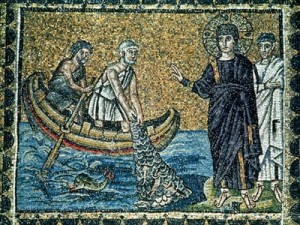
As Jesus passed along the Sea of Galilee, he saw Simon and his brother Andrew casting a net into the lake — for they were fishermen. And Jesus said to them, “Follow me and I will make you fish for people.” And immediately they left their nets and followed him. As he went a little farther, he saw James son of Zebedee and his brother John, who were in their boat mending the nets. Immediately he called them; and they left their father Zebedee in the boat with the hired men, and followed him.

(From the Daily Office Lectionary – Mark 1:16-20 (NRSV) – January 15, 2013.)

Mosaic, Sant'Apollinare Nuovo, Ravenna, Italy“I don’t know if this story happened, but I know it is true.” One of my favorite stories begins this way. The Gospel accounts do not, but they could . . . .

One of the things critics of Christianity like to point out is the inconsistency one finds in the gospel accounts of the various events they report. It cannot be denied that the stories of the calling of the initial disciples are contradictory. Mark’s is believed to be the earliest gospel and, therefore, one can assume the one written closest in time to the events described, but even it was probably written about sixty years after this event on the shore of Lake Galilee. Matthew relates the story similarly, but in Luke’s account Jesus first uses Simon Peter’s boat as a place from which to preach to crowds on the shore. Afterward, he tells Simon where to fish for a large catch and Simon actually tells Jesus to leave him because he, Simon, is a sinful human being; Andrew is never mentioned. John’s Gospel tells a very different story in which Andrew, described as a follower of the Baptizer, first encounters Jesus and then a day later introduces Simon to him.

So the community of faith has these three rather different accounts of his initial followers’ encounter with Jesus and the critics find in this a reason to disbelieve them all. I always ask them if their extended families have any favorite stories that are told at family gatherings, you know, the “remember the time Crazy Uncle Harry . . . . ” sorts of tales. My family did. If you were to go to one of my family’s reunions, you’d probably hear that story told. You’d probably hear it told by several different people. And you’d probably hear it told in several different ways. And you’d walk away wondering if you’d actually heard the same story because the details are so widely and wildly different! That’s the way it is with oral transmission of family stories, particularly as they are told by those who weren’t present but have heard them from someone else who heard them from someone else who maybe heard them from someone who was actually there.

A few days ago I heard the author Phyllis Tickle make a distinction between believing that the Bible is actually true and believing that the Bible is factually true. Her contrast is catchier than my own – in Bible studies and in confirmation classes I tell my students to make a distinction between facticity and truth – but the point is the same. Stories may be true (actual) without being factual. We make the Bible and its various forms of literature into something they are not if we insist upon treating them as factually accurate, as though they were scientific history, a reporting of facts. They are not. Biblical literature is concerned with truth, not with fact. Facts are true, but truth is larger than a collection of facts. To insist that truth is only factual devalues beauty, love, the spirit, personal honor, all those things which cannot be scientifically verified.

Were Simon and Andrew, James and John disciples of Jesus? Yes. Were they called as Mark relates? I have no idea. Is there truth in Mark’s story of their being called? Of course there is. Mark wants us to understand and appreciate the urgency of their call, the immediacy of their response to the call, the nature of the ministry to which they were called. These are all matters of truth although Mark’s account may not be factual. We of the modern age with our scientific worldview need to set aside our infatuation with the factual and become passionate about the actual, to give up our lust for facts and fall deeply in love with truth.

I don’t know if this story happened, but I know that it is true . . . .

====================

A request to my readers: I’m trying to build the readership of this blog and I’d very much appreciate your help in doing so. If you find something here that is of value, please share it with others. If you are on Facebook, “like” the posts on your page so others can see them. If you are following me on Twitter, please “retweet” the notices of these meditations. If you have a blog of your own, please include mine in your links (a favor I will gladly reciprocate). Many thanks!

====================

Father Funston is the rector of St. Paul’s Episcopal Church, Medina, Ohio.

Emerging Does Not Mean Leaving Behind – From the Daily Office – January 14, 2013

From the Letter to the Ephesians:

In Christ we have also obtained an inheritance, having been destined according to the purpose of him who accomplishes all things according to his counsel and will, so that we, who were the first to set our hope on Christ, might live for the praise of his glory. In him you also, when you had heard the word of truth, the gospel of your salvation, and had believed in him, were marked with the seal of the promised Holy Spirit; this is the pledge of our inheritance towards redemption as God’s own people, to the praise of his glory.

(From the Daily Office Lectionary – Ephesians 1:11-14 (NRSV) – January 14, 2013.)

Hands Holding SeedlingAt the emergence Christianity conversation I took part in at St. Mary’s Cathedral in Memphis, Tennessee, this past weekend a distinction was made between “emergence Christianity” and “inherited Christianity”. Paul’s thesis that “in Christ we have obtained an inheritance” and that this inheritance is “redemption as God’s own people” has brought this to mind. (For the details of this movement and some of its history, the book to read is Emergence Christianity by Phyllis Tickle, who was the keynoter of this weekend’s conversation.)

The conclusion I have drawn from the Memphis Conversation is that “emergent” and “emerging” are essentially meaningless labels, other than that the former is a brand name for the Emergent Village and the latter might describe anything that can be associated with what contemporary historians are calling “The Great Emergence” (a way to describe the current upheaval in western society). If it’s an edgy praxis that somehow claims to be “Christian” and uses glitzy up-to-date technology, it can call itself “emergent” or “emerging” without regard to theological content. (Nadia Bolz-Weber referred to this when suggesting that a label that could be applied to her and to Mark Driscoll is a meaningless term.) There are so many things that claim to be “emergent” or “emerging” (from post-evangelical neo-pentacostalism to a post-theist deconstructed church that claims to be “Christian” without any of the marks of the church) that there really is no substance in these terms; they signify nothing.

Perhaps helpfully another participant has suggested that “Emergence does not modify Christianity. Emergence describes an era; Christianity describes a movement. Whether or not Christianity as we/I know it is modified in this new era remains to be seen.” That may be as far as we can currently go with defining this thing that is happening.

As for the “inherited church” and Paul’s reference to our heritage (with the Ephesians) as followers of Christ, I am struck again by the wisdom of my own Episcopal/Anglican tradition. In the 1880s the bishops of the Episcopal Church looked at the question of organic reunions of the various streams of post-Reformation Christianity and suggested there are really only four things on which Christians would need to be agree. The fourth was “the historic episcopate” which, being bishops, you can sort of understand them thinking important. I value to apostolic office of bishop, but I’m not sure it’s a necessity. The other three, though, really our what we, the “inherited church” offer as foundation for the experimentation in the faith that the “emergent” group is undertaking. What those bishops produced was called a “quadrilateral” and their four points were later affirmed by the gathered bishops of the Anglican Communion and is now referred to as The Chicago/Lambeth Quadrilateral. The substantive content of what the American bishops wrote is:

We do hereby affirm that the Christian unity . . .can be restored only by the return of all Christian communions to the principles of unity exemplified by the undivided Catholic Church during the first ages of its existence; which principles we believe to be the substantial deposit of Christian Faith and Order committed by Christ and his Apostles to the Church unto the end of the world, and therefore incapable of compromise or surrender by those who have been ordained to be its stewards and trustees for the common and equal benefit of all men.

As inherent parts of this sacred deposit, and therefore as essential to the restoration of unity among the divided branches of Christendom, we account the following, to wit:

1. The Holy Scriptures of the Old and New Testaments as the revealed Word of God.

2. The Nicene Creed as the sufficient statement of the Christian Faith.

3. The two Sacraments, — Baptism and the Supper of the Lord, — ministered with unfailing use of Christ’s words of institution and of the elements ordained by Him.

4. The Historic Episcopate, locally adapted in the methods of its administration to the varying needs of the nations and peoples called of God into the unity of His Church. (The Book of Common Prayer – 1979, page 877)

I am quite certain that some among the “emergent” or “emerging” church movement would reject this foundational deposit. I am also quite certain that without at least the first three (as I said, I’m not so certain about the necessity of bishops) the movement cannot be considered “Christian” nor would its embodiment be “church”. I think we can talk about these things critically (for instance, noting that the first does not require a belief in the literal factuality or inerrancy of Scripture, or that the third does not set out a specific theology of the Sacraments, but that both leave open the possibility of a wide variety of understandings). But I do not believe that we can abandon them.

I do not believe that “emerging” means “leaving behind.” It does not mean abandoning our inheritance.

====================

A request to my readers: I’m trying to build the readership of this blog and I’d very much appreciate your help in doing so. If you find something here that is of value, please share it with others. If you are on Facebook, “like” the posts on your page so others can see them. If you are following me on Twitter, please “retweet” the notices of these meditations. If you have a blog of your own, please include mine in your links (a favor I will gladly reciprocate). Many thanks!

====================

Father Funston is the rector of St. Paul’s Episcopal Church, Medina, Ohio.

More Than Lukewarm – From the Daily Office – January 12, 2012

From the Revelation to John of Patmos:

To the angel of the church in Laodicea write: The words of the Amen, the faithful and true witness, the origin of God’s creation: “I know your works; you are neither cold nor hot. I wish that you were either cold or hot. So, because you are lukewarm, and neither cold nor hot, I am about to spit you out of my mouth. For you say, ‘I am rich, I have prospered, and I need nothing.’ You do not realize that you are wretched, pitiable, poor, blind, and naked.”

(From the Daily Office Lectionary – Revelation 3:14-17 (NRSV) – January 12, 2013.)

Boiling WaterWell! Here we are . . . just a few days ago I mentioned this text in regard to another lectionary reading. I am attending a conference on “emerging Christianity” this week and this text (having come up in that meditation) has been on my mind. There are many among the participants in this conversation who are quite passionate about the “emerging church” movement; they are definitely not “lukewarm”.

How, I wonder, can this passion enliven the “inherited church” (as Phyllis Tickle calls the institutional church)? Can what is happening among the emergents inspire those of us who still value the traditional church? I hope so.

But there is much about the emergent experience about which I am lukewarm! During the “tweet” conversations that accompanied the presentations there was much dismissiveness expressed. There were comments about the “irrelevancy” of holy orders and of the Holy Sacraments. There is a participant who describes himself as “post-theist” and a panel presenter who suggested that the emergent church needed to abandon Christianity! There are inconsistencies such as following a speaker who argued for a new understanding of the atonement (abandoning the substitutionary penal theory) with a congregational song about Jesus “shedding his precious blood for my sins,” or the movement’s infatuation with ancient spiritual practices (chant, incense, candles) coupled with rejection of the ancient creeds. None of these things are true of emergents across the board (anymore than any particular practice of the inherited church is true across the board of all traditions) but encountering them in this conference leaves me . . . lukewarm.

There is much in this conference of value and there is much about the emergent church that gives me hope, but I am firmly convinced that there is just as much if not more of value in the traditions of the faith and in the treasure of the institutional church. Our task is not to abandon the past, but to turn up the heat in the present. We must be more than lukewarm. I hope the experiments of the emerging church can show us one way to do that.

====================

A request to my readers: I’m trying to build the readership of this blog and I’d very much appreciate your help in doing so. If you find something here that is of value, please share it with others. If you are on Facebook, “like” the posts on your page so others can see them. If you are following me on Twitter, please “retweet” the notices of these meditations. If you have a blog of your own, please include mine in your links (a favor I will gladly reciprocate). Many thanks!

====================

Father Funston is the rector of St. Paul’s Episcopal Church, Medina, Ohio.

Ready To Be Sought? – From the Daily Office – January 10, 2013

From the Prophet Isaiah:

I was ready to be sought out by those who did not ask,
to be found by those who did not seek me.
I said, “Here I am, here I am”,
to a nation that did not call on my name.
I held out my hands all day long
to a rebellious people,
who walk in a way that is not good,
following their own devices;
a people who provoke me
to my face continually,
sacrificing in gardens
and offering incense on bricks; . . . .

(From the Daily Office Lectionary – Isaiah 65:1-3 (NRSV) – January 10, 2013.)

Waiting Figure“I was ready to be sought . . . I said, ‘Here I am, here I am’.” Almost more than anything else in Scripture, these words speak to me of God as not just wanting but needing to be in relationship with creation. I have written elsewhere about my understanding of God as the God who communicates; here is the God who seems almost desperate to be in relationship with his people. God speaks and everything comes in to being; in the beginning was the Word. But what good is speaking, what good is a word, if no one hears it, no one answers it? “Here I am, here I am” seems like a plea to be heard, to be recognized, to be answered. But in our modern society, very few people seem to be answering. Many claim to be seeking, many claim to be “spiritual but not religious,” but few are finding God in the traditional faiths and faith communities.

Recently, I had a discussion with a colleague about the non-church-goers who are best described as “apatheists”. This word is a “mash-up” of the words “apathy” and either “theist” or “atheist”. It describes people for whom religious belief is a matter of indifference. It’s not that they disbelieve (a recent article suggested that 80% of apatheists believe there is a God) or that they acknowledge some doubt or lack of understanding of God (as an agnostic would); it’s that the simply don’t care! An acquaintance of mine who accepts the label “apatheist” has put it this way: “I wouldn’t live my life any differently whether there is a God or not. It makes no difference.”

I think this is the modern trend, even among churchgoers. Cultural indifference to religion of any form, a “take or leave it” attitude, is becoming, if not already, the norm in our society. Religion and religious activities are one on a long list of options, and for most people not near the top.

But God is ready to be sought; God stands there in our world saying, “Here I am, here I am.” God does this through the church (and, I believe, other religious institutions of many faith traditions). If God is waiting to be sought, if God is calling “Here I am, here I am,” and people are not seeking and not answering the call, whose fault is that? If God and religion have become a matter of indifference, we who are active leaders of society’s communities of faith must bear the responsibility for that.

Among the Daily Office readings in this season are the letters to the churches in the Book of Revelation, and though it is not today’s reading, I am reminded of the letter to the church in Laodicea: “I know your works; you are neither cold nor hot. I wish that you were either cold or hot. So, because you are lukewarm, and neither cold nor hot, I am about to spit you out of my mouth.” (Rev. 3:15-16) If people are lukewarm about religion, it is because we, the religious, have become lukewarm, worthy of nothing more than being spat out.

Isaiah presents God as not just wanting but needing to be in relationship with creation. God is ready to be sought and calls out clearly “Here I am, here I am.” But does the church?

====================

A request to my readers: I’m trying to build the readership of this blog and I’d very much appreciate your help in doing so. If you find something here that is of value, please share it with others. If you are on Facebook, “like” the posts on your page so others can see them. If you are following me on Twitter, please “retweet” the notices of these meditations. If you have a blog of your own, please include mine in your links (a favor I will gladly reciprocate). Many thanks!

====================

Father Funston is the rector of St. Paul’s Episcopal Church, Medina, Ohio.

« Older posts Newer posts »