Occasional thoughts of an Anglican Episcopal priest

Category: Church (Page 83 of 116)

We Are Better Than This – From the Daily Office – December 28, 2012

From the Prophet Isaiah:

Surely your waste and your desolate places
and your devastated land—
surely now you will be too crowded for your inhabitants,
and those who swallowed you up will be far away.
The children born in the time of your bereavement
will yet say in your hearing:
“The place is too crowded for me;
make room for me to settle.”
Then you will say in your heart,
“Who has borne me these?
I was bereaved and barren,
exiled and put away—
so who has reared these?
I was left all alone—
where then have these come from?”

(From the Daily Office Lectionary – Isaiah 49:19-21 (NRSV) – December 28, 2012.)
 
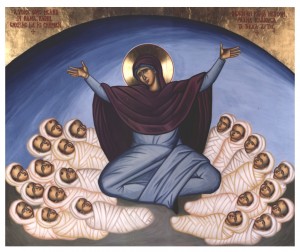
Holy Innocents IconToday is the Feast of the Holy Innocents and the Daily Office Lectionary again chooses lessons that underscore the day’s commemoration. In the midst of Christmas joy, we are reminded of the little children killed by Herod’s soldiers in the king’s attempt to do away with a perceived rival. I am not the first nor the only preacher or pastor to have thought of this story when, two weeks ago, gunman Adam Lanza opened fire at Sandy Hook Elementary School in Newtown, Connecticut. The wanton murder of children at any time makes the country where it occurs desolate and devastated. So today, again, we pray for the repose of the souls of those who died:

Charlotte Bacon, 6;
Daniel Barden, 7;
Olivia Engel, 6;
Josephine Gay, 7;
Ana M. Marquez-Greene, 6;
Dylan Hockley, 6;
Madeline F. Hsu, 6;
Catherine V Hubbard, 6;
Chase Kowalski, 7;
Jesse Lewis, 6;
James Mattioli, 6;
Grace McDonnell, 7;
Emile Parker, 6;
Jack Pinto, 6;
Noah Pozner, 6;
Caroline Previdi, 6;
Jessica Rekos, 6;
Avielle Richman, 6;
Benjamin Wheeler, 6;
Allison N. Wyatt, 6

Rachel Davino, 29;
Dawn Hocksprung, 47;
Anne Marie Murphy, 52
Lauren Russeau, 30;
Mary Sherlach, 56;
Victoria Soto, 27;

And, of course, also Nancy Lanza and Adam Lanza.

We pray for their souls, for comfort for their survivors, and for sanity in our land.

I just watched a public service announcement about our need for rational and reasonable regulation of gun and ammunition sales, gun ownership, and gun use. It includes the tag line, “We are better than this.” I pray God that the makers of the PSA are right, that we are better than this. We have to be. There are too many innocents dead.

====================

A request to my readers: I’m trying to build the readership of this blog and I’d very much appreciate your help in doing so. If you find something here that is of value, please share it with others. If you are on Facebook, “like” the posts on your page so others can see them. If you are following me on Twitter, please “retweet” the notices of these meditations. If you have a blog of your own, please include mine in your links (a favor I will gladly reciprocate). Many thanks!

====================

Father Funston is the rector of St. Paul’s Episcopal Church, Medina, Ohio.

There Is No Other Rock – From the Daily Office – December 27, 2012

From the Prophet Isaiah:

Thus says the Lord, the King of Israel
and his Redeemer, the Lord of hosts:
I am the first and I am the last;
besides me there is no god.
Who is like me? Let them proclaim it,
let them declare and set it forth before me.
Who has announced from of old the things to come?
Let them tell us what is yet to be.
Do not fear, or be afraid;
have I not told you from of old and declared it?
You are my witnesses!
Is there any god besides me?
There is no other rock; I know not one.

(From the Daily Office Lectionary – Isaiah 44:6-8 (NRSV) – December 27, 2012.)
 
Ruins of Masada Fortress in IsraelOn the third day of Christmas the church calendar directs our attention to St. John the Evangelist and, again, the Daily Office lectionary falls in line. John is the gospeller whose wonderful prologue serves as the Gospel lesson at the Eucharist on Christmas Day (1:1-14) and on the first Sunday after Christmas (1:1-18). It is for me a much more meaningful Gospel of the Incarnation than Luke’s sweet story of innkeepers, shepherds, angels, and the virgin birth: “In the beginning was the Word, and the Word was with God, and the Word was God.” (v. 1)

John’s prologue speaks to me of a God who communicates and through communication creates, redeems, and saves. It reminds us of the story of creation in Genesis: “God said . . . .” and everything came into being.

Isaiah’s prophecy in today’s evening reading, I’m sure, is meant to underscore this. Isaiah, speaking on God’s behalf, demands communication from other gods who would seek to supplant the Almighty: “Let them proclaim . . . let them declare . . . who has announced? . . . let them tell.” And God reminds us that God is a communicator: “Have I not told you from of old and declared it?” Our God is a God who communicates, who is in relationship with his people, who comes among them to speak and to listen. The other gods are nothing but mute idols.

Or, at least, in Isaiah’s time, they were. As I write these words my television happens to be on; others in the family are watching a morning talk show and there are advertisements sprinkled among the stories of post-Christmas sales, politics, and “the fiscal cliff”. The gods of greed and consumption are communicating most loudly; the objects of modern worship are promoting themselves wantonly.

But are they listening? Do these gods hear the cries of the poor and homeless? Do these gods listen to the moans of the hungry and the sick? Do these gods pay heed to the needs of those who have no resources, who cannot pay homage in their temples of commerce?

These are gods for whom communication is one-way. They tell of themselves and they expect their worshipers to come . . . come and buy, come and consume, come and be consumed. But they do not listen. Only God the Word, incarnate in that baby celebrated in Luke’s sweet story, “became flesh and lived among us” and listens to us. “There is no other rock; I know not one.”

====================

A request to my readers: I’m trying to build the readership of this blog and I’d very much appreciate your help in doing so. If you find something here that is of value, please share it with others. If you are on Facebook, “like” the posts on your page so others can see them. If you are following me on Twitter, please “retweet” the notices of these meditations. If you have a blog of your own, please include mine in your links (a favor I will gladly reciprocate). Many thanks!

====================

Father Funston is the rector of St. Paul’s Episcopal Church, Medina, Ohio.

We Are All Called to Martyrdom – From the Daily Office – December 26, 2012

From the Book of Acts:

While they were stoning Stephen, he prayed, “Lord Jesus, receive my spirit.” Then he knelt down and cried out in a loud voice, “Lord, do not hold this sin against them.” When he had said this, he died. And Saul approved of their killing him. That day a severe persecution began against the church in Jerusalem, and all except the apostles were scattered throughout the countryside of Judea and Samaria. Devout men buried Stephen and made loud lamentation over him. But Saul was ravaging the church by entering house after house; dragging off both men and women, he committed them to prison.

(From the Daily Office Lectionary – Acts 7:59-8:3 (NRSV) – December 26, 2012.)
 
Icon of Saint StephenOn the second day of Christmas the church remembers a murder, the martyrdom of Stephen, and our Daily Office lectionary won’t let us forget it. Often the readings of the Daily Office seem to have nothing to do with the season and they seldom are tied to a saint’s commemoration, but today the morning and evening readings tell the whole story in gruesome detail.

Stephen is revered as the church’s first martyr. The word martyr in Greek merely means “witness” but the church (and thus our modern society) uses it to mean someone who has suffered and died for their faith. The Celtic church would identify three kinds of martyrdom, only one of which involves death, so-called “red martyrdom.” The others were “green martyrdom” and “white martyrdom.”

The green martyrs were those who left ordinary society for the life of a hermit on the mountaintops or islands of Ireland following the example of the Egyptian anchorites. Eventually, they merged their individual dwellings into the monastic communities which dominated the Irish church from the 6th through 9th Centuries.

White martyrs went further. They left Ireland altogether as missionaries. The first of these were Columba and his followers who founded the monastery at Iona. Others following their example went into northern Europe and beyond.

The 2nd Century theologian Tertullian said that “the blood of the martyrs is the seed of the church.” This is usually understood to mean that through the sacrifice of their lives the “red martyrs” led others to conversion and, on this Feast of Stephen, we see the great example of that in the eventual conversion of Saul, the zealous Jewish persecutor of the church, into Paul, the equally-zealous Christian missionary. But it seems to me that the blood of the green martyrs and the white martyrs, which was not spilled but continued to course through their veins during a life of prayer and service, was equally effective in the conversion of others.

It is not so much the blood of the martyrs but, as the original Greek word says, the witness of the martyrs, the example and testimony of the martyrs of all sorts, red, green, and white, that nurtures the growth of the church. On this second day of Christmas, we should remember that, in some sense, we are all called to martyrdom; we are all called to witness to our faith in the Child whose birth we continue to celebrate.

====================

A request to my readers: I’m trying to build the readership of this blog and I’d very much appreciate your help in doing so. If you find something here that is of value, please share it with others. If you are on Facebook, “like” the posts on your page so others can see them. If you are following me on Twitter, please “retweet” the notices of these meditations. If you have a blog of your own, please include mine in your links (a favor I will gladly reciprocate). Many thanks!

====================

Father Funston is the rector of St. Paul’s Episcopal Church, Medina, Ohio.

Four Christmas Poems – Meditation for Christmas Day – December 25, 2012

====================

This meditation was offered on Christmas morning, December 25, 2012, at St. Paul’s Episcopal Church, Medina, Ohio, where Fr. Funston is rector.

(Revised Common Lectionary, Christmas, Proper Set III: Isaiah 52:7-10; Psalm 98; Hebrews 1:1-12; and John 1:1-14. These lessons can be read at The Lectionary Page.)

====================

Icon of the Nativity of Christ

Light Looked Down by Laurence Housman

Light looked down and beheld Darkness.
“Thither will I go,” said Light.
Peace looked down and beheld War.
“Thither will I go,” said Peace.
Love looked down and beheld Hatred.
“Thither will I go,” said Love.
So came Light and shone.
So came Peace and gave rest.
So came Love and brought life.
And the Word was made flesh and dwelt among us.

====================

====================

Praise for the Incarnation by John Newton

Sweeter sounds than music knows
Charm me in Immanuel’s name;
All her hopes my spirit owes
To his birth, and cross, and shame.

When he came, the angels sung,
“Glory be to God on high;”
Lord, unloose my stamm’ring tongue,
Who should louder sing than I?

Did the Lord a man become,
That he might the law fulfil,
Bleed and suffer in my room,
And canst thou, my tongue, be still?

No, I must my praises bring,
Though they worthless are and weak;
For should I refuse to sing,
Sure the very stones would speak.

O my Saviour, Shield, and Sun,
Shepherd, Brother, Husband, Friend,
Ev’ry precious name in one,
I will love thee without end.

====================

I Heard the Bells on Christmas Day by Henry Wadsworth Longfellow

I Heard the Bells on Christmas Day
Their old familiar carols play,
And wild and sweet the words repeat
Of peace on earth, good will to men.

I thought how, as the day had come,
The belfries of all Christendom
Had rolled along the unbroken song
Of peace on earth, good will to men.

And in despair I bowed my head:
“There is no peace on earth,” I said,
“For hate is strong and mocks the song
Of peace on earth, good will to men.”

Then pealed the bells more loud and deep:
“God is not dead, nor doth he sleep;
The wrong shall fail, the right prevail,
With peace on earth, good will to men.”

Till, ringing, singing, on its way,
The world revolved from night to day,
A voice, a chime, a chant sublime,
Of peace on earth, good will to men!

====================

On the Mystery of the Incarnation by Denise Levertov

It’s when we face for a moment
the worst our kind can do, and shudder to know
the taint in our own selves, that awe
cracks the mind’s shell and enters the heart:
not to a flower, not to a dolphin,
to no innocent form
but to this creature vainly sure
it and no other is god-like, God
(out of compassion for our ugly
failure to evolve) entrusts,
as guest, as brother,
the Word.

Today Is the Day! Well, Not Really – From the Daily Office – December 25, 2012

From the Prophet Zechariah:

Sing and rejoice, O daughter Zion! For lo, I will come and dwell in your midst, says the Lord. Many nations shall join themselves to the Lord on that day, and shall be my people; and I will dwell in your midst. And you shall know that the Lord of hosts has sent me to you. The Lord will inherit Judah as his portion in the holy land, and will again choose Jerusalem. Be silent, all people, before the Lord; for he has roused himself from his holy dwelling.

(From the Daily Office Lectionary – Zechariah 2:10-13 (NRSV) – December 25, 2012.)
 
Icon of the Nativity of ChristToday is the day! . . . . Well, not really. We don’t really know the date on which Jesus was born. In our ignorance, we Christians took over a pagan feast and made it our own. The feast of Sol Invictus became to feast of the Nativity. Celebrations of the birth of the conquering sun became the celebration of the birth of the conquering Son (a pun the only works in English).

Atheists and anti-religious types like to throw that fact in our faces and claim that Christianity is just a “made-up faith” (like all religions, they claim). Or, it used to suggest that Christianity is in someway “colonial”, taking over that which rightfully belongs to others. Or, the fact that many modern Christians do not know the history of the Christmas holiday becomes an indictment against all Christians as stupid and uninformed.

If you ask me, that is all a bunch of what my grandmother called pettifogging. The importance of this day lies not in its dating but in what it stands for. We don’t actually celebrate Jesus’ birthday; we celebrate the Nativity, the birth of God among us, the Incarnation of God in all times and in all places. We give thanks for God’s promise and God’s keeping God’s promise to come and dwell in our midst. It doesn’t matter on what particular day the Child in whom that was manifest was born. What matters is that he was born, not when. Before that reality silence and awe are the appropriate response, not pettifogging and bickering over calendars!

“How silently, how silently, the wondrous gift is given” wrote Episcopal priest Phillips Brooks in 1868 in the now popular carol O Little Town of Bethlehem. In it we sing this petition, “O holy Child of Bethlehem, descend to us, we pray; cast out our sin and enter in, be born to us today.” That is a prayer for everyday, not simply on this feast of Sol Invictus. Since we don’t know on what particular day Jesus was born, perhaps we should celebrate his birth on every day.

Everyday is the day!

====================

A request to my readers: I’m trying to build the readership of this blog and I’d very much appreciate your help in doing so. If you find something here that is of value, please share it with others. If you are on Facebook, “like” the posts on your page so others can see them. If you are following me on Twitter, please “retweet” the notices of these meditations. If you have a blog of your own, please include mine in your links (a favor I will gladly reciprocate). Many thanks!

====================

Father Funston is the rector of St. Paul’s Episcopal Church, Medina, Ohio.
Purify Our Conscience – Sermon for Advent 4, Year C – December 23, 2012

====================

This sermon was preached on Sunday, December 23, 2012, at St. Paul’s Episcopal Church, Medina, Ohio, where Fr. Funston is rector.

(Revised Common Lectionary, Advent 4, Year C: Micah 5:2-5a; Psalm 80:1-7; Hebrews 10:5-10; and Luke 1:39-55. These lessons can be read at The Lectionary Page.)

====================

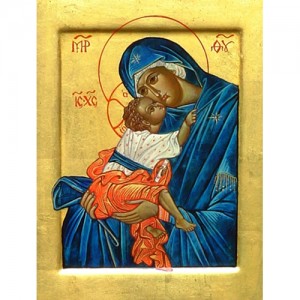
Orthodox Icon of the MadonnaI want to ask you to read along as I re-read the collect for the day, the particular prayer of the Fourth Sunday in Advent: “Purify our conscience . . . . ” That’s enough, just those three words: “Purify our conscience . . . . ” Don’t you think that’s asking a lot of God? I mean really . . . purify the human conscience, that place in ourselves where we know all the wrongs we have done. Tall order, purifying that! But that’s what the prayer asks and in doing so it draws on the language of the Letter to Hebrews from which our second lesson today is taken.

Our reading came from Chapter 10 of the letter, but what we heard is only small part of a longer section dealing with the efficacy of sacrifice, a section that begins in Chapter 9. There we read these words:

For if the blood of goats and bulls, with the sprinkling of the ashes of a heifer, sanctifies those who have been defiled so that their flesh is purified, how much more will the blood of Christ, who through the eternal Spirit offered himself without blemish to God, purify our conscience from dead works to worship the living God! For this reason he is the mediator of a new covenant . . . . (Heb. 9:13-15a)

But what is the conscience?

The dictionary tells us that the conscience is that “inner sense of what is right or wrong in one’s conduct or motives; the complex of ethical and moral principles that controls or inhibits the actions or thoughts of an individual.” (dictionary.com) Another definition comes from the devotional text My Utmost for His Highest compiled from the lectures of the British Baptist educator Oswald Chambers:

Conscience is that ability within me that attaches itself to the highest standard I know, and then continually reminds me of what that standard demands that I do. It is the eye of the soul which looks out either toward God or toward what we regard as the highest standard. This explains why conscience is different in different people. If I am in the habit of continually holding God’s standard in front of me, my conscience will always direct me to God’s perfect law and indicate what I should do. The question is, will I obey? I have to make an effort to keep my conscience so sensitive that I can live without any offense toward anyone. I should be living in such perfect harmony with God’s Son that the spirit of my mind is being renewed through every circumstance of life, and that I may be able to quickly “prove what is that good and acceptable and perfect will of God” (Romans 12:2 ; also see Ephesians 4:23).

So, then, our conscience is that sense within us which, if it is pure, directs us to do that which God asks of us. But note what our prayer asks of God . . . that the purification of our conscience has to happen everyday: “Purify our conscience, Almighty God, by your daily visitation . . . ” and then the prayer goes on to sound an Advent note ” . . . that your Son Jesus Christ, at his coming, may find in us a mansion prepared for himself.”

I was a great fan of Charles Schultz’s cartoon Peanuts. I recall a Sunday installment in Lucy and Charlie Brown were talking about cruise ships. Lucy was holding forth giving, as she was wont to do, her unflappable opinion: “You know,” she says to Charlie Brown, “there are two kinds of people who go on cruise ships. There are some people who face their deck chairs toward the stern so that they can see where they have been, and there are others who face their deck chairs toward the bow so that they can see where they are going. Now,” she asks Charlie Brown, “on the great cruise ship of your life, how do you face your deck chair?” Charlie Brown thinks for a moment, then says, “I can’t get mine unfolded!”

Focusing our conscience like “the eye of the soul,” as Chambers said, so that it looks outward toward God whom we beseech to purify it daily, is like getting our deck chair unfolded and faced toward the bow of the ship so we can see where we’re going, so that we are prepared for Jesus. I think that’s really what today’s Psalm is all about, too, especially the refrain that is repeated twice in the portion we read and is repeated again in the whole Psalm: “Restore us, O God of hosts; show the light of your countenance, and we shall be saved.” Purify our conscience so that we are prepared for our savior, for Jesus.

The great example of that preparation is the virgin Mary. Her trip to the hill country of Judea about which we heard in today’s Gospel lesson took place almost immediately after the angel Gabriel had visited her to inform her that she would be the mother of the savior. Her willing response to that news, of course, was, “Here am I, the servant of the Lord; let it be with me according to your word.” (Luke 1:38) If we are honest in our prayer that God purify our consciences each day, then we must be willing to follow Mary’s example and accept whatever God wills for us; when God makes God’s daily visitation to us, our response must echo hers, “Let it be with me according to your word.”

The German medieval mystical theologian put it this way: “We are all meant to be mothers of God. What good is it to me if this eternal birth of the divine Son takes place increasingly, but does not take place within myself? And, what good is it to me if Mary is full of grace if I am not also full of grace? What good is it to me for the Creator to give birth to his Son if I do not also give birth to him in my time and my culture? This, then, is the fullness of time: When the Son of Man is begotten in us.”

So it is that we pray today, “Purify our conscience, Almighty God, by your daily visitation,” that we like Mary may be bearers of the Eternal Word. Amen.

False Teachings and Guns – From the Daily Office – December 22, 2012

From the Letter of Jude:

You, beloved, must remember the predictions of the apostles of our Lord Jesus Christ; for they said to you, “In the last time there will be scoffers, indulging their own ungodly lusts.” It is these worldly people, devoid of the Spirit, who are causing divisions. But you, beloved, build yourselves up on your most holy faith; pray in the Holy Spirit; keep yourselves in the love of God; look forward to the mercy of our Lord Jesus Christ that leads to eternal life. And have mercy on some who are wavering; save others by snatching them out of the fire; and have mercy on still others with fear, hating even the tunic defiled by their bodies

(From the Daily Office Lectionary – Jude 1:17-23 (NRSV) – December 22, 2012.)

Glory in the SkySort of buried in Jude’s moralizing about false teachers and those who follow them is an Advent message: “Look forward to the mercy of our Lord Jesus Christ that leads to eternal life.” As I’ve been saying pretty consistently throughout the season, here and in my sermons, Advent is not so much about celebrating the birth of Jesus, wherever it was and whenever it was about 2,000 years ago, as it is about getting ready for his return, the parousia as seminary-educated folks like to say.

It’s kind of humorous that Jude’s letter with its warning about “worldly people, devoid of the Spirit, who are causing divisions” and others for whom we are to have mercy mixed with fear “hating even the tunic defiled by their bodies” should come up today. Yesterday, a lot of those very people were running around convinced the world was going to end because of the Mayan long calendar. It didn’t, we and they are still here . . . and don’t they have egg on their faces (or defilement on their tunics, as Jude might have said).

It is humorous, but it’s also a warning to us that Jude was right. We can be led astray by false and outlandish teachings. In the days since the tragedy in Newtown, Connecticut, there have been a lot of people saying a lot of things, some of which I agree with and some of which I don’t. And some who should know better have been saying things about the use of violence to curb violence. Even before the NRA’s spokesman yesterday suggested putting armed guards in every school (an idea I find repugnant), I heard Christian clergy suggest the same thing, or some variation on it (such as arming our school teachers).

I don’t want to get into the politics of gun control or the history and meaning of the U.S. Constitution’s Second Amendment. (Well . . . I do, but not here.) What I do want to suggest is that those clergy are not building themselves or other church members up on our most holy faith; I suggest that their teaching is false. As I understand the Christian faith, it is not about meeting violence with violence. The One whom we name “Prince of Peace” gave these instructions to his followers: “Love your enemies, do good to those who hate you, bless those who curse you, pray for those who abuse you. If anyone strikes you on the cheek, offer the other also; and from anyone who takes away your coat do not withhold even your shirt. Give to everyone who begs from you; and if anyone takes away your goods, do not ask for them again. Do to others as you would have them do to you.” (Luke 6:27-31) No matter how much I try, I cannot make those admonitions into any sort of support for taking up guns, for arming teachers, for adding to the surfeit of firearms already present in our culture.

Every Sunday, I end the Mass with these words from my parish’s patron saint: “Rejoice in hope, be patient in suffering, persevere in prayer. Bless those who persecute you; bless and do not curse them. Rejoice with those who rejoice, weep with those who weep. Live in harmony with one another; do not be haughty, but associate with the lowly; do not claim to be wiser than you are. Do not repay anyone evil for evil, but take thought for what is noble in the sight of all. If it is possible, so far as it depends on you, live peaceably with all. Do not be overcome by evil, but overcome evil with good.” (Romans 12:12,14-18,21)

So far as it depends on me to live peaceably with all, the one thing I cannot do is arm myself nor recommend that others be armed nor countenance those recommendations from others. The words I leave out of Paul’s encouragements to the Christians in Rome include these: “Beloved, never avenge yourselves, but leave room for the wrath of God; for it is written, ‘Vengeance is mine, I will repay, says the Lord.’ No, ‘if your enemies are hungry, feed them; if they are thirsty, give them something to drink; for by doing this you will heap burning coals on their heads.’” (Rom. 12:19-20) I cannot guarantee that I will never avenge myself, but I can take a step in that direction by not preparing in advance to do so.

I know that I have friends and parishioners who disagree with me and with our church’s official teaching on this point (which is in favor of strict gun regulation). I believe they are wrong, but I know they hold their views for what they believe to be good reasons. I can only hope they know the same of me and that we can come to some consensus in our country that honors all points of view and that, at the end of it all, at the parousia we will all “stand without blemish in the presence of God’s glory with rejoicing.” (Jude 1:24)

====================

A request to my readers: I’m trying to build the readership of this blog and I’d very much appreciate your help in doing so. If you find something here that is of value, please share it with others. If you are on Facebook, “like” the posts on your page so others can see them. If you are following me on Twitter, please “retweet” the notices of these meditations. If you have a blog of your own, please include mine in your links (a favor I will gladly reciprocate). Many thanks!

====================

Father Funston is the rector of St. Paul’s Episcopal Church, Medina, Ohio.

The World Didn’t End Today – From the Daily Office – December 21, 2012

From the Prophet Isaiah:

Therefore the Sovereign, the Lord of hosts,
will send wasting sickness among his stout warriors,
and under his glory a burning will be kindled,
like the burning of fire.
The light of Israel will become a fire,
and his Holy One a flame;
and it will burn and devour
his thorns and briers in one day.
The glory of his forest and his fruitful land
the Lord will destroy, both soul and body,
and it will be as when an invalid wastes away.
The remnant of the trees of his forest will be so few
that a child can write them down.

(From the Daily Office Lectionary – Isaiah 10:16-19 (NRSV) – December 21, 2012.)
 
The End of the World ImaginedThe world was supposed to end today. I slept in in hopes it would be gone before I got out of bed . . . but alas, it is still here and there are still laundry to be done and a dog who needs a bath and Christmas meals to be shopped for and sermons to be written.

I jest, of course. I didn’t really think the world would end. I had no faith in doomsday predictions based on a misunderstanding of the Mayan long calendar, any more than I believe the world will be destroyed by a collision with the invisible planet Nibiru. But having said that, I’m left open to this big, gaping question: Why, then, do I believe Isaiah? It’s a legitimate question – why believe one prophecy and not another?

The answer really boils down to what we mean by “prophecy”. The Mayan “prophecy” really wasn’t a prophecy at all, just the end of a calendar. The Mayans divided time into eras called “baktuns”. Based solely on mathematics and observation of the movement of celestial bodies, the so-called “long calendar” laid out the calculations for the length of the 13th Baktun, which ended today. The long calendar doesn’t say, in any way, that creation would also end; the rational implication of the long calendar is that the 14th Baktun would begin, but that’s not the way the nuttier folk among us took it.

The Nibiru “prophecy” is based on even less observable reality than the Mayan long calendar. It comes from the tortured and demonstrably inaccurate translations of ancient Babylonian and Sumerian texts by one Zecharia Sitchin, a proponent of the idea of “ancient astronauts”. The idea is that there is an invisible planet called “Nibiru” which circles through our solar system every 3,600 years and will eventually collide with Earth. The date of the collision has been recalculated and changed on several occasions.

This is what differentiates the Hebrew prophecies like Isaiah’s from the Mayan, Nibiru, and similar prophecies. The former are not based on mathematical calculations; the latter are. The former give voice to a moral sense of history; the latter give voice to a mechanistic model of the universe.

Isaiah and the other Hebrew prophets were not simply, nor even primarily, predicters of the future; they were historians, moralists, social critics, spokesmen for God. In general, one can outline a Hebrew prophet’s pronouncement sort of like this:

(a) In the past the People of God or their leaders or their enemies behaved in this manner.

(b) God responded to this behavior in this way. From this we know that . . .

(c) if the People of God or their leaders or their enemies continue to act as they currently are . . .

(d) then God will respond to this behavior in a similar way. On the other hand . . .

(e) if the People of God or their leaders or their enemies change their behavior . . .

(f) then God will change God’s mind and respond differently.

In other words, the prophecies of the Hebrew seers are conditional upon the moral behavior of human beings and a belief that the Creator of the universe also behaves in a moral way. I’ve heard it said that the role of a Hebrew prophet is not “foretelling” (predicting the future) but “forth telling” (speaking the word of God to God’s People in their time and place).

The Mayan calendar and the Nibiru prophecy are amoral; they simply assert that heavenly bodies (real or imagined) behave in certain ways and will continue to do so without regard to human or divine behavior. If they predict disaster (and it is by no means clear that they do – obviously the Mayan calendar did not), there is nothing anybody can do about it. And knowing about it offers us no moral guidance.The prophecies of Isaiah and other Hebrew prophets, on the other hand, are of a different sort. They provide us the same guidance they provided their original audiences: “God has dealt thusly with God’s People in the past; we can expect God to deal similarly with us; how, then, should we act?” Our specific reading today, a part of a pronouncement against the king of Assyria and in consolation to the People of Israel, is a reminder of the corrupting influence of political power and the dangers of political arrogance, a lesson we and our own leaders should often remember.

From the Mayan long calender we learn nothing of moral guidance; from the Nibiru prophecy we learn nothing except that poor scholarship produces ridiculous nonsense; from the prophecy of Isaiah, however, we learn that human political authority has its limits. This is why I trust in the prophecies of the Hebrew prophets, but not predictions of “the Mayan apocalypse.”

On the First Sunday of Advent this year, the Gospel lesson at the Holy Eucharist (Luke 21:25-36) included Jesus’ warning that before the end of time there would be “distress among nations” and that “people will faint from fear and foreboding.” These are much more important than “signs in the sun, the moon, and the stars,” though there may be those, as well. As Advent ends, let us pray for less distress, less fear, less foreboding, less political arrogance, less corruption . . . and let us give thanks that the world didn’t end today, even though we didn’t really think it would.

====================

A request to my readers: I’m trying to build the readership of this blog and I’d very much appreciate your help in doing so. If you find something here that is of value, please share it with others. If you are on Facebook, “like” the posts on your page so others can see them. If you are following me on Twitter, please “retweet” the notices of these meditations. If you have a blog of your own, please include mine in your links (a favor I will gladly reciprocate). Many thanks!

====================

Father Funston is the rector of St. Paul’s Episcopal Church, Medina, Ohio.

Advent Exclamations of Disappointment – From the Daily Office – December 20, 2012

From the Prophet Isaiah:

Ah, you who make iniquitous decrees,
who write oppressive statutes,
to turn aside the needy from justice
and to rob the poor of my people of their right,
that widows may be your spoil,
and that you may make the orphans your prey!
What will you do on the day of punishment,
in the calamity that will come from far away?

(From the Daily Office Lectionary – Isaiah 10:1-3a (NRSV) – December 20, 2012.)
 
Lonely Old WomanThe first word of this bit of Isaiah in Hebrew is often translated “Woe” but here in the New Revised Standard Version, it has been rendered “Ah”. The Hebrew is hôy ; it is a negative exclamation pronounced “oy!” Perhaps the “woe” translation is better. However, the construction “woe to you . . . . ” has taken on an oracular connotation to modern ears and that is not what the prophet is saying here. He will later make prediction about these oppressors, but for now he is simply making an indictment.

It is an indictment against the leaders of his own community. This is not a part of the prophet’s writings in which international politics play any part whatsoever; this is a complaint against his own people.

Whenever I read the prophets’ writings and they begin a statement with this Hebrew word hôy, I often wonder what tone of voice to use. I got a clue recently while talking to a Jewish friend.

My friend is a 75-year-old woman. She may be the only Jew in my small town; she claims to be but I don’t think she is. A couple of weeks ago, my friend and I were together with some other people at a luncheon. We were talking about the current “fiscal cliff” nonsense and the issue of whether Social Security and Medicare would be cut or otherwise changed. “Oy vey!” she said, “They’re going to rob us of our pensions!” She said it in that Jewish grandmother caricaturish voice that Jon Stewart sometimes mimics on his Daily Show television program.

I don’t know if the Hebrew word hôy is the origin of the Yiddish expression, “Oy vey!” But when I read this passage today, my friend’s comment and her tone of voice came immediately to mind. Think of Jon Stewart’s caricature, think of the cartoon character Zoidberg on Futurama, think of the character Howard Wolowitz’s never-seen mother on The Big Bang Theory, think of Judd Hirsch’s portrayal of Jeff Goldblum’s father in the movie Independence Day. Read Isaiah’s words in that tone of voice . . . a tone of exasperated disappointment, of deeply negative resignation, of an anger that can only be uttered in sorrow.

Last Friday the terrible tragedy at Sandy Hook Elementary School took place and in my sermon on Sunday (posted elsewhere on this blog) I said that I’d had a vision of unwrapped Christmas presents sitting under unlighted Christmas trees in darkened rooms. Today, similarly, I have a vision of the lonely elderly, the widowed sitting alone beside ancient menorahs or in rooms with a few tattered Christmas decorations. I know they are out there; I’ve visited them, as I know my colleagues in ordained ministry have all done. As Advent comes to a close this week and we put up our Christmas decorations (if they are not already up) and make our final preparations for Christmas, Isaiah’s prophecy reminds us of the plight of the elderly poor. They have been around a long long time . . . and so, apparently, have the political leaders “who make iniquitous decrees [and] write oppressive statutes.”

This Advent, this Christmas, and in the coming year . . . perhaps we should do more than simply utter exclamations of exasperated disappointment.

====================

A request to my readers: I’m trying to build the readership of this blog and I’d very much appreciate your help in doing so. If you find something here that is of value, please share it with others. If you are on Facebook, “like” the posts on your page so others can see them. If you are following me on Twitter, please “retweet” the notices of these meditations. If you have a blog of your own, please include mine in your links (a favor I will gladly reciprocate). Many thanks!

====================

Father Funston is the rector of St. Paul’s Episcopal Church, Medina, Ohio.

Defining God, or Not . . . . – From the Daily Office – December 19, 2012

From the Psalter:

The fool has said in his heart, “There is no God.”
All are corrupt and commit abominable acts;
there is none who does any good.
God looks down from heaven upon us all,
to see if there is any who is wise,
if there is one who seeks after God.
Every one has proved faithless;
all alike have turned bad;
there is none who does good; no, not one.

(From the Daily Office Lectionary – Psalm 53:1-3 (BCP 1979 Version) – December 19, 2012.)
 
God as envisioned by MichelangeloRecently, following the tragedy in Newtown, Connecticut, a bunch of Christian “leaders” (Mike Huckabee, James Dobson, Bryan Fisher, to name a few) have basically said, “God has been taken out of the schools,” or “God has been taken out of our society,” or some variation on this theme. This, they say is, the reason the shooting at Sandy Hook Elementary School took place. Because of God’s supposed absence (voluntary on God’s part, it would seem) the horror took place. They seek to blame those who have “put God out,” but the way they make this argument really places the responsibility on God who apparently made the decision to stay away; either that or they are describing a God who is powerless in the face of some alleged official refusal to “allow God in” because our Constitution prohibits state-prescribed sectarian prayer in the schools.

Their alternative theory seems to be that because America now condones some sort of behavior to which these so-called “ministers” object (marriage equality, for example), or disallows some behavior they would champion (that state-sponsored school prayer, for example) God is punishing us. They seem to believe that God shares their judgement and is acting upon it . . . by killing children.

If any of this is true about God then I am in the class of fools who have said in their hearts, “There is no God” because I sure don’t believe in a God of the sort they seem to be describing.

But then, to be honest, I’m finding myself not believing in a lot of the Gods various people have described over the years. I read the atheist arguments of folks like scientist Richard Dawkins or the late journalist Christopher Hitchens; when I read their descriptions of God, I think “I don’t believe in that God, either.”

Recently, I’ve been thumbing through an old theology book, one that I think got me through my General Ordination Exam almost single-handedly (if that description can be applied to a book). It is Theological Outlines by Francis J. Hall (Morehouse-Barlow:1933). I found this description of God in the section on Divine Perfection:

By virtue of His infinite perfection, God is self-sufficient. Nothing is wanting to His essence which is needed for His blessedness. Neither His knowledge, nor His will, nor His love, depend upon the existence of the creature, but have sufficient scope for their activity in the eternal relations subsisting between the Persons of the Trinity. Creation is an act of the Divine will, not the result of necessity.

I read that and (guess what?) thought, “I don’t believe in that God!” I don’t believe in a God that has no need of God’s creation. I don’t believe in a God whose love has “sufficient scope for [its] activity” in God alone. The God I believe in wants to be in relationship with God’s creation! The God I believe in not only “looks down from heaven upon us all;” the God I believe in became one of us! The God I believe in was and is incarnate in Jesus Christ, lived in First Century Palestine, was crucified, died, was buried, and ascended to heaven, and yet is with us always, even to the end of the age. (Matt. 28:20) That is not a God in whom “nothing is wanting;” that is a God who wants to be with his creatures, with us!

That, I believe, is a God who wants to know, who lovingly hopes to know “if there is one who seeks after God.” That, I believe, is a God who, finding instead “ministers” like Huckabee who portray him as powerless or Dobson who make God into some kind of child-killing monster, finding atheists who make God into a caricature that no one actually accepts, finding theologians who describe God as some sort of theoretical philosophical construct with no needs, probably does conclude that “every one has proved faithless.”

Maybe as Christmas gets closer and Advent draws to an end, as we celebrate the birth of the God incarnate in Jesus, as we anticipate his return . . . maybe we could stop trying to define God and start trying to relate to God? Maybe we could turn our attention from describing God and instead simply try to do good? Let’s leave defining God up to God.

====================

A request to my readers: I’m trying to build the readership of this blog and I’d very much appreciate your help in doing so. If you find something here that is of value, please share it with others. If you are on Facebook, “like” the posts on your page so others can see them. If you are following me on Twitter, please “retweet” the notices of these meditations. If you have a blog of your own, please include mine in your links (a favor I will gladly reciprocate). Many thanks!

====================

Father Funston is the rector of St. Paul’s Episcopal Church, Medina, Ohio.

« Older posts Newer posts »