From John’s Gospel:
Now Gideon had seventy sons, his own offspring, for he had many wives. His concubine who was in Shechem also bore him a son, and he named him Abimelech. Then Gideon son of Joash died at a good old age, and was buried in the tomb of his father Joash at Ophrah of the Abiezrites.
(From the Daily Office Lectionary – Judges 8:30-32 – August 9, 2012)
 OK. I know I shouldn’t get into this . . . I know that someone is going to give me a hard time; I can almost predict that someone will tell me they are planning to “leave the church” over this. But here goes.
I am sick and tired of hearing the words “traditional biblical marriage” bandied about by those who oppose the legal and religious recognition of the committed relationships of same-sex couples. Absolutely fed up with it. Because there is no such thing! Read these three verses from the Book of Judges slowly and carefully because they describe the marriage (or should one say marriages . . . or perhaps “sexual relations”) of one of the greatest heroes of the Bible. And what they describe is a far cry from what the proponents of so-called “traditional biblical marriage” think they are talking about about; Gideon was very definitely not in a “one man, one woman” marriage. The text doesn’t tell us how many wives he had, but with seventy sons I would estimated that he had at least fifteen if not a lot more! And he had at least one concubine! It’s entirely possible that he married his wives as part of some political arrangement with their families or tribes, and that it was his concubine who was his actual love interest.
I need not rehearse here the variety of marital arrangements one finds in the Holy Scriptures. Esther J. Hamori, Associate Professor of Hebrew Bible at Union Theological Seminary has already done a superb job of that in an article for the Huffington Post, Biblical Standards for Marriage. Suffice to say that there are all sorts of culturally conditioned settlements . . . and that’s the significant point, “culturally conditioned”. Our Bible does not and never has set down one sort of standard (for interpersonal relationships or for most other things) that is immutable and permanent; the Bible is a collection of stories of changing norms of behavior stretching over centuries. These changeable and changing behavioral norms may be grounded in a set of ethical or religious principles, but they adapt as cultures and conditions change.
I should also note, but will not dwell upon, the history of marriage (or “matrimony”) as a sacrament of the church. It wasn’t one for about the first millennium of the Christian era! The church wasn’t involved in overseeing marriages at all, but as the clergy became society’s record-keepers, and as the rising post-Empire royalty and aristocracy needed some control on the descent of property and titles, the church became involved. Initially it was only as record-keepers, but then ceremonies and rituals were devised and then, eventually, someone began theologizing about the marital estate and the church’s role in helping it be contracted . . . and, before you know it, Voila! It’s a Sacrament . . . and it’s “always” been one. And, of course, it is now incumbent upon all of society, not just the upper crust, to have church-approved marriages.
We live in a different world from Gideon, so fifteen wives and one or more concubines probably probably would not be an acceptable (or practical) living arrangement for a modern man. We live in a different world from medieval Europe. Marriage is no longer (usually) a political arrangement as it generally was in both those times; today, our concept of marriage honors the emotional attachment of the parties. Today, we know that that emotional attachment, that affective attraction is not universally a heterosexual one; we know that some definite percentage of the human species is affectively attracted to members of their same sex. We know that this is not a deviation from the norm; it is the norm. And knowing that, our culture is changing and the culturally conditioned normative behavior of marriage is changing with it.
The task ahead for religious people is not to insist upon enforcing as unchangeable the cultural norms of a long-departed world like Gideon’s. The task is, rather, to re-apply the underlying ethical and religious principles to our new situation. For Christians, this means looking to the two greatest commandments as stated by Jesus: Love God with all your heart, all your mind, and all your strength, and love your neighbor as yourself. (Matt. 22:37-40) Given that, how can we not re-assess our understanding of marriage? How can we not extend our blessing to the committed relationships of same-sex couples? How can we not give up some false notion of “traditional biblical marriage” and instead embrace Christ’s ethic of loving God and loving our neighbor?
====================
Father Funston in the rector of St. Paul’s Episcopal Church, Medina, Ohio.
 Just a few days ago the Public Religion Research Institute issued a new report entitled A Generation in Transition: Religion, Values, and Politics among College-Age Millennials. A “millennial” is somone currently 18 to 24 years of age, the youngest cohort of adults. (From my point of view at nearly 60 years of age these are children; my son and daughter are both older than this group!) According to the report, these young adults are more likely then the general population to be religiously unaffiliated; one-quarter of them so identify themselves. Interestingly, most of those who do so were reared in religiously affiliated households. The greatest movement away from religious affiliation was seen among those raised in Catholic and white mainline Protestant families. It would appear that we have not been doing a very good job of teaching our children “that they in their turn might tell it to their children”!
 Reading these oh-so-familiar words in the introduction to John’s Gospel, I remember other words I read on another blog yesterday:
 It is intriguing how often in stories of Holy Scripture food plays a role. From the “apple” in the Garden, to Abraham offering a meal of cakes and meat to the three men (who turn out to God) at the Oaks of Mamre, to this story of Gideon, to David and his men eating the Bread of the Presence, to all the food items listed as items of sacrifice in Leviticus, the Old Testament (indeed, the whole Bible) is food focused. The People of God define themselves through the annual reenactment of a ritual meal celebrating the Passover; the new People of God define themselves (in my tradition and others) by the weekly reenactment of a ritual meal celebrating the death and Resurrection of Christ and anticipating his return. It’s intriguing but not surprising. The Jewish and Christian faiths are not, in the long run, about following rules of ritual or moral conduct; they are about being in an intimate relationship with that which is the source of being, that which we call “God” and address as “Father” or brother or redeemer. And, other than sex, there is probably no more intimate activity two or more people can share than eating together.
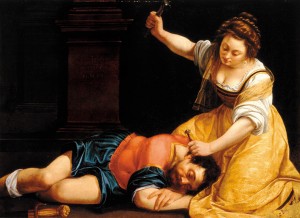 “Most blessed” be a murderess? What is this? Yesterday, a friend and colleague who was only a little older than I am passed away after several months of pancreatic cancer, so I’m a little sensitive on the subject of death this morning. So, really! What is this?
  These are the words spoken by the great crowd of Jews and others who thronged the streets of Jerusalem for the Festival of Shavu’ot when the Twelve, empowered by the Holy Spirit, begin to tell the story of Jesus in languages they had never before spoken. Shavu’ot is a celebration with both agricultural and historical significance in Judaism. It is known as the “festival of the first fruits,” a harvest feast when the first fruits were brought as offerings to the Temple; it is also known as the “festival of the giving of the Law,” a celebration of the handing down of Torah on Mt. Sinai. It was called Pentecost, a Greek word meaning “fiftieth”, because it always falls on the fiftieth day after the Passover. That year it fell on the fiftieth day after the Resurrection and, thus, the Christian feast of the Holy Spirit carries that name, as well.
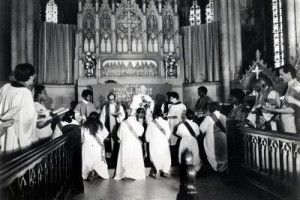 This past Sunday, the Episcopal Church marked the 28th anniversary of the women known as “the Philadelphia Eleven” who were ordained on July 29, 1974. Four retired bishops (Daniel Corrigan, Robert DeWitt, Edward Welles and George Barrett) chose to defy the General Convention of the Episcopal Church which, at its regular triennial meeting in 1973, had voted against opening the priesthood to women; women were already eligible for ordination as deacons. Joined by male presbyters who supported them and the candidates, they ordained eleven women deacons to the priesthood: Merrill Bittner, Alla Bozarth-Campbell, Alison Cheek, Emily Hewitt, Carter Heyward, Suzanne Hiatt, Marie Moorefield Fleisher, Jeannette Piccard, Betty Bone Schiess, Katrina Martha Swanson, and Nancy Hatch Wittig. Shortly thereafter, four additional women were also “irregularly” ordained: Eleanor Lee McGee, Alison Palmer, Betty Powell, and Diane Tickell. A firestorm of controversy erupted in the church: charges were filed against these dissident bishops (Daniel Corrigan, Robert DeWitt, Edward Welles and George Barrett) and an emergency meeting of the Episcopal House of Bishops was convened on August 15, 1974.
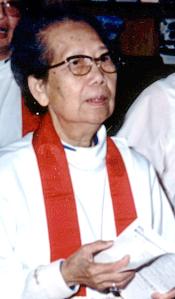 These women were not the first to be ordained to the Anglican priesthood, however. During the Second World War, Florence Li Tim-Oi was ordained to the presbyterate on January 25, 1944, by the Rt. Rev. Ronald Hall, Bishop of Hong Kong, in response to the crisis among Anglican Christians in China caused by the Japanese invasion. No male clergy could be found who were willing to take on the onerous ministry, but Ms. Li was, so she was ordained and served with distinction. After the war, the Archbishop of Canterbury sought to make the bishop and the priest rescind the ordination, but neither did. Ms. Li voluntarily ceased serving as a priest until more than 30 years later when she immigrated to Canada where the Anglican Church, following the Episcopal Church’s lead, had begun to ordain women. Her priesthood was recognized and she served as an honorary canon in Toronto, ministering among the immigrant Chinese population.
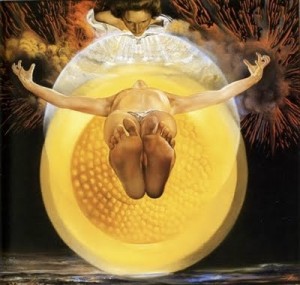 Have you ever done that thing on a public street corner where a couple of people stand there looking up and pretty soon some passing pedestrian, wondering what they are gazing at, will stop and look up, and then another and then another and so on until a lot of people are looking up into the sky at nothing for no reason? I have an image of that in my mind when I read the this passage, although in this case the “men of Galilee” are not looking at nothing for no reason. They are looking at something they can no longer see, except in their minds’ eye, and it is certainly not “for no reason” that they are doing so. Something phenomenal has happened to them; someone they thought had been killed by the authorities had returned from the dead, had eaten with them, talked with them, appeared to them over the course of over seven weeks, and now he had “ascended into heaven.” They had plenty of reason to stand there staring into the sky into which he had apparently gone.


