Occasional thoughts of an Anglican Episcopal priest

Category: Easter (Page 4 of 5)

Enter Into Resurrection: Sermon for Easter Sunday 2015

====================

A sermon offered on Resurrection Sunday, April 5, 2015, to the people of St. Paul’s Episcopal Church, Medina, Ohio, where Fr. Funston is rector.

(The lessons for the day are Isaiah 25:6-9; Psalm 118:1-2, 14-24; 1 Corinthians 15:1-11 and Mark 16:1-8. These lessons can be read at The Lectionary Page.)

====================
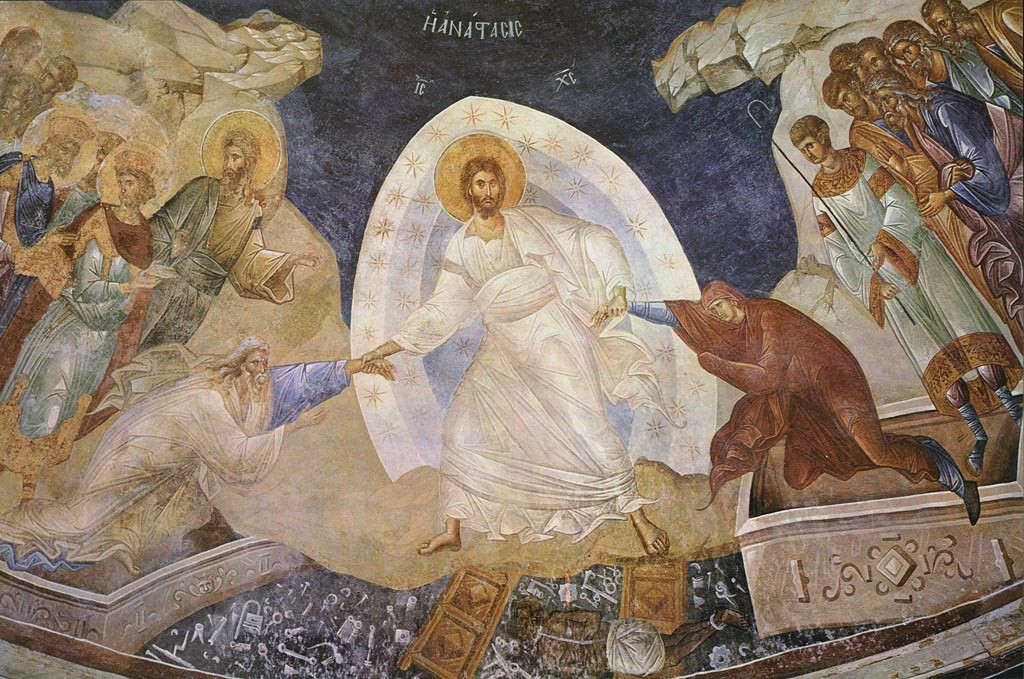
Anastasis Icon at Chora

I love poetry. There is something about the way poets describe the world that simply cannot be found in other forms of literature. Poets encourage us not to understand the world, but to experience it; not to be concerned with facts, but to comprehend Truth.

Recently, I’ve been introduced to the world of a Guatemalan woman named Julia Esquivel. Esquivel lived through the Guatemalan civil war which lasted from the 1960s into the 1990s and during which hundreds of thousands of people died in terror sanctioned by the Guatemalan government. Many of these simply “disappeared;” they were the “Desaparecidos,” taken away from their families and never seen again. Many families in Guatemala will never know what happened to their loved one; few of those responsible for the tragedies have stood trial and most never will. Darkness and evil often seem to entomb goodness and light. Into this hopelessness Esquivel’s poetry speaks a word of hope:

There is something here within us
which doesn’t let us sleep, which doesn’t let us rest,
which doesn’t stop pounding deep inside,
it is the silent, warm weeping
of Indian women without their husbands,
it is the sad gaze of the children
fixed there beyond memory,
in the very pupil of our eyes
which during sleep, though closed, keep watch
with each contraction of the heart
in every awakening . . . .

What keeps us from sleeping
is that they have threatened us with resurrection!
Because at each nightfall,
though exhausted from the endless inventory
of killings since 1954,
yet we continue to love life,
and do not accept their death!

. . . . because in this marathon of Hope,
there are always others to relieve us
in bearing the courage necessary
to arrive at the goal which lies beyond death. . . .

Accompany us then on this vigil
and you will know what it is to dream!
You will then know how marvelous it is
to live threatened with resurrection!
To dream awake,
to keep watch asleep
to live while dying
and to already know oneself resurrected!
(From Threatened With Resurrection: Prayers and Poems from an Exiled Guatemalan, September 1982)

Isn’t that wonderful? To “know how marvelous it is to live threatened by resurrection!”

We, unfortunately, live in a world in which other things are threatened — in which the sorts of things that happened in Guatemala (and in many Latin American countries) in the late 20th Century continue to happen in many places. Human cruelty to other humans often astounds us; human indifference to the suffering of other humans amazes us. We live in a world where laws are passed to make it easy for privileged majorities to discriminate against minorities, to abuse those who are unusual, to despoil the lives those who are different, to bury the poor in their poverty, to entomb the stranger in hopelessness, to start wars in distant countries, to trouble us so that “there is something here within us which doesn’t let us sleep, which doesn’t let us rest, which doesn’t stop pounding deep inside.”

Today, we celebrate the Resurrection of Jesus Christ, the One who “exhausted from the endless inventory of killings . . . continue[d] to love life, and [did] not accept . . . death,” the One in whose death and resurrection we acknowledge that, yes indeed, we are “threatened with” resurrection, the One in whom we “already know [ourselves] resurrected.”

I mentioned in our Parish Newsletter for April that one of my favorite contemporary American poets is Kentucky farmer Wendell Berry, and one my favorites among his poems is Manifesto: The Mad Farmer Liberation Front:

Love the quick profit, the annual raise,
vacation with pay. Want more
of everything ready-made. Be afraid
to know your neighbors and to die.
And you will have a window in your head.
Not even your future will be a mystery
any more. Your mind will be punched in a card
and shut away in a little drawer.
When they want you to buy something
they will call you. When they want you
to die for profit they will let you know.

So, friends, every day do something
that won’t compute. Love the Lord.
Love the world. Work for nothing.
Take all that you have and be poor.
Love someone who does not deserve it.
Denounce the government and embrace
the flag. Hope to live in that free
republic for which it stands.
Give your approval to all you cannot
understand. Praise ignorance, for what man
has not encountered he has not destroyed.

Ask the questions that have no answers.
Invest in the millennium. Plant sequoias.
Say that your main crop is the forest
that you did not plant,
that you will not live to harvest.
Say that the leaves are harvested
when they have rotted into the mold.
Call that profit. Prophesy such returns.

Put your faith in the two inches of humus
that will build under the trees
every thousand years.
Listen to carrion – put your ear
close, and hear the faint chattering
of the songs that are to come.
Expect the end of the world. Laugh.
Laughter is immeasurable. Be joyful
though you have considered all the facts.
So long as women do not go cheap
for power, please women more than men.
Ask yourself: Will this satisfy
a woman satisfied to bear a child?
Will this disturb the sleep
of a woman near to giving birth?

Go with your love to the fields.
Lie down in the shade. Rest your head
in her lap. Swear allegiance
to what is nighest your thoughts.
As soon as the generals and the politicos
can predict the motions of your mind,
lose it. Leave it as a sign
to mark the false trail, the way
you didn’t go. Be like the fox
who makes more tracks than necessary,
some in the wrong direction.
Practice resurrection.
(From The Mad Farmer Poems, January 2014)

Esquivel reminds us, in the face of a world of cruelty and death, that we are “threatened with resurrection” and that we should “already know [ourselves] resurrected;” Berry encourages us embrace that “threat” as a promise, to “expect the end of the world [and] laugh,” not merely to know ourselves resurrected, but to act upon that knowledge and “practice resurrection.”

That’s not easy to do in this world, no matter how simple Wendell Berry makes it sound. Sometimes the biggest barrier we face . . . is ourselves. The late Israeli poet Yehuda Amichai writes about this in his short verse The Place Where We Are Right:

From the place where we are right
Flowers will never grow
In the spring.

The place where we are right
Is hard and trampled
Like a yard.

But doubts and loves
Dig up the world
Like a mole, a plow.
And a whisper will be heard in the place
Where the ruined
House once stood.
(From The Selected Poetry Of Yehuda Amichai, Newly Revised and Expanded, October, 1996)

Every single human being on earth is convinced that he or she is right; that’s the nature of human beings and always has been. Judas was sure he was right; the chief priests and the scribes were sure that they were right; Pilate, the Imperial governor, was sure that he was right; the Roman soldiers were sure that they were right. We are always sure that we are right and, thus, we become the ones who pass the laws that make it easy to discriminate, to abuse, to despoil, to crucify, and to entomb beneath that hard and trampled place where we are right, where “there is something here within us which doesn’t let us sleep, which doesn’t let us rest, which doesn’t stop pounding deep inside.”

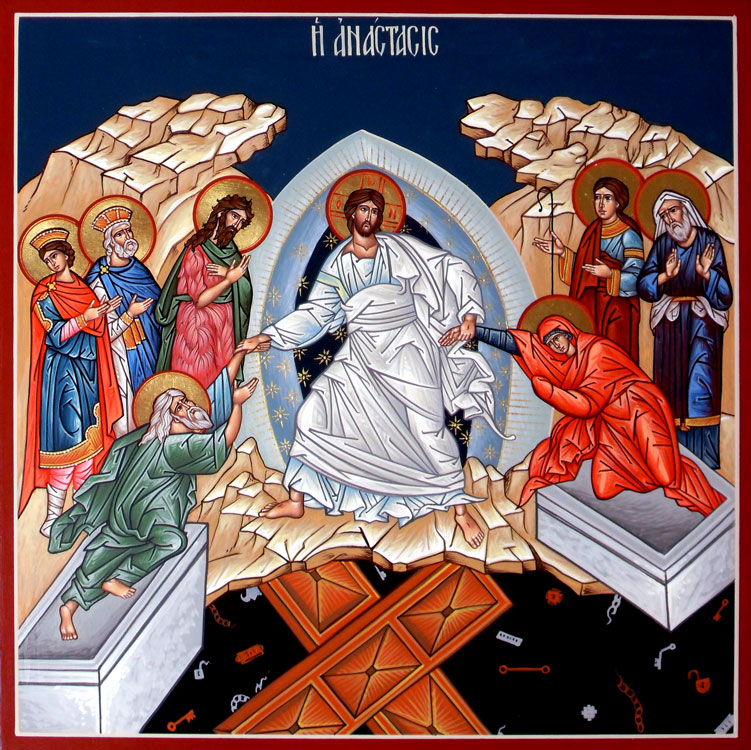
Yesterday, in our meditations for Holy Saturday, I shared with those assembled here that my favorite artistic depiction of Christ’s Resurrection is an Orthodox icon in which Jesus stands within the arch of his tomb ready to come out. Beneath his feet are the gates of Hell, broken and fallen into the form of a cross, and o either side of him are two other tombs, broken open. From them Christ is pulling two figures, a man and a woman representing Adam and Eve. They seem almost reluctant to leave their graves, but Jesus grasps them by their wrists and seems to strain to lift them. Behind them are ranged the prophets and patriarchs of Israel, the righteous dead awaiting resurrection. This liberation of those who were already dead is known as the “Harrowing of Hell,” which is the title of poet Denise Levertov’s contemplation of this icon:

Down through the tomb’s inward arch
He has shouldered out into Limbo
to gather them, dazed, from dreamless slumber:
the merciful dead, the prophets,
the innocents just His own age and those
unnumbered others waiting here
unaware, in an endless void He is ending
now, stooping to tug at their hands,
to pull them from their sarcophagi,
dazzled, almost unwilling. Didmas,
neighbor in death, Golgotha dust
still streaked on the dried sweat of his body
no one had washed and anointed, is here,
for sequence is not known in Limbo;
the promise, given from cross to cross
at noon, arches beyond sunset and dawn.
All these He will swiftly lead
to the Paradise road: they are safe.
That done, there must take place that struggle
no human presumes to picture:
living, dying, descending to rescue the just
from shadow, were lesser travails
than this: to break
through earth and stone of the faithless world
back to the cold sepulchre, tearstained
stifling shroud; to break from them
back into breath and heartbeat, and walk
the world again, closed into days and weeks again,
wounds of His anguish open, and Spirit
streaming through every cell of flesh
so that if mortal sight could bear
to perceive it, it would be seen
His mortal flesh was lit from within, now,
and aching for home. He must return,
first, in Divine patience, and know
hunger again, and give
to humble friends the joy
of giving Him food – fish and a honeycomb.
(From A Door in the Hive, October 1989)

Levertov, I think, is probably right when she suggests that the work of freeing those trapped in Hell was, for Christ, easier than “break[ing] through [the] earth and stone of the faithless world;” breaking through where privileged majorities to discriminate against minorities, abuse those who are unusual, despoil the lives those who are different, bury the poor in their poverty, entomb the stranger in hopelessness, and start wars in distant countries; breaking through the hard and trampled place where we insist that we are right . . . but break through he does for he is the love that digs up the world so that whispers are again heard where the ruined houses of our lives once stood.

Do you doubt that? Do you have difficulty feeling that promise of resurrection? Do you not feel threatened with resurrection in your own life? Do you not know yourself already resurrected?

At the vigil service each year, in place of a sermon of my own, I follow the ancient tradition of the Orthodox church and read for those present an oration or homily from one of the early doctors of the church; today I read selections from St. Gregory Nazianzan’s Second Easter Oration. In part of that great speech, St. Gregory offers advice on how one can enter personally into the Resurrection; if one cannot comprehend the whole of the story, focus on that part which most resonates with you. This is what he wrote:

If you are a Simon of Cyrene, take up the Cross and follow.
If you are crucified with Him as a robber, acknowledge God as a penitent robber.
If even He was numbered among the transgressors for you and your sin, do you become law-abiding for His sake. Worship Him Who was hanged for you, even if you yourself are hanging; make some gain even from your wickedness; purchase salvation by your death; enter with Jesus into Paradise, so that you may learn from what you have fallen.
Contemplate the glories that are there; let the murderer die outside with his blasphemies; and if you be a Joseph of Arimathæa, beg the Body from him that crucified Him, make your own that which cleanses the world.
If you be a Nicodemus, the worshiper of God by night, bury Him with spices.
If you be a Mary, or another Mary, or a Salome, or a Joanna, weep in the early morning. Be first to see the stone taken away, and perhaps you will see the Angels and Jesus Himself.
Say something; hear His Voice. If He say to you, Touch Me not, stand afar off; reverence the Word, but grieve not; for He knows those to whom He appears first.
Keep the feast of the Resurrection; come to the aid of Eve who was first to fall, of Her who first embraced the Christ, and made Him known to the disciples.
Be a Peter or a John; hasten to the Sepulchre, running together, running against one another, vying in the noble race. And even if you be beaten in speed, win the victory of zeal; not Looking into the tomb, but Going in.
And if, like a Thomas, you were left out when the disciples were assembled to whom Christ shows Himself, when you do see Him be not faithless; and if you do not believe, then believe those who tell you; and if you cannot believe them either, then have confidence in the print of the nails.
If He descended into Hell, descend with Him. Learn to know the mysteries of Christ there also, what is the providential purpose of the twofold descent, to save all [humankind] absolutely by His manifestation.
(From Oration 45, Nicene and Post-Nicene Fathers, Second Series, Volume 7, February 1996)

Become a part of the story in whatever way you can. If you cannot now comprehend the whole, grab hold of that fraction that resonates for you, but do not strive to understand, do not strive to be right, do not trample hard a place where flowers will never grow; instead, enter into the narrative, simply experience the truth, put your faith in two inches of spiritual humus where you may plant things you may not live to harvest. Remember that Christ is the love Who digs up the world, Who breaks through faithless earth and stone, expect the end of the world and laugh:
Accompany us then on this vigil
and you will know what it is to dream!
You will then know how marvelous it is
to live threatened with resurrection!
To dream awake,
to keep watch asleep
to live while dying
and to already know [your]self resurrected!

Christ is Risen! We are risen! Alleluia!

(Note: The illustration above is widely agreed to be the most striking exemplar of the traditional Byzantine Anastasis icon. It is the fresco in the apse of the arekklesion or funerary chapel, of the Monastery of Chora at Istanbul.)

====================

A request to my readers: I’m trying to build the readership of this blog and I’d very much appreciate your help in doing so. If you find something here that is of value, please share it with others. If you are on Facebook, “like” the posts on your page so others can see them. If you are following me on Twitter, please “retweet” the notices of these meditations. If you have a blog of your own, please include mine in your links (a favor I will gladly reciprocate). Many thanks!

====================

Father Funston is the rector of St. Paul’s Episcopal Church, Medina, Ohio.

Kingdom Life: Common, Routine, Mundane – Sermon for Palm Sunday 2015

====================

A sermon offered on Palm Sunday, March 29, 2015, to the people of St. Paul’s Episcopal Church, Medina, Ohio, where Fr. Funston is rector.

(At the blessing of the Palms, Zechariah 9:9-12 was read. The lessons at the Mass were Isaiah 50:4-9a; Psalm 31:9-16; Philippians 2:5-11; and Mark 11:1-11. The Passion according to Mark, Mk 14:1-15:47 was read at the conclusion of the service. Other than Zechariah, these lessons can be read at The Lectionary Page.)

====================

Icon of the Entry Into JerusalemThe four evangelists are traditionally represented by iconic depictions of the emphasis of their gospels. John, whose gospel is the longest and most different of the four tellings of Jesus’ story, is represented by an eagle because he emphasizes the divinity of Christ. Matthew, on the other hand, begins his gospel with Jesus’ genealogy and emphasizes the humanity of the Savior, so he is represented by a man. Luke emphasizes the sacrificial nature of Jesus’ ministry and mission; thus, he is represented by an ox or bull (often winged), the sort of animal offered in the Temple.
Mark, from whose gospel we read today, both the story of Jesus’ “triumphal entry” into Jerusalem and the story of his Passion, is represented by a winged lion, an emblem of kingship, because his emphasis is both the Jewish expectation that the Messiah would be of lineage of King David and that Jesus’ mission was rather different, the ushering in of the kingdom of God.

Which, I think, gives us an interpretive tool for understanding why Mark tells the story of the “triumphal entry” as he does. John, who (as I said) is most interested in portraying Jesus as divine, blows by this episode in two sentences: basically he says, “There was a crowd; they cheered; Jesus rode a donkey. Now back to the important stuff.” Matthew, who (remember) emphasizes Jesus’ humanity, adds the story of Jesus losing his temper with the money changers and animal merchants in the Temple courtyard. Luke, who is intent on portraying Jesus as the sacrificial Messiah predicted by prophecy, adds a second donkey to the parade (because he apparently misunderstands Zechariah, tells us that Jesus wept over Jerusalem on the way in to town, includes a conversation between Jesus and some Pharisees about the stones singing “Hosanna,” follows Matthew in adding the cleansing of the Temple, and concludes the story with Jesus staying in the Temple and teaching while the chief priests figure out how to kill him.

Mark, however…. Mark keeps it simple – not as simple as John, but direct and to the point. But what is his point? In the NRSV translation of Mark 11:1-11 which we read at the blessing of the palms there are 232 words. 144 of them are spent describing the process of locating, procuring, saddling (so to speak), and sitting astride the donkey. Only 67 words actually describe Jesus’ entry into Jerusalem. And 21 words finish the pericope with its anti-climactic ending, “…and when he had looked around at everything, as it was already late, he went out to Bethany with the twelve.” I find that intriguing.

Now it may seem silly to count words, but this is one of the things bible scholars do. Sometimes, when studying a book or section of the Bible, we can better understand an author’s theme by examining the frequency of word usage. For example, the use of love in the First Letter of John and the repeated use of immediately in Mark’s gospel are enlightening. So noting the number of words invested in telling the different parts of a story can, perhaps, tell us what the author felt important, and Mark seems to think the getting the donkey is roughly twice as important as Jesus actually riding it into the city!

So let’s first look at the lesser important part of the story, Jesus’ entry into Jerusalem. What’s going on here? In a word, what’s going on here is politics! Jesus is making a huge political statement; first, he is very clearly acting out the prophecy of Zechariah: “Rejoice greatly, O daughter Zion! Shout aloud, O daughter Jerusalem! Lo, your king comes to you; triumphant and victorious is he, humble and riding on a donkey, on a colt, the foal of a donkey.” (Zec 9:9) He is making an acted-out, very visual claim to be the king!

Furthermore, he is doing it in a way that mocks the Roman governor. It was the practice of the governor, at this time Pontius Pilate, to make a show of force at the time of the Passover. Because so many potentially rebellious Jews were gathered in Jerusalem to celebrate the feast of an historic liberation, the Exodus from Egypt, the Romans feared the possibility of open revolt. So at the beginning of the festival, the governor would come to Jerusalem from his usual residence at the imperial seaport of Caesarea Maritima, entering the city from the west, riding his war stallion or perhaps in a chariot of state, at the head of long column of armed soldiers. Jesus, on the other hand, is approaching from the east, coming up from Jericho and the Jordan valley, over the Mount of Olives through the peasant villages of Bethphage and Bethany. Riding the lowliest of beasts of burden, the least military of animals, Jesus is making the point that the kingdom of Heaven is about something other than regal authority and military might, something other than power elites and superiority over others.
And, I suggest, that’s why Mark spends so many words telling us about the locating, procuring, preparing, and mounting of the donkey.

There is a legendary suggestion that the two unnamed disciples whom Jesus’ sent to get the colt were none other than James and John, the sons of Zebedee, who just before this (at the end of Mark’s Chapter 10, in fact) had come to Jesus and said to him, “Grant us to sit, one at your right hand and one at your left, in your glory.” (10:37) None of the evangelist tell us the names of the two disciples sent to get the donkey, but wouldn’t that have been a graphic way for Jesus to demonstrate to them that “whoever wishes to become great among you must be your servant, and whoever wishes to be first among you must be slave of all?” (10:43-44) It is certainly a clear sign that life in the kingdom is not a glamorous thing; it’s not a life of war stallions and chariots, palaces and fine meals, or relaxing at your ease while others bear the burdens. It is not that sort of life for the king, and it is not that sort of life for his followers.

As Tom Long, who teaches preaching at Candler School of Theology, has noted,

The disciples in Mark get a boat ready for Jesus, find out how much food is on hand for the multitude, secure the room and prepare the table for the Last Supper and, of course, chase down a donkey that the Lord needs to enter Jerusalem. Whatever they may have heard when Jesus beckoned, “Follow me,” it has led them into a ministry of handling the gritty details of everyday life. (Donkey Fetchers, in The Christian Century, April 4, 2006, page 18)

Life in the kingdom, where all are servants, is common, routine, mundane, and often exhausting. This, I think, is why Mark makes more of getting the donkey than he does of Jesus’ riding it into Jerusalem. He wants us to understand that life in the kingdom is the life of the king whose faithfulness to his God and to his understanding of his mission required him to take up the cross, the king who said, “If any want to become my followers, let them deny themselves and take up their cross and follow me. For those who want to save their life will lose it, and those who lose their life for my sake, and for the sake of the gospel, will save it.” (Mk 8:34-35)

Poet Mary Oliver imagined this story from the point of view of the donkey when she wrote:

On the outskirts of Jerusalem
the donkey waited.
Not especially brave, or filled with understanding,
he stood and waited.

How horses, turned out into the meadow,
leap with delight!
How doves, released from their cages,
clatter away, splashed with sunlight!

But the donkey, tied to a tree as usual, waited.
Then he let himself be led away.
Then he let the stranger mount.

Never had he seen such crowds!
And I wonder if he at all imagined what was to happen.
Still, he was what he had always been: small, dark, obedient.

I hope, finally, he felt brave.
I hope, finally, he loved the man who rode so lightly upon him,
as he lifted one dusty hoof, and stepped, as he had to, forward.

(The Poet Thinks about the Donkey, Thirst, Beacon Press, 2007)

The One who rode the donkey also “stepped, as he had to, forward,” into that most common, most routine, most mundane, and most exhausting fact of life. He stepped willingly into death. Therefore,

“Death has been swallowed up in victory.”
“Where, O death, is your victory? Where, O death, is your sting?”
***
Thanks be to God, who gives us the victory through our Lord Jesus Christ.
Therefore . . . be steadfast, immovable, always excelling in the work of the Lord, [however common or routine or mundane or exhausting] because you know that in the Lord your labor is not in vain.” (1 Cor 15:54-55,57-58)

Let us pray:

Almighty God, whose dear Son went not up to joy but first he suffered pain, and entered not into glory before he was crucified: Mercifully grant that we, walking in the way of the cross, may find it none other that the way of life and peace; through Jesus Christ your Son our Lord, who lives and reigns with you and the Holy Spirit, one God, for ever and ever. Amen. (Collect for Monday in Holy Week, BCP 1979, page 220)

====================

A request to my readers: I’m trying to build the readership of this blog and I’d very much appreciate your help in doing so. If you find something here that is of value, please share it with others. If you are on Facebook, “like” the posts on your page so others can see them. If you are following me on Twitter, please “retweet” the notices of these meditations. If you have a blog of your own, please include mine in your links (a favor I will gladly reciprocate). Many thanks!

====================

Father Funston is the rector of St. Paul’s Episcopal Church, Medina, Ohio.

Preparing to Practice Resurrection

====================

The following will be published as The Rector’s Reflection in the April 2015 issue of The Epistle, the newsletter of St. Paul’s Episcopal Church, Medina, Ohio, where Fr. Funston is rector.

====================

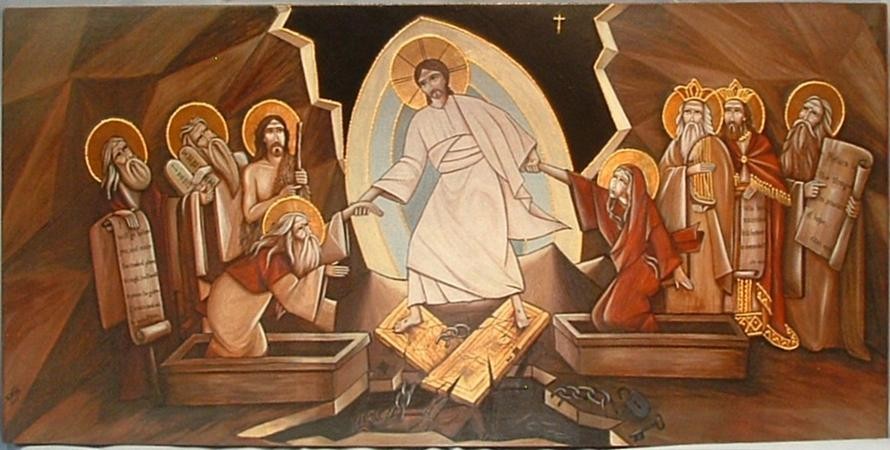
Resurrection Icon

One of my favorite poems is Manifesto: The Mad Farmer Liberation Front by Kentucky farmer and poet Wendell Berry:

Love the quick profit, the annual raise,
vacation with pay. Want more
of everything ready-made. Be afraid
to know your neighbors and to die.
And you will have a window in your head.
Not even your future will be a mystery
any more. Your mind will be punched in a card
and shut away in a little drawer.
When they want you to buy something
they will call you. When they want you
to die for profit they will let you know.

So, friends, every day do something
that won’t compute. Love the Lord.
Love the world. Work for nothing.
Take all that you have and be poor.
Love someone who does not deserve it.
Denounce the government and embrace
the flag. Hope to live in that free
republic for which it stands.
Give your approval to all you cannot
understand. Praise ignorance, for what man
has not encountered he has not destroyed.

Ask the questions that have no answers.
Invest in the millenium. Plant sequoias.
Say that your main crop is the forest
that you did not plant,
that you will not live to harvest.
Say that the leaves are harvested
when they have rotted into the mold.
Call that profit. Prophesy such returns.

Put your faith in the two inches of humus
that will build under the trees
every thousand years.
Listen to carrion – put your ear
close, and hear the faint chattering
of the songs that are to come.
Expect the end of the world. Laugh.
Laughter is immeasurable. Be joyful
though you have considered all the facts.
So long as women do not go cheap
for power, please women more than men.
Ask yourself: Will this satisfy
a woman satisfied to bear a child?
Will this disturb the sleep
of a woman near to giving birth?

Go with your love to the fields.
Lie down in the shade. Rest your head
in her lap. Swear allegiance
to what is nighest your thoughts.
As soon as the generals and the politicos
can predict the motions of your mind,
lose it. Leave it as a sign
to mark the false trail, the way
you didn’t go. Be like the fox
who makes more tracks than necessary,
some in the wrong direction.
Practice resurrection.

I love that poem for its critique of modern society, but mostly I love it for that last line which summarizes the whole poem: “Practice resurrection.”

Another is Gerard Manley Hopkins’ 1918 poem The Wreck of the Deutschland a very long elegy in honor of five Franciscan nuns killed in 1875 when a German passenger liner, the SS Deutschland, sunk off the coast of England. At the end of the poem Hopkins wrote these wonderful lines:

Remember us in the roads,
the heaven-haven of the Reward
Our King back … !
Let him easter in us.

I love that use of easter as a verb? “Let him easter in us.” God eastered Christ after three days. Christ easters in us. It’s the same as Wendell Berry’s admonition to “practice resurrection”! We often say, “Easter isn’t just a day; it’s a season!” These poets show us that it isn’t just a day or a season; it’s a verb! An activity! – Resurrection isn’t just something that happened about 2,000 years ago, or something that will happen sometime in some distant, unknown future; it’s an on-going reality, happening now; a joyful, laughter-producing, cosmic turning of the tables on death in which we are all invited, encouraged, and empowered to participate!

Easter is a verb! “To easter,” to “practice resurrection” is to join in a decision, a decision God took in not giving into the Crucifixion, a decision we can each take every day not giving into the forces of death and despair. To easter is to do all the things Wendell Berry set out in his Mad Farmer Manifesto: loving the Lord, loving the world, working for nothing, planting sequoias, lying down in the shade, willfully losing our minds, and looking forward to the end of the world with laughter!

To easter is to engage in the spiritual process of not giving in . . . not giving in to negation and death . . . not giving in to meaninglessness and despair . . . not giving in to isolation and fear . . . not giving in to powerlessness and incapacitation. Easter is an act of brave human existence. Not just a day-long holiday of bunnies, bonnets, and bluebirds, Easter is an every-day reality, a decision Christ’s Resurrection empowers each of us to take when faced with the inevitable difficulties of life, a decision to “practice resurrection” and refuse to surrender our essential humanity even in the face of death itself.

In the final days of Lent and Holy Week, we look forward to the focused celebration of our God-empowered commitment to practice resurrection as we celebrated the Christ who has eastered in us!

Alleluia! Christ is risen! The Lord is risen indeed! Alleluia!

====================

A request to my readers: I’m trying to build the readership of this blog and I’d very much appreciate your help in doing so. If you find something here that is of value, please share it with others. If you are on Facebook, “like” the posts on your page so others can see them. If you are following me on Twitter, please “retweet” the notices of these meditations. If you have a blog of your own, please include mine in your links (a favor I will gladly reciprocate). Many thanks!

====================

Father Funston is the rector of St. Paul’s Episcopal Church, Medina, Ohio.

So Many Martyrs – Sermon for the Fifth Sunday of Easter, RCL Year A – May 18, 2014

====================

This sermon was preached on the Fifth Sunday of Easter, May 18, 2014, at St. Paul’s Episcopal Church, Medina, Ohio, where Fr. Funston is rector.

(The lessons for the day were: Acts 7:55-60; Psalm 31:1-5,15-16; 1 Peter 2:2-10; and John 14:1-14 . These lessons can be read at The Lectionary Page.)

====================

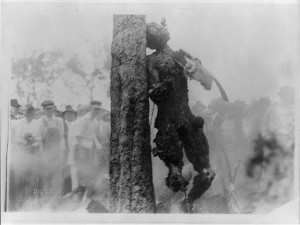
Lynching of Jesse WashingtonDoes the name “Jesse Washington” mean anything to you? It’s unlikely that it does. If I tell you that Jesse Washington died in 1916 in Waco, Texas, would that spark any memory? Have you ever been taught about the incident in which Washington was killed? Have you ever heard of what came to be called “The Waco Horror?”

Probably not. It’s not one of the incidents of American history that gets regularly taught in our schools. If I hadn’t taken a course in African American history when I was a college sophomore in 1970, I wouldn’t know anything about the death of Jesse Washington on May 15, 1916. It’s not the sort of story that makes a white person comfortable. But I do know about it, and the fact that its anniversary falls during the week when I was preparing a sermon on, among other passages from Scripture, Luke’s description of the martyrdom of Stephen in the Book of Acts struck me as significant. Both Stephen and Jesse Washington were murdered by mobs because they were different.

Jesse Washington was a 17-year-old African American farmhand. On May 8, 1916, he was accused of raping and murdering Lucy Fryer, the wife of his white employer in Robinson, Texas, not far from Waco. Jesse and his entire family (his parents and a brother) were questioned; the others were released, but Jesse was not. He was taken to Dallas, where he eventually signed a confession which some legal historians believed was coerced. There was little, if any, evidence that he was actually guilty.

Washington was tried for murder in Waco, in a courtroom filled with locals who had been provoked by local newspaper reports which included lurid, and demonstrably false, details about the crime. His defense counsel entered a guilty plea and Washington was quickly sentenced to death, but he had no opportunity to appeal.

After his sentence was pronounced, the teenager was dragged out of the courtroom and lynched in front of city hall. Over 10,000 spectators, including city officials and police, gathered to watch. Members of the mob castrated the boy, cut off his fingers, and hung him (still alive) over a bonfire. He was repeatedly lowered into the fire and raised again to prolong his agony and death. After he finally succumbed, the fire was extinguished and Jesse Washington’s charred torso was dragged through the town; parts of his body were actually sold as souvenirs. A professional photographer took pictures as the lynching progressed; these were printed and sold as postcards in Waco.

As a Christian society, we remember Stephen as the first Christian martyr and as a hero of our faith; his is a unique story told in the Book of Acts. As a Christian society, we don’t remember Jesse Washington, at all; he’s just one of thousands who were lynched. Historical reports indicate that between 1882 and 1968 there were over 4,700 lynchings in the United States. One history text estimates that between 1882 and 1930 in America at least one black person was lynched every week. (Tolnay, S., & E.M. Beck, A Festival of Violence, University of Illinois Press, 1992, p. ix) We know the numbers, but we don’t know their names.

We Americans, however, aren’t even in the minor leagues when it comes to martyring people for being different. Writing about Stephen’s death, Professor Daniel Clendenin reminds us that there have been so many more martyrs, that martyrdom is not ancient history. It is a very contemporary and present reality:

Millions more have been martyred for reasons other than religion — for their ethnicity (Jews, Armenians, Tutsis), for economic ideology (farmers, land holders), social prejudice (intellectuals, artists), race (American blacks), and gender (women around the world like the inspirational Malala Yousafzai of Pakistan).

Christians are just one group among many that honors their martyrs. Very few times, places or peoples have been spared mass murder.
If you can bear to read it, I recommend the book by Daniel Jonah Goldhagen, Worse Than War; Genocide, Eliminationism, and the Ongoing Assault on Humanity (2009). Goldhagen estimates that between 127–175 million people were “eliminated” in the last century.

These people came from all regions of the world, and from all social, economic and political groups. The vast majority of these victims were killed in their own countries, by their fellow citizens, by willing and non-coerced murderers, and almost never with any substantial dissent. Eliminationism is thus “worse than war.”

The numbers are mind-numbing, and therein lies our challenge. They bring to mind the infamous remark by [Joseph] Stalin in 1947 about the famine in Ukraine that was killing millions: “If only one man dies of hunger, that is a tragedy. If millions die, that’s only statistics.” (The Stoning of Stephen)

Clendenin concludes, “The martyrdom of Stephen disabuses us of a sentimental gospel. It roots us in the real world of industrial scale slaughter. The one man Stephen helps us to remember the individual humanity of the millions of people we might otherwise forget.”

Now I want to draw our attention away from mass murder and martyrdom, and focus instead, for a moment, on one another. I’d like you for just a few seconds to look around the room, and just take note of who and what you see here. (A short, silent pause)

What did you see? A bunch of living stones? The members of a holy priesthood? A chosen race? A royal priesthood? A people chosen and named by God? This is what Peter says we should see, the building material for a spiritual house, eternal in the heavens, not made with hands, that mansion in which there are many rooms where Jesus assures his disciples there is a place for all of us. But is that how we see one another?

Philip asked Jesus to show them the Father and Jesus replied, “Have I been with you all this time, Philip, and you still do not know me? Whoever has seen me has seen the Father. How can you say, ‘Show us the Father’?” I sometimes wonder if Jesus’ answer would perhaps have been different if Philip had asked, “Show us God.”

In the creation story in the first chapter of Genesis we are told, “God created humankind in his image, in the image of God he created them; male and female he created them.” (Gen 1:27) If Philip had asked Jesus, “Show us God,” might Jesus not have said, “Look around you, Philip.” Archbishop Desmond Tutu is fond of reminding people of those words from Genesis and suggesting that we should genuflect to one another! In a paper entitled Religious Human Rights and the Bible, he wrote:

The life of every human person is inviolable as a gift from God. And since this person is created in the image of God and is a God carrier a second consequence would be that we should not just respect such a person but that we should have a deep reverence for that person. The New Testament claims that the Christian person becomes a sanctuary, a temple of the Holy Spirit, someone who is indwelt by the most holy and blessed Trinity. We would want to assert this of all human beings. We should not just greet one another. We should strictly genuflect before such an august and precious creature. The Buddhist is correct in bowing profoundly before another human as the God in me acknowledges and greets the God in you. This preciousness, this infinite worth is intrinsic to who we all are and is inalienable as a gift from God to be acknowledged as an inalienable right of all human persons. (Emory International Law Review, Vol. 10 (1996): 63-68)

Which brings me back to Stephen and Jesse Washington, and to a strange little short story by the author Shirley Hardie Jackson entitled The Lottery that was first published in The New Yorker in June, 1948.

Set in a small, contemporary American town, a small village of about 300 residents, the story concerns an annual ritual known as “the lottery” which is practiced to ensure a good harvest; one character quotes an old proverb, “Lottery in June, corn be heavy soon.” As the story opens, the locals are excited but a bit anxious on the eve of the lottery. Children are gathering stones as Mr. Summers and Mr. Graves make the paper slips for the drawing and draw up a list of all the families in town.

When they finish the slips and the list, the men put them into a black box, which is locked up in the safe at a local coal company. The next morning the townspeople gather at 10 a.m. in order to have everything done in time for lunch. First, the eldest male of each family in town draws a slip; there’s one for every household. Bill Hutchinson gets the one slip with a black spot, meaning that his family has been chosen. In the next round, each member of the Hutchinson family draws a slip, and Bill’s wife Tessie gets the black spot. Each villager then picks up a stone and they surround Tessie, and the story ends as Mrs. Hutchinson is stoned to death while the paper slips are allowed to fly off in the wind.

Shortly after it was published, Ms. Jackson said of her story that she had hoped that by setting the particularly brutal ancient rite of stoning (the same thing that was done to Stephen) in the present she would shock her readers with “a graphic dramatization of the pointless violence and general inhumanity in [our] own lives.” (San Francisco Chronicle, July 22, 1948.) Her story suggests that we human beings are more capable of honoring our rituals and our preconceptions than we are of honoring one another.

I think the true stories of Stephen of Jerusalem, of Jesse Washington of Waco, Texas, and of those millions of martyrs who have been “eliminated” amply demonstrate that she was right. Not only are we more capable of honoring our rituals and prejudices that we of honoring one another, we are demonstrably willing to murder one another to protect them.

We are because when we look around at our fellow human beings we do not see one another as divine; we do not see living stones; we do not see members of a royal priesthood. Blinded, or perhaps just numbed, by familiar ritual, by preconception, by the simple human need to conform, we do not appreciate one another as fellow citizens of a holy nation, “chosen and precious in God’s sight,” as bearing the image of God.

“Have I been with you all this time, Philip, and you still do not know me?” Jesus asked. I’m not the least bit surprised in Philip, however; we human beings, made in the image of God, have been with each other for a long, long time, and we still do not know each other. Dr. Clendenin suggested that the martyrdom of Stephen helps us to remember the individual humanity of the millions of unnamed martyrs we might otherwise forget; may it also help us to remember the divinity of each of them and of each other.

Let us pray:

O God, you made us in your own image and redeemed us through Jesus your Son: Look with compassion on the whole human family; take away the arrogance and hatred which infect our hearts; break down the walls that separate us; unite us in bonds of love; and work through our struggle and confusion to accomplish your purposes on earth; that, in your good time, all nations and races may serve you in harmony around your heavenly throne; through Jesus Christ our Lord. Amen. (For the Human Family, Book of Common Prayer, Episcopal Church, 1979, page 815)

====================

A request to my readers: I’m trying to build the readership of this blog and I’d very much appreciate your help in doing so. If you find something here that is of value, please share it with others. If you are on Facebook, “like” the posts on your page so others can see them. If you are following me on Twitter, please “retweet” the notices of these meditations. If you have a blog of your own, please include mine in your links (a favor I will gladly reciprocate). Many thanks!

====================

Father Funston is the rector of St. Paul’s Episcopal Church, Medina, Ohio.

Chesed – From the Daily Office – April 25, 2014

From the Psalms:

O give thanks to the Lord, for he is good,
for his steadfast love endures for ever.
O give thanks to the God of gods,
for his steadfast love endures for ever.
O give thanks to the Lord of lords,
for his steadfast love endures for ever.

(From the Daily Office Lectionary – Psalm 136:1-3 (NRSV) – April 25, 2014.)

ChesedPsalm 136 is twenty-six verses long. The second half of every single verse is the same: “For [God’s] steadfast love endures for ever.”

In The Book of Common Prayer version this refrain is translated, “For [God’s] mercy endures forever.”

“Mercy” is the pertinent term in the Authorized Version, as well, while in the New American Standard, the word is “lovingkindness.”

The New International Version renders it “love” and the Complete Jewish translation uses “grace.”

They’re all good words . . . and not one of them fully and completely captures the meaning of the original Hebrew word chesed.

It seems to me that what is lacking in all of the translations is recognition of the implicit qualities of unconditionality, loyalty, and devotedness, and the explicit quality of covenant.

Chesed, additionally, conveys a sense of priority. God’s chesed is prior to all human response and in no way depends upon any human response; nonetheless, God binds Godself in chesed in covenant with humankind offering a loyalty and devotion humankind is incapable of reciprocating.

Perhaps this is why our translations of chesed (and even the word chesed itself) are inadequate. Human language cannot encompass the unconditional and endless self-giving of God. And, perhaps, this is what Psalm 136 must repeat, over and over again, that God’s steadfast love, mercy, lovingkindness, grace, chesed is eternal.

We must constantly remind ourselves of that which is fundamentally beyond our comprehension. We cannot comprehend it; we cannot offer any adequate response. We can only accept it and be grateful. Repeatedly.

====================

A request to my readers: I’m trying to build the readership of this blog and I’d very much appreciate your help in doing so. If you find something here that is of value, please share it with others. If you are on Facebook, “like” the posts on your page so others can see them. If you are following me on Twitter, please “retweet” the notices of these meditations. If you have a blog of your own, please include mine in your links (a favor I will gladly reciprocate). Many thanks!

====================

Father Funston is the rector of St. Paul’s Episcopal Church, Medina, Ohio.

Flesh and Blood – From the Daily Office – April 24, 2014

From the First Letter to the Corinthians:

What I am saying, brothers and sisters, is this: flesh and blood cannot inherit the kingdom of God, nor does the perishable inherit the imperishable.

(From the Daily Office Lectionary – 1 Corinthians 15:50 (NRSV) – April 24, 2014.)

Human BodyI think I know what Paul is trying to say here, but I don’t like the way he’s saying it. I mean, I really have a theological issue with the assertion that “flesh and blood cannot inherit the kingdom of God.” I think the statement is just plain wrong. It states a dualism that relegates the material, specifically the human body, to realm of the damned, the unclean, the unworthy. In light of a creation story in which the Creator “saw everything that he had made [including that human flesh and blood], and indeed, it was very good,” I cannot accept the condemnation of our material being.
We have in our scriptural tradition an understanding that there have been human beings bodily “ascended” into the spiritual realms. “Elijah, because of great zeal for the law, was taken up into heaven,” says the First Book of Maccabees (1 Mac 2:58), and that is what Second Book of Kings describes: “Elijah ascended in a whirlwind into heaven.” Elisha watched it happen and kept staring up until he could no longer see his master. (2 Kg 2:11-12) And then there is Enoch who “walked with God; then he was no more, because God took him,” (Gen 5:24) a statement which has always been understood to mean that he was taken, flesh and blood, into God’s eternal Presence.

Of even greater significance is the Ascension of Christ! As the Apostles stood “watching, he was lifted up, and a cloud took him out of their sight,” and then a couple of angels assured them that he had “been taken up from you into heaven.” (Acts 1:9,11) This was Jesus in the same body that had been executed! That body still bore the wounds of crucifixion; he had invited Thomas, “Put your finger here and see my hands. Reach out your hand and put it in my side.” (Jn 20:27) That flesh-and-blood body which ascended had sat at table with his friends; after his Resurrection, that same flesh-and-blood body had eaten a piece of honey and shared some grilled fish. Paul goes on and on about earthly bodies and heavenly bodies, physical bodies and spiritual bodies, perishable bodies and imperishable bodies . . . but Jesus lived, died, rose, and ascended in one and same body!

I’m rather fond of the body I’ve lived in. It’s fat and out of shape and, truth be told, I wish it were better looking! But I’ve done a lot of stuff with this body and, like Henry Higgins with regard to Eliza Dolittle’s face, I’ve grown accustomed to it. It has been useful — it’s climbed holy mountains and visited sacred places; it’s lifted babies from their cribs and cuddled them; it’s hugged my wife and children; it’s helped old people into and out of bed; it’s held the hands of dying parents; it’s fed the hungry and built shelters for the homeless; it’s stood at the altar of God and ministered the Flesh and Blood of Christ. This flesh and blood has done some holy things. If I’m going to be gifted with life eternal, I’ll be happy to do so in this flesh and blood that has served me well, and with which I have done my best to serve God and God’s people.

I think I know what Paul was trying to say, but I wish he’d found a different way to say it because I think what he said is just wrong. Flesh and blood can inherit the kingdom of God. Indeed, I believe that flesh and blood have already inherited the kingdom of God. Here and now.

====================

A request to my readers: I’m trying to build the readership of this blog and I’d very much appreciate your help in doing so. If you find something here that is of value, please share it with others. If you are on Facebook, “like” the posts on your page so others can see them. If you are following me on Twitter, please “retweet” the notices of these meditations. If you have a blog of your own, please include mine in your links (a favor I will gladly reciprocate). Many thanks!

====================

Father Funston is the rector of St. Paul’s Episcopal Church, Medina, Ohio.

Death Rattle of Death – From the Daily Office – April 22, 2014

From the First Letter to the Corinthians:

The last enemy to be destroyed is death.

(From the Daily Office Lectionary – 1 Corinthians 15:26 (NRSV) – April 22, 2014.)

Lungs and FacesTwo weeks before Easter I came down with the flu. I spent three days in bed with a high fever, a racking cough, and a good deal of body aches and pains. A friend who suffered the same illness (it’s gone around our town and several people have suffered through it) described the muscle pain as feeling as if one had been beaten up, thrown the ground, and kicked several times. It felt to me as if every square centimeter of connective tissue in my body was inflamed at the same time. (This is the first time in a couple of weeks or more that I’ve had enough morning energy to write anything after reading the daily lessons.)

It all made getting ready for Palm Sunday, Holy Week, and Easter rather difficult, and even when Resurrection Sunday got here, I didn’t really feel much like celebrating. I always end a respiratory illness like that with two lingering symptoms: a nagging cough and laryngitis – both were in full force on Easter Eve. Gargling with warm salt water and several doses of codeine-laced cough suppressant got me through the Festival Eucharist on Easter morning.

So here we are at Tuesday in Easter week and the lingering cough is still tagging along. I’m feeling like it, not death, is the “last enemy to be destroyed.” Death is already conquered; the cough is not! In my Easter homily, I preached about that sense many (if not all) people have had from time to time of “dying a little” because of life’s many small disappointments, of how that sense is a result of disordered (sinful) creation disrupting the proper relationships of life, and of how all that sinfulness crashed down through time and eternity, through space and the cosmos, hitting one moment, one place:

Think about the weight of all that sin, all that dying, experienced in little ways every day by all the people who have ever lived . . . think of that weight crashing down
through the centuries,
through the millennia,
through all of time and all of space,
crashing down to a single hour,
a single moment,
a single instant,
on a hill outside of Jerusalem,
on a single man,
a man hanging on a cross
who cried out
“It is finished!”

Death, the last enemy, has been conquered. But there seems to be this lingering, nagging cough still sounding through the universe, still tickling at the throat of creation, still hacking away. It’s the death rattle of death. Pay it no mind. Eventually it and even its echoes will fade away.

====================

A request to my readers: I’m trying to build the readership of this blog and I’d very much appreciate your help in doing so. If you find something here that is of value, please share it with others. If you are on Facebook, “like” the posts on your page so others can see them. If you are following me on Twitter, please “retweet” the notices of these meditations. If you have a blog of your own, please include mine in your links (a favor I will gladly reciprocate). Many thanks!

====================

Father Funston is the rector of St. Paul’s Episcopal Church, Medina, Ohio.

“You Have Died (a Little)” – A Sermon for Easter Morning – April 20, 2014

====================

This sermon was preached on Easter Sunday, April 20, 2014, at St. Paul’s Episcopal Church, Medina, Ohio, where Fr. Funston is rector.

(The lessons for the day were: Jeremiah 31:1-6; Psalm 118:1-2,14-24; Colossians 3:1-4; and John 20:1-18. These lessons can be read at The Lectionary Page.)

====================

Shrouded CorpseSeveral days ago, as I was reading again the Easter story and the sections of the Holy Scriptures appointed for this year, I had the radio on and tuned to my favorite oldies station.
I was prayerfully considering and trying to figure out what Paul was saying to the Colossians when he wrote these words that we heard in the Epistle lesson for today: “You have died, and your life is hidden with Christ in God.” (Col. 3:3) I was trying to figure out what Paul meant by “hidden with Christ.” The Greek word is krypto and in addition to “hidden” it can also mean “secret” or “not noticed.” It is the origin of words like cryptogram and cryptography and also of crypt, a synonym for tomb. What does Paul mean? Is he saying our life is buried with Christ? Or that, somehow, the Christian life is a “secret” or that it goes “unnoticed”?

So I was pondering all of that and my oldies station played a very old and familiar song:

It hurts to be in love when the only one you love
Turns out to be someone who’s not in love with you
It hurts to love her so when deep down inside you know
She will never want you, no matter what you do

And so you cry a little bit
Oh, you die a little bit
Day and night, night and day
It hurts to be in love this way

Some of you are old enough to recognize the lyrics of It Hurts To Be In Love by Gene Pitney, a Top Ten hit from 1964.

And then, right after that song, the radio station played the one which has this as the refrain:

Strumming my pain with his fingers
Singing my life with his words
Killing me softly with his song
Telling my whole life with his words
Killing me softly with his song

That was a Number One hit for Roberta Flack in 1973.

Those songs played just as I was prayerfully considering and trying to figure out what Paul was saying to the Colossians when he wrote: “You have died, and your life is hidden with Christ in God.” (Col. 3:3) Now I don’t really think that God speaks to me through the radio or in the lyrics of popular songs, although it’s possible that God does. However, that coincidence of lyrics and Biblical text did take me down a path of revelation that I’d like to share with you this morning.

Those songs and songs like them – you can probably name several popular melodies going back to Cole Porter’s 1944 tune Every Time We Say Goodbye (“Every time we say goodbye, I die little”) or before – songs that mention this sense we have all had of “dying a little” because of a broken heart, because of the loss of a loved one, because of a disappointment in life. I think that’s why these songs become popular. We’ve all had that sense of “dying a little inside” for these and for many other reasons. And so Paul writes to the Colossians and to us:

“You have died, and your life is hidden with Christ in God.”

In his historical play Julius Caesar, William Shakespeare has his title character observe that “a coward dies a thousand times before his death, but the valiant taste of death but once.” (Act 2, Sc. 2) Ernest Hemingway took Shakespeare to task about that. In A Farewell to Arms he wrote:

‘The coward dies a thousand deaths, the brave but one’…. (The man who first said that) was probably a coward…. He knew a great deal about cowards but nothing about the brave. The brave dies perhaps two thousand deaths if he’s intelligent. He simply doesn’t mention them.

I think the truth is that everybody, valiant or cowardly, everybody dies many little deaths throughout our existence on this earth. Each and every one of us is “killed softly” in myriad ways by the circumstances of life. We have, as Paul wrote to the Colossians, died . . . many times over.

Sometimes those little deaths are the result of our own actions; sometimes they are the result of other’s actions; sometimes they happen because that’s just the way the world is. The world, though created by God to be good, is out of kilter; it is, we say theologically, fallen. The world and everything in it, including you and me, are not in the proper relationship with our Creator. We are not in proper relationship with one another. We call that “sin.” And sin, as the writer of the Letter to the Hebrews reminds us, has weight, a weight that clings to us like dirt, and each time we experience one of those little deaths a little more weight, a little more dirt is tossed on until, as Paul wrote in this simple verse in the letter to the Colossians, we are buried.

“You have died, and your life is hidden with Christ in God.”

Think about the weight of all that sin, all that dying, experienced in little ways every day by all the people who have ever lived . . . think of that weight crashing down
through the centuries,
through the millennia,
through all of time and all of space,
crashing down to a single hour,
a single moment,
a single instant,
on a hill outside of Jerusalem,
on a single man,
a man hanging on a cross
who cried out
“It is finished!”

“You have died, and your life is hidden with Christ in God.”

They took him down from the cross and laid him in a tomb and on the day after the Sabbath the women came and found the tomb empty. We know that story so well. It is the foundational story of our faith. We know it so well and yet we have to be reminded of it again and again because those little deaths seem to keep happening and hiding it from us. “Our life is hidden;” it gets buried under that weight; it goes unnoticed.

Anastasis IconIn the Eastern Orthodox tradition, icons of the Resurrection depict Christ rising from the tomb with a whole crowd of people. To one side of him crowned and haloed are King David and King Solomon; on the other, we see Abel the first martyr of creation carrying a shepherd’s crook and Moses the first prophet of the Old Covenant. Also present is John the Baptist, who is both the first prophet and the first martyr of the New Covenant. Beneath Christ’s feet, the gates of hell lie broken, often forming a cross. And from two tombs, Adam and Eve are rising, but not of their own accord; Jesus holds them by the wrists and is pulling them from their graves.

The mythological proto-parents of our race, the ancient kings, the prophets and martyrs . . . this little crowd represents all of humankind . . . you and me and all the people who have ever lived, all the people who have ever died any kind of death, whether physical death or the little daily kinds of dying we all have experienced . . .
we are all there,
all being pulled from death,
pulled from out of hiding,
pulled from where we are buried,
pulled from where the life God wants for us is unnoticed,
all rising with Christ to new life.

“In a moment, in the twinkling of an eye, . . . ‘Death has been swallowed up in victory.’ ‘Where, O death, is your victory? Where, O death, is your sting?’” (1 Cor. 52,54-55) “You have died, and your life is hidden with Christ in God.”

We celebrate Easter, the historical fact of the Resurrection of Christ, not because it is something that happened 2,000 or so years ago, although it is certainly that. We celebrate the Resurrection because it is something that happens every day. “You have died . . .” Every day in myriad little ways, as those popular songs and our own experience reminds us, we die a little. Every day our life is obscured and hidden; every day our life is made secret even from us and the life God wants for us goes unnoticed.

But . . .
“It is finished!”
That seemingly endless round of sinful little deaths is over;
it crashed down through time and space
to that one instant
on that one cross
and it was done with,
conquered!
“It is finished!”

Every day Jesus, rising from the tomb, grabs us by the wrist and pulls us from the grave. “I came,” said Jesus, “that they may have life, and have it abundantly.” (John 10:10) Every day, he pulls us up out of the little deaths of sin into the resurrection of that abundant life. “Death has been swallowed up in victory.” “It is finished!”

“When Christ who is your life is revealed, then you also will be revealed with him in glory,” wrote Paul. (Col. 3:4)
Christ has been revealed; we are revealed with him in glory.
Christ is risen.
We are risen!
Death is conquered!
“It is finished!”
We are free!
Alleluia!

====================

A request to my readers: I’m trying to build the readership of this blog and I’d very much appreciate your help in doing so. If you find something here that is of value, please share it with others. If you are on Facebook, “like” the posts on your page so others can see them. If you are following me on Twitter, please “retweet” the notices of these meditations. If you have a blog of your own, please include mine in your links (a favor I will gladly reciprocate). Many thanks!

====================

Father Funston is the rector of St. Paul’s Episcopal Church, Medina, Ohio.

God’s Faithfulness Prevails — Sermon for the 10th Sunday after Pentecost (Proper 12C) — July 28, 2013

====================

This sermon was preached on the Tenth Sunday after Pentecost, July 28, 2013, at St. Paul’s Episcopal Church, Medina, Ohio, where Fr. Funston is rector.

(Revised Common Lectionary, Pentecost 10 (Proper 12, Year C): Hosea 1:2-10; Psalm 85; Colossians 2:6-19; and Luke 11:1-13. These lessons can be read at The Lectionary Page.)

====================

Baptism“Name this child.” That’s what I say to parents of infant baptismal candidates as I take their children from them. The words are not actually written in the baptismal service of The Book of Common Prayer as they are in some other traditions’ liturgies, but there is a rubric on page 307 that says, “Each candidate is presented by name to the Celebrant . . . .” so asking for the child’s name is a practical way of seeing that done. It’s practical, but it’s also a theological statement.

There is a common religious belief found in nearly all cultures that knowing the name of a thing or a person gives one power over that thing or person. One finds this belief among African and North American indigenous tribes, as well as in ancient Egyptian, Vedic, and Hindu traditions; it is also present in all three of the Abrahamic religions, Judaism, Christianity, and Islam.

The naming we do at baptism echoes the naming that takes place in Jesus’ tradition as a faithful Jew. In Judaism, when a male infant is circumcised on the eighth day after his birth, the mohel who performs the brit milah prays, “Our God and God of our fathers, preserve this child for his father and mother, and his name in Israel shall be called ________” and the prayer continues that, by his naming, the infant will be enrolled in the covenant of God with Israel. The same thing is done when a girl is named in the ceremony called zeved habat, or “presentation of the daughter” at the first formal reading of the Torah following her birth. In baptism, we do the same; the church says to its newest member, “This is who you are: washed in the waters of baptism, sealed by the Holy Spirit, and marked as Christ’s own forever,” a brother or sister in the church, a fellow member of the household of God.

To give a name to anything, especially to another human being, is a powerful thing! In the first verses of Genesis we are told, “God said ‘Let there be Light’ and there was light.” (Gen. 1:3) God named the light before it was created; this process continues through the rest of the story. God says, “Let there be” and names the thing which will come into existence; the naming seems a necessary first step in creation. There is a sense in which the name given shapes the future of the thing, or of the person, named.

So this morning I will ask that question of Danny and Nikki ___________ (parents) and of Peter ___________ (Godfather) who will name Ryan George __________ (infant) as a child of God, and of Mary __________ (sponsor) who will name Jacqueline Ann ____________ (adult) as a child of God, and through baptism we all will welcome Ryan and Jackie into the household of faith, into a covenant relationship with Almighty God and with each of us.

In today’s lesson from the Prophet Hosea, we find God instructing the prophet to give strange and bewildering names to his children as powerful, prophetic signs of Israel’s broken relationship with God. Hosea’s firstborn son is to be named Jezreel, which refers to the location of a particularly brutal and bloody massacre of Israelite royalty; his daughter is to be called, Lo-ruhamah, which means “no pity,” as a sign that God will have no compassion for his people who have gone astray; and a second son is to be named, Lo-ammi, which means “no people,” to let the Israelites know they are no longer God’s people.

Preachers often use their children as sermon illustrations, but what God demands of Hosea seems a little extreme. These poor kids aren’t going to have to live merely with the embarrassment of a single sermon, they are going to live with these names, these prophetic, judgmental names for their entire lives! But as bad as that is, giving these awful names to his children is not the hardest thing God demands of Hosea. No, the hardest thing is marrying their mother, Gomer.

Hosea is ordered by God to (in the words of our NRSV translation) “take for yourself a wife of whoredom and have children of whoredom.” He is to marry a prostitute who will continue in her scandalous and adulterous behavior, even though Hosea will be faithful to her throughout the marriage. Why? Because it is a prophetic sign, a prophetic action symbolizing the way in which Israel has dealt with God: because “the land commits great whoredom by forsaking the Lord.” God loves Israel with all the passion and loyalty of a faithful husband, but Israel, like a promiscuous wife, has been unfaithful to God.

It is an unfortunate prophetic metaphor, for it is misogynistic to the core! Portraying God as a faithful (but dominant) husband and Israel as a supposed-to-be obedient (and submissive) wife perpetuates a patriarchalism that is inappropriate to our society. As a metaphor it may have communicated clearly to its ancient Israelite audience, but it doesn’t communicate quite so clearly to us, clouded as it is with its ancient cultural bias. So as we read and seek to understand Hosea’s message in our day and age, we must extract the meaning from the metaphor and then, perhaps, cast the metaphor aside, separating the kernel of truth from the chaff of historical baggage.

In the modern world, marriage is not the patriarchal, male-dominated institution it was in Hosea’s time, but the metaphor can still work for us. In our Prayer Book, the meaning of marriage is summarized in the introductory comments with which the presiding minister begins the ceremony. We are told that it is a bond and covenant established by God in creation and that the union of the parties “in heart, body, and mind is intended by God for their mutual joy [and] for the help and comfort given one another in prosperity and adversity.” (BCP 1979, page 423)

Later in the service, just before the Nuptial Blessing is given, we pray for the couple that “each may be to the other a strength in need, a counselor in perplexity, a comfort in sorrow, and a companion in joy,” and that “their life together [may be] a sign of Christ’s love to this sinful and broken world, that unity may overcome estrangement, forgiveness heal guilt, and joy conquer despair.” (Page 429) In such a relationship neither party dominates the other, neither is submissive; it is a mutual and interdependent bond of covenant obligations, one to the other.

When Hosea’s prophetic metaphor is understood in these terms, it emphasizes that God is angry with God’s people for abandoning the covenant obligations they had to God, even as God remained faithful. What Hosea’s marriage metaphor communicates to us, as it did to his ancient audience, is that it is divine fidelity, not human inconstancy, that will ultimately save the relationship. It is God’s faithfulness, not our own, which prevails and redeems our relationship with God.

This is also the message of the author of the Letter to the Colossians, an epistle traditionally said to have been written by St. Paul, but which is now no longer believed to be of his authorship. The reason for that is in the very part of the text on which I want to focus our attention, the sentence where the author writes: “When you were buried with [Christ] in baptism, you were also raised with him through faith in the power of God, who raised him from the dead.” The author seems to echo Paul’s understanding of baptism in the Letter to the Romans, particularly a section we read every year on Easter Sunday. Paul writes, “Do you not know that all of us who have been baptized into Christ Jesus were baptized into his death? . . . . If we have been united with him in a death like his, we will certainly be united with him in a resurrection like his.” (6:3,5) The theology is similar, but note the significant shift: in Romans, Paul writes that we will be raised with Christ, whereas the author of Colossians asserts that our resurrection with Christ has already happened by reason of baptism. These two passages reflect the wonderful here-but-not-quite-here mysterious paradox of Christianity; we both celebrate the present reality of and anticipate the future consummation of our salvation in Christ. The victory has already been won, but not yet.

Now, what I really want to focus on is why our resurrection, our salvation, whether it is a present reality or something yet to occur, should happen at all! In Romans, Paul says that it happens “by the glory of the Father.” (v. 4) The author of Colossians asserts that it is “through faith in the power of God” according to our translation; that would seem to imply that our faith is somehow responsible for our salvation, that the means for our resurrection is our fidelity. But there is a growing body of scholarship which suggests that this is a misunderstanding of the original Greek of the text. The Greek is dia te pisteo te energeia tou theou . . . literally: “through the faith the working of God.” Traditional English translations add the preposition “in” into the interpretation which would imply that this powerful, operative faith is ours, but the Greek can also be understood to mean not “faith in” but rather “faith of” – in other words, it is God’s faith!

The 18th Century Lutheran translator Johann Albrecht Bengel suggested exactly this in his Annotations on the New Testament when he translated this text to say that our salvation, our resurrection comes about through faith which is a work of God. This text, he says, is “a remarkable expression: faith is of Divine operation.” (Gnomon of the New Testament, A. Fausset, tr., Clark:Edinburgh 1858, page 171, emphasis in original) Our resurrection with Christ is not brought about because of our faith; it is not because of us, or anything we do or believe! We are saved through the faithfulness of God who, by his glory and power, raised Christ from the dead.

It is also God’s faithfulness to which Jesus alludes in the parental metaphor which he uses in his instruction about prayer: “Is there anyone among you who, if your child asks for a fish, will give a snake instead of a fish? Or if the child asks for an egg, will give a scorpion? If you then, who are evil, know how to give good gifts to your children, how much more will the heavenly Father give the Holy Spirit to those who ask him!” God is the faithful parent who always responds when we ask, who is always there to be found when we search, who always opens the door when we knock. It is God’s faithfulness, not our own, which prevails and redeems our relationship with God.

On this we can rely; in this faithful God, we can have faith.

So let’s go back to Hosea’s marriage metaphor. The Lutheran Book of Worship, used by our brothers and sisters in the Evangelical Lutheran Church in America, with whom we enjoy a relationship of full communion, says this about marriage: “The Lord God in his goodness created us . . . and by the gift of marriage founded human community in a joy that begins now and is brought to perfection in the life to come. Because of sin, our age-old rebellion, the gladness of marriage can be overcast, and the gift of the family can become a burden. But because God, who established marriage, continues still to bless it with his abundant and ever-present support, we can be sustained in our weariness and have our joy restored.” (LBW 1978, page 203)

It is into the household of God, the community of joy restored, the covenant of mutual help and comfort sustained by the faithfulness of God, that we welcome Ryan George and Jacqueline Ann this morning. They (and we together with them) will make the statements of belief and the promises of action set out in the Baptismal Covenant (BCP 1979, pages 304-04), and they (and we) will try faithfully to keep them. Fortunately, however, it is God’s faithfulness, not theirs (nor ours), which will prevail and redeem them (and us), and their (and our) relationship with God.

Let us pray:

Almighty God, by our baptism into the death and resurrection of your Son Jesus Christ, you turn us from the old life of sin: Grant that we, being reborn to new life in him, may live in righteousness and holiness all our days; through Jesus Christ our Lord, who lives and reigns with you and the Holy Spirit, one God, now and for ever. Amen. (BCP 1979, page 254)

====================

A request to my readers: I’m trying to build the readership of this blog and I’d very much appreciate your help in doing so. If you find something here that is of value, please share it with others. If you are on Facebook, “like” the posts on your page so others can see them. If you are following me on Twitter, please “retweet” the notices of these meditations. If you have a blog of your own, please include mine in your links (a favor I will gladly reciprocate). Many thanks!

====================

Father Funston is the rector of St. Paul’s Episcopal Church, Medina, Ohio.

Mix Faith with Frustration – From the Daily Office – July 2, 2013

From the Gospel of Luke:

They said, “If you are the Messiah, tell us.” He replied, “If I tell you, you will not believe; and if I question you, you will not answer.”

(From the Daily Office Lectionary – Luke 22:67-68 (NRSV) – July 2, 2013.)

Frustration Relief KitIn the assembly of the elders of the people, the chief priests and the scribes, Jesus is asked, “Are you the Messiah?” and in response he gives vent to some very real human frustration.

I recently read an article about frustration as a plot element in writing fiction. The author suggested that frustration is, in fact, the most important emotion in fiction because nothing happens in a novel or short story unless the plans, wishes, or desires of the protagonist are frustrated. If Ahab had killed the white whale on his first attempt, Moby Dick would have been a very short tale, indeed. The author of the article pointed out, however, that frustration “is seldom a ‘pure’ emotion. It can come mixed with many others: anger (‘How dare they!’), hurt (‘Why won’t they help me?’), fear (‘I’ll never get what I want’), self-blame (‘I’m not good enough to succeed’), resignation (‘Can’t win ‘em all’), or bitterness (‘Life sucks’).”

One of my favorite episodes of The West Wing was about a submarine crisis off the coast of North Korea. The White House staff brought in an expert on submarine warfare to advise President Bartlett; Hal Holbrook played the character with droll dullness, droning on and on about difference experiences. In one scene, the expert and Leo McGarry were sitting on the sofas in the Oval Office talking; Leo was listening, the expert droning on. From off camera came the sound of a rhythmic thump – thump – thump. The camera pulled back to reveal the President banging his head on his desk . . . . I’m not sure what the President’s frustration might have been mixed with, but clearly that is not the best way to handle frustration!

With what, we might ask, is Jesus’ frustration mixed? I think the answer must be, “Faith.” Jesus is convinced that whatever happens, his God is with him. The night before this questioning, all the other emotions with which this frustration might have been mixed were sweated out in Garden of Gethsemane, leaving only faith: “Father, if you are willing, remove this cup from me; yet, not my will but yours be done.” (Luke 22:42) To be true to his mission (whatever we might now believe or understand it to be), to be true to his God, Jesus could not allow any other emotion to taint his frustration.

In any given situation, with what are our frustrations mixed? Too often they are like that article author described, mixed with emotions that result in negative or self-defeating outcomes. Our task is to spend some Gethsemane-time, sweating out those impurities, leaving only faith.

I think frustration mixed with faith might best be named “resolve,” which the dictionary defines as “firmness of purpose.” That certainly describes Jesus in the assembly of the elders (and throughout the Passion).

In an address at the University of Maine in October 1963, President John F. Kennedy exhorted his listeners: “Let us resolve to be masters, not the victims, of our history, controlling our own destiny without giving way to blind suspicions and emotions.” The example of Jesus suggests that, in some ways, we may still be “victims” no matter what we resolve and no matter how strong our faith may be. But our Lord’s example and the Christian faith also demonstrate that “victimization” to those who stand firm in their mission is a temporary state; on the other side one finds resurrection and redemption.

Frustration is a very real and very human situation. What we choose to mix with our frustrations is the determiner of outcome; followers of Jesus mix faith with frustration.

====================

A request to my readers: I’m trying to build the readership of this blog and I’d very much appreciate your help in doing so. If you find something here that is of value, please share it with others. If you are on Facebook, “like” the posts on your page so others can see them. If you are following me on Twitter, please “retweet” the notices of these meditations. If you have a blog of your own, please include mine in your links (a favor I will gladly reciprocate). Many thanks!

====================

Father Funston is the rector of St. Paul’s Episcopal Church, Medina, Ohio.

« Older posts Newer posts »