====================
On Trinity Sunday, the First Sunday after Pentecost, June 15, 2014, this sermon was offered to the people of St. Paul’s Episcopal Church, Medina, Ohio, where Fr. Funston is rector.
(The lessons for the day were: Genesis 1:1-2:4a; Canticle 13 (Song of the Three Young Men 29-34); 2 Corinthians 13:11-13; and Matthew 28:16-20. These lessons can be read at The Lectionary Page.)
====================
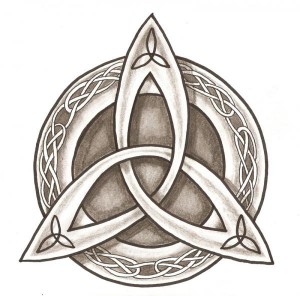
I arise today
Through a mighty strength, the invocation of the Trinity
Through belief in the Threeness
Through confession of the Oneness
Towards the Creator.
Although he probably didn’t actually write it, tradition credits St. Patrick of Ireland with the poetic charm called a “lorica” or “breastplate” which begins with these words, an invocation of the One, Holy, Blessed, and Glorious Trinity whom we today celebrate. Since the time of St. Thomas a Becket, the first Sunday after the Feast of Pentecost has been set aside as day of special veneration of the Triune nature of the Godhead. Becket was consecrated Archbishop of Canterbury on the Sunday after Pentecost, and his first act was to decree that the anniversary of his consecration should be commemorated each year in honor of the Holy Trinity. This observance spread from Canterbury throughout the whole of the western church.
Patrick continues:
I arise today
Through the strength of Christ with his baptism,
Through the strength of his crucifixion with his burial,
Through the strength of his resurrection with his ascension
Through the strength of his descent for the Judgment of doom.
Our Gospel lesson today is the end of Matthew’s Gospel. In it Christ on the mount of the ascension, just before going up into heaven, gives the eleven remaining Apostles what has come to be known as “The Great Commission”:
Go therefore and make disciples of all nations, baptizing them in the name of the Father and of the Son and of the Holy Spirit, and teaching them to obey everything that I have commanded you.
For Matthew mountains are what Celtic Christianity refers to as “thin places,” those places where the separation between the spiritual realm and the physical realm is narrowest, where the veil which separates heaven from earth is nearly transparent so that we have the feeling we could reach out and touch, even enter, the holy presence.
On a mountain, in such a place, Jesus calls his followers to a new beginning. The Eleven, standing proxy for all the followers of Jesus then and now, for you and for me, are called to be people moving in mission. It is important for us to note that this mountain is in Galilee, the place where Jesus began his ministry, the place from which he went forth but to which he returned, the place where he was grounded and rooted. The disciples, too, are from this place and their grounding in the Christian story is this same country where their journey began. Like them, we are called to claim our origins, to be rooted in the place where we entered the Christian story, not to be permanently bound there, but to draw strength from it as we venture out in mission into the wider world beyond. The place where we began as members of the community of Christ is, to each of us, an important place of foundation and also, perhaps, a thin place where we encounter the Triune God.
Patrick’s lorica continues:
I arise today
Through the strength of the love of Cherubim
In obedience to the Angels,
In the service of the Archangels,
In hope of resurrection to meet with reward,
In prayers of patriarchs,
In predictions of prophets,
In preaching of Apostles,
In faith of confessors,
In innocence of Holy Virgins,
In deeds of righteous [people].
Here, St. Patrick claims membership in the Christian community as his source of strength, as his foundation, as the community in which his mission is grounded and from which it is nurtured.
In a few moments, we will do something we have not done since Lent . . . join together in the General Confession, jointly and publically acknowledging that as individuals and as a community we have failed to live up to our obligations, that we have sinned “by what we have done, and by what we have left undone.” And we will be forgiven that failure by God’s absolution which reconciles us and restores us to the community and fellowship of the Church. When, as presiding priest, I pronounce the words of absolution, I speak not on my own behalf but for the whole church to which Jesus gave what is called “the power of the keys” when he said to the Apostles, “I will give you the keys of the kingdom of heaven, and whatever you bind on earth will be bound in heaven, and whatever you loose on earth will be loosed in heaven.” (Mt 16:19; cf. 18:18)
The words of absolution, which I speak as much to myself as to anyone, loose our sins, but also bind us into the beloved community:
Almighty God have mercy on you, forgive you all your sins through our Lord Jesus Christ, strengthen you in all goodness, and by the power of the Holy Spirit keep you in eternal life.
The community with which we are reconciled through confession and absolution is the community of the Trinity.
In the Triune Godhead all Christian community begins and finds its perfect expression. Humankind, as our Genesis reading reminded us, was and is created in the image of God. Thus, we are blessed with reason and skill; we are capable of experiencing emotion; and, like God, we have individual will and freedom of action. To be created in God’s likeness also means that we have the possibility of attaining holiness and immortality. To be created in God’s likeness further means that we are created to experience, participate in, and share interrelationship with others, for we are made in the image of the Holy Trinity.
The Doctrine of the Trinity is not a static principal of faith; it is the way in which the church, through the revelation of God, has come to appreciate and express of the significantly dynamic nature of God in the relationship of the Father, the Son, and the Holy Spirit. If we have been created in the image of God and if God is Trinity then at the deepest level of our being, we are communitarian, created not for ourselves, but for one another, for relationship with each other and with God.
Many look at the mystery of the Trinity as if it were a problem in differential calculus. They seem to have the attitude that if one solves the equation, they will have figured out God and earned their entry into heaven. But, as Benedictine poet Killian McDonnell writes, God is not a problem to be solved:
God is not a problem
I need to solve, not an
algebraic polynomial equation
I find complete before me,with positive and negative numbers
I can add, subtract, multiply.
God is not a fortress
I can lay siege to and reduce.God is not a confusion
I can place in order by my logic.
God’s boundaries cannot be set,
like marking trees to fell.God is the presence in which
I live, where the line between
what is in me and what
before me is real, but only Godcan draw it. God is the mystery
I meet on the street, but cannot
lay hold of from the outside,
for God is my situation,the condition I cannot stand
beyond, cannot view from a distance,
the presence I cannot make an object,
only enter on my knees.
Which brings us back to confession, to reconciliation, and to community.
The community to which and in which we are to be reconciled is not only that of the church or that of the human commonwealth, it is the community of the whole of creation. This is why our round of readings from Sacred Scripture bids us on Trinity Sunday to hear the long lesson from Genesis recounting the days of creation as each part of the natural order is ordained by God and pronounced good. This is the community that Matthew’s Jesus claims when he asserts that “all authority in heaven and on earth has been given to me.” “Heaven and earth” is a figure of speech called a merism, a manner of speaking by which the whole of something is referenced by enumerating its constituents or traits. In the Genesis creation story, heaven and earth comprise a single entity — God’s whole creation. We are a part of that community of creation and it is to that universal community that Patrick next looks in his lorica:
I arise today
Through the strength of heaven:
Light of sun
Brilliance of moon
Splendor of fire
Speed of lightning
Swiftness of wind
Depth of sea
Stability of earth
Firmness of rock.
The whole of nature comprises the foundational community of strength and support upon which a follower of Jesus may depend, because this community finds its strength and support in paradigm community of the Holy Trinity by whom it was creation.
Genesis insists that there is one God, who is sovereign and powerful. Unlike the gods of other peoples in the ancient Middle East, the God of Israel had no specified area of competence. The creation in the first chapter of Genesis is, as one commentator has said, “fiercely monotheistic,” yet even in its insistence on the one God, not limited in space or time, Genesis reveals the Trinity. From this god, the God, a wind, the Holy Spirit, came forth and spread across the void. This god, the God, created everything. This god, the God, simply spoke the Word (“in the beginning was the Word,” said John of Jesus) and creation happened. It is to this god, the God that Patrick looks for strength and protection:
I arise today
Through God’s strength to pilot me:
God’s might to uphold me,
God’s wisdom to guide me
God’s eye to look before me,
God’s ear to hear me,
God’s word to speak for me,
God’s hand to guard me,
God’s way to lie before me,
God’s host to secure me
against snares of devils
against temptations of vices
against inclinations of nature
against everyone who shall wish me ill,
afar and anear,
alone and in a crowd.
But we are never truly alone, nor are we ever really beset by these and the many other spiritual and physical dangers that Patrick goes on to list. St. Paul blessed and reminded his readers, “the grace of the Lord Jesus Christ, the love of God, and the communion of the Holy Spirit” are with us all. Jesus promised and reminded the Eleven (and through them, us), “I am with you always, to the end of the age.”
These are not mere blessings or simple an appeals to get along with one another; these are exhortations to be the new creation that the Spirit of God equips us to be, a foundational community patterned on the Holy Trinity. Just as the Persons of the Divine Trinity are never alone, human beings are created with a need for one another, a need to communicate with one another. Our thirst to communicate ourselves to others, to be in authentic relationship with each other is never exhausted. The only difference between our community and that of the Trinity is that God’s Triune relationship is perfect and total whereas in our human reality communication and relationship are imperfect and partial. Paul’s appeal for the presence of Christ’s grace, God’s love, and the Spirit’s fellowship is an appeal to enter more to the divine love that creates and sustains the church, that perfects and completes our relationships. The Trinity is the very source of our life in Christ, and in Christ we are a new creation with whom Christ promises always to stay.
So in the lorica, Patrick extols the totality of Christ’s presence, the inescapabilty of Jesus’ promise, “I am with you always, to the end of the age.” Patrick writes:
Christ with me,
Christ before me,
Christ behind me,
Christ in me,
Christ beneath me,
Christ above me,
Christ on my right,
Christ on my left,
Christ where I lie,
Christ where I sit,
Christ where I arise,
Christ in the heart of every [person] who thinks of me,
Christ in the mouth of every [person] who speaks of me,
Christ in every eye that sees me,
Christ in every ear that hears me.
Patrick concludes as he began, invoking the One, Holy, Blessed, and Glorious Trinity whom we today celebrate:
I arise today
Through a mighty strength, the invocation of the Trinity,
Through belief in the Threeness,
Through confession of the Oneness
Towards the Creator.
“The grace of our Lord Jesus Christ, and the love of God, and the fellowship of the Holy Spirit, be with us all evermore. Amen.” (2 Cor 13:14 as used to conclude the Daily Office in The Book of Common Prayer, page 102)
====================
A request to my readers: I’m trying to build the readership of this blog and I’d very much appreciate your help in doing so. If you find something here that is of value, please share it with others. If you are on Facebook, “like” the posts on your page so others can see them. If you are following me on Twitter, please “retweet” the notices of these meditations. If you have a blog of your own, please include mine in your links (a favor I will gladly reciprocate). Many thanks!
====================
Father Funston is the rector of St. Paul’s Episcopal Church, Medina, Ohio.
 I sort of remember something from New Testament class at seminary that Paul would compose his letters by dictation to a secretary and then add greetings in his own handwriting. What I can’t remember is whether this verse (which seems such a strange intrusion into the text of the letter to the Galatians) in which he comments on the quality of his penmanship is taken by scholars to be proof of genuine Pauline authorship or as evidence that the letter wasn’t truly written by him. I know it’s one or the other. Whatever . . . it’s in the accepted canon of the New Testament.
 I was listening to the radio yesterday. A golf club president was being interviewed about a professional golfer who had been killed in an air craft incident. I don’t golf or follow the game, so I have no idea who was being profiled, and that’s not relevant here. What is relevant is that the person being interviewed used the euphemism “he passed” to reference the golfer’s death.
  I have to admit that on first reading this, I had no idea what Qoheleth is saying here! Not the slightest.
  We got up this morning to the startling news that a major political figure had been defeated in his party’s primary by a candidate supported by what I would call an extremist fringe element of the party, a group which has gained more say and more influence in the party than it should have. I didn’t write a lectionary reflection until late in the day because, political news junkie that I am, I spent the morning listening to the radio pundits and perusing the on-line publications. Over and over I found the commentators using hyperbolic metaphors — earthquake, tornado, disaster, calamity — and asserting that the defeat was entirely unforeseen. “Wow!” I thought, “They sound like Qoheleth in today’s reading from Ecclesiastes!”
 My stepfather was a good man with faults. That is probably a description that could apply to millions of people, probably most people — good with faults. Whether he would be classed by Qoheleth as “righteous” or as “wicked” — or perhaps somewhere in between — I have no idea. What I do know is that he enjoyed himself.
  “What is truth?” asked Pilate. (Jn 18:38)
 Paul’s military armaments metaphor for facing the powers of sin and death is very well known; it’s quite popular with preachers and commentators. In the sixth chapter of the letter to the church in Ephesus we find him going on and on about the belt of truth, the breastplate of righteousness, the shield of faith, the helmet of righteousness, and the sword of the spirit. You can tell he’s really getting into this image; he’s having fun with it. My favorite bit of the whole thing is our shoes are to be “whatever will make you ready to proclaim the gospel of peace.” (v. 15)
 Can the finite ever truly know the infinite? Can the human mind ever fully grasp the knowledge of God? We have the assurance of Jeremiah’s prophecy, the consolation of God spoken through “the weeping prophet” that it can. And Jeremiah is not alone.
 Jesus healed a paralytic. More than that, he told him that his sins were forgiven! The scribes became irate, accusing Jesus of blasphemy. Jesus asked them, “Which is easier to tell him his sins are forgiven or to tell him to get up and walk?” As a demonstration of power and authority, Jesus did both.

