Occasional thoughts of an Anglican Episcopal priest

Category: Episcopal (Page 64 of 114)

Geographic Assumptions – From the Daily Office – January 16, 2014

From John’s Gospel:

Nathanael said to [Philip], “Can anything good come out of Nazareth?” Philip said to him, “Come and see.”

(From the Daily Office Lectionary – John 1:46 (NRSV) – January 16, 2014.)

Map  of StereotypesWe make many assumptions based on geography. Think of the all the comedians who make a living in North America by joking about stereotypes of Canadians — the television program South Park has made a running gag of Canadian stereotypes for years! Just try saying, as I truthfully can, “I was born in Las Vegas.” You’ll be very surprised by the reactions and the seriously ridiculous comments (I no longer am).

Although my wife is not a Las Vegan (she’s from a town in northeastern Nevada), we met and were married there. When I say that to someone in her presence — “We were married in Las Vegas” — she always adds “in a large church wedding.” She knows full well that the immediate assumption raised by my statement is that our marriage took place at the Little Chapel in the Parking Lot Behind Caesar’s Palace or some similar establishment.

Nathanael is voicing geographic assumptions in his question to Philip. In word, he is stereotyping.

Nazareth in Galilee, north of Jerusalem, was a nothing town, a poor, back water village of maybe 500 people ignored by nearly everyone, not only the Roman Empire but even by its nearby neighbors. Its residents were the First Century Jewish equivalent of hillbillies. It was not the sort of place from which one expected anything great, or anything at all . . . even an inhabitant of a similar neighboring town (like Bethsaida) could turn his nose up at it!

There are plenty of such places in the world today; there are many, many modern-day Nazareths. Every empire has its left-behind, forgotten, impoverished villages, its places from which no one expects any good thing to come. The spirit of Nazareth lives on in the slums and abandoned neighborhoods of Detroit, of Rio de Janeiro, of Calcutta, of hundreds of cities and towns around the globe.

“Can anything good come from [fill in the blank . . . I’m sure you know a place]?”

Philip’s answer to Nathanael is “Come and see.” God has two answers. The obvious answer: Yes! The less obvious answer is an admonition to stop stereotyping. If we can learn to take off the blinders of our geographic (and other) assumptions, if we can give up the habit of stereotyping, we will see greater things.

====================

A request to my readers: I’m trying to build the readership of this blog and I’d very much appreciate your help in doing so. If you find something here that is of value, please share it with others. If you are on Facebook, “like” the posts on your page so others can see them. If you are following me on Twitter, please “retweet” the notices of these meditations. If you have a blog of your own, please include mine in your links (a favor I will gladly reciprocate). Many thanks!

====================

Father Funston is the rector of St. Paul’s Episcopal Church, Medina, Ohio.
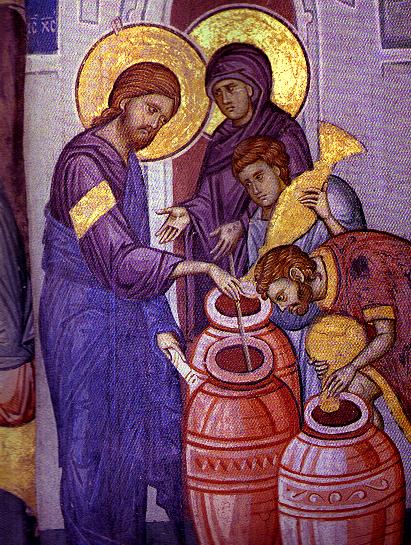
Unknown Ailments – From the Daily Office – January 15, 2014

From the Letter to the Hebrews:

Since, therefore, the children share flesh and blood, he himself likewise shared the same things, so that through death he might destroy the one who has the power of death, that is, the devil, and free those who all their lives were held in slavery by the fear of death.

(From the Daily Office Lectionary – Hebrews 2:14-15 (NRSV) – January 15, 2014.)

Low Back PainWhat is fear of death but fear of the unknown? The fear of death and the unknown brings anxiety, despair, and a frantic search for meaning. The fear of death and the unknown distracts us and makes us afraid to truly live. We end up fearing both death and life; we end up not attending to those things which are most important.

Yesterday, I woke up with an aching lower back. As the day progressed, the ache became acute, changing from ache to stabbing pain; it localized itself on the right side of my back. When the stabbing sensations occurred, the pain radiated around my right flank and into my abdomen. They got worse. “Kidney stone,” I thought, “I must have a kidney stone.” I’ve never had a kidney stone, but what I was experiencing seemed to be exactly what others have described as the symptoms of a kidney stone. I decided to seek medical advice.

It turned out to be no help. Diagnostic activities (urinalysis and a CAT scan) said it wasn’t a kidney stone. So what was it? What is it? It’s still here. I woke up with it again today. I’ve taken pain medication and applied heat, and they have helped with the discomfort . . . but the source remains unknown.

So I am concerned. Is my concern “fear?” Yes, to some extent it is. Is it disabling? It’s certainly distracting! Both the pain, which limits my motion, and the concern (or fear) which keeps my attention focused on it, and thus not on . . . my prayers, my work, my regular activities, the things important in my life . . . the distraction holds me in thrall. My imagination runs wild and I envision all sorts of dire and deadly medical conditions to explain my pain, when I know full well it’s probably nothing more than a pulled muscle. To the extent that I focus on the pain and its unknown source, I am a slave to my discomforts, both physical and psychological.

A petition from an old Scottish litany prays: “From ghoulies and ghosties, and long-leggedy beasties, and things that go bump in the night, Good Lord, deliver us!” It is a prayer for release from the fear of the unknown, a release the Letter to the Hebrews assures us we have already been given. The power of the unknown has been destroyed by God in Jesus sharing our flesh and blood, with all of its aches and pains and unknown ailments.

So today, I choose to be free of the pain. I may still feel it, but I won’t let it or fear of its still-unknown source distract me from getting on with life.

====================

A request to my readers: I’m trying to build the readership of this blog and I’d very much appreciate your help in doing so. If you find something here that is of value, please share it with others. If you are on Facebook, “like” the posts on your page so others can see them. If you are following me on Twitter, please “retweet” the notices of these meditations. If you have a blog of your own, please include mine in your links (a favor I will gladly reciprocate). Many thanks!

====================

Father Funston is the rector of St. Paul’s Episcopal Church, Medina, Ohio.

Angelic Toddlers – From the Daily Office – January 14, 2014

From the Book of Genesis:

The Lord God sent [Adam] forth from the garden of Eden, to till the ground from which he was taken. He drove out the man; and at the east of the garden of Eden he placed the cherubim, and a sword flaming and turning to guard the way to the tree of life.

(From the Daily Office Lectionary – Genesis 2:23-24 (NRSV) – January 14, 2014.)

Putti with Book by Giovanni Battista Tiepolo, 1744Look up cherub in a secular dictionary and this is what you find: “a member of the second order of angels, often represented as a beautiful rosy-cheeked child with wings.” (Collins) I don’t know why, when, or how the fat little boys with aerodynamically inadequate wings came to be an artistic and now normative depiction of cherubs, but there it is! Technically, these little guys (and they are male) are known as putti — an Italian plural; the singular is putto. (Putto is occasionally used in modern Italian to mean a male toddler.)
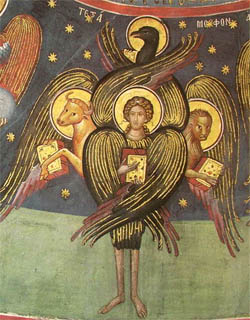

Say the word cherub (or its adjectival form, cherubic) to nearly anyone, and the image that will spring to his or her mind is almost guaranteed to be a putto. For me, this inaccurate representation of the cherubim has become the poster child for everything that needs to be unlearned.

As the end of the story of the Garden of Eden ought to make clear, the cherubim are beings of immense power, stationed on the path to the tree of life wielding flaming swords. They are the bearers of the throne of God (see Isaiah 37:16). Ezekiel describes the cherubim when recounting his vision of “four living creatures” whom he later identifies as cherubim:

Tetramorph, Fresco at Meteora Monastery

They were of human form. Each had four faces, and each of them had four wings. Their legs were straight, and the soles of their feet were like the sole of a calf’s foot; and they sparkled like burnished bronze. Under their wings on their four sides they had human hands. And the four had their faces and their wings thus: their wings touched one another; each of them moved straight ahead, without turning as they moved. As for the appearance of their faces: the four had the face of a human being, the face of a lion on the right side, the face of an ox on the left side, and the face of an eagle. (Ezek. 1:5b-10; cf. Ezek. 10)

Although our error of imagination in regard to the appearance of the cherubim can be easily corrected by a few minutes of bible study like this, the larger issue of unlearning is not so quickly or easily dealt with.

An old comedy album by the group the Firesign Theatre was entitled Everything You Know Is Wrong. I wouldn’t go that far, but we are conditioned by our families, societies, and culture to “know” many things . . . and much what we “know” as a result of that conditioning is simply inaccurate. Before we can know the truth, we have to unlearn the things of which we are convinced because of our conditioning.

Unlearning, however, is not simply replacing inaccuracies with “true facts.” It is not about right or wrong. Unlearning is an attitude of openness to that which lies beneath the judgment of right or wrong. It is about “moving away from” rather than “moving towards.” Zen masters often use the metaphor of emptying a full cup of tea. There is nothing beyond the emptying. The cup is not emptied so that it can be refilled; it is emptied so that it can be empty. Only when it is truly empty with no expectation or anticipation of being filled is the cup open to the future.

Jesus used another metaphor, that of an innocent child: “Truly I tell you, whoever does not receive the kingdom of God as a little child will never enter it.” (Mark 10:15)

So perhaps our chubby little wingéd friends, those little angelic toddlers, are a good image after all. If they are, as I suggested, the poster children for unlearning, let’s think about the way toddlers receive things.

A way to unlearn might be to try to go back to our first learning experiences and explore new things as toddlers would, through playfulness and curiosity. Toddlers never seem to have a plan, no preconceived notion of where they are going, no expectation of what is coming next. Jiddu Krishnamurti, the Indian philosopher, often described truth as a “pathless land;” toddlers seem to live in such a pathless country, a place of endless discovery. This, I think, is where Jesus invites: to a place where we can open ourselves, empty ourselves, and unlearn our conditioning, to the pathless country of truth where we can wander like a toddler with playfulness and deep curiosity.

====================

A request to my readers: I’m trying to build the readership of this blog and I’d very much appreciate your help in doing so. If you find something here that is of value, please share it with others. If you are on Facebook, “like” the posts on your page so others can see them. If you are following me on Twitter, please “retweet” the notices of these meditations. If you have a blog of your own, please include mine in your links (a favor I will gladly reciprocate). Many thanks!

====================

Father Funston is the rector of St. Paul’s Episcopal Church, Medina, Ohio.

The Boa and the Wart-Hog – From the Daily Office – January 13, 2014

From the Letter to the Hebrews:

“In the beginning, Lord, you founded the earth, and the heavens are the work of your hands; they will perish, but you remain; they will all wear out like clothing; like a cloak you will roll them up, and like clothing they will be changed. But you are the same, and your years will never end.”

(From the Daily Office Lectionary – Hebrews 1:10-12 (NRSV) – January 13, 2014.)

The writer of the Letter to the Hebrews quotes from Psalm 102 and asserts that the words are spoken by God the Father to the Son. In The Book of Common Prayer (TEC 1979), the verses quotes read:

Constrictor with Prey

In the beginning, O Lord, you laid the foundations of the earth,
and the heavens are the work of your hands;
They shall perish, but you will endure; they all shall wear out like a garment;
as clothing you will change them, and they shall be changed;
But you are always the same,
and your years will never end.
(Psalm 102:25-27 – BCP Version)

The lessons today focus on beginnings — the Old Testament lesson is the second (but older) creation story from the Book of Genesis and the Gospel lesson is the prologue of John’s Gospel. The epistle and the psalm which it quotes, however, remind us of endings: created things “will all wear out like clothing; like a cloak you will roll them up.” I’ve always thought that a wonderful poetic metaphor for theoretical entropic nature of the universe, the idea that all of the matter and energy in the universe will ultimately degrade to a state of inert uniformity.

That these lessons of cosmic beginnings and endings are on the lectionary today is a coincidence that somehow seems appropriate as the world says “Good-bye” to Dr. Ian Barbour, who died yesterday at the age of 90. Barbour was a physicist who embraced the truth of the Christian faith while holding fast to the ethic of scientific inquire; he demonstrated to the world that there is no contradiction between the pre-scientific religious stories of creation and the scientific explanation of the universe’s beginnings.

When he won the Templeton Prize in 1999, Dr. Barbour said:

If we take the Bible seriously but not literally, we can accept the central biblical message without accepting the prescientific cosmology in which it was expressed, such as the three-layer universe with heaven above and hell below, or the seven days of the creation story.

In his book Religion in an Age of Science (Harper San Francisco: 1990), Dr. Barbour proposed a colorful metaphor for the relationship between science and religion, decrying what he called (with characteristic understatement) the “misuse” of each in the extremes of scientific materialism and biblical literalism:

Warthog

In a fight between a boa constrictor and a wart-hog, the victor, whichever it is, swallows the vanquished. In scientific materialism, science swallows religion. In biblical literalism, religion swallows science. The fight can be avoided if they occupy separate territories or if, as I will suggest, they each pursue more appropriate diets.

He wrote that “our personal and social lives are intimately bound to the rest of the created order. We are redeemed in and with the world, not from the world. Part of our task, then, is to articulate a theology of nature, for which we will have to draw from both religious and scientific sources.” The wart-hog and the boa constrictor each have their part to play and their perspectives to contribute. Unfortunate, there are many who still encourage them to fight to the death rather than change their diets and cooperate. We need fewer leaders of that sort in both religion and science, and more like Dr. Barbour, to whom we say, “Well done, good and faithful servant; rest in peace and rise in glory.”

====================

A request to my readers: I’m trying to build the readership of this blog and I’d very much appreciate your help in doing so. If you find something here that is of value, please share it with others. If you are on Facebook, “like” the posts on your page so others can see them. If you are following me on Twitter, please “retweet” the notices of these meditations. If you have a blog of your own, please include mine in your links (a favor I will gladly reciprocate). Many thanks!

====================

Father Funston is the rector of St. Paul’s Episcopal Church, Medina, Ohio.

Gimmicks Distract – From the Daily Office – January 11, 2014

From the Psalter:

Hallelujah!
Praise God in his holy temple;
praise him in the firmament of his power.
Praise him for his mighty acts;
praise him for his excellent greatness.
Praise him with the blast of the ram’s-horn; *
praise him with lyre and harp.
Praise him with timbrel and dance;
praise him with strings and pipe.
Praise him with resounding cymbals;
praise him with loud-clanging cymbals.
Let everything that has breath
praise the Lord.
Hallelujah!

(From the Daily Office Lectionary – Psalme 150 (BCP Version) – January 11, 2014.)

Clown Presiding at CommunionThe musical Godspell debuted in 1971 (my junior year in college); in it, Christ is portrayed as a clown. Whether it was an expression of or the catalyst for the phenomenon of offering clown eucharists as an edgy, avant-garde presentation of the Christian Mysteries, I really don’t know. The two are inextricably linked in my memory.
And . . . to be honest, I never cared for either. And . . . being further honest, that may be because I have never like clowns. I find them creepy. On the other hand, a bishop of whom I was very fond and for whom I had great respect, loved Clown Eucharists. He had a set of clown-decorated vestments made; he offered a clown eucharist at least once each year (often at diocesan convention) throughout his episcopate. They may have resonated for him because, unlike me, he loved clowns.

But I didn’t (and don’t) and so the clown eucharist was, for me, a distraction. I couldn’t get passed the gimmick, the clown images and the circus music, to the Christ at the center of mass. The clown gimmick, not the foolishness of God to which it was supposedly pointing, took over and seemed to be the point of the whole thing.

Some years later, when the music of U2 became popular and new generation were finding spiritual meaning in the band’s lyrics, someone put together a celebration of the Holy Mysteries in which that music played a part — the major part — it was the only music — and promoted the event as a U2charist.

“Right,” I thought. “The clown eucharist in a new guise.” Again, for me, the gimmick (the U2 music) distracts from the principal focus. I attended a U2charist and, for me, all I heard was the band’s music; I didn’t hear the gospel. That’s not to say it wasn’t there; it may have been. I just couldn’t hear it through the distraction of the soundtrack.

Since then I have heard of (but not attended) celebrations of Holy Communion in which the music was all from the Beatles canon, or all “oldies” from the 1960s, or all Broadway show tunes . . . and I wouldn’t be surprised if there have been other similar “thematic” eucharists. All, I think, the descendants of the clown masses of the 1970s — attempts to package the Christian Mysteries in edgy and avant-garde ways to present them to a target audience, to sneak the gospel message in under the guise of entertainment.

Now, don’t get me wrong. Let me hasten to say that I think entertainment is fine. If clowns float your boat, go the circus! If you like the music of U2 (and I do), listen to it! If you like Broadway musicals (and I do), go to the theater! And if you find something of spiritual import in those entertainments (and I do), great! Make use of it in your spiritual life and, even, in church services and celebrations.

The last of the psalms encourages the people of God to make use of many forms of entertainment, symbolized by musical instruments — trumpets and horns (the ram’s horn), stringed instruments, percussion, wood winds — and dance, in their worship. So I believe it’s fine to make use of clowns, to use of U2’s music, to sing the Beatles’ lyrics, to offer the tunes from Broadway shows as part of the liturgy.

But when these things become the reason for the service, when we name the service for the clowns or the bands or the theater district, the tool meant to be used for praising God has become the object of praise. The psalm says, “Praise God with strings and pipe,” not “Praise the strings and pipe;” “Praise God with resounding cymbals,” not “Praise the cymbals.”

Others, I am quite certain, will have found the U2charists a path to God. Other, I know, will have found in the Beatles mass and in the Broadway eucharists the truth of the gospel. After all, that bishop whom I really did love found Christ in clowns no matter how creepy I may have found them!

But for me, these feel “gimmicky” — one or two Beatles songs might be used to good effect, but nothing but Beatles music through the whole service? Not so much. U2’s Gloria could certainly stand as a liturgical piece, but all U2 music throughout the mass? Too much of a good thing. I’m not sure that I can say anything positive about clowns . . . but someone might, perhaps. My point is that themed eucharists like these, in which the theme predominates, feel like gimmicks. It feels to me like we have stopped praising God with the clowns and have started praising the clowns; the gimmick distracts. Praise God with the gimmick, but don’t praise the gimmick!

====================

A request to my readers: I’m trying to build the readership of this blog and I’d very much appreciate your help in doing so. If you find something here that is of value, please share it with others. If you are on Facebook, “like” the posts on your page so others can see them. If you are following me on Twitter, please “retweet” the notices of these meditations. If you have a blog of your own, please include mine in your links (a favor I will gladly reciprocate). Many thanks!

====================

Father Funston is the rector of St. Paul’s Episcopal Church, Medina, Ohio.

WYSIWYG World – From the Daily Office – January 10, 2014

From the Letter to the Colossians:

Therefore do not let anyone condemn you in matters of food and drink or of observing festivals, new moons, or sabbaths. These are only a shadow of what is to come, but the substance belongs to Christ.

(From the Daily Office Lectionary – Colossians 2:16-17 (NRSV) – January 10, 2014.)

Green-on-Black TextI sometimes wonder to what extent Paul, as an educated Jewish citizen of a Greek-speaking empire, was schooled in the classical Greek philosophers. Had he read Plato’s Republic? Was he aware of the conversation portrayed in Book VII between Socrates and Glaucon in which the allegory of the cave is laid out?

In the dialog, Socrates describes a prison cave in which the inmates have lived all of their lives chained in such a way that all they can see is a blank wall. The prisoners watch shadows formed on the wall by things passing between them and a fire behind them. They recognize the shadows, give them the names of the things which cast them, and believe them to actually be those things. The shadows, says Socrates, are as close as the inmates get to viewing reality. According to Socrates, a philosopher is like a prisoner who is loosed, sees the real forms casting the images, and comes to understand that the shadows are not reality at all. He is aware of the true form of reality, not the shadows seen by the chained inmates. The story illustrates Plato’s “Theory of Forms,” which holds that things in the material world perceivable through sensation are mere “shadows” of ideal “forms.” These “forms,” not the “shadows,” possess the highest and most fundamental reality.

When Paul writes things like “these are only a shadow . . . the substance belongs to Christ,” he seems to be buying into this Platonic idea. His famous line from the first letter to the church in Corinth seems to do so as well: “For now we see in a mirror, dimly, but then we will see face to face. Now I know only in part; then I will know fully, even as I have been fully known.” (1 Cor. 13:12) Take these sorts of Pauline statements and mix them with the Letter to the Hebrews (“They offer worship in a sanctuary that is a sketch and shadow of the heavenly one.” – Heb. 8:5) and even a bit of James (“Every generous act of giving, with every perfect gift, is from above, coming down from the Father of lights, with whom there is no variation or shadow due to change.” – James 1:17), and one can see where the Neoplatonists and even the Gnostics get the notion that the material world is less than ideal, fallen, corrupt, or even evil. That’s a position that, unfortunately in my opinion, has made a significant impact on Christian theology.

It is also not a view to which the Hebrew Scriptures lend much support and one doubts very much that it was the opinion of Jesus of Nazareth! Oh sure, there are hints of it in Hebrew poetry and prayer. For example, King David prays with the assembly of the people: “For we are aliens and transients before you, as were all our ancestors; our days on the earth are like a shadow, and there is no hope.” (1 Chron 29:15) And Bildad the Shuhite advises Job: “For we are but of yesterday, and we know nothing, for our days on earth are but a shadow.” (Job 8:9) And from time to time the Psalms say things like the description of human beings as “like a breath; their days are like a passing shadow.” (Ps. 144:4) But on the whole, the Old Testament and (I suggest) the Christian faith declare a much different understanding of reality!

Just read the accounts of creation in Genesis! God is not shown to be casting shadows; God is creating hard, physical reality and, at each step along the way, declares it good. In the second account (which is probably the older of the two), God gets God’s hands dirty in all that good, hard, physical reality molding human beings out of the clay. I’m particularly fond of poet James Weldon Johnson’s retelling of that story (which I quoted in last Sunday’s sermon):

Up from the bed of the river
God scooped the clay;
And by the bank of the river
He kneeled Him down;
And there the great God Almighty
Who lit the sun and fixed it in the sky,
Who flung the stars to the most far corner of the night,
Who rounded the earth in the middle of His hand;
This Great God,
Like a mammy bending over her baby,
Kneeled down in the dust
Toiling over a lump of clay
Till He shaped it in His own image;
Then into it He blew the breath of life.

(“The Creation”, from God’s Trombones)

When I was a second-year student at law school I was a member of the law review where we used some very early word processing equipment and software in which one had to enter the codes for changes in typeface, indentation, and so forth (not too dissimilar from writing HTML code, frankly). What you looked at on the green-on-black computer screen bore no resemblance to what (you hoped) the printer would produce. The next year, when I became an editor, we purchased a new computer and were introduced to a new concept – “WYSIWYG” (pronounced “wissy-wig”) – What You See Is What You Get. What was on the screen looked like what the printer produced!

I believe that’s the kind of world we have been given, one in which what we perceive is real. Yes, I know that quantum mechanics and superstring theory bring that into some question, that at some super-micro-nano-reality level things are not quite what they seem; but that is a different issue than this philosophical nothing-is-really-real shadow-world construct of Plato’s, and a far cry from the fallen, corrupt, evil world of some Christian theologies. We live in a real, physical world, one in which God was pleased to take on flesh and dwell among us (John 1:1-14).

When I see beautiful winter hillside covered with glistening snow, when I taste a sweet-tart bite of homemade cherry pie, when I kiss my wife or hug my daughter, when I listen to a Vivaldi concerto, I am seeing/tasting/feeling/hearing what I get, not some shadow of an unseen and unknowable “ideal form.” Like that mammy bending over her baby, what I am experiencing is real and good; it is the ideal. We live in a WYSIWYG world!

====================

A request to my readers: I’m trying to build the readership of this blog and I’d very much appreciate your help in doing so. If you find something here that is of value, please share it with others. If you are on Facebook, “like” the posts on your page so others can see them. If you are following me on Twitter, please “retweet” the notices of these meditations. If you have a blog of your own, please include mine in your links (a favor I will gladly reciprocate). Many thanks!

====================

Father Funston is the rector of St. Paul’s Episcopal Church, Medina, Ohio.

An Anglo-Catholic Procession in a Midwestern Church – A Poem

Procession of Re-ordained in a Church

An Anglo-Catholic Procession in a Midwestern Church

Wearing his cope like a leather jacket and jeans,
the priest steers the procession,
a diesel truck with an oversized trailer
turning left through the narrow
two-laned small-town streets
of the congregation’s protestant piety,
heedless of the fenders of their faith
hastily backed away
from the crosswalk of the center aisle.

The thurible-swinging acolyte,
like the chrome-plated grill of a monstrous tractor
giving notice of the behemoth’s approach,
barrels on toward his goal,
smoke like diesel exhaust billowing
around and over the crucifer’s head.
If I pump my right fist arm raised high
like a kid in a passing Coupe de Ville,
will he let out with the shriek of an air horn?

The choir swings wide, rolling off the pavement,
leaving a deep polyphonic rut
in the garden sensibilities of the faithful
at the edge of the road.
Slightly over-correcting, they get back on track
and find the coda in the choir loft.
Torch-bearers and eucharistic ministers,
sub-deacon and deacon,
shudder and stumble to their places,
an 18-wheeler with defective air brakes.

“Blessed be God . . . ”
intones the trucker celebrant;
“And blessed be his kingdom . . . ”
sighs the relieved assembly.

(By C. Eric Funston)

Illustration: Procession of re-ordained in a church by Paolo Uccello (1469)

Sweetgum Balls – From the Daily Office – January 9, 2014

From the Psalter:

Have mercy upon us, O Lord, have mercy,
for we have had more than enough of contempt,
Too much of the scorn of the indolent rich,
and of the derision of the proud.

(From the Daily Office Lectionary – Psalm 123:4-5 (BCP Version) – January 9, 2014.)

Sweetgum Balls on SnowThere’s a lot of talk these days about “class warfare,” most of it sheer nonsense. There is, it must be admitted, a growing class divide, an increasing gap between the wealthiest Americans and the rest of us. One might be tempted to write about that in light of this psalm’s reference to the “scorn of the indolent rich” and the “derision of the proud.” But, let’s face it . . . scorn, derision, contempt, and generally obnoxious conduct transcend class and other distinctions.

Prickly, disagreeable people come in all income groups, all races, all genders and sexual preferences, all religions . . . in any grouping of human beings you care to make. Indeed, everyone of us can be and are, from time to time, prickly and unpleasant. A lot of the time, we are completely oblivious to our own unpleasantness.

Driving past our town square yesterday afternoon, I noticed that a sweet gum tree had shed its empty seedpods, the hard, prickly fruit littering the snow all around the trunk. I rolled down the car window, pulled out my smartphone and took this picture (which came out a bit unfocussed). I thought I might use it as inspiration (or illustration) for a poem. And then this psalm came up on the lectionary rotation and the sweet gum was an obvious metaphor.

Unpleasant people drop little bombs of scorn, little grenades of derision all around them. They mar the world around them the same way the sweet gum tree’s seedpods mar the snow around the tree. But like the tree, they are unaware (or uncaring) of the damage they are doing and seem unable (or unwilling) to bend; they lack the flexibility to remedy the mess they create around them.

The psalmist is right to pray for deliverance from such folk . . . but more importantly we should pray for change in ourselves, that we not be prickly, contemptuous, and scornful towards those around us. Jesus once said to his listeners:

Why do you see the speck in your neighbor’s eye, but do not notice the log in your own eye? Or how can you say to your neighbor, “Let me take the speck out of your eye,” while the log is in your own eye? You hypocrite, first take the log out of your own eye, and then you will see clearly to take the speck out of your neighbor’s eye. (Matt. 7:3-5, NRSV)

In terms of the tree on square . . . deal with your own prickly seedpods of contempt, scorn, or derision before criticizing another’s.

====================

A request to my readers: I’m trying to build the readership of this blog and I’d very much appreciate your help in doing so. If you find something here that is of value, please share it with others. If you are on Facebook, “like” the posts on your page so others can see them. If you are following me on Twitter, please “retweet” the notices of these meditations. If you have a blog of your own, please include mine in your links (a favor I will gladly reciprocate). Many thanks!

====================

Father Funston is the rector of St. Paul’s Episcopal Church, Medina, Ohio.

Be Glad – From the Daily Office – January 8, 2013

From the Psalter:

This is the day that the Lord has made; let us rejoice and be glad in it.

(From the Daily Office Lectionary – Psalm 118:24 (NRSV) – January 8, 2014.)

Whirling DervishesMy wife and I met at a Cursillo three-day weekend event. I was a part of the team (one of the cooks) putting on the Cursillo; she was “making” her Cursillo (as the lingo has it). She claims we’d met before at a fund-raiser fair at my parish (she attended elsewhere), but I was very busy during the fair and don’t recall that. I remember meeting her at the Cursillo weekend.

The Cursillo movement and the Cursillo community became an important of the early years of our marriage. We married about six months after meeting and in another six months we relocated to another state where I attended law school. There was an active Cursillo community in that location and we became involved.

An eye-opening move, that was. We discovered that the Cursillo community in our original home had been doing things incorreclty! Not just different. They’d been wrong. They’d been violating of the agreement between the Episcopal Church and the Roman Catholic Cursillo Movement, which had licensed the Cursillo method to the Episcopalians. And, we later learned, they knew they’d been doing so.

This comes to mind today because one of the major elements of a Cursillo weekend is music. In those communities, it was the sort of music that today might be called “praise choruses” or “church folk” or “contemporary.” Simple, easily remembered, repetitive songs accompanied by guitars, banjos, tambourines, bongos. One song common to both communities was based on this verse; in fact, it was this verse so far as I can remember.

There may have been verses and this may simply have been the chorus, but all I can recall is this verse: “This is the day, this is the day, that the Lord has made, that the Lord has made. We will rejoice, we will rejoice, and be glad in it, and be glad in it.” A catchy, bouncy little tune to which one could dance a formless dance, whirling like a dervish! It was easy to get caught up in and it demonstrated to me the spiritual power of music, simple melodies, and physical movement. Whirling and spinning and experiencing the power of the Spirit!

When my wife and I returned to our original home after three years in law school, we were asked to be the leaders of a coeducational three-day Cursillo event. We agreed, but we said we wanted to try to abide by the agreement between our church and the Roman Catholics, to discontinue those practices which violated the accord, to keep faith with our brothers and sisters who had gifted us with the Cursillo as a tool for deepening the faith of mature Christians.

There was push-back. In fact, there was outright rebellion. Members of the community refused to sponsor candidates to the weekend we were to lead; others refused to contribute to the cost of the event. Evelyn and I resigned from leadership and felt we had no choice but to withdraw from the community.

What had been an important support for us in the early years of married life became a source of grief and sadness. It still is. We miss being a part of that community and we miss the nearly automatic entry being in the Cursillo community gave us to a wider circle of church friends when we relocated. Where we live now, there is no active Cursillo community so the sharpness of the grief is dulled; there are no “Reunions,” nor “Ultreyas” (as the regular get-togethers of Cursillistas are called), so no constant reminders that we are no longer a part of Cursillo.

And yet we rejoice that we were fortunate to have been called to that community. It’s where we met; it sustained us. Like each day the Lord makes, it has passed. When it was here, we rejoiced in it and we were glad. And we look back on it still with gratitude. When I think of it, I think of this verse and that danceable chorus, and my soul comes alive in the Spirit, whirling and spinning, and expressing the joy that community gave us . . . and how grateful I am to that experience for the gift of my wife and the family we have created.

Everyday is a new day that the Lord has made; we will rejoice and be glad in it, whirling and spinning in the power of the Spirit.

====================

A request to my readers: I’m trying to build the readership of this blog and I’d very much appreciate your help in doing so. If you find something here that is of value, please share it with others. If you are on Facebook, “like” the posts on your page so others can see them. If you are following me on Twitter, please “retweet” the notices of these meditations. If you have a blog of your own, please include mine in your links (a favor I will gladly reciprocate). Many thanks!

====================

Father Funston is the rector of St. Paul’s Episcopal Church, Medina, Ohio.

Choosing Life – From the Daily Office – January 7, 2013

From the Book of Deuteronomy:

He humbled you by letting you hunger, then by feeding you with manna, with which neither you nor your ancestors were acquainted, in order to make you understand that one does not live by bread alone, but by every word that comes from the mouth of the Lord.

(From the Daily Office Lectionary – Deuteronomy 8:3 (NRSV) – January 7, 2014.)

Manna from Heaven CartoonJesus and a crowd who challenge his authority also make reference to the manna in today’s Daily Office gospel lesson in which Jesus says: “Your ancestors ate the manna in the wilderness, and they died. This is the bread that comes down from heaven, so that one may eat of it and not die. I am the living bread that came down from heaven. Whoever eats of this bread will live for ever; and the bread that I will give for the life of the world is my flesh.” (John 6:49-51)

So I know that I really ought to be thinking pious thoughts about the Eucharist, or something . . . .

But, truth be told, what I’m really led by these lessons to think about is dieting and weight loss. Damn it!

Back in late September, I was having trouble fastening my trousers and avoiding stepping onto the bathroom scale, but eventually I did so and was appalled at the number it gave me. So I decided to do something about it and, before going public, lost a few pounds. When I was down to 273 lbs. (273! For God’s sake!) I decided I needed the “moral support” of my congregation, so inspired by another priest who had done so, I created a “Reduce the Rector” campaign and asked people to pledge dollars against pounds lost.

By Thanksgiving I’d lost 20 pounds, and then . . . well, let’s just say there was a diet hiatus through New Year’s. Fortunately, only a pound and a half was regained. But, now . . . .

Now Moses and Jesus are talking about food and more than food and reminding me that I need to focus on the healthier stuff that God has in store for me. Moses’ line about being “humbled” by the food eaten (the manna) and Jesus’ comment that “they ate and they died” really put a zinger into it. Food, too much of it and not the right kinds of it, is a humbling thing for me and I know if I don’t change the way I deal with it, it will kill me. High cholesterol, hypertension, blood sugar issues, joint pain, tendonitis . . . in some way or another, they are all related to the excess weight I am embarrassed to carry.

So . . . end of diet hiatus. Back to healthy eating and (even in the frigid cold) taking walks and getting more exercise.

The annotations to Deuteronomy tell me the last verse of the passage has an alternative reading: “One does not live by bread alone, but by anything that the Lord decrees.” I’m going to start focusing on something else God decreed through Moses: “Choose life so that you and your descendants may live!” (Deut. 30:19) I choose healthy eating and healthy living; I choose life.

====================

A request to my readers: I’m trying to build the readership of this blog and I’d very much appreciate your help in doing so. If you find something here that is of value, please share it with others. If you are on Facebook, “like” the posts on your page so others can see them. If you are following me on Twitter, please “retweet” the notices of these meditations. If you have a blog of your own, please include mine in your links (a favor I will gladly reciprocate). Many thanks!

====================

Father Funston is the rector of St. Paul’s Episcopal Church, Medina, Ohio.

« Older posts Newer posts »