From the Psalter:
He shall deliver you from the snare of the hunter
and from the deadly pestilence.
He shall cover you with his pinions,
and you shall find refuge under his wings;
his faithfulness shall be a shield and buckler.
You shall not be afraid of any terror by night,
nor of the arrow that flies by day;
Of the plague that stalks in the darkness,
nor of the sickness that lays waste at mid-day.
(From the Daily Office Lectionary – Psalm 91:3-6 (BCP Version) – March 28, 2014.)
 The past couple of weeks my wife and I have suffered the slings and arrows of some sort of intestinal virus, or so we think. She had it first, seemed to get better, suffered a relapse. I didn’t seem to “catch” it from her, but a few days after her last bout I suffered an attack of what I thought was “food poisoning.” Three days later I’m not so sure.
In any event, it’s the sort of thing we’ve all suffered through and can hardly be described as “the deadly pestilence” or “the plague that stalks in the darkness” or “the sickness that lays waste at mid-day.” Still, reading this psalm today I have some small appreciation for the terror with which populations in pre-scientific societies must have viewed disease.
Today, of course, we have antivirals, antibiotics, and other medications to assist in treatment of these ills. We have indoor plumbing and sewage systems to remove the stuff our bodies produce when fighting them off. We know what causes these complaints and what the body needs in the way of fluids, rest, and other care to be best able to combat the infections.
We have all of that because modern science and modern medicine have done the hard work of scientific research, experimentation, and discovery. How did that get started? By religious people . . . by people of faith seeking to understand the Creation with which God had entrusted them.
For example, the 13th Century Franciscan, Roger Bacon was instrumental in formulating the process of research now generally called “the scientific method.” Further, he defended the need to utilize the philosophical and scientific writings of the ancient Greeks in Christian theology. It was his position that what was then called “natural philosophy” provided an essential complement to theology.
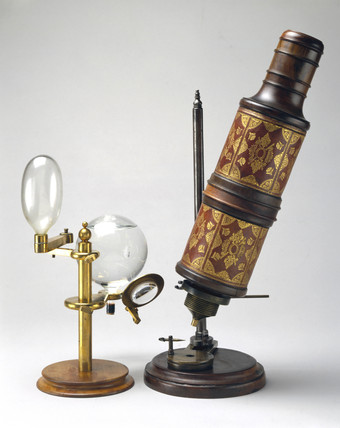
Another is Robert Hooke, the 17th Century Anglican who first saw cells in living matter and, in fact, coined the term “cells” (drawn from analogy to monastic cubicles). Hooke was the son and brother of Anglican clergymen and was the student of Dr. Richard Busby who had championed the church’s role in scientific investigations. In addition to his scientific achievements, Hooke was a devout church member who sang in choirs and designed church buildings.
Joseph Lister, the Scottish physician who pioneered modern surgery, did research into sepsis and infection, and developed modern antiseptic techniques. His name lives on in the antimicrobial mouthwash Listerine. He was raised a Quaker and later in life became an active member of the Scottish Episcopal Church. Lister has been quoted as saying, “I am a believer in the fundamental doctrines of Christianity.”
My point in rattling off this list of religiously-inclined scientists whose work laid the foundation for our modern understanding of disease and illness (and there are many, many others) is two-fold. First, there is (or, at least, there should be) no conflict between science and religion, despite what the hard-line proponents on either side of that divide may think or say. Second (and most pertinent to my Daily Office reading and experience today), it is through the work of these pioneers that we are no longer at the mercy of “the plague that stalks in the darkness” or “the sickness that lays waste at mid-day.” It is through the work of generations of scientists (believers and non-believers alike) that God has delivered us from “the deadly pestilence.”
So today, I sip my Gatorade and take my medications thankful to God for that deliverance.
====================
A request to my readers: I’m trying to build the readership of this blog and I’d very much appreciate your help in doing so. If you find something here that is of value, please share it with others. If you are on Facebook, “like” the posts on your page so others can see them. If you are following me on Twitter, please “retweet” the notices of these meditations. If you have a blog of your own, please include mine in your links (a favor I will gladly reciprocate). Many thanks!
====================
Father Funston is the rector of St. Paul’s Episcopal Church, Medina, Ohio.
 Paul’s use of the “body” metaphor is so well known it’s almost a cliché, but it was brought into clear focus by an article published (apparently) nearly a year ago by the blog Viral Christ, but brought to light on Facebook the past couple of weeks.
 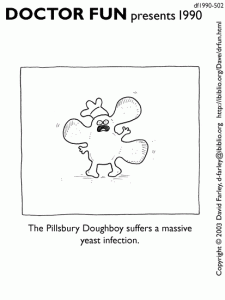 Seldom has depression been so artfully described as in these few lines of Hebrew poetry. Translated in the Prayer Book as “embittered,” the Hebrew is chamets which refers to yeast. It means “to be leavened” or “to be sour.” Most versions of the Scriptures translate it with some version of “bitterness,” a few use “grieved,” and the Complete Jewish Bible renders the verse, “when I had a sour attitude.” I rather like that last one, closest to the Hebrew, best; it describes depression perfectly.
 It might strike some as odd that of all the myriad metaphors and poetic images in the Psalter this this one, “I am as useless as a broken pot,” speaks to me most loudly.
 What is fear of death but fear of the unknown? The fear of death and the unknown brings anxiety, despair, and a frantic search for meaning. The fear of death and the unknown distracts us and makes us afraid to truly live. We end up fearing both death and life; we end up not attending to those things which are most important.
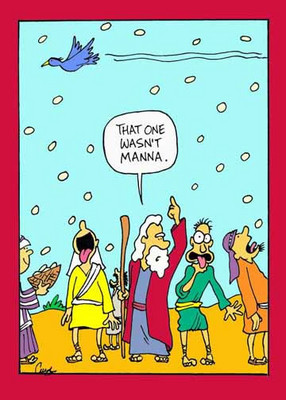 Jesus and a crowd who challenge his authority also make reference to the manna in today’s Daily Office gospel lesson in which Jesus says: “Your ancestors ate the manna in the wilderness, and they died. This is the bread that comes down from heaven, so that one may eat of it and not die. I am the living bread that came down from heaven. Whoever eats of this bread will live for ever; and the bread that I will give for the life of the world is my flesh.” (John 6:49-51)
 I started to write a meditation about St. Paul’s arrogance (today’s epistle lesson is one of his bits of baggadocio that always annoys me. So when I reviewed today’s lessons yesterday, that’s what caught my eye.
 In August of last year the
  I have an inch-long scar on the palm of my left hand; if I look closely, I can still see the pin-prick scars on either side of it which represent where the sutures that closed the wound were placed. The scar is just below my left pinky finger, which doesn’t work quite so well as my right pinky because underneath the scar the tendon was cut and had to be reconstructed. I’ve had this scar and this less-than-functional finger since I was not quite nine years old. It is a reminder of the need for boldness.
  “The thief comes only to steal and kill and destroy.” This sentence really hit me today for a lot of very personal reasons I won’t get into. As I was doing my morning ablutions, I thought of the thieves who have stolen in and taken away loved ones, family members, and friends. I thought of how obvious those thieves were about it, and yet we passed those thieves off as simple eccentricities and odd behaviors.

