From the Prophet Jeremiah:
Is there no balm in Gilead? Is there no physician there? Why then has the health of my poor people not been restored?
(From the Daily Office Lectionary – Jeremiah 8:22 (NRSV) – March 6, 2013.)
 Why has the health of the people not been restored? This is God’s question of the leadership of ancient Israel, but it could certainly be the question asked of modern America! Other questions could also be asked, even in the aftermath of the healthcare reform debates, the passage of the Affordable Care Act, and its vindication as constitutional by the U.S. Supreme Court. Why is it that, in the practice of medicine, we do not have equal treatment for everybody? Why is that every American is guaranteed a lawyer, but not a doctor? Why don’t we (even now) have guaranteed health care for everyone?
By an odd coincidence, on the Episcopal sanctorale calendar today is the commemoration of two pioneering physicians and their sons who followed in their footsteps, William W. Mayo and Charles F. Menninger. Among the readings prescribed for their celebration is Sirach 38:8: “God’s works will never be finished; and from him health spreads over all the earth.” Health is an endowment of the Creator to every person; it is a natural right. Why has it been taken from the people, and why has it not been restored?
The human right to good health should mandate a system of preventive health care and medical care for everyone. Every human being should be guaranteed the right to good quality health care, to living conditions that enable each to be as healthy as possible, to adequate food, to good housing, and to a healthy environment. Arguments about reforming our health care and medical treatment delivery system framed in terms of markets, costs, competition, or insurance are red herrings rooted in presumptions that deny this basic truth. A for-profit, market-driven medical care model treats health as a commodity to be bought and sold, and leads to inequities, to severely decreased well-being, and to needless loss of life. The Affordable Care Act is, at best, a stop-gap measure. What is required is a complete re-imagining of our health care system.
Any debate about medical treatment and health care should be structured and waged within the realm of human and civil rights, within the realm of morality and spirituality. A reform of our medical delivery system must take it out of the false model of markets (“competition” in health and medical delivery is a myth!) and place it squarely in the realm of human rights. Good health and medical care are basic rights recognized in the Declaration of Independence’s assertion that “life, liberty, and the pursuit of happiness” are guaranteed by God, protected by the penumbra of the U.S. Constitution, and explicitly spelled out in the United Nations’ Universal Declaration of Human Rights, a statement adopted in 1948 with strong American encouragement.
As Christians, we are called to remember the poor and those less fortunate than ourselves. Assuring that all enjoy their right to health care is basic to honoring life. Those without good preventive care and medical treatment when needed live shorter and sicker lives. Failure to work for universal health care sends the message that only those with the wealth to afford private health care really matter. This is a message squarely opposed by the Gospel of Jesus Christ who made it clear that we are called to care for “the least of these who are members of my family.” (Matthew 25:40 NRSV)
Recently, the Episcopal bishops of the two dioceses in the State of Ohio wrote to the state’s governor and other elected officials in support of the expansion of Medicaid coverage. In their public letter they set out the teaching of our church in this area:
The Episcopal Church affirms the following principles as they pertain to health care:
- health care, including mental health care, should be available to all persons in the United States;
- access to health care should be continuous;
- health care should be affordable for individuals, families, and businesses;
- national and state health care policy should be affordable and sustainable for society;
- health care should enhance health and well-being by promoting access to high-quality care that is effective, efficient, safe, timely, patient-centered and equitable; and
- health care providers should not be expected to assume a disproportionate share of the cost of providing care.
“God’s works will never be finished; and from him health spreads over all the earth.” . . . “Why then has the health of my poor people not been restored?” Good health is not a commodity to be bought and sold. It is a gift of God, and adequate preventive health care and good medical treatment are the right of every human being.
====================
A request to my readers: I’m trying to build the readership of this blog and I’d very much appreciate your help in doing so. If you find something here that is of value, please share it with others. If you are on Facebook, “like” the posts on your page so others can see them. If you are following me on Twitter, please “retweet” the notices of these meditations. If you have a blog of your own, please include mine in your links (a favor I will gladly reciprocate). Many thanks!
====================
Father Funston is the rector of St. Paul’s Episcopal Church, Medina, Ohio.
 Does it bother anyone else that as soon as Mrs. Simon’s mother is healed by Jesus she gets up from her sick bed and “begins to serve them”? That has always bothered me. I don’t know why it should. After all, if she’s healed (and one assumes that when Jesus healed someone they were really healed), then there’s no reason for her not to do what she would have done if she’d not been sick in the first place. But . . . it has bothered me. Why, I have thought, should this poor woman who’s been sick have to get out of bed and serve these men?
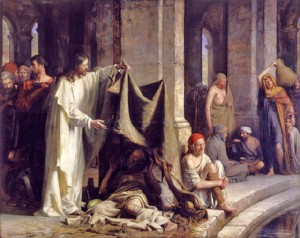 This is an old and familiar story, this tale of Christ healing the paralyzed man a the pool at Bethesda. We all know it well. The story continues with a confrontation between the man who has been and the Jewish religious authorities. This healing took place on the Sabbath. The confrontation is over whether it is proper for the man to carry his mat (i.e., perform work) on the Sabbath. The man’s defense is that the person who healed him told him to do so, although he doesn’t know (at the time) who the healer was. Later he learns it was Jesus and identifies him to the priests and scribes.
 I’ve been thinking about this little bit of Scripture all day! It’s nearly 10:30 p.m. – time for Compline! – and I’m still thinking about seven words from the morning gospel: “Let these words sink into your ears” . . . .
 Our first reading this morning is from a little book from the Apocrypha called The Book of Wisdom. At one time church tradition ascribed authorship to King Solomon, but it is now believed to have been written sometime in the first or second century before Christ by a Greek-speaking Jew of the Diaspora. It is found in the Greek-language version of Jewish scriptures, not in the Hebrew version, and is therefore not considered as canonical scripture by Jews or by Protestants. Roman Catholics and the Eastern Orthodox do accept it, and we Anglicans take a middle course, saying that we read them “for example of life and instruction of manners; but yet [we do] not apply them to establish any doctrine.” (Articles of Religion, Art. VI, BCP 1979, pg. 868). Well, here’s an example of life, then:
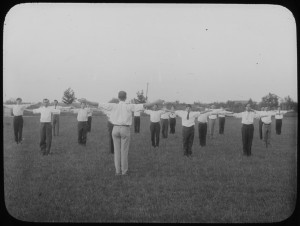 This is such a great verse! Matthew could have made some christological or soteriological comment about “the Son of Man” – in fact, he has done so earlier in this story and will do so again in the next chapter. But here the power and authority to heal is specifically described as being given not just to Jesus but “to human beings” . . . to you and to me! That’s great! ~ A couple of years ago the American Psychological Association reported that the first decade of the 21st Century saw a dramatic increase in the number of American adults praying about health issues. Even though attendance at formal religious services has fallen in the same period, informal and private spiritual practices such as prayer seem to be on the increase. One of the interesting results of a study by the Centers for Disease Control was that those who exercise are 25% less likely to pray than those who don’t…. One wonders if those who pray are less likely to exercise. ~ I’m not an exerciser myself. I admit that I should be; I’m just a lazy procrastinator who can’t get around to it. But I am a person who prays, and I often pray for health and healing for myself and for others. ~ The teacher of prayer who looms largest in my life is my late paternal grandfather. One of the things he taught me about prayer is “never pray for something you aren’t willing to work for.” His point was that God’s answer to your prayer just might be that God would send you into the midst of whatever the situation is to work toward a solution. I’m beginning to think that there’s a lesson here about exercise and health, too. I really shouldn’t be praying for my own physical health if I’m not willing to get off my duff and work for it. God has given me the authority to live a healthy life. I guess I’d better claim it and start doing it. ~ Tomorrow . . . maybe.
 A NYC Taxi driver wrote:


