 Today’s Gradual, Psalm 85, includes what may be my favorite verse in the entire collection of the Psalms: “Mercy and truth have met together; righteousness and peace have kissed each other.” (v. 10)
I think it may be my favorite because it figures prominently in the movie Babette’s Feast, based on a short story by the Danish write Isak Dinesen (Karen Blixen). The story tells of a grand meal prepared for the residents of a small Danish village in memory of their deceased Lutheran pastor. In flash backs, we see his ministry and on several occasions we hear him quote this verse, which seems to be a rallying cry for his flock.
Mercy and truth have met together; *
righteousness and peace have kissed each other.
It’s a lovely poetic summation of the Peaceable Kingdom painted by Isaiah in our Old Testament lesson and elsewhere in that book of prophecy.
 In a few minutes, when this sermon comes to an end, we will all stand together as we do every week and recite the Nicene Creed in which we will say that, among other things, we believe that Jesus Christ
 In Nigerian writer Chinua Achebe’s novel of post-colonial political intrigue in Africa, Anthills of the Savannah (1987), one of the characters (echoing Karl Marx’s famous aphorism about religion) opines:
 A lawyer asked Jesus a question to test him. “Teacher, which commandment in the law is the greatest?” He said to him, “’You shall love the Lord your God with all your heart, and with all your soul, and with all your mind.’ This is the greatest and first commandment. And a second is like it: ‘You shall love your neighbor as yourself.’ On these two commandments hang all the law and the prophets.”
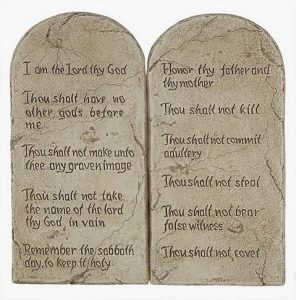
 As I pondered our scriptures for today I was struck by how different, how utterly foreign, one might most accurately use the word “alien,” the social landscape of the bible is from our own. We, children of a post-Enlightenment Constitution which makes a clear delineation, almost a compartmentalization, between the civic and the religious, simply cannot quickly envision the extent to which those areas of human existence were entangled and intertwined for those who wrote and whose lives are described in both the Old and New Testaments. I tried to think of an easy metaphor to help illustrate the difference between our worldview and that of either the ancient wandering Hebrews represented by Moses in the lesson from Exodus or of the first Century Palestinians and Romans characterized by Jesus, the temple authorities, and Paul.
 I’m wearing an orange stole today and a couple of you asked me on the way into church, “What season is orange?” Well, it’s not a seasonal stole … although I suppose we could say it commemorates the season of unregulated and out of control gun violence. A few years ago, a young woman named Hadiya Pendleton was shot and killed in Chicago; her friends began wearing orange, like hunters wear for safety, in her honor on her birthday in June. A couple of years ago, Bishops Against Gun Violence, an Episcopal group, became a co-sponsor of Wear Orange Day and some of us clergy here in Ohio decided to make and wear orange stoles on the following Sunday. Our decision got press notice and spread to clergy of several denominations all over the country.
  Authority. The authority of Jesus Christ is what Paul writes about in the letter to the Philippians, in which he quotes a liturgical hymn sung in the early Christian communities:
 When I told friends, colleagues, and parishioners I was contemplating a total knee replacement, the singular piece of consistent advice was, “Do the exercises! Keep up with the therapy!” The surgeon who was to do the deed gave me a booklet full of pre-operative exercises to do at least twice each day; that seemed doable and it was – twice a day for six weeks before surgery.

