From Ecclesiasticus:
Be generous when you worship the Lord,
and do not stint the first fruits of your hands.
With every gift show a cheerful face,
and dedicate your tithe with gladness.
Give to the Most High as he has given to you,
and as generously as you can afford.
(From the Daily Office Lectionary – Sirach 35:10-12 (NRSV) – November 1, 2014)
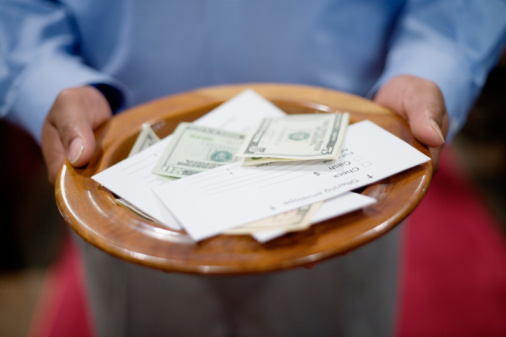
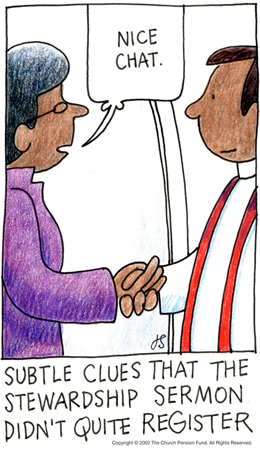 It’s about to come to an end, the annual appeal to church members everywhere to turn in a card saying how much they plan (hope, anticipate, expect, guess) to give in offerings in the coming year. Clergy everywhere are breathing both a sigh of relief that “stewardship season” is nearly done, while also wondering if there will be enough income to sustain the parish’s budget for another year. Congregational governing boards, treasurers, and budget committees are poring over the books and making plans – in some parishes they are adding new programs and new staff; in most, I suspect, they are trying to cut “fat” out of budgets already cut to the bone. I would guess there are more frowns than smiles being generated in the process of annual church budgeting.
And the Daily Office lectionary gives us this, Ben Sira’s admonition to cheerfulness and gladness in connection with first-fruit offerings and tithes . . . .
In my “Rector’s Reflection” column in our parish newsletter this month, I made note of the annual campaign and its coincidence with Thanksgiving Day:
How exactly do we give thanks to God? Primarily, it is through our songs of praise, our prayers of thanksgiving, our participation in worship. Secondarily, it is through sharing the blessings we have received. Most of us, I’m sure, are familiar with the phrase “time, talent, and treasure.” Those three “buzzwords” have been a staple of annual parish pledge campaigns for decades. They underscore that stewardship (a word we mistakenly often apply only to sharing of wealth) is a life activity, not simply a financial activity. We share all that we have been given, including our time and the talents with which we are blessed, not simply a portion of our income. But this time of year we focus on that financial piece as the church begins the process of budgeting for the next fiscal year. I will be the first to admit that we should do a better job of teaching about whole-life stewardship the entire year ‘round.
Perhaps there would be more smiles and fewer frowns, less stinting and more generous giving if we did less annual fund raising and more year-round stewardship education in the church. Let’s give that try.
In any event, smile . . . whatever this year’s outcome, it’s about to come to an end.
====================
A request to my readers: I’m trying to build the readership of this blog and I’d very much appreciate your help in doing so. If you find something here that is of value, please share it with others. If you are on Facebook, “like” the posts on your page so others can see them. If you are following me on Twitter, please “retweet” the notices of these meditations. If you have a blog of your own, please include mine in your links (a favor I will gladly reciprocate). Many thanks!
====================
Father Funston is the rector of St. Paul’s Episcopal Church, Medina, Ohio.
 The shadows tonight will be full of dreams moving from house to house, door to door, seeking handouts of candy or toys or whatever with a cry of “Trick or Treat!” We hope the wind will stay away, at least until America’s children’s annual celebration of the ancient Celtic feast of Samhain is completed.
 I often wonder what (if any) thought went into the construction of various lectionaries, particularly the Daily Office lectionary of the Episcopal Church. Are the sometimes strange, sometimes enlightening, often puzzling juxtapositions of texts planned or simply fortuitous?
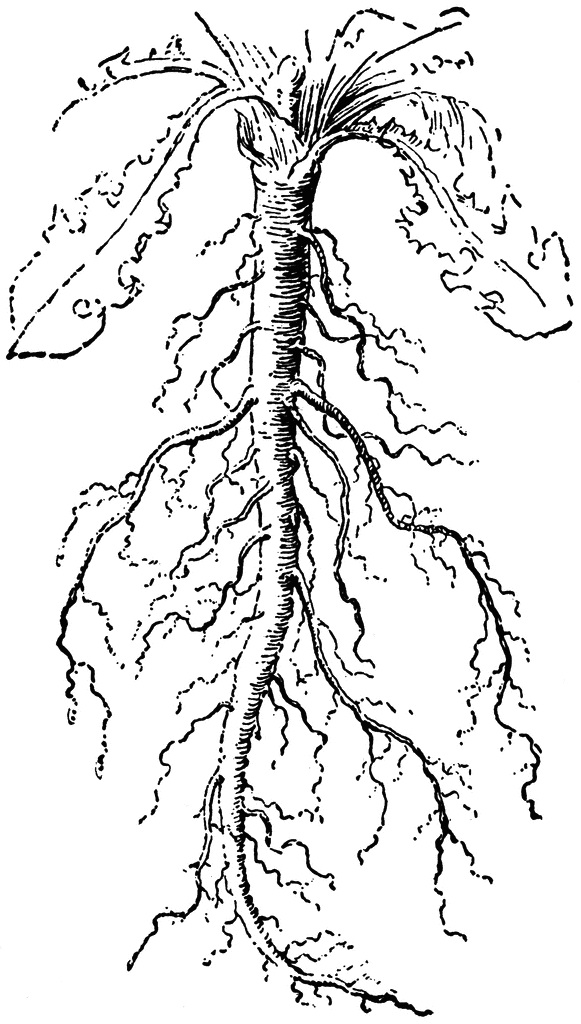 According to Ben Sira, personified Wisdom is rooted in Jerusalem; at the command of the Creator, she has take up residence in Zion among the Chosen People. These days I have a hard time seeing anything which can be counted as “wisdom” coming out of the modern government of that land, and I could write hundreds, even thousands, of words about what I believe to be the foolishness of the criminal injustice being perpetrated on the Palestinian people by that government. But I won’t. Not today. Today, my thoughts run to the question of rootedness, to the metaphor of sustenance drawn from a particular place, to the spatial and cultural peculiarity of wisdom, and to what happens when one leaves a particular place and takes up residence in another.