Occasional thoughts of an Anglican Episcopal priest

Category: Lectionary (Page 47 of 99)

Grandparental Nicknames – From the Daily Office – May 10, 2014

From Matthew’s Gospel:

As he walked by the Sea of Galilee, he saw two brothers, Simon, who is called Peter, and Andrew his brother, casting a net into the lake — for they were fishermen.

(From the Daily Office Lectionary – Matthew 4:18 (NRSV) –May 10, 2014)

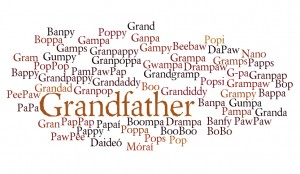
Grandfather NicknamesSometime this fall, probably during October, my wife and I will become grandparents for the first time. Last night, a friend asked, “What will you be called?” Because the question came out of the blue (we hadn’t been discussing children or grandchildren), I didn’t know what he was asking — and my face must have shown it. “As grandfather,” he clarified, “what will you be called as a grandparent?”

Good question. Is it really up to me? Do I get to say, “I want to be called [something]”? If so, I’d like to be called by one of the Irish nicknames: “Daideó” (pronounced “DAH-doe”) or “Móraí” (pronounced “MO-ree”) or “Papaí” (pronounced “PAH-pee”). The actual word for “grandfather” in Irish is seanathair which means “old father” or (in older Irish) “wise father”; an alternative is athair mór which means “great father” (“great” here is more akin to “big” than to “wonderful”).

But is it really up to me? Families have long-running traditions about naming grandparents, I think. Every grandmother (for the three generations I have known) on both sides of my family was known as “Grammy” — my mother called hers “Grammy Buss” and “Grammy Sargent”; mine were “Grammy Grace” and “Grammy Edna” (we were a less formal generation, I guess), and my mother was “Grammy Betty” to our children.

Grandfathers were less uniformly addressed. I don’t know what my greatgrandfathers were called; both were long dead when I was born. My maternal grandfather, Richard Sargent, was “Daddy Rich” (a combination of what my mother and grandmother called him); my paternal grandfather was “C.E.” (what everyone called him) or, less frequently, “Granddad.” My father was deceased when his grandchildren were born, so if he was referred to at all it was as “your grandfather, York”; my stepfather, Stan Shivers, was called “GrandStan” by my niece and nephew and my children.

One thing I’ve noticed is that the first-born grandchildren get to make the decision. My brother was nearly ten years older than me, and I had two older paternal cousins, so by the time I came along grandparental names were pretty much cast in stone. We have nieces and nephews several years older than our own children, so they had settled the issue on both sides long before our kids had a say.

All of this comes to mind this morning because of “Simon, who is called Peter.” It was Jesus who gave him that name: “I tell you, you are Peter, and on this rock I will build my church.” (Mt 16:18) For many years, I wondered why Jesus gave Simon this nickname and thought it was simply out of affection — it’s nearly the equivalent of “Rocky” and since Simon Peter often seems as dense as a bag of rocks, that made sense.

But I’ve come recently (while studying the prophets with an Education for Ministry group) to believe that Jesus is following in the tradition of Isaiah and, since he has no son to name, he is giving Simon a symbolic prophetic nickname in the same way that prophet named his children. Isaiah named his sons Shear-jashub, which means “the remnanet shall return,” and Maher-shalal-hash-baz, which means “he has hurried to plunder,” as signs against Judah and Jerusalem. I think Jesus gave Simon the new name Peter in a similar way, as a prophetic sign to the church.

Shear-jashub, Maher-shalal-has-baz, and Simon Peter had no say in the matter. So I still wonder with respect to this question of grandparental naming, is it really up to me?

And I wonder if grandparental naming is a prophetic activity. Does the name chosen shape the relationship? Does it portend what the relationship will be? Certainly, one would suspect that if a child is taught to call its grandfather “Grandfather,” that relationship will be rather different than that of a child who calls his or her grandfather “Grampa.” But do “Granddad” or “Papaí” or “Nano” shape the bond differently? And, if so, how?

This matter of choosing a grandparental nickname is serious stuff . . . assuming it really is up to me.

====================

A request to my readers: I’m trying to build the readership of this blog and I’d very much appreciate your help in doing so. If you find something here that is of value, please share it with others. If you are on Facebook, “like” the posts on your page so others can see them. If you are following me on Twitter, please “retweet” the notices of these meditations. If you have a blog of your own, please include mine in your links (a favor I will gladly reciprocate). Many thanks!

====================

Father Funston is the rector of St. Paul’s Episcopal Church, Medina, Ohio.

The Sacrament of Money – From the Daily Office – May 9, 2014

From the Book of Exodus:

The Lord said to Moses: Tell the Israelites to take for me an offering; from all whose hearts prompt them to give you shall receive the offering for me. This is the offering that you shall receive from them: gold, silver, and bronze, blue, purple, and crimson yarns and fine linen, goats’ hair, tanned rams’ skins, fine leather, acacia wood, oil for the lamps, spices for the anointing-oil and for the fragrant incense, onyx stones and gems to be set in the ephod and for the breastpiece. And have them make me a sanctuary, so that I may dwell among them.

(From the Daily Office Lectionary – Exodus 25:1-8 (NRSV) – May 9, 2014.)

Gold silver and bronze barsADDED LATER: Oops!!! I just realized late on May 9 that I had read the lessons for May 10 one day ahead of time. This lesson is actually for the next day . . . . mea culpa, mea culpa, mea maxima culpa! Apologies, faithful readers!

It occurred to me as I read this passage this morning that God is ordering Moses to conduct the first capital campaign.

In 24 years of ordained ministry I have been involved in three major capital campaigns in as many parishes. Each time, the parish leadership turned to professional fundraising consultants to assist them and each consultant told us the same thing: capital campaigns do not impact regular financial stewardship because people give to the operating budget out of income, but they give to the capital campaign out of wealth. In other words, our regular weekly support of our churches comes from our paychecks, but what we give to capital projects we take from savings and investments.

How is it that the Hebrews have all this wealth? These people are wandering around Sinai not carrying enough food to feed themselves — hence the manna and the quail in Exodus 16 — and yet they have gold, silver, bronze, spices, incense, and precious stones? That raises all sorts of issues for me about human priorities and the spirituality of possessions and wealth.

So, too, does Tuesday’s report that the 25 highest-earning hedge fund managers in the United States took home a total of $21.15 billion in compensation last year! That’s an average annual take-home for those investment advisors of $860 million each! That kind of compensation blurs the distinction between “income” and “wealth.” I would argue that this is not “income;” it is, rather, transfer of “wealth.”

In my most recent experience of capital campaigning, our goal was $500,000; we didn’t quite make it – we raised about 76% of the goal in five-year pledges. Because the work we were undertaking could not be postponed, our governing board made the “leap of faith” decision to finance the rest. For us, this was a difficult and painful decision. For any of those 25 hedge fund managers, it would have meant spending less than 6/10 of one percent of their annual compensation.

It has been suggested that money is a sacrament: it is a sign of the work we do, a symbol of our sweat and toil, an indicator of our values. I think I would refine that argument, however, to say that income is a sacrament of these things. Which then raises the question, of what is wealth a sacrament? Our security? Our faith in the future? Our faith in God? And just how sacramental (either as income or wealth) is a transfer of more millions of dollars than most people can even imagine, or an expenditure of less than one percent of our compensation?

I figured it out. 6/10 of one percent of my wife’s and my combined annual income is almost exactly what I spent a couple of days ago on a tankful of gasoline. That purchase was not a gut-wrenching decision; it required no thought at all, no spiritual or emotional investment, no “leap of faith” like the vestry’s decision to go forward with our recent capital improvement project. One of those hedge fund managers could have paid for that project with as little thought or spiritual reflection as I spent pumping gas into my car.

And, I suggest, that lack of thought and reflection about income and wealth permeates our society. A confession: This is the second time in a few months that I’ve read this passage of Exodus. The first was in the context of a bible study group at church. The first time the question of what the Hebrews were doing carting around that sort of wealth as they wandered the desert for forty years never occurred to me. It didn’t occur to me until it was juxtaposed with the report of hedge fund manager compensation and the inordinate wealth transfer it represents. But it should have. I should have, we all should have a spirituality of money, a theology of wealth and income.

And a theology of money, at the very least, should demand that we pause and engage in at least a bit of thought and spiritual reflection on what we do routinely — filling our tanks, buying books for leisure reading or study, letting the bank automatically pay our internet access fees. It requires us to get some perspective, to step back and think about the course we are charting, to consider what our spending says about us, what our saving says about us. What is money as a sacrament saying? What are the gold, silver, bronze, spices, incense, and precious gems we cart around our particular deserts saying about us?

====================

A request to my readers: I’m trying to build the readership of this blog and I’d very much appreciate your help in doing so. If you find something here that is of value, please share it with others. If you are on Facebook, “like” the posts on your page so others can see them. If you are following me on Twitter, please “retweet” the notices of these meditations. If you have a blog of your own, please include mine in your links (a favor I will gladly reciprocate). Many thanks!

====================

Father Funston is the rector of St. Paul’s Episcopal Church, Medina, Ohio.

Cleaving to Dust – From the Daily Office – May 7, 2014

From the Psalter:

My soul cleaves to the dust; give me life according to your word.

(From the Daily Office Lectionary – Psalm 119:25 (BCP Version) – May 7, 2014.)

Handful of DustThe Gospel lesson today is the baptism of Jesus as told by Matthew. With it, for the evening, is coupled a portion of Psalm 119 which includes this verse. This image of a soul clinging to the dirt caught my attention. I wonder if baptism is efficacious if the soul being baptized steadfastly and stubbornly “cleaves to the dust” of its pre-baptismal life.

I sometimes wonder about my own baptism, which happened when I was 14 years of age and attending a private, residential high school affiliated with the Episcopal Church.

As part of the religious instruction required of all students, I had taken the confirmation class offered by the chaplain and was, thus, included in the list of young men upon whom the bishop was to lay hands during his official visit at one Thursday evening chapel service. Earlier in the day, going over his records, the chaplain noticed he had not record of my baptism.

That was not surprising since I’d not been baptized. Growing up in a largely unchurched home with a father estranged from the Methodist Church and a mother who’d been reared in (but left) one of those traditions that practice “believers’ baptism,” there had been no encouragement of nor opportunity for baptism.

So, in a hastily arranged private afternoon ceremony at the back of the chapel after gym class, with two members of the faculty standing as sponsors, I was quickly sprinkled and informed that I was now a Christian, eligible to be confirmed as an Episcopalian. That done, I went to my room to shower and dress for dinner and the obviously more important confirmation service later that evening.

What exactly happened that afternoon? Did my soul turn loose of the dust, or did it cleave to the dirt from which it was supposed to be cleansed? Does it matter? I’m not even going to try to answer those questions this morning, but the pairing of the baptismal story and the image of the soul clinging to the dust is certainly an odd lectionary coincidence.

====================

A request to my readers: I’m trying to build the readership of this blog and I’d very much appreciate your help in doing so. If you find something here that is of value, please share it with others. If you are on Facebook, “like” the posts on your page so others can see them. If you are following me on Twitter, please “retweet” the notices of these meditations. If you have a blog of your own, please include mine in your links (a favor I will gladly reciprocate). Many thanks!

====================

Father Funston is the rector of St. Paul’s Episcopal Church, Medina, Ohio.

Ancestor Abraham – From the Daily Office – May 6, 2014

From the Gospel according to Matthew:

Do not presume to say to yourselves, “We have Abraham as our ancestor”; for I tell you, God is able from these stones to raise up children to Abraham.

(From the Daily Office Lectionary – Matthew 3:9 (NRSV) – May 6, 2014.)

StonesJohn the Baptizer is speaking to the Pharisees and the Sadducees, warning them against the very common human practice of relying upon the piety of our forebears instead of practicing our own faith. Relying on the religion of our ancestors is weakens and attenuates our own spirituality. One might as well be rocks lying by the roadside.

A few days ago, in what I consider a badly reasoned decision, Town of Greece v. Galloway, the U.S. Supreme Court upheld the practice of beginning secular legislative body meetings (in the particular case, a city council) with sectarian prayer. Justice Anthony M. Kennedy, writing for the majority, reasoned: “Legislative prayer has become part of our heritage and tradition, part of our expressive idiom, similar to the Pledge of Allegiance, inaugural prayer, or the recitation of ‘God save the United States and this honorable Court’ at the opening of this Court’s sessions.” He might as well have said, “We have Abraham as our ancestor.”

I’ve no problem with public prayer. I lead it on a pretty regular basis. I have a problem with prayer offered in a secular legislative body in a nation that is supposed to have a separation of church and state. The First Amendment to our Constitution includes two clauses which work that separation. One is known as “the establishment clause” and provides that government “shall make no law respecting an establishment of religion.” The other is called the “free exercise clause” and provides that government shall do nothing “prohibiting the free exercise” of religion.

A legislative body’s rule of procedure requiring prayer at the opening of its sessions violates at least the first of these clauses; it is a law establishing a religious practice. Arguably, it also violates the second clause although (as Kennedy and others have noted) no one is forced to participate in the prayer and, one supposes, could absent oneself from the session until the prayer was concluded.

My concern, in light of today’s reading from Matthew, is not with the Constitutional issue of public governmentally-sponsored prayer. Rather, it is with the notion that somehow the religiosity of our nation is dependent upon practices of government and the (mistaken) notion that our Founders (our equivalent of Abraham) intended this to be a “Christian nation.” This is the argument often made and now being repeated in innumerable online discussions of this ruling.

I can find no difference between “The Founders intended this to be a Christian nation” and “We have Abraham as our ancestor.” Both rely upon the supposed faith of long-dead forebears rather than the lively faith of living people. Any number of prayers may be recited at city council meetings or in state or national legislative chambers; unless and until the people of the nation begin actually living and practicing whatever religion they claim to hold — actually participating in religious events and, more importantly for Christians, feeding the hungry, clothing the naked, and housing the homeless — those prayers are no better than the protest of the Pharisees and Sadducees, “We have Abraham as our ancestor.”

This is especially true when Christian prayer opens a legislative session in which the legislators proceed to enact legislation which flies in the face of Jesus’ commands — when funds are stripped from feeding programs, when homelessness is made a crime, when public assets are diverted to the benefit of the rich at the expense of the poor. The prayer and the faith which it represents are rendered meaningless, with as little life as a pile of rocks.

There is a place for prayer, but it is not in the halls of government and it is not in the historic and attenuated traditions of long-dead forebears. It is in the hearts and lives of living persons acting out their faith. Relying on government-sponsored prayer is nothing more than claiming Abraham as our ancestor, nothing more than being dead stones.

====================

A request to my readers: I’m trying to build the readership of this blog and I’d very much appreciate your help in doing so. If you find something here that is of value, please share it with others. If you are on Facebook, “like” the posts on your page so others can see them. If you are following me on Twitter, please “retweet” the notices of these meditations. If you have a blog of your own, please include mine in your links (a favor I will gladly reciprocate). Many thanks!

====================

Father Funston is the rector of St. Paul’s Episcopal Church, Medina, Ohio.

College of Presbyters – From the Daily Office – May 5, 2014

From the Book of Exodus:

When Moses’ father-in-law saw all that he was doing for the people, he said, “What is this that you are doing for the people? Why do you sit alone, while all the people stand around you from morning until evening?” Moses said to his father-in-law, “Because the people come to me to inquire of God. When they have a dispute, they come to me and I decide between one person and another, and I make known to them the statutes and instructions of God.” Moses’ father-in-law said to him, “What you are doing is not good. You will surely wear yourself out, both you and these people with you. For the task is too heavy for you; you cannot do it alone.”

(From the Daily Office Lectionary – Exodus 18:14-18 (NRSV) – May 5, 2014.)

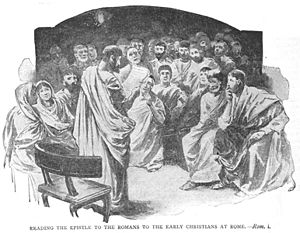
An Epistle being read in assemblyApparently Moses didn’t learn anything from his experience at the battle with Amelek when he needed Aaron and Hur to hold up his hands, so his father-in-law Jethro has to remind him that he can’t do it all alone and that, if he tries to do so, he will wear himself out. Smart man, Jethro!

Jethro’s recommendation is that Moses create a hierarchy: “Look for able men among all the people, men who fear God, are trustworthy, and hate dishonest gain; set such men over them as officers over thousands, hundreds, fifties and tens. Let them sit as judges for the people at all times; let them bring every important case to you, but decide every minor case themselves.” (vv. 21-22) Essentially, Jethro is suggesting what has become known as decentralization or subsidiarity in which matters are to be handled at the lowest possible level of the hierarchy by the least centralized authority capable of addressing them effectively; a matter beyond the competency of the authority is referred upward and only the most serious of matters come to the highest level.

This is good advice and a workable solution to the problem of Moses’ potential exhaustion, but another factor is not addressed, and that is the matter of collegiality. Even with a hierarchical organization and application of subsidiarity, the leadership at the highest level can burn out without sufficient collegial support. This is why bishops in the Episcopal Church are required by canon law to have councils of advice, standing committees and diocesan councils, and it is why the church should also have colleges of presbyters.

When a priest is ordained in the Episcopal Church among the charges he or she is given is “to work as pastor, priest, and teacher, together with your bishop and fellow presbyters, and to take your share in the councils of the Church.” (BCP 1979, page 531) This means more than working with the vestry and taking part in the annual diocesan convention. Among other things, it should also mean meeting regularly with the other presbyters of the diocese in conference with the bishop as a college of presbyters.

In a diocese where I once served, where there was a formal college of presbyters during my tenure, the college no longer exists. The regular meeting of clergy with the diocesan bishop no longer bears that title; the formal meeting of the college of presbyters has been replaced by a “gathering of clergy.”

While I’m sure (or at least I hope) that much the same conversation and consultation on ecclesial matters still takes place, I am also convinced that language and the words we use are important. A “gathering” is a social event without leadership authority; a “college” is an assembly of colleagues engaged in meaningful activity together. When a bishop meets his or her clergy in a “gathering,” they’re just having a drink; when a bishop meets with the college of presbyters, a council of the church is in session. What comes out of a “gathering” can be ignored; what comes out of the college must be taken seriously. If clergy only get together in a “gathering,” the bishop is acting like the early Moses and failing to take Jethro’s advice; if the clergy meet with the bishop as a college, the bishop is acting like the later Moses and honoring Jethro’s advice.

We need more colleges of presbyters in the Episcopal Church and fewer gatherings.

====================

A request to my readers: I’m trying to build the readership of this blog and I’d very much appreciate your help in doing so. If you find something here that is of value, please share it with others. If you are on Facebook, “like” the posts on your page so others can see them. If you are following me on Twitter, please “retweet” the notices of these meditations. If you have a blog of your own, please include mine in your links (a favor I will gladly reciprocate). Many thanks!

====================

Father Funston is the rector of St. Paul’s Episcopal Church, Medina, Ohio.

Jesus the Jedi – Sermon for the 3rd Sunday of Easter (Year A) – May 4, 2014

====================

This sermon was preached on the Third Sunday of Easter, May 4, 2014, at St. Paul’s Episcopal Church, Medina, Ohio, where Fr. Funston is rector.

(The lessons for the day were: Acts 2:14a,36-41; Psalm 116:1-3,10-17; 1 Peter 1:17-23; and Luke 24:13-35. These lessons can be read at The Lectionary Page.)

====================

Broken BreadSince the early 1970s this day, on the Episcopal Church calendar, this day on which we hear the story of Jesus’ appearance to the two disciples on the road to Emmaus has been known as Star Wars Sunday. It’s because Jesus is very much like a Jedi in this story. I mean, think about it . . .

In the Star Wars movies, Luke Skywalker is mentored first by Obiwan Kenobi, who dies, then by Yoda, who also dies. But both Obiwan and Yoda come back! They appear to Luke and others after their deaths, continue to teach and give sage counsel, and disappear. That’s what happens with Jesus in the story Luke tells us this morning.

It’s still Easter Sunday. (For us, we’re three weeks down the road, but for them it’s the afternoon of the same day on which Mary Magdalene and the others found the empty tomb.) Two disciples, one named Cleopas and the other unnamed (let’s call him “Bob” — although some feminists scholars suggest that the reason this disciple is not named is because she is a woman, so it might be “Bobbie”) are on their way to a village called Emmaus. Luke tells us this village is seven miles from Jerusalem; that’s a long walk — two or three hours. Sometime during this long afternoon journey, they are joined by a stranger whom they do not recognize; the stranger, Luke reveals, is Jesus but Cleopas and Bob can’t recognize him. They have a long talk with him about all the thing that have happened in Jerusalem in recent days, and he gives them sage counsel about the meaning of scripture, particularly the messianic prophecies. They arrive in Emmaus early in the evening and encourage their traveling companion to join them at dinner.

They sit down at an inn for the evening meal and the stranger takes the lead. He takes the bread served by the innkeeper, offers a blessing, and breaks the bread. Now, Cleopas and Bob realize who this is. As he does the same thing he had done with his followers just a few days before, their memory is tweaked and their eyes are opened (which suggests that Cleopas and Bob were in the upper room in Jerusalem on Thursday evening). That’s when they recognize him; that’s when they think they’ve figure out who he is — he’s Jesus the Jedi. And that’s when Jesus vanishes.

Why do you suppose that is? Why does Jesus disappear?

Well . . . let me remind you of what happened earlier in the day as the story is told by John. Mary Magdalene came to the tomb early in the morning, found it empty, and told Simon Peter. Peter and the disciple whom Jesus loved (another unnamed follower!) also found it empty, and then returned to their home to tell the others. Mary, however, hung behind and encountered Jesus but, like Cleopas and Bob on the road to Emmaus, she did not recognize him; she thought he was the gardener. Only when he addressed her by name (perhaps because of the tone of his voice) was something in her memory triggered and she realized who he was. She called him “Rabbouni” (which means teacher) and apparently fell at his feet and grabbed hold of them, for Jesus says to her, “Don’t hold on to me.” I think he did so for the same reason he disappeared from the table at the Emmaus inn.

Similarly, remember what happened before they arrived in Jerusalem, when Jesus took Peter and James and John up the mount of the Transfiguration. While they were on the holy mountain, the three disciples witnessed Jesus in conversation with Elijah and Moses. Peter wanted to memorialize the event by building booths, monuments to concretize the moment. Jesus said, “No. We’re not going to do that.” Again, I think for the same reason he disappeared in Emmaus.

That reason is that we cannot pin Jesus down. Jesus cannot be contained; he will not fit neatly into our boxes. When we think we have him figured out, we find out we are wrong. Jesus . . . God is bigger than any notion of him we may have; God is bigger than our conceptions, bigger than our doctrines, bigger than our creeds. And every encounter with Jesus is singular and unique. We cannot hold onto him; we cannot concretize and cast the moment in stone.

We just sang as our sequence hymn the old chestnut In the Garden, and that hymn makes this very point. We, the singer, say that we would like to stay there in that garden, but Jesus will not allow that:

I’d stay in the garden with Him,
Though the night around me be falling,
But He bids me go; through the voice of woe
His voice to me is calling.

We cannot pin him down! We cannot cast the moment in stone. When we think we’ve got hold of him, we find we are wrong; he disappears and what we are left with are our own notions, our own ideas, our own doctrines, our boxes. Our boxes, however, are too small; God is too big for them.

And the chorus of the hymn reminds us of the singularity and uniqueness of every meeting with our Lord:

And the joy we share as we tarry there,
None other has ever known.

Every time we encounter Jesus, the experience is unique; none other (not even our earlier selves) has ever had that experience before.

I think that is why it is significant that Cleopas and Bob recognized Jesus as he broke bread. Every loaf of bread is unique, similar perhaps to other loaves but never, ever identical. And every occasion on which bread is share is singular and unique. It may be a family meal or a celebration of the Eucharist; it may be a formal banquet or just friends having a bite. Whatever the circumstances, the situation is one unto itself, not like any other, never to be repeated.

A couple of Christmases ago, Evelyn gave me a set of books about the elements of the Eucharist. One volume is entitled The Spirituality of Wine; the other, which I have here, is The Spirituality of Bread by Donna Sinclair. The author is a Christian (in fact, I think she is an Anglican). I’d like to read you some of what she has to say about the symbolism of bread. About bread and community, she writes:

Jesus may have been lent significance by his association with other gods of bread. But that doesn’t acount for the power of his celebration, which persists daily around the world.

Everywhere, the words are similar: “He took a loaf of bread and after blessing it he broke it, gave it to them and said, ‘Take, this is my body.'” And, everywhere, people line up, blue-jean clad or robed, young or old, to receive bits of bread; or they sit in pews and pass tiny chunks on a plate; or they stand in a circle and murmur a blessing as a broken loaf moves from hand to hand.

Sometimes they gather around a sickbed.

Once, I sat in a circle of friends, in a smoky cabin in the bush, after a weekend of tending a woodstove and talking about dreams. We passed the bread around as gently as if it were the heart of the other, which it was.

The ritual has power. I get uneasy if I think I might be left out. Once, reporting on an event, I slipped up to take a photo of Archbishop Desmond Tutu serving Communion, and then paused anxiously. He winked and held out the bread.

Perhaps inclusion is this ceremony’s strength. This bread offers an enormous community, a family that stretches around the world and through the centuries. We don’t want to be left out.

We don’t want to be left out because we don’t want to miss the opportunity for that unique and singular encounter with Christ. Every celebration of Eucharist, like every sharing of bread and every meeting with Jesus, is a moment unto itself never to be repeated, never to be duplicated. We realize that in some way, that this encounter with Christ in the breaking of the bread will never happen again, and we don’t want to be left out.

With regard to bread and sacrifice, Ms. Sinclair writes:

The celebration of Communion is also a powerful experience of metaphor. Bread as body. Wine as blood. Love as sacrifice.

In the Jesus story, it is clear that love has great requirements. There is a price to pay, in an oppressive era, for feeding the unwanted.

It may help to see another story, that of the Celtic Earth goddess Tailtiu, queen of the Fir Bolg, one of the ancient peoples of pre-Christian Ireland.

When Tailtiu saw that her people were starving after an insufficient grain harvest, she took up an axe and, for a solid year, cleared a forest: “the reclaiming of meadowland from even wood by Tailtiu, daughter of Magmor,” is the way it is reported by the anonymous bard of The Dindsenchas, poems about Irish place names.

After the trees had been cut down, “roots and all, out of the ground,” the land became “a plain blossoming with clove,” presumably suitable for planting grain. But the cost was appalling. Tailtiu’s heart “burst in her body from the strain beneath her royal vest,” the bard says. The Celts loved their sacred groves, and the destruction to the enchanted richness of her forest must have broken Tailtiu’s heart.

Aware that she is dying, her courtiers gather around, and Tailtiu whispers her last command. She wants funeral games to be held in her honour each year, just before the harvest. And they are to be peaceful, she says, “without sin, without fraud, without reproach, without insult, without contention, without seizure, without theft.”

Thanks to her faithful foster-child Lugh (later associated with a bountiful harvest), Tailtiu’s wish came to pass. There was always an “unbroken truce” at her fair, and “men went in and came out without any rude hostility. Corn and milk in every stead, peace and fair weather for its sake, were granted to the heathen tribes of the Greeks for maintaining of justice.”

Tailtiu had given up her beloved forest and her life for a vision not too different from that of Archbishop Oscar Romero or of Mondawmin, who brought corn to the Ojibway. “Unbroken truce” and “corn and milk in ever stead,” represent the commonwealth of peace, the kingdom Jesus told his friends was close by. New parents get a glimpse of this kingdom looking at their tiny baby. Their sudden understanding that they would do anything to keep this child safe is the closest we can come, perhaps, to understanding the sacrifice that is part of love’s potential.

Perhaps that’s the power of Communion bread. Some say that it commemorates Jesus offering himself as a sacrifice for our sins, but I don’t think so. I would be appalled by a god who asked for the death of his child, or any child. But like any parent, I believe I would die for my children’s lives, even as absurdly grown-up as they are now.

Perhaps this bread simply expresses our wish to live little closer to the ideal of Tailtiu, Jesus, or Mondawmin, who died to give their people enough to eat. None of us can stand up to greed or selfishness as strongly as we wish. But eating this ceremonial bread with others, who also want to be just and loving, makes us brave enough to try.

Maybe that’s why I am sometimes overwhelmed at these ceremonies. Maybe I am simply terrified by the high sacrifices love assumes. Certainly the part most touching to me in the story of my own bread-god, Jesus, is not his death, but his constant focus on compassion. “Love one another as I have loved you,” he commands. “Love your enemies.”

Every encounter with this God who commands us to love, every encounter with love is unique and singular. Every encounter with this God who commands us to love, every encounter with love is larger than we can describe. We cannot constrain love in our boxes. Whatever our notions, our doctrines, our creeds, our understandings . . . they are too small to contain love, to pin love down, to hold onto and control love. When we try, love disappears, and that is why Jesus disappeared from the dinner table in that inn in Emmaus.

Now . . . I have to confess that, on the church’s calendar, this really isn’t Star Wars Sunday. But as every Star Wars aficionado knows, today is Star Wars Day: “May the Fourth be with you.”

But may Jesus the Jedi . . . Jesus, known in the breaking of the bread . . . Jesus, whom we cannot hold onto and pin down . . . Jesus, unique and singular . . . may Jesus be with you. Amen.

====================

A request to my readers: I’m trying to build the readership of this blog and I’d very much appreciate your help in doing so. If you find something here that is of value, please share it with others. If you are on Facebook, “like” the posts on your page so others can see them. If you are following me on Twitter, please “retweet” the notices of these meditations. If you have a blog of your own, please include mine in your links (a favor I will gladly reciprocate). Many thanks!

====================

Father Funston is the rector of St. Paul’s Episcopal Church, Medina, Ohio.
Magic Hands – From the Daily Office – May 3, 2014

From the Book of Exodus:

Amalek came and fought with Israel at Rephidim. Moses said to Joshua, “Choose some men for us and go out; fight with Amalek. Tomorrow I will stand on the top of the hill with the staff of God in my hand.” So Joshua did as Moses told him, and fought with Amalek, while Moses, Aaron, and Hur went up to the top of the hill. Whenever Moses held up his hand, Israel prevailed; and whenever he lowered his hand, Amalek prevailed. But Moses’ hands grew weary; so they took a stone and put it under him, and he sat on it. Aaron and Hur held up his hands, one on one side, and the other on the other side; so his hands were steady until the sun set. And Joshua defeated Amalek and his people with the sword.

(From the Daily Office Lectionary – Exodus 17:8-13 (NRSV) – May 3, 2014.)

Illustration from Die Bibel in Bildern by Julius Schnorr von CarolsfeldAt first blush, this just feels like another unbelievable story of religious ritual and “magic hands.” It fits neatly into the pattern of war stories one finds in the Torah that are attributed to the Deuteronomist. For that writer, the Hebrews’ victory in battle always depends not on military preparation, strength of arms, or fighting skill, but on ritual exactitude — perform a religious ritual properly and you win, flub it and you lose.

I recall reading rabbinic commentary, however, that puts a different spin on the story. According to the rabbis, there was nothing “magic” or even particularly noteworthy about Moses’ hands; they were simply a reminder to the Hebrew fighters below to put their faith in God. When they looked up to see Moses’ hands raised, they looked to heaven, trusted in God, and prevailed; when his hands were down, they failed to do so.

When I was in seminary, there was a practicum in liturgics, basically a class on how to do the ritual of the Eucharist. We called it “magic hands.” Our instructor, Dr. Louis Weil, repeatedly advised us to be aware of our hands, to be aware that the congregation would focus upon them and any movement we made, and therefore to make few gestures, but make every gesture one that would not distract the congregation from their worship. I am reminded of Dr. Weil’s instruction by this story.

I’m also mindful that Moses didn’t do this alone. If Aaron and Hur hadn’t been there to hold up Moses’ hands, whether “magic” in themselves or simply a motivational banner to the warriors, the battle would have gone otherwise. The story is a reminder of the importance of community and, for community leaders, of the importance of those with whom they work. No one does the task of leadership alone.

This, too, reminds me of the tradition of the Eucharist that holds that a priest alone cannot say the Mass; he or she must be accompanied by at least one other person: Jesus said, “Where two or three are gathered in my name, I am there among them.” (Mt 18:20) I am told that in some Orthodox traditions, there must be, in addition to the priest, at least one deacon and one lay person so that the fullness of the church is represented. (That would be impossible in my congregation; as much as I would like to have a vocational deacon or two in our midst, there is none.)

So I think this is a story of more than “magic hands,” more than a story of winning through proper religious ritual. If there is any magic in the hands of leaders, it is found in both the power to which those hands point and in the support on which those hands depend.

====================

A request to my readers: I’m trying to build the readership of this blog and I’d very much appreciate your help in doing so. If you find something here that is of value, please share it with others. If you are on Facebook, “like” the posts on your page so others can see them. If you are following me on Twitter, please “retweet” the notices of these meditations. If you have a blog of your own, please include mine in your links (a favor I will gladly reciprocate). Many thanks!

====================

Father Funston is the rector of St. Paul’s Episcopal Church, Medina, Ohio.

Measurement Is Not Control – From the Daily Office – May 2, 2014

From the Book of Exodus:

An omer is a tenth of an ephah.

(From the Daily Office Lectionary – Exodus 16:36 (NRSV) – May 2, 2014.)

Omer JarAn ephah is a bushel, about 35 liters. Ten ephahs make a homer; a tenth of an ephah is an omer. (I’ll bet that was sometimes confusing.) So an omer is 3.5 liters, just a little bit shy of a gallon.

Measurement is a human activity, a very necessary human activity. Accurate measurement is the basis of commerce — consider the weighing of commodities bought and sold, and the counting of the money (whatever it may be) with which the buying and selling is done. Accurate measurement is the basis of science — consider the search for ever more refined units of length, from the distance a horse could walk in a day, to the length of a king’s forearm, to the marks on standard bars of precious metal, to the wavelength of radiation from a krypton atom, to the distance light travels in a measurable fraction of a second. Measurement gives us control over our environment.

Or so it seems. Ultimately, all units of measurement are arbitrary, chosen by humans because they make human existence manageable, but they do not actually give us control over anything. They give us only the illusion of control.

Remember the old conundrum about a tree falling in the forest? “If a tree falls in the forest and there is no one to observe it, does it make a sound?” In other words, if someone is not there to measure the phenomenon, does it really happen? This is the riddle of modern physics expressed in the equations of quantum mechanics: the mathematics suggest that subatomic phenomena exist as “probability waves” and, until observed and measured, do not actually occur. Once observed, the wave function collapse; measurement causes a discontinuous change into an eigenstate, a discrete, “pinned-down” value. Once we have measured the system, we know its current state and this stops it from being in any other possible state.

But what if no one observes? What if no one measures? Quantum mechanics (and superstring theory which theoretical physicists have developed further from it) has always seemed to me rather theological. Obviously things have happened; subatomic phenomena have occurred; wave functions have collapsed. If an Observer is necessary for this to happen . . . Who is that Observer? And is that Observer thereby in control?

I’ll leave that to ponder another day and, for now, rely on common sense. If a tree falls in the forest, it makes a sound — it is not controlled by any human observer, by an human measurement. “An omer is a tenth of an ephah,” is a verse of scripture that reminds us that human measurement does not equate to human control.

This verse is found at the end of the story of God’s provision of manna to the Hebrews wandering the desert. Manna, “like coriander seed, white, and the taste of it was like wafers made with honey,” (Ex 16:31) condensed with the dew each morning and the Hebrews gathered it for their daily sustenance, “some gathering more, some less.” (Ex 16:17)

They could measure it, but they could not control it: “When they measured it with an omer, those who gathered much had nothing over, and those who gathered little had no shortage; they gathered as much as each of them needed.” (Ex 16:18) They could not gather more than they needed. If they tried to gather more and keep it to the next day, “it bred worms and became foul.” (Ex 16:20) Only on the sixth day were they permitted to gather a double amount and keep it over night for use on the sabbath.

And they were permitted to gather an omer of it to keep in the ark of the covenant, as a reminder of their time in the wilderness. And, perhaps, as a reminder that measurement is not control.

====================

A request to my readers: I’m trying to build the readership of this blog and I’d very much appreciate your help in doing so. If you find something here that is of value, please share it with others. If you are on Facebook, “like” the posts on your page so others can see them. If you are following me on Twitter, please “retweet” the notices of these meditations. If you have a blog of your own, please include mine in your links (a favor I will gladly reciprocate). Many thanks!

====================

Father Funston is the rector of St. Paul’s Episcopal Church, Medina, Ohio.

Wilderness – From the Daily Office – May 1, 2014

From the Book of Exodus:

As Aaron spoke to the whole congregation of the Israelites, they looked towards the wilderness, and the glory of the Lord appeared in the cloud.

(From the Daily Office Lectionary – Exodus 16:10 (NRSV) – May 1, 2014.)

Painted Desert Wilderness AreaTwo days ago we celebrated the Feast of St. Mark the Evangelist and the Gospel lesson for use at the Eucharist was the opening of his Gospel which relates the story of Jesus’ baptism following which, Mark says, “the Spirit immediately drove him out into the wilderness,” (Mk 1:12) so the word “wilderness” caught my attention today.

Years ago I read a commentary on the book of Revelation in which the author asserted that the wilderness is the true home of the People of God, that it is in the wilderness that the People find their true identity. Here in this verse we find the Hebrews looking towards the wilderness where they find the glory of God. Is that our true identity? St. Irenaeus wrote, “Gloria Dei est vivens homo,” which means “The Glory of God is a living person,” sometimes translated as “The Glory of God is the human fully alive.” Is that what the Hebrews spied in the wilderness? Is that what the Redeemer was compelled by the Spirit to discover out there with the wild beasts?

Yesterday I read an essay comparing the scientific theory of “dark matter” and “dark energy” to the doctrine of Original Sin, and suggesting that both spring from a human “primal desperation to make sense of our overwhelming ignorance.” The author suggested, “Truth lives in a lot of places – but we often just cannot seem to find out exactly where.” In the wilderness, where there is an absence of distraction, where our ignorance becomes more evident, where the Spirit drove Jesus, where the Hebrews encountered the Glory of God, perhaps truth is more readily apparent. And the truth will make us free (Jn 8:32), free to be truly alive.

I am a member of the Masonic fraternity (although these days not a very active one). In Freemasonry, the tools of stone masonry are given symbolic meanings. Among the first tools to which a new Mason is introduced is the common gavel. We are told that in operative masonry this tool breaks off the rough corners of the stone to better fit it to the builder’s use. Freemasons are to use it metaphorically to divest ourselves of the “vices and superfluities of life,” thereby becoming better fit as “living stones” to be used by the Supreme Architect of the Universe. The reference, of course, is to the First Letter of Peter in which the Apostle admonishes us:

Come to him, a living stone, though rejected by mortals yet chosen and precious in God’s sight, and like living stones, let yourselves be built into a spiritual house, to be a holy priesthood, to offer spiritual sacrifices acceptable to God through Jesus Christ. (1 Pet 2:4-5)

It seems to me that in the wilderness those “vices and superfluities,” which I think are all those things we use to cover up or deny our “overwhelming ignorance,” naturally fall away — the work of using that gavel to remove them is much easier. The wilderness is a sort of quarry where we are cut away from all that we have accumulated, all that we have used to deny our ignorance; we are trimmed of that excess to become the building stones of that “spiritual house” of which Peter wrote. Little wonder that the Hebrews looked to the wilderness and saw God, little wonder the Spirit drove Jesus into the wilderness to be fitted for his ministry, little wonder we find our true identity there. Stripped of the doctrines, theories, and metaphors with which we cover our ignorance, we find that we don’t need them. Without them we are living stones, living human beings, a spiritual house, a royal priesthood, truly alive, the glory of God.

====================

A request to my readers: I’m trying to build the readership of this blog and I’d very much appreciate your help in doing so. If you find something here that is of value, please share it with others. If you are on Facebook, “like” the posts on your page so others can see them. If you are following me on Twitter, please “retweet” the notices of these meditations. If you have a blog of your own, please include mine in your links (a favor I will gladly reciprocate). Many thanks!

====================

Father Funston is the rector of St. Paul’s Episcopal Church, Medina, Ohio.

Hyperbole – From the Daily Office – April 30, 2014

From the Psalter:

Help, O Lord, for there is no longer anyone who is godly;
the faithful have disappeared from humankind.

(From the Daily Office Lectionary – Psalm 12:1 (NRSV) – April 30, 2014.)

Hyperbole Is the Best Thing EverI am given to hyperbole. I know that. So, apparently, was David (the superscript to this psalm attributes it to David), as the first verse of today’s evening psalm amply demonstrates. I’ll bet he got into as much trouble (or maybe more) because of that as I get into!

Hyperbole is defined as “an extravagant statement or figure of speech not intended to be taken literally.” The problem is that some don’t understand a hyperbolic statement to be something “not intended to be taken literally.”

Hyperbole can be handy in conversation and public speaking. For example, I can tell you that I am so hungry I could eat a horse. You know very well that I can’t actually do that, but you get the message that it’s been a long time since I’ve eaten. Picking up your luggage, I can complain that your suitcase weighs a ton. Of course, it doesn’t, but you know I think you’ve packed too much. Hyperbole is useful shorthand, but it is risky. When one is speaking, perhaps, tone of voice can indicate the meaning, but in writing — absent tone of voice, facial expression, body language — there is a real risk of being misunderstood. The risk is greatest when one’s audience is unfamiliar with the writer.

Hyperbole, as it happens, is the language of theology. In Works of Love the Danish theologian-philosopher Soren Kierkegaard wrote of the need for hyperbole in Christian rhetoric: “The more learned, the more excellent the defense, the more Christianity is disfigured, abolished, exhausted like an emasculated man, for the defense simply out of kindness will take the possibility of offense away.” With religious subjects, argued Kierkegaard, it is sometimes more important to shout than to offer a reasonable discussion. Because the world assumes that Christianity has triumphed, he suggested, the theologian must use hyperbole as a rhetoric that makes the impossible both practical and necessary, that will draw attention to itself in order to point away from itself to the mystery of God.

Karl Barth, too, was given to hyperbole. In the preface to the second edition of his The Epistle to the Romans he warned his readers not be seduced by the contagious enthusiasm of his hyperbole, asking them not to receive the book with either “enthusiasm or peevishness.” He knew that his exaggerated critique of the church could be (and, indeed, was) found to be both exciting and irritating.

So if I express myself with hyperbole, with exaggeration, with rhetorical overstatement . . . I find myself in good company, as liable to be as misunderstood as David, as Kierkegaard, as Barth, as many other prophets and theologians. Not that I count myself in their league! If I am in their company it is only in the way a child may be in the company of adults, an apprentice in the company of masters, a mortal in the company of eternals. (How’s that for hyperbole?)

In any event, I have to keep that in mind: I’m given to hyperbole and that is risky business. I hope my readers will keep it in mind, too, otherwise their heads will explode! (No, they won’t. I’m just demonstrating my tendency to be hyperbolic.)

====================

A request to my readers: I’m trying to build the readership of this blog and I’d very much appreciate your help in doing so. If you find something here that is of value, please share it with others. If you are on Facebook, “like” the posts on your page so others can see them. If you are following me on Twitter, please “retweet” the notices of these meditations. If you have a blog of your own, please include mine in your links (a favor I will gladly reciprocate). Many thanks!

====================

Father Funston is the rector of St. Paul’s Episcopal Church, Medina, Ohio.

« Older posts Newer posts »