From the Revelation to John of Patmos:
To the angel of the church in Laodicea write: The words of the Amen, the faithful and true witness, the origin of God’s creation: “I know your works; you are neither cold nor hot. I wish that you were either cold or hot. So, because you are lukewarm, and neither cold nor hot, I am about to spit you out of my mouth. For you say, ‘I am rich, I have prospered, and I need nothing.’ You do not realize that you are wretched, pitiable, poor, blind, and naked.”
(From the Daily Office Lectionary – Revelation 3:14-17 (NRSV) – January 12, 2013.)
 Well! Here we are . . . just a few days ago I mentioned this text in regard to another lectionary reading. I am attending a conference on “emerging Christianity” this week and this text (having come up in that meditation) has been on my mind. There are many among the participants in this conversation who are quite passionate about the “emerging church” movement; they are definitely not “lukewarm”.
How, I wonder, can this passion enliven the “inherited church” (as Phyllis Tickle calls the institutional church)? Can what is happening among the emergents inspire those of us who still value the traditional church? I hope so.
But there is much about the emergent experience about which I am lukewarm! During the “tweet” conversations that accompanied the presentations there was much dismissiveness expressed. There were comments about the “irrelevancy” of holy orders and of the Holy Sacraments. There is a participant who describes himself as “post-theist” and a panel presenter who suggested that the emergent church needed to abandon Christianity! There are inconsistencies such as following a speaker who argued for a new understanding of the atonement (abandoning the substitutionary penal theory) with a congregational song about Jesus “shedding his precious blood for my sins,” or the movement’s infatuation with ancient spiritual practices (chant, incense, candles) coupled with rejection of the ancient creeds. None of these things are true of emergents across the board (anymore than any particular practice of the inherited church is true across the board of all traditions) but encountering them in this conference leaves me . . . lukewarm.
There is much in this conference of value and there is much about the emergent church that gives me hope, but I am firmly convinced that there is just as much if not more of value in the traditions of the faith and in the treasure of the institutional church. Our task is not to abandon the past, but to turn up the heat in the present. We must be more than lukewarm. I hope the experiments of the emerging church can show us one way to do that.
====================
A request to my readers: I’m trying to build the readership of this blog and I’d very much appreciate your help in doing so. If you find something here that is of value, please share it with others. If you are on Facebook, “like” the posts on your page so others can see them. If you are following me on Twitter, please “retweet” the notices of these meditations. If you have a blog of your own, please include mine in your links (a favor I will gladly reciprocate). Many thanks!
====================
Father Funston is the rector of St. Paul’s Episcopal Church, Medina, Ohio.
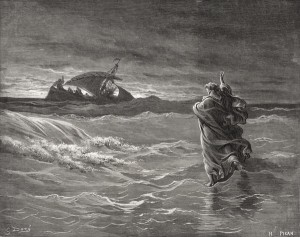 Jesus walking on the water has always struck me as a very funny story. “Funny” in the sense of “oddly out of place”, although it also has a certain Monty-Python-esque quality to it as well. The fact that it is reported in three of the Gospels – in the synoptic Gospels of Mark and Matthew and here in John – attests to its importance for the early church. John’s version of the story is the simplest, but it contains all the elements – a storm, rough seas, disciples’ fear. Like Mark, John leaves out Matthew’s addition of Peter trying to join Jesus on the surface of the lake.
  “I was ready to be sought . . . I said, ‘Here I am, here I am’.” Almost more than anything else in Scripture, these words speak to me of God as not just wanting but needing to be in relationship with creation. I have written elsewhere about my understanding of God as the God who communicates; here is the God who seems almost desperate to be in relationship with his people. God speaks and everything comes in to being; in the beginning was the Word. But what good is speaking, what good is a word, if no one hears it, no one answers it? “Here I am, here I am” seems like a plea to be heard, to be recognized, to be answered. But in our modern society, very few people seem to be answering. Many claim to be seeking, many claim to be “spiritual but not religious,” but few are finding God in the traditional faiths and faith communities.
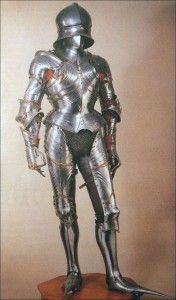 I am fascinated by this picture of God arming for battle, putting on his breastplate, his helmet, and his mantle, donning the “garments of vengeance.” It is, of course, injustice and evil against which God is arming. St. Paul picked up on the picture painted here by Isaiah when he admonished the Christians in Ephesus:
 Last week the senior seminarians of the Episcopal Church, those who will graduate in the spring and shortly thereafter be ordained to the transitional diaconate, sat for the General Ordination Examination. This mutli-day test is something like a Bar exam for the clergy of our denomination. Each day, after the testing was concluded, one or more bloggers were posting and commenting up on the questions.
 As I read the lesson from Exodus today, there is a bush in my dining room. It’s a four-foot tall evergreen and it’s sort of burning. There are little electrical lights all ablaze all over it. It’s our Christmas tree. (We have a short Christmas tree set on a table because we have three cats. We tried for a couple of years to have a normal size seven-foot tree with these guys, but it was impossible. So, small tree on table.)
 How many places do we go where the Lord is and we do not know it? This story of Jacob reminds me of a song we sang in the Cursillo community where I meant my wife. It’s very pretty, very contemplative, and usually sung as an accompaniment to Holy Communion:
 Every so often something in Holy Scripture speaks to me of something other than the “purely” spiritual or “only” religious . . . and this little piece of the Letter to the Hebrews is one of those bits: “what is seen was made from things that are not visible.” Right!