Occasional thoughts of an Anglican Episcopal priest

Category: Lectionary (Page 78 of 99)

Spiritual Fire Extinguisher? – From the Daily Office – December 17, 2012

From Luke’s Gospel:

Jesus came out and went, as was his custom, to the Mount of Olives; and the disciples followed him. When he reached the place, he said to them, “Pray that you may not come into the time of trial.” Then he withdrew from them about a stone’s throw, knelt down, and prayed, “Father, if you are willing, remove this cup from me; yet, not my will but yours be done.” Then an angel from heaven appeared to him and gave him strength. In his anguish he prayed more earnestly, and his sweat became like great drops of blood falling down on the ground. When he got up from prayer, he came to the disciples and found them sleeping because of grief, and he said to them, “Why are you sleeping? Get up and pray that you may not come into the time of trial.”

(From the Daily Office Lectionary – Luke 22:39-46 (NRSV) – December 17, 2012.)
 
Fire Extinguisher Use PosterWe are all, every American, still reeling from and trying to comprehend a tragedy. Twenty First Grade children, most age 6, and six teachers and school administrators were gunned down at an elementary school in Connecticut on Friday. There is not a person in this country, probably not a person in the world, who has not uttered some variation on “Father, if you are willing remove this cup . . . .” in the past 72 hours.

We would give anything to have those lives returned to us. But the cup was not to be taken from Jesus and the loss of those innocent lives will not be miraculously restored; the cup will not be removed.

And Christmas is still on the way. Today and tomorrow and the next I will be in my office preparing the liturgies of celebration. I will be reading the oh-so-familiar texts of Isaiah and Luke, contemplating what I might put into a sermon. I will be consulting with the staff musician about music for the Christmas Eve services and attending rehearsals of the choir and our brass ensemble. I will be in conversation with the altar guild director about flowers and vestments and the arrangement of the chancel for Christmas Eve. I will not be remembering or thinking about the children of Sandy Hook Elementary School.

I will, however, remember them and think deeply about them and their deaths at least twice each day for the foreseeable future. During these hours of disciplined prayer saying the Daily Offices of Matins and Vespers (Morning Prayer and Evening Prayer), reading the lessons of the daily lectionary, praying the Psalms; I cannot now foresee a day when they will not be remembered, as are the students at Columbine High School or Virginia Tech, or even those killed in the clock tower shootings at the University of Texas at Austin in 1966. (My late brother had been student at Austin and we were fearful that people we knew through him might have been among those shot.)

It is . . . perhaps “easy” is not the right word, but I can’t find the right word . . . to fall to our knees in prayer at times of crisis and I know of many who did, actually as well as metaphorically, in the past few days. Here in today’s gospel lesson, Jesus is doing the same. But prayer when we are desperate is empty and specious (and, frankly, dishonest) if it is not grounded in a disciplined habit of prayer . . . if we are not in the practice of spending time daily with God, in praise of God’s majesty, in thanksgiving for the blessings we have received, in petition for our everyday needs, in intercession for the needs of others. Prayer at a time of great distress, if it is not part of daily reverence, reduces God to nothing more than some sort of spiritual fire extinguisher, referred to in time of need, grabbed at in a moment of panic, expected to put out the blazing inferno of our trouble, but otherwise ignored.

I’m not suggesting that this would be true of God . . . but I think we all know what happens when fire extinguishers are ignored. The United States Fire Administration recommends an annual check to make sure that a fire extinguisher is not blocked by furniture, doorways, or any thing that might limit access in an emergency, that the pressure is at the recommended level, that all parts are operable and not damaged or restricted in any way, that hoses and nozzles are free of insects or debris, and that there are no any signs of damage or abuse, such as dents or rust, on the extinguisher. In the case of prayer and time with God, it’s not the “fire extinguisher” that needs to be checked, however, it’s the user, the pray-er. Are we blocked? Are we operating properly? Are we damaged by rust or abuse? Daily prayer checks these things and so much more.

Advent encourages us to develop, if we don’t already have, a custom of spending time with God every day. Advent teaches us to “get up and pray” every day. If we are not doing that, our prayer in time of crisis is simply grabbing at a spiritual fire extinguisher!

====================

A request to my readers: I’m trying to build the readership of this blog and I’d very much appreciate your help in doing so. If you find something here that is of value, please share it with others. If you are on Facebook, “like” the posts on your page so others can see them. If you are following me on Twitter, please “retweet” the notices of these meditations. If you have a blog of your own, please include mine in your links (a favor I will gladly reciprocate). Many thanks!

====================

Father Funston is the rector of St. Paul’s Episcopal Church, Medina, Ohio.
A Holy and a Broken Hallelujah – Sermon for Advent 3, Year C – December 16, 2012

====================

This sermon was preached on Sunday, December 16, 2012, at St. Paul’s Episcopal Church, Medina, Ohio, where Fr. Funston is rector.

(Revised Common Lectionary, Advent 3, Year C: Zephaniah 3:14-20; Canticle 9 (The First Song of Isaiah, Ecce Deus, Isaiah 12:2-6); Philippians 4:4-7; and Luke 3:7-18. These lessons can be read at The Lectionary Page.)

====================

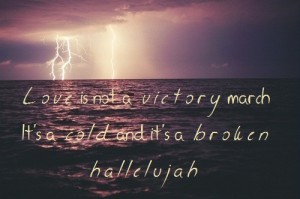
Broken Hallelujah LyricDid you pay attention to the words of the song we just sang as our sequence hymn? Listen to them again:
Comfort, comfort ye my people,
Speak ye peace, thus saith our God;
Comfort those who sit in darkness,
Mourning ‘neath their sorrows’ load . . . .

(Hymn 67, The Hymnal 1982)

These are God’s words to the prophet Isaiah; we find them in the 40th chapter of Isaiah. They are God’s instructions to Isaiah, but I think every priest hears them personally when we are called on to minister to someone in times of trouble and loss. “Comfort, comfort my people; comfort those who are in sorrow.”

Since Friday morning when I, like many others, sat in stunned silence struggling to understand the horror of what had just happened at Sandy Hook Elementary School in Newtown, Connecticut, I have had a recurring vision of Christmas presents under Christmas trees in darkened homes, presents that will never be unwrapped. I see mothers and fathers sitting in that darkness mourning beneath a load of sorrow I don’t think I could ever comprehend, and I wonder if I as a priest or as a friend could speak any word of comfort to them. I have known the pain and brokenness of losing loved ones; I have known the sadness that comes with the death of parents and siblings. But I can only imagine (and I’m sure completely inadequately) the grief and agony a parent must feel when his or her child has been murdered; I can only imagine how broken those parents’ hearts must be, how broken they must feel. I don’t know if I could offer any comfort to them.

I have spent the past 48 hours following the news reports, weeping, screaming at the television, reading the statements of bishops and other clergy, enraged at the injustice of it, angry because as a society we seem unwilling (not incapable, unwilling) to do anything about the epidemic of gun violence that seems to sweep unchecked across our country.

This is not the way we are supposed to be on this, the Third, Sunday of Advent! In the tradition of the church, today is known as Gaudete Sunday or “Rejoicing Sunday” because in the medieval church the introit, the first words of the Mass, was Gaudete in Domino semper: iterum dico, gaudete, the first words of our epistle lesson this morning: “Rejoice in the Lord always; again, I say, rejoice.” The same theme is struck in the Old Testament reading from the Prophet Zephaniah and in the Gradual taken from the Prophet Isaiah; these readings are meant to emphasize our joyous anticipation of the Lord’s coming. “Rejoice and exult with all your heart,” Zephaniah cries out, but when our hearts are broken how are we to do that? Here in the depths of dealing with a senseless act of brutality, there is damned little rejoicing in our broken hearts, there is damned little comfort. We are in the midst of a murderous gun violence epidemic and I find it hard to rejoice.

Consider what has gone on in just the past week: last Sunday a man fatally shot his security-officer wife, tried to kill another person, and then killed himself in an employee parking lot at Cleveland-Hopkins Airport; on Tuesday a masked gunman killed two people and seriously injured another in a Portland, Oregon, shopping mall; on Friday, the Sandy Hook Elementary School killings, the second worst mass shooting at a school in U.S. history; and yesterday, a gunman shot three people in a hospital in Birmingham, Alabama. Earlier this year we saw fatal mass shootings in Minneapolis, in Tulsa, in a Sikh temple in Wisconsin, in a theater in Colorado, in a coffee bar in Seattle, and in a college in California. It is painfully clear that this is an epidemic of violence, that all is not well in our country. Like our hearts, our society is broken.

According to the Centers for Disease Control, there are about 31,000 deaths from firearms annually in our country. Of those, 500 are accidental; another 300 or so are considered “legal” as the result of law enforcement actions; and the nature of about 200 cannot be determined. That means that about 30,000 intentional, illegal, fatal shootings occur in the United States in a year’s time; 62% of those are suicides; 38% are murders.

Speak ye to Jerusalem
of the peace that waits for them;
tell her that her sins I cover,
and her warfare now is over.

As someone who, everyday, tries to speak the word of God to people who need to hear it, I don’t know that I can do that! I don’t know if I could comfort those parents mourning beneath their dark load of sorrow, and I don’t know how I could tell you that our warfare, our plague of gun violence is over! Our warfare is not over; the slaughter goes on . . . one or two people here, thirteen theater-goers there, twenty children in Connecticut . . . the massacre continues more than 11,000 times a year. Yes, it is painfully clear that this is an epidemic of violence, that all is not well in our country. Like our hearts, our society is broken.

John the Baptizer warned the people who came to him that all was not well in their society, that it was broken. “Do not,” he told them, “begin to say to yourselves, ‘We have Abraham as our ancestor.'” Don’t think that because you are who you are that all is well and that all will be well; it is not and it will not be. Our society is broken! “And the crowds asked him, ‘What then should we do?'” John’s answer was simplicity itself – do what you know to be right. If you have two coats, if you have extra food, and your neighbor has none, share. If you have taken on the job of tax collector, or if you are a soldier entitled to ask citizens for support, collect no more than you should, ask no more than is proper. Just do what you know to be right, do what you know ought to be done.

Every time one of these mass shootings occurs there is an outpouring of public grief, and there are expressions of sorrow and sympathy. Every time this has happened, however, we have been told that it is not the appropriate time to talk about strengthening our nation’s gun control laws; we are told that it is too soon to talk about doing something about gun violence; we are told that we have to give the families of the victims time to heal. But as John the Baptizer said to those who came to him at the Jordan, the time is now – “Even now,” he said, “the ax is lying at the root of the trees . . . .” There is no time like the present to do what we know to be right, to do what we know ought to be done.

I believe that that talk about time to heal is a sham. I don’t think anyone ever “heals” from the death of a loved one; one remains broken. I know that I have never “healed” from the deaths of my parents or of my brother or of any other person I loved; forever, after each death, there is a part of me that is and will always be broken. As a parent, I am very sure I would never “heal” from the murder of my child; I would be forever broken. But I know that life goes on and, through the grace of God, we are given the strength to live it, even as wounded, as broken, as broken-hearted as we may be. As Isaiah said, “Surely, it is God who saves me; I will trust in him and not be afraid. For the Lord is my stronghold and my sure defense, and he will be my Savior.” The one who was broken on Calvary’s tree was broken that I, in my brokenness, might be made whole. Through his brokenness, in our brokenness, we are given the peace of God which passes all understanding.

Life goes on, and by the grace of our Savior we are given the strength to live it, and in it to do what we know to be right, to do what we know ought to be done. The only question is whether we have the will to do it.

Make ye straight what long was crooked,
make the rougher places plain;
let your hearts be true and humble,
as befits his holy reign.

Have we the will to do what we know to be right, to make what is crooked straight, to make what is rough plain? Are our hearts, broken though they may be, true and humble as befits our Savior’s holy reign?

Many of you know that I’m a great fan of the singer-songwriter Leonard Cohen and many of you are familiar with his song Hallelujah. In it there is this great line:

Love is not a victory march
It’s a cold and it’s a broken Hallelujah

And again, later in the song, the singer says of love,

It’s not a cry you can hear at night
It’s not somebody who has seen the light
It’s a cold and it’s a broken Hallelujah

In the funeral liturgy of our church, near the end of the service, the priest stands at the body of the deceased and says, “All of us go down to the dust; yet even at the grave we make our song: Alleluia, alleluia, alleluia.” When each of those twenty children, each of those seven adults are buried, their families will hear those as cold and broken Hallelujahs! But as our Advent hymn reminds us in its conclusion,

For the glory of the Lord
now o’er the earth is shed abroad,
and all flesh shall see the token
that the word is never broken.

Our hearts may be broken; our lives may be broken; our society may be broken, but God’s word, God’s promise is never broken. The Word made flesh, Jesus Christ, he was broken . . . broken on the Cross that we might be made whole. Risen unbroken though still bearing the scars of our brokenness, he will return again so that we might sing not a broken, but a whole Hallelujah, a holy Hallelujah, so that we might “rejoice in the Lord always.”

I still don’t know if I could comfort those grieving parents, but I do know that I believe in God, that I believe God’s promise, and that I believe in Jesus Christ, the One who was broken that we might be made whole. It is his birth and its promise of wholeness that we prepare to celebrate in this Advent season. And because I believe, I know that I could, at least, be with those families in this time of grief, that I could sit with them, and that I could assure them in words just slightly changed from the end of Mr. Cohen’s song . . . .

There’s a blaze of light in every word
It doesn’t matter which you heard
The holy or the broken Hallelujah.
* * * *
And even though it all went wrong
We’ll stand before the Lord in song
With nothing on our tongue but Hallelujah!

Good God, Do Easter! – From the Daily Office – December 16, 2012

From the Prophet Isaiah:

All hands will be feeble,
and every human heart will fail,
and they will be dismayed.
Pangs and agony will seize them;
they will be in anguish like a woman in labor.
They will look aghast at one another;
their faces will be aflame.

(From the Daily Office Lectionary – Isaiah 13:7-8 (NRSV) – December 16, 2012.)
 
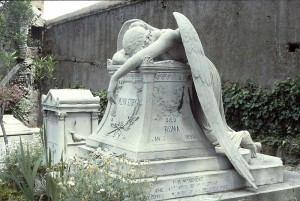
Angel of grief, a 1894 sculpture by William Wetmore StoryToday is the Third Sunday of Advent; in the tradition of the church it is known as Gaudete Sunday, Latin for “Rejoicing Sunday” so named because of the medieval introit to the Mass, “Gaudete in Domino semper: iterum dico, gaudete”, St. Paul’s words in the Letter to the Philippians, “Rejoice in the Lord always: again I say rejoice.” (4:4) (A reading from that very portion of Paul’s letter is this year’s epistle lesson for the Eucharist today; we will hear and consider those words at church this morning.)

But on Friday, at the Sandy Hook Elementary School in Newtown, Connecticut, twenty children and six of their teachers were gunned down by a 20-year-old man wielding two semi-automatic assault weapons. Before entering the school, if reports have been correct, he murdered his mother, and after killing the children, he shot himself. In the face of such insanity, how does one rejoice? Isaiah’s words of feebleness and failure, pangs and agony, anguish and faces aflame seem somehow so much more appropriate than Paul’s admonition to rejoice.

On Friday, following those tragic events, the Episcopal Peace Fellowship published this poem by Old Testament scholar Walter Brueggemann on its Facebook page. Entitled Grieving Our Lost Children, I offer it again here:

Another brutality,
another school killing,
another grief beyond telling . . .
and loss . . .
in Colorado,
in Wisconsin,
among the Amish
in Virginia.
Where next? (In Connecticut)

We are reduced to weeping silence,
even as we breed a violent culture,
even as we kill the sons and daughters of our “enemies,”
even as we fail to live and cherish and respect
the forgotten of our common life.

There is no joy among us as we empty our schoolhouses;
there is no health among us as we move in fear and bottomless anxiety;
there is little hope among us as we fall helpless before
the gunshot and the shriek and the blood and the panic: we pray to you only because we do not know what else to do.
So we pray, move powerfully in our body politic,
move us toward peaceableness
that does not want to hurt or to kill,
move us toward justice
that the troubled and the forgotten may know mercy,
move use toward forgiveness that we
may escape the trap of revenge.

Empower us to turn our weapons to acts of mercy,
to turn our missiles to gestures of friendship,
to turn our bombs to policies of reconciliation;
and while we are turning,
hear our sadness,
our loss,
our bitterness.

We dare to pray our needfulness to you because you have been there on that
gray Friday,
and watched your own Son be murdered
for “reasons of state.”

Good God, do Easter!
Here and among these families,
here and in all our places of brutality.

Move our Easter grief now . . .
without too much innocence –
to your Sunday joy.
We pray in the one crucified and risen
who is our Lord and Savior.

Good God, do Easter! It may be Advent. We may be getting ready for Christmas. But our hands are feeble; our hearts will fail; we are dismayed; our faces are aflame. Please God, do Easter!

====================

A request to my readers: I’m trying to build the readership of this blog and I’d very much appreciate your help in doing so. If you find something here that is of value, please share it with others. If you are on Facebook, “like” the posts on your page so others can see them. If you are following me on Twitter, please “retweet” the notices of these meditations. If you have a blog of your own, please include mine in your links (a favor I will gladly reciprocate). Many thanks!

====================

Father Funston is the rector of St. Paul’s Episcopal Church, Medina, Ohio.

Christmas Shopping with Peter – From the Daily Office – December 15, 2012

The following meditation was prepared before the news of yesterday’s tragic events in Newtown, Connecticut. I pray for the repose of the souls of all those who died and for comfort for their families, and I pray that this nation will come to its senses and enact reasonable and effective gun control legislation.

====================

From Luke’s Gospel:

Jesus said, “Simon, Simon, listen! Satan has demanded to sift all of you like wheat, but I have prayed for you that your own faith may not fail; and you, when once you have turned back, strengthen your brothers.” And he said to him, “Lord, I am ready to go with you to prison and to death!” Jesus said, “I tell you, Peter, the cock will not crow this day, until you have denied three times that you know me.”

(From the Daily Office Lectionary – Luke 22:21-24 (NRSV) – December 15, 2012.)
 
Holiday Shopping at the MallThis is the part of the Maundy Thursday – Good Friday story that breaks my heart! I so identify with Peter; he’s such a bumbling fool on so many occasions and Jesus just keeps on holding him close, knowing that eventually he will pull through. I know that I would have done no better than Peter in those dark hours of Thursday night. I might not even have done as well as he did; I’m not sure I’d have had the courage to follow Jesus into the high priest’s courtyard!

And now, during this season of Advent, do I do any better? The world around us is going mad with consumption. The malls are filled with shoppers buying garbage to give to people they probably don’t really like who probably don’t really want what they are buying and will probably return it or “regift” it. And I’m right out there with them – although so far I haven’t bought anything. I can’t, for the life of me, figure out what my wife or kids or friends would want to receive from me as a gift. Can I just tell them I love them and leave it at that? Can I just tell Jesus that?

I don’t. I go to the shopping centers and try to find that perfect gift for each family member; I seldom do and often end up getting nothing for anyone and feeling guilty about that in the end. Meanwhile, I melt into the crowd and wander the mall and drive the crowded streets and, just like Peter, I look like one of them. I emulate Peter and do not open my mouth. His accent gave him away as a Galilean — I might inadvertently hold forth with the cadences of the Book of Common Prayer or make some reference to orthodox theology and give myself away as a Christian, a follower of Jesus rather than a minion of Santa Claus. By my failure to say “Enough!” and fight against the commercial Christmas consumption madness, the avalanche of advertising that has annihilated Advent, I have denied Christ many more times than Peter ever did.

But I know what Peter did not yet know, that even my denial will not separate me from my Lord, that even shamed by my denial as I am, I can return to him and I will be received, welcomed, forgiven. And so today, after a Saturday of shopping surrounded by the crass commercialism of secular Christmas, blinded by holiday lights, deafened by the roar of the shopping crowd and the public address systems blaring Winter Wonderland, a Saturday spent joining Peter in silence and denial, I am still able to pray the evening Psalm –

Send out your light and your truth, that they may lead me,
and bring me to your holy hill and to your dwelling;
That I may go to the altar of God, to the God of my joy and gladness;
and on the harp I will give thanks to you, O God my God.

====================

A request to my readers: I’m trying to build the readership of this blog and I’d very much appreciate your help in doing so. If you find something here that is of value, please share it with others. If you are on Facebook, “like” the posts on your page so others can see them. If you are following me on Twitter, please “retweet” the notices of these meditations. If you have a blog of your own, please include mine in your links (a favor I will gladly reciprocate). Many thanks!

====================

Father Funston is the rector of St. Paul’s Episcopal Church, Medina, Ohio.

You Know, Sweetie, Jesus Did Grow Up – From the Daily Office – December 14, 2012

From Luke’s Gospel:

When the hour came, Jesus took his place at the table, and the apostles with him. He said to them, “I have eagerly desired to eat this Passover with you before I suffer; for I tell you, I will not eat it until it is fulfilled in the kingdom of God.” Then he took a cup, and after giving thanks he said, “Take this and divide it among yourselves; for I tell you that from now on I will not drink of the fruit of the vine until the kingdom of God comes.” Then he took a loaf of bread, and when he had given thanks, he broke it and gave it to them, saying, “This is my body, which is given for you. Do this in remembrance of me.” And he did the same with the cup after supper, saying, “This cup that is poured out for you is the new covenant in my blood.”

(From the Daily Office Lectionary – Luke 22:14-20 (NRSV) – December 14, 2012.)
 
Talladega Nights: The Ballad of Ricky Bobby Prayer SceneIn ten days we will begin our celebration of his birth, but the Daily Office lectionary today has us consider his last meal on the night before his death . . . .

When our son was born, my wife and I designed our own announcements. On the front we put a quotation from poet Carl Sandburg’s only novel: “A baby is God’s opinion that life should go on.” The birth of a baby is a marvelous event, a hopeful one, an occurrence that focuses on the future. During Advent the secular commercial world, buying into a certain sentimental spirituality, when it isn’t focused on the legend of Santa Claus, constantly reminds us that we are getting ready to celebrate the birth of a cherubic, rosy-cheeked baby. For some, it is difficult to move beyond that icon of hopefulness, that image of God’s opinion of continuation.

In the movie Talladega Nights: The Ballad of Ricky Bobby, the title character, played by Will Ferrell, is one of those. When the family gathers for a Thanksgiving meal, he offers a grace addressed to the Christmas cherub and a conversation ensues:

Ricky Bobby: Dear Lord baby Jesus, we thank you so much for this bountiful harvest of Domino’s, KFC, and the always delicious Taco Bell. I just want to take time to say “Thank you” for my family – my two sons, Walker, and Texas Ranger, or TR as we call him. And of course my red-hot smokin’ wife Carley, who is a stone cold fox. Dear tiny infant Jesus…

Carley Bobby: Hey, um… you know, Sweetie, Jesus did grow up. You don’t always have to call him “baby”. It’s a bit odd and off-puttin’ to pray to a baby.

Ricky Bobby: Well look, I like the Christmas Jesus best, and I’m sayin’ grace. When you say grace, you can say it to grown-up Jesus, or teenage Jesus, or bearded Jesus, or whatever you want.

Today’s gospel lesson reminds us, in the midst of our Christmas preparations, “You know, Sweetie, Jesus did grow up.” He lived the life of an itinerant preacher; he challenged the authorities; he was crucified; he died; he was buried; he rose from the dead; he ascended into heaven. On the night before he died, he had this meal with his friends. In her book The Spirituality of Bread (Northstone:2007, p. 146), Donna Sinclair writes, “The re-enactment of Jesus’ last conversation with his friends says that those who share a meal with the compassionate one can become just and brave agents of healing. Such bread offers the hope of human change. That’s why, over and over, I form a circle with my friends and say the words, ‘The bread of new life . . .'”

Advent prepares us to witness once again that baby whose birth was God’s opinion that not only should life go on, it should be redeemed. Advent prepares us for the return of the One who grew up and gave himself that life might be changed.

====================

A request to my readers: I’m trying to build the readership of this blog and I’d very much appreciate your help in doing so. If you find something here that is of value, please share it with others. If you are on Facebook, “like” the posts on your page so others can see them. If you are following me on Twitter, please “retweet” the notices of these meditations. If you have a blog of your own, please include mine in your links (a favor I will gladly reciprocate). Many thanks!

====================

Father Funston is the rector of St. Paul’s Episcopal Church, Medina, Ohio.

The Water Bearer – From the Daily Office – December 13, 2012

From Luke’s Gospel:

Then came the day of Unleavened Bread, on which the Passover lamb had to be sacrificed. So Jesus sent Peter and John, saying, “Go and prepare the Passover meal for us that we may eat it.” They asked him, “Where do you want us to make preparations for it?” “Listen,” he said to them, “when you have entered the city, a man carrying a jar of water will meet you; follow him into the house he enters and say to the owner of the house, ‘The teacher asks you, “Where is the guest room, where I may eat the Passover with my disciples?”‘ He will show you a large room upstairs, already furnished. Make preparations for us there.” So they went and found everything as he had told them; and they prepared the Passover meal.

(From the Daily Office Lectionary – Luke 22:7-13 (NRSV) – December 13, 2012.)
 
Water Carrier, Cairo, Egypt (1860-1890)This, of course, is the familiar story of the preparation for the Last Supper, the supper in the Upper Room where so much of the story of Jesus’ last days and of the church’s first days takes place. Reading it again today I have noticed the little remarked “man carrying a jar of water.” From time to time in Holy Scripture we meet these people, sometimes named (especially in Paul’s letters), sometimes anonymous, about whom we are told very little, but who play important roles. This water bearer is a pivotal character in this story; without him Peter and John would be unable to find the place which would become so important in the Christian story, the scene of the first eucharist, the place where the Resurrected Lord would appear to his friends, the location of the Pentecost event. And yet, we know nothing about him.

Whenever I read or hear a passage of Scripture about a water carrier, a water jar, or a clay pot, I cannot help but remember a folk tale from India, a story I’ve used as a sermon illustration on several occasions:

A water bearer had two large pots, each hung on each end of a pole which he carried across his neck. One of the pots had a crack in it, and while the other pot was perfect and always delivered a full portion of water at the end of the long walk from the stream to the master’s house, the cracked pot arrived only half full. For a full two years this went on daily, with the bearer delivering only one and a half pots full of water to his master’s house. Of course, the perfect pot was proud of its accomplishments, perfect to the end for which it was made. But the poor cracked pot was ashamed of its own imperfection, and miserable that it was able to accomplish only half of what it had been made to do.

After two years of what it perceived to be a bitter failure, it spoke to the water bearer one day by the stream. “I am ashamed of myself, and I want to apologize to you.”

“Why?” asked the bearer. “What are you ashamed of?”

“I have been able, for these past two years, to deliver only half my load because this crack in my side causes water to leak out all the way back to your master’s house. Because of my flaws, you have to do all of this work, and you don’t get full value from your efforts,” the pot said.

The water bearer felt sorry for the old cracked pot, and in his compassion he said, “As we return to the master’s house, I want you to notice the beautiful flowers along the path.”

Indeed, as they went up the hill, the old cracked pot took notice of the sun warming the beautiful wild flowers on the side of the path, and this cheered it some. But at the end of the trail, it still felt bad because it had leaked out half its load, and so again it apologized to the bearer for its failure.

The bearer said to the pot, “Did you notice that there were flowers only on your side of your path, but not on the other pot’s side? That’s because I have always known about your flaw, and I took advantage of it. I planted flower seeds on your side of the path, and every day while we walk back from the stream, you’ve watered them. For two years I have been able to pick these beautiful flowers to decorate my master’s table. Without you being just the way you are, he would not have this beauty to grace his house.”

The cracked and leaking pot was unaware of its importance in the life of the water bearer. I wonder if the “man carrying a jar of water” in the story of the Last Supper was aware of his importance; did he even know the disciples were following him? Would he later say, “I took them to my master’s home where Jesus ate his last meal”? We can’t know since Luke tells us no more, but we can take an Advent lesson from his inclusion in this story.

The message of Advent, spoken by Jesus in the gospel lesson for its first Sunday, is “Be alert!” (Luke 21:36) Slow down and pay attention. Be aware of those around you, the unknown carriers of water jars, and more especially those for whom you may be the water bearer . . . or the water jar.

====================

A request to my readers: I’m trying to build the readership of this blog and I’d very much appreciate your help in doing so. If you find something here that is of value, please share it with others. If you are on Facebook, “like” the posts on your page so others can see them. If you are following me on Twitter, please “retweet” the notices of these meditations. If you have a blog of your own, please include mine in your links (a favor I will gladly reciprocate). Many thanks!

====================

Father Funston is the rector of St. Paul’s Episcopal Church, Medina, Ohio.

The Book of Life – From the Daily Office – December 12, 2012

From John’s Gospel:

Each of them went home while Jesus went to the Mount of Olives. Early in the morning he came again to the temple. All the people came to him and he sat down and began to teach them. The scribes and the Pharisees brought a woman who had been caught in adultery; and making her stand before all of them, they said to him, “Teacher, this woman was caught in the very act of committing adultery. Now in the law Moses commanded us to stone such women. Now what do you say?” They said this to test him, so that they might have some charge to bring against him. Jesus bent down and wrote with his finger on the ground. When they kept on questioning him, he straightened up and said to them, “Let anyone among you who is without sin be the first to throw a stone at her.” And once again he bent down and wrote on the ground. When they heard it, they went away, one by one, beginning with the elders; and Jesus was left alone with the woman standing before him. Jesus straightened up and said to her, “Woman, where are they? Has no one condemned you?” She said, “No one, sir.” And Jesus said, “Neither do I condemn you. Go your way, and from now on do not sin again.”

(From the Daily Office Lectionary – John 7:53-8:11 (NRSV) – December 12, 2012.)
 
Book of Life by ~radeck0There is one ancient manuscript that adds that what Jesus wrote in the sand was “the sins of each of them,” but no others. Most scholars generally hold that we really don’t know what Jesus wrote. I think one of the more fascinating ideas is that Jesus was writing the names of those who were judging the woman.

If that is the case, Jesus’ doing so is another of his “prophetic actions” – deeds done as illustrations of a prophetic point. The probable reference is to Jeremiah 17:13. The NRSV translation of that verse is “O hope of Israel! O Lord! All who forsake you shall be put to shame; those who turn away from you shall be recorded in the underworld, for they have forsaken the fountain of living water, the Lord.” An alternative rendering from the King James version is “O Lord, the hope of Israel, all that forsake thee shall be ashamed , and they that depart from me shall be written in the earth, because they have forsaken the Lord, the fountain of living waters.” The Hebrew word translated in the first as “the underworld” and in the second as “the earth” is ‘erets, which can also be translated as “the ground.” Is Jesus, by writing their names in the ground immediately after calling for “anyone without sin” to cast the first stone, referring to Jeremiah’s warning?

It is only by happenstance that our Jewish friends are celebrating Chanukah this week. Among the many tradition of Chanukah is to greet one another, especially on the last of the eight days of the celebration, with the same greeting used at Yom Kippur: “May your name be written in the book of life.” The contrast between names of the forsaken written in the ground and names of the righteous written in the book of life underscores the Second Coming anticipation of Advent.

The book of life is not only a Jewish image. It is also seen in the Savior’s Second Coming as revealed to John of Patmos who saw “a new heaven and a new earth” and saw “the holy city, the new Jerusalem coming down out of heaven from God, prepared as a bride adorned for her husband.” (Rev. 21:1-2) The gates of that city, John saw, “will never be shut by day – and there will be no night there. People will bring into it the glory and the honor of the nations. But nothing unclean will enter it, nor anyone who practices abomination or falsehood, but only those who are written in the Lamb’s book of life.” (Rev. 21:25-27)

Advent is a time of reflection, a time to prepare, a time to make sure our names are not written on the ground but rather in the book of life, to focus on our own worthiness and not on the sins of others.

====================

A request to my readers: I’m trying to build the readership of this blog and I’d very much appreciate your help in doing so. If you find something here that is of value, please share it with others. If you are on Facebook, “like” the posts on your page so others can see them. If you are following me on Twitter, please “retweet” the notices of these meditations. If you have a blog of your own, please include mine in your links (a favor I will gladly reciprocate). Many thanks!

====================

Father Funston is the rector of St. Paul’s Episcopal Church, Medina, Ohio.

Lighten Up! – From the Daily Office – December 11, 2012

From Luke’s Gospel:

Jesus said, “Be on guard so that your hearts are not weighed down with dissipation and drunkenness and the worries of this life, and that day does not catch you unexpectedly, like a trap. For it will come upon all who live on the face of the whole earth. Be alert at all times, praying that you may have the strength to escape all these things that will take place, and to stand before the Son of Man.”

(From the Daily Office Lectionary – Luke 21:34-36 (NRSV) – December 11, 2012.)
 
Light Hearted by DarkslavarDon’t be “weighed down by dissipation and drunkenness.” I’m told that the Greek word translated as “dissipation”, kraipale, describes the headache that results from drinking too much wine; in other words, it describes a hangover.

When I read these words I immediately think “office party”. We don’t do those sorts of parties in the office where I currently work (I suspect very few church staffs do), but when I was a practicing trial lawyer . . . . ‘Tis the season for that sort of thing and here in the middle of it (we are about half way through Advent right now) Jesus tells us to knock it off. Negative experiences and tales of stupid and self-destructive behavior from such parties abound. That sort of thing, we know without Jesus telling us, weighs down one’s heart. But just to be sure we do understand, Jesus does warn us: drunkenness and its result and “the worries of this life” weighing down your heart, he warns, might make us miss things, like Judgment Day. Well, not miss it perhaps, but certainly be unprepared when it gets here.

I got to thinking about the opposite of a “heart weighed down” and realized that that would be “light-hearted.” According to the dictionaries, to be light-hearted is to be carefree and happy, to be known for a blithe spirit, to possess a merry blithesome nature. And I realized that this is not the currently accepted understanding of someone who self-identifies as “Christian”. A few years ago, David Kinnaman, president of the Barna research organization, published a book entitled unChristian: What a New Generation Really Thinks about Christianity… and Why It Matters (Baker:2007). In it he revealed that his organization’s findings are that modern young adults consider Christians to be judgmental, bigoted, sheltered, right-wingers, hypocritical, insincere, and uncaring. Not exactly adjectives suggesting light-heartedness.

And then last week Lutheran pastor David L. Hansen in Texas published an article about his experience listening to non-churchgoers explain why they don’t go to church: “The No. 1 thing that keeps people away from the church is the people who are in the church.” He went on to say, “It’s not that people outside the church have low expectations of Christians. It’s the opposite. They expect us to actually live out the things we proclaim on Sunday. They expect us to love our neighbor, care for the least of these and love our enemies.” (Why Don’t People Come to Church?)

Kinnaman and Hansen, I think, are simply demonstrating that we haven’t properly heard nor learned to live the message of Advent, the message of Jesus reported here by Luke. It’s really quite a simple message: “Lighten up!” Somehow, we just can’t quite seem to believe that that’s what Jesus meant, but I really think it is. Jesus wants us to be light-hearted; not weighed down by stupid and self-destructive behaviors. He wants us to be carefree and happy, and known by our blithe spirit: “I give you a new commandment, that you love one another. Just as I have loved you, you also should love one another. By this everyone will know that you are my disciples, if you have love for one another.” (John 13:34-35)

It’s Advent! Don’t let your heart be weighed down stupid and self-destructive behavior! Don’t be weighed down by drunkenness and dissipation and worry! Don’t be weighed down by judgmentalism, bigotry, prejudice, hypocrisy, insincerity, or lack of caring! Don’t be weighed down! Lighten up!

====================

A request to my readers: I’m trying to build the readership of this blog and I’d very much appreciate your help in doing so. If you find something here that is of value, please share it with others. If you are on Facebook, “like” the posts on your page so others can see them. If you are following me on Twitter, please “retweet” the notices of these meditations. If you have a blog of your own, please include mine in your links (a favor I will gladly reciprocate). Many thanks!

====================

Father Funston is the rector of St. Paul’s Episcopal Church, Medina, Ohio.

Road Builders with God – From the Daily Office – December 10, 2012

From the Psalms:

Show me your ways, O Lord,
and teach me your paths.
Lead me in your truth and teach me,
for you are the God of my salvation;
in you have I trusted all the day long.
***
Gracious and upright is the Lord;
therefore he teaches sinners in his way.
He guides the humble in doing right
and teaches his way to the lowly.
All the paths of the Lord are love and faithfulness
to those who keep his covenant and his testimonies.

(From the Daily Office Lectionary – Psalm 25:3-4,7-9 (BCP Version) – December 10, 2012.)
 
Road Building in North East IndiaAdvent sometimes seems to be a season of mixed messages. We are preparing to celebrate the anniversary of the Messiah’s birth, so the focus at times seems to be joy and happiness, good times, family gatherings, all that sort of thing. But we are also preparing for the Second Coming, so the focus shifts to the end of time, the destruction of the world, wars and rumors of wars, a world in tumolt, turmoil, and tribulation, all that sort of thing. Mixed messages!

This week in yesterday’s Eucharistic lectionary we heard John at the River Jordan claiming to be the voice prophesied by Isaiah crying in the wilderness to make straight and level a roadway for God. If I read John’s message correctly, the obligation of preparing that pathway is ours. Then today we sing a Psalm acknowledging that we have not the vaguest idea where God’s path is, that we have no choice but to call upon God to show us the way to go. We are assured by the Psalm that God’s paths are “love and faithfulness to those who keep his covenant and his testimonies,” but the message of the Psalm is clear that we do not know and cannot find the route without God’s guidance.

So which is it? Are we supposed to go out and survey and prepare the road for God? Or do we wait upon the Lord to point out and teach the road to us? Mixed message!

Or is it? Process theologian C. Robert Mesle wrote, “The world is not the way God wants it to be. Unjust social structures do not reflect God’s vision for us. Poverty, hunger, and violence are not trials intentionally put into the world by God for our education. They are evils against which God is struggling and against which God calls us to struggle . . . . God can work in the world; but God can work in our world most effectively, most quickly, through us.” (Process Theology: A Basic Introduction, Chalice Press:1993, p. 79) God shows us the way; we build the path where God shows us.

Today in the Episcopal Church, we commemorate the 20th Century monk Thomas Merton. A prayer written by him speaks to me about our call to joint road building with God:

My Lord God, I have no idea where I am going. I do not see the road ahead of me. I cannot know for certain where it will end. Nor do I really know myself, and the fact that I think I am following your will does not mean that I am actually doing so. But I believe that the desire to please you does in fact please you. And I hope I have that desire in all that I am doing. I hope that I will never do anything apart from that desire. And I know that if I do this you will lead me by the right road, though I may know nothing about it. Therefore I will trust you always though I may seem to be lost and in the shadow of death. I will not fear, for you are ever with me, and you will never leave me to face my perils alone.

The message of Advent is not a mixed message; it is a clear message. God shows us the way; we build the path where God shows us. We are to be road builders with God.

====================

A request to my readers: I’m trying to build the readership of this blog and I’d very much appreciate your help in doing so. If you find something here that is of value, please share it with others. If you are on Facebook, “like” the posts on your page so others can see them. If you are following me on Twitter, please “retweet” the notices of these meditations. If you have a blog of your own, please include mine in your links (a favor I will gladly reciprocate). Many thanks!

====================

Father Funston is the rector of St. Paul’s Episcopal Church, Medina, Ohio.

What Is the Crying? – Sermon for Advent 2, Year C – December 9, 2012

====================

This sermon was preached on Sunday, December 9, 2012, at St. Paul’s Episcopal Church, Medina, Ohio, where Fr. Funston is rector.

(Revised Common Lectionary, Advent 2, Year C: Baruch 5:1-9; Canticle 16 (The Song of Zechariah, Benedictus Dominus Deus, Luke 1: 68-79); Philippians 1:3-11; and Luke 3:1-6. These lessons can be read at The Lectionary Page.)

====================

John the Baptist

What is the crying at Jordan?
Who hears, O God, the prophecy?
Dark is the season, dark our hearts
and shut to mystery.

Who then shall stir in this darkness,
prepare for joy in the winter night?
Mortal, in darkness we lie down, blindhearted,
seeing no light.

Lord, give us grace to awake us,
to see the branch that begins to bloom;
in great humility is hid all heaven
in a little room.

Now comes the day of salvation,
in joy and terror the Word is born!
God comes as gift into our lives;
oh let salvation dawn!

(Words: Carol Christopher Drake)

What is the crying at Jordan? What is the crying in New York? What is the crying at Arlington? What is the crying in Southern California? What is the crying at Checkpoint 18 outside of Kabul? What is the crying in Medina? What is that crying?

“Take off the garment of your sorrow and affliction,” wrote Baruch, “and put on forever the beauty of the glory from God.” This is a time and a season when we expect to leave behind our sorrows and our afflictions; we expect to feel happiness and joy, and if we don’t we feel guilty because that’s what your supposed to feel at Christmas, right? But the truth is that for many this is a time and a season when sorrow and affliction are felt most acutely. That crying is the voice of those feeling the cold hand of death and the emptiness of loss in this season of joy and celebration.

This is a time and a season when death and loss can and do really hit home. Nine days ago, a week ago Friday, we received word that Nancy Lawrence, a long-time, life-time member of this congregation had passed away. Even though her last several months of life were, frankly, awful and everyone who has known Nancy is relieved that she is no longer suffering, still any death is an occasion of sadness. For many this is a time and a season when sorrow and affliction are felt most acutely.

This past Friday, day before yesterday, I got word in the evening that Deborah Griffin Bly, a woman I’ve known and whose music I have enjoyed for seventeen years had died. She was one of the singing duet called “The Miserable Offenders” and it was she and her partner who introduced me to that exquisite piece of poetry and its musical setting, Hymn 69, in our hymnal. Deb and I were part of community of Anglicans online that extends around the world; through it we have had nearly a thousand mutual friends. For many this is a time and a season when sorrow and affliction are felt most acutely.

Thirteen years ago, on the longest night of the year, the winter solstice, December 21, my mother passed away. Losing a parent is one of life’s hardest lessons, and never a good prelude to Christmas, and every year after the joyous holiday is also a reminder of the most profound loss. For me, as for many, this is a time and a season when sorrow and affliction are felt most acutely.

And, yet, Baruch writes, “Take off the garment of your sorrow and affliction, and put on forever the beauty of the glory from God.”

In the current issue of the magazine The Christian Century, Lutheran pastor Peter Marty tells of preaching a Christmas Eve sermon in which he made “reference to a little boy in a rough section of Trenton, New Jersey, whose body was found stuffed in a bag under a fire escape.” At the conclusion of the service a woman “told [him] in the receiving line that mention of children being murdered had no place in a Christmas sermon. [She said,] ‘I will never set foot in this church again.'” (December 12, 2012, Vol. 129, No. 25, page 10) I don’t know if I would mention a murder in a Christmas sermon, but I think we all need to remember that for many this time of year is not a “holly, jolly” season.

As we get ready for whatever good times we anticipate, as we prepare to celebrate the Messiah’s birth, let’s remember that unless we see the shadow of the cross falling on the crib we are not seeing Christmas clearly. Jesus did not enter this world just to be a cute little baby; he grew up! He lived in a time of political turmoil in a land oppressed by the military might of the Roman Empire. He taught a subversive “good news” that offended both that Empire and the religious establishment of his own country which sought to appease it. His truth would lead to his arrest and he would suffer and die on a cross. That he did so and rose from the dead so that our sins might be forgiven and we might enter into the Kingdom of God is why Christmas is special. Christmas Eve might not be the time or place to make mention of the murder of children, but our time of preparing to appreciate Christmas is a time to appreciate the reality of death and suffering, the reality of sorrow and affliction.

Traditionally, on this Second Sunday of Advent (and again next week on the Third Sunday) we focus our attention on John the Baptist, the forerunner who was the voice crying in the wilderness. His was the voice crying at Jordan, “In the desert, make straight a pathway for our God.” We turned our attention toward John this morning by saying together the words of the song his father, the priest Zechariah, sang at his birth. It’s a great canticle, and I love its final words:

In the tender compassion of our God
the dawn from on high shall break upon us,
To shine on those who dwell in darkness and the shadow of death,
and to guide our feet into the way of peace.

They are words that speak especially to those for whom this is a time and a season when sorrow and affliction are felt most acutely.

They are also words that speak to and for all of us, because we all dwell in darkness and the shadow of death. At one time or another, we all, as that marvelous poem says, lie down in darkness, blind-hearted, seeing no light. At one time or another, we all, as the Psalmist so eloquently put it, walk through the valley of the shadow of death. But we need fear no evil for as John the Baptist, cried out at Jordan

Every valley shall be filled,
and every mountain and hill shall be made low,
and the crooked shall be made straight,
and the rough ways made smooth;
and all flesh shall see the salvation of God.

It is for and through those for whom this is a time and a season when sorrow and affliction are felt most acutely that the real meaning of Advent comes through. Only a very shallow and superficial understanding of the story of the Savior’s birth would lead us to think that the Christmas for which we prepare is only about happiness. Christmas is about real life – yes, it is about joy, but it is also about sorrow; yes, it is about birth, but it is also about death; yes, it is about redemption, but it is also about affliction. It is about God coming to us incarnate in Jesus to give us life, real life, and that abundantly. It is about Christ crucified, risen, and ascended returning for us in glory. When we realize this and are enabled to give thanks for the birth of Christ and to look forward to his triumphant return even in the midst of death and loss, even as we live with profound sorrow and affliction, it is then that the dawn from on high breaks upon us brings us. It is then that we harvest the “righteousness that comes through Jesus Christ;” it is then that we see salvation; it is then that we put on forever the beauty of the glory from God.

Let us pray:

O God of grace and glory, as we continue to prepare to celebrate the birth of our Savior, as we await his return in glory, we remember before you our loved ones departed. We thank you for giving them to us, their families and friends, to know and to love as companions on our earthly pilgrimage. In your boundless compassion, comfort us when we are overcome by sorrow and affliction. Give us faith to know that the valley of the shadow of death shall be filled, that your dawn will break upon us to guide our feet into the way of peace, so that in quiet confidence we may continue our course on earth, until, by your call, we shall see your salvation and be reunited with those who have gone before; through Jesus Christ our Lord. Amen.

« Older posts Newer posts »