====================
This sermon was preached on Sunday, July 29, 2012, at St. Paul’s Episcopal Church, Medina, Ohio, where Fr. Funston is rector.
(Revised Common Lectionary, Proper 12B: 2 Kings 4:42-44; Psalm 145:10-19; Ephesians 3:14-21; and John 6:1-21)
====================
 How many of you have ever attended a potluck supper or potluck luncheon in this parish? Let’s have show of hands. OK – hands down. Those of you who have done so . . . have you ever known there to be an insufficiency of food at any such event? Ever? Keep that in mind, please, as we take a look at these lessons today.
First of all, a story about the prophet Elisha from the Second Book of Kings. This the fourth in a series of miracles which are set out in Chapter 4 to prove that Elisha is a spokesman for God. In the first story, one of Elisha’s disciples dies leaving a widow with two children to raise by herself; her only possession, we are told, is a jar of oil. Elisha instructs her to borrow as many vessels from her neighbors as she can and to pour the oil from her jar into the borrowed vessels. She and her children fill vessel after vessel with the oil from her jar. When all the borrowed vessels are filled, the miraculous supply of oil stops. Elisha then instructs her to sell the oil, pay her debts, and live off the remaining money. It is a story of over-flowing abundance.
In the second story, Elisha promises a barren woman who has provided him hospitality that she will conceive and bear a son, which she does. Sometime later, however, the son becomes ill and dies. The woman, after placing the body in the room of her house where Elisha had stayed, finds Elisha and tells him what has happened; he offers to send his servant Gehazi but she insists that the prophet himself must come. He does so and raises the son from the dead. Again, it is a story of over-flowing grace.
The third and fourth stories are tales about food. In the third, we learn that on his return from raising the boy a time of famine has come upon his land of Gilgal, but Elisha nontheless orders his disciples to make a big pot of stew. One of the students goes into the field to gather herbs. Along with other ingredients he brings some gourds from a wild vine. As they eat the stew, apparently some fall ill and die as the men cry out, “O man of God, there is death in the pot!” Elisha, by the simple expedient of throwing some flour in the pot, “cures” the stew. Once again, the prophet brings life out of death. Perhaps more importantly, when his disciples were without food, God through Elisha’s ministry was able to provide them with what they needed.
And then we come to our reading for today at the end of the chapter. In this fourth story, twenty loaves of barley bread and some undefined but clearly small amount of grain feed a hundred people with plenty left over. This story differs from the first three in that it specifically mentions the commandment of God. The instruction to give the loaves and grain to the people and to eat and have some left over are not Elisha’s, they are the Lord’s.
This series of miracles accomplished through Elisha proves his legitimacy as a prophet of God, but beyond that in each of these events God meets and satisfies a significant human need. Saving orphaned children and their widowed mother from poverty and possibly slavery, providing a son to a barren woman and then raising that child from the dead, and feeding the hungry with more than enough are accomplished in these miracles. These are not demonstrations of power for the sake of impressing an audience; these are acts of abundant compassion and love flowing from God.
These stories, especially the one chosen by the Lectionary this morning, form a backdrop to the story of Jesus feeding the 5,000. This story was so important to and had made such an impression upon the first Christians that we find it in all four of the Gospels – each of the the Evangelists puts a different “spin” on the story, but there it is in every Gospel. In fact, it is the only miracle of Jesus that is reported in all four Gospels. John, whose version we heard today, uses it to introduce a lengthy discourse on the “bread of life” from which we will hear pieces read over the next five weeks, but for now let’s just concentrate on story itself.
As John tells the story, Jesus had gone off to be by himself after a particularly intense period of ministry. However, the crowds followed him: “Jesus,” writes John, “went up the mountain and sat down there with his disciples. . . . . [Then] he looked up and saw a large crowd coming toward him.” This isn’t the sermon on the mount; it’s not a teaching event; he hadn’t encouraged this group of people to come to this place. In fact, as John tells it, there is almost a suggestion that Jesus didn’t want these people around, but there they are! There they are in a wilderness area at the end of the day, tired, hungry, and apparently without food.
“How are we going to buy food to feed these people?” he asks Phillip. Notice that there is no doubt or hesitation about whether or not he and his disciples have any responsibility to do so; it’s not even a question worth asking or thinking about. These people are here; they need to eat; what are we going to do about it? And Phillip’s immediate response is, “We don’t have enough money.” Meanwhile, Andrew pops up with the fact that there is a boy present with five loaves fish and two loaves, but then immediately observes (like Elisha’s servant in the story from Second Kings) that that clearly isn’t enough food for the number of people to be fed.
Elisha’s servant could not see how twenty loaves could feed a hundred men; Philip and Andrew could not see past the probably out-of-reach cost of sufficient supplies or the meagerness of the boy’s five loaves and two fish. And we, even though we regularly experience episodes of improbable and exorbitant abundance (remember those potluck meals I asked you to keep in mind), are much like them. We base many of our decisions on an assumption of scarcity and on our fear of insufficiency; we hoard and save and worry and end up living our lives, personally and corporately, in small and safe (but largely boring and ineffective) activities. We pull back when we should push forward. We give in to our fear of a shortfall rather than exercising faith in God’s profligate generosity. Elisha and Jesus, out of God’s overflowing abundance, gave the people what they needed.
These miracles, Elisha’s feeding of his 100 disciples and Jesus’ feeding of the 5,000, demand that we as the church face squarely this question: “Do we believe that God will provide what we need to do the ministry God wants done?” Note the essential qualifiers – what we need, not necessarily what we want, and the ministry God wants, not necessarily the ministry we’ve planned. Another way to ask the question: Do we operate according to a mind-set of abundance or of scarcity? The former engenders generosity, joy, and hope; the latter brings anxiety, fear, and decline. These stories encourage us to rely about God’s infinite abundance, to live in God’s world of generosity and hope, in God’s world of infinite possibility.
These stories demonstrate that will of God for God’s people, throughout both the Old and the New Testaments, is profligate generosity; God’s will for God’s people is the same today. God wants to meet our human needs. We face no problems that are any different from those faced by God’s people in the past; the problems we face can and will be resolved when we rely upon God’s generous abundance without fear of scarcity or insufficiency. Our problems are not our problem! Our problem is really believing that God is still able and willing to enter into our lives to meet our needs.Our problem is in really internalizing what we are saying when we repeat the words of the Psalm: “You open wide your hand and satisfy the needs of every living creature.”
And yet we have our own experiences of that abundant provision. Elisha told his servant to feed the 100 men with the twenty loaves of bread: “He set it before them, they ate, and had some left, according to the word of the Lord.” Jesus had the people sit down; he took five loaves and two fish from the boy, gave thanks to God, and distributed the food. After everyone had eaten, “he told his disciples, ‘Gather up the fragments left over, so that nothing may be lost.’ So they gathered them up, and . . . filled twelve baskets.”
That’s exactly what happens when we have those potlucks I asked you to keep in mind! When we have shared suppers in this parish, no one has ever gone away hungry. There are always plenty of leftovers. They don’t always go home with the people who brought them either – they are sent home with our seniors who live alone, with struggling young families with children to feed, or with the family whose breadwinner has recently lost his job. At our potlucks we personally experience of the very stories we read in the Bible. God not only meets our needs, God overfills them with profligate generosity.
With that experience, we really should have no trouble believing that God is able and willing to enter every area of our lives to meet our needs, not just at our potluck suppers but in every thing we do as individuals and together as the church. We should have no trouble comprehending, with all the saints, the breadth and length and height and depth of the love of Christ and the fullness of God whose power, working in us, can do infinitely more than we can ask or imagine. Amen.
 I once served under a bishop who used a slightly edited version of this text as his final blessing at the conclusion of a eucharist, adding “and may the blessing of God Almighty (etc.)” to Paul’s admonitions. Whenever he would recite these words, my mind would stumble over that last sentence: “If it is possible, so far as it depends on you, live peaceably with all.” Doesn’t it always depend on us? Isn’t that the point of the gospel mandate, to live peaceably with all even when they don’t want to? Isn’t that what “turn the other cheek” and “give even your cloak” and “go the extra” (Matt. 5:39-41) mile are all about? It is always in our power to do the peaceable thing.
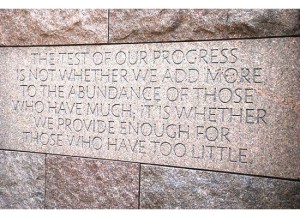
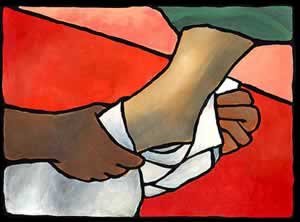 In yesterday’s gospel lesson Jesus told the story of the king separating the righteous form wicked as a shepherd separates sheep from goats and saying “As you care for the poor, you care for me.” It reminded me of a few cogent remarks that have been made about the measure of society – From Samuel Johnson: “A decent provision for the poor is the true test of civilization.” From Mahatma Ghandi: “A nation’s greatness is measured by how it treats its weakest members.” From Franklin Delano Roosevelt: “The test of our progress is not whether we add more to the abundance of those who have much, it is whether we provide for those who have too little.”
 More than any other story in all of the gospel accounts, this one underscores for me what is at the heart of the Good News of Jesus Christ: love of neighbor, service to others, care for those who are unable to care for themselves, and in so doing to demonstrate our love of God.
  You know this story. A rich man goes away for some period of time entrusting huge amounts of wealth to his servants. To one he gives five talents, an amount of silver roughly the value of one hundred years of work of an ordinary laborer. To another two and to the third one. The first two use the money and double it. The third, timid and fearful of his employer’s reprisal should he lose it, buries it in the ground. Upon the owner’s return, he is punished for failing to invest the money.
 This is one of the things that I find so captivating about the Old Testament: its heroes and heroines are not supermen and superwomen. They aren’t even regular, run-of-the-mill folks. They are often, as here, the outcasts and sinners, the morally flawed, the ethically ambiguous, the folks who were looking out for themselves as much as they were trying to do something good (sometimes a lot more the former than the latter). “A prostitute whose name was Rahab” was as capable of doing God’s work as was a Levite, a priest, or a great military leader.
  In our lessons today, we have two stories about silencing the prophetic voice. First, a snippet of the not-very-familiar story of the Prophet Amos which is, frankly, cut from its context so badly that some explanation really is necessary. Second, the almost-too-familiar story of the beheading of John the Baptizer.
  More than thirty years of studying scripture and today is the first time I really paid attention to the fact that “to those who have, more will be given; and from those who do not have, even what they seem to have will be taken away” is a dependent clause! Its meaning must be understood as deriving from the admonition to “pay attention to how you listen”! The entire sentence follows a remark about hidden things being disclosed, secrets coming to light, and facts becoming known. This is not a statement about position, possessions, wealth, or power; this is a statement about communication, understanding, and confusion. More specifically, it is a warning to be aware of the filters through which we hear and understand what we receive from others.
  The 77th General Convention of the Episcopal Church has just concluded and, I know from having been a deputy or a volunteer at past conventions, those who attended had a wonderful time (unless they came away righteously angry over one action or another, in which case they are now thoroughly enjoying being in the “right” while the rest of the church, they are sure, is going to Hell in a hand-basket). But I do wonder whether the actions of #GC77 (as the Twitter hashtag named it) will “drop like the rain” and “condense the like dew” and provide gentle nurture for “new growth.”
  This overload of unproductive work is not a “gentle rain” . . . this is a Category-5 hurricane, a tsunami, a deluge of biblical proportions! Actually, the thought did occur to me that it’s bigger than “biblical proportions” – the Law of Moses, the Torah, the Pentateuch, the first five books of Holy Scripture, the word of God to the Chosen People for all time (whatever one calls it) in my Oxford Annotated Bible only takes up 308 pages (complete with footnotes). The word of GC77 to the people of the Episcopal Church for a mere three years is more than twice the size, not including the loose-leaf supplement!
  God had made it abundantly clear to Moses that he wasn’t going to be allowed to cross over into the Holy Land. He would be allowed to see the Promised Land from the opposite side of the river, but not to enter it. Despite Moses’ requests, God’s mind was not going to be changed, as this divine outburst of temper makes clear. ~ There have been times in my career – maybe I should say “careers”, because it was true when I was a businessman and when I was a lawyer, as well as during my ministry as a parish priest – that I have felt like Moses standing on Mt. Pisgah: I can see where this business, firm, community is (or ought to be) headed, but I am pretty sure I’m not going to get there with them. ~ A colleague and I once made note of a common occurrence in parish ministry: the aftermath of a building program. It seemed to us (and later we both personally experienced) that once a pastor has led a congregation through a building program and the building is up and running, the pastor leaves. Like Moses’ life, his or her ministry among that people is at an end. We were never sure why that was, and even having been through the experience I’m still not sure. ~ Moses (and his brother), of course, died without entering the Promised Land because of his lack of faith: the Lord said to Moses and Aaron, “”Because you did not trust in me, to show my holiness before the eyes of the Israelites, therefore you shall not bring this assembly into the land that I have given them.” (Num. 20:12) Is it because clergy lose faith (maybe faith in their communities) during a building program? Is it because the community loses faith in the clergy? I remember reading (several times) about how the stress of designing and building a home can be a cause of divorce; maybe something of the same dynamic is at work in the pastor/parish relationship during a church building program. ~ In any event, whether a building program or a change of ministry direction or a shift in church style, I’m pretty sure that every church leader (clergy and lay, I’m sure, but probably more the clergy) has felt, at some time, that he or she could see a vision of the church’s future that he or she was probably not going to be joining in. And if it hasn’t happened yet, I’m confident that it eventually will. When that happens, clergy, know that you are in good company! You are standing with Moses atop Mt. Pisgah!

