Revised Common Lectionary for the Third Sunday of Easter, Year B: Acts 3:12-19; Psalm 4; 1 John 3:1-7; and Luke 24:36b-48
From the Gospel according to Luke:
While in their joy they were disbelieving and still wondering, he said to them, “Have you anything here to eat?” They gave him a piece of broiled fish, and he took it and ate in their presence. (Luke 24:41)
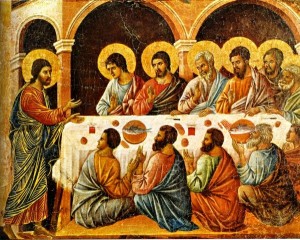 I have to admit that I would be hard-pressed to choose one of the many post-resurrection appearances of Christ as my favorite. Each one recorded in Scripture is so full of vivid imagery and meaning that it would be nearly impossible to put one above another … having said that, however, I also have to admit an especial fondness for the one described here by Luke.
There are two things about this one that I really like. First is Luke’s comment that the disciples “in their joy … were disbelieving.” It’s such a great description of what their amazement must have been; it calls to my mind some of the great, little-used emotional descriptors of our language: consternation, bewilderment, perplexity, astonishment, and (my favorite) stupefaction. I think that’s what Luke is saying in this delightful turn of phrase, that the disciples were stupefied! It’s also Luke’s way of describing something that is handled somewhat more harshly in Mark’s telling of the story, which just happens to be the gospel lesson for the Daily Office today.
Mark, with typical economy of expression, describes the scene this way:
Later he appeared to the eleven themselves as they were sitting at the table; and he upbraided them for their lack of faith and stubbornness, because they had not believed those who saw him after he had risen. (Mark 16:14)
In one ancient manuscript of Mark’s gospel that is not accepted in the received version the text continues by describing the apostles’ reply:
And they excused themselves, saying, “This age of lawlessness and unbelief is under Satan, who does not allow the truth and power of God to prevail over the unclean things of the spirits. Therefore reveal your righteousness now” – thus they spoke to Christ. (Codex Washingtonensis or Freer Logion)
I like this recorded post-resurrection appearance, apocryphal though it may be, nearly as much as the one in today’s reading from Luke’s gospel. The fact that “they excused themselves” and that they demanded of Jesus “reveal your righteousness now”. It’s nearly as good as Luke’s description of “joyful disbelief”! I absolutely love this! It’s so darned modern . . . or maybe even post-modern. You can almost hear the eleven saying something like, “Well, Jesus, that resurrection stuff may be true for you, but it’s not true for us!” When we read these to texts together, Luke and Mark, describing this scene in their different ways, we get such a wonderful picture of the apostles. Astonished but still making excuses, perplexed but still making demands, stupefied but still relativizing the situation . . . these men aren’t just First Century Palestinian Jewish fisherman; they are 21st Century Americans; they are us!
The second thing I find absolutely delightful about Luke’s telling of the story is Jesus’ question: “Have you anything here to eat?” If this scene were set in a modern home, I think we could envision it happening in the kitchen, the apostles sitting around the kitchen table, Jesus showing up, saying “Hey!” then going to the refrigerator, opening the door, and looking in like a teenager getting home from school, “Anything here to eat?” They do, as this version of Luke tells us, have that broiled fish handy, and in the King James Version (supported by some ancient manuscripts) Luke also reports that they gave him a piece of honey-comb.
There is a long line of biblical scholarship that tells us that Jesus’ asking for something to eat, and then actually eating it, is his way of proving to the stupefied disciples that he’s not a phantom. The idea is that by consuming it in front of them, Jesus proves that he has not returned as a spirit, or a ghost, or some sort of apparition; a ghost, after all, could not be touched, or have an appetite, or eat things. Lutheran pastor Doug Schmirler put it this way: “It may be Luke’s way of saying: ‘Ghost? Did you ever see a ghost chew? Did you ever see a ghost swallow? Did you ever see a ghost digest? Well, did you?'” That’s certainly a good way to look at this, but this story seen from the combined perspectives of Luke and the Freer Logion addition to Mark speaks to me in a different way.
I prefer the versions that include the honey-comb because that makes Jesus’ eating much more than a mere demonstration of non-ghost-ness; it makes it a meal. Something savory, and something sweet; an entree and a dessert. This is not just a “Look; see, I’m not a spirit”. This is Jesus once again sitting down at the dinner table with his friends, just like he had done in the home of Mary, Martha and Lazarus, just like he did once before in this upper room, just like he did with Cleopas and his companion in the inn on the road to Emmaus. This is the community once again sitting together at the kitchen table.
And just like every family, every community at every dinner table, they are talking and discussing and maybe even getting a little cross with one another if that additional bit to Mark’s Gospel is trustworthy.
There is a restaurant in San Francisco called Credo, which I’m sure you know is simply the Latin word for “creed”. On their walls are painted quotations from all sorts of philosophers, writers, politicians, and so forth. On their menus they have their business credo written out:
At Credo, we believe in nourishing both the body and the mind. Our walls depict the universality of ideas, the clash of conflicting viewpoints and the democratic nature of discussion and debate. We believe that good food and good company go hand-in-hand. We believe in the time-honored tradition of the dinner table debate and the value of impassioned points of view. We believe simple things can be wonderful, like authentic ingredients, genuine creativity and gracious hospitality.
This is what is happening here: dinner table debate, impassioned points of view, genuine creativity, and gracious hospitality. This is the glory and power of Christ’s Resurrection; the creation of community, a new community.
This is why I like this story that Luke and Mark tell from different perspectives so much; it is such a clear vision of the resurrected community. In the very human act eating of a meal, in very human condition perplexity and befuddlement, in the very human process of making excuses and making demands, these eleven, once a dispirited and possibly dying community, are resurrected. These are not simply individuals on a personal spiritual quest; they are joined together into a new community in Christ, crucified with him, now risen with him, given new life and new purpose and new mission because of his resurrection.
This new community is an on-going one, a growing one, a maturing one. As John says in the reading from his first letter this morning:
See what love the Father has given us, that we should be called children of God; and that is what we are. … What we will be has not yet been revealed. What we do know is this: when he is revealed, we will be like him, for we will see him as he is. (1 John 3:1-2)
We do know this: that his eating the fish and the honey-comb revealed him to be a real human being and that that is what we are called to be – real human beings. Carroll Simcox, who edited the Episcopal Church magazine The Living Church for many years, put it this way:
You and I shall be our real, complete selves for the first time ever. We think of ourselves now as human beings. We really aren’t that?not yet. We are human becomings. The fetus conceived only yesterday is a human becoming. If you are living in Christ, believing in him and trying to follow and obey him as the master of your life, you are by his grace, becoming ever more and more like him. (Quoted by Guy Sayle, infra)
But John does not mean that God is making us into clones or exact replicas of Jesus of Nazareth. The wonderful paradox of the Christian faith is that the more we become like Jesus, the more we become our truest selves. The hope of the Christian faith is that we can become as truly human as the Resurrected Christ. Dr. Guy Sayles, a Cooperative Baptist preacher, put it this way:
As we discover deeper dimensions of Christ-likeness, we uncover more and more of our honest-to-God selves.
Jesus is the pattern and the power, the model and the source, of authentic human life. We are meant to have what he had and has:
- a radical and liberating faith in God;
- a childlike trust in the grace of God;
- a trembling wonder before the mystery of life;
- a durable hope that, because we are in God’s hands, death and sorrow and pain and tears are not the end, but joy and wholeness and laughter are;
- an astonishing confidence that we and the world are headed, not toward midnight, but toward sunrise; and
- an undimmed awareness that the heart of all things is unconditional and compassionate love.
Those eleven disciples sitting around that dinner table, confronted by what they at first thought was an apparition, were astonished but still making excuses, perplexed but still making demands, stupefied but still relativizing the situation. They were just like us, but as church history and the Book of Acts shows, in stories like the one we heard today, they became like him, they became their truest selves, and so shall we all. That is the power and promise of the Resurrection.
Alleluia and amen!
 In some ancient manuscripts of this “longer ending” of Mark’s Gospel the text above continues with the following response by the apostles: “And they excused themselves, saying, ‘This age of lawlessness and unbelief is under Satan, who does not allow the truth and power of God to prevail over the unclean things of the spirits. Therefore reveal your righteousness now’ – thus they spoke to Christ.” Jesus says a few nearly incomprehensible words about Satan’s power ending in this age and so forth, and then the text picks up with the received version’s comments about snake-handling and poison-drinking. ~ I absolutely love this first part of that addition: the fact that “they excused themselves” and that they demanded of Jesus “reveal your righteousness now”. I love it! It’s so darned modern . . . or maybe even post-modern. I can almost hear them saying something like, “Well, Jesus, that resurrection stuff may be true for you, but it’s not true for us!” Making excuses, making demands, relativizing the situation . . . these men aren’t just First Century Palestinian Jews; they are 21st Century Americans; they are US! ~ Well, actually, they aren’t. Where they differ is that after this confrontation with the Risen Christ, they got up off their duffs and went to work. “They went out and proclaimed the good news everywhere, while the Lord worked with them and confirmed the message by the signs that accompanied it.” (Mark 16:20) Very few excuse-making, demanding, relativizing, modern American church members do anything like that! ~ For nearly forty years, since Authorized Services, 1973 (a precursor to the current American Book of Common Prayer), at every baptism, the Episcopal Church has been asking its members if they will “proclaim by word and example the Good News of God in Christ” and those members have answered affirmatively, “I will, with God’s help.” However, when we discuss evangelism, inviting people to church, talking with others about one’s faith, and similar topics, it becomes painfully clear that very few of those Episcopalians are actually doing so. And it does no good to confront them with that failure; they excuse themselves, just like the apostles! And just like the apostles, many of them make note of the fact that they don’t see much response when they try, that God doesn’t seem to be helping much. ~ Maybe we need to confront God, just like the apostles . . . maybe we need to say to God, as the apostles said to their risen Lord, “Reveal your righteousness now.” After all, when they went out and spread the gospel “the Lord worked with them and confirmed the message” with “signs” . . . we could use a few signs right now. ~ Yesterday, I made mention here of those times when it’s hard to see Jesus, when we fail to recognize him. I think we must all admit that there are times like that, when we do not see God, when we cannot feel God’s presence, when God seems to be silent. One of the most important books I read while in theological study was Hope in Time of Abandonment (Seabury 1973) by the French Protestant philosopher Jacques Ellul. In it Ellul wrote, “Hope comes alive only in the dreary silence of God, in our loneliness before a closed heaven, in our abandonment . . . Hope is a protest before this God, who is leaving us without miracles and without conversions, that he is not keeping his Word.” Hope, said Ellul, is humanity’s answer to God’s silence and it is through prayer that we demand the fulfillment of God’s promise. ~ If God is not living up to God’s promise to support the work of Jesus’ present-day apostles with confirming signs, then perhaps we Episcopalians who excuse ourselves from fulfilling our promise in the baptismal covenant are not to be faulted. Perhaps, like those first apostles we should be demanding of God in Christ, “Reveal your righteousness now!” ~ On the other hand, if God is living up to God’s promises and we just aren’t seeing that . . . .
 “A little while, and you will no longer see me, and again a little while, and you will see me.” Say, what? I have to admit that I have the same reaction to what Jesus says here that the disciples seem to have – a sort of scratching of the head and wondering, “What the heck does that mean?” ~ On the other hand, when I read that statement what immediately comes to mind is that traveling carnival arcade game “Whack-a-Mole” – the one where the rodent pops up unexpectedly from holes and you’re supposed to hit it with a mallet! Undoubtedly, someone will tell me that I’m being blasphemous or sacrilegious or something, but the image that comes to my mind is that game with Jesus popping up out of the holes – “Now you see me. Now you don’t. A little while . . . you’ll see me again. Try to get me!” ~ And truly, that is the way Jesus sometimes “pops up” in my life. I see Jesus in the hungry who come to my church’s food pantry on Saturday mornings and in the volunteers who serve them, but then sometimes on Sunday I wonder where he is: “He was here yesterday. Why isn’t he here now?” Or sometimes, I do see him on Sunday morning in the wonder and glory of worship and in the fellowship among parishioners during coffee hour, but then on Monday I see folks I know driving less-than-courteously in what my daughter calls “gas guzzling SUVs” (confession: I drive one, too) and I wonder: “Where’s Jesus?” He pops up, I see him, he disappears, I don’t see him, a little while . . . there he is again. Like that darned rodent popping up in the game! ~ I know full and well that this is not what Jesus was talking about to the disciples. I know he’s talking about his crucifixion and his resurrection and his ascension; I know that . . . but I still see that “Whack-a-Mole” game in my mind’s eye! That’s one of the beauties of Scripture, that we can find applications of the text in situations that may not be exactly what the original story was about, but that are nonetheless related and valid. Jesus may have been talking about his immediate return in the resurrection, but he also returns in his community through the ages. The original disciples didn’t see him and then they did; church members today are still seeing him in many places and contexts. Sometimes we don’t, but then in a little while, we do. ~ I’m terrible at “Whack-a-Mole”, by the way. I have lousy reaction times with such things, always have – it’s why I was terrible at sports like baseball or tennis in elementary, junior high, and high schools. But I was good at shooting guns. I went to a military high school where we were required to pass Army ROTC firearms tests. I qualified as either a “marksman” or an “expert” with every weapon on which we trained. I was also pretty good at archery. Did you know that the New Testament word for “sin” comes from the sport of archery? It’s hamartia, which means “missing the mark”. Aristotle (384-322 BC) borrowed the term and used it in his Poetics to describe the “fatal flaw” in the hero of a dramatic tragedy; the writers of the New Testament then used it to mean “sin”. ~ So, sometimes I don’t see Jesus when I ought to. It’s not that Jesus isn’t there; it’s just that I don’t see him or if I do, like not reacting to the mole fast enough, I don’t recognize him. Like playing “Whack-a-Mole” and failing to hit the rodent, my reaction timing is just not right and I “miss the mark”. I sin by failing to “whack” when Jesus pops up! Therein lies the spiritual discipline to which this text calls me – to look, to recognize, to hone my reaction time, to respond quickly and affirmatively, and (if you’ll pardon some really blatant sacrilege) to Whack-a-Jesus!
 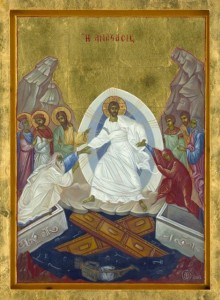 If you’ve been with us here for the services of Maundy Thursday, Good Friday, and Holy Saturday, or have been following the sermons on line, you know that we have come to Act Three of the three-act drama of redemption. In the first act, we saw the protagonist, Jesus of Nazureth, trying one last time make his disciples understand his mission and his message. Through the metaphor of bread and wine, through the enacted parable of foot-washing, through an agonized night of prayer in a garden, he tried to teach them that his was a mission of love and life, but they just didn’t seem to get it. As the curtain fell on Act One, he was being taken away to be questioned by Jewish and Roman authorities and the disciples, frightened and confused, were scattering, unsure of what was going to happen next.
 Some time in the late Fourth Century, St. John Chrysostom, Archbishop of Constantinople and an important Early Church Father known for his eloquence in preaching and public speaking (hence, the surname Chrysostom which means “golden-mouthed”), preached this sermon on Easter.
  In the beginning he had been tempted by riches, by power, by idolization; all these had been offered in the desert. Now how great the temptation must have been to simply give up! Poet Denise Levertov ponders this allure in her poem Salvator Mundi: Via Crucis
 In this second act of the drama all that has gone before is recapitulated; all that we saw in yesterday’s first act, the supper in the upper room, the act of servanthood taught there, the agonized prayer in the garden, the willing surrender to unjust authority, and more. Not just yesterday’s first act, but all that has gone before from our first act of defiance in the first garden. Poet Ross Miller reminds us of that bond in his brief verse entitled Tau
 A meal is in progress… Is it a seder, the ritual meal of remembrance of the Passover? We don’t really know; the playwrights have not made this clear; the theater critics, the scholars debate this issue. Three of the story-tellers suggest that it is but the fourth, John, tells the tale very differently. (The synoptic gospels tell the story in a similar way and, if truth be told, in the same way – Luke and Matthew based their stories on Mark’s, so to be honest there aren’t three stories, there’s only one that would make us think that this supper is a seder, but John doesn’t. In fact, John doesn’t even care about that – he spends no time at all describing the meal, for him the important thing is what happened afterward, and that comes in a later scene. So as we begin this three-day, three-act drama of redemption, since we have heard Luke’s voice narrating the story, let’s just assume that what we see in this first scene of the first act is, indeed, a seder.)
 The meal is over, the dishes have been cleared. The disciples are arguing among themselves about who is the greater among them. Jesus looks frustrated and troubled; the teachable moment has passed and they clearly have not understood! They just haven’t gotten it.
 “Stay here,” he tells them, “Stay awake while I go over there to pray.” As they settle themselves, he moves away from them, and collapses in a heap, sobbing: “O God … Father, let this pass!”
  I’m taking a week away from doing the meditations on the Daily Office Lectionary. During Holy Week there are simply too many other things to get done. I’ll be back with more meditations on bits of the Daily Office readings after Easter.
 We have just read the simple, yet dramatic story of our Lord’s Passion as related in Mark’s Gospel. But we began our worship this morning with John’s story of Christ’s triumphal entry into Jerusalem. In the span of a few minutes we covered an entire week at the end of Jesus’ earthly life. Logic and reason cannot really make sense of this, and no ten-minute homiletic exegesis of these texts can help us comprehend the enormity of those events.
  Why is Moses angry at Pharaoh? Moses (and God) have put the Egyptians through a series of miserable plagues. The people of the Nile valley have lived through water turning to blood killing all life in the river; invasions of frogs, lice, and flies; livestock diseases; painful, unhealing boils; hail and thunder; locusts; and unnatural darkness. Throughout the course of this series of events, there have been many times when Pharaoh seemed on the verge of releasing the Hebrews but then “the Lord hardened Pharaoh’s heart, and he did not let the sons of Israel go.” (Exod. 10:20) ~ Over the years, I’ve read a lot of commentary on this passage, the introduction to the slaughter of the first born which is context of the Passover. Wesley opined, “Moses hereupon was provoked to a holy indignation, being grieved, as our Saviour afterwards, for the hardness of [Pharaoh’s] heart.” Well, yeah, but who’s responsible for that? Over and over again the Scripture tells us it was God who hardened Pharaoh’s heart! Pharaoh’s not just obstinate, he’s manipulated into stubbornness by God himself! Why be angry at Pharaoh? ~ I don’t really think he is. I think he was mad at God…. ~ I think it’s OK to be mad at God. We have the freedom to express and respond to that emotion, to own up to our occasional anger with God. When parishioners come to me and “confess” being angry at God, I tell them it’s OK, that God is a big boy and can take their anger. The issue to be addressed is whether they can! Can they pray their anger honestly? Prayer is not always peaceful and serene and believing that ought to be can be a real obstacle to faith. But praying out one’s anger is unfamiliar territory; it feels awkward; it’s not much like any prayer we hear in church. ~ Do you remember the episode of The West Wing in which Pres. Bartlett’s secretary was killed by a drunk driver? Her funeral was held in the Washington National Cathedral (an Episcopal church, by the way). After the funeral, Bartlett stays behind in the quiet privacy of the cathedral to offer a personal prayer to God … not out of sadness or faith or hope. His prayer is offered out of anger. He begins by calling God a “son of a bitch” and a “feckless thug.” Then, good Roman Catholic that Josiah Bartlett was, he continued in Latin. Here’s what he said: “Am I really to believe that these are the acts of a loving God? A just God? A wise God? To hell with your punishments. I was your servant here on earth and I spread your word and I did your work. To hell with your punishments and to hell with you!” No amen – just a cigarette stamped out on the cathedral floor, after which Bartlett stalked out. Pretty clearly “in hot anger he left.” Praying our anger is not like any prayer we (usually) hear in church. ~ Scripture doesn’t tell us what Moses did in or with his anger, but we do know what followed. The story of Moses’ “hot anger” and what followed it affirms for us that anger, even anger at God, need not be destructive. It can be the source of a rebirth of hope; it can heighten our confidence in the future, and empower us to undertake the creation of a new reality. Appropriately and creatively channeled, anger, even anger at God, can lead us out of bondage and into freedom.

