Occasional thoughts of an Anglican Episcopal priest

Category: Marriage (Page 3 of 5)

Questions from the Press – Sermon for the 3rd Sunday in Lent – Year A – March 23, 2014

====================

This sermon was preached on the Third Sunday in Lent, March 23, 2014, at St. Paul’s Episcopal Church, Medina, Ohio, where Fr. Funston is rector.

(The lessons for the day were: Exodus 17:1-7; Psalm 95; Romans 5:1-11; and John 4:5-42. These lessons can be read at The Lectionary Page.)

====================

Russian Icon: Woman at the Well and ZacchaeusFour interesting things happened this week. The first was our monthly Brown Bag Concert. During the construction of our Gallery addition to the Parish Hall, the attendance at the concerts had dropped off. Tuesday’s was the first since construction has been completed and we were unsure what sort of turn out we would see. Well, as it happened, we had over 100 people in this church for that concert! What a great thing!

The second thing was the death of Fred Phelps on Wednesday, March 19. The so-called Reverend Mr. Phelps was the so-called pastor of the so-called Westboro Baptist Church. I say “so-called” so many times because I believe Mr. Phelps was essentially self-ordained, and he founded the Westboro congregation which, despite its name, is not recognized by any national or regional Baptist convention. If you don’t recognize those names, Fred Phelps and his congregation are the people who show up with picket signs at the funerals of servicemen and other notable people, picket signs which read “God Hates [Homosexuals]” (only they use a much viler term on their signs). There’s a meme floating around the internet that reads, “Live your life in such a way that Fred Phelps will picket your funeral.” I recommend that.

In the days surrounding his death, my gay and lesbian friends were having quite a discussion of whether anyone should picket his funeral. Another Facebook meme answered that question: it was a cartoon of God saying, “I give you a new commandment: you shall not stoop to Fred Phelps’ level.” That’s where I came down on the question. We pray for the repose of Mr. Phelps’ soul, as we do for anyone who died; we pray that he find in death the peace he seemed not to find in life and which he denied to so many.

His death nearly coincided with what would have been the 86th birthday of another Fred, Fred Rogers, the man who assured children that everyday “it’s a beautiful day in the neighborhood.” What a contrast these two Freds present: the man who invited everyone to be his neighbor and the man who wanted almost no one to be his. I had a little vision when I heard of Fred Phelps’ death that he had arrived at the Pearly Gates to be greeted by Fred Rogers saying, “It’s a beautiful day in the neighborhood, Fred, and everybody’s here!”

The third thing was our “St. Patrick’s Last Gasp” Irish Festival yesterday. It was a great party and a smashing success. Ray and I were trying to figure out how many people actually attended and we think that, at the highest point, we probably had more than 250 people in this building – here in the church, in the parish hall, in the dining room – if we’d had 25% more people, we couldn’t have moved. That’s a great problem to have!

The fourth interesting thing that happened was that our diocesan communications office contacted me and asked if I would be one of seven Episcopal clergy in the Cleveland metropolitan area to answer some questions posed by the Cleveland Plain Dealer. “Sure,” I said and set about answering their questions. After doing so, I thought I ought to share my answers with you so you won’t be surprised when you open the paper someday soon and see what your rector is quoted as saying . . . because although their questions start innocently enough, they escalate rather quickly to address some thorny issues in our tradition and in our society.

I will get to addressing today’s Gospel lesson, trust me, but I want to share those answers with you first. So here they are . . . .

What is my favorite Easter tradition?

My favorite tradition is the Great Vigil of Easter celebrated as an evening service on Saturday evening or as a sunrise service on Resurrection Sunday. At St. Paul’s, Medina, we celebrate the Vigil in even numbered years on Resurrection Eve Saturday evening, and in odd numbered years on Sunday at sunrise. This year is our Saturday evening year and the service will begin after sundown at 8 p.m. Beginning the service in the dark with the lighting of the new fire, processing the Paschal Candle through the dark church, the church coming to light as other candles are lighted one from another, and finally the sanctuary fully lighted as the cry of “Alleluia! Christ is risen!” is sounded, the sun just rising (when we do it at sunrise), and the bells ringing . . . all of that brings me great joy. It speaks to me more clearly of the Light of Christ than any other tradition we observe at Easter or at any time during the church year. Of course, the Sunday morning Festival Eucharist (which will start at 10 a.m.) is great fun, as well!

How do I feel about the way Easter is celebrated in popular/secular culture?

I think the secular traditions of Easter (bunnies, eggs, new bonnets, a new set of dress clothes for the kids, lots of candy) are fine. They are celebrations of the new life of springtime. I’ve gotten out of the habit of calling our church celebration “Easter” and more often refer to it as “Resurrection Sunday” or “Resurrection Season,” so the term “Easter” actually speaks more to me of the secular festivities than of church observance, but the popular Easter traditions and the Christian celebration of Christ’s Resurrection all celebrate the joy of life returning. Human beings in all religious traditions (and those in none) have been celebrating springtime for millennia, and all that we do is good fun and spiritually uplifting. I don’t think the popular traditions detract from the religious significance at all.

What is the relationship between the Episcopal Church and the Anglican Communion (including the Church of England)?

The Episcopal Church is one of the many churches around the world which trace their lineage to Christ and the Apostles through the historic Church of England, a family of churches called “the Anglican Communion.” The U.S. Episcopal Church is the second such offshoot of the Church of England; the Scottish Episcopal Church, which ordained our first bishop, was the first. As Anglicans, we are a part of a reformed catholic tradition which separated from the Roman Catholic Church as a political act during the reign of England’s King Henry VIII, not as a result of theological reform or protest. The Episcopal Church is the only Anglican church in the United States officially recognized as such by the Archbishop of Canterbury, the Lambeth Conference, and the Anglican Consultative Council (our international “instruments of unity”).

What does it mean for the Episcopal Church to allow gay & lesbian weddings when the state of Ohio does not legally recognize these unions?

In considering this question, I think we should make a distinction between the civil contract of marriage, which is a creature of law defined by state statutes and constitutions, and the Sacrament of Holy Matrimony, which is the church’s blessing of a committed, loving relationship of two adult persons. Currently, the Episcopal Church does not offer this sacramental blessing to same-sex couples; we offer a service of blessing and life-long commitment. A study group has been appointed by our highest governing body, the General Convention, to reflect upon our theology of matrimony and make recommendations as to whether the sacrament can and should be extended to same-sex couples; I believe that it should.

Although state law (wrongly, in my opinion) currently denies same-sex couples the right to form the civil contract, that law cannot prohibit the church from offering its blessing to anyone or for any purpose; that would be a violation of the U.S. Constitution’s First Amendment. Therefore, the church is free to and does offer a service of blessing to couples who wish to make solemn vows of life-long commitment one to the other. The church’s blessing does not (and should not be understood to) constitute the formation of the legal contract of marriage. When in a traditional wedding ceremony the husband and wife make their promises, in the Episcopal Church, the first part of the service before the reading of Scripture and the making of the religious vows, is the formation of the contract; after that is done, Scripture is read, prayers are offered, and the religious vows are made and sanctified during the sacramental service of blessing.

By the way, I don’t like to use the term “gay wedding” or “lesbian wedding” because the wedding or commitment ceremony is just that, a ceremony, regardless of the gender or sexual orientations of the persons involved; the couple may be both of the same sex or of opposite sexes, but the nature of the commitments they make to each other in the religious vows — to rely upon God, to love and support one another, to care for each other, and so forth — are the same, neither gay nor lesbian nor straight.

What does “God loves you. No exceptions.” mean to me in a culture that’s spiritual but not religious or with little to no religious affiliation?

Well, I think the statement speaks for itself and would mean the same thing whether the surrounding culture were highly religious or completely secular; God’s love for everyone is not culture dependent. As a statement of belief of the Episcopal Church in this diocese, it means that everyone is welcome. As a former Presiding Bishop of our church once said, “There will be no outcasts in this church,” meaning no one is excluded from participating in our worship, our educational programs, or the social life of the church community. A few weeks ago we put up on our church sign this invitation: “You can belong before you believe.” There is welcome here for the “spiritual but not religious,” the unaffiliated, the disaffiliated, the questioner, the doubter . . . everyone. We don’t pretend to have all the answers, but we love exploring the questions and we offer a safe place for those with questions to do so. Although he’s not an Episcopalian, the author Brian McLaren speaks for our tradition when he writes in one of his books that the church should offer responses to questions, not answers; answers cut off conversation, while responses invite further discussion. The Episcopal Church offers responses. We think that’s what God does, too; God responds.

Considering the Gospel story of the Samaritan woman at Jacob’s well

Which brings us to today’s Gospel reading, a very long reading setting out the longest conversation Jesus has with anyone in any of the four Gospels. It’s amazing that Jesus had this conversation at all. First of all, he is speaking with a Samaritan. The Samaritans were the descendants of those who were left behind when the important families of Jerusalem and the country were taken into exile in Babylon. Those who got to stay in Israel had intermarried with the surrounding Canaanite peoples and continued to worship God according to the first four Books of Moses; they built a temple on Mt. Gerizim not far from the city of Sychar where this conversation took place and offered their sacrifices there. When the exiles returned and restored the temple in Jerusalem, they launched a campaign of “racial purity” demanding that those with “foreign” wives divorce them; adding the Book of Deuteronomy to the Scriptures, they also insisted that sacrifices could only be made at the Jerusalem temple. The Samaritans rejected these demands and “bad blood” existed between the two groups. By Jesus’ time, there was real hatred and enmity between them; John is a master of understatement when he says, “Jews do not share things in common with Samaritans.”

Not only was Jesus’ conversational partner a Samaritan, she was a woman! If we accept the Gospel’s naming of Jesus as a Rabbi, he was breaking all sorts of laws and traditions by conversing with a woman, even if she were a good and faithful Jew. Rabbis simply did not speak to any woman to whom they were not related; it just wasn’t done. And this particular woman, apart from being a Samaritan, was also a woman of (shall we say) besmirched reputation. She had been through five failed relationships and had entered into yet another with a man not her husband (how Jesus knows this I’m not sure, but he knows it).

So this poor woman was everything Jesus should have had nothing to do with, and yet there he is carrying on a conversation as if they were old friends. No wonder the disciples were astonished when they returned.

A fifth interesting thing happened this week. I was introduced to a Russian Orthodox icon depicting this Gospel story, and the interesting thing about it is that the icon writer chose to depict not only this story, but also the story of Zacchaeus. Zacchaeus, you remember, was the Jewish tax collector who climbed a tree so that he could get a look at Jesus as he walked through a crowd in the Jewish city of Jericho. (Luke 19:1-27) Just as with the woman at the well, Jesus spoke to Zacchaeus. And he didn’t just talk to him; he walked up to the tree and said, “Zacchaeus, come down because I’m going to have dinner with you.”

Now, Zacchaeus was a tax collector, a lacky of the hated Roman occupiers of Israel. We all, I’m sure, have our opinions of the agents of the I.R.S. and as we get closer to April 15, that opinion is probably going to get pretty bad. But whatever we may think of contemporary revenue agents, what the Jews thought of Jewish tax collectors was a thousand times worse. They were collaborators working with oppressive Roman Empire which had invaded and occupied the Jewish nation. They were given what was for practical purposes a license to steal. The Roman authorities would tell them what they were to collect, but they could take more and did; they excess was what they lived on. So they were as hated and as outcast among their own people as a Samaritan would have been.

I believe that is the reason the Russian iconographer depicted the two stories on the same panel; he was illustrating that for Jesus there were no outcasts. For God incarnate in Jesus, there are no outcasts. Despite what Fred Phelps may have taught in his church, the Gospel story we heard this morning and the story of Zacchaeus demonstrate that God hates no one. As that diocesan bumper sticker and billboard about which the Plain Dealer asked says, “God loves everyone. No exceptions.” In Christ’s church, in this church there will be no outcasts. Ever.

Amen.

====================

A request to my readers: I’m trying to build the readership of this blog and I’d very much appreciate your help in doing so. If you find something here that is of value, please share it with others. If you are on Facebook, “like” the posts on your page so others can see them. If you are following me on Twitter, please “retweet” the notices of these meditations. If you have a blog of your own, please include mine in your links (a favor I will gladly reciprocate). Many thanks!

====================

Father Funston is the rector of St. Paul’s Episcopal Church, Medina, Ohio.

Really? What? No! – From the Daily Office – March 20, 2014

From the First Letter to the Church in Corinth:

Do you not know that whoever is united to a prostitute becomes one body with her? For it is said, “The two shall be one flesh.”

(From the Daily Office Lectionary – I Corinthians 6:16 (NRSV) – March 20, 2014.)

Wedding rings and moneyThis is one of those times (there are, I admit, quite a few) when Paul loses me! I step back from his words and say, “Really? What?” Is Paul seriously equating sex with a prostitute with marriage? I know that Paul didn’t have too high an opinion of marriage. In the next chapter he will say that he thinks staying single is a much better idea: “I wish that all men were even as I myself am. . . . I say to the unmarried and to widows that it is good for them if they remain even as I.” (1 Cor. 7:7,8) But does he really hold it in such low regard so as to equate it with prostitution?
Paul’s quotation is from the second chapter of Genesis, from the story of the creation of Eve at the conclusion of which the biblical author writes, “Therefore a man leaves his father and his mother and clings to his wife, and they become one flesh. ” (Gen. 2:24) The story of the creation of Eve is about God fashioning for Adam a helper, someone with whom he would spend his life tending, caring for, and protecting the Garden of Eden — it’s not the story of a “one night stand.”

The two are not the same, but in the midst of his argument about preserving the purity of the church Paul has let his guard down, blurted out an honest (if inappropriate) appraisal of marriage, and let us see what he really thinks of it. To my mind, this makes suspect everything else he writes about marriage (or that someone else has written in his name). If, for example, he believes that marriage is nothing more than a cheap sexual liaison, that stuff about wives being “subject” to their husbands (Eph. 5:22, Col. 3:18) takes on a different color! I don’t know, it might be reasonable to expect a paid call girl to be “subject” to the man who’s paying her (prostitution seems to be inherently a relationship of power and domination) . . . but that’s not what I understand the relationship between spouses to be.

I rather like what the introduction to the Episcopal Church’s rite of Holy Matrimony says about the mutuality of marriage:

The union of husband and wife in heart, body, and mind is intended by God for their mutual joy; for the help and comfort given one another in prosperity and adversity; and, when it is God’s will, for the procreation of children and their nurture in the knowledge and love of the Lord. Therefore marriage is not to be entered into unadvisedly or lightly, but reverently, deliberately, and in accordance with the purposes for which it was instituted by God. (BCP 1979, page 423)

And I don’t think marriage was instituted by God to be equivalent to prostitution despite what the Apostle Paul may have thought. So when I read this verse, I step back and ask, “Really? What?” . . . and I answer, “No!”

====================

A request to my readers: I’m trying to build the readership of this blog and I’d very much appreciate your help in doing so. If you find something here that is of value, please share it with others. If you are on Facebook, “like” the posts on your page so others can see them. If you are following me on Twitter, please “retweet” the notices of these meditations. If you have a blog of your own, please include mine in your links (a favor I will gladly reciprocate). Many thanks!

====================

Father Funston is the rector of St. Paul’s Episcopal Church, Medina, Ohio.

Be Glad – From the Daily Office – January 8, 2013

From the Psalter:

This is the day that the Lord has made; let us rejoice and be glad in it.

(From the Daily Office Lectionary – Psalm 118:24 (NRSV) – January 8, 2014.)

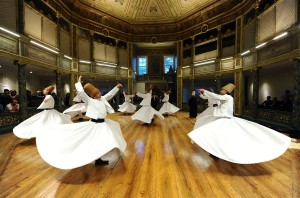
Whirling DervishesMy wife and I met at a Cursillo three-day weekend event. I was a part of the team (one of the cooks) putting on the Cursillo; she was “making” her Cursillo (as the lingo has it). She claims we’d met before at a fund-raiser fair at my parish (she attended elsewhere), but I was very busy during the fair and don’t recall that. I remember meeting her at the Cursillo weekend.

The Cursillo movement and the Cursillo community became an important of the early years of our marriage. We married about six months after meeting and in another six months we relocated to another state where I attended law school. There was an active Cursillo community in that location and we became involved.

An eye-opening move, that was. We discovered that the Cursillo community in our original home had been doing things incorreclty! Not just different. They’d been wrong. They’d been violating of the agreement between the Episcopal Church and the Roman Catholic Cursillo Movement, which had licensed the Cursillo method to the Episcopalians. And, we later learned, they knew they’d been doing so.

This comes to mind today because one of the major elements of a Cursillo weekend is music. In those communities, it was the sort of music that today might be called “praise choruses” or “church folk” or “contemporary.” Simple, easily remembered, repetitive songs accompanied by guitars, banjos, tambourines, bongos. One song common to both communities was based on this verse; in fact, it was this verse so far as I can remember.

There may have been verses and this may simply have been the chorus, but all I can recall is this verse: “This is the day, this is the day, that the Lord has made, that the Lord has made. We will rejoice, we will rejoice, and be glad in it, and be glad in it.” A catchy, bouncy little tune to which one could dance a formless dance, whirling like a dervish! It was easy to get caught up in and it demonstrated to me the spiritual power of music, simple melodies, and physical movement. Whirling and spinning and experiencing the power of the Spirit!

When my wife and I returned to our original home after three years in law school, we were asked to be the leaders of a coeducational three-day Cursillo event. We agreed, but we said we wanted to try to abide by the agreement between our church and the Roman Catholics, to discontinue those practices which violated the accord, to keep faith with our brothers and sisters who had gifted us with the Cursillo as a tool for deepening the faith of mature Christians.

There was push-back. In fact, there was outright rebellion. Members of the community refused to sponsor candidates to the weekend we were to lead; others refused to contribute to the cost of the event. Evelyn and I resigned from leadership and felt we had no choice but to withdraw from the community.

What had been an important support for us in the early years of married life became a source of grief and sadness. It still is. We miss being a part of that community and we miss the nearly automatic entry being in the Cursillo community gave us to a wider circle of church friends when we relocated. Where we live now, there is no active Cursillo community so the sharpness of the grief is dulled; there are no “Reunions,” nor “Ultreyas” (as the regular get-togethers of Cursillistas are called), so no constant reminders that we are no longer a part of Cursillo.

And yet we rejoice that we were fortunate to have been called to that community. It’s where we met; it sustained us. Like each day the Lord makes, it has passed. When it was here, we rejoiced in it and we were glad. And we look back on it still with gratitude. When I think of it, I think of this verse and that danceable chorus, and my soul comes alive in the Spirit, whirling and spinning, and expressing the joy that community gave us . . . and how grateful I am to that experience for the gift of my wife and the family we have created.

Everyday is a new day that the Lord has made; we will rejoice and be glad in it, whirling and spinning in the power of the Spirit.

====================

A request to my readers: I’m trying to build the readership of this blog and I’d very much appreciate your help in doing so. If you find something here that is of value, please share it with others. If you are on Facebook, “like” the posts on your page so others can see them. If you are following me on Twitter, please “retweet” the notices of these meditations. If you have a blog of your own, please include mine in your links (a favor I will gladly reciprocate). Many thanks!

====================

Father Funston is the rector of St. Paul’s Episcopal Church, Medina, Ohio.

Facebook friends with God – From the Daily Office – August 19, 2013

From the Second Book of Samuel:

Now Absalom had set Amasa over the army in the place of Joab. Amasa was the son of a man named Ithra the Ishmaelite, who had married Abigal daughter of Nahash, sister of Zeruiah, Joab’s mother.

(From the Daily Office Lectionary – 2 Samuel 17:24 (NRSV) – August 19, 2013.)

Social Media IconsReading a verse like this one from the Second Book of Samuel makes me feel like I’m sitting at my in-laws’ kitchen table, or even in my grandmother’s kitchen. Up until very recently, this is the way people connected with other people. I can hear my late father-in-law reminding my wife of someone in the small town where she was born and raised:

“Oh, you know Sally! She was married to Bob, Jim’s brother, and her uncle Fred was your second grade teacher’s (Mrs. Jones’s) husband’s brother-in-law, Bill. Mr. Jones’s sister Margaret was his first wife.”

Often as I listened to conversations like this I would find myself lost in the tangled web of interpersonal relationships, trying desperately to trace the connections between spouses, siblings, cousins, friends-of-the-family, business associates, church members, and the-people-we-don’t-know-but-talk-about that defined a person’s identity in the society of that small town and within my spouse’s extended community of family and friends.

With the advent of the internet, Facebook, Tumblr, Pinterest, Linked-In, Google+, and the list goes on . . . With the advent of social media and these means of connecting that are at once more direct but more tenuous, more easily understood but less well defined, how do we now understand personal identity or personhood?

Personhood is a social construct that entails the very relationships the writer of Second Samuel sought to portray, the relationships my father-in-law used to recall to my wife who Sally was. The ability to be in those relationships is one way to understand what it means to be a person. Personhood is defined by a human being’s ability to have relationships with other human beings and, from a theological standpoint, to enter into the special relationship human beings have with God.

Contemporary social media now allows me to be in relationship with more people more immediately than has ever been possible in the past. Some years ago in a course in pastoral practice, I read that the greatest number of close interpersonal relationships a clergy person can sustain is about fifty. We may “know” many more people, but the limit on the number of people with whom our face-to-face relationships can be meaningful in any particular sense is about fifty – maybe a little lower for an introvert like myself, possibly a little higher for an extrovert.

But now I have over 800 “friends” on Facebook and “know” maybe a similar number of additional Facebook users through discussion group pages . . . . “Oh, you know Eric! He’s friends with Michael, who’s in that glass collecting Facebook group started by Brad, who follows Sid on Twitter.”

We Christians are supposed to understand God through the metaphor of personhood — the Holy Trinity, a unity of three Persons (Father, Son, and Holy Spirit). When our understanding of personhood is stretched (and some might say “warped”) by new technologies of relationship, does our concept of God change? How do we understand God and God’s Personhood in this new digital age?

I don’t know. I don’t have an answer. But I know this: I’m not just Facebook friends with God.

====================

A request to my readers: I’m trying to build the readership of this blog and I’d very much appreciate your help in doing so. If you find something here that is of value, please share it with others. If you are on Facebook, “like” the posts on your page so others can see them. If you are following me on Twitter, please “retweet” the notices of these meditations. If you have a blog of your own, please include mine in your links (a favor I will gladly reciprocate). Many thanks!

====================

Father Funston is the rector of St. Paul’s Episcopal Church, Medina, Ohio.

God’s Faithfulness Prevails — Sermon for the 10th Sunday after Pentecost (Proper 12C) — July 28, 2013

====================

This sermon was preached on the Tenth Sunday after Pentecost, July 28, 2013, at St. Paul’s Episcopal Church, Medina, Ohio, where Fr. Funston is rector.

(Revised Common Lectionary, Pentecost 10 (Proper 12, Year C): Hosea 1:2-10; Psalm 85; Colossians 2:6-19; and Luke 11:1-13. These lessons can be read at The Lectionary Page.)

====================

Baptism“Name this child.” That’s what I say to parents of infant baptismal candidates as I take their children from them. The words are not actually written in the baptismal service of The Book of Common Prayer as they are in some other traditions’ liturgies, but there is a rubric on page 307 that says, “Each candidate is presented by name to the Celebrant . . . .” so asking for the child’s name is a practical way of seeing that done. It’s practical, but it’s also a theological statement.

There is a common religious belief found in nearly all cultures that knowing the name of a thing or a person gives one power over that thing or person. One finds this belief among African and North American indigenous tribes, as well as in ancient Egyptian, Vedic, and Hindu traditions; it is also present in all three of the Abrahamic religions, Judaism, Christianity, and Islam.

The naming we do at baptism echoes the naming that takes place in Jesus’ tradition as a faithful Jew. In Judaism, when a male infant is circumcised on the eighth day after his birth, the mohel who performs the brit milah prays, “Our God and God of our fathers, preserve this child for his father and mother, and his name in Israel shall be called ________” and the prayer continues that, by his naming, the infant will be enrolled in the covenant of God with Israel. The same thing is done when a girl is named in the ceremony called zeved habat, or “presentation of the daughter” at the first formal reading of the Torah following her birth. In baptism, we do the same; the church says to its newest member, “This is who you are: washed in the waters of baptism, sealed by the Holy Spirit, and marked as Christ’s own forever,” a brother or sister in the church, a fellow member of the household of God.

To give a name to anything, especially to another human being, is a powerful thing! In the first verses of Genesis we are told, “God said ‘Let there be Light’ and there was light.” (Gen. 1:3) God named the light before it was created; this process continues through the rest of the story. God says, “Let there be” and names the thing which will come into existence; the naming seems a necessary first step in creation. There is a sense in which the name given shapes the future of the thing, or of the person, named.

So this morning I will ask that question of Danny and Nikki ___________ (parents) and of Peter ___________ (Godfather) who will name Ryan George __________ (infant) as a child of God, and of Mary __________ (sponsor) who will name Jacqueline Ann ____________ (adult) as a child of God, and through baptism we all will welcome Ryan and Jackie into the household of faith, into a covenant relationship with Almighty God and with each of us.

In today’s lesson from the Prophet Hosea, we find God instructing the prophet to give strange and bewildering names to his children as powerful, prophetic signs of Israel’s broken relationship with God. Hosea’s firstborn son is to be named Jezreel, which refers to the location of a particularly brutal and bloody massacre of Israelite royalty; his daughter is to be called, Lo-ruhamah, which means “no pity,” as a sign that God will have no compassion for his people who have gone astray; and a second son is to be named, Lo-ammi, which means “no people,” to let the Israelites know they are no longer God’s people.

Preachers often use their children as sermon illustrations, but what God demands of Hosea seems a little extreme. These poor kids aren’t going to have to live merely with the embarrassment of a single sermon, they are going to live with these names, these prophetic, judgmental names for their entire lives! But as bad as that is, giving these awful names to his children is not the hardest thing God demands of Hosea. No, the hardest thing is marrying their mother, Gomer.

Hosea is ordered by God to (in the words of our NRSV translation) “take for yourself a wife of whoredom and have children of whoredom.” He is to marry a prostitute who will continue in her scandalous and adulterous behavior, even though Hosea will be faithful to her throughout the marriage. Why? Because it is a prophetic sign, a prophetic action symbolizing the way in which Israel has dealt with God: because “the land commits great whoredom by forsaking the Lord.” God loves Israel with all the passion and loyalty of a faithful husband, but Israel, like a promiscuous wife, has been unfaithful to God.

It is an unfortunate prophetic metaphor, for it is misogynistic to the core! Portraying God as a faithful (but dominant) husband and Israel as a supposed-to-be obedient (and submissive) wife perpetuates a patriarchalism that is inappropriate to our society. As a metaphor it may have communicated clearly to its ancient Israelite audience, but it doesn’t communicate quite so clearly to us, clouded as it is with its ancient cultural bias. So as we read and seek to understand Hosea’s message in our day and age, we must extract the meaning from the metaphor and then, perhaps, cast the metaphor aside, separating the kernel of truth from the chaff of historical baggage.

In the modern world, marriage is not the patriarchal, male-dominated institution it was in Hosea’s time, but the metaphor can still work for us. In our Prayer Book, the meaning of marriage is summarized in the introductory comments with which the presiding minister begins the ceremony. We are told that it is a bond and covenant established by God in creation and that the union of the parties “in heart, body, and mind is intended by God for their mutual joy [and] for the help and comfort given one another in prosperity and adversity.” (BCP 1979, page 423)

Later in the service, just before the Nuptial Blessing is given, we pray for the couple that “each may be to the other a strength in need, a counselor in perplexity, a comfort in sorrow, and a companion in joy,” and that “their life together [may be] a sign of Christ’s love to this sinful and broken world, that unity may overcome estrangement, forgiveness heal guilt, and joy conquer despair.” (Page 429) In such a relationship neither party dominates the other, neither is submissive; it is a mutual and interdependent bond of covenant obligations, one to the other.

When Hosea’s prophetic metaphor is understood in these terms, it emphasizes that God is angry with God’s people for abandoning the covenant obligations they had to God, even as God remained faithful. What Hosea’s marriage metaphor communicates to us, as it did to his ancient audience, is that it is divine fidelity, not human inconstancy, that will ultimately save the relationship. It is God’s faithfulness, not our own, which prevails and redeems our relationship with God.

This is also the message of the author of the Letter to the Colossians, an epistle traditionally said to have been written by St. Paul, but which is now no longer believed to be of his authorship. The reason for that is in the very part of the text on which I want to focus our attention, the sentence where the author writes: “When you were buried with [Christ] in baptism, you were also raised with him through faith in the power of God, who raised him from the dead.” The author seems to echo Paul’s understanding of baptism in the Letter to the Romans, particularly a section we read every year on Easter Sunday. Paul writes, “Do you not know that all of us who have been baptized into Christ Jesus were baptized into his death? . . . . If we have been united with him in a death like his, we will certainly be united with him in a resurrection like his.” (6:3,5) The theology is similar, but note the significant shift: in Romans, Paul writes that we will be raised with Christ, whereas the author of Colossians asserts that our resurrection with Christ has already happened by reason of baptism. These two passages reflect the wonderful here-but-not-quite-here mysterious paradox of Christianity; we both celebrate the present reality of and anticipate the future consummation of our salvation in Christ. The victory has already been won, but not yet.

Now, what I really want to focus on is why our resurrection, our salvation, whether it is a present reality or something yet to occur, should happen at all! In Romans, Paul says that it happens “by the glory of the Father.” (v. 4) The author of Colossians asserts that it is “through faith in the power of God” according to our translation; that would seem to imply that our faith is somehow responsible for our salvation, that the means for our resurrection is our fidelity. But there is a growing body of scholarship which suggests that this is a misunderstanding of the original Greek of the text. The Greek is dia te pisteo te energeia tou theou . . . literally: “through the faith the working of God.” Traditional English translations add the preposition “in” into the interpretation which would imply that this powerful, operative faith is ours, but the Greek can also be understood to mean not “faith in” but rather “faith of” – in other words, it is God’s faith!

The 18th Century Lutheran translator Johann Albrecht Bengel suggested exactly this in his Annotations on the New Testament when he translated this text to say that our salvation, our resurrection comes about through faith which is a work of God. This text, he says, is “a remarkable expression: faith is of Divine operation.” (Gnomon of the New Testament, A. Fausset, tr., Clark:Edinburgh 1858, page 171, emphasis in original) Our resurrection with Christ is not brought about because of our faith; it is not because of us, or anything we do or believe! We are saved through the faithfulness of God who, by his glory and power, raised Christ from the dead.

It is also God’s faithfulness to which Jesus alludes in the parental metaphor which he uses in his instruction about prayer: “Is there anyone among you who, if your child asks for a fish, will give a snake instead of a fish? Or if the child asks for an egg, will give a scorpion? If you then, who are evil, know how to give good gifts to your children, how much more will the heavenly Father give the Holy Spirit to those who ask him!” God is the faithful parent who always responds when we ask, who is always there to be found when we search, who always opens the door when we knock. It is God’s faithfulness, not our own, which prevails and redeems our relationship with God.

On this we can rely; in this faithful God, we can have faith.

So let’s go back to Hosea’s marriage metaphor. The Lutheran Book of Worship, used by our brothers and sisters in the Evangelical Lutheran Church in America, with whom we enjoy a relationship of full communion, says this about marriage: “The Lord God in his goodness created us . . . and by the gift of marriage founded human community in a joy that begins now and is brought to perfection in the life to come. Because of sin, our age-old rebellion, the gladness of marriage can be overcast, and the gift of the family can become a burden. But because God, who established marriage, continues still to bless it with his abundant and ever-present support, we can be sustained in our weariness and have our joy restored.” (LBW 1978, page 203)

It is into the household of God, the community of joy restored, the covenant of mutual help and comfort sustained by the faithfulness of God, that we welcome Ryan George and Jacqueline Ann this morning. They (and we together with them) will make the statements of belief and the promises of action set out in the Baptismal Covenant (BCP 1979, pages 304-04), and they (and we) will try faithfully to keep them. Fortunately, however, it is God’s faithfulness, not theirs (nor ours), which will prevail and redeem them (and us), and their (and our) relationship with God.

Let us pray:

Almighty God, by our baptism into the death and resurrection of your Son Jesus Christ, you turn us from the old life of sin: Grant that we, being reborn to new life in him, may live in righteousness and holiness all our days; through Jesus Christ our Lord, who lives and reigns with you and the Holy Spirit, one God, now and for ever. Amen. (BCP 1979, page 254)

====================

A request to my readers: I’m trying to build the readership of this blog and I’d very much appreciate your help in doing so. If you find something here that is of value, please share it with others. If you are on Facebook, “like” the posts on your page so others can see them. If you are following me on Twitter, please “retweet” the notices of these meditations. If you have a blog of your own, please include mine in your links (a favor I will gladly reciprocate). Many thanks!

====================

Father Funston is the rector of St. Paul’s Episcopal Church, Medina, Ohio.

What a Long, Strange Trip – From the Daily Office – June 10, 2013

From the Second Letter to the Corinthians:

Look at what is before your eyes.

(From the Daily Office Lectionary – 2 Corinthians 10:7a (NRSV) – June 10, 2013.)

Road to the Desert HorizonDo we ever really know what is “before our eyes”?

I’ve been saying the Daily Office and reading the associated lessons of the two-year-cycle lectionary for the better part of 40 years and never before has this short sentence jumped out at me like it does today!

30 years ago tonight, my wife and I made the short trip from our small bungalow in East San Diego, where we had lived while I attended law school, to Sharp Hospital in Kearney Mesa where she would, early the next morning, give birth to our son, Aidan Patrick. If anyone had said to us, “Look at what is before your eyes,” we would have described a life of law practice and stability in our home state of Nevada. We had it pretty definitely planned out. We were very definitely wrong!

As I thought about the last three decades, a line from a song kept popping into my head. I’d like to be all religious and spiritual and pretend it is a line from a hymn . . . but it’s not. The words are, “What a long, strange trip it’s been.” From Truckin’ by the Grateful Dead. Now that song is an ear-worm which probably will eat away at me all day. What it’s definitely done is taken over this meditation.

So rather than write some other words, I give you the lyrics to Truckin’:

Truckin’ got my chips cashed in.
Keep truckin’, like the do-dah man
Together, more or less in line, just keep truckin’ on.

Arrows of neon and flashing marquees out on Main Street.
Chicago, New York, Detroit and it’s all on the same street.
Your typical city involved in a typical daydream
Hang it up and see what tomorrow brings.

Dallas, got a soft machine; Houston, too close to New Orleans;
New York’s got the ways and means; but just won’t let you be.

Most of the cats that you meet on the streets speak of true love,
Most of the time they’re sittin’ and cryin’ at home.
One of these days they know they gotta get goin’
Out of the door and down on the streets all alone.

Truckin’, like the do-dah man.
Once told me “You got to play your hand,”
Sometimes your cards ain’t worth a damn, if you don’t lay ’em down,

Sometimes the light’s all shinin’ on me;
Other times I can barely see.
Lately it occurs to me
What a long, strange trip it’s been.

What in the world ever became of sweet Jane?
She lost her sparkle, you know she isn’t the same
Livin’ on reds, vitamin C, and cocaine,
All a friend can say is “Ain’t it a shame?”

Truckin’, up to Buffalo. Been thinkin’, you got to mellow slow
Takes time, you pick a place to go, and just keep truckin’ on.

Sittin’ and starin’ out of the hotel window.
Got a tip they’re gonna kick the door in again
I’d like to get some sleep before I travel,
But if you got a warrant, I guess you’re gonna come in.

Busted, down on Bourbon Street, Set up, like a bowling pin.
Knocked down, it get’s to wearin’ thin. They just won’t let you be.

You’re sick of hanging around and you’d like to travel;
Get tired of traveling and you want to settle down.
I guess they can’t revoke your soul for tryin’,
Get out of the door and light out and look all around.

Sometimes the light’s all shinin’ on me;
Other times I can barely see.
Lately it occurs to me, What a long strange trip it’s been.

Truckin’, I’m a goin’ home,
Whoa whoa baby, back where I belong,
Back home, sit down and patch my bones, and get back truckin’ home.

Now that I sing it through, I realize this is a song that’s all spiritual and religious. It occurs to me that life is a trip and, despite Paul’s admonition, no matter how careful we scope it out, we really can’t see what is before our eyes. We always end up looking back and saying, “What a long, strange trip it’s been!”

Strange and wonderful. Thanks be to God!

====================

A request to my readers: I’m trying to build the readership of this blog and I’d very much appreciate your help in doing so. If you find something here that is of value, please share it with others. If you are on Facebook, “like” the posts on your page so others can see them. If you are following me on Twitter, please “retweet” the notices of these meditations. If you have a blog of your own, please include mine in your links (a favor I will gladly reciprocate). Many thanks!

====================

Father Funston is the rector of St. Paul’s Episcopal Church, Medina, Ohio.

Life Is Like Time Magazine – From the Daily Office – May 20, 2013

From the Book of Ruth:

In the days when the judges ruled, there was a famine in the land, and a certain man of Bethlehem in Judah went to live in the country of Moab, he and his wife and two sons. The name of the man was Elimelech and the name of his wife Naomi, and the names of his two sons were Mahlon and Chilion; they were Ephrathites from Bethlehem in Judah. They went into the country of Moab and remained there. But Elimelech, the husband of Naomi, died, and she was left with her two sons. These took Moabite wives; the name of one was Orpah and the name of the other Ruth. When they had lived there for about ten years, both Mahlon and Chilion also died, so that the woman was left without her two sons or her husband.

(From the Daily Office Lectionary – Ruth 1:1-5 (NRSV) – May 20, 2013.)

Time Magazine cover, December 23, 1929And there you have it, ten years in the lives of six people, and the deaths of three of them, put to rest in five short Bible verses. As Antonio said to Sebastian, “What’s past is prologue” (The Tempest, Act 2, Scene 1) and for the author of Ruth apparently not very interesting prologue. The storyteller is (pardon the pun) ruthlessly efficient in his introduction (I assume the author was “he” – maybe not). He clears away the unnecessary detail of sixty “person-years” of life to set the stage for what is to follow.

When I realized that, it hit me pretty hard. I’m sixty years old! Could the sum-total of my life be as easily summarized and shuffled off simply as prologue for something else? I suppose it could, but I would hope not.

Recently I was at a gathering with a bunch of other clergy and at some point during our deliberations comments were made about the use and organization of time; someone else made a remark about how we compartmentalize the different areas of our lives; and then I heard someone say something about a magazine. I have to be honest and admit that (a) I wasn’t paying close attention and (b) I don’t know if these comments were all made in the context of the same conversation. In my head, though, they merged into a rumination about Time magazine as a metaphor for a human life.

I used to be a very faithful subscriber to and reader of Time magazine. I took out my first subscription when I was in high school (1967) and didn’t stop subscribing until I attended seminary in 1991. And before that, my parents and my brother had been subscribers, so I’d been reading that magazine for a long time. It didn’t change much in all those years and I suppose it still hasn’t, at least insofar as the magazine is organized.

The classic issue of Time magazine is a study in compartmentalization. There are “departments” for all the areas of news, or if you prefer the areas of life (although Life is a different, if related publication): U.S., World, Politics, Sports, Lifestyle, Religion, Fashion, Tech, Science, and so forth. Which departments appeared in a given weekly issue depended on what was making news that week. There were always overlaps between these departments, of course, and I suppose the editors would have to determine if a story about regulation of new oil technologies fit better under Politics or Tech or Science; one would guess that the decision would be based on which subject predominates.

Life (life, not Life magazine) is a lot like a Time magazine. We have “departments” – Family, Job, School, Church, Friends, Hobbies, Politics, and so forth – and somehow, like the editors of Time magazine, we decide how all the stories of our lives get organized. We decide what order they are put in and how, like the magazine, they are arranged; we put some things closer to the front cover of our lives, where the public is most apt to see them, and other things we bury in the back pages. Then stories are neatly bound for our presentation of self to the world.

Time magazines were held together with staples through the spines. Sometimes, the pages would come loose from the staples. First, the four center pages would come away. You’d put them back in and hope the magazine would hang together until you finished reading all the articles of interest, but it wouldn’t always work out that way. Sometimes someone would take the magazine apart because they needed a picture for a school report, or wanted to send an article to someone in a letter, or whatever . . . sometimes the staple would get pulled out or work its way out on its own, and then all the pages would be loose. If you weren’t careful, the pages would get mixed up in a mishmash. As you were sitting out by the pool, a breeze would come along and blow them away, and you’d chase them across the yard hoping to gather them all. Some would blow into the pool and get soaking wet; some would blow into the neighbor’s yard on the other side of the fence and you couldn’t get them because of the vicious dog; some would take flight and get caught in the branches of trees. The articles would be all jumbled and some pages would be missing and the stories would be incomplete and not make sense.

And sometimes life can be a lot like that unstapled, jumbled, blown apart, partly missing, chaotic Time magazine, too.

Suppose someone actually did report on everything you did everyday for a week, on every work related task, about every friend or co-worker or family member with whom you talked, on every school assignment, every leisure activity, every television program you watched, on everything. Suppose they wrote it all out, organized it into departments, bound it with a staple, and produced a magazine of your week. Suppose they did that every week. Suppose those magazines were stacked week after week, month after month, year after year. Can you visualize those stacks? Can you see the piles and piles of magazines with your face and your name on the cover like the Time magazine Person of the Year?

Now think about this . . . if Antonio was right that “what’s past is [simply] prologue” and some storyteller were going to summarize what’s in those stacks of magazines, those piles of stories as foreword to a new story, would five verses be enough? Do you think it could even be done in a way that would honor your existence? I don’t.

I think life is a lot more like Time magazine and a lot less like the introduction to the Book of Ruth! And I believe the Author of life is a lot more interested in the stories of our lives than the author of Ruth was in the stories of Elimelech, Mahlon, and Chilion. And for that, I’m grateful.

====================

A request to my readers: I’m trying to build the readership of this blog and I’d very much appreciate your help in doing so. If you find something here that is of value, please share it with others. If you are on Facebook, “like” the posts on your page so others can see them. If you are following me on Twitter, please “retweet” the notices of these meditations. If you have a blog of your own, please include mine in your links (a favor I will gladly reciprocate). Many thanks!

====================

Father Funston is the rector of St. Paul’s Episcopal Church, Medina, Ohio.

The Helplessness of God – From the Daily Office – May 6, 2013

From the Book of Deuteronomy:

Know then in your heart that as a parent disciplines a child so the Lord your God disciplines you.

(From the Daily Office Lectionary – Deuteronomy 8:5 (NRSV) – May 6, 2013.)

Frustrated ManRecently, I sat down with a fellow clergy person, a cleric about my own age who is also a parent. We were talking about our kids and how there are times when, as mothers and fathers, we simply have to let go and let our children live their own lives and make their own mistakes. He made the interesting comment that, until he was parent to a maturing teenager, he hadn’t really understood what helplessness is. “As parents, ” he said, “we are essentially helpless.” This, he suggested, gives us a clue to understanding God.

I told him I wasn’t quite comfortable with the concept of helplessness; it feels somehow negative and akin to “playing the victim.” But then none of the synonyms of helpless – powerless, ineffective, inadequate, impotent – seem any better. I know what my friend is getting at . . . how to express it, that’s the issue.

I read this single verse of Deuteronomy and, as parent to adult children, I think, “How does one ‘discipline’ an adult child?” One doesn’t. It’s that simple. Adult children are adults, free to do as they will. The “children of Israel” had come of age. Like any nation, like any adult individual, they were free to do as they would. How was God the parent to discipline this mature, adult nation? Disinheritance? It wouldn’t work; I can attest to that from personal experience.

My parents, shortly after both turned 21 years of age, married in the face of parental opposition on both sides; neither set of my grandparents approved. So what did my grandparents do, on both sides? They disinherited my parents. And what did that accomplish? Nothing, except to alienate my folks from their siblings, and deprive me and my brother, my children and my brother’s children of any possibility of first-hand knowledge of our heritage. Who got punished? Who got disciplined? Certainly not my parents. I think the only people who really got hurt were my grandparents.

How does one “discipline” an adult child? One doesn’t. One simply loves them. One acknowledges that one is . . . helpless . . . it really is the only word to use . . . and one simply loves them. That’s a pretty good clue to understanding God.

====================

A request to my readers: I’m trying to build the readership of this blog and I’d very much appreciate your help in doing so. If you find something here that is of value, please share it with others. If you are on Facebook, “like” the posts on your page so others can see them. If you are following me on Twitter, please “retweet” the notices of these meditations. If you have a blog of your own, please include mine in your links (a favor I will gladly reciprocate). Many thanks!

====================

Father Funston is the rector of St. Paul’s Episcopal Church, Medina, Ohio.

Blindness and Sour Grapes – From the Daily Office – March 18, 2013

From the Gospel according to John:

As Jesus walked along, he saw a man blind from birth. His disciples asked him, “Rabbi, who sinned, this man or his parents, that he was born blind?” Jesus answered, “Neither this man nor his parents sinned; he was born blind so that God’s works might be revealed in him.”

(From the Daily Office Lectionary – John 9:1-3 (NRSV) – March 18, 2013.)

Sour GrapesI’m not the least bit sure I like the last thought of Jesus reply . . . Is he suggesting that a loving God caused this innocent man’s blindness so that Jesus could come along and heal him with some mud made of spittle and demonstrate his power? I mean, really, is he? I don’t want to get into that today, but surely there must be another interpretation for Jesus words and perhaps someday I’ll explore that.

Today, I want to focus on the first clause of his answer, which is basically just a wordy, “No.” As a parent, I cannot tell you how happy it makes me that the man’s blindness was not his parents’ fault! Because accepting that blame is all too often our parental response when things go wrong in our children’s lives . . . . It doesn’t really matter what it is – accident, illness, bad grades, suspension from school, trouble with the law, break-up with their partner or spouse – it doesn’t matter what it is, when something goes wrong in our children’s lives a parent’s response is often an overwhelming sense of guilt. “What did I do wrong that this happened to my child?”

This is, after all, a perfectly acceptable biblical view! In the Book of Exodus, Moses told the Hebrews that God does not “clear the guilty, but visits the iniquity of the parents upon the children and the children’s children, to the third and the fourth generation.” (Exod. 34:7 NRSV) And again the same words are reported the Book of Numbers: “The Lord is slow to anger, and abounding in steadfast love, forgiving iniquity and transgression, but by no means clearing the guilty, visiting the iniquity of the parents upon the children to the third and the fourth generation.” (Numb. 14:18 NRSV) And, again, in Deuteronomy, Moses says, “Be careful to obey all these words that I command you today, so that it may go well with you and with your children after you forever, because you will be doing what is good and right in the sight of the Lord your God” (Deut. 12:28 NRSV) implying that disobedience would mean things wouldn’t go well for the kids! Finally, there is that great biblical proverb reported by both Jeremiah and Ezekiel: “The parents have eaten sour grapes, and the children’s teeth are set on edge.” (Jer. 31:29 and Ezek. 18:2 NRSV)

So there is plenty of biblical support for our parental guilt pangs! But here is Jesus saying that the sins of parents are not responsible for the misfortune of their son. Thanks be to God! What that says to me is that we need to start looking at our feelings of parental remorse in a different way.

Not that those feelings are “wrong” or “bad.” Guilt is a basic human emotion. Everyone feels it and, when it comes to parenting, whatever we do is liable to cause us a little bit of guilty self-reproach because it sometimes seems that “you’re damned if you do and you’re damned if you don’t.” What if, instead of beating ourselves up over these things, we think of what feels like guilt as simply evidence that we are being good parents, good enough to be constantly thinking about what we’re doing and how we’re doing it? We care enough to do our best at the very important, frequently frustrating, often terrifying, and even more often incredibly rewarding job of raising children we love more than we will ever be able to tell them. No parent is perfect, but the ones who worry about whether they are doing it well, probably are doing it well, really well.

Here’s something I know. During the past sixty or so years that I’ve been alive, I’ve had a lot of rough patches, a lot of problems. I’ve done some bonehead things and made some really stupid mistakes. I’ve been in trouble with various authorities, and broken up with lovers and partners. And you know what? Very little of any of that was my parents’ fault! On the other hand, I’ve gotten through those rough spots. I’ve solved the problems. I’ve learned from my mistakes and avoided doing even more boneheaded stuff. I’ve made up with the lovers and, if I haven’t made up with the authorities, at least I’ve figured out how to work with them. And you know what? Most of my ability to do so is due to what I learned from my parents, from what I observed of the way they lived their lives and from the values they taught me. They may have eaten some sour grapes, I don’t know, but my teeth were not set on edge.

I love my kids a whole lot more than I can ever tell them, and I can only hope they have learned from me the way I learned from my folks.

====================

A request to my readers: I’m trying to build the readership of this blog and I’d very much appreciate your help in doing so. If you find something here that is of value, please share it with others. If you are on Facebook, “like” the posts on your page so others can see them. If you are following me on Twitter, please “retweet” the notices of these meditations. If you have a blog of your own, please include mine in your links (a favor I will gladly reciprocate). Many thanks!

====================

Father Funston is the rector of St. Paul’s Episcopal Church, Medina, Ohio.

The Holy Families – From the Daily Office – March 2, 2013

From the Gospel of John:

After this Jesus went about in Galilee. He did not wish to go about in Judea because the Jews were looking for an opportunity to kill him. Now the Jewish festival of Booths was near. So his brothers said to him, “Leave here and go to Judea so that your disciples also may see the works you are doing; for no one who wants to be widely known acts in secret. If you do these things, show yourself to the world.” (For not even his brothers believed in him.) Jesus said to them, “My time has not yet come, but your time is always here. The world cannot hate you, but it hates me because I testify against it that its works are evil. Go to the festival yourselves. I am not going to this festival, for my time has not yet fully come.” After saying this, he remained in Galilee.

(From the Daily Office Lectionary – John 7:1-10 (NRSV) – March 2, 2013.)

Holy Family IconThirty or so years before the episode described here by John, Mary “gave birth to her firstborn son and wrapped him in bands of cloth, and laid him in a manger, because there was no place for them in the inn” in a town called Bethlehem. (Luke 2:7) We are told here and elsewhere that Jesus had brothers, and his brothers were named “James and Joseph and Simon and Judas.” (Matthew 13:55) He had sisters, too, but their names are not reported in Scripture.

We know next to nothing about his family life. His siblings are not mentioned in the two stories we have from his childhood and adolescence. One supposes it was pretty typical of his time and place. We are told that a Jewish man in First Century Palestine live a life of hard, physical labor either in the farm fields or in the workshop. His wife prepared meals, kept the house, made and washed clothing, and bore and cared for the children. Babies were breastfed, and weaned after 18 months to 3 years. At the age of 13, boys entered adulthood and were apprenticed to learn a craft. Although there is no evidence that boys at the time underwent a ritual bar mitzvah as current Jewish adolescents do, Shmuel ha-Katan a Talmudic scholar writing at the close of the First Century AD does indicate that the completion of the 13th year marked the age for responsibility to the Law. Girls assisted their mothers with domestic work and rearing the younger children; at the age of 12 they were eligible to marry.

If we assume Mary’s and Joseph’s family followed this pattern Jesus and his siblings lived together for at least their formative years. Furthermore, it appears from this story (and others in the Gospels) that as adults the children lived nearby. This seems to have been a tightknit family, although maybe one with some issues. Modern psychology has shown that first born children hold the exclusive attention of the parents and grandparents until the birth of the next child. This is believed to allow for the development of a confident individual who is certain of his place and does fear competition. Jesus would certainly seem to live up to this expectation.

Eventually, the first born does have to deal with the challenge of newcomers. The second born usually ends up in a fight for attention that starts even before he or she is weaned. The expectation that the second will achieve the same standards as the older sibling can result in self-undercutting behavior or in over-achieving behavior in competition with the elder sibling. We don’t know who was the second child in this family; if the listing of Jesus’ brothers’ names in Matthew’s Gospel is in birth order, perhaps it was James. Given that James later became the first Bishop of Jerusalem, that is an interesting possibility.

The arrival of more brothers and sisters may lead second and later children to “middle child syndrome” where the child, being neither youngest nor oldest strives to find a rational role to fill within the family. The youngest children of a large family can face a variety of confusing relationships. Could this be the reason that “not even his brothers believed in him?”

Of course, all this is speculation. We don’t, as I said before, really know anything about Jesus’ early family life. Nor do we have any basis for supposing that the family of Joseph and Mary conformed to these modern psychological stereotypes. What we do know is that Jesus grew up in the bosom of a family, reared by a loving mother and foster father, surrounded by brothers and sisters. In doing so, he sanctified family life in whatever form it may come – large families like his own, childless couples, single-parent households, same-sex couples with or without children – in whatever configurations human beings may form themselves into household units, those families are holy families because each, in its own way, replicates the family in which the Son of God was reared.

The Book of Common Prayer (1979) of the Episcopal Church includes a traditional prayer for families. I’ve edited it to be more inclusive than the original:

Almighty God, our heavenly Father, you set the solitary in families: We commend to your continual care the homes in which your people dwell. Put far from them, we pray, every root of bitterness, the desire of vainglory, and the pride of life. Fill them with faith, virtue, knowledge, temperance, patience, godliness. Knit partners together in constant affection. Turn the hearts of the parents to the children, and the hearts of the children to the parents; and so enkindle fervent charity among us all, that we may evermore be kindly affectioned one to another; through Jesus Christ our Lord. Amen.

====================

A request to my readers: I’m trying to build the readership of this blog and I’d very much appreciate your help in doing so. If you find something here that is of value, please share it with others. If you are on Facebook, “like” the posts on your page so others can see them. If you are following me on Twitter, please “retweet” the notices of these meditations. If you have a blog of your own, please include mine in your links (a favor I will gladly reciprocate). Many thanks!

====================

Father Funston is the rector of St. Paul’s Episcopal Church, Medina, Ohio.

« Older posts Newer posts »