Occasional thoughts of an Anglican Episcopal priest

Category: Ministry (Page 26 of 59)

Fully Human: A Baptismal Sermon for All Saints Day, November 1, 2015

====================

A sermon offered on All Saints Day, Sunday, November 1, 2015, to the people of St. Paul’s Episcopal Church, Medina, Ohio, where Fr. Funston is rector.

(The lessons for the day are Isaiah 25:6-9; Psalm 24; Revelation 21:1-6a; and John 11:32-44. These lessons may be found at The Lectionary Page.)

====================

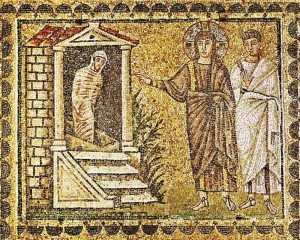
The Raising of Lazarus, Basilica di Sant'Apollinare Nuovo, Ravenna, Italy, 6th centuryFor some reason, although I know that the Lectionary is a three-year cycle and thus that the lessons are not the same every year, when All Saints Sunday rolls around I’m surprised when the lessons do not include John the Divine’s vision of the multitude in white robes standing before the Lamb’s Throne in heaven (Rev 7:9-17) or Jesus preaching the Beatitudes in the Sermon on the Mount (Mt 5:1-12). Those were the lessons, the only lessons provided for this feast in prior editions of the Book of Common Prayer. I’ve preached the “new” Lectionary for thirty years, so you’d think I’d be used to it . . . but each time the raising of Lazarus pops up as the Gospel lesson I think, “Well, what’s up with that?” You may have had that thought this morning, as well: “It’s All Saints Day. We’re doing a baptism. What’s up with this Lazarus story?”

So I want to delve briefly into a couple details of the story.

First of all, let’s remember who this family is, Mary, Martha, and their deceased brother Lazarus. They are clearly people who believe in Jesus and in his mission, but their belief is much, much more than simply signing on to his program, a new approach to religion. These people seem to know Jesus; he apparently stayed with them on several occasions. He lodged with them, ate with them, taught in their home. Earlier in this story, Lazarus is described to Jesus as “he whom you love” when Jesus is told of his illness. (John 11:3) These people are close to Jesus; they are practically family, may even be family.

Secondly, we’re told that the family is accompanied by “Jews.” That seems a bit odd, doesn’t it? After all, aren’t they all Jews? Mary, Martha, Lazarus, Jesus, the whole lot of them? Of course they are! So many scholars suggest that we should better understand John’s term Ioudaiou to mean “Judeans,” that is people native to the Jerusalem area; these scholars suggest that Mary, Martha, and Lazarus, like Jesus, were Galileans who had moved to Judea and been accepted into this southern community. This strengthens the suggestion that they may have been members of Jesus’ extended family.

Next, when both of the sisters greet Jesus (Martha’s greeting is earlier in the story), the very first thing each says is, “If you had been here, he wouldn’t have died.” (vv. 21 & 32) Not “Hi, how are you?” Not “Welcome back.” Not “I’m so sorry we have to tell you.” What the sisters say is not really a greeting; it’s an angry, accusative confrontation. “You could have prevented this!”

In the portion we read, we’re told that Jesus’ response to this is that he is “greatly disturbed in spirit and deeply moved.” That’s a fine translation, but it’s also a bit misleading. The word rendered “disturbed” – embrimesato – very literally means he “snorted with anger”; and the word translated “deeply moved” – etaradzen – means “stirred up” and implies a certain physicality, not simply an emotionalism. Jesus response to the sisters’ confrontations, to Lazarus’ death, to the whole situation is to become indignant and sick to his stomach.

Angry and physically ill, Jesus wept. Some of the Judeans, John tells us, interpreted this as a sign of Jesus’ love for Lazarus; “See how he loved him!” they said. While I’ve no doubt that that is true, I suggest we consider another way to understand what is happening in this story.

In a few moments, we will baptize two young men, Aiden and his brother Carson, and together with them we will affirm the Baptismal Covenant beginning with a recitation of the Apostle’s Creed in which we will claim that Jesus, the Son of God, was “conceived by the power of the Holy Spirit and born of the Virgin Mary” (BCP 1979, p 304). In the Nicene Creed, which we recite most Sundays during the Holy Eucharist, we go further and declare that he “became incarnate . . . and was made man,” that is, that he became a flesh-and-blood human being. (BCP 1979, p 358). In the Definition of Chalcedon, which you can find on page 864 of the Prayer Book, the church goes even beyond that and asserts its conviction that Jesus is “truly [human] . . . like us in all respects, apart from sin.”

I believe that standing before that tomb where his beloved friend Lazarus had been buried four days earlier, feeling the anger and frustration of his close friends Mary and Martha, surrounded by Judeans muttering “couldn’t he have prevented this,” and perhaps physically exhausted from traveling from the other side of the Jordan valley where he was when he got the news, Jesus’ humanity hit him like a ton of bricks. In that moment, everything that it meant to be human came crashing in on him: the way human beings settle for easy answers, half-truths, and superficial relationships; the injustice, oppression, and exploitation we impose on one another; the pain, rejection, hunger, and war we endure . . . but, also, the love, friendship, community, family, support, and every other good thing about being a human being; it all come together in that moment standing at that grave.

Why do I think that? Because that’s what I feel every time I stand at a grave. The first time I did that, I was 5-1/2 years old. I remember standing between my mother and my paternal grandmother watching two members of the US Army fold the flag that had draped my father’s coffin, feeling loss, grief, anger, confusion, and emotions I couldn’t even name. But there was also the love of family, pride in my father’s military service, a sense of community with extended family and friends, all the comfort that comes from our common humanity. And every time I have stood beside a grave, I have felt that again, and I can surely imagine our Lord experience something very like that. No wonder Jesus – the fully-human, like-us-in-all-respects Jesus – wept.

We should feel that same way when we welcome a new member into the household of God through the Sacrament of Baptism. Symbolically, baptism is burial; in the oldest tradition of the church, full immersion baptism, we go down under the water in the same way a body is buried in the earth, then we come up out of the water as Lazarus came from his tomb, as Jesus came from his grave. Baptism is death, burial, and restoration to life all encapsulated in one short liturgical act. As the Prayer Book says in the blessing of the baptismal water, “In it we are buried with Christ in his death. By it we share in his resurrection. Through it we are reborn by the Holy Spirit” (BCP 1979, p 306). As he called Lazarus from to rise from his funeral wrappings, through Holy Baptism Jesus calls us “from the bondage of sin into everlasting life” (ibid), into a new life of full humanity joined with “those who have clean hands and a pure heart, [those] who have not pledged themselves to falsehood nor sworn by what is a fraud, [those who] shall receive a blessing from the Lord and a just reward from the God.” (Ps 24:4-5)

The Creation story in Genesis tells us that “God created humankind in his image, in the image of God he created them; male and female he created them.” (Gn 1:27) The story of the Fall reminds us that somehow that divine likeness has been marred, that on our own we fail to live up to that image; we fail to fully live up to the potential God created in humankind. Through baptism, the divine image is restore; through our baptism into the life, death, and resurrection of Jesus Christ, a process of transformation begins and God restores us to who and what we were meant to be – fully human.

When John the Divine witnessed his Revelation, he saw that multitude of human beings in white robes standing before the Lamb’s Throne in heaven. He was told who they were – those “who have come out of the great ordeal; they have washed their robes and made them white in the blood of the Lamb” (Rev. 7:14) – and why they were there, and nowhere in that description did the Elder who spoke to him say anything about the saints having agreed to a doctrine. When the voice spoke from the throne and said, “See, the home of God is among [human beings]. He will dwell with them as their God; they will be his peoples, and God himself will be with them” (Rev. 21:3), not a word was said about assent to a creedal formula. Nonetheless, when we baptized someone, we ask them (and ourselves) some questions that sound a lot like doctrine; we ask questions which are taken directly from the creedal formulation we call “the Apostle’s Creed,” to which I referred earlier.

Recently, a commission of Anglican theologians representing you and me and all Anglicans everywhere agreed with a similar group of theologians representing Orthodox Christians that three words could be removed from the Nicene Creed, three words that theologians and liturgists call “the filioque clause.” Filioque is a Latin word meaning “and the Son.” It refers to that place in the Creed where we say, “We believe in the Holy Spirit . . . who proceeds from the Father and the Son.” Those three words (or that single Latin word) were added to the Nicene Creed by the Third Council of Toledo in 589 CE, a council in which no Eastern bishops took part; that additional phrase, which the East rejected, was one of the causes of the schism between Eastern Orthodoxy and Western Catholicism. The theologians’ agreement is part of the on-going work to heal the rift between Eastern and Western Christianity.

As you might imagine, that agreement has excited no little amount of discussion amongst us clergy. In one of our conversations, another priest said this about the Creed which I think applies equally these doctrinal statements we require of baptismal candidates:

For the past couple of years, I have introduced the creed with, “Using the words of the Nicene Creed, we proclaim our faith and trust in the God . . . .” Last Sunday . . . I asked people to substitute “We trust in” for each “We believe in” as we said the Creed, since the original Greek word . . . could have been translated either way. I wonder if the Body of Christ would be far less chopped up, if we had used “trust”. There might have been far less of, “You don’t believe exactly what I believe, so I’m out of here,” or, “You don’t believe exactly what I believe, so you are out of here”, and another denomination is created. Also, there is that “in” . . . we are doing a whole lot more than expressing belief. We are expressing a deep community whether we say, “We believe in . . .” or “We trust in . . .” Maybe you don’t believe exactly the same things I believe, but we both believe/trust in the same God.

In that same discussion, another of our colleagues objected to what he called the distinction between “faith as trust and faith with content.” “It’s always struck me as a strange distinction,” he said. “If, for example, faith as trust is about relationship [and not about content], it is like someone saying to a prospective marriage partner, ‘I love you and I want to marry you, but I’m not certain who you are.'” I suggested to him, however, and I suggest to you now that this distinction really doesn’t exist, that faith as trust or as relationship necessarily implies and includes “faith with content.” One cannot place trust in another person, such as the Father, the Son, and the Holy Spirit named in the Creed, without assenting to that person’s existence and properties; to say, “I trust you” or “I love you” and not also agree that you exist makes very little sense.

This is why we ask those questions of baptismal candidates. When we say, “Do you believe in” the three Persons of the Holy Trinity, we are not merely asking if the candidates (and the congregation who join them in answering) are assenting to certain doctrines about them; we are asking if they claim to be in a relationship of trust and love with them, and through them with the full community of human beings whom God loves, with whom God will live, from whose eyes God will wipe every tear, and for whom God will spread that glorious and eternal feast described by the Prophet Isaiah.

That relationship, I believe, is why Jesus wept. To be sure, he grieved the death of his friend Lazarus, but he knew he was about to do something to change that; there was no reason to cry about that. But that in-rushing crash of realization of what it is to be a human being, of what it is to be fully human, that is enough to make anyone cry. The story of the raising of Lazarus is a story about Jesus’ full humanity, the full humanity he shares with and promises to us. It is into that promise that we baptize Carson and Aiden today. And that is what’s up with the Lazarus story!

In the words of a popular Franciscan blessing, let us pray that, as these boys grow into the full humanity into which they are initiated today, God will bless them with discomfort at easy answers, half-truths, and superficial relationships, so that they may live deep within their hearts; that God will bless them with anger at injustice, oppression, and exploitation of people, so that they may work for justice, freedom, and peace; that God will bless them with tears to shed for those who suffer from pain, rejection, hunger, and war, so that they may reach out their hands to comfort others and turn their pain into joy; and that God bless them with enough foolishness to believe that they can make a difference in this world, so that they can do what others claim cannot be done, to bring justice, kindness, and love to all.

May God bless them with the gift and the commission to be, like Christ, fully human. Amen.

====================

A request to my readers: I’m trying to build the readership of this blog and I’d very much appreciate your help in doing so. If you find something here that is of value, please share it with others. If you are on Facebook, “like” the posts on your page so others can see them. If you are following me on Twitter, please “retweet” the notices of these meditations. If you have a blog of your own, please include mine in your links (a favor I will gladly reciprocate). Many thanks!

====================

Father Funston is the rector of St. Paul’s Episcopal Church, Medina, Ohio.

Cupbearers and Butlers – From the Daily Office Lectionary

Cupbearers and Butlers

From the Daily Office Lectionary for Thursday in the week of Proper 25, Year 1 (Pentecost 22, 2015)

Nehemiah 1:11c ~ At the time, I was cupbearer to the king.

“Cupbearer” sounds like such a lowly position, but I’m given to understand that just the opposite is true. Cupbearers to monarchs in the ancient world were people of high rank, greatly trusted by their royal patrons. It was the cupbearer’s job to guard the king against poisoning cup, often by risking his own death by swallowing some of the king’s wine before serving it. The cupbearer’s close relationship to the king often gave him great influence at court.

In some translations of Scripture, the Hebrew word “mashkeh” is translated as “butler,” which perhaps makes the relationship of television’s currently most popular butler, the indomitable Mr. Carson, to Robert Crawley, 7th Earl of Grantham, Viscount Downton, the master of Downton Abbey, come to mind. Or, perhaps the relationship of Lord Grantham and his manservant, the unflappable (and apparently occasionally deadly) Mr. Bane. If Nehemiah was to King Ataxerxes as one of these gentlemen are to Robert Crawley, then one can understand how a “cupbearer” could be appointed the governor of Jerusalem.

Every Sunday (and often on other days of the week) I stand at the Table and bear the Cup, so it occurs to me that there may be something here worth considering. But . . . to whom am I cupbearer? It strikes me as inaccurate (perhaps even inappropriate) to claim to be cupbearer to my king. My king has no need of someone to taste his wine and test for poison; my king has no need of advice from a trusted servant; my king has no need of a sounding board or confidant from amongst the common folk. To whom, then, am I, the parish priest, cupbearer?

There is only one other possible candidate. I am cupbearer to the church, to the Body of Christ which gathers, worships, engages in fellowship, lives its life and its life-crises in the community of the parish church. I am Carson, or perhaps Bane, to the parishioners’ Lord Grantham.

The International Guild of Professional Butlers describes the duties of a Butler as follows:

“A Butler typically: Oversees the household staff usually of one residence. Understands concepts like being anticipatory, friendly not familiar, privacy and confidentiality, invisible and available. Answers residence phone, receives guests at the door and supervises the reception of visitors. Assists with staff training and organizes the duties and schedule of domestic staff. May assist or be charged with keeping the household budgets and inventory supplies. May schedule and oversee vendors of contracted services. May assist with household and family security measures. Oversees family packing and travel preparations. Understands social etiquette and formal service. Assists with planning and organizing parties and events in the home. Oversees and participates in proper table settings and entertainment prep. Serves meals and drinks and performs wait services related thereto. Knowledgeable about wines and spirits and oversees the wine cellar and liqueur inventory. May also serve as personal valet to the household and/or gentleman of the house. Performs light housekeeping duties. Coordinates with other staff as needed as well as with other parts of the employer’s organization.”

With only a few changes of language, much said in that job description can apply to a parish priest! Like any metaphor, it is partial, incomplete, and ultimately misleading, but also illuminating, instructive, and intriguing if not indulged too far. Perhaps it’s time to get a cut-away coat and some winged-collar shirts.

Faith, Hope, and Charity – Sermon for Pentecost 22 (25 October 2015)

====================

A sermon offered on Twenty-Second Sunday after Pentecost (Proper 25B, Track 1, RCL), October 25, 2015, to the people of St. Paul’s Episcopal Church, Medina, Ohio, where Fr. Funston is rector.

(The lessons for the day are Job 42:1-6,10-17, Psalm 34:1-8, Hebrews 7:23-28; and Mark 10:46-52. These lessons may be found at The Lectionary Page. The collect for the day, referenced in the sermon, is found at the same site.)

====================

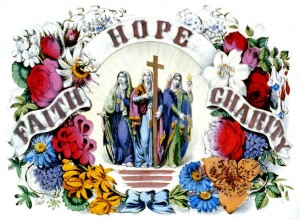
Faith-Hope-CharityLast week, I gave away the ending of Job. I told you that everything turned out all right in the end, and so it has. Job has repented, not of any sin that warranted his suffering, but of the pride and arrogance (and ignorance) he displayed during his suffering by demanding to confront God. God has forgiven him and to make up for all his loss, his fortunes have been restored many times over. Happy ending! Except not quite . . .

I’ll come back to Job in a minute, but first I want to look at a petition in today’s opening collect and then at the gospel story. The petition is this: “Increase in us the gifts of faith, hope, and charity.” The gospel story is the restoration of sight to blind Bartimaeus to whom Jesus says, “Your faith has made you well.”

What is “faith,” the first of the theological virtues our prayer asks of God and the active agent in healing Bartimaeus? The writer of the Letter to the Hebrews tells us that “faith is the assurance of things hoped for, the conviction of things not seen.” (Heb 11:1) Faith is sometimes equated with belief, and in an ancient way that is true but in the modern sense of the word “belief,” that is a misleading equation.

In contemporary English, “belief” is understood to be an opinion or judgment of which the believer is fully persuaded, or alternatively it is considered intellectual assent to a factual assertion. By some it is derided as a false alternative to scientific certainty: one is said to believe that which cannot be proven, but to know that which is made evident by factual data. That’s a false dichotomy, but not one I want to debate this morning. For the moment, let’s accept the notion that belief is assent to an opinion, judgment, or assertion. This may be the first step of faith for, as Paul reminds us in the Letter to the Romans, “faith comes from what is heard,” (Rom 10:17a), through acceptance of assertions. However, faith must be more than that.

In the Epistle of James, we are reminded that such faith, faith which consists only of belief, “by itself, if it has no works, is dead,” (Jm 2:17) and Paul would seem to agree with that when, in his letter to the Galatians, he writes that “the only thing that counts is faith working through love.” (Gal 5:6b, emphasis added)

So, then, faith is not simply the same as belief (as belief is currently understood). Faith is belief plus action. This is in accord with the New Testament understanding of faith; remember that our New Testament was written in Greek and the word we translate as “faith” is pistis, a verb. From a New Testament perspective, faith is not a noun, an object or substance which one has; faith is a verb, an action which one does. But is it more? Is there another element of faith.

I suggest to you that there is and we find that element in the original meaning of the word “belief.” Our word “belief” derives from the same root as our word “beloved,” and in original meaning as more the sense of “confidence” or “trust” than of intellectual assent. It means to give one’s heart to the object of one’s belief.

Faith then is belief plus action plus confidence, and it was faith such as this which led blind Bartimaeus to throw off his cloak and cry out to Jesus, “Son of David, have mercy on me!” Even when those around him would silence him, this faith made him yell even more loudly. This is the faith which our opening prayer asks God to increase in us: not our assurance of the rectitude of some factual assertion made (for example) in the Nicene Creed, but that belief given shape in action and that action undertaken with confidence, and confidence (the Letter to the Hebrews tells us) belongs to hope (Heb 3:6), which is the second theological virtue in our petition to God this morning.

Did you know that we have iconic depictions of the theological virtues in our stained glass windows? Look to the back of the church over the entrance doors. Below the circular rose window are the figures of three women. One holds a cross; one, an anchor; and one, loaves of bread. The figure with the cross is the depiction of Faith. Next to her is the figure holding the anchor of Hope. Which brings us back to Job.

We are, as I mentioned earlier, at the end of the story and everything has turned out all right. Job confesses that he has been arrogant and prideful in demanding a hearing before God; he is healed of his loathsome sores, reconciled to God, and rewarded with an abundance of wealth and family and comfort.

Once again, however, the lectionary leaves something out. Between verse 6, the end of his confession, and verse 10, which begins the description of his reward, God addresses Job’s three friends, Eliphaz the Temanite, Bildad the Shuhite, and Zophar the Naamathite. God says, “My wrath is kindled against you . . . ; for you have not spoken of me what is right, as my servant Job has.” (v. 7)

What is the difference between Job and these other three? The answer is, “Hope.” Throughout his ordeal, despite his pride, despite his arrogant demand that God present himself, despite his denials of any sin, Job has steadfastly maintained his hope in the justice of God. His friends have counseled him to admit to wrongdoing that even they are not sure he has done; they have advised him to just give up. They have given up hope, but Job has not.

What is “hope”? Well, that’s a good question. St. Paul wrote a lot about hope in his various letters, but he never really defines it. He comes closest to doing so in the Letter to Romans in which he writes: “[S]uffering produces endurance, and endurance produces character, and character produces hope, and hope does not disappoint us.” (Rm 5:3-5) And then later in the same letter he says, “In hope we were saved. Now hope that is seen is not hope. For who hopes for what is seen? But if we hope for what we do not see, we wait for it with patience.” (Rm 8:24-25)

Theologically, hope is the “virtue by which we desire the kingdom of heaven and eternal life as our happiness, placing our trust in Christ’s promises and relying not on our own strength, but on the help of the grace of the Holy Spirit.” (C.C.C., 2nd Ed., 1997, Para. 1817)

Hope is not optimism. Optimism claims everything will be good despite all evidence of reality to the contrary; pessimism denies even the possibility of good because of present evidence. The nuclear physicist J. Robert Oppenheimer said, “The optimist thinks this is the best of all possible worlds. The pessimist fears it is true.”

Optimism can be defeated by reality. Pessimism revels in reality but defeats itself. Hope, like optimism, expects the good. Hope, like pessimism, accepts reality. Hope does not deny the poverty of spirit that underlies fear, the sinfulness that underlies all tragedy, and the evil that causes systemic inertia. Hope, however, has a trump card – the capacity of the human heart. When reality grinds optimism down and reduces pessimism to a self-defeating smugness, hope will go toe-to-toe with reality because the heart’s capacity to love refuses to quit. This is why the letter to the Hebrews describes hope as “a sure and steadfast anchor of the soul” (Heb 6:19) and why the iconic figure of Hope holds an anchor.

This is the steadfastness that our opening prayer seeks from God.

The last of the theological virtues for which we have prayed is Charity, who is depicted in our window as a woman distributing bread to hungry children. Theologically, Charity is the “virtue by which we love God above all things for his own sake, and our neighbor as ourselves for the love of God.” (C.C.C., Para. 1822) Interestingly, though, we almost never read of charity in our English language bibles. In the New Revised Standard Version, the word “charity” appears only five times and four of those are in the Apocrypha; in the canonical scriptures, the word appears only in the book of Acts. In the Authorized or “King James” version it appears 24 times, more than a third of those in one book, St. Paul’s First Letter to the Corinthians from which you will (I’m sure) recognize these words:

Though I speak with the tongues of men and of angels, and have not charity, I am become as sounding brass, or a tinkling cymbal. And though I have the gift of prophecy, and understand all mysteries, and all knowledge; and though I have all faith, so that I could remove mountains, and have not charity, I am nothing. And though I bestow all my goods to feed the poor, and though I give my body to be burned, and have not charity, it profiteth me nothing. Charity suffereth long, and is kind; charity envieth not; charity vaunteth not itself, is not puffed up, doth not behave itself unseemly, seeketh not her own, is not easily provoked, thinketh no evil; rejoiceth not in iniquity, but rejoiceth in the truth; beareth all things, believeth all things, hopeth all things, endureth all things. Charity never faileth . . . . (1 Cor 13:108a)

In our modern translation we have changed the word “charity” to “love” and that bit of First Corinthians has become very popular at weddings, but it’s not about romantic love at all. It is about something much different. You know (you’ve heard it here before!) that the word in the original Greek is agape, which refers to selfless love. This is the love that one extends to all people, whether family members or distant strangers; it is the according of human dignity to everyone, simply because they are human. Agape was translated by St Jerome into the Latin word caritas, which is the origin of our word “charity.” C.S. Lewis referred to it as “gift love” and described it as the highest form of Christian love. But it is not solely a Christian concept; it appears in other religious traditions, such as the idea of metta or “universal loving kindness” in Buddhism.

Charity, agape, is not simply love generated by an impulse emotion. Instead, charity, agape, is an exercise of the will, a deliberate choice. This is why Jesus can command us to love one another as he loves us, to love our neighbors, even our enemies, as ourselves. God is not commanding us to have a good feeling for these others, but to act in charity, in “gift love,” in self-giving agape toward them. Charity, agape, is matter of commitment and obedience, not of feeling or emotion. When Paul admonishes Christians in the Letter to the Ephesians to “live in love, as Christ loved us and gave himself up for us,” offering himself (as our reading from Hebrews says) “once for all,” it is precisely this kind of self-sacrificing love, Charity, agape, to which we are called.

When the Resurrected Jesus asks Peter, “Do you love me?” three times, the first two times the word is agape. “Peter,” Jesus is asking, “are you willing to do things for my sake that you do not want to do?” This is the sort of love, of Charity, that is depicted in our third iconic window, the woman giving bread to poor and hungry children, love which leads us to give sacrificially.

The contemporary hymn writer John Bell, a Scotsman affiliated with the Iona Community, has written a beautiful song entitled The Summons which I wish I had the voice to sing to you. I don’t, so you don’t want me to sing it, but please listen as I read the lyrics. I believe these words perfectly describe the sort of Charity our opening prayer asks God to increase in us:

Will you come and follow me
If I but call your name?
Will you go where you don’t know
And never be the same?
Will you let my love be shown,
Will you let my name be known,
Will you let my life be grown
In you and you in me?

Will you leave yourself behind
If I but call your name?
Will you care for cruel and kind
And never be the same?
Will you risk the hostile stare
Should your life attract or scare?
Will you let me answer pray’r
In you and you in me?

Will you let the blinded see
If I but call your name?
Will you set the pris’ners free
And never be the same?
Will you kiss the leper clean,
And do such as this unseen,
And admit to what I mean
In you and you in me?

Will you love the ‘you’ you hide
If I but call your name?
Will you quell the fear inside
And never be the same?
Will you use the faith you’ve found
To reshape the world around,
Through my sight and touch and sound
In you and you in me?

Lord, your summons echoes true
When you but call my name.
Let me turn and follow you
And never be the same.
In your company I’ll go
Where your love and footsteps show.
Thus I’ll move and live and grow
In you and you in me.

We have prayed this morning that God will increase in us the gift of faith – faith like Bartimaeus’s, belief given shape by action undertaken in confidence which is sustained by hope. We have prayed this morning that God will increase in us the gift of hope – hope like Job’s, the sure and steadfast anchor of the soul not crushed by the suffering of the present sustained by the heart’s capacity to love and the assurance that in end all will make sense. And we have prayed this morning that God will increase in us the gift of charity – the agape love commanded and demonstrated by Christ who gave himself once for all which leads us to give sacrificially.

“And now abideth faith, hope, charity, these three; but the greatest of these is charity.” (1 Cor 13:13) May Christ’s charity move and live and grow in us and we in him. Amen.

====================

A request to my readers: I’m trying to build the readership of this blog and I’d very much appreciate your help in doing so. If you find something here that is of value, please share it with others. If you are on Facebook, “like” the posts on your page so others can see them. If you are following me on Twitter, please “retweet” the notices of these meditations. If you have a blog of your own, please include mine in your links (a favor I will gladly reciprocate). Many thanks!

====================

Father Funston is the rector of St. Paul’s Episcopal Church, Medina, Ohio.

Dog Crap, the Temple, and Love – From the Daily Office Lectionary

Dog Crap, the Temple, and Love

From the Daily Office Lectionary for Friday in the week of Proper 24, Year 1 (Pentecost 21, 2015)

Ezra 3:10 ~ When the builders laid the foundation of the temple of the Lord, the priests in their vestments were stationed to praise the Lord with trumpets, and the Levites, the sons of Asaph, with cymbals, according to the directions of King David of Israel . . . .

So I haven’t written one of these random meditations for a week . . . and instead of starting this one early in the morning as I usually do (so that they are sort of sleep befuddled first impressions of the Daily Office lessons more than anything else), I went out to do yard work.

I was reminded of another verse of scripture: “You shall have a designated area outside the camp to which you shall go. With your utensils you shall have a trowel; when you relieve yourself outside, you shall dig a hole with it and then cover up your excrement.” (Dt 23:12-13) We have a “dog yard” on the west side of our house; it is our “designated area outside the camp” and it is my privilege to clean it up every Friday on my day off. After doing that, I mow the lawn.

The yard clean up is the foundation, if you will, of my day off. After that is accomplished, I can relax and enjoy the day; I can rejoice and praise the Lord. Foundations, it seems to me, are like that. The work of digging footings, laying foundation stones (or blocks of concrete, or pumping in concrete), making sure the work is level, providing for proper drainage, and so forth, is all very hard work. And then it gets covered up and no one ever sees or thinks about it again, unless something goes wrong. Picking up dog crap is like that. It’s gross and unpleasant work, and no one ever thinks about it . . . unless it doesn’t get done and the stuff piles up. Getting that unpleasant but necessary work done, the work that makes everything else possible, the very important and absolutely necessary work that no one notices when all is well, that is good reason to praise the Lord.

This was not, of course, my initial thought reading the lessons this morning; this only came to me after the dog yard was cleaned and the lawn was mowed. My initial thought was a question: Did St. Paul have this scene in mind when he wrote to the Corinthians, “If I speak in the tongues of mortals and of angels, but do not have love, I am a noisy gong or a clanging cymbal”? (1 Cor 13:1) Was he thinking of noisy temple rituals when he wrote of actions lacking the foundation of love?

For love is the true foundation of all good. On its website, a Canadian food ministry in which the Anglican Church of Canada is a part includes a prayer beginning with these words: “Creator God, we know that love is the foundation of creation and all life, your love and ours. We know that all things are possible with love – that the least becomes the most important, the last becomes the first.” Done with love even the grossest and most unpleasant of jobs, even most hidden and little recognized work, becomes the most important. Picking up dog shit, cleaning up the latrine, digging ditches, laying stones . . . done with love they are the foundation of the temple and worthy of praise and celebration.

Old Rags & Worn Clothes ~ From the Daily Office Lectionary

Old Rags & Worn Clothes

From the Daily Office Lectionary for Thursday in the week of Proper 23, Year 1 (Pentecost 20, 2015)

Jeremiah 38:11-13 ~ Ebed-melech took the men with him and went to the house of the king, to a wardrobe of the storehouse, and took from there old rags and worn-out clothes, which he let down to Jeremiah in the cistern by ropes. Then Ebed-melech the Ethiopian said to Jeremiah, “Just put the rags and clothes between your armpits and the ropes.” Jeremiah did so. Then they drew Jeremiah up by the ropes and pulled him out of the cistern.

About a half-century ago, I dropped out of college and went to work as a janitor in a small Southern California hospital. Not too long after being hired, I found myself invited to become an orderly in the facility, an invitation I accepted and went to work primarily in the radiology and emergency departments. In that position, I had opportunity observe situations in which rescues had resulted in injuries that the patient would otherwise not have suffered.

I remember one instance in which a surfer had been knocked out by his own surfboard. Because of inept handling by the rescue crew, he suffered a broken leg and a broken arm while unconscious. That surfer came to mind as I read today’s story of the rescue of Jeremiah the prophet from the cistern of Malchiah.

I’m sure there are greater lessons to learn from the tale of Jeremiah’s cistern imprisonment and rescue, but what impresses me today is the care taken by the eunuch Ebed-melech to insure that Jeremiah is not injured by the ropes during the rescue. There’s a lesson there about ministry, especially our “rescue ministries,” our food pantries, soup kitchens, clothing cabinets, and other “handout” programs. We must ask ourselves whether we are doing more harm than good; are the ropes of these programs chafing those we rescue?

The surfer suffered those fractures because his rescuers, getting him out of the water and off the rocks of the beach, weren’t sufficiently careful; they failed to make use of “old rags and worn clothes” to protect the subject of their beneficence. How often do we do the same? How often do we foster dependence or cause greater injury by our handouts and our rescue ministries?

We’ve all heard the old saw about giving a hand-up, not a handout. Usually, we hear this from those who want curtail both hand-ups and handouts, to cut off all social services and so-called “entitlements” from government funding. However, there is some validity to the notion that our rescue missions should encourage self-determination and independence rather than foster dependence; whether a hand-up or a handout, our actions should not further harm those rescued. Again, we must ask whether the ropes of our programs are chafing those we rescue and, if so, make use of the “old rags and worn clothes” to prevent that.

Second Draft – From the Daily Office Lectionary

Second Draft

From the Daily Office Lectionary for Tuesday in the week of Proper 23, Year 1 (Pentecost 20, 2015)

Jeremiah 36:32 ~ Then Jeremiah took another scroll and gave it to the secretary Baruch son of Neriah, who wrote on it at Jeremiah’s dictation all the words of the scroll that King Jehoiakim of Judah had burned in the fire; and many similar words were added to them.

A second draft. That’s what this story is about . . . not a willingly done second draft, but one necessitated by the reader’s destruction of the first. Jeremiah had written (or, rather, dictated) his words of prophecy and delivered them to the king, who tore the scroll into pieces and burnt them. So Jeremiah does it again, and then some! “Many similar words were added!”

I would guess that prophets didn’t write second drafts very often. They got their words from God, wrote them down (or dictated them to hapless secretaries like Baruch), delivered the product to the intended audience, and that was that. The rest of us are not so fortunate, at least I’m not. I write plenty of second drafts, and third, and fourth.

Seldom do I write something down and call it done. There is always room for improvement, even if there isn’t always time to make the improvements. I often find myself editing sermons on the fly – jotting something in the margin just before the worship service, scratching through a line and adding another, ad-libbing an additional thought. I also find myself looking back a few days after preaching, thinking “I could have, should have, ought to have, might have . . .” That’s not second drafting, however; that’s second guessing.

Second guessing looks back and tries to improve on something that has already had an effect, and that’s what has happened between Jeremiah and the king. The prophet wrote, the king reacted (by burning the scroll), now the prophet is writing again. How many of those “many similar words [which] were added” got added because Jeremiah had had more to say to begin with and how many were added because Jeremiah is now hoping for a different result? We’ll never know.

This is why second (and other later) drafts are necessary. Most writers and preachers don’t get a chance to second guess ourselves, so all we can do is second draft, and third draft, and fourth draft, and . . . until the final product is presented and then it’s done. That’s best, too. Better to second draft than to second guess.

At That Time: A Sermon Offered on St. Francis Day, 4 October 2015

====================

A sermon offered on Feast of St. Francis of Assisi, October 4, 2015, to the people of Trinity Cathedral, Cleveland, Ohio.

(The lessons for the day are Jeremiah 22:13-16, Psalm 148:7-14, Galatians 6:14-18, and Matthew 11:25-30.)

====================
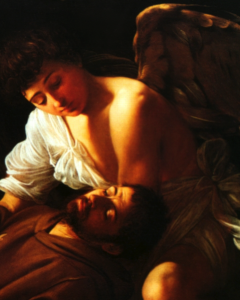
Detail, Francis in Ecstasy, CaravaggioWhen I was learning the art of preaching, my instructor was a fan of the old Barthian aphorism that a homilist should enter the pulpit with the newspaper in one hand and the Bible in the other. So here I am, newspaper and Bible at the ready, and opening the first I find glaring at me the headline you all have also seen: another mass shooting in America – the 294th multiple gun homicide of the year. Like many, if not most, of the clergy here this evening I have preached too many sermons about mass murder and gun control: after Columbine, after the Aurora theater, after the Milwaukee gurdwara, after Sandy Hook Elementary School, after Mother Emanuel Church, after so many others . . . . I’m sorry; my heart is broken and my prayers arise for the Umpqua College victims, their families, and their community. But, even as we gather to remember the Little Poor Man of Assisi, in whose name we often pray, “make me a servant of your peace,” I just don’t have another mass-murder-gun-control sermon to offer.

So I want to tell you about the other headline that grabbed my attention earlier in the week. The hairstyle commonly known as the “man-bun,” which described as “typically worn with hair shaved on the sides of the head with a top-knot worn in the middle,” has been banned at Brigham Young University’s Rexford, Idaho, campus. According to the school’s “Student Honor Administration,” the man-bun is not consistent with the school’s dress code; it is no considered “an extreme hairstyle . . . just something that deviates from the norm.” (BYU-Idaho Scroll)

The BYU action reminded me of a story the late Senator Sam Ervin used to tell about a rather puritanical North Carolina preacher whose ministry bridged a time when women’s hairstyles were changing and women were beginning to wear their hair up in buns and this preacher found that most objectionable. It was, he thought, wanton and sinful for women to tempt men by exposing the curve of their shapely and attractive necks, and so he preached against this “modern” hairstyle. He chose as his text the famous admonition of the Savior Himself: “Top knot, come down!”

“At the conclusion of his sermon an irate woman, wearing a very pronounced topknot, told the preacher that no such text could be found in the Bible. The preacher thereupon opened the Scriptures to the seventeenth verse of the twenty-fourth chapter of Matthew and pointed to the words: ‘Let him which is upon the house top not come down to take anything out of his house.’” (Schutz, C., Political Humor: From Aristophanes to Sam Ervin, Fairleigh Dickinson Univ Pr, 1976, p. 42)

That story has nothing to do with St. Francis, but it does illustrate the quandary I felt when considering the lessons assigned to this feast. I don’t want to accuse those who selected these lessons of decontextualizing Scripture quite so badly as Sen. Ervin’s preacher . . . but let’s be honest: these traditional lessons have been selected less because they convey a gospel message than for their superficial reminders of Francis. Clearly, this is true of the epistle in which Paul claims “I carry the marks of Jesus branded on my body,” a reminder that late in his life Francis bore the Stigmata. Similarly, the Psalm reminds us of Francis’s Canticle of Brother Sun; the reading from Jeremiah, of his service to the needy.

One supposes the gospel lesson was similarly chosen because Jesus’s dismissal of the “wise and intelligent” reminds us that Francis, who came from a wealthy family and could have lived among the educated elite, chose instead a life in solidarity with the voiceless, uneducated poor.

But, when the first words I read in a gospel lesson are “At that time” my curiosity is immediately piqued! “What time?” I want to know. Our evangelist contextualized these words of Jesus, and I want to know what that context is. I hope you do, as well, because I’m about to tell you; we are going to untie this “top knot”.

Chapter 11 of Matthew’s Gospel, the end of which constitutes our lesson, is a discrete literary unit which opens with messengers from John the Baptist asking Jesus if he is the anticipated messiah. Jesus’s reply is, “Tell John what’s happening: the blind see, the lame walk, the mute speak, the dead are raised.” He then turns to those who are with him and says, “By the way, when you went out to the Jordan to see John, what were you expecting?”

He answers his own question, “You expected to see a prophet, and that’s what you got and more.” But, he reminds them that they rejected John because of his asceticism: “John came neither eating nor drinking, and they say, ‘He has a demon.'” (v. 18) But when Jesus came, “eating and drinking, … they say, ‘Look, a glutton and a drunkard, a friend of tax-collectors and sinners!'” (v. 19) They didn’t want the tough asceticism of John, nor did they did want the lighter touch of Jesus.

Why? Because both challenged the status quo; to follow either would have meant changing the rules! John’s way would have required them to renounce worldly pleasure; Jesus’s would have meant welcoming everyone including (heaven forbid!) sinners. They didn’t want to change the rules. They didn’t want to deviate from the status quo. They just wanted someone to bless them the way they were.

Jesus compares them to children who can’t make up their minds, “children sitting in the market-places and calling to one another, ‘We played the flute for you, and you did not dance; we wailed, and you did not mourn.'” (v. 16-17) They are like children who cannot decide whether they want to hold a pretend funeral or a make-believe wedding and end up doing nothing. Australian theologian Bill Loader calls them “the religious wise who seriously go about trying to protect God,” to maintain the status quo. They are the rule-makers and the rule-keepers who miss the point.

In their book The Unblocked Manager (Gower:Brookfield, VT, 1996), Dave Francis and Mike Woodcock make the argument that in business an overly-serious obsession with rules, with established norms, is not compatible with playful creativity and receptivity, that such an attitude inhibits communication and saps new ideas of their excitement, vitality, and strength. St. Francis said much the same thing according to his first biographer, Thomaso da Celano: “It is the devil’s greatest triumph when he can deprive us of the joy of the Spirit. He carries fine dust with him in little boxes and scatters it through the cracks in our conscience in order to dim the soul’s pure impulses and its luster.” (Quoted in Dorothee Solle, The Silent Cry: Mysticism and Resistance; see also, Celano, Second Life, Ch. LXXXVIII.125) That’s what had happened to Jesus’s audience in Matthew 11; they were the rule-makers and the rule-keepers who had been sprinkled with Satan’s powder of unmitigated seriousness.

So Jesus gets really personal and really pointed with them! He condemns three particular communities, pronouncing woes upon Bethsaida, Chorazin, and Capernaum, saying of the first two that “if the deeds of power done in you had been done in Tyre and Sidon, they would have repented long ago in sackcloth and ashes.” (v. 21) Tyre and Sidon were Philistine centers of pagan religion, business and commerce, and (apparently) prostitution; Isaiah, Jeremiah, Ezekiel, and other prophets foretold their doom and destruction as a result. Of Capernaum, Jesus says that because of its rejection of those same deeds of power “on the day of judgment it will be more tolerable for the land of Sodom than for you!” (v. 24) In that condemnation we get a hint of what has so angered Jesus for we know that Sodom’s sin was not about sexuality, despite centuries of misinformation on that score; Sodom’s sin was a failure of compassion, generosity, and hospitality. And those words clearly describe the “deeds of power” witnessed and dismissed by Chorazin, Bethsaida, and Capernaum.

Actually, we don’t really know what may have happened in Chorazin; it is not otherwise mentioned in the gospels. But we do know that in Bethsaida Jesus gave sight to a blind man and we believe that it was a few miles south of town at Tel Hadar that he fed the Four Thousand. We know that in Capernaum Jesus healed Peter’s mother-in-law and that a few miles south of there at Tabgha he fed the Five Thousand. Works of compassion, acts of generosity, instances of hospitality, these are the “deeds of power” scorned by the religiously “wise and intelligent,” the overly serious who go about enforcing rules, trying to protect the status quo, missing the point, and sapping Jesus’s gospel of its excitement, vitality, and strength.

We don’t know what the “wise and intelligent” of those towns may have said, what criticism they may have leveled, but on the basis of other conversations reported by the evangelists we can surely speculate. Were the healings done on the Sabbath so that they might constitute “work” in violation of the Law of Moses? Did the crowds at Tel Hadar and Tabgha wash their hands or did they eat in a defiled condition? Especially at Tel Hadar, might there have been Gentiles present? I’m sure we can with some accuracy suggest the concerns and critiques of the rule-keepers.

It is Jesus’s deeds of mercy and compassion that are the evidence of God’s gracious will, not rules! That is why Jesus told John’s messengers, “Look at what’s been done.” “Wisdom,” said Jesus, “is vindicated by her deeds.” (v. 19)

So this is the context of our gospel reading: “At that time, Jesus [angry and frustrated] said, ‘I thank you, Father, because you have hidden these things from’” these people, these overly-serious rule-keepers who cannot see that there is something more important than rules, who stifle compassion, and generosity, and hospitality, and mercy, and grace. (He’d run into this before. Remember when he visited his home synagogue at Nazareth? Mark tells us that “he could do no deed of power there. . . . And he was amazed at their unbelief.” [Mk 6:5-6]) At that time, he was offended that Capernaum, Bethsaida, and Chorazin had refused to respond. At that time their overly serious attitude and unbelief sapped his good news of its excitement, its vitality, and its strength.

Those overly-serious rule-keepers, the defenders of the status quo are with us today; at this time there are lots of Chorazins, Bethsaidas, and Capernaums. We read about them in the newspaper at this time.

Woe to you, Ft. Lauderdale and Philadelphia and Salt Lake City (and 20 other cities), who deny compassion and make it illegal to feed the homeless and the hungry just to protect your rules about public order!

Woe to you, House of Representatives, you deny health care to hundreds of thousands of poor women who need cancer screenings and perinatal care because of your rules about abortion funding (rules that weren’t being violated in any event)!

Woe to you, Rowan County, KY, you would deny two people who love each other the possibility of marriage because of your rule about homosexuality (a rule that isn’t the law of the land any longer)!

Woe to you, Rexburg, ID, you would deny self-expression to your students because of your petty dress code about hair!
Woe to you, America, you sacrifice the students in your colleges, the children in your schools, the movie-goers in theaters, the worshipers in your temples and churches just to protect a rule you call “the Second Amendment.”

At this time, this is the context within which we hear Jesus say, “I thank you, Father, because you have hidden these things from [the rule-makers, the rule-keepers, and the overly serious] and have revealed them to infants.” (v. 25)

Here’s an interesting thing . . . the Greek word translated as “infant,” the word nepioi, is unlike much of the koiné Greek of the New Testament; it is a word one also finds in classical Greek literature. In the Septuagint, it is used in the Psalms to translate the Hebrew words for the naive, the innocent, and the uneducated. In the Illiad and the Odyssey, it describes those who are socially and spiritually disenfranchised, who have no say not only in public affairs but in their own lives, as well. In all these contexts, it carries the connotation of voicelessness, of being not a rule-maker or a rule-keeper, but one burdened without one’s say by the rules of others.

Our saint today was born in late medieval Italy and christened Giovanni di Pietro di Bernardone. “Francis” was a derogatory nickname meaning “little Frenchman,” which apparently had been given him by his father because of his habit of dressing in the French style. He tried to live up to the conventions of his place and time first as merchant with his wealthy father, then as a soldier in the service of his city. Eventually, experiencing a mystical call and a religious conversion, he gave that all up. When his father hauled him before the Bishop of Assisi in legal proceedings, Giovanni renounced his inheritance and stripped naked in public, returning to his father the garments he had paid for. According to his second biographer, St. Bonaventure, “the servant of the most high King was left stripped of all that belonged to him, that he might follow the Lord whom he loved, who hung naked on the cross.” (Major Life, Ch. II.4) He left behind a life among the rule-makers and the rule-keepers, and began a life among the voiceless and the disenfranchised; he laid down the heavy burden of social convention to take up the yoke of Christ.

The life to which Jesus invited Francis, and to which he invites us, is not found in the rules; it is not found in the newspaper. It is found in the examples, in the “deeds of power” we encounter in the Bible. For Francis, it was a life full of risks and challenges, and Jesus has made it abundantly clear that it will be for us. He calls us to a life of humble service, a life of generosity, compassion, and hospitality, a life of mercy and grace.

To live, as Francis did, yoked to Jesus is to live free from the burden of sin, resting freely, deeply, and securely in God’s grace. To live yoked to Jesus is to be free from the need to prove oneself under some set of rules whether they be the mitzvoth of Moses, the social conventions of medieval Italy, the dress codes of a university, or the amendments of the Constitution. To live yoked to Jesus is to be the voice to the voiceless who always face the oppression and the opposition of the rule-makers and the rule-keepers.

It is to live the life described in the prayer attributed to St. Francis, which though not actually written by him, “admirably expresses the thought and spirit of Francis, ‘the Man of Peace.'” (Marion Habig, OFM, Francis of Assisi: Writer, in Omnibus of Sources, Franciscan Herald:Chicago, 1983, p 1930)

Will you join me in offering that prayer now?

Let us pray:
Lord, make us instruments of your peace.
Where there is hatred, let us sow love;
where there is injury, pardon;
where there is discord, union;
where there is doubt, faith;
where there is despair, hope;
where there is darkness, light;
where there is sadness, joy.
Grant that we may not so much seek to be consoled as to console;
to be understood as to understand;
to be loved as to love.
For it is in giving that we receive;
it is in pardoning that we are pardoned;
and it is in dying that we are born to eternal life. Amen.
(BCP 1979, Prayer No. 62, p 833)

It’s a beautiful prayer, but it’s essential to recognize that praying isn’t enough. Like Francis, we must live yoked to Jesus and be the voice of the voiceless in answer to the rule-keepers. Amen.

====================

A request to my readers: I’m trying to build the readership of this blog and I’d very much appreciate your help in doing so. If you find something here that is of value, please share it with others. If you are on Facebook, “like” the posts on your page so others can see them. If you are following me on Twitter, please “retweet” the notices of these meditations. If you have a blog of your own, please include mine in your links (a favor I will gladly reciprocate). Many thanks!

====================

Father Funston is the rector of St. Paul’s Episcopal Church, Medina, Ohio.
That’s Not How It Works! – Sermon for Pentecost 18 (Proper 21B) – 27 September 2015

====================

A sermon offered on Eighteenth Sunday after Pentecost (Proper 21B, Track 1, RCL), September 27, 2015, to the people of St. Paul’s Episcopal Church, Medina, Ohio, where Fr. Funston is rector.

(The lessons for the day are Esther 7:1-6,9-10;9:20-22, Psalm 124, James 5:13-20, and Mark 9:38-50. These lessons may be found at The Lectionary Page.)

====================

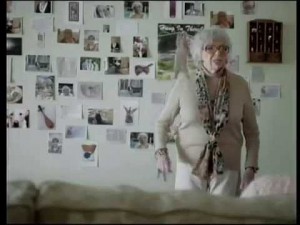
BeatriceIf you’re like me, you usually ignore television commercials; like my wife, you may even mute the sound on your TV when they come on. But every once in a while there will be one that is just so good you have to give it credit, you watch it when it comes on because it’s just a really good piece of little film making.

One such little story that I think is brilliant is a commercial for Esurance entitled Beatrice in which an older lady, standing in front of her living room wall which is plastered with photographs of her vacation, she says, “Instead of mailing everyone copies of my vacation photos, I’m saving a ton of time by posting them to my wall.” She goes on to extol her quick on-line insurance and when her friend, who has a very puzzled and concerned look on her face, responds that she’s saved more, Beatrice says to her, “I ‘unfriend’ you.” And the friend replies, “That’s not how it works. That’s not how any of this works.”

That, I suggest to you, is Jesus’ message to his misguided disciples when they “saw someone casting out demons in your name, and . . . tried to stop him, because he was not following us.” It’s like they are saying, “Hey, Jesus! We saw this guy doing this . . . so we ‘unfriended’ him!”

The disciples are quite pleased with themselves. Like later generations of church members, their aim is to preserve the purity and orthodoxy of the Jesus’ movement by silencing the ministry of someone they consider an outsider, by delegitimizing someone who is not like them, by cutting off the other. They are surprised when Jesus rebukes them for their narrow-mindedness and limited understanding of Jesus’ mission

“That’s not how it works,” says Jesus, “That’s not how any of this works. Whoever is not against us is for us.” That is a radical statement of hospitality and inclusion.

Jesus then launches into these hyperbolic instructions to remove body parts. I used to believe that Jesus in this, as in other passages, was making use of a rabbinic teaching technique which scholars have named “Semitic hyperbole.” After all, Jesus was a native speaker of Aramaic (although his words have been transmitted to us in the koiné Greek of the New Testament) so we can assume that Jesus said this originally in Aramaic in which hyperbole was an accepted way of making a point. Speakers of Semitic languages (Hebrew, Aramaic, and Arabic) use hyperbole so often and in such grossly exaggerated forms that to an English speaker it almost seems to border on lying.

By exaggerating something beyond the bounds of rationality, speakers of these languages catch our attention, stating truths in a “bigger than life” way and waking us up to the reality of life, to the reality of our own lives. G. K. Chesterton noted that Jesus was a master of the hyperbole: “Christ had even a literary style of his own . . . The diction used by Christ is quite curiously gigantesque; it is full of camels leaping through needles and mountains hurled into the sea.” (Orthodoxy, John Lane: New York, 1908, pp 271-72)

However, hyperbolic though this language is, I don’t think Jesus is actually using hyperbole as a teaching tool in this case. I think he’s just being sarcastic. I think he’s saying, “Go ahead! Cut off your nose to spite your face! Go ahead! You’ll see how pointlessly self-defeating your behavior is. You will only hurt yourself in the effort to correct or punish someone else.”

Because . . . that’s not how it works. That’s not how any of this works!

It is not by cutting off hands or feet, or by plucking out eyes that an individual is healed or saved; similarly, it is not by cutting off another or by stopping another’s ministry that the community of faith is grown. “Whoever is not against us is for us.” Healing and salvation happen through relationship, through radical hospitality and radical inclusion.

James, in our epistle lesson today, writes: “My brothers and sisters, if anyone among you wanders from the truth and is brought back by another, you should know that whoever brings back a sinner from wandering will save the sinner’s soul from death and will cover a multitude of sins.” Salvation is not accomplished by hacking away; salvation is accomplished by grafting on, by relationship, by hospitality, and by inclusion.

“The prayer of faith will save the sick,” writes James, “The prayer of the righteous is powerful and effective.” The quality of our prayer lives influences others; it creates relationships and opens pathways for divine energy. We achieve well-being for ourselves and for others by reaching out and grafting on, not by cutting away. No one who does a deed of power in Jesus’ name will be able soon afterward to speak evil of him or of his church, and anyone who promotes abundant life is on God’s side, whether it be by liturgical laying on of hands such as we will offer here today, or by reiki massage, or social action, or Zen meditation, or chemotherapy, or Tai Chi, or yoga, or whatever . . . even by something as simple as offering a cup of cool water to thirsty child. God is present and moving in all things, in all healthful, health-giving, hospitable, and inclusive relationships.

There is, I believe, a reason that our lectionary links James’ message of healing in relationship with today’s gospel story of radical inclusion, and that reason lies in the often overlooked relationship between the words “hospital” and “hospitality.” The linguistic connection between these words is no accident. As early as the 4th Century, it was common for Christian congregations to have “houses of lodging for strangers.” Later, medieval monasteries and convents carried on this tradition, and it was common for a member of the community to serve as “hospitaler,” the one who extended hospitality to strangers. Sometimes this meant caring for the travelers’ injuries and ailments. Thus, these “houses for the lodging of strangers,” these “hospitals,” became the first infirmaries where the other was welcomed and healed in Jesus’ name.

This mission of hospitality is not simply a sideline of the Christian mission, an add-on or plug-in, if you will, but rather the heart of it. As David Atkinson and his co-authors write in the New Dictionary of Christian Ethics & Pastoral Theology:

[C]are for the stranger goes hand in hand with preaching the gospel. ~ The Bible’s insistence that the Lord’s people should be hospitable highlights several vital, lasting theological and ethical principles. One is stewardship: showing hospitality is simply good caretaking, distributing the Master’s resources where they are most needed. Another is the imitation of God: being hospitable is being like God, who treated his people so generously when they were strangers in Egypt. And a third is grace: as God lavishes his love on those who deserve none of it, so Christians must provide hospitality for those who cannot earn or repay their generosity. (Atkinson, David, J., et al., New Dictionary of Christian Ethics & Pastoral Theology, Inter-Varsity Press, 1995, p 517)

“Hey, Jesus! We saw a guy healing in your name, but he wasn’t one of us and he wasn’t doing it our way, so we ‘unfriended’ him!”

“That’s not how it works! That’s not how any of this works! Whoever is not against us is for us!”

Jesus ends the conversation, and Mark ends the entire episode, with an obscure and confusing metaphor about salt. “Salt is good; but if salt has lost its saltiness, how can you season it? Have salt in yourselves, and be at peace with one another.”

morton-saltThe Bible is full of metaphors which can be lost on modern American Christians, and this is one of them. We buy our salt (sodium chloride) in neat blue boxes from the supermarket; it’s purified, though it may be mixed with a small amount of an additive to make it run smoothly and flow freely. It may have a bit of granulated sugar added to it because pure salt is too salty for modern tastes! And it may have iodine added to it as a protection against goiter and other iodine deficiency issues; sea salt naturally contained iodine, but highly processed and refined salt does not.

This modern “pure” salt is incredibly stable and does not lose its saltiness. But salt which is mined from deposits such as one might have found in First Century Palestine is not pure. It is an amalgam of sodium chloride with other salts and minerals. If this mixture becomes wet, the sodium chloride can dissolve and leech away. The remaining substance looks the same but the salty flavor is lost and it cannot be brought back.

Followers of Jesus are called to be salty and, like that First Century salt, people are amalgams; we are not pure in any way. And we certainly can lose our “saltiness” as the “dampness” of life dilutes and leeches it away, or if (as Jesus has sarcastically suggested) we start cutting away bits and pieces of our lives.

What is the “saltiness” that we are meant to retain? What is the human “saltiness” that Jesus is concerned cannot be restored? Jesus words are often taken to be spiritual and lofty and, since salt was a required part of the grain and incense offerings in the Temple, this “salt” metaphor is often understood in that way.

However, another definition of “salty” is “down-to-earth,” and a third is “coarse” in the sense of colorful, spicy, racy, risqué, naughty, vulgar, or even rude. I don’t really know if “salt” had those connotations in Jesus’ time, but I do know that salt was considered symbolic of friendship, loyalty, and hospitality, all of which Jesus valued.

Time and time again the Gospels remind us that Jesus was a down-to-earth and hospitable sort of guy. He want to dinner parties and wedding receptions, and had a good time. He told jokes, most of which we don’t get because we’ve lost the cultural references (like the impure salt metaphor). He was condemned by the religious people for associating with sinners and was publicly criticized as a “winebibber,” the quaint King James English term for “drunkard.”

This all suggests to me that the “saltiness” that Jesus here speaks of is not some lofty, holy preservative of morality; it’s that down-to-earth hospitable conviviality that builds community and makes life fun. It might be what the French call “joie de vivre.”

There’s a series of advertisements for Dos Equis beer in which the corporate spokesman, described in the ads as “the Most Interesting Man in the World.” He’s not quite as entertaining as Beatrice and her “wall,” but he does memorably advise consumers, “Stay thirsty, my friends.”

I think Jesus is more entertaining than Beatrice and more interesting that the beer man and, in this gospel story, I see him looking into the camera, perhaps thinking of the parties and weddings he has attended and of the sinners he has befriended, of the hospitality and inclusiveness he is trying to teach his disciples, and saying, “Stay salty, my friends.”

Because that’s how it works! That’s how all of it works! Be hospitable, stay in relationship, reach out, include the stranger, do not cut off things or people. “Whoever is not against us is for us! . . . Have salt in yourselves, and be at peace with one another.” Amen.

====================

Note: This sermon includes a somewhat edited version of a previously published Daily Office meditation.

====================

A request to my readers: I’m trying to build the readership of this blog and I’d very much appreciate your help in doing so. If you find something here that is of value, please share it with others. If you are on Facebook, “like” the posts on your page so others can see them. If you are following me on Twitter, please “retweet” the notices of these meditations. If you have a blog of your own, please include mine in your links (a favor I will gladly reciprocate). Many thanks!

====================

Father Funston is the rector of St. Paul’s Episcopal Church, Medina, Ohio.

More Than Much Fine Gold: Sermon for Pentecost 16, Proper 19B – 13 September 2015

====================

A sermon offered on Sixteenth Sunday after Pentecost (Proper 19B, Track 1, RCL), September 13, 2015, to the people of St. Paul’s Episcopal Church, Medina, Ohio, where Fr. Funston is rector.

(The lessons for the day are Proverbs 1:20-33, Psalm 19, James 3:1-12, and Mark 8:27-38. These lessons may be found at The Lectionary Page.)

====================

GoldSo here’s a thing that happened this week . . . . We prepared the bulletins for today; both the church secretary and I reviewed them and proof-read them and only after they’d been copied and folded that I saw something out of order with today’s Psalm (as printed in the bulletin). It’s Verse 10….

There’s nothing really wrong with it, but the verse number, you see, is larger than the numbers of all the other verses. We set the type size for the verse numbers at 10 pt, but that one verse number didn’t get set that way . . . it’s 14 pt; stands out like a sore thumb, calls attention to the verse: “More to be desired are they [the statutes and judgments of God] than gold, more than much fine gold . . . . ” I took that as a sign that I should talk about gold this morning, that I should talk about money, and that seemed like a good idea because next week you will be receiving the annual pledge campaign flier.

On the other hand, I’d rather talk about today’s gospel in which Jesus asks his closest companions, “Who do people say that I am?” to which they give a variety of answers, but then he really puts them on the spot with his follow-up question: “But who do you say that I am?” Peter, of course, comes up with a correct answer, but this is a question which is never completely answered, is it?

It’s funny, but when I read this particular story I can’t help thinking of The Logical Song by the rock group Supertramp. The refrain of the song goes:

There are times when all the world’s asleep,
The questions run so deep
For such a simple man.
Won’t you please, please tell me what you’ve learned
I know it sounds absurd
Please tell me who I am.

Now I know that the pleading, lost, confused, and rebellious attitude of the singer of the song is not the attitude of Jesus in his conversation with the disciples, but the lyric is right that this is a question that runs deep, as absurd as it may sound. Jesus asks us this question on a regular basis: “Tell me what you’ve learned. Tell me who I am to you.”

Jesus first asks the twelve, “What have you learned? What’s public saying about me?” But he doesn’t stop with asking about public opinion. He asks them for a personal position: “Who do you say that I am?”

We live in a pluralistic society; we live in a time in which there are many religious choices, and we have much to learn from the many others, different sorts of Christians as well as those of other faiths and those of none, all the variety of persons among whom we live and with whom we interact. In this pluralistic milieu we also have much to share with these others and we need to be able to give an account of our own religious choice. We have chosen to follow Christ. We have chosen to follow Christ in a particular way. Why? Who is Jesus to us?

Paul, in the letter to the Ephesians, insists that he is the model of our spiritual maturity, the gauge (if you will) of our spiritual development: it is our calling, Paul insists, to “come to the unity of the faith and of the knowledge of the Son of God, to maturity, to the measure of the full stature of Christ.” (Eph 4:13) Mark’s way of making this same point is to quote Jesus as saying to us, as he said to Peter and the other disciples, “Deny [your]selves and take up [your] cross and follow me. For those who want to save their life will lose it, and those who lose their life for my sake, and for the sake of the gospel, will save it.”

Jesus’ question is really not about his identity, at all. It’s really about ours. When each of us answers his question, what we respond says more about our self than it can ever say about Jesus. Who are we becoming as we follow him, as we come “to the measure of the full stature of Christ,” as we live into his identity that resides within us? “Who do you say that I am?” is a question about our identities and our priorities.

It is often said if you want to know your real priorities, look at two things: your appointment book and your checkbook. These days you might look at your Google calendar and your online bank account statement, or the calendar app on your smartphone and your credit card statement. Whatever. The point is that your priorities are always going to be reflected in the way you spend your resources: your time, your talents and abilities, your money, your energy. Jesus said it plainly: “Where your treasure is, there your heart will be also.” (Lk 12:34). Where your gold is, there are your priorities.

Jesus says, “These are the priorities: Deny yourself and take up the cross and follow me.”

A theology of the cross or a theology of self-denial does not mean a contrived humility or a self-sacrificing martyrdom; we do not follow Jesus, we do not take up our cross, we do not grow into the full stature of Christ by demeaning ourselves. A true theology of the cross, a true denial of self means that we are called to selflessness, to an unselfishness in which we do the very best we can with the treasure, the talents, the abilities, and the energy God gives us. To “deny oneself” and take up one’s cross means to keep one’s priorities in harmony with what Jesus told us in the two “great commandments” — love God and love your neighbor (Mk 12:28-31).

The commandment[s] of the Lord [are] clear
and give light to the eyes.
The judgments of the Lord are true
and righteous altogether.
More to be desired are they than gold,
more than much fine gold . . . .

So, I guess I ended up talking about money after all, and that probably is a good idea because this next week you will be receiving your annual pledge card for 2016.

Late at night, when all the world’s asleep,
And the questions run so deep
When you fill out next year’s card.
Won’t you please, please tell us what you’ve learned
I know it sounds absurd
Tell Jesus who he is; tell him who you are.

Amen.

====================

A request to my readers: I’m trying to build the readership of this blog and I’d very much appreciate your help in doing so. If you find something here that is of value, please share it with others. If you are on Facebook, “like” the posts on your page so others can see them. If you are following me on Twitter, please “retweet” the notices of these meditations. If you have a blog of your own, please include mine in your links (a favor I will gladly reciprocate). Many thanks!

====================

Father Funston is the rector of St. Paul’s Episcopal Church, Medina, Ohio.

Of Dogs and Lives that Matter: Sermon for Pentecost 15 (Proper 18B) – 6 September 2015

====================

A sermon offered on Fifteenth Sunday after Pentecost (Proper 18B, Track 1, RCL), September 6, 2015, to the people of St. Paul’s Episcopal Church, Medina, Ohio, where Fr. Funston is rector.

(The lessons for the day are Proverbs 22:1-2,8-9,22-23; Psalm 125; James 2:1-17; Mark 7:24-37. These lessons may be found at The Lectionary Page.)

====================

syrophenician woman icon“Jesus set out and went away to the region of Tyre. He entered a house and did not want anyone to know he was there.” Mark’s Gospel can be infuriating at times. This introduction to the story of the Syrophoenician woman is definitely one of those times, two short sentences which leave us wanting to know so much more. We can, I think, understand why Jesus might not want anyone to know he was in the place; we frequently observe him throughout the Gospels trying to find some “down-time,” some privacy, some solitude to be with God. But why did he set out and go “to the region of Tyre?”

Tyre was a Greek commercial center in southern Lebanon. For the Jews of First Century Palestine it was just beyond the northernmost extent of their province; “the region of Tyre” was where Jews and Gentiles frequently interacted, a frankly uncomfortable situation for Jews whose religion and law forbade that, whose racial and religious prejudices informed them that they were God’s chosen and that all other persons were unclean, whose sense of self and national importance required that they separate themselves from Gentiles. It was not the sort of place one would have expected the Jewish Messiah to go. So why is he there?

“He entered a house . . . “ Whose?!? Why!?! There are just all sorts of questions that erupt from those four short words.

Mark leaves us wanting so much more information! It’s infuriating.

Of course, Mark leaves out those details that he doesn’t think important. What’s crucial for Mark is the story of the interaction between Jesus and the Syrophoenician woman, probably the most uncomfortable, the most disturbing story about Jesus in all of the Gospel literature.

The story is simple and brief. A non-Jewish woman who has heard of Jesus’ power as a healer comes seeking aid for her daughter. Mark specifically identifies her as a Syrophoenician, a Greek-speaking resident of what we now call Syria. She has, perhaps, come from Syria to the Mediterranean with her child seeking a better life and now she needs help. Jesus dismisses her; to be honest, he blows her off. “I’m here for the Jewish children,” he says, “not you Gentile dogs.” He’s not just dismissive; he’s rude. He’s not just rude; he’s insulting! “But even the dogs,” she replies in the face of his insult, “even the dogs get the children’s scraps.”

My friend David Henson, an Episcopal priest and journalist, writes of this story:

Jesus uttered an ethnic slur.

To dismiss a desperate woman with a seriously sick child.

In this week’s gospel text, in the Black Lives Matter era, I think we have to start with that disturbing and disorienting fact.

Our immediate response likely is, “Of course not! Jesus couldn’t possibly have uttered a slur!” But Jesus’ exchange with the Syrophoenician woman seems to tell a different story. No matter what theological tap dance can avoid it: Jesus calls the unnamed woman a dog, an ethnic slur common at the time.

To be clear, while there is some debate about the social and cultural dynamics at work here, Jesus holds all the power in this exchange. The woman doesn’t approach with arrogance or a sense of entitlement associated with wealth or privilege. Rather she comes to him in the most human way possible, desperate and pleading for her daughter. And he responds by dehumanizing her with ethnic prejudice, if not bigotry. In our modern terms, we know that power plus prejudice equals racism. (In Patheos “Edges of Faith” Blog.)

I believe David is right to link this story to the refrain “Black Lives Matter” which we have begun to hear with increasing fervor and increasing frequency, because that is exactly what this woman says to Jesus: “Syrophoenician Lives Matter” . . . . and Jesus responds out of his religion which forbade interaction with non-Jews, out of the racial and religious prejudices which informed his society that Jews were God’s chosen and that all other persons were unclean, out of that sense of self and national importance that required that he and all Jews separate themselves from Gentiles. When we hear “Black Lives Matter,” we are likely to do very much the same thing.

More than once I have heard members of my race and economic class respond with the comeback “All lives matter” and at first that made sense to me. Then I read an editorial in which was written:

If I say, “Black lives matter,” and you think I mean, “Black lives matter more than others,” we’re having a misunderstanding.

If I say, “White privilege is real and it means white people have some unearned social advantages just because they’re white,” and you think I mean, “White privilege is real and it means white people should be ashamed of themselves just because they’re white,” we’re having a misunderstanding.

If I say, “We have a problem with institutionalized racism in our legal system,” and you think I mean, “We have a problem with everyone being racist in our legal system,” we’re having a misunderstanding.

If we are having these misunderstandings, where are they coming from and what can we do about them?

(Note: The source is an internet meme seen on Facebook and Pinterest; the origin of the text is unknown.)

“Sir,” said the Syrophoenician woman, “even the dogs under the table eat the children’s crumbs. [We are having a misunderstanding, where is it coming from and what can we do about it?]”

I came to realize “All lives matter” is a retort that dilutes and even negates the assertion that “black lives matter.”

We generally do not respond in that way when others make claim to particularity. When Jesus says, “Blessed are the poor,” we don’t rise up and insist “No, Jesus, blessed is everybody in every economic class.” When the Buddha says, “The enlightened one must delight in the forest,” we don’t dismiss him with “No, Siddhartha, one should delight in the desert and the meadow, as well” We don’t because we realize that their specificity has a point; the specific does not negate the general or the other, but it does highlight the particular. “Blessed are the poor” highlights the plight of those who lack; “Delight in the forest” draws attention to the interconnections of all life.

“Black lives matter” underscores the sad fact that, for many, black lives do NOT matter, and offering “All lives matter” as a response invalidates that specific and particular realization. Of course, all lives matter, but in our contemporary social circumstance specifically noting that black lives matter has particular currency and validity.

To respond “All lives matter” drowns the specificity of the assertion in an undifferentiated sea of sameness and unrecognizability which we know darn good and well really does not exist! The claim of the particular cannot be overwhelmed by the flood of the undefined, and we are wrong to respond in that way, just as wrong as Jesus came to know himself to have been in calling the woman a dog!

Early last week the news media and social media were flooded with pictures of three-year-old Aylan Kurbi, and later with photos of his five-year-old brother Galip and their mother Rehan. Like the woman in our Gospel story today, a mother and her children come from Syria to the Mediterranean seeking a better life, three refugees fleeing their own war-torn and atrocity-ravaged country, trying to get to Europe and from there to Canada where Aylan’s aunt and uncle live and were preparing a new life for them. They didn’t make it. Whatever vessel they were in capsized and they drowned, Aylan’s little body washing up onto the beach of a Turkish resort.

Aylan KurbiAs photos of his lifeless body laying face down in the sand made their way instantaneously around the world, an international hew and cry was heard; in a phrase, the world said, “Refugees’ lives matter! Syrian lives matter!” In response to the death of that one, specific little boy, no one was heard to say, “All lives matter” . . . .

It is easy for us to look across the wide ocean to the Middle East and Europe, and diagnose the social ills, the evil spirits, and the political injustices that led to Aylan’s death; it is less easy for us to acknowledge and diagnose in our own country what Presiding Bishop Katharine and President Jennings called the “structures that bear witness to unjust centuries of the evils of white privilege, systemic racism, and oppression that are not yet consigned to history.” (A Letter to the Episcopal Church. Note: The letter was read in full to the congregation prior to the service.) As Jesus noted, it is much easier to see our neighbors’ problems than our own, but he advises us: “First take the log out of your own eye, and then you will see clearly to take the speck out of your neighbor’s eye.” (Lk 6:41-42, cf Mt 7:4-5)

Mark’s Gospel can be infuriating at times, his ending to the story of the Syrophoenician woman no less so than its introduction. Jesus listened to the Syrophoenician woman, heard the truth of her Gentile reality, and realized the brokenness of his own Jewish milieu: “For saying that,” he tells her, “you may go – the demon has left your daughter.” Going home she finds that to be so and that’s where Mark ends the tale; he gives us not a single additional detail. In the next paragraph, Jesus is forty miles away somewhere east of the Sea of Galilee in the region of the Decapolis, another place with that troublesome intermixture of Jews and Gentiles.

While he is there, another soul in need of help is brought to him, a deaf man with a speech impediment. Mark, having been so careful in the last story to make sure that his readers understand that the woman seeking help for her daughter was a Gentile, completely ignores this man’s ethnicity; but Mark leaves out details that he considers unimportant. Although this story takes place in exactly the same sort of social situation as the last – Jews and Gentiles living side-by-side in that uneasy mix, the Jews here no less bound by those laws of separation, no less steeped in those racial and religious prejudices of chosenness and uncleanness – those differences no longer matter. Jesus’ eyes and ears and heart having been opened by the Syrophoenician woman’s plea; he ministers to the deaf man without regard to whether he is Jew or Gentile. He “put his fingers into his ears, and he spat and touched his tongue. Then looking up to heaven, he sighed and said to him, ‘Ephphatha,’ that is, ‘Be opened.’” I wonder if he thought about how his own understanding of his messianic ministry had been opened up by the woman in Tyre.

“Racism will not end with the passage of legislation alone; it will also require a change of heart and thinking,” our leaders quoted AME Bishop Jackson. It will require that our ears be opened, that we remove the logs from our eyes, and that we confess and repent of the sin of racism, including those times when we have simply ignored it, tolerated it, accepted it, or even unknowingly benefited from it. And lest any of us think that we have nothing in this way to confess, just ponder briefly the words we heard from James’ epistle this morning:

If a person with gold rings and in fine clothes comes into your assembly, and if a poor person in dirty clothes also comes in, and if you take notice of the one wearing the fine clothes and say, “Have a seat here, please,” while to the one who is poor you say, “Stand there,” or, “Sit at my feet,” have you not made distinctions among yourselves, and become judges with evil thoughts?

[Silence]

“A good name is to be chosen rather than great riches, and favor is better than silver or gold. The rich and the poor[, Jews and Gentiles, blacks and whites, women and men, Syrians and Europeans, Christians and Muslims] have this in common: the Lord is the maker of them all.”

Yes, all lives matter.

All lives matter because . . . .

Black lives matter.

Syrian lives matter.

Refugees’ lives matter.

Aylan Kurbi’s life mattered.

The Syrophoenician woman’s daughter’s life mattered.

“Even the dogs under the table eat the children’s crumbs,” and “those who are generous are blessed, for they share their bread with the poor.”

Let us understand and affirm that the call to pray and act for racial reconciliation, to pray and act for an end to racism in our world and in our country, is integral to our witness to the Gospel of Jesus Christ and to our living into the demands of our Baptismal Covenant. “[We] do well if [we] really fulfill the royal law according to the scripture, ‘You shall love your neighbor as yourself.'”

Let us pray:

Grant, O God, that your holy and life-giving Spirit may so move every human heart and especially the hearts of the people of this land, that barriers which divide us may crumble, suspicions disappear, and hatreds cease; that our divisions being healed, we may live in justice and peace; through Jesus Christ our Lord. Amen. (Prayer for Social Justice, BCP 1979, page 823)

====================

A request to my readers: I’m trying to build the readership of this blog and I’d very much appreciate your help in doing so. If you find something here that is of value, please share it with others. If you are on Facebook, “like” the posts on your page so others can see them. If you are following me on Twitter, please “retweet” the notices of these meditations. If you have a blog of your own, please include mine in your links (a favor I will gladly reciprocate). Many thanks!

====================

Father Funston is the rector of St. Paul’s Episcopal Church, Medina, Ohio.

« Older posts Newer posts »