Occasional thoughts of an Anglican Episcopal priest

Category: Ministry (Page 29 of 59)

Thomas the Realist: Sermon for Easter 2 – 12 April 2015

====================

A sermon offered on the Second Sunday of Easter, April 12, 2015, to the people of St. Paul’s Episcopal Church, Medina, Ohio, where Fr. Funston is rector.

(The lessons for the day are Acts 4:32-35; Psalm 133; 1 John 1:1-2:2; and John 20:19-31. These lessons can be read at The Lectionary Page.)

====================

I assume that you are all familiar with Leonardo da Vinci’s famous mural of The Last Supper in the refectory of the Convent of Santa Maria delle Grazie, Milan. Nearly all of us have seen reproductions of it; it is said to be one of the most reproduced (and most parodied or satirized) paintings in human history. I have been privileged to see it in person twice in my life: once when I was a 16-year-old student studying in Florence and again in the summer of 2000 when I chaperoned the Kansas City Youth Symphony on a concert tour of northern Italy.

Each time I have looked at that painting, either the original or reproductions, I have found myself drawn more to da Vinci’s depiction of the disciples than to his Jesus. We know from Leonardo’s notebooks who each of the figures is meant to be. Thomas, who figures prominently in today’s Gospel lesson, figures prominently in the painting, as well. He is the first figure on Jesus’ left, right next to Jesus, looking intently at Jesus (we see him only in profile) with his right index finger pointing in Jesus’ face!

Has anyone ever done that to you? Gotten in your face making a point, raising their finger in emphasis? [Gesturing with index finger pointed upward] You know that this is a serious person. They know the way the world is; they have a very definite view of reality; and they are intent and making sure you see and understand their viewpoint. In The Last Supper, Thomas is only the first person on Jesus’ left because he leaning over St. James the Greater to make his point. He is a serious person with a definite view of reality.

That’s why I never call St. Thomas “Doubting Thomas.” This was not, in the upper room, and never in any other Gospel story, a man filled with doubt. This man is serious, sure of himself, and sure of his world. He is, in a word, a realist, a pragmatist, not a doubter.

Although Thomas is listed among the Twelve in all of the Gospels, we only encounter him as a speaker in John’s Gospel, and our first view of him is in the discussion leading up to the raising of Lazarus. We are told that the disciples (perhaps it was even Thomas) tried to dissuade Jesus from returning to Bethany in Judea, where Lazarus and his sisters lived, because they believed his life would be in danger: they remind Jesus that the Judeans “were just now trying to stone you, and are you going there again?” (Jn 11:8) Jesus, however, will not be turned away, so Thomas says to his fellow disciples, “Let us also go, that we may die with him.” (Jn 11:16) This man is a serious realist.

He is so realistic, so down-to-earth, that he doesn’t understand metaphor. When, in his farewell discourse, Jesus says . . .

In my Father’s house there are many dwelling places. If it were not so, would I have told you that I go to prepare a place for you? And if I go and prepare a place for you, I will come again and will take you to myself, so that where I am, there you may be also. And you know the way to the place where I am going.

. . . Thomas’s very pragmatic reply is, “Lord, we do not know where you are going. How can we know the way?” (Jn 14:2-5)

So we should not be surprised, and we should not call Thomas a “doubter” when he demands proof of Jesus’ resurrection. Would any of us have been any different? And, let’s be honest, none of the other disciples were themselves any different. None of them believed it either. In his Gospel, Luke is very clear about that: “Mary Magdalene, Joanna, Mary the mother of James, and the other women with them who told . . . the apostles. But [their] words seemed to them an idle tale, and they did not believe them.” (Lk 24:10-11; emphasis added)

I’m fairly certain that when Thomas said, “Unless I see the mark of the nails in his hands, and put my finger in the mark of the nails and my hand in his side, I will not believe,” (Jn 20:25) he never really expected to have the chance. Such a thing simply wouldn’t fit into the real world he understood. He wasn’t a doubter; he was a realist.

So, I think, Thomas has gotten a bad rap because of this story and the story has gotten a resultingly bad interpretation. This is not a story about changing someone’s mind; it’s a story about changing someone’s life!

Confronted by the reality of the risen Jesus, Thomas the realist is confounded by what reality really is; his perception of reality and thus his life is what is changed. When Jesus rises to his challenge and invites him to “put your finger here and see my hands; reach out your hand and put it in my side,” (Jn 20:27) he is not belittling Thomas, but he is positing the possibility that Thomas’s reality was too little. Thomas’s vision of reality is too small, too limited; his life is too circumscribed. His worldview is defined too much by evidence and too little by trust. When Jesus calls him to believe, he is calling on him to accept the evidence of an intellectual proposition; he is inviting him to live into a whole new world of trust. This is not a story about changing someone’s mind; it’s a story about changing someone’s life!

In 1961, an English priest named J.B. Phillips published a short book entitled Your God Is Too Small. In it he challenged many prevailing notions of God, many of which we still have with us today. He called these the “unreal gods” and gave them names such as “the Resident Policeman,” the “Parental Hangover,” and the “Grand Old Man.” These unreal gods, he said, were the gods of what he called “the modern outlook, which regards the whole of life as a closed system.” That “modern outlook” is precisely the point of view that Thomas had before meeting the risen Jesus! It is a too-small vision of reality in which it is unthinkable that anything could happen outside of what Phillips called “the whole huge cause-and-effect process,” that view of the world supported by physical evidence of the sort Thomas initially wanted.

But Thomas’s life and point of view, and that of all the apostles, were radically altered by their experience of Christ’s resurrection. Phillips wrote:

We may . . . point out the great difference that has come to exist between the Christianity of the early days and that of today. To us it has become a performance, a keeping of rules, while to the men of those days it was, plainly, an invasion of their lives by a new quality of life altogether. The difference is due surely to the fact that we are so very slow (even though we realize our impotence) to discard the closed-system idea. *** With the closed-system sooner or later you have to say: “You can’t change human nature.” Ideals fail for very spiritual poverty, and cynicism and despair take their place. But the fact of Christ’s coming is itself a shattering denial of the closed-system idea which dominates our thinking. And what else is His continual advice to “have faith in God” but a call to refuse, despite all appearances, to be taken in by the closed-system type of thinking? “Ask and ye shall receive, seek and ye shall find, knock and it shall be opened unto you”—what are these famous words but an invitation to reach out for the Permanent and the [truly] Real? (Your God Is Too Small, online PDF, The Common Life, pp. 88-89)

The story of Thomas is a story for all of us because we too easily fall into that closed-system worldview with its rules and its limitations. The story of Thomas reminds us of a grander vision. A vision defined not by limitation but by possibility, governed not by scarcity but by abundance, ruled not by remembered offenses but set free by forgiveness and reconciliation.

This is the vision shared by “the men of those days” (as Phillips called them), the members of the earliest Christian community described by Luke in the Book of Acts, that community of believers “who . . . were of one heart and soul, and no one claimed private ownership of any possessions, but everything they owned was held in common.” They had this shared vision because “the apostles gave their testimony to the resurrection of the Lord Jesus.” In other words, Mary Magdalene and the other women told their story of the empty tomb and of meeting Jesus in the garden; Cleopas and his companion told their story of meeting Jesus along the road to Emmaus; Thomas and the others told their story of meeting Jesus in the upper room.

The result was that peoples’ lives were changed. They lived in a way radically different than they had before, radically different from those around them: “There was not a needy person among them, for as many as owned lands or houses sold them and brought the proceeds of what was sold. They laid it at the apostles’ feet, and it was distributed to each as any had need.”

“From each according to his ability; to each according to his need” is not an economic model developed by Karl Marx; it is a religious model lived by the followers of Jesus Christ whose lives have been radically altered by their encounter with the Risen Lord. “Oh, how good and pleasant it is, when brethren live together in unity!” (Ps 133:1)

We live in different times. The total sharing of resources practice by Christ’s first followers no longer seems practical to us. We say to ourselves, “It just won’t work in our circumstances.” And we call ourselves realists and pragmatists. We hang onto that closed-system model and say [gesturing with index finger pointed upward]: “You can’t change human nature.”

But Jesus appeared to Thomas and said, “Put your finger here and see my hands. Reach out your hand and put it in my side. Do not doubt but believe.” (Jn 20:27) And proved that he can change human nature. Are we willing to let him change ours?

====================

A request to my readers: I’m trying to build the readership of this blog and I’d very much appreciate your help in doing so. If you find something here that is of value, please share it with others. If you are on Facebook, “like” the posts on your page so others can see them. If you are following me on Twitter, please “retweet” the notices of these meditations. If you have a blog of your own, please include mine in your links (a favor I will gladly reciprocate). Many thanks!

====================

Father Funston is the rector of St. Paul’s Episcopal Church, Medina, Ohio.
Washing Away RFRA: Sermon for Maundy Thursday – 2 April 2015

====================

A sermon offered on Maundy Thursday, April 2, 2015, to the people of St. Paul’s Episcopal Church, Medina, Ohio, where Fr. Funston is rector.

(The lessons for the day are Exodus 12:1-14; Psalm 116:1,10-17; 1 Corinthians 11:23-26, and John 13:1-17,31b-35 [all of Ch. 13 was read]. These lessons can be read at The Lectionary Page.)

====================

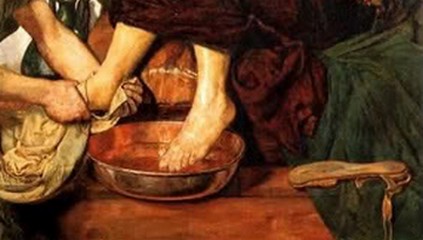
Foot WashingEvery year on Maundy Thursday in the Episcopal Church we do this thing: we gather for Eucharist and we hear these lessons – the story of the Passover from the Book of Exodus, St. Paul’s retelling of the institution narrative of the Eucharist, and St. John’s story of the Last Supper in which he focuses not on the meal but on Jesus’ act of humility and service during the meal (probably quite early in the evening) of washing the feet of the others present.

In many parishes the liturgy of this evening will include a formal washing of the feet of selected participants by the presiding priest and others. You may have seen pictures or video of the Pope doing so in the Vatican’s celebration of this feast. We’ve broadened that practice to allow any who wish to follow Jesus’ example to do so during the Agape Feast. There are foot washing stations in the Parish Hall for that purpose.

Why did Jesus wash his disciples’ feet? Tradition (as I just mentioned) tells us that it was to display and model humility and servanthood. In First Century Palestine, sandals were the most common form of footwear. Walking the dusty desert roads made one’s feet filthy; it was imperative that that be washed before a communal meal. In those days, people didn’t sit on chairs to eat at a table. Instead, they reclined at low tables; feet were very much in evidence. When Jesus rose from the table and began to wash the others’ feet, he was doing the work of the lowliest of servants. The disciples must have been stunned by this act of self-effacement and condescension. The humility expressed by this action with towel and basin foreshadowed Jesus’ ultimate act of humility on the cross.

Although the Lectionary only requires that we read certain verses of Chapter 13 of John’s Gospel, I
chose to read the entire chapter because I think tonight we need to remember exactly whose feet Jesus washed. When we read only that he washed “the disciples’ feet” we can gloss over and forget that John makes it very plain that among that group were two who, to our modern minds, clearly did not deserve the honor: Judas, who would betray him, and Peter, who would deny him. And John also makes it very clear that Jesus knew that both of them would do what they ultimately did.

I think it is important that we note that in particular this year, this Holy Week because for the past several days we have all heard a great deal about something called the Religious Freedom Restoration Act, something that was passed 25 years ago by the federal government and versions of which have been adopted in several states, most recently next door to us to the west in the State of Indiana. The law recently passed in Indiana, though it bears the same name as the federal act, is not the same as the federal law. During the past 25 years various state and federal courts have interpreted and to some extent limited the application of the federal or similar state laws, and so later-enacted versions have tried to answer and overcome those judicial limitations, Indiana’s (and now a nearly-identical act in Arkansas) being the broadest.

The impetus for these laws, of course, is the growing legal acceptance of marriage equality, the movement to allow same-sex couples to contract civil marriage in the same way as opposite-sex couples. Indeed, Professor Garrett Epps, who teaches Constitutional Law at the University of Baltimore, has said of the Indiana law that it is clear that its purpose is

. . . to be used as a means of excluding gays and same-sex couples from accessing employment, housing, and public accommodations on the same terms as other people. True, there is no actual language that says, All businesses wishing to discriminate in employment, housing, and public accommodations on the basis of sexual orientation, please check this “religious objection” box. But, as Henry David Thoreau once wrote, “Some circumstantial evidence is very strong, as when you find a trout in the milk.” (What Makes Indiana’s Religious-Freedom Law Different?, The Atlantic, March 30, 2015)

And the Rev. Franklin Graham, the son and heir of the Dr. Billy Graham, specifically extolled the Indiana act as “a religious freedom bill that would protect [Christian] business owners who want to decline to provide services for same-sex marriages.” (Facebook posting, March 25, 2015, 10:39 am)

And that is why I think it important that we specifically name Judas and Peter as being among those before whom Jesus knelt in abject humility and washed their feet. Presumably those ‘Christians (about whom Mr. Graham spoke) [want] to live out their faith’ and follow Jesus Christ by refusing to serve those whose actions they find offensive. The problem with that is that Jesus didn’t refuse to serve those whose actions were not only offensive to him; their actions were downright fatal to him! He didn’t refuse to serve them; he knelt in humility and washed their feet!

In answer to Mr. Graham, another Baptist preacher, the Rev. Russ Dean, co-pastor of Park Road Baptist Church in Charlotte, NC, wrote these words in Baptist News Global:

Mr. Graham opposes same-sex marriage. Maybe he also thinks women should stay home with their kids, and not work outside the home. Some Christians believe this, too. Maybe Indiana should also defend an employer’s right to decline employing young mothers? Whose religious views will we defend? Whose won’t we defend? And where will it stop?

Religious freedom is one of the principles that defines the genius of America – but only a secular state can actually defend that principle for all of its citizens. Otherwise, we might have Indiana defending conservative Christian views and another state defending liberal Christian views; one state defending Sharia law and another writing the codes of Leviticus into the law books in favor of a Jewish majority.

What this means, of course, is that some Christian business owners may have to break the law to defend their religious convictions. (Some Christian business owners did just that when Jim Crow was the law of the land.) But when Christians, or adherents of any religion, go into business, the secular law of the land rules. I have no doubt that in the coming months gay marriage will be the law of the entire land, so some Christian business owners will have a decision to make: uphold the law, or defend their understanding of one religious conviction — and suffer the consequence of breaking that law.

But let the government keep its hands out of religion. When the day comes that Christians have no other way to motivate religious conviction than through legislation, secular government will be the least of our worries. (Why do so many Christians think we need government to prop up Jesus?, Baptist News Global, April 1, 2015)

My purpose tonight is not to debate the merits or demerits of marriage equality; like the Rev. Mr. Dean, I believe that in the not-too-distant future same-sex marriages will be legal throughout the country, but whether that is or is not the case is irrelevant at the moment. What is relevant is how we as followers of Jesus Christ relate to and interact with those who are different from us in whatever way and for whatever reason, so different that, in fact, we find them or their actions offensive. What is relevant is this: do we respond to them with arrogance and condescension, enacting laws that some have gone so far as to call “a license to discriminate,” or do we embrace them in humility and love, kneeling down to wash their feet? Do we try to motivate religious conviction by enacting secular legislation or do we do so the way Jesus did, by example?

“Do you know what I have done to you?” Jesus asked Judas and Peter. “If I . . . have washed your feet, you also ought to wash one another’s feet. . . . If you know these things, you are blessed if you do them.” Judas failed utterly and committed suicide when he realized it; Peter failed, as well, but was forgiven and eventually taught the church “that God shows no partiality” and that “everyone who believes in [Jesus] receives forgiveness of sins through his name.” (Acts 10:34,43)

We call this day “Maundy Thursday” from an old English word meaning “commandment” because, after demonstrating what it means by washing their feet, Jesus admonished the Twelve, and through them admonishes us: “I give you a new commandment, that you love one another. Just as I have loved you, you also should love one another. By this everyone will know that you are my disciples, if you have love for one another.”

May the world know that we are his disciples because, in everything we do, we do not stand in arrogance and condescension, but rather we kneel in humility and love before others, even those who differ greatly from us, even those who offend us.

Steve Garnaas-Holmes, United Methodist pastor and poet, recently published this poetic prayer with which I will close:

Lord, what was it like to wash Judas’ feet,
on your knees, with such tender kindness?
An act of love, not irony.

What is it like to so humbly serve me,
to kneel at the feet of my failure and betrayals,
to welcome and wash and soothe me
as if I am your master?
Pure love, without demand.

Give me this love, this gentle humility,
to wash the feet of those who oppose me,
to treat them with tender kindness,
to seek always to be closer to you,
on your knees below us all,
serving in perfect love.
(Found at the poet’s Unfolding Light blog)

Amen.

====================

A request to my readers: I’m trying to build the readership of this blog and I’d very much appreciate your help in doing so. If you find something here that is of value, please share it with others. If you are on Facebook, “like” the posts on your page so others can see them. If you are following me on Twitter, please “retweet” the notices of these meditations. If you have a blog of your own, please include mine in your links (a favor I will gladly reciprocate). Many thanks!

====================

Father Funston is the rector of St. Paul’s Episcopal Church, Medina, Ohio.
Decision Train: Between Stimulus and Response – Sermon for Lent 2, 2015

====================

A sermon offered on the Second Sunday in Lent, March 1, 2015, to the people of St. Paul’s Episcopal Church, Medina, Ohio, where Fr. Funston is rector.

(The lessons for the day were Genesis 17:1-7,15-16; Psalm 22:22-30; Romans 4:13-25; and Mark 8:31-38. These lessons can be read at The Lectionary Page.)

====================

Decision Train TrackI was an English and American literature major in college (well, I finished as an English literature major – I was a biology major, a sociology major, an anthropology major, a philosophy major, and an undeclared major before ending up with a degree in literature.) I remember a certain type of end-of-term take home exam, the compare-and-contrast question. For instance, you’d read a bunch of novels and then along would come the final exam with a question like, “Compare and contrast the vision of the sea in Hemingway’s Old Man and the Sea and Melville’s Moby Dick.”
Reading our lectionary selections today, I had the sense that I was being handed a compare-and-contrast question: Compare and contrast the covenant made by God with Abram in Genesis 17 with the demand made by Jesus in the 8th Chapter of Mark.

On the one hand, we have “I will make you exceedingly numerous. You shall be the ancestor of a multitude of nations. I will make you exceedingly fruitful.” On the other, “If any want to become my followers, let them deny themselves and take up their cross and follow me. For those who want to save their life will lose it, and those who lose their life for my sake, and for the sake of the gospel, will save it.”

On the one hand, “I will give you everything.” On the other, “Give it all up.”

And yet the process and the promise is the same. The covenant offered to Abram and the demand made by Jesus both require a decision (that’s the process) and both lead to the promise described both by Paul in his letter to the Romans and by the Psalmist in Psalm 22: “the promise that [the righteous will] inherit the world” – the promise that “they shall be known as the Lord’s for ever” – that they shall enjoy what Jesus variously described as the kingdom of God, the kingdom of heaven, eternal life, or abundant life.

As I was making my notes for this homily, I was also carrying on a conversation by internet chat with a friend and colleague about something else, and my friend quoted the late philosopher-psychiatrist Viktor Frankl. He reminded me of something Frankl, an Austrian Jew, had written in his book Man’s Search for Meaning which described the things he had observed and learned as a prisoner in the Nazi concentration camp at Auschwitz. Frankl wrote, “Between stimulus and response, there is space. In that space is our power to choose our response. In our response lies our growth and our freedom.” It occurred to me that Frankl’s “space between stimulus and response” is a key to understanding the process which is common to God’s covenant and Jesus’ requirement.

Between God’s offer to Abram and Abram’s answer, between Jesus’ demand of his disciples and their reply is what Frankl identified as this space of our power to choose, this place where our potential for growth and freedom lies entirely within our control, where we either accept the kingdom of God or reject that abundant life. God offers, Jesus mandates, but we decide. We choose our response and “in our response lies our growth and our freedom.”

In our response also lies our identity. It is important to note that it is when Abram accepts God’s offer – which he does not only for himself but for his wife Sarai, a detail we might explore at another time – he and his wife are given new names; they become Abraham (“father of many nations”) and Sarah (“princess to all”). Their new names are symbolic of their act of giving up their former lives for the sake of God’s truth. In that “space between stimulus and response,” they were freed to live and grow into the new names, the new identities that God promised to give them.

The same is true for the disciples of Jesus. In that moment of decision, that “space between stimulus and response,” they (we) are given a new name. It is not without reason that in the sacramental sign of that decision, baptism, we are given a name, “sealed by the Holy Spirit,” and “marked as Christ’s own for ever.” As Peter reminds us in his first letter, we are to “glorify God because [we] bear [the] name” of Christian.

I got to thinking about the language we use to describe the act of deciding, and particularly the difference between the way Americans describe deciding and the way the British refer to it. We are, as George Bernard Shaw is supposed to have quipped, “two countries separated by a common language.” In colloquial American speech, we “make decisions,” but in idiomatic British, one “takes a decision.” To “make” a decision, or to “take” a decision? In all honesty, I think the British have the better of us here. To take a decision is certainly more responsible and more theologically sound than to make one. Here’s what I mean . . . .

Consider the difference between “making” something and “taking” something.

When you make something . . . when you have made something, you’re done with it. You do a lot of preparation, a lot work getting ready; you put a lot into the process, and then you create whatever it is – a painting, a piece of pottery, a casserole, a pie, whatever. You make it, and then you stop making it because there it is. You’ve made it. It has an independent existence in the world. You set it on the counter and the world will do with it whatever the world will do. You can just leave it there and let the world have it.

When we “make” decisions, we do the same thing. We treat decisions as destinations, as end points. In business management courses, students are taught to use “decision trains” in which the process of deciding is metaphorically diagrammed as a locomotive passing through “stations” labeled “situation,” “factors to consider,” “desired outcomes,” “possible consequences,” and so forth, eventually arriving at the terminus labeled “decision.” We even, in everyday speech, talk about “reaching a decision.”

There! We have arrived! We’ve done it! We’ve made our decision! Set it on the counter, record it in the minutes, put it in the filing cabinet, and let the world do with it whatever the world will do. We’re finished.

But when you “take a decision” the act of deciding is not the end . . . it is the beginning. When you take something, you are doing something very different from making something. When you take something, you hold it in your hands rather than set it on the counter. When you take something, you have to do something with it rather than let the world do with it whatever the world will do. When you take a decision, you have to act on it. It is not the terminus of your decision train; it is the start of the journey. Not the end, but the beginning.

When we make a decision, our “decision train” runs from stimulus to response . . . and stops. When we take a decision, our “decision train” starts at the response and runs for the rest of our lives.

In that “space between stimulus and response,” between God’s offer of covenant and our reply, between Jesus’ demand for discipleship and our answer . . . in that space lies our power to choose, to decide, not to make a decision and simply end an old way of being, but to take a decision and begin a new way of being, to give up an old life and save a new one, to surrender our old name and take on a new name, our true name.

As Episcopal theologian Elizabeth Webb reminds us: “To know our true name is, as it was for Abraham and Sarah, to turn, to reorient ourselves according to that name, and to live it. Just as God’s naming of Abraham and Sarah was also a calling, in naming us God is calling us to discipleship, casting off the old names by which we’ve been known, and living into (and maybe ‘up to’) the name that God bestows.” Whether that name be Abraham (“father of nations”), or Sarah (“princess to all”), or, simply, Christian (“follower of Jesus”).

So . . . compare and contrast . . .

For some, the decision we must take is to accept God’s offer: “I will give you everything.” For others, the decision we must take is to follow Jesus’ demand: “Give it all up.” For all, the promise is the same: “[We] shall be [named and] known as the Lord’s for ever.” Amen.

====================

A request to my readers: I’m trying to build the readership of this blog and I’d very much appreciate your help in doing so. If you find something here that is of value, please share it with others. If you are on Facebook, “like” the posts on your page so others can see them. If you are following me on Twitter, please “retweet” the notices of these meditations. If you have a blog of your own, please include mine in your links (a favor I will gladly reciprocate). Many thanks!

====================

Father Funston is the rector of St. Paul’s Episcopal Church, Medina, Ohio.

I Wish I Knew Her Name: Simon’s Mother-in-Law – Sermon for Epiphany V, February 8, 2015

====================

A sermon offered on the Fifth Sunday after Epiphany, February 8, 2015, to the people of St. Paul’s Episcopal Church, Medina, Ohio, where Fr. Funston is rector.

(The lessons for the day were Isaiah 40:21-31; Psalm 147:1-12,21c; 1 Corinthians 9:16-23; and Mark 1:29-39 . These lessons can be read at The Lectionary Page.)

====================

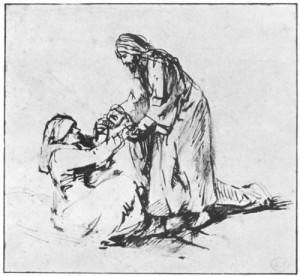
Rembrandt, 1660, Healing of Peter's Mother-in-LawAfter I did my first sermon-prep read through of this morning’s gospel I thought, “There are two stories here.” Then I thought, “No, there are three.” And then I realized that there are really more stories here than I can count.
Mark, of course, is interested in telling only one story, Jesus’ story, and so he gives us these glimpses into the lives of others only insofar as they serve to move his main story along.

We haven’t even reached the end of Chapter One yet and already Jesus has been baptized in a river, heard the voice of God, spent forty days in the wilderness tempted by Satan and waited on by angels, recruited four disciples, taught in a synagogue, cast out a demon, and (in today’s bit) healed a woman in a private home, gone back out into the wilderness to pray, and then traveled throughout the region preaching in more synagogues and casting our more demons.

And Mark has told us all of that in only 39 sentences. Mark probably would have failed a creative writing class and definitely would have failed a journalism class! He hasn’t even come close to answering those all important questions known to every reporter and every novelist on the planet: Who? What? When? Where? How? and Why? He hasn’t come close to answering them because he doesn’t care; unless those are questions about Jesus, Mark simply isn’t interested in them.

But I am! I would like to know some details. I’m like Karoline Lewis, Associate Professor of Preaching at Luther Seminary in St. Paul, Minnesota, who in writing about Simon’s mother-in-law repeatedly makes the parenthetical observation, “I so wish she had a name!” I would love to know her name. In fact, not only would I like to know who she is, I’d like to know what she’s doing there! Why is she in Simon’s household at all?

Is she there because she’s widowed and, bound by the law of Moses to be dependent on some man, has no male relatives other than her daughter’s husband to rely on for support? Is she there because Simon’s widowed and needs her help to raise his children? (Are there any children to raise?) Why is Simon’s mother-in-law the one who (after arising from her sickbed) performs the duties of hostess which normally would be those of a wife or an elder daughter? For that matter, why was she sick in the first place? What was actually wrong with her? There are more stories here than I can count because Mark hasn’t told them, because he hasn’t answered any of these questions.

Mark isn’t interested in answering the questions; the answers aren’t necessary to moving his story of Jesus along, but they would help me in understanding my story of Jesus. I know I’m not very much like Jesus, though I try to be; I am, however, a lot like those other people, like Simon or his mother-in-law or that man in the synagogue we heard about last week. If I could know more about how they related to and followed Jesus, it would help me as I stumble along trying to do the same.

I wish we knew more about the nameless Mrs. Simon’s mother (I wish Simon’s wife had a name!) because it would help me understand this statement: “The fever left her, and she began to serve them.” I read that statement and my 1960s-70s college student, sexual revolution, women’s liberation, gender equality heart just goes all cold and still, and I think, “Really? The first thing an elderly woman does on being relieved of sickness is get up and cook for the men?” But, you see, that’s my story, not Mark’s; that’s me reading into the text, instead of setting aside my preconceptions and letting the text read out to me. If I read the text carefully and in the context of the whole story of Jesus (as told by Mark’s and the other gospel writers), my gender-equality objections may not entirely fade away, but at least they are answered.

Here’s how . . . .

First, there’s the way Jesus seems to have refused to countenance the position of women in First Century Jewish society. In the Palestine of Jesus’ day, women were subservient men; they had no rights of their own; they could not own property; they were completely dependent upon the eldest male member of their family (which is one reason why Simon’s mother-in-law may have been living in his household). But we should remember that Jesus would have none of that! Jesus spoke openly with women when that was absolutely contrary to the norms of his culture as, for example, when he converse with the woman at Jacob’s well in Sychar (Jn 4) or when he prevented a crowd from stoning the woman caught in adultery (Jn 8:3-11). Jesus believed that a woman had as much right to study Torah with him as a man might, as when (over her sister’s objection) he permitted Mary of Bethany to sit at his “feet and listen to what he was saying.” (Lk 10:38-42) Jesus allowed women to whom he was not related to touch him, as when (in the home of another Simon) he allowed a woman known to be a sinner to bathe and anoint his feet (Lk 7), or when Mary of Bethany did the same just before his crucifixion (Jn 12:3). Would Jesus, who seemed to value women as the equals of men, have allowed an elderly woman to wait on him in a subservient manner? I wouldn’t think so.

Second, there’s that word “serve.” In this passage the translation of the Greek original is not incorrect, but it’s a certainly a loaded one! A 21st Century Christian American like myself hears inequality in that word “serve;” I hear a disparity in social position between the one who serves, the servant, and the one who is served, the master. I cannot shake the sense that the one serving is subservient, and that is especially so when reading Holy Scripture in English translation.

There are a couple of Greek words we should learn here; they both are interpreted as meaning “to serve” in modern translations of the New Testament. One is douleuo; its root is doulos, a noun meaning “slave.” One who serves in the since of douleuo serves as a slave serves. Jesus frequently uses this as a metaphor for the Christian life. When, for example, he said, “A disciple is not above the teacher, nor a slave above the master,” it is this word doulos that he uses; not simply “servant,” but “slave.” (Mt 10:24) And again, when he instructs the Twelve that “whoever wants to be first must be last of all and servant of all,” it is this word doulos, “slave,” that he uses. (Mk 9:35) And when he reminds us all that “no slave can serve two masters; for a slave will either hate the one and love the other, or be devoted to the one and despise the other. You cannot serve God and wealth,” it is again this word doulos, “slave,” and this kind of servitude – slavery – that he describes. (Lk 16:13)

And that is what we hear, what we understand when we read this word “serve” in English translation. We hear it here: Simon’s mother-in-law rose from her sickbed and like a subservient slave she waited on these men. Except she didn’t! That’s not what the Greek says even though that’s how we hear it when the second of the Greek words is translated as “serve” and that word, used in this passage, is diakoneo. As a noun, the word is diakonos. The verb means “to minister;” the noun we is the root of our word “deacon.” This is not the servile submission of a slave. When Mark, or any of the gospel writers, uses this term, something very different is intended: this is the willing ministration of one equal to another.

It is instructive to look at other instances where Mark uses the word diakoneo; this author uses the word only four times! The first is when Jesus is in the desert for forty days and Mark tells us that “the angels waited on him.” (Mk 1:13) The second is in today’s gospel reading. The third is when Jesus tells his disciples, “the Son of Man came not to be served but to serve.” (Mk 10:45) The last is when Mark describes those who were present at Christ’s crucifixion: “There were also women looking on from a distance; among them were Mary Magdalene, and Mary the mother of James the younger and of Joses, and Salome. These used to follow him and provided for him when he was in Galilee; and there were many other women who had come up with him to Jerusalem.” (Mk 15:40-41) In that last, the word translated “provided for” is diakoneo. This then is the sort of “serving” Simon’s mother-in-law does: ministering to Jesus and his disciples in the manner of the angels, serving as Jesus himself came to serve, providing for Jesus and the others as the women at the cross had provided for him.

Episcopal nun and priest, Suzanne Guthrie, writes, “Something more than healing occurs when Jesus ‘grasps’ her. The word used is the same as the word for Jesus’ resurrection – he ‘raises her up’. She embodies the Easter mystery of resurrection and the Pentecost mystery of apostleship – of service. …. She’s a mother of the church. A deacon. A template of holiness.” (Edge of the Enclosure)

Cuban theologian Ofelia Ortega observes, “This woman gets up and turns the Sabbath into a paschal day of service to others. Jesus does not command her. She is the one that assumes the initiative and awaits the consequences, discovering the value of mutual service above the sacredness of the Sabbath.” (Feasting on the Word Year B, Vol. 1)

This is the story Mark does not tell. Mark is interested only in moving forward his tale of Jesus, his life and ministry, his death and resurrection, so he does not give us any details about other stories that he considers tangential. If we want to learn from those other stories, we have to ferret out the details ourselves; we have to read Mark’s brief mention of other people along the way within the larger contexts of Mark’s whole story and the gospel story as told by others. When we read the story of Simon’s mother-in-law in this way, we find much more than the story of a subservient First Century woman merely doing what was expected of her. We learn from and are called to emulate the ministry of a woman many scholars have called “the first deacon of the church,” who rose restored from her sickbed, made well and whole by Son of God, and offered herself in service to others.

As Professor Lewis said, “I so wish I knew her name.” Amen.

====================

A request to my readers: I’m trying to build the readership of this blog and I’d very much appreciate your help in doing so. If you find something here that is of value, please share it with others. If you are on Facebook, “like” the posts on your page so others can see them. If you are following me on Twitter, please “retweet” the notices of these meditations. If you have a blog of your own, please include mine in your links (a favor I will gladly reciprocate). Many thanks!

====================

Father Funston is the rector of St. Paul’s Episcopal Church, Medina, Ohio.

Beyond Jesus’ Instructions: Annual Parish Meeting Sermon – January 25, 2015

====================

A sermon offered at the 198th Annual Parish Meeting, the Feast of the Conversion of Paul, January 25, 2015, to the people of St. Paul’s Episcopal Church, Medina, Ohio, where Fr. Funston is rector.

(The lessons for the day were Acts 26:9-21; Psalm 67; Galatians 1:11-24; and Matthew 10:16-22. These lessons can be read at The Lectionary Page.)

====================

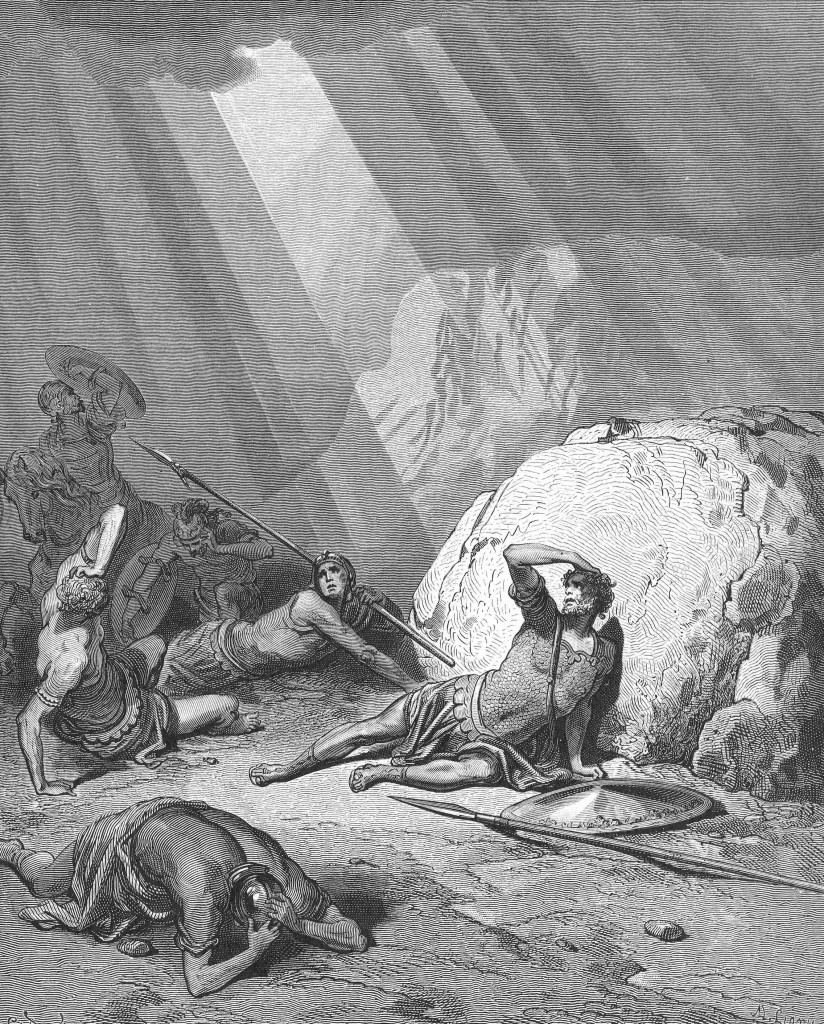
St Paul's Conversion by Gustav Doré“I heard a voice saying in Hebrew: ‘I have a job for you. I’ve handpicked you to be a servant and witness to what’s happened today, and to what I am going to show you. I’m sending you off to open the eyes of the outsiders so they can see the difference between dark and light, and choose light, see the difference between Satan and God, and choose God.'” (Acts 26:16-18a, The Message)

Amen.

A personnel recruitment and testing agency sent this memorandum to their client:

To: Jesus, Son of Joseph, Carpenter Shop, Nazareth

Thank you for submitting the resumes of the twelve men you have picked for managerial positions in your new organization. All of them have now taken our battery of tests. We have not only run the results through our computer, but we have also arranged personal interviews for each of them with our psychologist and our vocational aptitude consultant.

The profiles of all tests are included. You will want to study each of them carefully. As part of our service, we make some general observations. These come without any additional fee. It is the staff opinion that most of your nominees are lacking in background, educational and vocational aptitude for the type of enterprise you are undertaking. Specifically, we have the following observations about these candidates:

Simon Peter is emotionally unstable and given to fits of temper. Andrew has absolutely no qualities of leadership. The two brothers, James and John, place personal interest above company loyalty. Thomas demonstrates a questioning attitude that would tend to undermine morale. We feel that it is our duty to tell you that Matthew (the former tax collector) has been blacklisted by the Greater Galilee Better Business Bureau. James the-son-of-Alphaeus and Thaddaeus have radical leanings and registered high manic-depressive scores.

Only one candidate shows great potential. He is a man of ability and resourcefulness who meets people well and has a keen business mind. He has contacts in high places and is highly motivated, ambitious, and responsible. We recommend Judas Iscariot as your chief financial officer and right-hand man.

All the other profiles are self-explanatory. The candidates do not have the team concept. We would recommend that you continue to search for persons of experience and proven capacity in management. We wish you every success in your new venture.

Of course, our commemoration today is not about any of these guys . . . today we celebrate the “conversion” of our Patron Saint, Paul of Tarsus, who was (as he says himself in his letter to the Galatians) “violently persecuting the church of God and was trying to destroy it.” (Gal 1:13) Clearly not someone you would recruit to grow the church . . . and yet that is exactly what the Risen Jesus did! He handpicked him to be a servant and witness. As has been observed by many writers: God does not call the qualified; God qualifies the called.

And that’s as true for the church today as it was when Jesus was calling fishermen from their boats on the Sea of Galilee, or recruiting tax collectors out of their offices in Capernaum, or accosting the firebrand Pharisee Saul on the road to Damascus. Just look around this room. If you were going to call some group of people to represent God and spread the gospel in Medina, Ohio, would you call any of us? Be honest! Maybe one or two . . . but the whole group of us? Not likely. But here we are, tasked with doing just that.

The other thing Jesus doesn’t do is give instructions. He calls the unqualified and then sets them to work with minimal direction. Just a few verses before the bit we heard this morning Jesus has told the Twelve:

Cure the sick, raise the dead, cleanse the lepers, cast out demons. You received without payment; give without payment. Take no gold, or silver, or copper in your belts, no bag for your journey, or two tunics, or sandals, or a staff; for laborers deserve their food. (Mt 10:8-10)

Then he gives them some advice about finding lodgings. That’s it. Minimal instructions and then the part read today, which boils down to “This is hazardous work” and “Don’t be naive.” (Thanks to Eugene Peterson’s The Message for those paraphrases.)

Professor Greg Carey, who teaches New Testament at the UCC’s Lancaster Theological Seminary in Lancaster, PA, in discussing this passage notes that although “Jesus gives the Twelve clear [if minimal] instructions,” once they are sent, “they are on their own. They must assess the responses of the cities; they determine whether to stay or to move along.” They probably wanted something more in the way of training (they were, as that fictional memorandum suggests, grossly unqualified). We would like more in the way of instructions and that drives many Christians to treat scripture as a rule book. But scripture isn’t a rule book and Jesus instructions, as Prof. Carey notes, “only take us so far. The faithful church must move beyond Jesus himself, as the disciples do.” Like “the disciples the church finds itself cast into the world, taking Jesus’ message [of healing and liberation] beyond his instructions into surprising new contexts.” (Working Preacher commentary)

As we begin our 199th year of being the Episcopal Church in Medina, Ohio, that is the self-examination we must undertake. Have we moved beyond the minimal instructions we have been given? Have we successfully taken the gospel message of healing and liberation into our context in this time and place?

In the Annual Journal that you will be given when we begin the business session is a page of parish statistics which reflects the data our national church requests from us each year in the Annual Parochial Report. Looking at those statistics might suggest that the answer to that question is “No.” You will find there, for example, that we began the year with a registered membership of 539 persons (active and inactive); we baptized six but lost two to transfer and one to death for a net growth of three; that’s a growth rate of a little more than 1/2 of 1% – not really very good. But . . . that report is constrained by the definitions and requirements of the canons, our “instructions,” if you will, from the national church.

If we move beyond the instructions, as Prof. Carey suggests the followers of Jesus are supposed to do, one gets a much different picture. We may have a “registered” membership of 542, but a good number of those people are inactive . . . some don’t even live in Ohio anymore. Our active worshiping community at the beginning of the year was really composed of around 200 people and to that active group this year we have added 19 adults and six children that I can name. They are not yet technically “members” as defined by the canons, but they are certainly part of our parish family! There may be some more, people who have quickly grown so familiar that they seem to have been here longer than the year. But even just counting those I can name off the top of my head, that’s a growth rate of 12-1/2%, twenty-five times what our “official” statistics would suggest.

However, as the Rev. Loren Mead suggested more than twenty years ago in his book More Than Numbers, there are other measures of church growth: there is growth in maturity of faith, increase in corporate effectiveness, and success in transforming the outside world. Those are very difficult metrics to measure. It’s really not easy to determine if, when, and how God’s “ways [have been made] known upon earth,” and God’s “saving health [manifested] among all nations.” (Ps 67:2) There, however, some indicators.

We have, for example, not only added 25 people to our worshiping community, we also added two pledging households to our stewardship base and have seen an increase in financial commitments from pledging households of about 2-1/2%. In 2014, we added to our outreach ministries, increasing our outreach expenditures to 18% of our operating budget, well above the nationwide Episcopal Church average which is 11%. Our outreach includes, as you can read in the Annual Journal, $11,000 raised for and spent on feeding the hungry through the Free Farmers’ Market which provided almost 50,000 pounds of food to over 4,300 of our neighbors.

We are offering education in biblically based personal fiscal responsibility and financial management through the Financial Peace University program in which sixteen Medina households are participating, about half of them not (yet) members of this congregation.

We have added to our youth group which now includes middle and high school students not only from our own congregation but from other Episcopal congregations in our mission area and other Christian churches in our city, youths who meet in this building every Wednesday evening for supper and bible study and who, throughout the year, have raised awareness of homelessness in our community, raised money for shelter ministries, built teddy bears for children in need, repaired the homes of the poor, and taken part in the councils and ministries of the church. Two of our youth group members, Nick _______ of our own parish and Richard __________ of Christ Church, Kent, are among thirteen diocesan youth nominated to be part of the official youth presence at this summer’s General Convention of the Episcopal Church.

Of course, we completed addition of 400 square feet of open and inviting gallery space to our parish hall, and reorganized our usage of space moving the nursery to the second floor of Canterbury House (on the same level as our worship space) and consolidating our offices in the undercroft. (There are still some finishing touches to complete, but for the most part that process is done.)

I suggest to you that all of this represents growth in maturity of faith, increase in corporate effectiveness, and success in transforming the outside world . . . and that it is just the tip of the ice berg.

Yes, our official statistics may not look all that good and when the hierarchs of the diocese and the national church look at them, they may “hand [us] over to councils and flog [us] in their synagogues,” (Mt 10:17) although I don’t really think they will. As we approach the bicentennial of our congregation, I believe we have ample evidence that we have followed Jesus’ instructions to feed the hungry, house the homeless, cure the sick, and liberate the captive. And we have followed his last instruction, “Go therefore and make disciples of all nations, baptizing them in the name of the Father and of the Son and of the Holy Spirit, and teaching them to obey everything that I have commanded you.” (Mt 28:19-20a)

Can we do better? Yes, of course, we can and we will because we have faith that those “who endure to the end will be saved,” (Mt 10:22) and we believe Jesus’ assurance that he is “with [us] always, to the end of the age.” (Mt 28:20b) We have followed Jesus’ instructions and gone beyond them. We may not be the most qualified, but we are the ones who have been called. We have taken Jesus’ message of healing and liberation beyond his basic instructions into our context in Medina, Ohio.

I believe that through the open windows of our gallery, through the activities of our youth, through the ministry of our food pantry, through our faithfulness our neighbors and all who pass by “can see the difference between dark and light, and choose light, see the difference between Satan and God, and choose God.” (Acts 26:18a, The Message) I believe that through our faithfulness and God’s grace St. Paul’s Parish has grown in many ways and will continue to increase; “may God, our own God, give us his blessing. May God give us his blessing, and may all the ends of the earth stand in awe of him.” (Ps 67:6-7)

Amen.

====================

A request to my readers: I’m trying to build the readership of this blog and I’d very much appreciate your help in doing so. If you find something here that is of value, please share it with others. If you are on Facebook, “like” the posts on your page so others can see them. If you are following me on Twitter, please “retweet” the notices of these meditations. If you have a blog of your own, please include mine in your links (a favor I will gladly reciprocate). Many thanks!

====================

Father Funston is the rector of St. Paul’s Episcopal Church, Medina, Ohio.

The Great Dance with the Christ-about-to-be-Born: Sermon for Christmas Eve 2014

====================

A sermon offered, on Christmas Eve, December 24, 2014, to the people of St. Paul’s Episcopal Church, Medina, Ohio, where Fr. Funston is rector.

(The lessons for the day were Isaiah 9:2-7; Psalm 96; Titus 2:11-14; and Luke 2:1-20. These lessons can be read at The Lectionary Page.)

====================

Dachshund Plush ToyTonight we gather once again to celebrate a memory, the memory of the birth of Christ, the Christ who is about to be born again as he is every year. We don’t really know if he was born at this time of the year; in fact, most scholars agree he wasn’t. But that doesn’t matter. It isn’t the date that we celebrate; it is his birth, then and in our lives each time we remember.

I have mentioned in this pulpit before my memory of a childhood incident in which my brother, clothed in a cowboy outfit he’d received at Christmas, wondered in a neighborhood bar and, when told that the bar did not serve minors, retorted “I’m not a miner; I’m a cowboy!”

I remember that incident as if it was yesterday. I can see that set of cowboy clothes. I know the bar where it occurred. That memory is as clear as clear can be.

But here’s the weird thing about that memory: That incident happened four years before I was born.

I think probably everyone has memories like that, constructed memories, memories which are ours, but are of events which we did not experience; that’s what it is to be a part of a family, of a community. We share the collective memories of the group and make them our own. Celebrating the Nativity each year at this time is like that, a memory and a future we have made our own because we are part of God’s family.

My first real personal memory is also a Christmas memory. The Christmas I was three years old I got a puppy, a dachshund puppy my father named “Baron.” Baron was probably about ten weeks old and what a mess he made of our Christmas! We had Baron for five years, but when my father passed away and my mother decided that we would move to southern California, Baron had to be given away. Still, one always remembers one’s first dog!

So imagine how delighted I was a few days before Thanksgiving when Evelyn and I went shopping at Aldi and I found this! [Holds up stuffed plush toy dachshund dressed in green Christmas attire] A Christmas dachshund! Like a visit from my first Christmas dog. And imagine my further delight when I squeezed his foot and discovered that he plays this Christmas classic:

[Toy plays truncated version of C+C Music Factory’s Everybody Dance Now]

Everybody dance now
Da da da, Da!
Da da da, Da!
Dance till you can’t dance
Till you can’t dance no more
Get on the floor and get warm
Then come back and upside down
Easy now, let me see ya
Move
(Let your mind)
Move
(Put me online)
The music is my life

Okay, so maybe it’s not so much a Christmas classic . . . . But it did remind me of the Great Dance, a classic metaphor for the actions of God, and how that metaphor can help us to understand and enter into the joy of the God’s Incarnation in the Christ-about-to-be-Born.

This is nothing new, of course; the old Cornish Christmas carol portrays the birth of Christ as an invitation to the Dance.

Tomorrow shall be my dancing day;
I would my true love did so chance
To see the legend of my play,
To call my true love to my dance;
Then was I born of a virgin pure,
Of her I took fleshly substance
Thus was I knit to man’s nature
To call my true love to my dance.
Sing, oh! my love, oh! my love, my love, my love,
This have I done for my true love.

The metaphor of the Great Dance portrays the cosmos as rhythmic, trustingly and lovingly attuned to and following the lead of its Creator. The concept of the Great Dance is found throughout human cultures and predates Christianity. It is found in Plato who wrote, “The dance, of all the arts, is the one that most influences the soul. Dancing is divine in its nature and is the gift of the gods.” The Roman poet Lucian wrote of the dance of the heavenly bodies which came into existence at creation. The Hindu God Shiva is called “Lord of the Dance,” and his eternal dance creates, destroys, and recreates all things. The spiritual practices of many tribal cultures involve communal dance. King David, the Second Book of Samuel tells us, “danced before the Lord with all his might” (2 Sam 6:14) as the Ark of the Covenant was brought into Jerusalem. The last of psalms enjoins us to dance:

Praise [God] with the blast of the ram’s-horn; *
praise him with lyre and harp.
Praise him with timbrel and dance . . . .
(Ps 150:3-4a, BCP Version)

In his book To a Dancing God, theologian Sam Keen, wrote that human flesh “has a natural sense of the sacred.” (Harper & Row, 1970, pg 153) When human flesh dances it joins in patterns and takes on memories and dreams of a future that are not originally its own.

Are you a dancer? Do you and your beloved enjoy a turn on the dance floor from time to time? Do you remember what it was like when you were first learning to dance? Tentatively and awkwardly you took your position on the floor, shuffling your feet not knowing where to put them, raising your arms, hands trembling, feeling like an idiot. Where do your hands go? Where do your feet go? Which way should you look? At first, this strange position with arms outstretched in an awkward formal embrace of your partner, your feet oddly placed on the floor, is a position of vulnerability and humility. But eventually, whatever the form you may have been learning – foxtrot, two-step, waltz, tango, whatever it may have been – eventually you learned it; your body learned it; your body with its “natural sense of the sacred” becomes a part of the Great Dance, remembers the steps and moves that were not originally your own.

Those of you who know me well know that for relaxation I like to read science fiction. It was through science fiction that I was introduced to the great Anglican apologist Clive Staples Lewis. Most people become familiar with Lewis because of the Narnia stories and then move on to read The Screwtape Letters and then possibly Lewis’s Christian apologetics such as Mere Christianity or his memoir Surprised by Joy. My first encounter with Lewis was his science fiction trilogy and in that work was where I first read about the Great Dance.

The story of the trilogy centers on an Oxford Don named Elwin Ransom who, in the first book entitled Out of the Silent Planet, voyages to Mars and discovers that Earth is exiled from the rest of the solar system. Ransom learns of and meets angelic beings called eldila who oversee the solar system on behalf of the Creator (who is called “the Old One”). One of these eldila, a being known as the Bent Oyarsa, has turned (as modern Hollywood would put it) “to the Dark Side” and taken control of earth. In the second book, entitled Perelandra, Ransom journeys to Venus. Near the end of the book, Ransom is shown the Great Dance by the eldila. At first, they describe it to him and then he begins to experience it for himself. This is the way Lewis tells it: one of the eldila says to Ransom –

The Great Dance does not wait to be perfect . . . . We speak not of when it will begin. It has begun from before always. There was no time when we did not rejoice before His face as now. The dance which we dance is at the centre and for the dance all things were made.

Others of the eldila speak of the Dance and then Ransom begins to see it for himself. Lewis describes it this way:

And now, by a transition which he did not notice, it seemed that what had begun as speech was turned into sight, or into something that can be remembered only as if it were seeing. He thought he saw the Great Dance. It seemed to be woven out of the intertwining undulation of many cords or bands of light, leaping over and under one another and mutually embraced in arabesques and flower-like subtleties. Each figure as he looked at it became the master-figure or focus of the whole spectacle, by means of which his eye disentangled all else and brought it into unity – only to be itself entangled when he looked to what he had taken for mere marginal decorations and found that there also the same hegemony was claimed, and the claim made good, yet the former pattern not thereby dispossessed but finding in its new subordination a significance greater than that which it had abdicated. He could see also (but the word ‘seeing’ is now plainly inadequate) wherever the ribbons or serpents of light intersected, minute corpuscles of momentary brightness: and he knew somehow that these particles were the secular generalities of which history tells – peoples, institutions, climates of opinion, civilisations, arts, sciences, and the like – ephemeral coruscations that piped their short song and vanished. The ribbons or cords themselves, in which millions of corpuscles lived and died, were things of some different kind. At first he could not say what: But he knew in the end that most of them were individual entities. If so, the time in which the Great Dance proceeds is very unlike time as we know it. Some of the thinner more delicate cords were beings that we call short-lived: flowers and insects, a fruit or a storm of rain, and once (he thought) a wave of the sea. Others were such things as we also think lasting: crystals, rivers, mountains, or even stars. Far above these in girth and luminosity and flashing with colours from beyond our spectrum were the lines of the personal beings, yet as different from one another in splendour as all of them from the previous class. But not all the cords were individuals: some were universal truths or universal qualities. It did not surprise him then to find that these and the persons were both cords and both stood together as against the mere atoms of generality which live and died in the clashing of their streams: but afterwards, when he came back to earth, he wondered. And by now the thing must have passed together out of the region of sight as we understand it. For he says that the whole solid figure of these enamoured and inter-inanimated circlings was suddenly revealed as the mere superficies of a far vaster pattern in four dimensions, and that figure as the boundary of yet others in other worlds: till suddenly as the movement grew yet swifter, the interweaving yet more ecstatic, the relevance of all to all yet more intense, as dimension was added to dimension and that part of him which could reason and remember was dropped farther and farther behind that part of him which saw, even then, at the very zenith of complexity, complexity was eaten up and faded, as a thin white cloud fades into the hard blue burning of the sky, and simplicity beyond all comprehension, ancient and young as spring, illimitable, pellucid, drew him with cords of infinite desire into its own stillness. He went up into such quietness, a privacy, and a freshness that at the very moment when he stood farthest from our ordinary mode of being he had the sense of stripping off encumbrances and awaking from trance, and coming to himself. (Lewis, C.S., Perelandra, Scribner:NYC, 2003, pp. 183-88)

This, then, is the Dance into which the Christ-to-be-Born invites us.

In a book of the Christian apocrypha called The Acts of St. John, we are told that after the Last Supper Jesus came down from the table and danced a ring dance with his twelve disciples. The picture here is of the disciples united with their Rabbi in the mystery of atonement. Sounding through the dance is the voice of Christ, the Logos, the original Word that was there at the beginning, that came to dwell among us, that will be there at the end, imparting the essence of divine mystery through the Great Dance described so brilliantly by Lewis.

Perhaps because of that dance scene in The Acts of St. John, Christian writers, musicians and poets have repeatedly used the image of the dance. Theologians use the Greek word perichoresis, which means “dancing around,” to describe the way in which the Three Persons of the Blessed Trinity relate one to another. In the Trinity’s dance, “each of the divine persons centers upon the others. None demands that the others revolve around him. Each voluntarily circles the other two, pouring love, delight, and adoration into them. Each person of the Trinity loves, adores, defers to, and rejoices in the others. [This] creates a dynamic, pulsating dance of joy and love.” (Timothy Keller, The Reason for God: Belief in an Age of Skepticism, Penguin: New York, 2009, p. 215) Creation is a dance with the inner life of the Trinity written all through it and the Christ-about-to-be-Born invites us to join the dance, to share the memories and dreams of God, to be part of the family of God.

Early Fathers of the Church often commented on the dance as a means of worship and of linking the faithful to the angels and blessed souls in Paradise. The Fourth Century bishop, St. Basil of Caesarea wrote, “Could there be anything more blessed than to imitate on earth the ring-dance of the angels . . . . ?” And, although the attribution may be spurious, there is a poem in praise of the dance credited to St. Augustine of Hippo:

I praise the dance,
for it frees people from the heaviness of matter
and binds the isolated to community.
I praise the dance,
which demands everything:
health and a clear spirit and a buoyant soul.
Dance is a transformation of space,
of time,
of people,
who are in constant danger
of becoming all brain, will, or feeling.
Dancing demands a whole person,
one who is firmly anchored in the center of his life,
who is not obsessed by lust for people and things
and the demon of isolation in his own ego.
Dancing demands a freed person,
one who vibrates with the equipoise of all his powers.
I praise the dance.
O man, learn to dance,
or else the angels in heaven will not know what to do with you.

“Tomorrow shall be my dancing day,” sings the Christ-about-to-be-Born in the old Cornish Christmas carol. In a more contemporary song many of you will know, the Christ-about-to-be-Born says:

I danced in the morning when the world was begun.
I danced in the moon and the stars and the sun.
I came down from heaven and I danced on the earth;
At Bethlehem, I had my birth.
Dance, then, wherever you may be;
For I am the lord of the dance, said he.
And I’ll lead you all, wherever you may be;
And I’ll lead you all in the dance, said he.
(Lord of the Dance by Sydney Carter)

The Christ-about-to-be-Born invites us to join the Great Dance, to share the memories and dreams of God and to be part of the family of God.

Or as Baron the Christmas Puppy would put it [sings]

“Everybody dance now! A-a-a-a-men! A-a-a-a-men! A-a-a-a-men!”

====================

A request to my readers: I’m trying to build the readership of this blog and I’d very much appreciate your help in doing so. If you find something here that is of value, please share it with others. If you are on Facebook, “like” the posts on your page so others can see them. If you are following me on Twitter, please “retweet” the notices of these meditations. If you have a blog of your own, please include mine in your links (a favor I will gladly reciprocate). Many thanks!

====================

Father Funston is the rector of St. Paul’s Episcopal Church, Medina, Ohio.

Mary Is No Different: Sermon for Advent 4B – December 21, 2014

====================

A sermon offered, on the Fourth Sunday of Advent, Year B, December 21, 2014, to the people of St. Paul’s Episcopal Church, Medina, Ohio, where Fr. Funston is rector.

(The lessons for the day, RCL Advent 4B, were 2 Samuel 7:1-11,16; Canticle 15 [Luke 1:46-55]; Romans 16:25-27; and Luke 1:26-38. These lessons can be read at The Lectionary Page.)

====================
The Episcopal Church is a church of refugees. The majority of Episcopalians were not born into this faith tradition; we came from somewhere else. We are a denomination which attracts refugees from other faith communities, those who’ve had a negative experience somewhere else, or those who can’t stay in their childhood churches because of life circumstances. We often find in our congregations those who were reared in the Roman Catholic tradition but have left that fold because they couldn’t accept the Roman church’s teaching about birth control or abortion, or about the ministry of women in the church, or the several other matters on which we differ with Rome. We also find in Episcopal Church congregations former Roman Catholics who married protestants of one type or another who were unwilling to become Roman Catholic, so we are the church of the marital compromise.

As one of my seminary professors observed, “As long as Methodists keep marrying Roman Catholics, there will be an Episcopal Church.”

I bring this up because today, the Fourth Sunday of Advent, we focus on the Virgin Mary in our gospel readings and whenever I talk with Roman Catholics who are interested in joining our branch of the catholic faith, the subject of Mary always comes up. Do we Episcopalians and other Anglicans revere and venerate the Blessed Virgin in the same way the Church of Rome does? When we consider our Advent 4 gospels, it would certainly seem that we do.

In each of the three years of the Lectionary Cycle, we hear a story about Mary and her pregnancy.

In Year A of the Lectionary (last year) we heard of Joseph’s dream in which an angel says to him, “Joseph, son of David, do not be afraid to take Mary as your wife, for the child conceived in her is from the Holy Spirit. She will bear a son, and you are to name him Jesus, for he will save his people from their sins.” And we are told that Jospeh “took [Mary] as his wife, but had no marital relations with her until she had borne a son; and he named him Jesus.”

In Year B (this year) we hear, as we just have, the story of the angel Gabriel’s Annunciation to Mary.

In Year C we will hear of Mary’s Visitation to her cousin Elizabeth who is “filled with the Holy Spirit and exclaim[s] with a loud cry, ‘Blessed are you among women, and blessed is the fruit of your womb,’” to which Mary replies by singing her famous song of liberation, the Magnificat, which we recited this morning as our Gradual.

So each year on the Fourth Sunday of Advent we consider Christ’s Blessed Mother and contemplate how she is a model for all Christians. But do we revere this holy woman in the same way as the Roman Catholic tradition. The answer is a fairly resounding, “No.”

There are at least two important medieval doctrines about Mary that the Roman tradition holds but that the Anglican tradition generally rejects, although there are Anglicans who adhere to them. (That’s the thing about being an Anglican. It’s practically impossible to say that there are universally accept doctrines or universally rejected doctrines; ours is such a large tent that nearly every variety of Christian belief has found a home under it. But these two doctrines about Mary are pretty generally not the Anglican norm.)

The first is the doctrine of the “Immaculate Conception.” Most non-Roman Catholics think this refers to Jesus’ conception in Mary’s womb by the power of the Holy Spirit. However, it does not. It is, instead, the belief that Mary was conceived by her mother (whom tradition names Anne) and her father (whom tradition names Joachim) without the stain of Original Sin. Although found in the writings of some medieval theologians, particularly among the Franciscans, it was rejected by others, notably Bernard of Clairvaux, Albertus Magnus and Thomas Aquinas. Eventually, however, long after the Reformation, it was made dogma in the Roman tradition. It was not until 1854 that Pope Pius IX decreed “that the Blessed Virgin Mary, at the first instant of her conception, by a singular privilege and grace of the Omnipotent God, . . . was preserved immaculate from all stain of original sin,” and enjoined this belief upon all members of the Roman church. (Ineffabilis Deus, December 8, 1854) While some Anglicans may have accepted this, it is not and never has been a part of official Anglican or Episcopal doctrine.

The point of the doctrine of the “Immaculate Conception” is to set Mary apart from all other women (and men, for that matter) as a holier and more appropriate “vessel” for the incarnation of the Son of God. We may profess, as we do in one of our eucharistic prayers (Prayer C, Book of Common Prayer – 1979, page 370) that, “in the fullness of time [God] sent [God’s] only Son, born of a woman,” but this doctrine declares that she was a woman like no other. Anglican theology, on the other hand, would hold that that turns the whole importance of Mary upside-down; it is precisely because Mary is like other women that her motherhood of Jesus is to be celebrated.

The second of these doctrines about Mary is that of her “perpetual virginity.” Although this idea has been around since the very beginnings of the church, and probably more Anglicans would hold this belief than would accept the “immaculate conception” idea, I believe most Episcopalians would agree with the reformer John Calvin rejected as “unfounded and altogether absurd” the idea that Mary had made a vow or practice of perpetual virginity. In his commentary on Luke’s Gospel, he wrote: “She would, in that case, have committed treachery by allowing herself to be united to a husband, and would have poured contempt on the holy covenant of marriage; which could not have been done without mockery of God.” (Commentary on Luke 1:34, Harmony of Matthew, Mark, and Luke, Vol. 1) On the basis of the clear evidence of Scripture that Jesus had brothers and sisters, Calvin came to the obvious conclusion that Mary had other children. As the 20th Century Anglican New Testament scholar, Canon Leon Morris put it, the “most natural interpretation is that [the un-named ‘brothers of the Lord’] were the children of Joseph and Mary.” (1 Corinthians: Introduction and Commentary, IVP: Leicester, 1958, page 133)

Again the point of this doctrine is to set Mary apart from all other human beings and, again, the Anglican and Episcopal tradition would argue that it is precisely her identity with other human beings, not her difference from us, that makes her so important. Any piety which makes Mary somehow different from you and me misses the point!

Mary is regularly hailed as a model of faith for her acceptance of the role God invites her to play as the mother of Jesus. But what is the very first thing that Gabriel the Angel says to her? “Greetings, favored one! The Lord is with you.” Before Mary accepts anything, before she hears another word, before she consents to God’s notion, she is greeted as “favored,” as one who enjoys the Presence of God. The Greek here is xaritoó which means “to be graced,” “to be blessed.” Mary is blessed even before she accepts her new role; she is blessed because she perceives and believes that God notices her, that God favors her, that God has blessed her, and that God has great things in store for her even before Gabriel tells her what those things may be!

This is important not because Mary is extraordinary or remarkable, not because she is immaculate or perpetually virginal. This is important for precisely the opposite reason. Mary is venerated not because she is an exception, but rather because she is an example of what can happen when anyone believes that God notices, favors, and blesses us, that God has great things in store for every one of us. You are important and so God notices, favors, and blesses you and, like Mary – like plain ol’ ordinary Mary – you may just change the world!

Some of you may now be sitting out there thinking that can’t possibly be the case. If so, by doing so you simply prove my point!

What happens next in this story? Luke specifically tells us that Mary “was much perplexed by [the angel’s] words and pondered what sort of greeting this might be.” Again, if we look at the original Greek we get a much fuller understanding. The word translated here as “perplexed” is dietarachthé. Scholars disagree as to what the root of this adjective might be. Some believe it is diatasso which means “to be puzzled,” while others insist it is diatarasso which mean “to be agitated.”

And Mary’s response to all this puzzlement or agitation is to “ponder,” and here’s where the Greek really gets instructive. The original word is dielogidzeto, which comes from the word dialog. Mary carries on a dialog or debate with herself. Just like any of us, faced with that which puzzles or troubles us, she deliberates over it, facing doubts and uncertainties.

Mary is important not because she is exceptional, but rather because she is just like us. (She was even a refugee – after the birth of her Son, she and her family had to flee to Egypt for a time. Church of refugees that we are, Mary would fit right in!)

In the narthex of St. Gabriel Roman Catholic Church in McKinney, Texas, is a painting of the Annunciation by contemporary artist John Collier. In it Mary is depicted as a young schoolgirl dressed in a blue and white parochial school uniform; she has dark hair pulled into a simple pony-tail; she is wearing white bobby socks and saddle shoes. The angel Gabriel approaches on the threshold of the front door of a modern tract home; it could be the door of any home here in Medina.

Collier’s painting, in my opinion, is brilliant because it emphasizes not merely Mary’s youth, but her utter lack of exceptionality! She is simply an ordinary person. Mary is an ordinary person in an extraordinary circumstance and, thus, she is an example for us. She is like us . . . and we can be like her.

I am indebted to my friend and colleague the Rev. Suzanne Guthrie for reminding me of this observation by the 13th Century German mystic Meister Eckhart:

We are all meant to be mothers of God. What good is it to me if this eternal birth of the divine Son takes place unceasingly, but does not take place within myself? And, what good is it to me if Mary is full of grace if I am not also full of grace? What good is it to me for the Creator to give birth to his Son if I do not also give birth to him in my time and my culture? This, then, is the fullness of time: When the Son of Man is begotten in us.

Each year on this, the Fourth Sunday of Advent, we focus our attention on Mary, not because she is exceptional, but rather because she is just like us. She is like you . . . and you are like her.

Please take a look again at the collect for this morning, the special prayer for the Fourth Sunday of Advent. It’s in the Prayer Book on page 212:

Purify our conscience, Almighty God, by your daily visitation, that your Son Jesus Christ, at his coming, may find in us a mansion prepared for himself; who lives and reigns with you, in the unity of the Holy Spirit, one God, now and for ever. Amen.

“By your daily visitation . . . . ” Every morning an angel of the Lord crosses the threshold of your life . . . every morning, though most mornings you (like me) probably fail to see that angel. And every morning that angel speaks to you . . . every morning, though most mornings you (like me) probably fail to hear that angel. And every morning that angel greets you saying, “Hail! You are graced by the Presence of God” . . . every morning, though most morning you (like me) probably fail to apprehend that greeting. And every morning the angels hold their breath waiting to hear what you (and I) might answer.

Mary is important not because she was conceived immaculately or remained a virgin perpetually. She is important because she is like us and we are like her. It Mary is exceptional, it is because unlike us she saw, and heard, and apprehended, and answered: “Here am I, the servant of the Lord; let it be with me according to your word.” In her exceptionality she is exemplary; she is to be venerated and revered because she demonstrates that we, too, can and should see and hear and apprehend and answer, because this is the fullness of time when the Son of Man is to be begotten in us. Amen.

====================

A request to my readers: I’m trying to build the readership of this blog and I’d very much appreciate your help in doing so. If you find something here that is of value, please share it with others. If you are on Facebook, “like” the posts on your page so others can see them. If you are following me on Twitter, please “retweet” the notices of these meditations. If you have a blog of your own, please include mine in your links (a favor I will gladly reciprocate). Many thanks!

====================

Father Funston is the rector of St. Paul’s Episcopal Church, Medina, Ohio.

Clergy Saturday Before Christmas – December 20, 2014

Cluttered DeskI’m sitting in my office in the basement of the church building. So far as I know, I’m the only person here.

The food pantry volunteers have cleaned up and put away the tables, boxes, and other accoutrements of their ministry. The hundred or so client families have been sent away with bags of groceries, frozen chickens, stuffing, sweet potatoes, and all the rest of what they need not only for a Christmas dinner but for a week or two of everyday meals.

The ladies and gentlemen of the altar guild have done their duties. The altar is set with its veiled chalice; the credence table is laden with extra communion vessels, cruets of water and wine, the wooden and silver basins to receive the alms of worshipers.

The sexton has come and gone. The rack of parishioner name tags has been rolled into place in the entryway. The parish hall is set for coffee hour.

All is ready for the last Sunday before Christmas. All, that is,
except the sermon.

I’m sitting in my office in the basement of the church building trying to make sense of notes I’ve written myself over the course of the past two weeks, notes about Mary, notes about pregnancy, notes about the unexpected and the impossible, all of which I thought would somehow work themselves into a great sermon. And hopefully later today they will.

But right now, sitting here in my office in the basement of the church building, that isn’t happening.

What’s happening is that I’m dealing with my annual attack of Christmas blues. What’s happening is that I’m weeping like a baby remembering all the people who aren’t here, all the people (dead and living) who won’t be gathering for a Funston family Christmas.

What’s happening is that I am once again facing the reality of being a clergyman at Christmas, an aging, nearing-retirement clergyman with lots of memories of Christmases on which there was no gathering of the family.

Clergy (this should be no surprise to anyone, but I think it is to many) work at Christmas time. There’s no taking off a few days to visit parents and grandparents. There’s no traveling to some special family place.

So my children have very few memories of Christmas with grandparents, and none of Christmases at their grandparents’ homes; there are no stories to tell of sledding with Grampa or working in the kitchen with Gramma, no recollections of opening presents around a grandparental Christmas tree, of feasts at a grandparental dining table.

Most of my ordained life I’ve spent as the only ordained person in my congregation, which means that whatever Christmas services are offered, I’ve been the officiant or presider. So if there is to be a late afternoon service for tots and toddlers, an early evening service for families, and a “midnight mass” for the traditionalists, I’m the one who does them, energetically as if each were the only service of the holiday.

That means Christmas morning finds me wiped out, sleeping in, in no mood for fun-and-game, and with no interest in any sort of meal that takes any effort to prepare. I suspect that my children’s memories of Christmas morning are probably not happy ones.

I’m sorry, kids. I wish I’d done better by you. I wish I’d figured out how to get those plum corporate parish jobs with lots of clergy on staff so that we could have taken, occasionally, a Christmas away. I wish I’d figure out how to not spend my resources on my job and to have more energy for you. There are many times I’ve wished I could have ignored God’s nagging and said “No!” to God’s call to this ordained life. But that wasn’t possible.

So I am sitting here in my office in the basement of the church building. I have to make sense of these notes about Mary and pregnancy and the unexpected . . . and then I have to make sense of this other pile of notes about Jesus and birth and celebration.

Come, Holy Spirit, come!
And from your celestial home
Shed a ray of light divine!

. . . especially in this office in the basement of the church building.

Making the Organic Connection: Sermon for Advent 3B – December 14, 2014

====================

A sermon offered, on the Third Sunday of Advent, Year B, December 14, 2014, to the people of St. Paul’s Episcopal Church, Medina, Ohio, where Fr. Funston is rector.

(The lessons for the day, RCL Advent 3B, were Isaiah 66:1-4,8-11; Psalm 8126; 1 Thessalonians 5:16-24; and John 1:6-8,19-28. These lessons can be read at The Lectionary Page.)

====================

Bible and Newspaper “There was a man sent from God, whose name was John. He came as a witness to testify to the light. . . .” (Jn 1:6) The baptism of Jesus is never mentioned in the Gospel of John, so John the forerunner is never called “the Baptist” in this Gospel. He is, instead, the one who testifies, the witness who tells the truth.

Truth telling is risky business, as we all know and as John the witness would find out. He told the truth about Herod Antipas and his adulterous relationship with Herodias, and he lost his head over it. Telling the truth is risky business.

John told the Truth to Power. Dressed like a wild man (according to Mark’s Gospel which we heard last week), he stood in the midst of the People of Israel and interpreted for them the signs of the time in light of the words of the Prophets who had preceded him.

The mid-20th Century theologian Karl Barth is reputed to have advised preachers that they should work the newspaper in one hand and the Bible in the other. Whether he ever actually said that is a matter of some debate, but in a letter to his friend Eduard Thurneysen in November of 1918, he described himself as “brood[ing] alternately over the newspaper and the New Testament” seeking to discern “the organic connection between the two worlds concerning which one should … be able to give a clear and powerful witness.” (Barth to Thurneysen, 11-11-1918) John the testifier of Truth to Power was doing that very thing, making the organic connection between the world of his day and the world of his Scriptures, and giving a clear and powerful witness.

And that is the very thing which you and I and every follower of Jesus Christ are also called to do; it is the ministry not only of the professional theologian, not only of the parish priest and preacher, not only of the prophet; it is the ministry of each and every baptized person to “proclaim by word and example the Good News of God in Christ.” (BCP 1979, page 305) That is the ministry which we promise to undertake when we are baptized, a promise we repeat at every baptism in which we take part.

Today is the second anniversary of the killing of twenty children and six adults at Sandy Hook Elementary School in Newtown, Connecticut. On the Sunday following that awful massacre I stood in this pulpit and told you that I had spent the previous “48 hours following the news reports, weeping, screaming at the television, reading the statements of bishops and other clergy, enraged at the injustice of it, angry because as a society we seem unwilling (not incapable, unwilling) to do anything about the epidemic of gun violence that seems to sweep unchecked across our country.” (2012 Sermon)

I was later advised by a well-meaning member of the congregation suggested that I should turn off the TV, put down the newspaper, disconnect my internet news-feeds, and “just tell the nice parts of the Jesus story.” But I can’t do that, you see, because that wouldn’t be making the organic connection between the world of our day and the world of our Scriptures. That wouldn’t be testifying to the light; that would be lying about the darkness. Psalmist didn’t simply sing about shouldering the sheaves with joy; the Psalmist also paid heed to the fact that that joy follows carrying out the seed with weeping; the harvest of rejoicing comes after the seed is sowed with tears. (Ps 126:6-7)

Rejoicing in the midst of difficulty is the theme of this Third Sunday of Advent! In the tradition of the church, today is known as Gaudete Sunday or “Rejoicing Sunday” because in the medieval church the introit, entrance chant which began the Mass, was Gaudete in Domino semper: iterum dico, gaudete, “Rejoice in the Lord always; again, I say, rejoice,” from Paul’s letter to the Philippians (Phns 4:4), the same message he writes to the Thessalonian church in today’s epistle lesson: “Rejoice always, pray without ceasing, give thanks in all circumstances.” (1 Th 5:16)

This year, as two years ago, it is difficult to focus on that theme of thanks and rejoicing. Although we hold in one hand the Gospel of light, in the other we hold the newspaper coverage of the Senate Intelligence Committee’s executive summary of a report detailing the unspeakable acts of “enhanced interrogation techniques” undertaken by the Central Intelligence Agency as part of the so-called “war on terror.” (See, e.g., Mother Jones) It is difficult to focus on thanksgiving and joy when we read about the things done on our behalf . . . and let’s be honest and not try to distance ourselves from that fact, these things were done on our behalf to gain information to ferret out and punish those who had accomplished, and to protect us from other potential, acts of terrorism.

Let’s also be honest and put to rest the euphemism of “enhanced interrogation techniques” and admit that it is more accurate and truthful to describe the CIA’s actions as torture, as Senator John McCain did in his statement on the Senate floor: “I have long believed some of these practices amounted to torture, as a reasonable person would define it.” (McCain Floor Statement) Unfortunately, the public debate about the CIA’s actions has, in the words of my friend and colleague Tobias Haller, gotten “lost in the utilitarian thicket of ‘did it produce results’ rather than sticking with the basic truth that ‘torture is wrong’.” (Facebook status)

Although it is clear that we, as Americans, can differ on the question of whether torture produces useful information – personally, I agree with Senator McCain “that the abuse of prisoners will produce more bad than good intelligence . . . that victims of torture will offer intentionally misleading information if they think their captors will believe it . . . [and that] they will say whatever they think their torturers want them to say if they believe it will stop their suffering” – although we can differ on that issue, we need to set aside the “utility” question, this red herring about whether torture produces useable intelligence. “Utility” underlies an ends-justifies-means morality which is contrary to, among other things, the Christian faith we claim to hold.

“Utility” is not and never should have been the basis of discussion or consideration of or decision to use torture to gather intelligence. As Christians we believe that God spoke to and through the prophet and commissioned not only him, commissioned not only Jesus who used his words to begin his public ministry, but commissioned all of God’s People

to bring good news to the oppressed,
to bind up the brokenhearted,
to proclaim liberty to the captives, and release to the prisoners;
* * *
to comfort all who mourn. (Isa. 61:1-2)

As Christians who have accepted this as our own ministry in our baptismal promise to “strive for justice and peace among all people, and respect the dignity of every human being,” (BCP 1979, page 305) we must insist that morality, not utility, is and should have been the touchstone for that decision, and that that decision should have been other than it was.

We must speak that Truth to Power. Some of us may feel called to hold signs in marches and protests, though not all of us need do so; some of may feel called to telephone or write our senators and congressmen, though not all of us need do so; some of may feel called to author letters to the editors of national or local publications, though not all of us need do so. What we must all do, however, is witness to the Truth as we know it in our everyday lives: Jesus said to his disciples and says to us today, “You will be my witnesses in Jerusalem, in all Judea and Samaria, and to the ends of the earth.” (Acts 1:8)

We are to witness to and rejoice in the moral truth of the simple command, “Do to others as you would have them do to you.” (Lk 6:31) This, as Jesus made clear, is the heart of the Law and the central message of the Prophets. (Mt 7:12) We witness to this truth when we “love [our] enemies, do good, and [give], expecting nothing in return,” when we are “merciful, just as [our] Father is merciful,” when we refuse to judge, when we forswear condemnation, when we extend forgiveness. (Lk 6:35-37)

There was another story in the news this week, one which initially made me quite sad but in which, in retrospect, I find cause to rejoice.

Last Wednesday there was a funeral in Los Angeles, California. People of faith, from several religious traditions, came together to assist the County of Los Angeles in burying the ashes of nearly 1500 people who had been cremated in 2011 and whose ashes, for a variety of reasons, had been unclaimed by family members for three years. They included over 900 men, over 400 women, and nearly 140 infants and children. They were buried together in one grave with a simple stone bearing only the year, 2011.

According to the report in the L.A. Times, those present decorated the grave with teddy bears and flowers; a cellist played a simple, somber tune. Clergy offer Christian and Jewish prayers; a Hindu chant was intoned. The Lord’s Prayer was said in English, Spanish, Korean and a language from the Fiji Islands. Religious leaders read poems by the late Maya Angelou.

I rejoice that people of faith joined together to pray for the repose of those who had been abandoned, that people of faith took the place of the families who had forgotten them, that people of faith provided for these forsaken dead a human community to mourn their passing.

And this is the relationship between these two otherwise unrelated news stories of the past week. Studies of the survivors of torture demonstrate that they are left with intense feelings of abandonment, with a sense of estrangement from their families and communities, with an inability to form or reform human relationships of dependency and attachments, and with muted and inexpressible rage and grief. Those who are tortured are made to feel like those dead and abandoned ashes.

In concluding his statement on the Senate floor, Senator McCain agreed with me that torture’s immorality, not any concern about its utility, is the reason it should not be used. “In the end,” he said, “torture’s failure to serve its intended purpose isn’t the main reason to oppose its use. I have often said, and will always maintain, that this question isn’t about our enemies; it’s about us. It’s about who we were, who we are and who we aspire to be.”

We Christians stand with our Bible in one hand, with the newspaper in our other, making the organic connection between the world of our day and the world of our Scriptures. Making that connection we must face the question, who do we aspire to be? Who are we called to be? Are we called to be those who, themselves or by delegation to others, make the living feel like dead ashes? Or are we rather called to be those who “comfort [and] provide for those who mourn, [who] give them a garland instead of ashes, the oil of gladness instead of mourning, the mantle of praise instead of a faint spirit?” (Isa 61:2-3)

“Rejoice always, pray without ceasing, give thanks in all circumstances” (1 Th 4:4) that we aspire to the latter calling, the great calling to be Christ’s witnesses, tellers of Truth to Power, to the ends of the earth! Amen.

====================

A request to my readers: I’m trying to build the readership of this blog and I’d very much appreciate your help in doing so. If you find something here that is of value, please share it with others. If you are on Facebook, “like” the posts on your page so others can see them. If you are following me on Twitter, please “retweet” the notices of these meditations. If you have a blog of your own, please include mine in your links (a favor I will gladly reciprocate). Many thanks!

====================

Father Funston is the rector of St. Paul’s Episcopal Church, Medina, Ohio.

Anticipating an Ordination – From the Daily Office – November 7, 2014

From the Wisdom of Jesus, Son of Sirach:

The leader of his brothers and the pride of his people
was the high priest, Simon son of Onias,
who in his life repaired the house,
and in his time fortified the temple.
When he put on his glorious robe
and clothed himself in perfect splendor,
when he went up to the holy altar,
he made the court of the sanctuary glorious.

(From the Daily Office Lectionary – Eccesiasticus 50:1,11 (NRSV) – November 7, 2014)

Ordination and First Mass of Saint John of Matha by Vincenzo CarducciTonight, as my diocese begins its annual governing convention in traditional fashion with a celebration of the Holy Eucharist, we will doing so in the context of an ordination – two ordinations, in fact, one to the diaconate and one to the presbyterate. This morning’s reading from Ben Sira is lengthy description of the glories of the ceremonial priesthood. One might have expected the church to have made this one of the potential readings for a presbyteral ordination, but in its wisdom, it has not.

My personal religious background is as the child of an inactive, not-quite-thoroughly-unchurched mixed marriage of a Disciple of Christ and a Methodist, the disinterested products of two decidedly American expressions of protestant evangelical Christianity. Until I was in high school my church attendance depended on which set of grandparents I was visiting; at home, church was out of the question. My grandparents’ churches were proudly non-ceremonial; the closest anyone came to wearing a vestment was the Methodist pastor’s doctoral gown.

In high school, I encountered the Episcopal Church in an Anglo-Catholic diocese. Bells, smells, chants, rich vesture . . . I knew I had come home! As I read the entire lesson today from Ecclesiasticus, I can almost remember every detail of that first encounter with the ritual of religion.

But the rubrics of the ordination service for a priest of the Episcopal Church do not permit or recommend Ben Sira’s soaring description of ceremonial liturgy and priestly elegance! Instead, we are given these choices from the Hebrew Scriptures:

  • Isaiah 6:1-8, in which the soon-to-be-commissioned prophet cries, “Woe is me! I am lost, for I am a man of unclean lips, and I live among a people of unclean lips,” and has his lips seared with a burning coal; or
  • Numbers 11:16-17,24-25, in which Moses is instructed to recruit seventy elders to “bear the burden of the people along with you so that you will not bear it all by yourself.”

And then there are the choices from the Psalter:

  • Psalm 43 in which we ask, “Why are you so full of heaviness, O my soul? and why are you so disquieted within me?” or
  • Psalm 132:8-19 in which we beg God “do not turn away the face of your Anointed.”

In the New Testament readings, Peter reminds us, “Do not lord it over those in your charge, but be examples to the flock” (1 Pt 5:3), a rather different vision than Ben Sira’s description of the magnificent Simon, son of Onias. Paul warns us through his words to the Ephesians to not “be children, tossed to and fro and blown about by every wind of doctrine, by people’s trickery, by their craftiness in deceitful scheming” (Eph 4:14), and in his admonition to the church in Philippi he instructs us, “Let your gentleness be known to everyone.” Again, a contrast to the picture of priesthood in this morning’s reading.

Don’t get me wrong! I love the ritual and the ceremonial. I love great vestments, incense, chant, trumpets, the clanging of bells – it’s all great show and great fun and adds to the experience of religion for me. But the priesthood is much, much more than all of that.

In my vesting sacristy hangs a simple frame with a printed copy of an address by an Englishman who was a bishop in Africa in the early years of the 20th Century. The Rt. Rev. Frank Weston, Bishop of Zanzibar, in his concluding address to the Anglo-Catholic Congress of 1923, finished with these words:

If you are Christians then your Jesus is one and the same: Jesus on the Throne of his glory, Jesus in the Blessed Sacrament, Jesus received into your hearts in Communion, Jesus with you mystically as you pray, and Jesus enthroned in the hearts and bodies of his brothers and sisters up and down this country. And it is folly – it is madness – to suppose that you can worship Jesus in the Sacraments and Jesus on the Throne of glory, when you are sweating him in the souls and bodies of his children. It cannot be done.

There then, as I conceive it, is your present duty; and I beg you, brethren, as you love the Lord Jesus, consider that it is at least possible that this is the new light that the Congress was to bring to us. You have got your Mass, you have got your Altar, you have begun to get your Tabernacle. Now go out into the highways and hedges where not even the Bishops will try to hinder you. Go out and look for Jesus in the ragged, in the naked, in the oppressed and sweated, in those who have lost hope, in those who are struggling to make good. Look for Jesus. And when you see him, gird yourselves with his towel and try to wash their feet.

Every time I put on my fine silk vestments from Whipple or Almy, the hand-made stoles and chasubles commissioned from private tailors, or the humble offerings created by members of the congregation, I read those words. The priesthood is not about Simon’s glorious robes and perfect splendor; it’s not about trumpets and thuribles and magnificent altars. That’s just the fun stuff we are privileged to enjoy. As the ordination readings and Bishop Weston remind us, priesthood is about serving God’s people in whom we find the living Jesus.

====================

A request to my readers: I’m trying to build the readership of this blog and I’d very much appreciate your help in doing so. If you find something here that is of value, please share it with others. If you are on Facebook, “like” the posts on your page so others can see them. If you are following me on Twitter, please “retweet” the notices of these meditations. If you have a blog of your own, please include mine in your links (a favor I will gladly reciprocate). Many thanks!

====================

Father Funston is the rector of St. Paul’s Episcopal Church, Medina, Ohio.

« Older posts Newer posts »