Occasional thoughts of an Anglican Episcopal priest

Category: Ministry (Page 30 of 59)

Anticipating an Ordination – From the Daily Office – November 7, 2014

From the Wisdom of Jesus, Son of Sirach:

The leader of his brothers and the pride of his people
was the high priest, Simon son of Onias,
who in his life repaired the house,
and in his time fortified the temple.
When he put on his glorious robe
and clothed himself in perfect splendor,
when he went up to the holy altar,
he made the court of the sanctuary glorious.

(From the Daily Office Lectionary – Eccesiasticus 50:1,11 (NRSV) – November 7, 2014)
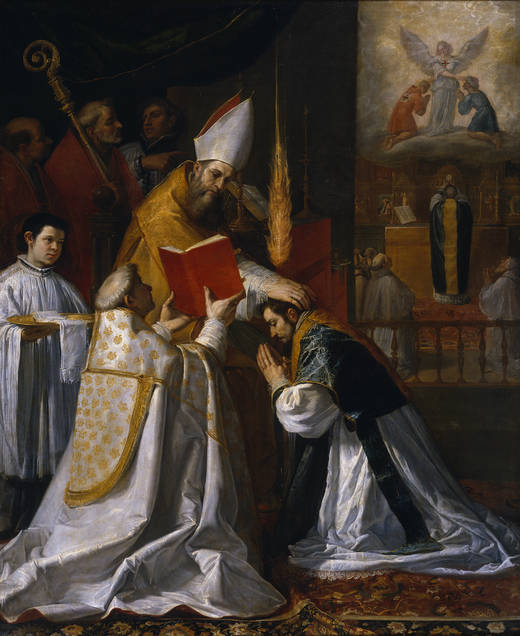
Ordination and First Mass of Saint John of Matha by Vincenzo CarducciTonight, as my diocese begins its annual governing convention in traditional fashion with a celebration of the Holy Eucharist, we will doing so in the context of an ordination – two ordinations, in fact, one to the diaconate and one to the presbyterate. This morning’s reading from Ben Sira is lengthy description of the glories of the ceremonial priesthood. One might have expected the church to have made this one of the potential readings for a presbyteral ordination, but in its wisdom, it has not.

My personal religious background is as the child of an inactive, not-quite-thoroughly-unchurched mixed marriage of a Disciple of Christ and a Methodist, the disinterested products of two decidedly American expressions of protestant evangelical Christianity. Until I was in high school my church attendance depended on which set of grandparents I was visiting; at home, church was out of the question. My grandparents’ churches were proudly non-ceremonial; the closest anyone came to wearing a vestment was the Methodist pastor’s doctoral gown.

In high school, I encountered the Episcopal Church in an Anglo-Catholic diocese. Bells, smells, chants, rich vesture . . . I knew I had come home! As I read the entire lesson today from Ecclesiasticus, I can almost remember every detail of that first encounter with the ritual of religion.

But the rubrics of the ordination service for a priest of the Episcopal Church do not permit or recommend Ben Sira’s soaring description of ceremonial liturgy and priestly elegance! Instead, we are given these choices from the Hebrew Scriptures:

  • Isaiah 6:1-8, in which the soon-to-be-commissioned prophet cries, “Woe is me! I am lost, for I am a man of unclean lips, and I live among a people of unclean lips,” and has his lips seared with a burning coal; or
  • Numbers 11:16-17,24-25, in which Moses is instructed to recruit seventy elders to “bear the burden of the people along with you so that you will not bear it all by yourself.”

And then there are the choices from the Psalter:

  • Psalm 43 in which we ask, “Why are you so full of heaviness, O my soul? and why are you so disquieted within me?” or
  • Psalm 132:8-19 in which we beg God “do not turn away the face of your Anointed.”

In the New Testament readings, Peter reminds us, “Do not lord it over those in your charge, but be examples to the flock” (1 Pt 5:3), a rather different vision than Ben Sira’s description of the magnificent Simon, son of Onias. Paul warns us through his words to the Ephesians to not “be children, tossed to and fro and blown about by every wind of doctrine, by people’s trickery, by their craftiness in deceitful scheming” (Eph 4:14), and in his admonition to the church in Philippi he instructs us, “Let your gentleness be known to everyone.” Again, a contrast to the picture of priesthood in this morning’s reading.

Don’t get me wrong! I love the ritual and the ceremonial. I love great vestments, incense, chant, trumpets, the clanging of bells – it’s all great show and great fun and adds to the experience of religion for me. But the priesthood is much, much more than all of that.

In my vesting sacristy hangs a simple frame with a printed copy of an address by an Englishman who was a bishop in Africa in the early years of the 20th Century. The Rt. Rev. Frank Weston, Bishop of Zanzibar, in his concluding address to the Anglo-Catholic Congress of 1923, finished with these words:

If you are Christians then your Jesus is one and the same: Jesus on the Throne of his glory, Jesus in the Blessed Sacrament, Jesus received into your hearts in Communion, Jesus with you mystically as you pray, and Jesus enthroned in the hearts and bodies of his brothers and sisters up and down this country. And it is folly – it is madness – to suppose that you can worship Jesus in the Sacraments and Jesus on the Throne of glory, when you are sweating him in the souls and bodies of his children. It cannot be done.

There then, as I conceive it, is your present duty; and I beg you, brethren, as you love the Lord Jesus, consider that it is at least possible that this is the new light that the Congress was to bring to us. You have got your Mass, you have got your Altar, you have begun to get your Tabernacle. Now go out into the highways and hedges where not even the Bishops will try to hinder you. Go out and look for Jesus in the ragged, in the naked, in the oppressed and sweated, in those who have lost hope, in those who are struggling to make good. Look for Jesus. And when you see him, gird yourselves with his towel and try to wash their feet.

Every time I put on my fine silk vestments from Whipple or Almy, the hand-made stoles and chasubles commissioned from private tailors, or the humble offerings created by members of the congregation, I read those words. The priesthood is not about Simon’s glorious robes and perfect splendor; it’s not about trumpets and thuribles and magnificent altars. That’s just the fun stuff we are privileged to enjoy. As the ordination readings and Bishop Weston remind us, priesthood is about serving God’s people in whom we find the living Jesus.

====================

A request to my readers: I’m trying to build the readership of this blog and I’d very much appreciate your help in doing so. If you find something here that is of value, please share it with others. If you are on Facebook, “like” the posts on your page so others can see them. If you are following me on Twitter, please “retweet” the notices of these meditations. If you have a blog of your own, please include mine in your links (a favor I will gladly reciprocate). Many thanks!

====================

Father Funston is the rector of St. Paul’s Episcopal Church, Medina, Ohio.
Stewardship Smiles – From the Daily Office – November 1, 2014

From Ecclesiasticus:

Be generous when you worship the Lord,
and do not stint the first fruits of your hands.
With every gift show a cheerful face,
and dedicate your tithe with gladness.
Give to the Most High as he has given to you,
and as generously as you can afford.

(From the Daily Office Lectionary – Sirach 35:10-12 (NRSV) – November 1, 2014)

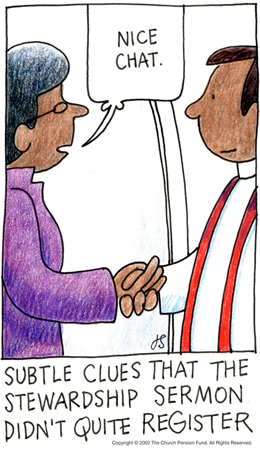
Stewardship Sermon by Jay SidebothamIt’s about to come to an end, the annual appeal to church members everywhere to turn in a card saying how much they plan (hope, anticipate, expect, guess) to give in offerings in the coming year. Clergy everywhere are breathing both a sigh of relief that “stewardship season” is nearly done, while also wondering if there will be enough income to sustain the parish’s budget for another year. Congregational governing boards, treasurers, and budget committees are poring over the books and making plans – in some parishes they are adding new programs and new staff; in most, I suspect, they are trying to cut “fat” out of budgets already cut to the bone. I would guess there are more frowns than smiles being generated in the process of annual church budgeting.

And the Daily Office lectionary gives us this, Ben Sira’s admonition to cheerfulness and gladness in connection with first-fruit offerings and tithes . . . .

In my “Rector’s Reflection” column in our parish newsletter this month, I made note of the annual campaign and its coincidence with Thanksgiving Day:

How exactly do we give thanks to God? Primarily, it is through our songs of praise, our prayers of thanksgiving, our participation in worship. Secondarily, it is through sharing the blessings we have received. Most of us, I’m sure, are familiar with the phrase “time, talent, and treasure.” Those three “buzzwords” have been a staple of annual parish pledge campaigns for decades. They underscore that stewardship (a word we mistakenly often apply only to sharing of wealth) is a life activity, not simply a financial activity. We share all that we have been given, including our time and the talents with which we are blessed, not simply a portion of our income. But this time of year we focus on that financial piece as the church begins the process of budgeting for the next fiscal year. I will be the first to admit that we should do a better job of teaching about whole-life stewardship the entire year ‘round.

Perhaps there would be more smiles and fewer frowns, less stinting and more generous giving if we did less annual fund raising and more year-round stewardship education in the church. Let’s give that try.

In any event, smile . . . whatever this year’s outcome, it’s about to come to an end.

====================

A request to my readers: I’m trying to build the readership of this blog and I’d very much appreciate your help in doing so. If you find something here that is of value, please share it with others. If you are on Facebook, “like” the posts on your page so others can see them. If you are following me on Twitter, please “retweet” the notices of these meditations. If you have a blog of your own, please include mine in your links (a favor I will gladly reciprocate). Many thanks!

====================

Father Funston is the rector of St. Paul’s Episcopal Church, Medina, Ohio.

Dreams of Samhain – From the Daily Office – October 31, 2014

From Ecclesiasticus:

The senseless have vain and false hopes,
and dreams give wings to fools.
As one who catches at a shadow and pursues the wind,
so is anyone who believes in dreams.

(From the Daily Office Lectionary – Sirach 34:1-2 (NRSV) – October 31, 2014)

Samhain IllustrationThe shadows tonight will be full of dreams moving from house to house, door to door, seeking handouts of candy or toys or whatever with a cry of “Trick or Treat!” We hope the wind will stay away, at least until America’s children’s annual celebration of the ancient Celtic feast of Samhain is completed.

As much as I like Ben Sira, I think he is too dismissive of dreams in this passage. He’s right to sound a note of caution against self-delusion (or buying into the fantasies and fallacies of others), but dreams are also the stuff of hope and aspiration. Young Joseph, son of Israel, became overseer of Egypt because of his ability to correctly interpret dreams. Another Joseph received the message that he would be foster-father to the Son of God in a dream. Dreams can be substantial!

So, parting company with Ben Sira, I say, “Believe in your dreams! Chase them!” Yesterday I wrote about using our imaginations and playing with metaphors to better understand the words of Scripture. Following our dreams is a further exercise of imagination. Imagination, as I see it, is our only way forward; without dreams and imagination we have no way to envision the future.

Forty-five years ago, when I was in college, I read a newly published book by Scottish anthropologist Victor Turner entitled The Ritual Process in which the author explored the idea of liminality, the experience of standing on a threshold leaving behind a known, accepted reality and entering into an as-yet-unknown, new reality. (I was reminded of that book this week when I found it cited in the footnotes of another, a text on the use of imagination in biblical exegesis and preaching.) That threshold is the place of shadows and wind; it can be a frightening place. To stand at that threshold demands that we dream and imagine; otherwise, we will never move through it.

Ben Sira is right, dreams give wings, not just to fools, but to everyone. Have the imagination and the courage to take those wings and fly! Fly through the threshold of shadow and wind into the unknown future.

I hope that is what the costumed children, the living dreams wandering the shadows tonight will do.

====================

A request to my readers: I’m trying to build the readership of this blog and I’d very much appreciate your help in doing so. If you find something here that is of value, please share it with others. If you are on Facebook, “like” the posts on your page so others can see them. If you are following me on Twitter, please “retweet” the notices of these meditations. If you have a blog of your own, please include mine in your links (a favor I will gladly reciprocate). Many thanks!

====================

Father Funston is the rector of St. Paul’s Episcopal Church, Medina, Ohio.

A Third Tongue – From the Daily Office – October 29, 2014

From Ecclesiasticus:

Slander has shaken many,
and scattered them from nation to nation;
it has destroyed strong cities,
and overturned the houses of the great.
Slander has driven virtuous women from their homes,
and deprived them of the fruit of their toil.
Those who pay heed to slander will not find rest,
nor will they settle down in peace.

(From the Daily Office Lectionary – Sirach 28:14-16 (NRSV) – October 29, 2014)

In law school I learned that slander is the spoken form of defamation; defamation in print is called libel. I doubt the translators of Ben Sira were making any such fine distinction; Ben Sira certainly does not. The Greek original reads, Glossa trite, meaning “a third tongue.” The British Greek scholar G.T. Emery translates this text not as “slander” but as “unrestrained talk of a third party,” which carries no particular suggestion of falsehood or defamation; gossip could be the subject, as well. In any event, our current preferred translation suggests some element of prevarication.

Which brings me to political advertising and clergy relocation . . . .

I don’t know if it’s still the case but several years ago, right after the Roman Catholic Church’s troubles with pedophilia and child sexual abuse perpetrated by clergy became big news, it became mandatory for Episcopal Church clergy seeking new callings to be background checked. One company in particular seemed to corner the market on these reviews and were used by nearly every diocese of the church; maybe they had a contract with the national hierarchy (I really don’t know). The covers of their reports had a box, a big red-flag check box, labeled something like “has been accused of sexual misconduct.” If that box was checked, it was unlikely the clergy person’s file would even be opened or looked at for a new position; their file would be tossed into the rejection stack without even a cursory review.

Note that the big red-flag check box’s label didn’t say “proven” or “shown” or “convicted” or anything of that nature, just “accused.” One unrestrained, possibly even untrue flap of “a third tongue” and one’s service as clergy was essentially done. I knew people who fell victim to slander of that sort. Accusations of misconduct are serious and should be looked into, but accusations are simply that – unproved assertions – and until proven they should be treated with great care.

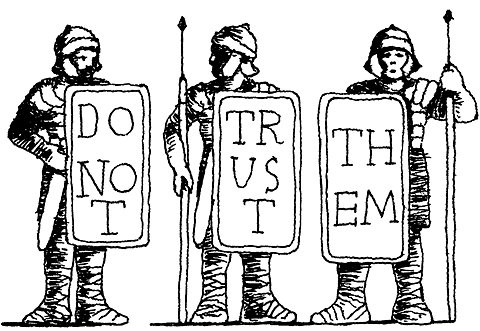
The same is true of political advertisements. Elections in our country have become a farce (in my humble opinion) because of political advertisements run without regard to truth or verification. Anonymous groups run overwhelmingly negative ads making suggestions about “the other side” which may or may not be grounded in fact. They are like great big red-flag check boxes labeled “is accused of inflammatory nonsense we don’t ever have to prove,” and that’s enough to sway the electorate.

Is this any way to run a church? Is this any way to run a country? Ben Sira would suggest otherwise – our “great houses” are apt to fall if we continue to do so. Possibly they have already fallen and we just haven’t noticed.

N.Y. Time Op-Ed illustration

====================

A request to my readers: I’m trying to build the readership of this blog and I’d very much appreciate your help in doing so. If you find something here that is of value, please share it with others. If you are on Facebook, “like” the posts on your page so others can see them. If you are following me on Twitter, please “retweet” the notices of these meditations. If you have a blog of your own, please include mine in your links (a favor I will gladly reciprocate). Many thanks!

====================

Father Funston is the rector of St. Paul’s Episcopal Church, Medina, Ohio.

Shut Up! – From the Daily Office – October 24, 2014

From Ecclesiasticus:

Do not find fault before you investigate; examine first, and then criticize. Do not answer before you listen, and do not interrupt when another is speaking.

(From the Daily Office Lectionary – Sirach 11:7-8 (NRSV) – October 24, 2014)

I should have taken a course on the Deutero-Canon when I was in seminary! Really! I’m just astounded at the amount of really good advice there is in this one book, The Wisdom of Jesus, Son of Sirach, the Liber Ecclesiasticus. Of course, there’s a lot of nonsense, too. You could build a good sermon on the “prosperity gospel” from some of the stuff here . . . but mostly there’s just good common sense.

Like these two verses. They remind me of things my parents said, things like “Get the facts” and “Shut up and listen” and “Don’t interrupt.” Good advice that people in our society seem to have forgotten.

Have you listened to any of the joint interviews that journalists sometimes try to conduct with representatives of opposing camps? I listened to one not long ago on NPR regarding the anti-abortion legislation passed in Texas that requires a pregnancy clinic’s physicians to have admitting privileges at a hospital within some specified distance. A representative of the so-called “right to lifers” and another from the so-called “pro-choice” side were both miked . . . and you couldn’t hear what either had to say because they were so busy trying to shout over each other. Neither would shut up and let the other get a word in edgewise.

My late brother was an avid sports fan (he writes in an apparent non-sequitur). He would get so wrapped up watching football and basketball games on television that he would forget where he was and who he was with. I recall one family Thanksgiving gathering when we were watching some game (between who in what sport I have no idea). My brother got so excited at one point he yelled at the top of his lungs, “Run, you son of a bitch! Move that fucking ball!” My mother was not pleased.

I do not get that excited about sports. I get that excited about politics. That’s why I don’t discuss it with friends and parishioners. That’s why I don’t attend election night poll-watching parties. I tend to cut loose with exactly the same sort of excited utterance to which my brother was prone while watching football.

When I heard the report on the Texas legislation, I was driving to a clergy conference — wearing a Roman collar. I was by myself, but it was a nice day and the window was down. The conversation (I use the term very loosely) started and soon the talking-over and the shouting-down began. At some point I became so annoyed with the interviewees that I yelled at them (well, at my car radio, actually), “Shut the fuck up!” I hope no pedestrian or passerby heard me.

But if they had, I now know that I could point to the Book of Sirach and assert very affirmatively that it is a biblical injunction. “Shut up!” even, perhaps, the more aggressive phrasing. It’s right there! Right here, in the 11th Chapter of Ecclesiasticus!

So, folks, want to prove to us that you pay attention to scripture? Want us to really believe that you follow its injunctions when you try to enforce them on the whole of society, on our friends and neighbors who don’t share our faith? Then pay attention to Jesus, Son of Sirach.

STFU Please

====================

A request to my readers: I’m trying to build the readership of this blog and I’d very much appreciate your help in doing so. If you find something here that is of value, please share it with others. If you are on Facebook, “like” the posts on your page so others can see them. If you are following me on Twitter, please “retweet” the notices of these meditations. If you have a blog of your own, please include mine in your links (a favor I will gladly reciprocate). Many thanks!

====================

Father Funston is the rector of St. Paul’s Episcopal Church, Medina, Ohio.

Alms? – From the Daily Office – October 22, 2014

From Ecclesiasticus:

Do not grow weary when you pray; do not neglect to give alms.

(From the Daily Office Lectionary – Sirach 7:10 (NRSV) – October 22, 2014)

“Do not neglect to give alms.” Alms: “charitable donations of money or goods to the poor or needy” says the dictionary with an etymological note saying it comes from an old Greek word, eleemosyne, meaning “pity, mercy.”

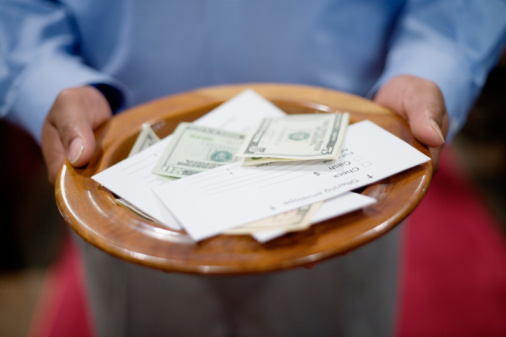
The fancy plates of wood or brass or silver passed down the rows of pews on Sunday morning are called “alms basins” by some. (Others call them “offering plates” or, worse, “collection plates.”) But they really aren’t for alms, are they? I know people want to believe that what they turn loose of in church is used for the benefit of the poor, but look at any church budget and ask “How much of this is used for relief of the poor?” The answer will surprise you.

Most of what is given to the church is used for upkeep of the institution. The two largest expenses for most congregations are (1) upkeep of aging, often-remodeled, energy-inefficient, and frequently under-utilized buildings and (2) paying for professional staff, clergy and lay. Is that the way it should be? As one dependent on the church for my paycheck, I benefit from the current arrangement, but I’m not at all sure that the church is managing the alms given by church members properly.

I offer no answer today; I simply raise the question.

Alms Basin

====================

A request to my readers: I’m trying to build the readership of this blog and I’d very much appreciate your help in doing so. If you find something here that is of value, please share it with others. If you are on Facebook, “like” the posts on your page so others can see them. If you are following me on Twitter, please “retweet” the notices of these meditations. If you have a blog of your own, please include mine in your links (a favor I will gladly reciprocate). Many thanks!

====================

Father Funston is the rector of St. Paul’s Episcopal Church, Medina, Ohio.

A Learning Experience – From the Daily Office – October 20, 2014

From the Psalter:

Who are they who fear the Lord?
he will teach them the way that they should choose.
They shall dwell in prosperity,
and their offspring shall inherit the land.

(From the Daily Office Lectionary – Psalm 25:11-12 (BCP Version) – October 20, 2014)

When my wife and I decided to join a pilgrimage group and spend several days in the Holy Land this summer several people who had been there before us said, “It will change the way your read Scripture.” That’s turned out to have been true. It also changed the way we read current news.

As I pondered that, I realized that every major life event affects the way we read Scripture, the way we interpret the news. Getting married did so. The births of our children did so. Ordination and ministry as a priest has done so. Every event is a learning experience which colors our view of the world.

Early yesterday morning our daughter-in-law gave birth to our first grandchild, a little girl who has been given the name Eirnín Marjory. Her first name is Irish Gaelic (pronounced “EHR-neen”) and means “knowing” or “experienced,” and also “iron” connoting strength of character. Her middle name was my later mother-in-law’s name.

We have yet to meet Eirnín (she and her parents live nearly half-way across the continent from us), but already her being a part of this world is changing the way I read Scripture. Words like “prosperity” and “offspring” have both a broader and a more immediate meaning.

Welcome to the world, little one! You’re sure to be a learning experience over and over again.

Eirnín Marjory

====================

A request to my readers: I’m trying to build the readership of this blog and I’d very much appreciate your help in doing so. If you find something here that is of value, please share it with others. If you are on Facebook, “like” the posts on your page so others can see them. If you are following me on Twitter, please “retweet” the notices of these meditations. If you have a blog of your own, please include mine in your links (a favor I will gladly reciprocate). Many thanks!

====================

Father Funston is the rector of St. Paul’s Episcopal Church, Medina, Ohio.

Frustration – From the Daily Office – October 18, 2014

From the Gospel of Luke:

“You faithless and perverse generation, how much longer must I be with you and bear with you?”

(From the Daily Office Lectionary – Luke 9:41 (NRSV) – October 18, 2014)

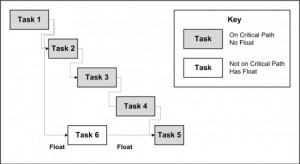
PERT ChartProject Evaluation Review Technique – “PERT” . . . . I learned to do PERT charts in business school. PERT charts diagram the flow of a project through its various tasks and processes, assigning some as “essential” tasks which must be done in a particular order, later tasks depending on earlier tasks to have been accomplished by particular persons, while other tasks “float,” they can be done any time by any team member.
I wonder sometimes if Jesus could have made use of one. What would he have put into the “essential task” boxes and what into the “floating task” boxes and what would have been the flow of activities and to whom would everything be assigned? If Jesus had made use of a PERT chart, I wonder if he would do with it what I eventually did with every one I tried to make for parish ministry . . . throw it away in frustration!

That was the eventual outcome of every parish project PERT chart because inevitably some essential task to be done by a volunteer would not get done; the entire enterprise would grind to a halt and either never be accomplished or only get done if the rector or another paid staff member did what the volunteer had promised to do.

I confess to possibly breaking the Third Commandment on a regular basis. I suppose I could have echoed Jesus’ words of frustration, “You faithless and perverse generation, how much longer must I be with you and bear with you?” However, more often than not, my prayer of weariness is a single word, “Jesus!” I try not to do that, but it just pops out. Stymied and upset, before I even think about it, I let loose, “Jesus!” My hope is that he understands this as a prayer rather than as an curse. (I once had a Jesuit spiritual director who opined that, uttered in exasperation, the ejaculation “O fuck!” may be the most honest of human prayers. I don’t use that one very often.)

In such instances, the PERT chart, now useless, ends up in the circular file cabinet. In fact, I’ve stopped making PERT charts for any project that requires volunteer labor. It’s just a waste of time.

Of course, the church is not a volunteer organization. The apostles were not volunteers – they were called. Christians, likewise, are not volunteers – we are called. “You did not choose me but I chose you.” (Jn 15:16) Jesus, the one who does the calling, probably has more claim to be frustrated that parish clergy like me, who are simply among the called . . . but there it is.

In any event, I hear the frustration in this text and, therefore, I trust that he understands when I utter my prayers of exasperation.

====================

A request to my readers: I’m trying to build the readership of this blog and I’d very much appreciate your help in doing so. If you find something here that is of value, please share it with others. If you are on Facebook, “like” the posts on your page so others can see them. If you are following me on Twitter, please “retweet” the notices of these meditations. If you have a blog of your own, please include mine in your links (a favor I will gladly reciprocate). Many thanks!

====================

Father Funston is the rector of St. Paul’s Episcopal Church, Medina, Ohio.

Clear Instructions – From the Daily Office – October 17, 2014

From the Gospel of Luke:

Then from the cloud came a voice that said, “This is my Son, my Chosen; listen to him!”

(From the Daily Office Lectionary – Luke 9:35 (NRSV) – October 17, 2014)

You couldn’t get clearer instructions, could you? “Listen to him!” So why don’t people?

I don’t mean people in general, I mean people who call themselves Christian. They pay attention to Leviticus and Deuteronomy. They pay attention to Paul. Why don’t they pay attention to Jesus?

Get their knickers all in a twist, for example, about gay and lesbian people and their relationships when Jesus had nothing at all to say about that — they pay attention to a couple of verses in Leviticus, a couple of verses in the letters of Paul, but do they listen when Jesus says to the woman guilty of adultery, “Neither do I condemn you. Go your way, and from now on do not sin again.” (Jn 8:11) That’s just about the only thing he had to say about anyone’s sexual relationships, “I don’t condemn you.” Why don’t they listen to him and do likewise?

Seems to me that Jesus boiled everything down to something just about as simple as the Father’s admonition. When asked which of the commandments was the greatest, he said: “The first is, ‘Hear, O Israel: the Lord our God, the Lord is one; you shall love the Lord your God with all your heart, and with all your soul, and with all your mind, and with all your strength.’ The second is this, ‘You shall love your neighbor as yourself.’ There is no other commandment greater than these.” (Mk 12:29-31) My diocese has summarized this on a bumper sticker:

Love God Bumper Sticker

You can’t get clearer instructions, can you? Listen to him!

====================

A request to my readers: I’m trying to build the readership of this blog and I’d very much appreciate your help in doing so. If you find something here that is of value, please share it with others. If you are on Facebook, “like” the posts on your page so others can see them. If you are following me on Twitter, please “retweet” the notices of these meditations. If you have a blog of your own, please include mine in your links (a favor I will gladly reciprocate). Many thanks!

====================

Father Funston is the rector of St. Paul’s Episcopal Church, Medina, Ohio.

Leftist? Rightist? – From the Daily Office – October 16, 2014

From the Gospel of Luke:

If any want to become my followers, let them deny themselves and take up their cross daily and follow me. For those who want to save their life will lose it, and those who lose their life for my sake will save it. What does it profit them if they gain the whole world, but lose or forfeit themselves? Those who are ashamed of me and of my words, of them the Son of Man will be ashamed when he comes in his glory and the glory of the Father and of the holy angels.

(From the Daily Office Lectionary – Luke 9:23-26 (NRSV) – October 16, 2014)

So ….

I left off writing these things publicly, but found that not writing them put a crimp in my spiritual life. I write them for my own spiritual well-being and if they are of assistance to anyone else that’s all well and good, too. I thought I was stressing out under the self-imposed pressure of writing one everyday, but I think now the stress was from trying to be “gentle” with my words so as not to offend anyone. However, since I now realize that I am writing them for myself, I don’t need to worry about that. If someone reads what I have to say and is offended by it, they can choose not to read another thing I write. That’s their responsibility, not mine. (Frankly, I think that’s part and parcel of the attitude demonstrated by Jesus in the last sentence of this selection. “I say what I say. If it resonates, follow me. If not, we part company.”)

OK . . . introductory remarks done with . . . this morning someone in an internet discussion group did the drama-queen leaving act. “TEC [the stupid current trendy abbreviation for the Episcopal Church] and this group have veered too far left, so I’m leaving.” You could hear the door slam as they left (and picture them standing outside with their ear pressed to it listening for the reaction).

What do people mean when they apply the terms “Left” or “Right” to the church? Do people even know what those terms mean, period?

These terms are political terms translated into British and American politics from the French Revolution of 1789 during which members of the National Assembly divided themselves by where they sat in the chamber, supporters of the king to the president’s right, supporters of the revolution to his left. They were first introduced into British politics in the 1930s to label politicians according to their position on the Spanish Civil War — those who supported Franco’s Nationalists were “the Right,” those who supported the Republicans were “the Left.” From Britain, these terms made their way into American political discourse, but what they actually mean in the political arena today is pretty muddled.

Which means, of course, that when they are applied to the church they basically mean nothing! Or, rather, they mean “the church is doing that with which I disagree.” For example, when someone opens the distribution of Holy Communion to the non-baptized (something I disagree with, by the way), is that a “Leftist” or a “Rightist” thing to do? I don’t really know; I suspect that, depending on what one thinks those terms mean, one can construct an argument for the application of either one.

What a ridiculous waste of time!

When judging a church denomination, parish, diocese, organization, ministry, whatever . . . isn’t the question not whether it is “Leftist” or “Rightist” but whether it embodies and follows the gospel? Whether it and those people who claim membership or activity within it have denied themselves and taken up their cross and followed Jesus? And when we make that discernment, exercise that judgment, aren’t we called to do so with the greatest possible amount of charity, allowing the possibility that others may perceive the gospel mandate differently from ourselves? “Faith, hope, and love abide, these three; and the greatest of these is love.” (1 Cor. 13;13) That’s neither “Leftist” nor “Rightist” in my thinking.

Here’s my final thought on this subject . . . OK, it’s not my final thought; I’ll probably have more to say or write at some other time . . . but for now, it’s the concluding bit of what I’m writing today.

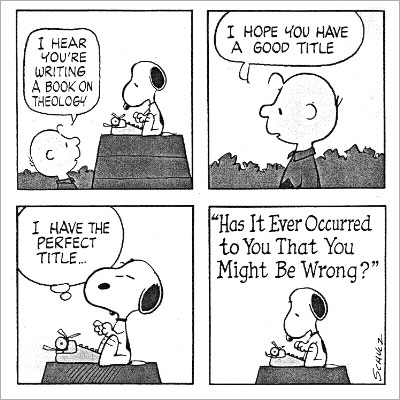
Any time I am tempted to label someone else in the church or some church group or some theological or ministerial activity, to say “That’s Leftist” or “That’s Rightist,” I remind myself of the question asked by one of America’s best popular theologians, the late cartoonist Charles Schultz speaking through the character of Snoopy:

You Might Be Wrong

Keeping that in mind, my hope is that Christ will not be ashamed of me.

====================

A request to my readers: I’m trying to build the readership of this blog and I’d very much appreciate your help in doing so. If you find something here that is of value, please share it with others. If you are on Facebook, “like” the posts on your page so others can see them. If you are following me on Twitter, please “retweet” the notices of these meditations. If you have a blog of your own, please include mine in your links (a favor I will gladly reciprocate). Many thanks!

====================

Father Funston is the rector of St. Paul’s Episcopal Church, Medina, Ohio.

« Older posts Newer posts »