Occasional thoughts of an Anglican Episcopal priest

Category: Ministry (Page 36 of 59)

Living With Integrity – Sermon for the Seventh Sunday after Epiphany (Year A) – February 23, 2014

====================

This sermon was preached on the Seventh Sunday after Epiphany, February 23, 2014, at St. Paul’s Episcopal Church, Medina, Ohio, where Fr. Funston is rector.

(The lessons for the day were: Leviticus 19:1-2,9-18; Psalm 119:33-40; 1 Corinthians 3:10-11,16-23; and Matthew 5:38-48. These lessons can be read at The Lectionary Page.)

====================

Integrity Venn DiagramJesus doesn’t ask much, does he? Only perfection! “Be perfect,” he tells us, “as your heavenly Father is perfect.” Of course, Jesus is simply echoing the words Moses spoke on God’s behalf delivering the Law to the Hebrews: “You shall be holy, for I the Lord your God am holy.” What can this mean? How can we be expected to be perfect and holy like God? How can we do that, especially when both Moses and Jesus insist that that means, among other things, loving our enemies, not seeking redress, not holding a grudge, and not getting that to which we are sure we are entitled?

Let’s first be certain that we know what we’re talking about! Let’s remember that these English words are translations of ancient Hebrew and biblical Greek, and that there may be connotations and nuances in those older languages that the English interpretations obscure.

The Hebrew in our reading from Leviticus is qadowsh and is derived from a root word meaning “set apart” (qadash). This, of course, was the purpose of the Law which God, through Moses, was giving to the Hebrews: it was to set them apart from other nations, other peoples. They were to be consecrated to God as a “holy nation” – a nation separated from the rest of humankind for a God’s special purposes.

God, through Moses and then repeatedly through the prophets, makes it clear that this does not mean that they are in any way better than other nations; they are simply different in that they will be used by God to accomplish God’s purposes. The prophet Amos, for example, reminded the Israelites that God had relationships with other nations: “Are you not like the Ethiopians to me, O people of Israel? says the Lord. Did I not bring Israel up from the land of Egypt, and the Philistines from Caphtor, and the Arameans from Kir?” (Amos 9:7)

The modern Orthodox Jewish view is that God chooses and sets apart many nations for differing purposes. The former Chief Rabbi of Great Britain, Immanuel Jakobovits, expressed it this way:

I believe that every people—and indeed, in a more limited way, every individual—is “chosen” or destined for some distinct purpose in advancing the designs of Providence. Only, some fulfill their mission and others do not. Maybe the Greeks were chosen for their unique contributions to art and philosophy, the Romans for their pioneering services in law and government, the British for bringing parliamentary rule into the world, and the Americans for piloting democracy in a pluralistic society. The Jews were chosen by God to be “peculiar unto Me” as the pioneers of religion and morality; that was and is their national purpose. (Commentary Magazine, August, 1966)

So this is what “holiness” means in our reading from Leviticus – to be set apart for God’s use in a particular way. It does not mean that the ancient Jews, nor we as the grafted-on “new Israel,” are expected to be God-like or sacred (whatever that means) or divine or particularly righteous or pure. It means, rather, that we are to be prepared, like a tool is prepared, to be used for God’s purposes.

In echoing Moses, however, Jesus chose to use another word, the word perfect. In the koine Greek of the New Testament, the word is teleios which signifies wholeness and completion, something brought to its intended end; it derives from a word meaning “the end” (telos) which carries with it a nuanced suggestion of a goal or a purpose. It is not identical to the Hebrew word used by Moses, but it carries much of the same implications. Jesus is not admonishing his hearers, then or now, to some sort of moral perfectionism, but rather to becoming what God has intended, to accomplishing one’s God-given purpose.

And so the question for us in response both to Leviticus and to Matthew’s Gospel is, “How do we do this? How can we be holy as God is holy? How can we be perfect as the Father is perfect?” We find the answer close at hand both in God’s giving of the Law and in Christ’s Sermon on the Mount.

The Levitical admonition to holiness is followed by several exemplary commandments, none of which are particularly religious! Leave something in your fields for the hungry to glean. Don’t lie to one another. Don’t defraud one another. Don’t steal from each other. Don’t mistreat the handicapped. Don’t be partial in your judgments. Don’t hate anyone or seek vengeance or even bear a grudge. That’s what holiness is; that’s what being set apart for God’s purposes is.

In the section of the Sermon on the Mount in today’s Gospel, Jesus continues with the rhetorical form he began in last week’s Gospel reading, the antitheses in which he contrasts the Law with his own teaching: “You have heard it said . . . but I say to you . . . .” You have heard the rule of justice, “an eye for an eye,” but I say to you, “Don’t insist on it. In fact, offer more. If you’re struck on one cheek, offer the other. If someone takes your cloak, give them your shirt, too. If you are pressed into service to carry a burden, carry it twice the distance.” You have heard it said, “Love your neighbor and hate your enemy” . . . . (Now, that one puzzles the scholars because although the Law does say, “You shall love your neighbor as yourself,” there is no commandment to hate one’s enemy. There are plenty of Old Testament examples of hating one’s enemy, but no commandment along those lines. In any event . . . .) You have heard it said, “Love your neighbor and hate your enemy,” but I say to you, “Love your enemies and pray for those who persecute you.” Why? Because God sends rain on the righteous and the unrighteous alike; God gives sunshine to both the good and the evil. God treats everyone impartially – and so should you. God is good to everyone impartially – and so should you be. That’s what it means to be perfect, to be whole and complete and living according to God’s purposes.

Another word for this is integrity. Integrity is that sort of wholeness that we experience or perceive in someone when their life is integrated – when who they are matches what they do. And more than that it’s that wholeness that we sense when a person not only “practices what they preach,” but when it all seems to flow from the very core of their being, when their preaching and their practice all seem to be in accord with God’s purpose for them. When we meet such a person, say for example Jesus, we know that they have no trouble forgiving their enemies and praying for their persecutors, don’t we? We’re sure of it!

So, how do we live an integrated life? How do we live with integrity? It’s really easy for a preacher to stand here and tell you to do that by imitating Christ, by living out God’s generous and unrestricted grace, mercy and love in all your relationships, with friend and foe alike. But that just begs the question! That’s just saying, “Live with integrity by living with integrity” and it’s not fair for a preacher to do that because we all know that there are times when being gracious and merciful and loving just isn’t all that easy, such as those times when we are called to love our enemies and those who do us wrong.

Frederick Buechner, the great Presbyterian story teller, wrote about this in his book Whistling in the Dark in an essay entitled Enemy:

Cain hated Abel for standing higher in God’s esteem than he felt he himself did, so he killed him. King Saul hated David for stealing the hearts of the people with his winning ways and tried to kill him every chance he got. Saul of Tarsus hated the followers of Jesus because he thought they were blasphemers and heretics and made a career of rounding them up so they could be stoned to death like Stephen. By and large most of us don’t have enemies like that anymore, and in a way it’s a pity.

It would be pleasant to think it’s because we’re more civilized nowadays, but maybe it’s only because we’re less honest, open, brave. We tend to avoid fiery outbursts for fear of what they may touch off both in ourselves and the ones we burst out at. We smolder instead. If people hurt us or cheat us or stand for things we abominate, we’re less apt to bear arms against them than to bear grudges. We stay out of their way. When we declare war, it is mostly submarine warfare, and since our attacks are beneath the surface, it may be years before we know fully the damage we have either given or sustained.

Jesus says we are to love our enemies and pray for them, meaning love not in an emotional sense but in the sense of willing their good, which is the sense in which we love ourselves. It is a tall order even so. African Americans love white supremacists? The longtime employee who is laid off just before he qualifies for retirement with a pension love the people who call him in to break the news? The mother of the molested child love the molester? But when you see as clearly as that who your enemies are, at least you see your enemies clearly too.

You see the lines in their faces and the way they walk when they’re tired. You see who their husbands and wives are, maybe. You see where they’re vulnerable. You see where they’re scared. Seeing what is hateful about them, you may catch a glimpse also of where the hatefulness comes from. Seeing the hurt they cause you, you may see also the hurt they cause themselves. You’re still light-years away from loving them, to be sure, but at least you see how they are human even as you are human, and that is at least a step in the right direction. It’s possible that you may even get to where you can pray for them a little, if only that God forgive them because you yourself can’t, but any prayer for them at all is a major breakthrough.

In the long run, it may be easier to love the ones we look in the eye and hate, the enemies, than the ones whom—because we’re as afraid of ourselves as we are of them—we choose not to look at, at all.

“Pray for them a little, if only that God forgive them because you yourself can’t . . . .”

When I read those words I was reminded of an incident in my own life which I’m pretty sure I have told here before. Back when I was a practicing attorney defending doctors and dentists in malpractice cases, I had occasion to defend a maxillofacial surgeon whose hobby was sculpting. One of the pieces he showed me was a crucifix on which the face of Jesus was contorted in extreme rage. When I asked him what that was all about, he asked if I remembered Jesus’ words in the Gospel according to Luke: “Father, forgive them; for they do not know what they are doing.” (Luke 23:34) He said he’d never heard those words as expressing forgiveness on Jesus’ part. Quite to the contrary, he said, he heard Jesus saying, “You forgive them, because right now, I can’t!”

Jesus was put in that place on that cross because he was holy – set apart for God’s particular purpose. Jesus was put in that place on that cross because he was perfect – he had a goal, a purpose, to be good, to live according to the law of love, to demonstrate God’s love for all humankind. If he was truly to live that life, to show that love, his integrity required that he do and say the things that put him in that place on that cross. But if my dentist client was correct (and I think he may have been), the best that even he could do in all his holiness, in all his perfection, in all his integrity, was turn forgiveness over to God; on his own on that cross, Jesus couldn’t do it.

And there is the answer to our question: How do we live with integrity? How can we be holy and perfect? Well, it’s what I suggested earlier, by imitating Christ, and that means by turning things over to God. On his own on that cross, Jesus couldn’t do it; on our own, we cannot do it. The Psalmist put it this way:

There is no king that can be saved by a mighty army; *
a strong man is not delivered by his great strength.
The horse is a vain hope for deliverance; *
for all its strength it cannot save. (Ps. 33:16-17; BCP version)

and again

Though my flesh and my heart should waste away, *
God is the strength of my heart and my portion for ever. (Ps. 73:26)

In our human weakness, we may be (we probably are) unable to not hate anyone, unable to eschew vengeance, unable to let go of our grudges. We may be (we probably are) unable to love our enemies or to pray for those who persecute us. But that’s OK. Because if the best we can do is pray, “God, you forgive them, because right now, I can’t!” that will be enough.

Let us pray:

O God, the Father of all, whose Son commanded us to love our enemies: Lead them and us from prejudice to truth: deliver them and us from hatred, cruelty, and revenge; and in your good time enable us all to stand reconciled before you, through Jesus Christ our Lord. Amen. (BCP 1979, page 816)

====================

A request to my readers: I’m trying to build the readership of this blog and I’d very much appreciate your help in doing so. If you find something here that is of value, please share it with others. If you are on Facebook, “like” the posts on your page so others can see them. If you are following me on Twitter, please “retweet” the notices of these meditations. If you have a blog of your own, please include mine in your links (a favor I will gladly reciprocate). Many thanks!

====================

Father Funston is the rector of St. Paul’s Episcopal Church, Medina, Ohio.

The Issue – From the Daily Office – February 22, 2014

From the First Letter of John:

How does God’s love abide in anyone who has the world’s goods and sees a brother or sister in need and yet refuses help?

(From the Daily Office Lectionary – 1 John 3:17 (NRSV) – February 22, 2014.)

Feet of the PoorThis, for me, is the issue of our day. It is the religious issue. It is the economic issue. It is the political issue. It is the moral issue. I think the answer to John’s question is, “It doesn’t.”

And anyone who claims to be Christian and yet supports policies that do not help those in need is not, in fact, a Christian.

Nor is such a person a moral or ethical person.

I cannot say anything more than that.

====================

A request to my readers: I’m trying to build the readership of this blog and I’d very much appreciate your help in doing so. If you find something here that is of value, please share it with others. If you are on Facebook, “like” the posts on your page so others can see them. If you are following me on Twitter, please “retweet” the notices of these meditations. If you have a blog of your own, please include mine in your links (a favor I will gladly reciprocate). Many thanks!

====================

Father Funston is the rector of St. Paul’s Episcopal Church, Medina, Ohio.

Choose Life! L’Chaim – Sermon for the 6th Sunday after Epiphany – February 16, 2014

====================

This sermon was preached on the Sixth Sunday after Epiphany, February 16, 2014, at St. Paul’s Episcopal Church, Medina, Ohio, where Fr. Funston is rector.

(The lessons for the day were: Deuteronomy 30:15-20; Ecclesiasticus 15:15-20 (used as the gradual); 1 Corinthians 3:1-9; and Matthew 5:21-37. These lessons can be read at The Lectionary Page.)

====================

Alphabet ChartAs I have mentioned here more than a couple of times, I went to high school at a boarding school in the middle of nowhere . . . a place called Kansas. At the time, my family was living in Southern California in the San Fernando Valley area of Los Angeles, so I was very far from home. Truth be told, nearly all of us in the cadet corps of St. John’s Military School in Salina were far from home; there were very few Kansans in the student body.

The dormitory at the school was called “the barracks” but, in truth, it wasn’t barracks-style living with everyone sharing one big room. We had discrete two-, three-, or four-bed rooms; there were also single rooms, but those were reserved to the highest ranking officers of the cadet battalion. At the end of each year, you could request a particular room for the next school year. Each size of room had its particular advantages; the four-bed rooms were newer, had better study carrels, nicer beds, and larger closets. So at the end of my first year, I requested a four-person room for the coming year.

You could also request particular roommates but that didn’t always work out. It usually would if it was just two people agreeing to share a two-bed room, but even then you couldn’t be guaranteed a roommate. I really didn’t care, so I just asked for the size of room I wanted and trusted to the luck of the draw for my roommates.

We got notice in late July what our room assignments were and who are roommates would be. As it turned out, two other continuing students with whom I was good friends got assigned to the same room, as did a new kid. I think they may have assigned him to room with me because, like me, he was from Southern California — San Diego, to be exact.

So I get this notice and it tells me that my roommates will be the two guys I knew and someone named “Joseph Joachim __________.” Well, with a name like that I was pretty certain that he was going to turn out to be Roman Catholic and Latino, specifically, since he was from San Diego, I figured he’d be a Mexican-American. So in August, when I reported to school, I was expecting to meet someone with brown skin and dark hair, and probably smaller than me. (This is an object lesson in never forming expectations based solely on someone’s name!)

What I encountered, instead, was a young man who stood about 6′ 2″ and towered over me! Plus, he had flaming red hair and a face full of freckles. He looked as Irish as Brian Boru! And turned out to be Jewish.

We became good friends and through that friendship, I had my first introduction to Judaism. Jojo (that was his nickname, Joseph Joachim shortened to “Jojo”) took me with him to a Chanukah party at one of the local — actually, I think, the only synagogue in Salina, Kansas, and it was there, also, that I experienced a Passover Seder for the first time. It was also because of my friendship with Jojo that I first experienced a traditional Jewish wedding.

I was attending college in San Diego, Jojo’s hometown. Jojo, though a year behind me in high school, had graduated from college before me, and shortly after completing his degree decided to get married. He invited me to be a part of that celebration and I accepted. One of the traditions of a Jewish wedding (as in every wedding) is the offering of toasts and one frequently given is the Hebrew salutation, “L’chaim!” — “To Life!” It is a wish for a person’s, or in this case the couple’s, health and well-being.

Jojo’s father was the first to offer the toast. I was standing beside him as he did so, and I may have been the only person to hear a muttered after-thought that he spoke when giving the toast. He said the usual few words about how proud and happy he was, loudly proclaimed “L’chaim!” and then muttered, “And don’t screw it up.”

That is precisely what Moses is saying to the people of the Hebrews today in our reading from the Old Testament: “L’Chaim! – And don’t screw it up!”

Remember where we are in this reading. The Book of Deuteronomy is supposed to be the farewell address from Moses to the people he has led across the desert for forty years. The first generation that had left Egypt has died off — you may remember that they angered God with their stiff-necked whining so God had sworn that none of them could enter the Promised Land, even Moses! God has promised Moses, however, that he would be able to see Canaan, even though he couldn’t go in.

So in Deuteronomy, we are standing on a high hill looking over the border into Canaan-land and Moses is reminding the Hebrews of their past. In a series of three discourses, Moses reminds them of their time of slavery in Egypt, of their liberation at the Passover, of their trek through the desert, and of God’s giving of the Law at Sinai. He has recounted the Ten Commandments and the rest of 613 mitzvot required in the Torah. And he is now, in the third discourse, consigning the Hebrews to the leadership of his assistant, Joshua the son of Nun, and encouraging them to success in the land God is giving them.

In the portion that was read this morning he says to them, “I am laying before you a choice between life and death. Choose life.” And then he tells them that doing so successfully is really a very simple thing; there are only three elements, three things that have to be done. There may be ten major commandments and 613 little rules and regulations, but really there are only three things that are required for them to live a good life in the land God is giving them: love God, obey God, and be faithful. He underscores this by saying it twice in this short passage: “If you obey the commandments of the Lord your God that I am commanding you today, by loving the Lord your God, walking in his ways, and observing his commandments, decrees, and ordinances, then you shall live . . . .” (v. 16) and again “Choose life so that you and your descendants may live, loving the Lord your God, obeying him, and holding fast to him . . . .” (vv. 19b-20) Love God, obey God, and be faithful. Choose life!

Or as Jojo’s father put it, “L’Chaim! And don’t screw it up!”

In our epistle lesson, Paul is writing to the Christians in Corinth. He’s gotten word that they are screwing it up! The church he planted there has become split; there is conflict; people are following different practices and different teachings, dividing themselves according to whomever they were converted or baptized or taught by. “It has been reported to me by Chloe’s people,” he says in the beginning of this letter, “that there are quarrels among you.” (1 Cor. 1:11) The followers of Apollos were at odds with followers of Paul and both were at odds with the followers of Cephas.

In correcting them, Paul basically tells them that they are acting like children! He reminds them that in proclaiming the Gospel to them he spoke to them as if they were children: “I could not speak to you as spiritual people, but rather as people of the flesh, as infants in Christ. I fed you with milk, not solid food, for you were not ready for solid food. Even now you are still not ready . . . . (1 Cor. 3:1-2)

Paul made the same point about religion, really about maturity in religion, in his letter to the Galatians when he spoke of the Jewish law (the Torah, the same law of ten major commandments and 613 mitzvot about which Moses had spoken to the Hebrews on that hill overlooking Canaan) as a “disciplinarian”:

Before faith came, we were imprisoned and guarded under the law until faith would be revealed. Therefore the law was our disciplinarian until Christ came, so that we might be justified by faith. But now that faith has come, we are no longer subject to a disciplinarian, for in Christ Jesus you are all children of God through faith. (Gal. 3:23-26)

The actual Greek word is paidagogos which is more accurately translated as “tutor” or “schoolmaster.” It is the word from which we get pedagogy.

Traceable Letter AAs I thought about this image of learning, this metaphor of the Law as schoolmaster, I thought about the way we all learn to write, by first learning to letter (or “print” as some people call it). I’m sure we all started in the same way, with those workbooks with very wide ruled lines, maybe 1/2 inch? And there were dashed lines over which we traced with our pencils. We started with the straight-line letters . . . I . . . then added a crossbar at the top . . . T . . . or a bar at the bottom . . . L . . . then two bars . . . F . . . and so on. Eventually, when we had mastered the straight lines, we learned to make diagonals . . . X . . . and . . . Z . . . and then . . . Y And after that came the curved letters . . . O . . . then . . . C . . . then . . . S. And I remember that . . . Q . . . was last because it had that little squiggly addition.

What was the point of that? Were we learning to trace dashed lines? Not really. The rule was to trace the dashed line, but what we were learning was lettering, writing, and really not even that . . . what we were learning was a means of communication! The point was not to trace dashed lines; the point was to communicate.

As I thought about that further, I remembered my grandfather Funston. I’ve mentioned him a time or two and told you how I spent my childhood summers with my grandparents. My grandfather, when I knew him, was an insurance salesman, the owner of the Funston Insurance Agency on Fourth Street in Winfield, Kansas (another part of the middle of nowhere). But earlier in life, before he “retired,” he was a school teacher, and he had been a certified Palmer method penmanship instructor. So one of the “fun” things his grandchildren got to do during their summer vacations was learn to write in cursive. Does anybody do that anymore? Write what we used to call “long-hand”? Email begat texting and texting begat tweeting and it seems no one writes notes or letters in beautiful flowing script anymore. But my grandfather made sure that my cousins and I learned to write that way!

There was one sentence that we practiced over and over. Later, in high school at St. John’s Military School, when I learned to type from a retired baseball player named “Lefty” Loy, I encountered that sentence again. And when my mother and I bought my first typewriter for college, we used that sentence to test the key action — and still to this day when I test computer keyboards I type out that same sentence. It’s one that I am sure is familiar to many if not most of you: “The quick brown fox jumps over the lazy white dog.” An English sentence containing every letter of the Latin alphabet.

The quick brown fox . . . .

Writing that sentence again and again, typing it over and over, was I learning about brown foxes or white dogs? No! The rule was to write or type the sentence, but the goal was to learn yet another means of written communication. The dashed lines in the workbook, the constant repetition of that sentence were training us in an underlying principle. In Paul’s words, they served as a schoolmaster until we had internalized the lessons. The Law of Moses, the Ten Commandments, the 613 mitzvot, served as schoolmaster until the Hebrews had (as Moses said) learned to love God, obey God, and be faithful. Until they had learned to choose life.

But over time, the rules and regulations, the commandments, the laws, and the ordinances had become more important than those underlying principles. They screwed it up! So that the tracing of the dashed lines was more important than the communication. Then, through God’s grace, Jesus came “so that we might be justified by faith,” so that we might be set free from a disciplinarian, from a schoolmaster which had become more important the lessons the schoolmaster was supposed to teach.

In our Gospel lesson, Jesus is on a hillside beside the Sea of Galilee delivering what we have come to know as “The Sermon on the Mount.” And here in this section we hear a part of what are known as “the antitheses” in which Jesus deals with this very issue. He takes apart the Torah and shows that beneath its specific rules is an underlying principle by dealing with several of the commandments in this fashion: “You have heard it said . . . . but I say to you.” You have heard the rule, but I tell you something more basic, something that is the foundation of the rule.

For example, he begins with the commandment, “You have heard that it was said to those of ancient times, `You shall not murder’; and `whoever murders shall be liable to judgment.'” (v. 21) So, why do people commit murder? The last time you murdered someone, why did you do it? Statistically, we know that most murders are committed in what the law calls “the heat of passion.” In other words, people mostly kill other people because they’re angry! They’re mad as hell and lose control. So Jesus says, “But I say to you that if you are angry with a brother or sister, you will be liable to judgment.” And he continues to say that if you act on that anger in any way you will be liable to damnation. It isn’t the rule against murder that is, in and of itself, important; it is the underlying principle of not losing control to anger. The commandment is a schoolmaster; the commandment is a dashed line; the commandment is a repetitive sentence teaching us the foundational lesson to control our passions. And so Jesus continues with the commandment against adultery and its relationship to foundational issue of lust and covetousness, and with the commandment against false swearing and its relationship to the foundational issue of honesty. And so it goes for all of the Ten Commandments and all of the 613 mitzvot. And the foundational principle for the whole of the Torah is what Moses taught on the hill overlooking Canaan: Love — love God, obey God, be faithful — choose life.

You recall that Jesus was once asked what the greatest commandment was and you remember how he answered: the greatest commandment is this, “Love the Lord your God with all your heart, with all your mind, and with all your strength.” And, he added, there is a second, “Love your neighbor as yourself.” In so answering, Jesus was not declaring anything new; his answer was straight up traditional rabbinic teaching.

There is a story about a rabbi contemporary to Jesus, Rabbi Hillel, the leader of one of the influential schools of Judaism at the time. A story related in the Jewish Talmud tells about a gentile who was curious about Judaism. This man challenged Hillel to explain Jewish law while he (the gentile) stood on one foot. Accepting the challenge, Hillel said: “What is hateful to you, do not do to your neighbor. That is the whole Torah; the rest is commentary. Now, go and read it!”

Jesus and Hillel, good First Century rabbis, were simply saying what Moses had said to the people of the Hebrews standing on that hill looking into Canaan-land so many centuries before. There are a lot of commandments, a lot of rules, a lot of ordinances . . . but they are simply schoolmasters, disciplinarians teaching an underlying, foundational principle: Love God, obey God, be faithful. To do this is to choose life; to do anything else is to choose death.

Choose life!

L’Chaim! And don’t screw it up!

Amen.

====================

A request to my readers: I’m trying to build the readership of this blog and I’d very much appreciate your help in doing so. If you find something here that is of value, please share it with others. If you are on Facebook, “like” the posts on your page so others can see them. If you are following me on Twitter, please “retweet” the notices of these meditations. If you have a blog of your own, please include mine in your links (a favor I will gladly reciprocate). Many thanks!

====================

Father Funston is the rector of St. Paul’s Episcopal Church, Medina, Ohio.
Dancin’ Already – From the Daily Office – February 12, 2014

From the Letter to the Romans:

For as in one body we have many members, and not all the members have the same function, so we, who are many, are one body in Christ, and individually we are members one of another.

(From the Daily Office Lectionary – Romans 12:4-5 (NRSV) – February 12, 2014.)

Fred Astaire and Ginger Rogers in Flying Down to RioPaul’s use of the “body” metaphor is so well known it’s almost a cliché, but it was brought into clear focus by an article published (apparently) nearly a year ago by the blog Viral Christ, but brought to light on Facebook the past couple of weeks.

In a nutshell, the story is that he shared with his class this quotation: “Christianity started in Palestine as a fellowship; it moved to Greece and became a philosophy; it moved to Italy and became an institution; it moved to Europe and became a culture; it came to America and became an enterprise.” He added, by way of explanation, that “an enterprise” here means “a business.” One young woman in the class then commented, “A business? But isn’t it supposed to be a body?” Prompted, she continued, “But when a body becomes a business, isn’t that a prostitute?” The professor, in his article, remarked, “There is only one answer to her question. The answer is ‘Yes.'”

I immediately thought of the comment made by Dorothy Day, the Roman Catholic social justice advocate, who wrote, “As to the Church, where else shall we go, except to the Bride of Christ, one flesh with Christ? Though she is a harlot at times, she is our Mother.” I was reminded also of the line spoken by actor Harold Gould, playing Salvadoran aristocrat Francisco Galedo in the biographical movie Romero; blaming the church for violent uprisings in El Salvador he mocks the archbishop, “The Church is a whore who will spread her legs to the highest bidder.”

So although the author of the article seemed shocked by his student’s suggestion, it wasn’t all that original. Nonetheless, his essay has sparked dialog among church folk. Several of my clergy colleagues on Facebook have been discussing the piece and in one such conversation, a colleague took issue with the professor’s blanket affirmation of his student’s comment. “No,” she said, “not necessarily. A body that becomes a business can also be a professional athlete, a dancer, a model, or a number of other things. The leap to prostitute as the only way in which a body can become a business is just that, a leap.”

Thank you, I said, bravo! She’s absolutely right. Body-to-business doesn’t necessarily imply prostitution; the alternatives she suggests, and many others, provide more positive metaphors for our consideration. And even if we decline to accept the shorthand history of Christian religious development from ancient Near Eastern fellowship to modern North American business offered by the professor, these metaphors provide instructive insight into Paul’s initial metaphor of church-as-body.

Paul’s point in using the metaphor was to illustrate how all who are members of the church have need of one another even though all are not of equal social standing or equal ability, or called to equal ministries: “The eye cannot say to the hand, ‘I have no need of you,’ nor again the head to the feet, ‘I have no need of you.'” (1 Cor. 12:21) But my friend’s objection to the prostitute metaphor is a reminder that bodies are more than the sum of their parts, and that bodies need things and do things. That, in turn, should speak volumes about the church. The church, like any body (but especially if the church is a professional athlete or a dancer), needs nourishment; it needs exercise; it needs rest; sometimes it needs treatment of injuries or diseases.

If we understand the church as a body, not just as a metaphor for the connection of the members one to another, but as a body that needs the same care and attention that our own physical bodies need, how would that change the way we “run the church”? How would that change the way we deal with issues, conflicts, and challenges within the church? How would that change the way we encourage and promote stewardship?

I intend to work on this some more, and work this broader, more holistic understanding of the body metaphor into my theology, into my preaching, and into my ministry of church leadership. The church as dancer, in particular, is an image that appeals to me. Church as Isadora Duncan, church as Nureyev, church as Fred and Ginger, church as Gene Kelly . . . We’re dancin’ already!

====================

A request to my readers: I’m trying to build the readership of this blog and I’d very much appreciate your help in doing so. If you find something here that is of value, please share it with others. If you are on Facebook, “like” the posts on your page so others can see them. If you are following me on Twitter, please “retweet” the notices of these meditations. If you have a blog of your own, please include mine in your links (a favor I will gladly reciprocate). Many thanks!

====================

Father Funston is the rector of St. Paul’s Episcopal Church, Medina, Ohio.

Miss the Mark? – From the Daily Office – February 11, 2014

From the Gospel of John:

[Jesus said:] “Let anyone among you who is without sin be the first to throw a stone at her.”

(From the Daily Office Lectionary – John 8:7 (NRSV) – February 11, 2014.)

Archery TargetA very familiar sentence from a very familiar story. I am intrigued today by the way in which Jesus carefully phrases his invitation to stone the woman caught in adultery. He does not say, “Let anyone among you who has not sinned be the first . . . .” Rather, “Let anyone among you who is without sin . . . .” As Jesus has phrased it, sin is not something done; it is a condition possessed. Those who would condemn the woman are focused on actions and behavior. Jesus turns their attention and their consciences from human behavior toward human nature.

The Greek here is complicated: the word used by John to relay Jesus’ words is anamartetos. It is a negated form of a term borrowed from archery meaning “to miss the mark;” with the addition of the negating prefix a- the word means “one who cannot sin.” In a way, Jesus is saying, “Throw a stone if you are absolutely sure that you can never miss.” “Who among you,” he seems to be asking, “is perfect?” His focus is the human condition, not on human activity, and his point is that we all share an imperfect nature; all of us can, and eventually all of will, miss. Obviously everyone in that crowd knew him- or herself well enough to know that none was incapable of missing the mark!

Are any of us? Do any of us always get everything right?

I am fascinated by the apprehension of the “human condition” in various cultures. Not every human culture believes the problem of the human condition is “sinfulness,” as western culture influenced by the Hebrew and Christian Scriptures, does. For example, Indian culture sees the problem as suffering; the traditional Chinese would see lack of social harmony to be the issue; Native American spirituality might focus on environmental harmony. Jesus’ invitation would make a different kind of sense in each of those contexts, but it would make sense. What I wonder is how his death makes sense, how the atonement makes sense, within these differing understandings of the basic human problem.

And I wonder if any 21st Century culture, west or east or Native American, sees sinfulness as the problem. What is the perceived problem of human existence in modern America? Boredom? Lack of meaning? Loneliness? No sense of personal value? How does Jesus’ death address that problem, whatever it is? What nature of atonement makes the act of atonement comprehensible in a new and different problematic context?

I won’t figure that out in an early morning meditation on the Daily Office, but today it seems to me that maybe this episode described by John, and Jesus’ careful phrasing of the invitation to stone the woman caught in adultery, might hold a key.

====================

A request to my readers: I’m trying to build the readership of this blog and I’d very much appreciate your help in doing so. If you find something here that is of value, please share it with others. If you are on Facebook, “like” the posts on your page so others can see them. If you are following me on Twitter, please “retweet” the notices of these meditations. If you have a blog of your own, please include mine in your links (a favor I will gladly reciprocate). Many thanks!

====================

Father Funston is the rector of St. Paul’s Episcopal Church, Medina, Ohio.

Dancing Shoes – From the Daily Office – February 10, 2014

From the Letter to the Hebrews:

Do not neglect to show hospitality to strangers, for by doing that some have entertained angels without knowing it.

(From the Daily Office Lectionary – Hebrews 13:2 (NRSV) – February 10, 2014.)

Dancing AngelThe writer of the Letter to Hebrews, of course, is making a tangential reference to Abraham’s experience at the oaks of Mamre when he entertained three “men” who turned out to be “angels of the Lord.” (Gen. 18)

The ministry of hospitality in the church is a subject of constant discussion. How do we make the stranger among us, the visitor, the newcomer, the seeker, welcome? How do we encourage them to make a connection with our church? How do we incorporate them into our fellowship?

These are important questions and there is never a final answer. The task of being a gracious host and, more importantly, the work of welcoming others as Christ would have welcomed them is never done and we can always get better at it.

However, I don’t believe the writer of this letter is addressing the issue of church growth. I’m not even all that sure he is talking about how we, collectively, as the church practice Sunday morning hospitality. I think he or she is simply giving advice about every day living, about how we interact with . . . well . . . everyone!

A few years ago I read a humorous article about hospitality in a Christian publication. The author had asked Sunday School children how they would obey this verse, how they would prepare to entertain angels. One youngster said that he would be sure that his house was clean and that there was a pot of potatoes in the oven. I think he may have been Irish. Another said that she would be sure to have on her dancing shoes. She may have been Irish, too.

I love that response! It’s great advice: prepare to dance! Some years ago I used to like to line dance at a particular country western saloon. I’m not a big fan of a lot of country western music, but the pieces you can line dance to, I kinda like. Back then one of the popular tunes for line dancing was a song by John Michael Montgomery entitled Life’s a Dance. The chorus went

Life’s a dance you learn as you go.
Sometimes you lead, sometimes you follow.
Don’t worry about what you don’t know.
Life’s a dance you learn as you go.

Prepare to dance! Prepare for life! Prepare to entertain angels . . . . G.K. Chesterton is supposed to have said that the reason angels can fly is because they take themselves lightly. When they come into your life, they’ll sweep you off your feet and you’ll be dancing amongst the clouds. Be sure to have on your dancing shoes.

====================

A request to my readers: I’m trying to build the readership of this blog and I’d very much appreciate your help in doing so. If you find something here that is of value, please share it with others. If you are on Facebook, “like” the posts on your page so others can see them. If you are following me on Twitter, please “retweet” the notices of these meditations. If you have a blog of your own, please include mine in your links (a favor I will gladly reciprocate). Many thanks!

====================

Father Funston is the rector of St. Paul’s Episcopal Church, Medina, Ohio.

City on the Hill, Obscured – Sermon for the 5th Sunday after Epiphany, Year A – February 9, 2014

====================

This sermon was preached on the Fifth Sunday after Epiphany, February 9, 2014, at St. Paul’s Episcopal Church, Medina, Ohio, where Fr. Funston is rector.

(The lessons for the day were: Isaiah 58:1-12; Psalm 112:1-10; 1 Corinthians 2:1-16; and Matthew 5:13-20. These lessons can be read at The Lectionary Page.)

====================

The Mythical City on the Hill by Colej_ukListen again to the words of the Prophet Isaiah:

Is not this the fast that I choose:
to loose the bonds of injustice,
to undo the thongs of the yoke,
to let the oppressed go free,
and to break every yoke?
Is it not to share your bread with the hungry,
and bring the homeless poor into your house;
when you see the naked, to cover them,
and not to hide yourself from your own kin?
Then your light shall break forth like the dawn,
and your healing shall spring up quickly;
your vindicator shall go before you,
the glory of the Lord shall be your rear guard.
Then you shall call, and the Lord will answer;
you shall cry for help, and he will say, Here I am.
If you remove the yoke from among you,
the pointing of the finger, the speaking of evil,
if you offer your food to the hungry
and satisfy the needs of the afflicted,
then your light shall rise in the darkness
and your gloom be like the noonday.

Listen again to the words of our Savior Jesus Christ:

You are the salt of the earth; but if salt has lost its taste, how can its saltiness be restored? It is no longer good for anything, but is thrown out and trampled under foot. You are the light of the world. A city built on a hill cannot be hid. No one after lighting a lamp puts it under the bushel basket, but on the lampstand, and it gives light to all in the house. In the same way, let your light shine before others, so that they may see your good works and give glory to your Father in heaven.

If you read my blog of meditations on the Daily Office readings which I post to the internet everyday and offer to this parish and to others through Facebook, you will already have read some of what I have to say this morning. This is because earlier this week the Daily Office lectionary included the story of the near-sacrifice of Isaac by his father Abraham, at the end of which, after Abraham has shown himself willing to do this humanly unthinkable thing at the command of God and thus demonstrated his faithfulness to God, the angel of the Lord addresses Abraham saying, “By your offspring shall all the nations of the earth gain blessing for themselves, because you have obeyed my voice.” It is the first mention in Scripture of the over-arching purpose of God’s People, the ministry that will be Israel’s and then will be the church’s: to be a source of blessing for all people, not just to be the recipients of blessing, but to be the source of blessing for all nations, to be (as Jesus says in this morning’s gospel) salt and light for the world.

This is and has always been the mission of God’s People; it is repeated again and again throughout the Old Testament. Isaiah prophesied to Israel that “in days to come the mountain of the Lord’s house shall be established as the highest of the mountains, and shall be raised above the hills; all the nations shall stream to it.” (Isa. 2:2) Psalm 72 includes the prayer for the king of Israel that all nations may be blessed in him (v. 17), and Psalm 87 proclaims that God will say of all people from every nation that “this one was born” in Zion (v. 6). Ben Sira refers to the promise to Abraham when he writes, “To Isaac also he gave the same assurance for the sake of his father Abraham. The blessing of all people and the covenant he made to rest on the head of Jacob.” (Ecclus. 44:22-23)

We were reminded last Sunday that this mission was inherited by Jesus when old Simeon took the infant Christ in his arms and proclaimed that he was to be “a light for revelation to the Gentiles and for glory to your people Israel.” (Lk 2:32) And now this week, as an adult rabbi, Jesus passes on that mission to his church, the new Israel (as St. Paul would later call it). Jesus instructs his disciples, those present at the Sermon on the Mount and all those to follow them through the ages, right down to you and me, to “let your light shine before others, so that they may see your good works and give glory to your Father in heaven.” (Mt 5:16) He has commissioned us to be “the salt of the earth” and “the light of the world,” and reminds us that “a city built on a hill cannot be hid.” (v. 14)

The Puritan preacher John Winthrop, who became governor of the Massachusetts Bay Colony, took up that image when he proclaimed the Puritan colonists’ covenant aboard the vessel Arbella in 1630; he admonished his band of pilgrims to set an example of righteousness for the world. He concluded a very long sermon with these words:

Now the only way . . . to provide for our posterity, is to follow the counsel of Micah, to do justly, to love mercy, to walk humbly with our God. For this end, we must be knit together, in this work, as one man. We must entertain each other in brotherly affection. We must be willing to abridge ourselves of our superfluities, for the supply of others’ necessities. We must uphold a familiar commerce together in all meekness, gentleness, patience, and liberality. We must delight in each other; make others’ conditions our own; rejoice together, mourn together, labor and suffer together, always having before our eyes our commission and community in the work, as members of the same body. So shall we keep the unity of the spirit in the bond of peace. The Lord will be our God, and delight to dwell among us, as His own people, and will command a blessing upon us in all our ways, so that we shall see much more of His wisdom, power, goodness, and truth, than formerly we have been acquainted with. We shall find that the God of Israel is among us, when ten of us shall be able to resist a thousand of our enemies; when He shall make us a praise and glory that men shall say of succeeding plantations, “may the Lord make it like that of New England.” For we must consider that we shall be as a city upon a hill. The eyes of all people are upon us. So that if we shall deal falsely with our God in this work we have undertaken, and so cause Him to withdraw His present help from us, we shall be made a story and a by-word through the world. We shall open the mouths of enemies to speak evil of the ways of God, and all professors for God’s sake. We shall shame the faces of many of God’s worthy servants, and cause their prayers to be turned into curses upon us till we be consumed out of the good land whither we are going.

And to shut this discourse with that exhortation of Moses, that faithful servant of the Lord, in his last farewell to Israel, Deut. 30. “Beloved, there is now set before us life and death, good and evil,” in that we are commanded this day to love the Lord our God, and to love one another, to walk in his ways and to keep his Commandments and his ordinance and his laws, and the articles of our Covenant with Him, that we may live and be multiplied, and that the Lord our God may bless us in the land whither we go to possess it. But if our hearts shall turn away, so that we will not obey, but shall be seduced, and worship other Gods, our pleasure and profits, and serve them; it is propounded unto us this day, we shall surely perish out of the good land whither we pass over this vast sea to possess it.

Therefore let us choose life,
that we and our seed may live,
by obeying His voice and cleaving to Him,
for He is our life and our prosperity.

Presidents John F. Kennedy and Ronald Reagan made use of the “city on the hill” metaphor in their inaugural addresses; Reagan conflated it with Jesus’ lamp on a lampstand by adding the adjective “shining” . . . America, said President Reagan, should be a “shining city on the hill.”

Now, I would be the last person to stand in a pulpit and tell you that I believe the United States of America was founded to be a “Christian nation.” I know my history far too well to offer that canard. America was not founded to be a Christian nation; it was founded to be a religiously free nation, a pluralist nation, a spiritually diverse nation. But America is a Christian majority country; it is a nation in which Christians have had influence; it is a nation in which Christians still have influence; and it is a nation in which Christians should act like Christians! It is we, the Christians — the followers of Jesus Christ — to whom Jesus gave the mission to be the “city on the hill,” to “let our light shine before others.”

Governor Winthrop, in his address to Puritan pilgrims, made reference to the Prophet Micah and made specific reference to that prophet’s proclamation: “[God] has told you, O mortal, what is good; and what does the Lord require of you but to do justice, and to love kindness, and to walk humbly with your God?” (Mic. 6:8) Isaiah’s prophecy read today puts flesh on the bones of Micah’s admonition: we do justice, love kindness, and walk with God when we feed the hungry, house the homeless, and clothe the naked.

We Episcopalians are pretty good at those material things. We run food pantries like our own Free Farmers’ Market. We run soup kitchens like the phenomenal ministry at Church of the Holy Apostles in New York City. We plant public gardens like our brothers and sisters at our own diocesan cathedral have done. We support shelters for the homeless and the abused, like our local Battered Women’s Shelter. We provide financial backing and volunteer labor to programs like Habitat for Humanity. Our own youth group and their adult supporters have traveled on mission trips to the Gulf Coast, to Appalachia, to central Pennsylvania, and to north-central Ohio to participate in housing improvement projects. We participate in Blanket Sunday programs to provide warm blankets and clothing to those in need. Our own knitting groups make shawls for the sick, and mittens, scarves, and woolen caps for merchant seamen. And we are just one of thousands of parishes around the country doing these things and many others.

We Episcopalians are pretty good, really, at the material mercies of feeding, housing, and clothing those in need.

But Isaiah didn’t stop fleshing out Micah’s call to justice, kindness, and humility with only those material ministries. He added that we have to “remove the yoke from among [us], the pointing of the finger, [and] the speaking of evil.” This is what Governor Winthrop was addressing when he said:

We must uphold a familiar commerce together in all meekness, gentleness, patience, and liberality. We must delight in each other; make others’ conditions our own; rejoice together, mourn together, labor and suffer together, always having before our eyes our commission and community in the work, as members of the same body. So shall we keep the unity of the spirit in the bond of peace.

I’m not so sure we Episcopalians . . . I’m not so sure that we mainstream American Christians of any denomination . . . have done such a good job in these areas.

Last Sunday was notable not only as the Feast of the Presentation, on which we heard that story of Simeon declaring the infant Jesus to be the light of the world, it was also Super Bowl Sunday. During the broadcast of that game, Coca-Cola offered an advertisement featuring several people of differing ethnicities singing in a variety of languages a rendition of the song America the Beautiful. It was, I thought, a lovely commercial. I enjoyed it. It reminded me of the same company’s ad from nearly 40 years ago when a crowd of folks on hillside proclaimed their desire to “teach the world to sing in perfect harmony.”

Apparently, however, there were others who saw the ad differently. Almost immediately after its showing, the internet social media was flooded with statements of outrage demanding that the Coca-Cola singers “speak American,” condemning the singing of “our national anthem” in any language other than English, and threatening a boycott of Coke. (As much as I might want to, I’m not going to address the issues that are raised by someone referring to the English language as “American” or by someone not knowing that America the Beautiful is not the national anthem of the United States.)

I must admit that I was both shocked and puzzled that people whom I believe would claim to be Christian, and who clearly claim to be Americans, would be upset with a successful American corporation advertising its product in a commercial in which people from all over the world extol the beauty of our country. The only explanation I can conceive is some sort of misunderstanding of what national unity is, and a misapprehension that uniformity of language promotes such unity. Indeed, that is the tenor of many remarks I’ve seen in the internet social media since the Super Bowl advertisement was aired. In many of those comments, the old image of America as a “melting pot” has been invoked.

Many of us may remember that image from grade school and junior high civics lessons; I remember a junior high school civics and history instructor who suggested another image. Our society is not and never has been a melting pot, he told us. A melting pot, he said, blends everything together. If our country was a melting pot, there wouldn’t be Hispanic barrios, black ghettos, Little Italies, Chinatowns, Levittowns, lace-curtain Irish neighborhoods, and all the other ethnic enclaves that have existed for decades and even centuries. We’re not a melting pot, he said. We are a tossed salad, a lively, tasty, vibrant, salty (to use Jesus’ metaphor) tossed salad. It is our diversity that makes us exciting and makes us strong, unity in diversity, not uniformity, which is what the critics of the Coca-Cola ad seem to want.

Ethnic diversity, however, is the biblical model. All the nations of the world receive a blessing through Abraham and his descendants, but they do not become Israel; they do not become Jews. Even as the nations stream to the mountain of God as Isaiah prophesied, even as God enrolls them as Psalm 87 describes declaring their birth in Zion, they remain Rahab, Babylon, Philistia, Tyre, Ethiopia, and all the other nations of the world. As immigrants come to be part of America, even as they may become naturalized citizens, they retain their histories and identities as Moroccan, Thai, Xosa, French, Maori, and all the rest, with cultural heritages to be honored, languages to be spoken and sung, and diversity to be celebrated. The shining city on the hill shines with diversity, the diversity shown in the Coke commercial!

I hope you saw the ad. I hope you enjoyed as much as I did. I hope you didn’t send any of those tweets and other messages condemning it and calling for people to “speak American.” I hope you didn’t receive any of those messages from acquaintances, but I have to tell you that I did. And I have to confess to you that it wasn’t until a few days later that I was able to reply to them. I have to confess to you that in failing to immediately respond and to gently rebuke, I failed to “remove the yoke from among [us], the pointing of the finger, [and] the speaking of evil.” I failed to “uphold a familiar commerce in meekness, gentleness, patience, and liberality.” I failed to “keep the unity of the spirit in the bond of peace.” And in that failure I allowed the bushel of hatred and malice to cover the light set upon the lampstand; I allowed the darkness of injustice and oppression to obscure the city on the hill.

And . . . I’m sorry to say . . . I don’t think I’m untypical as an Episcopalian, even as a mainstream American Christian. We are very good at the material ministries of food, housing, and clothing. Not so good at the spiritual ministries of unity and peace. We need to get better — I need to get better — at expressing the Christian faith in public. When someone tells a joke that is racist or sexist or homophobic, when someone makes a statement that demeans another, when someone speaks in any way that promotes injustice or oppression, we need — I need — to not be silent, but to respond immediately with “all meekness, gentleness, patience, and liberality.” Otherwise all of our material works of mercy, all the feeding, all the housing, all the clothing, will be obscured; the city on the hill will be hidden; our light will not shine for all to see; and none will glorify our Father in heaven.

Let us pray:

Grant, O God, that your holy and life-giving Spirit may so move every human heart and especially the hearts of Christian people throughout our country — especially our own hearts — that any barriers which divide us may crumble, suspicions disappear, and hatreds cease; that we recognize that diversity is not division and that unity does not require uniformity. Help us to confront injustice and oppression without hatred or bitterness, to struggle for justice and truth with gentleness and patience, and to work with everyone with forbearance and respect, that our city on the hill may not be obscured and that our light may shine before others so that they glorify you, our Father in heaven, through your Son, our Savior Jesus Christ. Amen.

====================

A request to my readers: I’m trying to build the readership of this blog and I’d very much appreciate your help in doing so. If you find something here that is of value, please share it with others. If you are on Facebook, “like” the posts on your page so others can see them. If you are following me on Twitter, please “retweet” the notices of these meditations. If you have a blog of your own, please include mine in your links (a favor I will gladly reciprocate). Many thanks!

====================

Father Funston is the rector of St. Paul’s Episcopal Church, Medina, Ohio.

Interviewing with Jesus – From the Daily Office – February 8, 2014

From the Gospel of John:

[Jesus said,] “Do not judge by appearances, but judge with right judgment.”

(From the Daily Office Lectionary – John 7:24 (NRSV) – February 8, 2014.)

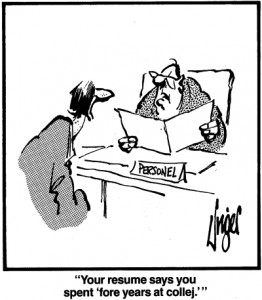
Interview CartoonMy grandmother was a great fan of that old shibboleth, “Don’t judge a book by its cover.” We all know what it means: you have to get to know someone (“read the book”) before you can make any judgment about them. “Appearances,” goes another, “can be deceiving.” Until you have worked passed and through the surface, you cannot know and make judgments about what lies underneath. Until, as the Native American teaching goes, you have walked a mile in another person’s moccasins, you have no basis on which to render judgment.

On the other hand, we all know how incredibly difficult it is to avoid doing exactly what Jesus here counsels against, how very hard not to do what the old sayings say we shouldn’t. Everyone makes “snap decisions” based on very little evidence, and everyone is influenced by their first impressions of others. I’ve been acutely aware of this during the past week while interviewing applicants for a part-time job at my church office.

Since the job is part-time (and not particularly well-paid), I’ve not done the same kind of extensive job-skills testing, or background and reference checking, that I would do with a full-time, high responsibility job. I’ve relied mostly on first impressions gained during the course of a brief interview and a quick review of resumes and letters of recommendation.

When I was first in the job market as a professional, I was counseled on the value of a good first impression. I learned about something called “the halo effect,” which is the psychological phenomenon in which our perception of positive traits about one aspect of a person gives rise to the perception or expectation of similar qualities in the individual as a whole. For example, you might be impressed with how tastefully and neatly dressed a person is and, thus, perceive them as organized and knowledgeable in their work; they may, of course, be nothing of the sort.

First impressions matter, but eventually substance will prevail. While dressing well may predispose an interviewer to think the applicant must be a good worker because she creates a competent first impression, the effect will wear off if she turns out to be a poor secretary. “Time will tell,” advises another old shibboleth.

So I have tried even more this week not to make judgments on first impressions. The person I hire will be working not just with me, but with every member of the congregation. It’s important that I choose wisely. A snap decision just wouldn’t be a good idea!

Jesus is quite obviously right to counsel against judging by appearances. But it’s awfully hard advice to follow! Sometimes Jesus says some really hard things: “If your right hand causes you to sin, cut it off and throw it away” (Mat. 5:30), comes immediately to mind. I find, however, that his “hard sayings” are less difficult to follow than when he’s simply giving reasonable advice! It’s when Jesus sounds like my grandmother, that it’s hardest of all.

====================

A request to my readers: I’m trying to build the readership of this blog and I’d very much appreciate your help in doing so. If you find something here that is of value, please share it with others. If you are on Facebook, “like” the posts on your page so others can see them. If you are following me on Twitter, please “retweet” the notices of these meditations. If you have a blog of your own, please include mine in your links (a favor I will gladly reciprocate). Many thanks!

====================

Father Funston is the rector of St. Paul’s Episcopal Church, Medina, Ohio.

Yeast Infection – From the Daily Office – February 7, 2014

From the Psalter:

When my mind became embittered,
I was sorely wounded in my heart.
I was stupid and had no understanding;
I was like a brute beast in your presence.
Yet I am always with you;
you hold me by my right hand.
You will guide me by your counsel,
and afterwards receive me with glory.

(From the Daily Office Lectionary – Psalm 73:21-24 (BCP Version) – February 7, 2014.)

The Pillsbury Doughboy suffers a massive yeast infectionSeldom has depression been so artfully described as in these few lines of Hebrew poetry. Translated in the Prayer Book as “embittered,” the Hebrew is chamets which refers to yeast. It means “to be leavened” or “to be sour.” Most versions of the Scriptures translate it with some version of “bitterness,” a few use “grieved,” and the Complete Jewish Bible renders the verse, “when I had a sour attitude.” I rather like that last one, closest to the Hebrew, best; it describes depression perfectly.

Several years ago, sixteen to be exact, I went through a severe depressive episode requiring treatment with medication and cognitive therapy. Both of those were helpful but of most value was my work was a spiritual director, really learning the discipline of daily prayer. In the course of that episode, I learned about psychological rumination, how to recognize its early stages, and how to get myself out of it.

The word rumination is borrowed by psychology from biology; it derives from the Latin ruminare meaning “to chew again.” It is the process by which ruminants (animals like cows, goats, sheep, giraffes, yaks, deer, and camels) digest their food. Having consumed and swallowed it, they regurgitate it together with digestive juices, chew it again to thoroughly mix it (“chewing the cud” we call that), and swallow it again.

In psychology, and especially with regard to depression, it refers to the process of returning again and again to replay in one’s mind, think over, regret, and obsess about some small but painful incident. It describes a useless but harmful feedback loop of negative emotion.

The Hebrew language’s and, thus, the psalm’s use of leavening to describe this process is nothing short of brilliant; it is wisdom. The process of rumination is exactly like the process of leavening. As the yeast fills the lump of bread dough, the negative emotions of rumination fill one’s every thought, every moment. The result, as the psalm says, is that one becomes “stupid” (ba`ar — ” brutish”) and “ignorant” (lo-yada — “lacking understanding”). In my own experience, when I would get stuck in a rumination cycle I simply became unable think outside of the feedback loop of negative thoughts; sometimes I couldn’t even think at all — I would simply “zone out.” Talk about “brutish” and “ignorant” — that was me in those ruminant moments!

But as the psalm suggests, there is a way out: God holds me by my right hand; God guides me by God’s counsel. For me, the structures of Prayer Book liturgy provided a way out of the cycle of rumination. If I could just get my hands on a Prayer Book and begin to read the Daily Office, or the prayers and thanksgivings section, the cadences of prayer would break through the obsessive replaying and over-thinking of whatever had triggered the cycle. I found, in fact, that the older language forms of the Rite One liturgies (or the 1928 Book of Common Prayer) were best for this purpose.

Depression is an awful thing. (As I contemplated it this morning — in a non-ruminative fashion — in light of the Hebrew linkage to leavening, I was tempted write something about a “yeast infection of the spirit” . . . but decided not to get there. I’ll just plant that image and leave it for later contemplation.) It is an awful thing, but there are ways to deal with it and ways to get out of it. I know, from personal experience. The best way is the one today’s psalm reminds us of — the guidance and counsel of God.

====================

A request to my readers: I’m trying to build the readership of this blog and I’d very much appreciate your help in doing so. If you find something here that is of value, please share it with others. If you are on Facebook, “like” the posts on your page so others can see them. If you are following me on Twitter, please “retweet” the notices of these meditations. If you have a blog of your own, please include mine in your links (a favor I will gladly reciprocate). Many thanks!

====================

Father Funston is the rector of St. Paul’s Episcopal Church, Medina, Ohio.

Costly Funeral – From the Daily Office – February 6, 2014

From the Book of Genesis:

Abraham bowed down before the people of the land. He said to Ephron in the hearing of the people of the land, “If you only will listen to me! I will give the price of the field; accept it from me, so that I may bury my dead there.” Ephron answered Abraham, “My lord, listen to me; a piece of land worth four hundred shekels of silver — what is that between you and me? Bury your dead.” Abraham agreed with Ephron; and Abraham weighed out for Ephron the silver that he had named in the hearing of the Hittites, four hundred shekels of silver, according to the weights current among the merchants. So the field of Ephron in Machpelah, which was to the east of Mamre, the field with the cave that was in it and all the trees that were in the field, throughout its whole area, passed to Abraham as a possession in the presence of the Hittites, in the presence of all who went in at the gate of his city.

(From the Daily Office Lectionary – Genesis 23:12-18 (NRSV) – February 6, 2014.)

Funeral Home CartoonI seem to recall from studying Genesis each time I have had to preach on it that this purchase of the cave at Machpelah has been a subject of much rabbinic speculation over the centuries. Why, the rabbis seem to wonder, is Abraham willing to pay what is clearly an exorbitant price for the cave and the field (a field he doesn’t even actually want)?

“Four hundred” is sort of Old Testament code for “a whole bunch,” and when it comes to this particular episode it means something like 10 pounds of silver for this tiny piece of real estate. (On today’s market — I looked it up this morning — silver is going for $20 per ounce; so this purchase price would be about $3,200. That doesn’t seem terribly high, but clearly it was “back then,” whenever “then” was.) An interesting note is the relationship of the price to the location where the deal is struck, Kiriath Arba. The name means “the City of Four,” so the number 400 would be significant to the residents and the Hittites — 100 times the “number” of their city, 100 times the value? In any event, Abraham is willing to pay a whole lot of money for a burial plot.

My favorite of the rabbinic flights of fancy is the kabbalistic notion that the cave was known to Abraham to be the burial place of Adam. As the story goes, after God tossed Adam and Eve out of Eden, God carved out a cave that he would use to bury the first man and, after him, the patriarchs of God’s Chosen People. Sure enough, when Adam died, God buried him there as planned; God lit an eternal candle whose light would be visible only to certain humans and the presence of Adam’s body gave the cave the scent of Eden which, like the light, could be detected only by that select group.

Eons later, when Abraham was visited by three men (who turned out to be angels of God) at the oaks of Mamre (Gen. 18) he served them a roasted calf. The story goes that he had to chase the calf, which ran into this very cave where Abraham saw the light of the candle and perceived the scent of Eden. He also heard a voice saying, “Adam is buried here, and Abraham, Isaac and Jacob should be prepared for this place as well.” So, that day he became determined to eventually take possession of the cave and Sarah’s death ended up being the opportunity to do so. (One of the rabbis who tells this story asserts that he did not do so earlier so as to avoid arousing suspicion.)

There are other (mostly less outlandish) rabbinic speculations, but none of them strike me as anymore likely than the most obvious. Abraham is grief-stricken. He has lost his life partner, his wife of several decades, the mother of his son and heir. He simply is not thinking straight. He seems to be, but he’s just going through the motions. He doesn’t even try to bargain with Ephron! This is Abraham, for pity’s sake, a man who has bargained with God, and he doesn’t haggle one bit over the excessive price of the cave.

I’ve seen it time and time again, particularly with the death of a spouse or a child. The survivors, left to figure things out, to go on alone, to honor their departed loved one, spare no expense on the funeral. An entire industry has grown up and become profitable — highly profitable — catering to (preying on?) the grief of the American people.

Don’t get me wrong, I respect most of the funeral directors with whom I have worked. They are good people trying to be of help at a difficult time. But, let’s be honest, the costs associated with burial today can be outrageous — they put Abraham’s paltry ten pounds of silver to shame. You might get a casket for that value, but then there’s the plot, the embalming, the hearse and limousine rental, the flowers, and on and on and on . . . . Funerals are costly — and when someone is numb with grief, they can be even more so!

That’s why I’ve made pre-arrangements and planned my own funeral, and why I counsel parishioners and friends to do the same. Abraham would have been much better off if he and Sarah had purchased Ephron’s cave ahead of time. (Although that would have meant that we wouldn’t have some really fantastic and outlandish rabbinic tall tales to enjoy.)

====================

A request to my readers: I’m trying to build the readership of this blog and I’d very much appreciate your help in doing so. If you find something here that is of value, please share it with others. If you are on Facebook, “like” the posts on your page so others can see them. If you are following me on Twitter, please “retweet” the notices of these meditations. If you have a blog of your own, please include mine in your links (a favor I will gladly reciprocate). Many thanks!

====================

Father Funston is the rector of St. Paul’s Episcopal Church, Medina, Ohio.

« Older posts Newer posts »