Occasional thoughts of an Anglican Episcopal priest

Category: Ministry (Page 38 of 59)

Toxic Church – From the Daily Office – January 22, 2014

From the Letter to the Hebrews:

Ground that drinks up the rain falling on it repeatedly, and that produces a crop useful to those for whom it is cultivated, receives a blessing from God. But if it produces thorns and thistles, it is worthless and on the verge of being cursed; its end is to be burned over.

(From the Daily Office Lectionary – Hebrews 6:7-8 (NRSV) – January 22, 2014.)

West Virginia Toxic Chemical Storage TanksThe writer of the Letter to the Hebrews is speaking of folks (the “ground”) who have received the Gospel of Jesus Christ (the “rain”) and have either produced some sort of fruit of good works (a “useful crop”) or have fallen away from the church (producing “thorns”). Of the latter, he says they are “impossible to restore” because “they are crucifying again the Son of God.”

It’s a hard metaphor and a harsh judgment that doesn’t leave any room for repentance and reconciliation. It seems a denial of hope, frankly.

But the writer’s original intent is not what attracts me to his metaphor of ground, rain, and plant growth this morning.

It’s been more than a week since I scribbled down a poem. In fact, it’s been more than a week since I even made any notes that might later become a poem.

I keep a notebook in which I write down things that occur to me, images that I’ve seen or conceived, emotions that have been oddly triggered, anything. Driving down the road I may see (as I recently did) an overturned birdbath and begin playing with that image – it will go in the notebook. Singing along with the radio or a hymn in church I may get choked up with emotion for reasons not entirely apparent at the time – emotion and lyric will go into the notebook. In conversation with someone or just standing in line in the grocery store I may hear an odd turn of phrase from someone, a thought put into words in a way I wouldn’t have put it – it will go into the notebook. Eventually some of what is in the notebook will work its way into a sonnet or a work of free-verse (my usual form).

My time the past week, however, has been devoted to preparations for my congregation’s annual parish meeting. Which means I’ve been reviewing attendance figures and financial reports and numbers of communions, baptisms, weddings, funerals, etc. Not, for me, the stuff of wonder and delight. Not the stuff that goes in the notebook and, to be honest, nothing has gone into the notebook while I’ve been working on these reports.

While I’ve been doing the statistical and financial work (and not keeping the notebook), the news has been filled with the story of a chemical leak, a spill of toxic waste in West Virginia that poisoned a river and left 300,000 people unable to use their household water for anything other than flushing toilets.

And reading this morning’s metaphor of ground, rain, and plant growth, it occurs to me that although the ground may be ready, and though it might usually produce a useful crop, if it is not watered with the proper rain, it will produce nothing good. In fact, it may produce nothing at all! Perhaps, for me, the seeds of images, feelings, lyrics, and odd phrases are not growing into poems (nor even getting planted in my notebook!) because they are not being watered correctly. I’m not suggesting that year-end statistics and financial reports are toxic, but they certainly don’t nurture the muse!

Sometimes, it isn’t the ground’s fault that it’s not producing. And it isn’t the rain’s fault that it’s not falling on the ground that isn’t producing. Sometimes there’s something blocking the rain, or adulterating the rain. It is the church’s job to see that the rain of the Gospel falls on the ground of people free of toxic adulteration . . . but all too often the church is guilty of adding the poison! (These are church statistics and church finances, I’m dealing with!) All too often it isn’t the fallen-away that need to repent and be reconciled to the Gospel; it’s the church. The toxic church . . . .

The metaphor and the judgment of the writer of the Letter to the Hebrews is hard and harsh. And, like most metaphors, it can be stretched too far. I don’t think I’m doing so, however, because, like the writer, I am “confident of better things . . . things that belong to salvation.” Although the church can be, and often is, toxic, I still believe that it is also the Body of Christ and the means of salvation. We can, by the grace of God, clean up our toxic spills. (And get passed the annual meeting with its statistics and financial reports and maybe get back to some poetry!)

====================

A request to my readers: I’m trying to build the readership of this blog and I’d very much appreciate your help in doing so. If you find something here that is of value, please share it with others. If you are on Facebook, “like” the posts on your page so others can see them. If you are following me on Twitter, please “retweet” the notices of these meditations. If you have a blog of your own, please include mine in your links (a favor I will gladly reciprocate). Many thanks!

====================

Father Funston is the rector of St. Paul’s Episcopal Church, Medina, Ohio.

What’s a Cubit? – From the Daily Office – January 18, 2013

From the Book of Genesis:

God said to Noah, “I have determined to make an end of all flesh, for the earth is filled with violence because of them; now I am going to destroy them along with the earth. Make yourself an ark of cypress wood; make rooms in the ark, and cover it inside and out with pitch. This is how you are to make it: the length of the ark three hundred cubits, its width fifty cubits, and its height thirty cubits.”

(From the Daily Office Lectionary – Genesis 6:13-15 (NRSV) – January 18, 2014.)

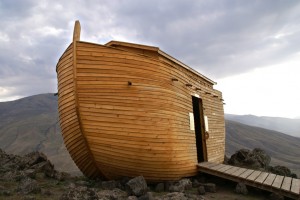
Noah's Ark ReconstructionI read those words and heard Bill Cosby’s voice. I’ll bet I’m not alone. More than 50 years ago (1963), Cosby’s debut comedy album Bill Cosby Is a Very Funny Fellow…Right! included a 3-1/2 minute skit he’d been doing on stage entitled Noah: Right! Ever since, it has colored the story of Noah and the ark for Americans; I know people who wouldn’t be born for another quarter century after that album’s release for whom Cosby’s skit is nonetheless an interpretive filter for the Noah story. Millions read the story and hear Noah asking, in Cosby’s voice, “Lord, what’s a cubit?”

In 1979, the comedy sketch troupe Monty Python released a full length movie entitled Month Python’s Life of Brian, which spoofed the life and ministry of Jesus of Nazareth by telling the story of Brian, the baby born in the stable stall next door and who spends his life being mistaken for the messiah. When he is present at the Sermon on the Mount, Brian is at the edge of the crowd among those who are so far away from Jesus they cannot hear clearly what he says. As they struggle to hear and understand Jesus’ words, they have this conversation:

What did he say?
I think it was “Blessed are the cheesemakers.”
Aha, what’s so special about the cheesemakers?
Well, obviously it’s not meant to be taken literally; it refers to any manufacturers of dairy products.

I cannot read the Beatitudes without that dialog coming to mind; I have to bite my lip to keep from laughing. I’m sure that when it is the appointed Sunday Gospel, my parishioners wonder why I have such a goofy expression while reading it!

Because I’m a child of the television generation, I also cannot read the story of Adam and Eve without seeing in memory Bob Newhart and Ruth Buzzi in beige long underwear playing a Garden-of-Eden skit on the old Laugh-In show, or sometimes Richard Basehart as a shipwrecked, alien space-traveling Adam encountering a similarly shipwrecked Eve (the plot of an old Twilight Zone episode).

I’ve two points in mind this morning in recalling these comedy routines to mind. The first is the difficulty of setting aside preconceptions when reading the scriptures. What we think we know about the text may be helpful as we study and interpret it, but it can also be a barrier to hearing it fresh each time to encounter it. I am convinced that the bible speaks to us anew in each reading, and that what we already “know” can and does interfere with our appreciating that. So I struggle to not hear Cosby’s voice, to not understand peacemakers as cheesemakers, to not see Adam climbing out of his space ship.

The second point is rather the opposite of the first, that these comedic or fanciful takes on the stories of the bible are as helpful as they are distracting. I know a lot of people who have a hard time finding humor about God or Jesus or the bible acceptable. My staunch Methodist grandfather frowned upon any humor about church, Sunday School, or other things religious; he considered them disrespectful and (I’m sure) blasphemous.

I find wisdom in a line by Oscar Wilde (from Lady Windemere’s Fan): “Life is far too important a thing ever to talk seriously about it.” The same can be said of the bible. Theologian and author Madeleine L’Engle once wrote, “I take the Bible too seriously to take it all literally” (a quotation often misattributed to Karl Barth). Finding humor or inspiration for fanciful works of fiction and comedy in scripture is part of both taking it seriously and not talking seriously about it. These comedic or fanciful treatments help us hear the scriptures with new ears.

And the question still remains: “What’s a cubit?”

====================

A request to my readers: I’m trying to build the readership of this blog and I’d very much appreciate your help in doing so. If you find something here that is of value, please share it with others. If you are on Facebook, “like” the posts on your page so others can see them. If you are following me on Twitter, please “retweet” the notices of these meditations. If you have a blog of your own, please include mine in your links (a favor I will gladly reciprocate). Many thanks!

====================

Father Funston is the rector of St. Paul’s Episcopal Church, Medina, Ohio.

Geographic Assumptions – From the Daily Office – January 16, 2014

From John’s Gospel:

Nathanael said to [Philip], “Can anything good come out of Nazareth?” Philip said to him, “Come and see.”

(From the Daily Office Lectionary – John 1:46 (NRSV) – January 16, 2014.)

Map  of StereotypesWe make many assumptions based on geography. Think of the all the comedians who make a living in North America by joking about stereotypes of Canadians — the television program South Park has made a running gag of Canadian stereotypes for years! Just try saying, as I truthfully can, “I was born in Las Vegas.” You’ll be very surprised by the reactions and the seriously ridiculous comments (I no longer am).

Although my wife is not a Las Vegan (she’s from a town in northeastern Nevada), we met and were married there. When I say that to someone in her presence — “We were married in Las Vegas” — she always adds “in a large church wedding.” She knows full well that the immediate assumption raised by my statement is that our marriage took place at the Little Chapel in the Parking Lot Behind Caesar’s Palace or some similar establishment.

Nathanael is voicing geographic assumptions in his question to Philip. In word, he is stereotyping.

Nazareth in Galilee, north of Jerusalem, was a nothing town, a poor, back water village of maybe 500 people ignored by nearly everyone, not only the Roman Empire but even by its nearby neighbors. Its residents were the First Century Jewish equivalent of hillbillies. It was not the sort of place from which one expected anything great, or anything at all . . . even an inhabitant of a similar neighboring town (like Bethsaida) could turn his nose up at it!

There are plenty of such places in the world today; there are many, many modern-day Nazareths. Every empire has its left-behind, forgotten, impoverished villages, its places from which no one expects any good thing to come. The spirit of Nazareth lives on in the slums and abandoned neighborhoods of Detroit, of Rio de Janeiro, of Calcutta, of hundreds of cities and towns around the globe.

“Can anything good come from [fill in the blank . . . I’m sure you know a place]?”

Philip’s answer to Nathanael is “Come and see.” God has two answers. The obvious answer: Yes! The less obvious answer is an admonition to stop stereotyping. If we can learn to take off the blinders of our geographic (and other) assumptions, if we can give up the habit of stereotyping, we will see greater things.

====================

A request to my readers: I’m trying to build the readership of this blog and I’d very much appreciate your help in doing so. If you find something here that is of value, please share it with others. If you are on Facebook, “like” the posts on your page so others can see them. If you are following me on Twitter, please “retweet” the notices of these meditations. If you have a blog of your own, please include mine in your links (a favor I will gladly reciprocate). Many thanks!

====================

Father Funston is the rector of St. Paul’s Episcopal Church, Medina, Ohio.

Gimmicks Distract – From the Daily Office – January 11, 2014

From the Psalter:

Hallelujah!
Praise God in his holy temple;
praise him in the firmament of his power.
Praise him for his mighty acts;
praise him for his excellent greatness.
Praise him with the blast of the ram’s-horn; *
praise him with lyre and harp.
Praise him with timbrel and dance;
praise him with strings and pipe.
Praise him with resounding cymbals;
praise him with loud-clanging cymbals.
Let everything that has breath
praise the Lord.
Hallelujah!

(From the Daily Office Lectionary – Psalme 150 (BCP Version) – January 11, 2014.)

Clown Presiding at CommunionThe musical Godspell debuted in 1971 (my junior year in college); in it, Christ is portrayed as a clown. Whether it was an expression of or the catalyst for the phenomenon of offering clown eucharists as an edgy, avant-garde presentation of the Christian Mysteries, I really don’t know. The two are inextricably linked in my memory.

And . . . to be honest, I never cared for either. And . . . being further honest, that may be because I have never like clowns. I find them creepy. On the other hand, a bishop of whom I was very fond and for whom I had great respect, loved Clown Eucharists. He had a set of clown-decorated vestments made; he offered a clown eucharist at least once each year (often at diocesan convention) throughout his episcopate. They may have resonated for him because, unlike me, he loved clowns.

But I didn’t (and don’t) and so the clown eucharist was, for me, a distraction. I couldn’t get passed the gimmick, the clown images and the circus music, to the Christ at the center of mass. The clown gimmick, not the foolishness of God to which it was supposedly pointing, took over and seemed to be the point of the whole thing.

Some years later, when the music of U2 became popular and new generation were finding spiritual meaning in the band’s lyrics, someone put together a celebration of the Holy Mysteries in which that music played a part — the major part — it was the only music — and promoted the event as a U2charist.

“Right,” I thought. “The clown eucharist in a new guise.” Again, for me, the gimmick (the U2 music) distracts from the principal focus. I attended a U2charist and, for me, all I heard was the band’s music; I didn’t hear the gospel. That’s not to say it wasn’t there; it may have been. I just couldn’t hear it through the distraction of the soundtrack.

Since then I have heard of (but not attended) celebrations of Holy Communion in which the music was all from the Beatles canon, or all “oldies” from the 1960s, or all Broadway show tunes . . . and I wouldn’t be surprised if there have been other similar “thematic” eucharists. All, I think, the descendants of the clown masses of the 1970s — attempts to package the Christian Mysteries in edgy and avant-garde ways to present them to a target audience, to sneak the gospel message in under the guise of entertainment.

Now, don’t get me wrong. Let me hasten to say that I think entertainment is fine. If clowns float your boat, go the circus! If you like the music of U2 (and I do), listen to it! If you like Broadway musicals (and I do), go to the theater! And if you find something of spiritual import in those entertainments (and I do), great! Make use of it in your spiritual life and, even, in church services and celebrations.

The last of the psalms encourages the people of God to make use of many forms of entertainment, symbolized by musical instruments — trumpets and horns (the ram’s horn), stringed instruments, percussion, wood winds — and dance, in their worship. So I believe it’s fine to make use of clowns, to use of U2’s music, to sing the Beatles’ lyrics, to offer the tunes from Broadway shows as part of the liturgy.

But when these things become the reason for the service, when we name the service for the clowns or the bands or the theater district, the tool meant to be used for praising God has become the object of praise. The psalm says, “Praise God with strings and pipe,” not “Praise the strings and pipe;” “Praise God with resounding cymbals,” not “Praise the cymbals.”

Others, I am quite certain, will have found the U2charists a path to God. Other, I know, will have found in the Beatles mass and in the Broadway eucharists the truth of the gospel. After all, that bishop whom I really did love found Christ in clowns no matter how creepy I may have found them!

But for me, these feel “gimmicky” — one or two Beatles songs might be used to good effect, but nothing but Beatles music through the whole service? Not so much. U2’s Gloria could certainly stand as a liturgical piece, but all U2 music throughout the mass? Too much of a good thing. I’m not sure that I can say anything positive about clowns . . . but someone might, perhaps. My point is that themed eucharists like these, in which the theme predominates, feel like gimmicks. It feels to me like we have stopped praising God with the clowns and have started praising the clowns; the gimmick distracts. Praise God with the gimmick, but don’t praise the gimmick!

====================

A request to my readers: I’m trying to build the readership of this blog and I’d very much appreciate your help in doing so. If you find something here that is of value, please share it with others. If you are on Facebook, “like” the posts on your page so others can see them. If you are following me on Twitter, please “retweet” the notices of these meditations. If you have a blog of your own, please include mine in your links (a favor I will gladly reciprocate). Many thanks!

====================

Father Funston is the rector of St. Paul’s Episcopal Church, Medina, Ohio.

Reading in Context – A Poem

Harsh Light on the BibleReading in Context

I sit at night,
Wrapped in a shawl preparing to read.
Warm, I sit in my recliner.
A fire burns in my den’s old stone hearth.
I take up the book.
The table-lamp’s friendly liquid light
illumes metaphors of similes of analogies.
Invasions and wars and mayhem and death;
traveling tents turned into temples,
temples transfixed on tentpegs,
temples topped with spires,
temples crowned with thorns,
thorny words that bring no comfort.
This is my work.
I read.

The page is slick; the writing, oily.
The eye slides off,
like a late-night dancer from a lubricated
length of well-polished pole.
This? This is supposed to be holy?

The words are sour; the prose is acrid.
The brain spits up,
like a distempered infant disgorging
a dose of terpin hydrate.
This? This is supposed to be sacred?

The verse is harsh; the stories, dreadful.
The spirit rebels,
like a captive cruel-clawed kitten
being clutched too tightly.
This? This is supposed to be helpful?

She died tonight,
Breathed her last and turned away.
Numb, I sit in the unused chapel.
An electric candle flickers in the darkness.
I pick up a book.
The fluorescent light
callously barging in through the doorway
shines on praises of glories of blessings of forgiveness.
Seas parting, tables spread, honey, milk, wine, bread;
mountaintop holy ground welcoming feet,
feet of the messengers,
feet bathed at Passover,
feet pierced with spikes,
spikenard-like words that succor and soothe.
This is our life.
I read.

The words make sense; the stories comfort.
My soul unwinds
like the knotted cord of an old
black telephone desk set.
This. This is the word of the Lord.

(By C. Eric Funston)

Be Glad – From the Daily Office – January 8, 2013

From the Psalter:

This is the day that the Lord has made; let us rejoice and be glad in it.

(From the Daily Office Lectionary – Psalm 118:24 (NRSV) – January 8, 2014.)

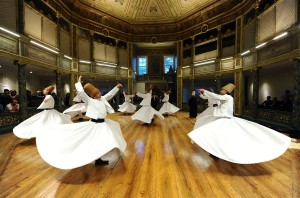
Whirling DervishesMy wife and I met at a Cursillo three-day weekend event. I was a part of the team (one of the cooks) putting on the Cursillo; she was “making” her Cursillo (as the lingo has it). She claims we’d met before at a fund-raiser fair at my parish (she attended elsewhere), but I was very busy during the fair and don’t recall that. I remember meeting her at the Cursillo weekend.

The Cursillo movement and the Cursillo community became an important of the early years of our marriage. We married about six months after meeting and in another six months we relocated to another state where I attended law school. There was an active Cursillo community in that location and we became involved.

An eye-opening move, that was. We discovered that the Cursillo community in our original home had been doing things incorreclty! Not just different. They’d been wrong. They’d been violating of the agreement between the Episcopal Church and the Roman Catholic Cursillo Movement, which had licensed the Cursillo method to the Episcopalians. And, we later learned, they knew they’d been doing so.

This comes to mind today because one of the major elements of a Cursillo weekend is music. In those communities, it was the sort of music that today might be called “praise choruses” or “church folk” or “contemporary.” Simple, easily remembered, repetitive songs accompanied by guitars, banjos, tambourines, bongos. One song common to both communities was based on this verse; in fact, it was this verse so far as I can remember.

There may have been verses and this may simply have been the chorus, but all I can recall is this verse: “This is the day, this is the day, that the Lord has made, that the Lord has made. We will rejoice, we will rejoice, and be glad in it, and be glad in it.” A catchy, bouncy little tune to which one could dance a formless dance, whirling like a dervish! It was easy to get caught up in and it demonstrated to me the spiritual power of music, simple melodies, and physical movement. Whirling and spinning and experiencing the power of the Spirit!

When my wife and I returned to our original home after three years in law school, we were asked to be the leaders of a coeducational three-day Cursillo event. We agreed, but we said we wanted to try to abide by the agreement between our church and the Roman Catholics, to discontinue those practices which violated the accord, to keep faith with our brothers and sisters who had gifted us with the Cursillo as a tool for deepening the faith of mature Christians.

There was push-back. In fact, there was outright rebellion. Members of the community refused to sponsor candidates to the weekend we were to lead; others refused to contribute to the cost of the event. Evelyn and I resigned from leadership and felt we had no choice but to withdraw from the community.

What had been an important support for us in the early years of married life became a source of grief and sadness. It still is. We miss being a part of that community and we miss the nearly automatic entry being in the Cursillo community gave us to a wider circle of church friends when we relocated. Where we live now, there is no active Cursillo community so the sharpness of the grief is dulled; there are no “Reunions,” nor “Ultreyas” (as the regular get-togethers of Cursillistas are called), so no constant reminders that we are no longer a part of Cursillo.

And yet we rejoice that we were fortunate to have been called to that community. It’s where we met; it sustained us. Like each day the Lord makes, it has passed. When it was here, we rejoiced in it and we were glad. And we look back on it still with gratitude. When I think of it, I think of this verse and that danceable chorus, and my soul comes alive in the Spirit, whirling and spinning, and expressing the joy that community gave us . . . and how grateful I am to that experience for the gift of my wife and the family we have created.

Everyday is a new day that the Lord has made; we will rejoice and be glad in it, whirling and spinning in the power of the Spirit.

====================

A request to my readers: I’m trying to build the readership of this blog and I’d very much appreciate your help in doing so. If you find something here that is of value, please share it with others. If you are on Facebook, “like” the posts on your page so others can see them. If you are following me on Twitter, please “retweet” the notices of these meditations. If you have a blog of your own, please include mine in your links (a favor I will gladly reciprocate). Many thanks!

====================

Father Funston is the rector of St. Paul’s Episcopal Church, Medina, Ohio.

Choosing Life – From the Daily Office – January 7, 2013

From the Book of Deuteronomy:

He humbled you by letting you hunger, then by feeding you with manna, with which neither you nor your ancestors were acquainted, in order to make you understand that one does not live by bread alone, but by every word that comes from the mouth of the Lord.

(From the Daily Office Lectionary – Deuteronomy 8:3 (NRSV) – January 7, 2014.)

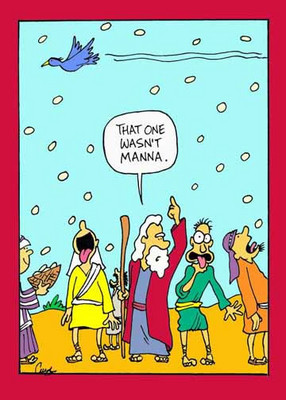
Manna from Heaven CartoonJesus and a crowd who challenge his authority also make reference to the manna in today’s Daily Office gospel lesson in which Jesus says: “Your ancestors ate the manna in the wilderness, and they died. This is the bread that comes down from heaven, so that one may eat of it and not die. I am the living bread that came down from heaven. Whoever eats of this bread will live for ever; and the bread that I will give for the life of the world is my flesh.” (John 6:49-51)

So I know that I really ought to be thinking pious thoughts about the Eucharist, or something . . . .

But, truth be told, what I’m really led by these lessons to think about is dieting and weight loss. Damn it!

Back in late September, I was having trouble fastening my trousers and avoiding stepping onto the bathroom scale, but eventually I did so and was appalled at the number it gave me. So I decided to do something about it and, before going public, lost a few pounds. When I was down to 273 lbs. (273! For God’s sake!) I decided I needed the “moral support” of my congregation, so inspired by another priest who had done so, I created a “Reduce the Rector” campaign and asked people to pledge dollars against pounds lost.

By Thanksgiving I’d lost 20 pounds, and then . . . well, let’s just say there was a diet hiatus through New Year’s. Fortunately, only a pound and a half was regained. But, now . . . .

Now Moses and Jesus are talking about food and more than food and reminding me that I need to focus on the healthier stuff that God has in store for me. Moses’ line about being “humbled” by the food eaten (the manna) and Jesus’ comment that “they ate and they died” really put a zinger into it. Food, too much of it and not the right kinds of it, is a humbling thing for me and I know if I don’t change the way I deal with it, it will kill me. High cholesterol, hypertension, blood sugar issues, joint pain, tendonitis . . . in some way or another, they are all related to the excess weight I am embarrassed to carry.

So . . . end of diet hiatus. Back to healthy eating and (even in the frigid cold) taking walks and getting more exercise.

The annotations to Deuteronomy tell me the last verse of the passage has an alternative reading: “One does not live by bread alone, but by anything that the Lord decrees.” I’m going to start focusing on something else God decreed through Moses: “Choose life so that you and your descendants may live!” (Deut. 30:19) I choose healthy eating and healthy living; I choose life.

====================

A request to my readers: I’m trying to build the readership of this blog and I’d very much appreciate your help in doing so. If you find something here that is of value, please share it with others. If you are on Facebook, “like” the posts on your page so others can see them. If you are following me on Twitter, please “retweet” the notices of these meditations. If you have a blog of your own, please include mine in your links (a favor I will gladly reciprocate). Many thanks!

====================

Father Funston is the rector of St. Paul’s Episcopal Church, Medina, Ohio.

River of Words – From the Daily Office – January 6, 2013

From the Psalter:

There is a river whose streams make glad the city of God, the holy habitation of the Most High.

(From the Daily Office Lectionary – Psalm 46:5 (BCP Version) – January 6, 2014.)

A River in the Desert

Two poems about rivers . . . first from the Malaysian poet John Tiong Chunghoo who is known best for his haiku, a work entitled Part of God:

created in his likeness
the anger – thunder
the warning – lightning
the tears – rain
the smile – the breeze
the punishment – earthquake
lesson – the echo, memory
the trees, birds,
sea, clouds and sky
his pictorial poetry
in his likeness
i paint them
with words
that run
like a river
reflecting their beauty in me
styling them in realism
on a calm day
impressionism
on a breezy one
as the river
dances with light
modernism
when the river
shakes the
inquisitive mind
of the mysteries of life
all the blocks and angles
the river registers
as it unfolds a scroll
of god’s law
surrealism
mistfilled
a river scene
i did to run away from
a mind that torments
a world that begs for
an answer to everything

I am intrigued by Chunghoo’s image of poetry as a river, of words as flowing water. I grew up in the desert of southern Nevada and, as an adult, enjoyed recreational backpacking down the valley of the Virgin River, a tributary of the Colorado that now makes up the northern branch of Lake Mead. In the desert, a river is a source of life. Around it the ground is parched, dry, and apparently lifeless, but immediately next to it and in it there is abundance of life. Words, Chunghoo seems to suggest, are like that; they are more than mere devices of communication — they are sources of life in a world that “begs for an answer to everything.”

That’s a biblical image! Genesis: “Then God said, ‘Let there be . . . .'” John’s Gospel: “In the beginning was the Word . . . . ” God’s words are life-giving. Human words can be, too! Communication sustains the life of community. The river of words makes glad the city.

The second poem, read together with Chunghoo’s, read in the light of the image of a river of communication, is an old hymn given new meaning:

Shall we gather at the river,
Where bright angel feet have trod,
With its crystal tide for ever flowing
by the throne of God?
Gather at the river!
Yes, we’ll gather at the river,
The beautiful, the beautiful river,
Yes well gather at the river
that flows by the throne of God.
Shall we gather? Shall we gather at the river?

Shall we gather at the river of words? Shall we give life to one another with our communication and our conversation? Is there any other way?

Interestingly, Robert Lowry, the Baptist minister who wrote the hymn, was also a professor of literature. I wonder what he might have thought of a “river of words” . . . .

====================

A request to my readers: I’m trying to build the readership of this blog and I’d very much appreciate your help in doing so. If you find something here that is of value, please share it with others. If you are on Facebook, “like” the posts on your page so others can see them. If you are following me on Twitter, please “retweet” the notices of these meditations. If you have a blog of your own, please include mine in your links (a favor I will gladly reciprocate). Many thanks!

====================

Father Funston is the rector of St. Paul’s Episcopal Church, Medina, Ohio.

A Theology of Gift Giving – Sermon for the Second Sunday of Christmas – January 5, 2014

====================

This sermon was preached on the Second Sunday of Christmas, January 5, 2014, at St. Paul’s Episcopal Church, Medina, Ohio, where Fr. Funston is rector.

(The Revised Common Lectionary, Christmas 2A: Jeremiah 31:7-14; Ephesians 1:3-6,15-19a; Psalm 84; and Matthew 2:1-12. These lessons can be read at The Lectionary Page.)

====================
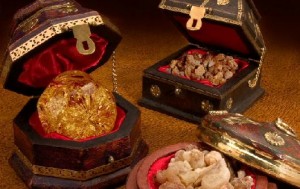
Gifts of the Wise MenVery recently in the church office mail there was this small envelope addressed to me personally — the address has been typed out on a separate sheet of paper, cut therefrom, and glued onto the envelope. There is no return address and the postmark is a Cleveland, OH, cancelation. Inside there was no personal note of any kind, just a page torn from the last quarter’s Forward Day by Day devotional. One side, as you can see, has been scribbled all over; clearly not the side I am supposed to read. The other is the meditation for October 30, 2013, which begins:

Have you ever suffered because you sat through a really boring, abstract, incoherent, and disconnected sermon? Most of us have. Believe it or not, some people report that after enduring something like that, they decide never to go back to that particular church or any church at all. Sermons can make or break some people’s relationship with the church.

(The entire meditation can be read at Forward Day by Day.)

I have to be honest — my first reaction on receiving this was to think, “Well, that’s not something I wanted to get!” And immediately I was reminded of one Christmas when our children were quite young.

Our family tradition is to wait until Christmas morning to open our packages, so even if we’d been to the Midnight Mass we would rise early to see what Santa had brought. On the Christmas I recalled, our daughter rushed down the stairs from her second-floor room to the tree set up in our first-floor den and tore open the largest of her gifts, ripping to shreds the wrapping paper with obvious excitement. However, when she saw what was under the wrapping her expression changed to disappointment and she cried out, “That’s not what I wanted!” I don’t remember what she had wanted; I don’t even remember what we had given her. But I remember that reaction.

It got me to thinking about the reasons we give things to one another, the how of it and the why of it. What is the “theology of gift giving?” The gifts of the wise men to the Christ-child help us to explore that question.

The first element of such a theology would be the recognition that the giving of gifts is perfectly acceptable! There are some who teach that it is not, but we have plenty of examples in Scripture including, of course, the very story we are told in today’s gospel reading of the visitation of the Magi. More basically, we have God’s own example starting with the gift of life to plants, animals, and human beings as described in the Creation stories and exhibited most clearly in God’s self-giving in Jesus Christ. Generosity and charity are fundamental to an active Christian faith. Giving is the very thing that defines our belief: God-made-human gave himself entirely so that we might be free to give ourselves entirely back to God. As James said, “Every generous act of giving, with every perfect gift, is from above, coming down from the Father of lights.” (James 1:17, NRSV) Gift-giving, in a sense, is the purpose of the Incarnation, so it is something strongly encouraged.

The second element of a theology of gift giving is that giving gifts allows us to be ministers of grace, the free and undeserved help of God. The gifts of the wise men were symbolic: the hymn “We Three Kings” lays out in verse what these are. Gold is a symbol of kingship, frankincense (used for incense in worship) is a symbol of deity, and myrrh (an embalming oil) is a symbol of death. (By the way, did you know that that hymn is quintessentially Episcopalian? It was written by John J. Hopkins in 1857 for a Christmas pageant at General Theological Seminary, the Episcopal Church divinity school in New York City.) In other words, they are symbolic of the full grace and mercy of God incarnate in Jesus. Every gift we receive, especially those from God but really from anyone, is a demonstration of God’s grace because, after all, grace is undeserved. How many times have you opened a present and sat there with the gift still in the box, looking at the giver with eyes and thinking to yourself, “What done to deserve this?” That question, of course, is rhetorical. The answer is “Nothing.” Gift giving is a form of grace by which we imitate the behavior of God and model the character of God.

The third element of a theology of gift giving is that it give us opportunity to display the love of God. “Each one must give as he has decided in his heart, not reluctantly or under compulsion, for God loves a cheerful giver,” wrote Paul to the Corinthians. (2 Cor. 9:7, ESV) And, of course, “God so loved the world that he gave his only Son.” (John 3:16, NRSV) Every gift should be a reflection of that love. If a gift is a real gift it is given with no thought of return. It’s not about starting an endless series of gift exchanges. It’s not about buttering someone up. It’s not about impressing someone or trying to get someone to do something for you. A real gift is an act of unconditional love, with no demands, no hints, no requirements of any return. Love, as Paul reminds us in the First Letter to the Corinthians,

is patient; love is kind; love is not envious or boastful or arrogant or rude. It does not insist on its own way; it is not irritable or resentful; it does not rejoice in wrongdoing, but rejoices in the truth. (1 Cor. 13:4-6)

Our gift-giving character should be one of genuine love. By giving a gift, we are symbolically recalling the gift of Christ for our salvation because “God so loved the world.”
The final element of a theology of gift giving, the element to which the first three point, is that it is relational. When the Magi encountered the Christ-child, they worshiped him: “On entering the house, they saw the child with Mary his mother; and they knelt down and paid him homage.” Worship is an expression of relationship at its deepest. However we define the word worship, it has its center in how we relate to God; it is the very reason, Scripture tells us, that we were created.

As I think I’ve mentioned before, one of my favorite poets is the African American James Weldon Johnson. At funerals, I often use one the poems from his collection God’s Trombones: Seven Negro Sermons in Verse. Another poem in that book is entitled The Creation; it explores this truth of our creation. The poem begins —

And God stepped out on space,
And he looked around and said:
“I’m lonely —
I’ll make me a world.”

The poem continues, as Genesis does, detailing the creation of earth, the seas, the plants, the animals . . . and then goes on —

Then God walked around,
And God looked around
On all that He had made.
He looked at His sun,
And He looked at His moon,
And He looked at His little stars;
He looked on His world
With all its living things,
And God said, “I’m lonely still.”

Then God sat down
On the side of a hill where He could think;
By a deep, wide river He sat down;
With His head in His hands,
God thought and thought,
Till He thought, “I’ll make me a man!”

Up from the bed of the river
God scooped the clay;
And by the bank of the river
He kneeled Him down;
And there the great God Almighty
Who lit the sun and fixed it in the sky,
Who flung the stars to the most far corner of the night,
Who rounded the earth in the middle of His hand;
This Great God,
Like a mammy bending over her baby,
Kneeled down in the dust
Toiling over a lump of clay
Till He shaped it in His own image;
Then into it He blew the breath of life,

And man became a living soul.
Amen. Amen.

“Like a mammy bending over her baby . . . .” We are created for relationship — relationship with God and relationship with each other. Like the gift giving of the Magi, that’s what our gift giving to one another is all about. It is a tangible expression of relationship; although gifts are given out of love with no expectation of reciprocation, they do provoke a response. They are relational, and in the way we relate to each other, especially in our giving of gifts to each other, we exhibit how we relate to God.

I’ll be honest. I was upset by this anonymous gift. But in the end I’m grateful for it because it is a reminder of this most important element of the theology of gift giving, this relational aspect. After that rather brutal opening paragraph, the Forward Day by Day meditation examines what it calls “Jesus’ methodology” of preaching by story-telling and then concludes, “In spite of all of our media gadgets, communications systems, and technological tools, we still need to truly perceive, listen, and understand.”

My mentor, the late Fr. Karl Spatz, taught me to think of a sermon as a conversation and as a gift. A sermon is not a lecture and it has many participants. Preaching is grounded in community, and like gift giving is relational. Preaching is not me or any clergy person standing in the pulpit telling you what we think that you should hear. A sermon is an exploration of the things we all struggle to understand, the troubles we all have to deal with, the things we all try to do better, the joys we all celebrate. A sermon is a priest’s prayerful and considered reflection upon these things, offered humbly as a gift to the gathered community. The congregation’s part in the conversation is to receive the gift and, as the meditation says, make the effort “to truly perceive, listen, and understand.” That may sometimes mean that we continue the conversation at a later time, perhaps through notes like this one — but we can only really continue the conversation that if I know who you are . . . .

When all is said and done, any gift giving (including any preaching) is an imperfect thing. It is an imperfect thing that seeks the perfection of the one true gift, the gift of Jesus for the salvation of the world. Amen.

====================

A request to my readers: I’m trying to build the readership of this blog and I’d very much appreciate your help in doing so. If you find something here that is of value, please share it with others. If you are on Facebook, “like” the posts on your page so others can see them. If you are following me on Twitter, please “retweet” the notices of these meditations. If you have a blog of your own, please include mine in your links (a favor I will gladly reciprocate). Many thanks!

====================

Father Funston is the rector of St. Paul’s Episcopal Church, Medina, Ohio.

Technical Support – From the Daily Office – January 4, 2013

From the Psalter:

Restore us then, O God our Savior;
let your anger depart from us.
Will you be displeased with us for ever?
will you prolong your anger from age to age?
Will you not give us life again,
that your people may rejoice in you?

(From the Daily Office Lectionary – Psalm 85:3-6 (BCP Version) – January 4, 2014.)

Help KeyLate yesterday I created and posted a “meme” on Facebook and then put it on this blog as well . . . a picture of a sack lunch with words from the early 1970s humor piece entitled The Deterioriata: “

Gracefully surrender the things of youth:
The birds, clean air, tuna, Taiwan . . .
And let not the sands of time
Get in your lunch.

I edited the posting this morning to include the whole text of The Deteriorata. It’s a parody. It’s humor. It’s not the way I actually see the universe functioning. Let’s make that clear. But another part of the piece strikes awfully close to home:

Therefore, make peace with your god
Whatever you conceive him to be —
Hairy thunderer, or cosmic muffin.
With all its hopes, dreams, promises, and urban renewal
The world continues to deteriorate.

There is ample evidence that the world does continue to deteriorate, even more so than when that piece was written in 1972 as a part of a National Lampoon comedy record! Economic injustice and wealth inequality, increased pollution and anthropogenic climate change, wars and civil wars . . . you can complete the list. So perhaps making peace with one’s god is a good idea.

And that’s the line that gets to me this morning, the bit about “whatever you conceive him to be.”

And the line (or, actually, the word) that got my attention in the morning psalm is “Restore…”

Here’s why.

For several hours yesterday and this morning, when I would try to access this site (a family domain I set up several years ago and host with a company whose servers and technical support staff are in . . . God knows where), I could not do so. I would get strange error messages. It would tell me that the “resource limit” had been exceeded; it would claim there was a “database error;” it would give me an HTTP 500 error saying that it had “encountered an unexpected condition that prevents fulfilling the request by the client;” it would give me an HTTP 404 error – “Page not found!”

My only recourse when these things happen is to go to my hosting company’s website and complete a “support ticket” detailing the error received and saying something very much like “Restore us then, O hosting company.”

Before reading the Daily Office this morning, I checked the weather. In our area we are experiencing very cold winter temperatures and in this morning’s prediction there was a “Winter Wind Chill Watch” for the next few days. Beginning early Monday morning and continuing through mid-day on Tuesday, there are predicted temperatures at Zero Degrees Fahrenheit or below, blowing snow showers (winds of 20-25 mph), and wind chills of -25 to -40 . . . . Not being a fan of cold, snowy winters in the first place, the Psalm’s plea, “Restore us then, O God our Savior; let your anger depart from us” seemed to me particularly appropriate; bad winter weather will screw up a whole lot of plans that I have made!

But then I had to pull myself up short and ask myself, “How are you conceiving God to be? Hairy thunderer, cosmic muffin, universal weatherman, celestial technical support department?” All might be good metaphors to help us understand the divine in bible study, but as with any metaphor they are of limited use in most circumstances, and especially in these.

Faced with glitches and bugs in the programs we’ve tried to write for our own lives, what do we do? Call on God as some sort of master IT technician to come fix them? Or do we knuckle down and do the hard work of reading through the code line-by-line and fixing things ourselves, relying on the tools and skills that God has already given us.

In my own life, I’m trying to do the latter, but I must confess that every once in a while I really do just want to throw up my hands and submit a “support ticket” to the heavenly technician, and then gripe about how slowly he gets around to fixing things: “Will you be displeased with us for ever?”

No, better not to call on technical support; best to work things out for ourselves and with the help and support of our communities to the extent we can. And we will find out that that extends really pretty far!

====================

A request to my readers: I’m trying to build the readership of this blog and I’d very much appreciate your help in doing so. If you find something here that is of value, please share it with others. If you are on Facebook, “like” the posts on your page so others can see them. If you are following me on Twitter, please “retweet” the notices of these meditations. If you have a blog of your own, please include mine in your links (a favor I will gladly reciprocate). Many thanks!

====================

Father Funston is the rector of St. Paul’s Episcopal Church, Medina, Ohio.

« Older posts Newer posts »