Occasional thoughts of an Anglican Episcopal priest

Category: Ministry (Page 41 of 59)

Surreal Scripture – From the Daily Office – November 22, 2013

From the Book of Revelation:

Let the evildoer still do evil, and the filthy still be filthy, and the righteous still do right, and the holy still be holy

(From the Daily Office Lectionary – Revelation 22:11 (NRSV) – November 22, 2013.)

The Lovers by Rene MagritteToday is the 50th anniversary of the assassination of President John F. Kennedy. Like everyone who was even marginally grown up or conscious on that day, I know exactly where I was and what I was doing when it happened. It is one of those moments in time that are surreal in their clarity.

This verse from the Book of Revelation randomly and coincidentally shows up in the Daily Office Lectionary today. It strikes me as equally surreal. This is Jesus talking, Jesus ascended to heaven, Jesus the Incarnation of God, Jesus the Second Person of the Trinity, Jesus speaking from his heavenly throne, Jesus who in a verse or two will say, “I am the Alpha and the Omega, the first and the last, the beginning and the end.” (v. 13) What can it mean that Jesus says to “Let the evildoer still do evil, and the filthy still be filthy?” Doesn’t that run contrary to everything that he taught and lived on earth? What?

Anyone who knows me is aware that I have a streak of weirdness a mile wide. I love theater of the absurd (Eugene Ionesco and Samuel Beckett are among my favorite playwrights) and surrealist art (give me Salvador Dali and Rene Magritte over the “old masters” any day). That’s why I love the Book of Revelation.

I don’t love it in the way the folks that preach the Rapture and the Tribulation love it. I don’t love it in the way the authors of the Left Behind novels love it. I don’t love it in the way that people who predict the end of the world love it. I think are that is theological nonsense . . . or, more accurately, theological bullshit.

No, I love Revelation for the same reason I love absurdist theater and surrealism. There’s an old saw about random chance that if you put a bunch of monkeys in a room with a bunch of typewriters they would eventually produce the works of Shakespeare. I think if you put Ionesco, Beckett, Magritte, and Dali in a room together and told them to write something about the destruction and fall of the Roman Empire, they might come up with the Book of Revelation . . . .

Throughout my life, I have collected oddball memories that I keep saying I am going to put into a great novel, and I keep collecting potential titles for that novel – things people say or do that, heard out of context, challenge reality. Here are some of my potential titles:

“Hello spelled backwards is sweet roll.”

“Before you sink the Bismark, I need to brush my teeth.”

“My only regret was bronzing the kangaroo.”

Sorting cat food in the nude

This thing that John of Patmos says Jesus said seems to me to rank right up there with these potential titles. Like anything surrealistic, this admonition of the Risen and Ascended Christ to “let the evildoers do evil and let the filthy be filthy” challenges our perceptions of reality; it demands that we resolve contradictory perceptions. It demands that we make choices. It demands that we decide which group we are going to be in — the evildoers and the filthy, or the righteous and the holy. It demands that we change.

With surreal clarity, I remember exactly where I was and what I was doing when John F. Kennedy was killed. It was an event that awakened and transformed a nation. The Book of Revelation with surreal clarity demands that we awaken and transform ourselves . . . before we sink the Bismark or bronze the kangaroo.

====================

A request to my readers: I’m trying to build the readership of this blog and I’d very much appreciate your help in doing so. If you find something here that is of value, please share it with others. If you are on Facebook, “like” the posts on your page so others can see them. If you are following me on Twitter, please “retweet” the notices of these meditations. If you have a blog of your own, please include mine in your links (a favor I will gladly reciprocate). Many thanks!

====================

Father Funston is the rector of St. Paul’s Episcopal Church, Medina, Ohio.

Creating Community – From the Daily Office – November 21, 2013

From the Matthew’s Gospel:

Whoever welcomes one such child in my name welcomes me.

(From the Daily Office Lectionary – Matthew 18:5 (NRSV) – November 21, 2013.)

Creating CommunityI’m following a thread on a friend’s Facebook page about the future of the “institutional church,” by which I think the various participants mean their several denominations. (We are Episcopalians, Methodists, Presbyterians, Lutherans, etc., all of whom seem primarily to identify as Christians and only secondarily with the variety of polities, theologies, liturgical styles, and so forth we each prefer.) I suggested in the discussion that creating institutions is in the very nature of human beings; we create them, criticize them, tear them down, reform them, and recreate them, but we never escape from them. Another participant in response said, “I do not create community.”

“Really?” I thought as I read that. Then what is Jesus talking about when he bids us to welcome others? What is it that we are about when we enter a church fellowship? The other continued, “Community is right in front of us.” Now, that’s true. But do we not “create” a new community when we join that which pre-exists us? When we welcome the child in Christ’s name, we so alter the existing community that it is no longer the same, it is something new. It can never go back to, never again simply that which it was.

“See,” says the Lord, “I am making all things new.” (Rev. 21:5) We and our welcome are the tools which God uses to create new communities out of the old.

In that thread, I said, “I don’t despair of the institutional church; I believe it is in a state of flux and reform, but it will survive. We may not recognize it were we to come back in a 100 years or so, but it will be here.” Whether it will be Episcopalian or Presbyterian or Congregational or Methodist is anyone’s guess, but it will definitely be community created by human beings empowered by God and used for God’s purpose of making all things new.

====================

A request to my readers: I’m trying to build the readership of this blog and I’d very much appreciate your help in doing so. If you find something here that is of value, please share it with others. If you are on Facebook, “like” the posts on your page so others can see them. If you are following me on Twitter, please “retweet” the notices of these meditations. If you have a blog of your own, please include mine in your links (a favor I will gladly reciprocate). Many thanks!

====================

Father Funston is the rector of St. Paul’s Episcopal Church, Medina, Ohio.

Drawing Water from the Springs of Salvation – Sermon for Pentecost 26, Proper 28C – November 17, 2013

====================

This sermon was preached on the 26th Sunday after Pentecost, November 17, 2013, at St. Paul’s Episcopal Church, Medina, Ohio, where Fr. Funston is rector.

(The Revised Common Lectionary, Proper 28C: Isaiah 65:17-25; Canticle 9 (Isaiah 12:2-6); 2 Thessalonians 3:6-13; and Luke 21:5-19. These lessons can be read at The Lectionary Page.)

====================

Illustration of Chinese Fifteen Buckets Idiom“You shall draw water with rejoicing from the springs of salvation.”

Their placement in the Book of Isaiah suggests that these words were written early in the career of the first prophet whose writings are collected into this book (there are three), a time when Judah had been conquered by and was a tributary-state of the Assyrian Empire. In the first eleven chapters of the book, Isaiah had prophesied against the Jewish people and the nation’s leaders, condemning their failure to follow God’s Law, their failure to take care of the widows, the orphans, the poor, the resident alien. He had even given his son a prophetic name, Maher-shalal-hash-baz — meaning “He has made haste to the plunder!” — to reflect God’s judgment against them. Isaiah prophesied of desolation and loss, and those prophecies seemed to have come true. It was a time such as Jesus describes in the Gospel today, a time when nation had risen against nation, kingdom against kingdom. Yet, in the midst of it, Isaiah offers this song of hope.

“You shall draw water with rejoicing from the springs of salvation.”

I once worked with a man who blew, as the saying goes, hot and cold. If you asked him, “How’s it going?” you’d get one of two responses. If things were OK, he’d say, “God’s in his heaven and all’s right with the world.” But on another day he’d answer, “The world’s going to Hell in a hand-basket!” There was no in-between with him, no shades of gray, no shades of anything! Either everything was great, or everything was awful. Isaiah’s message in our Gradual today is a message that even when everything is awful, even if the world is going to Hell in a hand-basket, God’s still in his heaven, God’s still in charge and eventually all will be right with the world.

“You shall draw water with rejoicing from the springs of salvation.”

One of the things we preachers do is look back to see if we said anything about a Biblical text the last time it came up on the lectionary rotation, so that is what I did. The last time we had the First Song of Isaiah as part of our Sunday worship, it was the Sunday following the Sandy Hook School shooting in Newtown, Connecticut. I didn’t preach on this particular text that Sunday, but it would have been a fitting text; it is a message of reassurance for the worst of times.

“You shall draw water with rejoicing from the springs of salvation.”

So . . . there are three themes or images in this one verse that I’d like to explore with you today: drawing water, rejoicing, and the springs of salvation. And I want to begin with the middle one because that is the way Isaiah begins.

Chapter 12 is only six verses long but, for some reason, when it is used liturgically as a canticle, the first verse is dropped off: we begin with Verse 2, “Surely, it is God who saves me . . . . ” But Isaiah began his song this way: “You will say in that day: I will give thanks to you, O Lord, for though you were angry with me, your anger turned away, and you comforted me.” (v 1) “I will give thanks to you, O Lord . . . .”

This is more than a polite “Thank You” note. This is a song of praise that describes, that would accompany a physical expression of gratitude. The Hebrew word here is yadah, which signifies the stretching out of one’s hands in thanks while singing.

It’s like . . . do you know the 1964 movie Zorba the Greek? It’s based on a novel of the same name by Nikos Kazantzakis. It is the story of Basil, a young English-Greek intellectual played by Alan Bates, and his encounter with a vibrant Greek peasant, Alexis Zorba, the title character; it is a story full of betrayal, death, and failure. But, at the end, as Basil is preparing to leave Crete (where the story is set) and return to Oxford, he asks Zorba to teach him to dance. What follows is this wonderful scene in which Anthony Quinn, who plays Zorba, lifts his hands and begins slowly to demonstrate the sirtaki. The music, by Mikis Theodorakis, builds as Quinn and Bates dance, with their hands raised, faster and faster, laughing, and overcoming all the darkness and tragedy that has gone before. That is yadah!

That theme is continued in this pivotal verse: “You shall draw water with rejoicing from the springs of salvation.” The word yadah is not repeated; here we have another word sawsone, which means “joyfulness,” or “mirth,” or even “giddiness,” translated in our Prayer Book text as “rejoicing.” Nonetheless, the meaning is the same: an exultant joy which requires physical expression.

“You shall draw water with rejoicing” — with dancing and singing and laughter and giddiness — “from the springs of salvation.”

The next image to consider is the drawing of water from a well. That’s not something many of us are familiar with, even if we live on farm properties with wells those wells are equipped with electric pumps and we get our water from a tap at the sink; we just turn a handle and the water comes out. Not so in Isaiah’s day or in Jesus’ time, nor even for some of our grandparents. In those days you took your bucket to the well and you lowered down, filled it, drew it up (not with a turn crank, by the way, but by brute strength), and then you carried it into the home, however far away that might be.

That day to day reality would most certainly have been in the minds of Isaiah’s first audience, but perhaps for them it would have been overshadowed by memories of an annual ritual. An important part of the celebration called Sukkoth or the Feast of Tabernacles was the “Festival of Water-drawing.” In this ritual, on each morning of the seven days of Sukkoth, a young priest would take a golden pitcher to the Pool of Siloam and fill it with water. He would then carry the water in a procession with lighted torches up to the Temple where the water was poured upon the altar, and the people broke out into jubilant song and dance.

The ritual of water-drawing was a reminder that God’s Presence is as fundamental and basic to human life as the water that falls from the sky or springs up from the earth. Life-giving water symbolizes God’s power. The image here is of water flowing with abundance, spilling over, and flowing out to the whole earth. In Isaiah’s song, the ritual of water-drawing leads directly to the proclamation of good news to all nations. The good news of God’s salvation cannot be contained; it must reach out to all the world.

Now something lost in the English translation is Isaiah’s use of singular and plural “yous,” his address is first to individuals and then to the community as a whole. In the ritual of water-drawing, it was the priest who drew the water as representative of the community, but in Isaiah’s song the “you” in this verse is addressed to each individual. “You shall draw water . . . .” — not the priest on your behalf — not the community of which you are a part — but you individually, you personally, you shall draw from the well of living water. Each of us goes to the well-spring individually . . . but what a mess it would be if we all showed up and tried to do that at the same time without any coordination!

As I thought about that, I remembered an old Chinese proverb I learned in Asian folklore course in college: Qi shang ba xia, literally, “seven up, eight down.” The full saying is, “My heart has fifteen buckets, seven up, eight down.” The image is from a folktale of fifteen people at a community well, all trying to draw water; seven with their buckets going up and eight going down, all clanging and banging against one another, spilling the water and achieving nothing. It refers to a person or a community faced with a time of uncertainty, fear, or turmoil. The English equivalent is “to be all sixes and sevens,” to be in a general state of confusion and disarray, possibly even a condition of irreconcilable conflict.

That certainly cannot be what Isaiah had in mind with his image of each of drawing out water individually! Surely there is here a lesson about working together in community! Remember that though each of us draws from the well we do so together, with yadah and sawsone, with that thankfulness and joy that expresses itself in dancing. Like Zorba and Basil dancing the sirtaki together, we work together so that our buckets are not “seven up, eight down,” not banging against one another and spilling their water uselessly, but all filled, drawn up, and poured out in proclamation of God’s good news. We never go to the well alone; we go together, and together we fill and draw out our buckets in a purposeful and concerted dance of joyful abundance.

“You” — each of you individually, but all of you together — “shall draw water with rejoicing” — with dancing and singing and laughter and giddiness — “from the springs of salvation.”

Which brings us to the last image of this verse: the springs of salvation.

While reviewing the commentaries and study guides about this text, I came across an alternative translation: “With great joy, you people will get water from the well of victory.” (CEV) At first blush, “well of victory” and “springs of salvation” seem like very different images! Salvation is something we receive, something that God gives us. Victory is something achieved, something that we do ourselves! But when I went to my Hebrew lexicon, I discovered that, indeed, the Hebrew word used here has been translated in other circumstances as “victory” (Psalm 20:5) and also as “prosperity” (e.g., Job 30:1) or as “deliverance” (e.g., Psalm 3:2). The well of God’s grace produces all of these things: deliverance, salvation, prosperity, victory.

In John’s Gospel we are told a story of Jesus meeting a Samaritan woman at the communal well in the city of Sychar. He asked her to draw him a drink from the well, and when she expressed surprise that a Jewish man would ask that of a Samaritan woman . . .

Jesus answered her, “If you knew the gift of God, and who it is that is saying to you, “Give me a drink,’ you would have asked him, and he would have given you living water.” The woman said to him, “Sir, you have no bucket, and the well is deep. Where do you get that living water? Are you greater than our ancestor Jacob, who gave us the well, and with his sons and his flocks drank from it?” Jesus said to her, “Everyone who drinks of this water will be thirsty again, but those who drink of the water that I will give them will never be thirsty. The water that I will give will become in them a spring of water gushing up to eternal life.” The woman said to him, “Sir, give me this water, so that I may never be thirsty or have to keep coming here to draw water.” (John 4:10-15)

The word used by the Prophet Isaiah, the word translated as “salvation,” as “victory,” as “prosperity,” as “deliverance,” is also a Name. The word is yeshu’ah; the name we translate as “Jesus.”

Even when the enemy (whoever or whatever that may be) has invaded and all seems to be desolation and loss . . . even when nations rise against nations and kingdoms against kingdoms . . . even when the world seems to be going to hell in a hand-basket . . . even in a time of unfathomable tragedy and grief, Isaiah’s words comfort and reassure us. They are a promise of “buoyant and determined hope that refuses to give in to debilitating present circumstances.” (Walter Brueggemann)

“You” — each of you, each of us individually, but all of us together —

“shall draw water” — living water —

“with rejoicing” — with dancing and singing and laughter and giddiness —

“from the springs of salvation” — from the wellspring who is Jesus.

Let us pray:

Lord Jesus, you promised that you would give to any who asked living water gushing up to eternal life: Make us thirsty for that living water that we may love God with our whole heart and soul and mind, that we may rejoice in your victory and salvation with dancing and singing and laughter, that we may fill our buckets with your abundant prosperity and may pour out your good news for all the world, that we may love our neighbor as ourselves; in your Holy Name we pray. Amen.

====================

A request to my readers: I’m trying to build the readership of this blog and I’d very much appreciate your help in doing so. If you find something here that is of value, please share it with others. If you are on Facebook, “like” the posts on your page so others can see them. If you are following me on Twitter, please “retweet” the notices of these meditations. If you have a blog of your own, please include mine in your links (a favor I will gladly reciprocate). Many thanks!

====================

Father Funston is the rector of St. Paul’s Episcopal Church, Medina, Ohio.

The Literature of Veterans Day — In Lieu of a Sermon for Pentecost 25C, November 10, 2013

====================

In lieu of a sermon on November 10, 2013, the 25th Sunday after Pentecost at St. Paul’s Episcopal Church, Medina, Ohio, where I am rector, I gave a report on the recently concluded 197th Diocesan Convention of the Diocese of Ohio.

In lieu of a sermon transcript, therefore, this week I offer two pieces of literature I read every Veterans Day.

====================

Veterans Day HonorBoth my father and my father-in-law were veterans of World War II. My father was gravely injured in France — while he was running from his position as a forward artillery spotter to convey information for the gunners (running because his radio had malfunctioned and he had vital data to convey), shrapnel entered the bottom of his right foot, exited, entered and exited his calf, then entered his thigh and damaged the bone. Wounded, he made it to a place where his information could be transmitted. He was eventually evacuated to England, underwent surgery, and was sent home to the States for therapy and convalescence. He was nearly always in pain from those injuries and frequently found relief in a bottle; it was that drinking that eventually killed him when he lost control of his car in a single-vehicle accident.

My father-in-law suffered no physical injuries. But he did witness friends and fellow soldiers die in horrible ways, and he was in the group of soldiers who liberated Ohrdruf and Buchenwald. He was never able to talk about his war experiences, but I know he suffered psychic and spiritual damage.

Every year on Veterans Day, I especially remember my father and (since my marriage) my father-in-law. In their honor, since being introduced to them in college as a student of English and American literature, I make it a practice to read two pieces of literature on this day. The American piece is a short story by Mark Twain, The War Prayer:

It was a time of great and exalting excitement. The country was up in arms, the war was on, in every breast burned the holy fire of patriotism; the drums were beating, the bands playing, the toy pistols popping, the bunched firecrackers hissing and spluttering; on every hand and far down the receding and fading spread of roofs and balconies a fulttering wilderness of flags flashed in the sun; daily the young volunteers marched down the wide avenue gay and fine in their new uniforms, the proud fathers and mothers and sisters and sweethearts cheering them with voices choked with happy emotion as they swung by; nightly the packed mass meetings listened, panting, to patriot oratory with stirred the deepest deeps of their hearts, and which they interrupted at briefest intervals with cyclones of applause, the tears running down their cheeks the while; in the churches the pastors preached devotion to flag and country, and invoked the God of Battles beseeching His aid in our good cause in outpourings of fervid eloquence which moved every listener.

It was indeed a glad and gracious time, and the half dozen rash spirits that ventured to disapprove of the war and cast a doubt upon its righteousness straightway got such a stern and angry warning that for their personal safety’s sake they quickly shrank out of sight and offended no more in that way.

Sunday morning came — next day the battalions would leave for the front; the church was filled; the volunteers were there, their young faces alight with martial dreams — visions of the stern advance, the gathering momentum, the rushing charge, the flashing sabers, the flight of the foe, the tumult, the enveloping smoke, the fierce pursuit, the surrender!

Then home from the war, bronzed heroes, welcomed, adored, submerged in golden seas of glory! With the volunteers sat their dear ones, proud, happy, and envied by the neighbors and friends who had no sons and brothers to send forth to the field of honor, there to win for the flag, or, failing, die the noblest of noble deaths. The service proceeded; a war chapter from the Old Testament was read; the first prayer was said; it was followed by an organ burst that shook the building, and with one impulse the house rose, with glowing eyes and beating hearts, and poured out that tremendous invocation:

God the all-terrible! Thou who ordainest,
Thunder thy clarion and lightning thy sword!

Then came the “long” prayer. None could remember the like of it for passionate pleading and moving and beautiful language. The burden of its supplication was, that an ever-merciful and benignant Father of us all would watch over our noble young soldiers, and aid, comfort, and encourage them in their patriotic work; bless them, shield them in the day of battle and the hour of peril, bear them in His mighty hand, make them strong and confident, invincible in the bloody onset; help them crush the foe, grant to them and to their flag and country imperishable honor and glory —

An aged stranger entered and moved with slow and noiseless step up the main aisle, his eyes fixed upon the minister, his long body clothed in a robe that reached to his feet, his head bare, his white hair descending in a frothy cataract to his shoulders, his seamy face unnaturally pale, pale even to ghastliness. With all eyes following him and wondering, he made his silent way; without pausing, he ascended to the preacher’s side and stood there waiting. With shut lids the preacher, unconscious of his presence, continued his moving prayer, and at last finished it with the words, uttered in fervent appeal, “Bless our arms, grant us the victory, O Lord and God, Father and Protector of our land and flag!”

The stranger touched his arm, motioned him to step aside — which the startled minister did — and took his place. During some moments he surveyed the spellbound audience with solemn eyes, in which burned an uncanny light; then in a deep voice he said:

“I come from the Throne — bearing a message from Almighty God!” The words smote the house with a shock; if the stranger perceived it he gave no attention. “He has heard the prayer of His servant your shepherd, and will grant it if such be your desire after I, His messenger, shall have explained to you its import — that is to say, its full import. For it is like unto many of the prayers of men, in that it asks for more than he who utters it is aware of — except he pause and think.

“God’s servant and yours has prayed his prayer. Has he paused and taken thought? Is it one prayer? No, it is two — one uttered, and the other not. Both have reached the ear of Him who heareth all supplications, the spoken and the unspoken. Ponder this — keep it in mind. If you would beseech a blessing upon yourself, beware! lest without intent you invoke a curse upon your neighbor at the same time. If you pray for the blessing of rain on your crop which needs it, by that act you are possibly praying for a curse on some neighbor’s crop which may not need rain and can be injured by it.

“You have heard your servant’s prayer — the uttered part of it. I am commissioned by God to put into words the other part of it — that part which the pastor — and also you in your hearts — fervently prayed silently. And ignorantly and unthinkingly? God grant that it was so! You heard the words ‘Grant us the victory, O Lord our God!’ That is sufficient. The whole of the uttered prayer is compact into those pregnant words. Elaborations were not necessary. When you have prayed for victory you have prayed for many unmentioned results which follow victory — must follow it, cannot help but follow it. Upon the listening spirit of God fell also the unspoken part of the prayer. He commandeth me to put it into words. Listen!

Lord our Father, our young patriots, idols of our hearts, go forth into battle — be Thou near them! With them — in spirit — we also go forth from the sweet peace of our beloved firesides to smite the foe. O Lord our God, help us tear their soldiers to bloody shreds with our shells; help us to cover their smiling fields with the pale forms of their patriot dead; help us to drown the thunder of the guns with the shrieks of their wounded, writhing in pain; help us to lay waste their humble homes with a hurricane of fire; help us to wring the hearts of their unoffending widows with unavailing grief; help us to turn them out roofless with their little children to wander unfriended in the wastes of their desolated land in rags and hunger and thirst, sports of the sun flames in summer and the icy winds of winter, broken in spirit, worn with travail, imploring thee for the refuge of the grave and denied it —

For our sakes who adore Thee, Lord, blast their hopes, blight their lives, protract their bitter pilgrimage, make heavy their steps, water their way with their tears, stain the white snow with the blood of their wounded feet!

We ask it, in the spirit of love, of Him Who is the Source of Love, and Who is the ever-faithful refuge and friend of all that are sore beset and seek His aid with humble and contrite hearts. Amen.

(After a pause.) “Ye have prayed it; if ye still desire it, speak! The messenger of the Most High waits.”

It was believed afterward that the man was a lunatic, because there was no sense in what he said.

The other, the English piece, is a poem from World War I by Wilfrid Owen, Dulce et Decorum Est. The title and last lines of the poem are the Latin for “It is sweet and proper to die for one’s country.” It is a line from one of the Roman poet Horace’s Odes. In that poetic setting, it has been translated, “What joy, for fatherland to die!”

Bent double, like old beggars under sacks,
Knock-kneed, coughing like hags, we cursed through sludge,
Till on the haunting flares we turned our backs
And towards our distant rest began to trudge.
Men marched asleep. Many had lost their boots
But limped on, blood-shod. All went lame; all blind;
Drunk with fatigue; deaf even to the hoots
Of disappointed shells that dropped behind.

GAS! Gas! Quick, boys! — An ecstasy of fumbling,
Fitting the clumsy helmets just in time;
But someone still was yelling out and stumbling
And floundering like a man in fire or lime…
Dim, through the misty panes and thick green light
As under a green sea, I saw him drowning.

In all my dreams, before my helpless sight,
He plunges at me, guttering, choking, drowning.

If in some smothering dreams you too could pace
Behind the wagon that we flung him in,
And watch the white eyes writhing in his face,
His hanging face, like a devil’s sick of sin;
If you could hear, at every jolt, the blood
Come gargling from the froth-corrupted lungs,
Obscene as cancer, bitter as the cud
Of vile, incurable sores on innocent tongues, —
My friend, you would not tell with such high zest
To children ardent for some desperate glory,
The old Lie: Dulce et decorum est
Pro patria mori.

I honor the sacrifices made by those who have served. I mourn the loss of those who died. I remember the wounds sustained by my father and father-in-law. May no one ever be asked by their country to do so again.

God, our refuge and strength, bring near the day when wars shall cease and poverty and pain shall end, that earth may know the peace of heaven through Jesus Christ our Lord. Amen. (Church of England, Common Worship, Collect for Remembrance Sunday)

====================

A request to my readers: I’m trying to build the readership of this blog and I’d very much appreciate your help in doing so. If you find something here that is of value, please share it with others. If you are on Facebook, “like” the posts on your page so others can see them. If you are following me on Twitter, please “retweet” the notices of these meditations. If you have a blog of your own, please include mine in your links (a favor I will gladly reciprocate). Many thanks!

====================

Father Funston is the rector of St. Paul’s Episcopal Church, Medina, Ohio.

Cleaning the Windshield — Sermon for All Saints Sunday, RCL Year C – November 3, 2013

====================

This sermon was preached on All Saints Sunday, November 3, 2013, at St. Paul’s Episcopal Church, Medina, Ohio, where Fr. Funston is rector.

(The Revised Common Lectionary, All Saints: Daniel 7:1-3,15-18; Psalm 149; Ephesians 1:11-23; and Luke 6:20-31. These lessons can be read at The Lectionary Page.)

[Note: The Revised Common Lectionary Old Testament reading for All Saints in Year C is an edited pericope; I had the reader at Mass read the entire thing, verses 1 through 18.]

====================

Windshield with BugsToday is the first Sunday in November which means that instead of the normal sequence of lessons for Ordinary Time, we are given the option of reading the lessons for All Saints Day, which falls every year on November 1. So today we heard a very strange reading from the Book of Daniel, a to-my-ear very troubling gradual psalm (in which we sing of wreaking vengeance on the nations and punishment on the peoples, of binding king in chains, and of inflicting judgment on the nobles bound in iron), a bit of Paul’s letter to the Church in Ephesus extolling the riches of the inheritance of the saints, and to Luke’s version of the Beatitudes in which Jesus not only blesses the poor, the hungry, and the weeping, he sighs woefully over the future plight people like ourselves – the comparatively wealthy, those whose bellies are full, and those in relatively good state of mind.

I asked our Old Testament reader this morning to read a somewhat longer lesson from Daniel than you find in your bulletin insert because the edited (or, more accurately, gutted) version there (which are the verses required for the day by the Revised Common Lectionary) includes only the introduction of a dream or vision experienced by Daniel and then skips immediately to the interpretation. We would have heard none of the apocalyptic imagery of the dream, but I think it important that we listen to and consider Daniel’s troubling vision of four strange beasts and the coming of one “like a son of man,” else how are we to understand the interpretation given by the “attendant.”

Early in my meditations and study for preaching today, I thought I would explore with you the meaning of the beasts and so on, but the more I thought about that, and especially as I began actually organizing my thoughts and writing out my sermon, I decided against doing so. It would I think be a distraction from the focus of the day. I was thinking that the reading as edited in the Lectionary presents us with a passage that makes little sense, but after reading and hearing again the full Daniel’s story of seeing a winged lion, a tusked bear, a four-headed leopard, and a ten-horned and iron-toothed monster, I guess that’s what we have in the longer reading, too! A lesson that distracts us, as so much in the Bible can do; so many people focus on these arcane details that they miss the bigger picture the Bible tries to show. As result, we get such non-Biblical nonsense as the various forms of “tribulationism” and the story of “the Rapture;” we get “one-issue Christians” who refuse to recognize as members of the same faith Christians who disagree with them. We get exactly the opposite of what the Feast of All the Saints is supposed to underscore.

So, instead of dealing with this troubling bit of the Bible right now, what I’d like you to do is come with me for a drive. Let’s just set the Bible aside and go get in our car and head off down the road. It’s a country road, a hard-pack dirt country road out in the farm country. We’re taking a country drive on a fine, beautiful spring day. It’s been raining, but it’s not raining now. Now the sun is shining and the birds are singing and insects of all sorts are buzzing and humming and chirping. In fact, there are loads of insects. It’s one of those days when the damsel flies are swarming, doing their brief romantic aerial ballets to attract mates and perpetuate their species. It’s one of those days when the grasshoppers are doing their best to eat everything in sight. It’s one of those days with yellow swallow-tails and monarchs and viceroys and white cabbage butterflies are flittering all over the place.

As we drive along, we’re traveling at a pretty good clip and, as you might expect with all those bugs around, the windshield is getting pretty messy. And since it just stopped raining and the dirt road is still a bit muddy, a lot of that has splashed up onto the windows and the windshield, as well. In fact, we can barely see through the windshield! We put the wipers on and twist the knob so the washer fluid sprays onto the glass, but the bug juice is sticky and there’s a lot of mud, so the washers only clear a little of the muck away, and the windshield is now not only covered with dead bugs and muck, it’s streaky, too!

Still, we peer through the streaks of bug blood and mud, and keep our eyes on the road ahead. Eventually we come to a filling station and we pull in. In a bygone era, a man in coveralls with a greasy rag tucked in his pocket would have run out and begun filling our tank with gas, and he would have checked under the hood, and he would have carried out a bucket of soapy water with a large sponge and a squee-gee, and he would have washed our bug-be-splattered, mud-streaked windshield and cleaned away all that distracting muck that was keeping us from seeing our way ahead.

A few days ago, I was reviewing a Vacation Bible School curriculum based on the story of Jonah and in the sales literature the publisher had written these words: “The Bible is a window that shows us God’s heart. In the stories, in the writings, and in the Gospels we see what God is like. The Bible reveals God to us, just like the windows in a car or in a building reveal what is going on outside.”

Isn’t that a great image for Holy Scripture: “The Bible is a window that shows us God’s heart.” Now I don’t know about you, but when I am driving in a car on a day like I described to you, a day when the windshield gets are splattered and messy with dead bugs and mud, I have a hard time looking beyond that cloudy window in front of me. I get distracted by the details on the window; I focus on them and not on the road out in front of me.

But so long as I focus on the window, the window is not serving its purpose. The window is not there to be the object of my attention; it is there to let me see what is happening on the other side. So it is with the Bible.

The Education for Ministry group that I have the privilege to mentor in this parish is made up of all first year students, so everyone in the group is working through study of the Old Testament. We are about six weeks into reading Genesis and Exodus now, and one of the things we’ve noticed is that the stories of the Patriarchs and the first Hebrews are not very pretty: Abraham is a liar; Jacob is a cheat; Joseph’s brothers are petulant bullies who nearly kill him; Moses whines a lot; and Aaron (Moses’ brother), although he is the first high priest, is the one who turns the people away from God and fashions the golden calf for them to worship! We are all, I think, finding it difficult to look past the peccadillos of the Patriarchs in order to see the God who is behind the stories; just like its difficult to look past the bugs and the mud on the windscreen!

And then today, along comes Daniel with his weird vision, the Palmist with his bloodthirsty delight in vengeance and revenge, and Jesus telling us that those of us who are fairly well off are destined to be hungry and in mourning! It’s hard to look past all of that understand where God is. As one commentator on Daniel noted, we who read this story in the Bible are “in the midst of bewildering events that affright and confuse.”

We find this all hard to accept and difficult to look through because we want the Bible to be clear! We want the Bible to be the answer book, to lay it all out for us in simple and easy-to-follow instructions; we want to be able to say, as our Sunday School children sang last week, “The B-I-B-L-E, that’s the book for me! I stand alone on the word of God, the B-I-B-L-E!” We just want it to be clear! But the Bible doesn’t exist to be the object of our devotion; the Bible doesn’t exist to be regarded on its own and for itself. The Bible is a window through which God is reveals Godself to us and, like any window, its got some distracting stuff we have to look past.

It does so because it is book (several books, actually) full of human stories, and human stories are messy. So we end up with stories of people who are sometimes liars and cheaters; people who can sometimes whine and be unfaithful. We end up with stories of weird hallucinations and frightful dreams. We end up with poetry by someone who’s been hurt so badly that vengeance and revenge can look like a gift of God. We end up with troubling warnings that we might, probably will, face hunger and grief. How do we look past that to see, as Paul encouraged the Ephesians, with the eyes of our hearts enlightened, so that we may know what is the hope to which God has called us?

Well, when we were on our drive through the countryside with our windshield spatted with bug goo and mud, we pulled into a gas station, and a mechanic came out and washed all of that away. Remember? Today is the day that we remember those who help clean away all of the distractions, the filling station attendants of the faith. Today we remember the saints who help to clear our vision of God. Broadly speaking, of course, the saints are all those who are baptized, who follow Jesus Christ, and who live their lives according to his teaching, which would include all of us here today. Church tradition, however, also uses the term more narrowly to refer to especially holy women and holy men who are heroes of the faith, who through lives of extraordinary virtue reveal the Presence of God to us, who clean that window through which we all look.

Cleaning a WindshieldThe saints whom we celebrate on this day (and the many who are given special days of individual recognition) were people who tried to live according to the Bible as they understood its teachings. Like us, they read it and encountered those troubling visions, those petulant patriarchs, those bloodthirsty psalms, and somehow looked past them and through them to see the God of faith, the God who Incarnate in Jesus said, “Love your enemies, do good to those who hate you, bless those who curse you, pray for those who abuse you.” We extoll the virtues of those saint and we celebrate their lives and their witness because they help us to do the same. By their lives and their examples, they clean the windshield for us; they clean away the bug blood and the mud, so that we no longer focus on the window, but on the God the window shows us.

This is not to suggest that we should not study nor seek to understand the murkiness and cloudiness that we find on the window, the questionable and troublesome visions of Daniel, the lying and cheating of the Patriarchs, the bloodthirstiness of the Psalmist, or the petulant pettiness of the Prophets. Certainly, we should for we can learn thereby of the graciousness of the God who overlooked and overcame those faults, who regarded and redeemed those men and women! But following the example of the saints before us, we should not let ourselves be distracted by them so that we fail to see and appreciate that same God.

Today we give thanks for the saints, the filling station attendants of the faith, who help us clean our windshields.

O God, the King of saints, we praise and glorify your holy Name for all your servants who have finished their course in your faith and fear: for the blessed Virgin Mary; for the holy patriarchs, prophets, apostles, and martyrs; and for all your other righteous servants, known to us and unknown; and we pray that, encouraged by their examples, aided by their prayers, and strengthened by their fellowship, we also may be partakers of the inheritance of the saints in light; through the merits of your Son Jesus Christ our Lord. Amen. (BCP 1979, Burial of the Dead, page 504)

====================

A request to my readers: I’m trying to build the readership of this blog and I’d very much appreciate your help in doing so. If you find something here that is of value, please share it with others. If you are on Facebook, “like” the posts on your page so others can see them. If you are following me on Twitter, please “retweet” the notices of these meditations. If you have a blog of your own, please include mine in your links (a favor I will gladly reciprocate). Many thanks!

====================

Father Funston is the rector of St. Paul’s Episcopal Church, Medina, Ohio.

To Boldly Go: Sermon for a Celebration of Ministry – St. Paul’s, Manhattan, Kansas – October 16, 2013

====================

This sermon was preached on October 16, 2013, at St. Paul’s Episcopal Church, Manhattan, Kansas, where Fr. Funston’s son, the Rev. A. Patrick K. Funston is rector. Fr. Patrick was installed as rector, and the appointment of the Rev. Sandra Horton-Smith as Deacon in the parish was also celebrated.

(The Episcopal Church sanctoral lectionary for the Feast of Hugh Latimer & Nicholas Ridley, bishops and martyrs: Zephaniah 3:1-5; Psalm 142; 1 Corinthians 3:9-14; and John 15:20-16:1.)

====================
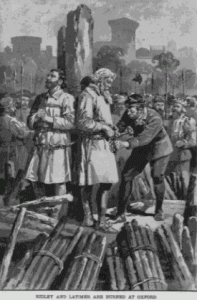
Ridley and LatimerI bring you greetings from the people of St. Paul’s Parish, Medina, Ohio, where I am privileged to serve as rector. Nearly all the active members of our congregation know and respect Patrick, and have asked me to convey their congratulations to him and to you, together with the assurance of their prayers, as you continue together in a new ministry only recently begun. Of course, none of them know Sandy, but we offer our greetings and prayers for her diaconal ministry among you, as well.

I suppose my son asked me to preach this evening because he believes that in 40 years of church leadership including 23 years in ordained ministry as a deacon, curate, associate rector, and now rector in four dioceses, I may have picked up one or two bits of useful information to pass along. I shall strive, Fr. Funston, to make it so.

Sandy, I have never been a vocational deacon and I have had only a little experience working with deacons in the course of my ministry; nonetheless, it is my hope there may be something in what I have to say that will be of use to you.

We are gathered this evening on the feast of two Anglican martyrs — Nicholas Ridley and Hugh Latimer. They were bishops of the reformed Church of England put to death, by being burned at the stake, during the short reign and attempted Roman Catholic restoration of Queen Mary I, eldest daughter of Henry VIII. During her less-than-six years on the English throne, nearly 300 Protestants were killed, including these two bishops, so she is known to history as “Bloody Mary.”

The bishops’ martyrdom is most notable for the probably apocryphal story that Latimer, as the fires were lighted beneath them, reached to Ridley, took him by the hand and said, “Be of good cheer, Master Ridley, and play the man, for we shall this day light such a candle in England as I trust by God’s grace shall never be put out.”

I’ll skip the other details of Latimer’s and Ridley’s lives and ministries; I bring them up really only to explain the otherwise incomprehensible choices of lessons for this service; one really must stretch to find anything remotely enlightening about parish ministry in Zephaniah’s “soiled, defiled, oppressing city” filled with faithless people and profane priests, or in the Psalmist’s languishing spirit and loud supplications. There may be (indeed there will be) times when both priest and people may feel like the Psalmist in the course of a pastorate (as Paul wrote to the Corinthians, the work of ministry will be tested by fire), but dwelling on that hardly seems a constructive way to begin the relationship.

I must admit that I was tempted to use the bishop’s martyrdom as a metaphor for parish ministry, but thought better of it; it would be an incomplete metaphor, at best. I think I’ve found a much better metaphor, but before I get to it, I want to digress for a moment and tell you something about our experience, my wife’s and mine, in raising our son.

When Patrick was in junior high school and high school, his band and orchestra directors said to us, “Your son is a talented musician. He could have a great career in music.”

“Yes!” we replied, “Encourage him in that!”

When he was in high school and college, his mathematics instructors said to us, “Your son is a natural mathematician. He could have a great career as a professor or a theoretician.”

“Yes!” we replied, “Encourage him in that!”

When he decided to major in business, we heard from his fellow students and his professors that he had a great mind for economics and finances, and could make millions as a financial planner.

“Yes!” we said, “Encourage that!”

Earlier in his life, from about the age of 14 on, when he was active as an acolyte, and in youth group, and in the diocesan peer ministry program, people would come to us and say, “Patrick has all the skills and the personality to be a wonderful priest.”

“No!” we cried, “Please do not encourage him that way!”

It’s not that we didn’t want Patrick to become a priest; we’re delighted that he has found his calling amongst the clergy of the church and that he has been called to be Rector in this parish. However, his becoming a priest or Sandy’s becoming a deacon is not something we, any of us, including them, have any business “wanting.” It isn’t something that we or anyone should be “encouraging.” Ordained ministry is something to be discerned and what it is to be discerned is whether the potential priest or deacon can be anything else.

Every potential clergy person is asked, over and over again, “Why do you want to be clergy?” And every priest and deacon here tonight has answered that question. We may have phrased the answer differently, but for each of us it is the same. It’s not that the person called to the diaconate wants to be a deacon; it’s that she must be a deacon! It’s not that the person called to priesthood wants to be a priest; it’s that he must be a priest!

Presbyterian pastor and author Frederick Buechner spoke for us all when he answered the question in his book, The Alphabet of Grace:

“I hear you are entering the ministry,” the woman said down the long table meaning no real harm. “Was it your own idea or were you poorly advised?” And the answer that she could not have heard even if I had given it was that it was not an idea at all, neither my own nor anyone else’s. It was a lump in the throat. It was an itching in the feet. It was a stirring of the blood at the sound of rain. It was a sickening of the heart at the sight of misery. It was a clamoring of ghosts. It was a name which, when I wrote it out in a dream, I knew was a name worth dying for even if I was not brave enough to do the dying myself and if I could not even name the name for sure. Come unto me all ye who labor and are heavy laden and I will give you a high and driving peace. I will condemn you to death. (Frederick Buechner, The Alphabet of Grace, pp. 109-110)

Buechner’s last sentence does call to mind the martyrdom of Latimer and Ridley and so many others: “I will condemn you to death.” As a description of the call to parish ministry it is both terrifying and terrific!

The Christ we follow, the Christ we proclaim, the Christ who said, “If they persecuted me, they will persecute you,” does call us, does lead us to die! To die to selfishness, to die to ego. But through that death he leads us to life. We die to self to uncover what the Quakers call, “that of God within” or the “inner Teacher” … the True Self. Your call, Patrick, to priesthood and yours, Sandy, to the diaconate … our call to parish ministry is a call to continue dying to self and, as a result, to continue becoming truly alive.

It is, as any priest or deacon here will tell you, a painful process. To be clergy in Christ’s church is, as Paul made quite clear in his letters to the congregations in Ephesus and Rome, a gift; it is a wonderful, precious, costly, and painful gift. It will take you into the deepest intimacy with God’s people, with your people. At times you will be with them in the midst of their worst nightmares – death and divorce, devastating illness and the depths of despair. At times, you will feel put-upon and misused. At times, you will feel left out and neglected. At times, there will be conflict, and it will seem like it is consuming you alive. At times, it may seem that, a bit like Latimer and Ridley, you are being burned at the stake, because people will hurt you, sometimes intentionally and spitefully, sometimes negligently, often simply because they are in pain.

But as I said a moment ago, that would be an incomplete metaphor because the source of that pain is also the source of the most exquisite joy, when that same intimacy will privilege you with sharing God’s people’s, your people’s happiest and most blessed moments – when two people commit themselves to one another for life, when their children are born, when they get that long-sought promotion, when their kids graduate with honors, when children marry, when grandchildren are born, when these people among whom and with whom you minister know themselves to be God’s beloved.

Cherish those intimate moments — both the painful and the joyful — because they are moments of grace. Each of them is unique; never fall into the black hole of thinking you’ve “been there, done that.” There may have been similar moments . . . but that couple has never been married before and never will be again, that baby has never been born or baptized before and never will be again, that teenager has never graduated from high school before and never will again, that man has never died before and never will again. Each intimate moment, painful or joyful, is unique and no one has ever been there before. Each unique intimate moment, painful or joyful, is bursting with the promise and potential of God’s grace!

Do not fear those moments of graceful intimacy; cherish them because it is in them that you and the people of St. Paul’s Parish will die to self and become truly alive, to continue growing in boldness and righteousness, in faithfulness and patience, in wisdom and even holiness. It is in those moments when we are in the presence of God, when we stand before the throne of grace.

I think you know, Patrick, that one of my favorite verses of Scripture is from the Letter to Hebrews: “Let us therefore come boldly unto the throne of grace, that we may obtain mercy, and find grace to help in time of need.” (Heb. 4:16 KJV) So . . . if I say to you that our mission in parish ministry is to boldly go into those unique moments of grace where no one has gone before, you probably know that my metaphor for parish ministry is “the voyages of the Starship Enterprise.”

I read somewhere recently that one can consider oneself an unqualified success as a parent if you have raised your child to be a Star Trek fan; by that measure, Patrick’s mother and I were successful.

Star Trek Uniform SocksIn the original Star Trek series, the crew’s uniforms were color coded: gold uniforms were command; red uniforms were engineering and security; and blue uniforms were science and medical. Parish ministry entails all three. So, Patrick, I have a little gift for you — a set of three pairs of official Star Trek color-coded uniform socks to remind you of these aspects of pastoral ministry.

Gold — command: Patrick, the canons of your diocese (with which, you may recall, I have some familiarity) provide that as rector, “by virtue of such office, [you have] the powers and duties conferred by the General Canons of the Church, and in this connection shall exercise pastoral oversight of all guilds and societies within the parish, and [you are] entitled to speak and vote on all questions before these bodies.” (Canon IV.6, Diocese of Kansas) The canons provide that you are the chair person of the vestry and that you not only chair the annual meeting of the parish, you are also the final arbiter of who may vote at the meeting.

That’s a good deal of command authority and it should not be taken lightly. Remember two things about it. First, that you share it with others. The canons specify that the vestry “shall share with the Rector a concern and responsibility for the mission, ministry, and spiritual life of the parish.” (Canon IV.5.6(a)) But not only the vestry, all the good people this parish are your co-workers. As our catechism makes clear, “the ministers of the Church are lay persons, bishops, priests, and deacons;” every single baptized person, every member of this church has a ministry. The Rector does not do it alone, nor should he.

You remember on Star Trek: TOS, Captain Kirk went on every away mission. That’s a model of poor leadership; the captain should not have commanded, or even been a part of, every away team. Trust the rest of the crew — the vestry, the staff, volunteers, all the people of the parish — to handle things.

Remember Paul’s opening words to the Corinthians in this evening’s epistle: “We are God’s servants, working together . . . .” You and the vestry and people of this congregation are God’s servants, working together. You as the Rector don’t have to do it all — you do have to know what is happening; you have to be in the information loop and be privy to all the information pertinent to the running of the church and to ministering with and among its members, but you don’t have do it all!

I suspect that if Jesus were to critique Kirk’s style of leadership, he might say something along the lines of “It will not be so among you; whoever wishes to be great among you must be your servant.” (Matt. 20:26) That is the second thing to remember about command authority in the church. Be like the 6th Century pope St. Gregory the Great and remember that as a leader in the church you are the “servant of the servants of God.”

The red uniforms were for those doing engineering and security, and there is a lot of that in parish ministry. Much of it, knowing where the boilers are and how they work, knowing where the circuit breakers and fuses are, knowing how to fix a leaky faucet or a squeaky hinge or a broken kneeler . . . much of it falls into the category of “things they didn’t teach us in seminary.” But there is also a lot of engineering and security that they did teach us.

The ministry of word and sacrament are the engineering and security jobs of the parish priest; preaching God’s word and celebrating God’s Sacraments, for which seminary did prepare us. They are central to any priest’s ministry, and to do them well takes time and it takes prayer.

Preparing a sermon can easily consume 10-15 hours per week. Similarly, planning liturgies, not only for regular Sunday services, but for weddings, funerals, holidays, and other special events takes time and care. Many people are willing to say their clergy should put in this kind of time, but the only way the rector can have this time is if other demands are otherwise taken care of. I have admonished Patrick not to be Captain Kirk going on every away mission. So I admonish you, the people of St. Paul’s Parish, that you must not expect him to make every pastoral visit, oversee every parish activity, make every administrative decision. As St. Paul wrote the Ephesians, each member of the church is given grace according to the measure of Christ’s gift and each member must work to properly promoting the body’s growth. I encourage you to claim the shared ministry of the whole people of God and join with your rector and your deacons in providing pastoral care to one another, in managing parish activities, and in administrative governance.

Patrick, this obligation of the congregation means that you must answer it with a similar commitment. Just like Engineer Scott was always adjusting the “warp coils” and tuning the “dilithium crystals” (whatever those were), you must take time in prayer adjusting your spirit and tuning your psyche. Take the time your congregation gives you to prepare prayerfully for these “red uniform” ministries — preaching and sacramental celebration. Be like Captain Jean-Luc Picard in TNG; take private time in your “ready room;” spend time in conversation with God every day. Other things can wait or someone else can do them . . . but no one else can listen to God for you. You must spend your own time in prayer.

Sandy, I would say the same thing to you. Your engineering and security ministry will be different from Patrick’s, obviously. As a deacon, you are (I’m sure) familiar with the description of the role of the deacon as bringing the world’s needs to the attention of the church and taking the church’s ministry into service in the world. Deacons exemplify Christian discipleship, nurture others in their relationship to God, and lead church people to respond to the needs of the most needy, neglected, and marginalized of the world. Those are definitely “red uniform” tasks, and they too can only be done well with careful and prayerful preparation.

Prayer is also the “red uniform” ministry of whole congregation. The early 19th Century American Presbyterian preacher and seminary professor Gardiner Spring wrote in his book The Power of the Pulpit:

[H]ow unspeakably precious the thought to all who labor in this great work, whether in youthful, or riper years, that they are … habitually remembered in the prayers of the churches! Let the thought sink deep into the heart of every church, that their minister will be very much such a minister as their prayers may make him. If nothing short of Omnipotent grace can make a Christian, nothing less than this can make a faithful and successful minister of the Gospel!

We might express this thought differently today, but Gardiner’s point remains valid. Your prayers, good people, even more than their own, are the wellspring from which flows the water of God’s grace on which Patrick’s ministry as priest and Sandy’s as a deacon so much depend. If you wish their ministries to bear good fruit, do not forget to pray for them, and let them know that you are doing so!

Star Trek:TOS CrewWhich brings us, at last, to the blue uniforms, the science and medical corps of the star ship. Mr. Spock the Science officer and Doctor “Bones” McCoy always wore blue. One of the ancient terms that we still use for pastoral ministry is “the cure of souls,” the word “cure” having pretty much the same meaning as it has in medicine. Broadly speaking, this ministry is the care, protection, and oversight of the nourishment and spiritual well-being of the souls committed to the pastor’s care; it may be shared with others, with deacons or with lay ministers, but it is truly the ministry of the parish priest. It is in this “blue shirt” ministry that those wonderful, painful, joyful, intimate moments of grace that I spoke of earlier will happen.

It is customary at these services to ask the clergy about to be installed to stand for an admonition or a charge, but I’m not going to do that this evening. We aren’t here celebrating only the installation of the rector, or only the new ministry of these two clergy; we are celebrating the whole ministry of all the People of God in this parish. So I have a charge for all of you.

I know you expect me to say something like “explore strange new worlds, seek out new life and new civilizations, and boldly go where no one has gone before,” but that would just be too hokey, don’t you think?

No, I have rather more practical and down-to-earth advice.

Give each other time; give one another your attention; support one another with your prayers; respect yourselves and each other; and, most importantly, love one another. (Members of St. Paul’s, I can’t underscore the last one enough. You expect your clergy to remember your birthdays and your wedding anniversaries, to thank you when you perform some volunteer service, to greet you pleasantly when they see you at the grocery store. That’s only natural, and it’s right and proper that you do so. But, please, do the same for them! It is the most important thing the people of a parish can do for their clergy. Love Patrick and Sandy, their spouses and their families. Invite them into your homes. Remember their birthdays and anniversaries. Remember to say, “Thank you” once in a while. Believe me: it really is such little things that make all the difference.)

And, again, remember Paul’s words to the Corinthians: “We are God’s servants, working together.” So together represent Christ, bear witness to him wherever you may be and, according to the gifts given to each of you, carry on his work of reconciliation in the world.

If you do these things, you shall, by God’s grace, like Ridley and Latimer, light such a candle in Kansas, as, I trust, will never be put out.

Make it so! Amen!

====================

A request to my readers: I’m trying to build the readership of this blog and I’d very much appreciate your help in doing so. If you find something here that is of value, please share it with others. If you are on Facebook, “like” the posts on your page so others can see them. If you are following me on Twitter, please “retweet” the notices of these meditations. If you have a blog of your own, please include mine in your links (a favor I will gladly reciprocate). Many thanks!

====================

Father Funston is the rector of St. Paul’s Episcopal Church, Medina, Ohio.

By the Rivers of Babylon – Sermon for the 20th Sunday after Pentecost, Proper 22C – October 6, 2013

====================

This sermon was preached on the 20th Sunday after Pentecost, October 6, 2013, at St. Paul’s Episcopal Church, Medina, Ohio, where Fr. Funston is rector.

(The Revised Common Lectionary, Proper 22C: Lamentations 1:1-6; Psalm 137; 2 Timothy 1:1-14; and Luke 17:5-10. These lessons can be read at The Lectionary Page.)

====================

You may recognize this reggae version of a portion of Psalm 137, the psalm we recited this morning, combined with a paraphrase of verse 14 of Psalm 19. It was originally done by the Melodians in 1969, but the version I played was recorded by Boney M, a German Caribbean group, in 1978 and claimed the Number 1 spot on the European pop charts that year. It’s quite a danceable little tune; it puts a bounce in your step which seems quite at odds with Psalm 137’s words of lament and with the violent imprecation with which the psalm concludes. I’ll return to this musical version in a moment, but first let’s take a closer look at this psalm and our other lessons today.

Paul begins his letter to the young bishop, Timothy, whom he has nurtured in the faith, with these words: “I am grateful to God — whom I worship with a clear conscience, as my ancestors did . . . .” I’m glad that Paul was able to do so, to worship with a clear conscience, because I think he was wrong about his ancestors! His ancestors were the ones who wrote the psalm we recited just before Paul’s letter was read, the psalm that ends with these words:

Remember the day of Jerusalem, O Lord, against the people of Edom, *
who said, “Down with it! down with it! even to the ground!”
O Daughter of Babylon, doomed to destruction, *
happy the one who pays you back for what you have done to us!
Happy shall he be who takes your little ones, *
and dashes them against the rock!
(Ps 137:7-9)

I don’t know about you, but I have a hard time worshiping with a clear conscience after reciting such words and, I suspect, so did the ancient Jews, even though those awful words may have been as heart-breakingly genuine, as horrifically honest as possible.

There is academic debate about the authorship of this letter; many scholars believe that it was not written by Paul even though it purports to be his personal farewell address, “Paul modeling how to die” as one commentator puts it. So we don’t really know when or why this letter was written, or by whom (but we’ll call the author “Paul” anyway). We know that Timothy was in tears: “Recalling your tears,” writes Paul, “I long to see you so that I may be filled with joy.” Presumably, Timothy is distraught over Paul’s imprisonment and probable impending execution. Paul’s advice to Timothy is to buck up! “God did not give us a spirit of cowardice, but rather a spirit of power and of love and of self-discipline.” Please keep this advice (and the happy, danceable music to which the Melodians and Boney M set Psalm 137) in mind as we turn to the other lessons of the day.

Lessons like the reading from Luke’s Gospel in which Jesus admonishes his followers (specifically the Apostles, but also us), “When you have done all that you were ordered to do, say, ‘We are worthless slaves; we have done only what we ought to have done!'” Bill Loader, an Australian theologian whose work and words I rather like, says this admonition is a slap in the face to the established order:

It deconstructs hierarchy [and] debunks the idea that we achieve value by achieving the good, as though we deserve a bonus for being decent, caring human beings. It does not let us play the game. We can’t claim: you ought to love me, because look at how good I am! Look at what I have done! The passage is probably deliberately offensive in flooring aspirations to human worth based on achievement capital. It is annoying and frustrating, and even seems mean. It gives us no credit. (First Thoughts)

Jesus’ comment subverts any system that bases value on achievement; very simply, Jesus is saying that we are valued by God (and thus should value one another), not because of what we achieve, but because of who we are! Paul’s admonition to Timothy to buck up because we have been given “a spirit of power and of love and of self-discipline” is grounded in the assurance of Jesus that we are loved by God not because we have accomplished anything, but simply because of who we are.

The way Jesus (who is, remember, the incarnation of God) approaches human dignity and value is hugely comforting in a world where the poor are exploited and where anger explodes in violence and terror which disregards human life, in the very world of Psalm 137 and its cry for vengeance, its imprecation that someone will ” take [Babylon’s] little ones and dash them against the rock!”

So what was the world of Psalm 137? It was the world of the Babylonian exile, the world of the destruction of Jerusalem, the world of the demolition of the Temple, the very heart and soul of the Jewish people. The year was 587 B.C.E. The armies of Nebuchadnezzar of Babylon, aided and cheered on by the Edomites (ancestral enemies of the Jews, supposedly descended from Jacob’s brother Esau) invaded the southern kingdom of Judah. (The northern kingdom of Israel had already been destroyed by the Assyrians 150 years or so before.) The Babylonians took possession of Jerusalem, raping, pillaging, and slaughtering with abandon. They seized the priests and the scribes, the king and the nobles, the wealthy leaders and their accountants, and took them away to Babylon. For those left behind, the economy quickly collapsed, food became scarce, water became foul, the daily life ceased to make sense. Order was replaced by chaos. Jerusalem became a wasteland. The Book of Lamentations describes the scene:

How lonely sits the city
that once was full of people!
. . . .
How like a widow she has become,
she that was great among the nations!
. . . .
Her foes have become the masters,
her enemies prosper;
. . . .
her children have gone away,
captives before the foe.
(Lamentations 1:1,5)

The psalmist, speaking for those who have suffered through this desolation, curses those who have caused it. The psalm’s cries of deep sorrow (“We wept; we could not sing!”) and the dreams of horrible acts of vengeance (“Happy the one who murders their infants!”) are cathartic; they are a means of working through and overcoming the intense hurt of defeat and exile. By voicing anger to God, the exiles cleanse themselves of violent emotion, but they also give themselves a reason to persist.

In his book, Man’s Search for Meaning (Beacon Press, Boston, 2006), psychologist Viktor Frankl described his own experience in the Nazi death camps of the Holocaust and the lessons he and his fellow inmates learned about spiritual survival. Among those learnings was the need for a goal: “It is a peculiarity of man that he can only live by looking to the future,” (p. 73) even if that future is one of vengeance. Without a goal, the concentration camp prisoners ceased to live for the future; indeed, they ceased to live at all, they simply decayed. “He who has a ‘why’ to live for can bear with almost any ‘how'” wrote Frankl. (p. 76) Their anger and dreams of revenge supplied the exiles with the why, the goal, the reason for them to survive. The provocative and hyperbolic language of the psalm expresses the horror and outrage the exiles were experiencing, and describes a future for which they could live. That it is a horrific future does not deprive it of its spiritually supportive power.

In their defense, we should note that “dashing babies” was a common practice of warfare in the international community of the exiles’ time. In the Second Book of Kings, for example, Elisha weeps in the presence of a foreign general who asks why the man of God is crying, and Elisha answers: “Because I know the evil that you will do to the people of Israel; you will set [Israel’s] fortresses on fire, you will kill their young men with the sword, dash in pieces their little ones, and rip up their pregnant women.” (2 Kgs.8:12) Babylonian armies are known to have killed babies, raped women, and blinded some their war prisoners. The Babylonians committed terrible atrocities against the people Judah so, in their dreams of retribution, they cried out to God for proportional retribution. There is, however, no evidence that the exiles ever followed through on their bloodthirsty dreams of revenge.

Psalm 137 “tells it like it is;” anger, vengeance, hatred, rage, pain and suffering are a human reality. The people of Judah believed that everything they had hoped for and everything they relied upon, their own country, their sacred priesthood, the Davidic kingdom, and the Jerusalem temple had been taken away by the bloodthirsty Babylonians. We know that faith becomes compromised when hopes of ease and comfort and success are snatched away by economic chaos, by terrorism, by personal health problems, by hunger, or by the dysfunction (or non-function) of government. Bad things happen and people react. Many, I am sure, have been guilty of extremes of thought like those voiced by the psalmist. Have you never wished someone dead, even in unspoken your thoughts? I confess that I have. Have you never told someone (even if only under your breath) to “Go to Hell”? I have! In today’s culture, that may be more acceptable than threatening to “dash babies,” but theologically speaking, it voices a much stronger sentiment than the psalm. We and our world are more like the exiles and theirs than we know or want to admit.

This is how this psalm, this awful, horrific psalm, speaks both to and for us. The Babylonians may not have attacked us, but we live in a world at least as violent as that of the exiles. Since 1900, there have been 232 wars; more than 96 million people have been killed in those wars, and it is an inescapable fact of modern history that the same barbarism described in Psalm 137 or the Book of Lamentations or the Second Book of Kings occurred in many of those wars and still occurs today. One need only think of the ethnic cleansing episodes in the former Yugoslavia, the civil war in Rwanda, and the almost daily atrocities currently happening in Iraq, Syria, Pakistan, Myanmar, and elsewhere.

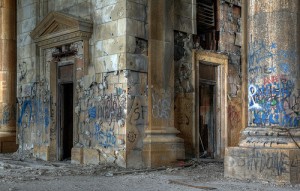
Abandoned Train Station, Detroit, MIWe live in a country where there are cities once full of people now sitting lonely: we sit here today less than 200 miles by turnpike from Detroit, where the picture on the cover of our bulletin was taken, a city which has been described as looking as if it had been bombed in a war! Just yesterday, Salon reported that in the United States there are 14 million unoccupied residences. Six months ago, “Detroit had more than 83,000 unoccupied residential addresses. That constitutes nearly 25 percent of the city’s potential housing stock. New Orleans had 44,000, for 21 percent. Cleveland had 41,000, or 19 percent.” (Salon, Abandoned Homes) Cities once full of people are sitting abandoned and lonely. Meanwhile, on any given night in this country over 633,000 homeless people sleep in shelters, and no one knows how many may be sleeping in cars, under bridges, squatting in abandoned buildings, or simply out on the streets. (National Alliance to End Homelessness)
We live in a country where 49 million Americans live in food insecure households, including almost 16 million children; where over 29 million people rely on assistance from government programs (now sadly shut down) to obtain sufficient food; and where 6.2 million households at least once in the last year have accessed emergency food from a food pantry or soup kitchen. (Feeding America)

This is not the country of our hopes and dreams; it is not the country we want it to be; it’s not even the country we think it is! It is a strange land: “How shall we sing the Lord’s song in a strange land?” The psalm speaks to and for us.

In this psalm, the poet and the exiles turned their pain over to God! Giving voice to their sorrow, their anger, and their thirst for revenge, they were able to let go of them and to trust in God to act as God might. They were able to follow Paul’s advice to Timothy, to buck up, to rely not on the spirit sorrow and of anger and of cowardly vengeance, but rather a spirit of power and of love and of self-discipline. Eventually, they came to understand that they were valued by God (and thus should value others, even their enemies), not because of what they had or had not achieves, but simply because of who they were! This brought them a sense of freedom — even in their exile — to dream, to hope, and to pray. Their prayers may have been, as Bible scholar Walter Wink said, “impertinent, persistent, shameless, indecorous, [and] more like haggling in an outdoor bazaar than the polite monologues of the church,” and they may have offered them with far less a clear conscience than Paul claims, but through them they voiced faith and courage to hand their desire for revenge over to God; through them they started the long healing process of returning home and truly worshiping God.

And so can we. We can end the wars and put a stop to the genocides. We can rebuild the cities and house the homeless. We can provide good nutrition for everyone and end food insecurity. We can do so because, I believe, we have faith at least the size of a mustard seed, because we have been given a spirit of power and of love and of self-discipline, and because we are God’s servants and we know what we ought to do. And when we have done it, we can sing Psalm 137 like a dance tune, with a spring in our step, like exiles returning home to God!

Amen!

====================

A request to my readers: I’m trying to build the readership of this blog and I’d very much appreciate your help in doing so. If you find something here that is of value, please share it with others. If you are on Facebook, “like” the posts on your page so others can see them. If you are following me on Twitter, please “retweet” the notices of these meditations. If you have a blog of your own, please include mine in your links (a favor I will gladly reciprocate). Many thanks!

====================

Father Funston is the rector of St. Paul’s Episcopal Church, Medina, Ohio.

The Better Angels – Sermon for St. Michael & All Angels Day – September 29, 2013

====================

This sermon was preached on St. Michael and All Angels Day, September 29, 2013, at St. Paul’s Episcopal Church, Medina, Ohio, where Fr. Funston is rector.

(The Episcopal Lectionary, Michaelmas: Genesis 28:10-17; Revelation 12:7-12; Psalm 103; and John 1:47-51. These lessons can be read at The Lectionary Page.)

====================

Icon of the ArchangelsWe are stepping out of the “common of time,” away from the progression of lessons assigned for the Sundays of Ordinary Time, and instead celebrating the Feast of Michaelmas, known variously as the Feast of Saint Michael the Archangel or as the Feast of Saints Michael, Gabriel, Uriel, and Raphael, or as the Feast of the Archangels, or as the Feast of Saint Michael and All Angels (the latter being the preferred Anglican name for this commemoration). The only reason we are doing so is a personal conceit of your rector; Michaelmas, the 29th of September, just happens to be my birthday. Today I am celebrating the 30th anniversary of my twenty-eleventh birthday. I’ll get back to that in a moment, but first . . . a word about Michaelmas.

It shouldn’t surprise any of us that on, St. Michael and All Angels Day, we are treated to three very familiar stories of angels in Holy Scripture: first, the story of “Jacob’s ladder;” second, the story of the war in heaven in which Michael, leading the “good” angels, beats “the dragon” (named “the Devil or Satan”) and his “bad” angels; and finally, the gospel story of Jesus telling Nathanael that he will see something like Jacob’s ladder, “ascending and descending upon the Son of Man.”

We know what angels are, or at least we think we do. They are a separate order of creation, beings of spiritual energy who interact with human beings as the servants and often as the messengers of God. The English word angel derives from the Latin angelus which in turn is the romanization of the ancient ángelos which means “messenger” or “envoy.” In the Hebrew of the Old Testament, we find the terms mal’ak elohim (“messenger of God”), mal’ak YHWH (“messenger of the Lord”), bene elohim (“sons of God”) and haqqodesim (“holy ones”) translated into English as angels. The first of these, mal’ak elohim, is what we find in today’s Genesis passage. In addition, there are specific kinds of angels identified in the Hebrew Scriptures. There are the Cherubim – one of whom is placed with a flaming sword to guard the gateway to the Garden of Eden in Genesis 3 and who are said to flank or support God’s throne as, for example, in Hezekiah’s prayer in the book of the Prophet Isaiah (ch. 37); the Cherubs are apparently not cute, little, chubby baby angels! And there are the Seraphim – whom Isaiah describes as having “six wings: with two they covered their faces, and with two they covered their feet, and with two they flew,” and who sing God’s praises in the heavenly throne room.

We know the personal names of some of the angels, particularly the archangels – Gabriel, who is named in the Book of Daniel and identified in the Gospel of Luke as the angel of the Annunciation; Raphael, who is identified as a companion and advisor to Tobias in the apocryphal Book of Tobit; Uriel, who was sent to test the prophet Ezra according to the apocryphal Second Book of Esdras; and Michael, who is the leader of God’s angel army in the story of Revelation today.

We know that human beings, when they die, do not become angels . . . although lots of people say things like that in order to comfort the bereaved who have lost loved ones. Angels, as I said, are a separate order of creation, beings of immense spiritual energy. If the Book of Job is correct, they were created before the physical world: in questioning Job, God asks him if he was there when the foundations of the earth were put in place, “when the morning stars sang together and all the heavenly beings shouted for joy?” (38:7; the term here is bene elohim, sons of God.)

So . . . we know a lot about angels, but why do we venerate them on this particular day? And what can we learn from them? The first question is easy to answer: the date commemorates the dedication of the Sanctuary of St. Michael Archangel built on Monte Gargano in Italy in 493 a.d. in honor of an apparition of the archangel a few years before. The second question is not so easy.

What I think we learn from angels is conscience. Whenever I hear the word “angels,” to be very honest, my first thought is not of their religious history or meaning, but of the conclusion of Abraham Lincoln’s first inaugural address given on March 4, 1861, just two weeks after Jefferson Davis had been inaugurated as president of the Confederacy. Referring to that secession and the potential of war to preserve the Union, finished his speech saying:

We are not enemies, but friends. We must not be enemies. Though passion may have strained it must not break our bonds of affection. The mystic chords of memory, stretching from every battlefield and patriot grave to every living heart and hearthstone all over this broad land, will yet swell the chorus of the Union, when again touched, as surely they will be, by the better angels of our nature.

I love that turn of phrase, “the better angels of our nature.” I’m not the least bit sure what Mr. Lincoln meant by the phrase, but it has always appealed to me. A few years ago, a Harvard psychologist named Steven Pinker used it as the title of a book in which he named four of these “better angels:”

  • Empathy, which “prompts us to feel the pain of others and to align their interests with our own”
  • Self-control, which “allows us to anticipate the consequences of acting on our impulses” and thus to regulate those impulses
  • Moral sense, which “sanctifies a set of norms and taboos that govern the interactions among people”
  • Reason, which “allows us to extract ourselves from our parochial vantage points.”

These are all, to my way of thinking, gifts of God. In a sense, they are a modern rendition of what St. Paul called the “fruit of the Spirit,” although Paul listed nine attributes: love, joy, peace, forbearance, kindness, goodness, faithfulness, gentleness and self-control. (Galatians 5:22-23) Or of those gifts of the Holy Spirit listed by Isaiah: wisdom, understanding, counsel, fortitude, knowledge, piety, and fear of the Lord. It is through these fruits and gifts that human conscience is informed and moral judgment enlightened, and conscience, as Thomas Merton said, “is the light by which we interpret the will of God in our own lives.” (No Man Is an Island)

Some of you may be familiar with the Henry Fonda film from the 1940s entitled The Ox-Bow Incident. It’s based on a novel of the same name by the Nevada writer Walter Van Tilburg Clark. In the story, the narrator Art Croft is one of two men who drift into a Nevada ranching town and end up becoming part of a posse that turns into a lynch mob. They end up hanging, without a trial, three men who may or may not actually be guilty of the crimes they are accused of — cattle rustling and murder. Reflecting on what has happened, Art Croft asks, “If we can touch God at all, where do we touch him save in the conscience?” If the angels are the messengers of God, perhaps our conscience is the means through which the “better angels of our nature” communicate God’s will to us. As Theologian Peter Kreeft explains, the conscience as “the voice of God in the soul.”

Along those lines, in a Michaelmas sermon preached a few years ago, the Very Rev. John Hall, Dean of Westminster Abbey, said this:

We can and should then think of God speaking directly to us, out of his love and care for us as individuals. However we must understand God’s presence with us as a reality inseparable from that of God’s presence among us. Through our fellowship in the Church, Christ’s Body, God informs our conscience through his Word and feeds our soul through the sacraments, drawing us together as Christians into unity with each other and with himself. If we try to go it alone as Christians, we run great risks of going astray. The Church understands the work and role of the angels as assisting in mediating the presence of God with us and amongst us. (29 September 2010)

I don’t think I can learn much from angels as mighty beings standing guard at the entrance to Eden, or as warriors fighting Satan and casting him out of heaven, or as singers in the heavenly choir, or as the pillars and supports of God’s throne. But as the prompters and prickers of my conscience, as the “better angels” of empathy, moral sense, self-control, and reason, as the communicators of the gifts and fruits of the Spirit, as mediators of God’s presence in the Church, I can learn a great deal from them.

The Psalmist, in our gradual this morning, declared that God’s righteousness and merciful goodness endure forever “on those who keep his covenant and remember his commandments and do them.” It is these “better angels” who keep that memory alive in our consciences and to them, and to the God whose presence they mediate within us individually and among us corporately, we can turn for answers to life’s challenges.

So . . . as I said, it’s my birthday. Today, and for the next decade or so, when asked how old I am, I can answer, “Sixty-something.” (A graphic I posted today on my Facebook page says, “I’m not sixty-something. I’m $59.95 plus shipping and handling.”) In any event, a birthday is a time of taking stock, or considering one’s past, one’s actions, the answers one has developed in one’s life, and one’s future.

I mentioned in a conversation with some parishioners last week that when I’d been ten years at St. Francis Parish in Stilwell, Kansas, my congregation last before this one, Evelyn and I came to the conclusion that it was time to leave. One of the people I was talking with asked, “You’ve been here at St. Paul’s for ten years. Is it time to leave?” That’s a birthday sort of question. It’s what might be called “a big question.”

The past six decades, like everyone’s life, has been full of big questions of that sort, to be honest. Whether to study law? Whether to get married? Whether to leave the practice of law? Whether to become a priest? Move to Kansas? Leave Kansas? Accept nomination in an episcopal election? Those are big questions. But sometimes our replies to big questions are little answers, puny responses that put off meeting the real challenges.

A friend recently shared a poem with me, a poem by Dame Edith Louisa Sitwell. I wasn’t familiar with Sitwell so I did some research on her. She was the eldest child of the 4th Baronet of Renishaw Hall, born in 1887. In her twenties, she began publishing poems in the Daily Mirror newspaper. She was six feet tall and habitually wore brocade gowns, gold turbans, and (one biographer said) “a plethora of rings.” Apparently she was given to public feuds with other literary figures. One critic said of her that “wore other people’s bleeding hearts on her own safe sleeve,” and another called her “an eccentric matriarch with a slender grip on reality.” Just my sort of poet! No wonder I liked what she had to say about our responses to life’s questions in a short poem entitled Answers:

I kept my answers small and kept them near;
Big questions bruised my mind but still I let
Small answers be a bulwark to my fear.

The huge abstractions I kept from the light;
Small things I handled and caressed and loved.
I let the stars assume the whole of night.

But the big answers clamoured to be moved
Into my life. Their great audacity
Shouted to be acknowledged and believed.

Even when all small answers build up to
Protection of my spirit, still I hear
Big answers striving for their overthrow.

And all the great conclusions coming near.

I believe the “great conclusions coming near,” the big answers clamoring, the huge abstractions shouting to be acknowledged, are the angels calling each of us to greater ministries, the messengers of God urging us to a more audacious Christian presence in the world.

In a couple of months’ time, our construction project will be done. We’ll have a great new gallery, an expanded parish hall, a great new face presented to the community. When we broke ground here in July, the Old Testament lesson was the same reading from Genesis we hear this morning. I suggested then that this place, this St. Paul’s Episcopal Church located at 317 East Liberty Street in Medina, Ohio, is like Jacob’s Bethel.

It is an awesome place. It is a house of God. It is a gate of heaven. But just like Jacob’s Bethel, it is a place we are bidden to leave; it is a place from which the angels of God bid us go. A church building is meant to be the base from which the people of God go into the world. A church building is meant to be a place of life, a center of ministry, a place of assembly, where God’s people gather to worship, to hear the message of the angels, to celebrate the meaning of life, and to be transformed, and then “burst forth,” back out into the world to share the Good News with, and transform the lives of, others. The angels of God call us individually and corporately to greater ministries, to a more audacious Christian presence in our world.

The answer to that “big question” I was asked is, “No, it’s not time for me to leave St. Paul’s.” But it is time for all of us as St. Paul’s to leave this place, to go out from this new building we are creating, to “burst forth” into the world like Jacob and his offspring, to be “angels,” messengers of God, telling the world the Good News of God in Christ.

Amen.

====================

A request to my readers: I’m trying to build the readership of this blog and I’d very much appreciate your help in doing so. If you find something here that is of value, please share it with others. If you are on Facebook, “like” the posts on your page so others can see them. If you are following me on Twitter, please “retweet” the notices of these meditations. If you have a blog of your own, please include mine in your links (a favor I will gladly reciprocate). Many thanks!

====================

Father Funston is the rector of St. Paul’s Episcopal Church, Medina, Ohio.

Radical Transformation — Sermon for the 16th Sunday after Pentecost, Proper 18C — September 8, 2013

====================

This sermon was preached on the Sixteenth Sunday after Pentecost, September 8, 2013, at St. Paul’s Episcopal Church, Medina, Ohio, where Fr. Funston is rector.

(Revised Common Lectionary, Pentecost 16 (Proper 18, Year C): Jeremiah 18:1-11; Psalm 139:1-5,12-17; Philemon 1-21; and Luke 14:25-33. These lessons can be read at The Lectionary Page.)

====================

Swallowtail MetamorphosisWe are given three very challenging readings from Holy Scripture this morning. First, there is Jeremiah’s familiar, but radical, prophetic metaphor of God as a potter able to do with the nation of Israel what a potter does with a spoiled piece of work. Second, perhaps the oddest piece of New Testament literature, Paul’s personal letter to a man named Philemon returning a runaway slave whom Paul has converted to Christianity. And, lastly, Luke’s report of Jesus’ radical requirement that his followers must hate their possessions, their families, and even themselves. What I believe is common among these lessons is a call to radical transformation.

Let’s look first at the Gospel lesson. According to Luke, Jesus says to a great multitude of people, “Whoever comes to me and does not hate father and mother, wife and children, brothers and sisters, yes, and even life itself, cannot be my disciple.” It appears to have been Jesus’ intention to turn away any potential follower who might be half-hearted, or luke-warm; he was not willing to just let anyone come along. Jesus was not interested in “church growth.” But when Jesus says, “You cannot be my disciple,” we need to careful parse and understand what he is saying. He is not say, “I will not let you be my disciple.” The Greek is ou dunatai einai mou mathetes. The verb dunamai means “to be able to, to have power to” – from its root dunamis we get our word “dynamic.” Jesus is not saying he will prevent or stand in the way of such a person becoming a disciple; rather, Jesus is saying such a person is simply incapable of becoming a disciple. The blockage is in that person, not in Jesus.

Jesus goes on to illustrate what he means with two short parables which would have been within the experience and understanding of his listeners: a man counting the cost of building a tower and a king calculating the probability of success in going to war. These examples of what we might call “social calculus” give meaning to Jesus’ use of the word “hate” — and that’s what it is in Greek; in fact, “detest” might be an even better translation — and applying it to family, wealth, and even one’s own soul. Discipleship, as Jesus understands it, is complete, total, uncompromising. It includes counting the costs and considering what it means to set out on the path of discipleship; one cannot do so on the spur of the moment in a brief burst of enthusiasm without a thought where that path might end. Jesus’ use of “hate,” illustrated by stories where there are two possible courses of action, only one of which may chosen and that one must be chosen decisively, underscores that, for Jesus, full commitment means the severance of even potential commitment to any other possibility.

For us, as contemporary Christians, this Gospel faces us with the hard truth of what it means to follow Jesus; we must grapple with the reality that our Messiah is a radical, counter-cultural prophet. As my friend Presbyterian theologian Bruce Reyes-Chow puts it, in this Gospel Jesus calls us “to step into that space of faithfulness that Jesus calls ‘hate.'” (The Hardest Question) That’s really, really hard! His message and actions are not easy to follow, and they do not fit easily or comfortably into our 21st Century context. It is a call to radical transformation.

This was also the message of the Prophet Jeremiah with his deceptively folksy metaphor of a potter reworking a lump of clay.

A potter working with clay was an everyday occurrence in the ancient world. This is not an artisan working on an art piece that Jeremiah is describing. This is a merchant working on the rough and ready pots that were the everyday utensils of a typical Judean household, not perfect, not particularly attractive, but serviceable, useful to hold the grain, oil, and wine to sustain life, the jug to hold water, the bowl or plate from which to eat. God sends Jeremiah to the potters to watch him at this everyday commercial task, and as Jeremiah looks on, the potter decides that his work just isn’t going according to plan . . . and so he smashes the clay and destroys the pot that he is making. He begins again.

There was, in Jeremiah’s time, a conflict or tension between what has come to be called “temple theology,” which the religious leaders of the nation, the King and the priests, believed, and a “covenant theology” taught by the prophets. Temple theology taught that Israel was God’s chosen nations so that bad things would not happen to Israel; indeed, bad things could not happen because of the protection of God guaranteed by performance of the proper rituals and sacrifices in the temple. Covenant theology, on the other hand, was an understanding that God rewards obedience and punishes disobedience, that more than ritual sacrifice was required of God’s people, that fulfillment of the whole covenant, especially its social teachings of justice and care for the poor, the widowed, the orphan, and the stranger, was required.
God says to Jeremiah, “I can do with Israel what this potter has done with his clay.” The word “potter” spoken here by God is based on the verb, yatsar, “to fashion, form.” This is the verb used in Genesis 2:7 to describe God’s creative action when God took up a piece of wet clay and molded it into Adam, the human being. It is a reminder that humankind was formed for a purpose just the way the jugs and bowls and plates of the potter are formed for a purpose and, when that purpose is unfulfilled . . . . well, you understand.

Jeremiah’s prophecy is a call for repentance which includes the unequivocal warning that there are consequences for failing to honor God’s covenant and that those consequences can be severe. The people of God need to know that God’s actions toward them are not limited to the blessings of temple theology; they include the possible consequences of covenant theology, as well. It is a call, as all true calls for repentance are, to radical transformation.

And then we have the Letter to Philemon.

This one chapter letter, the shortest piece of literature in the Christian bible, may just be the most challenging. On its face, it’s just a letter sending a slave back to his master, and therein lies the difficulty.

In the ancient Greco-Roman world, anybody could become a slave for a variety of reasons — being captured in war, becoming unable to pay your own debts, being sold in to slavery by one’s own parents faced with bankruptcy. It is estimated that as much as 40% of the populace of the Roman Empire were slaves! Slaves were the property of their masters. They could be bought and sold at discretion; they could be expelled from their master’s demesne simply for being old or sick. They were often abused. Most important for our understanding of Paul’s letter to Philemon is that a master had the right to kill a slave when he or she ran away. It is not clear that Onesimus was a run-away, but that is the accepted understanding of this letter. Paul was dealing with a potential life or death matter.

Paul’s appeal to Philemon is to accept Onesimus back because, under Paul’s tutelage, Onesimus has become a Christians, as Philemon himself has become. Paul urges the master to accept the slave as his brother in Christ. What is troubling for us is that Paul does not demand that Philemon give Onesimus his freedom. What is troubling for us is that Paul says nothing about what Onesimus might want. From Philemon’s perspective Onesimus is a slave and a useless one at that. What Onesimus actually was, we are not told. We are never told what he thinks or feels.

As Holly Hearon, Professor of New Testament at Christian Theological Seminary, in Indianapolis, Indiana, says:

The letter to Philemon challenges us to discern, in and for Christ, what is the right thing to do. It would be easy if doing the right thing was, for example, taking out the garbage, or helping an elderly person cross the street. It is another when the right thing involves a radical transformation of social relationships: of learning to see people that time and experience have led us to view one way in a completely new way. It is another thing when this radical transformation of social relationships asks us to give up what we have come to view as our rights: to willingly let go of privilege. It is another thing when this letting go of privilege leads us to assume a relationship of kinship — of obligation — with those whom we have formerly viewed with suspicion because we now recognize that we are bound together in Christ. (Working Preacher)

So, again, the theme of the reading, the demand of the reading, is radical transformation.

In his Second Letter to the church in Corinth, Paul wrote, “If anyone is in Christ, there is a new creation: everything old has passed away; see, everything has become new!” (2 Cor. 5:17) In his letter to the Romans, he wrote, “Do not be conformed to this world, but be transformed by the renewing of your minds.” (Rom. 12:2a)
Radical transformation involves removing the barriers that prevent us from becoming Christ’s new creation, the things that prevent us from being renewed. Jesus told us to “hate” anything that stands in our way; simply put, that means letting go of those things. That’s easier said than done; in fact, on our own I don’t believe we can. The message of Jeremiah’s homely potter metaphor is that the One with the power to do so is not us, poor lumps of clay that we are; it is God. In Alcoholics Anonymous the first two of the Twelve Steps are:

1. We admitted we were powerless over alcohol — that our lives had become unmanageable.
2. Came to believe that a power greater than ourselves could restore us to sanity.

That is a statement of the very core of Jeremiah’s metaphor: We’re powerless; God isn’t. We do not have the power in ourselves to follow Jesus, but with God’s grace we can.

Being a follower of Jesus and living a life of radical transformation requires a commitment to allow God to continually work on transforming us, and that commitment must be full including severing every potential commitment to any other possibility. Radical transformation does not happen overnight; it takes time, it takes persistence, it takes faith. It takes a willingness to let go and an inner desire to allow the Potter to remake us into the creation God intends us to be.

And when we are transformed, when we are that new creation, we can turn to God and say with the Psalmist: “I will thank you because I am marvelously made; your works are wonderful, and I know it well.” Amen.

====================

A request to my readers: I’m trying to build the readership of this blog and I’d very much appreciate your help in doing so. If you find something here that is of value, please share it with others. If you are on Facebook, “like” the posts on your page so others can see them. If you are following me on Twitter, please “retweet” the notices of these meditations. If you have a blog of your own, please include mine in your links (a favor I will gladly reciprocate). Many thanks!

====================

Father Funston is the rector of St. Paul’s Episcopal Church, Medina, Ohio.

« Older posts Newer posts »